CS501: DATABASE AND DATA
MINING
Relational Algebra1
QUERY LANGUAGES
 Language in which user requests informationg g q
from the database.
 Categories of languages
 Procedural
 Non-procedural, or declarative
 “Pure” languages: Pure languages:
 Relational algebra (Procedural)
 Tuple relational calculus (Non-procedural)
 Domain relational calculus (Non-procedural)
 Pure languages form underlying basis of query
languages that people uselanguages that people use. 2
RELATIONAL ALGEBRA
 Procedural languageg g
 Six basic operators
 Selection: 
 Projection: 
 Union: 
 Set difference: – Set difference: –
 Cartesian product: x
 Rename: 
 The operators take one or two relations as inputs
and produce a new relation as a result.
3
SELECTION OPERATION
 Relation r A B C D




1
5
7
7




12
23
3
10 )()5()( rDBA 
A B C D




1
23
7
10
4
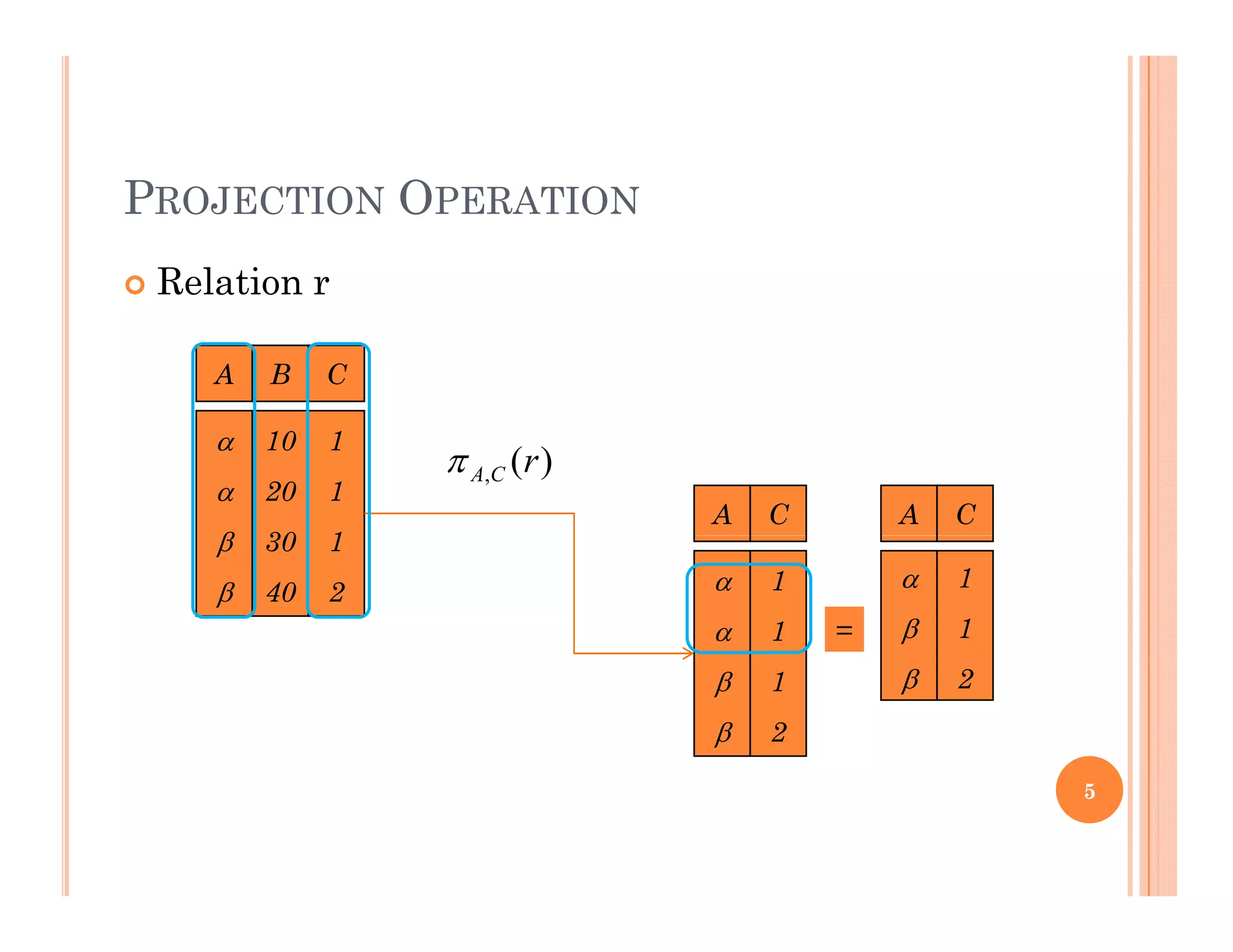
PROJECTION OPERATION
 Relation r
A B C



10
20
30
1
1
1
A C A C
)(, rCA


30
40
1
2 

1
1 =


1
1


1
2
 2
5
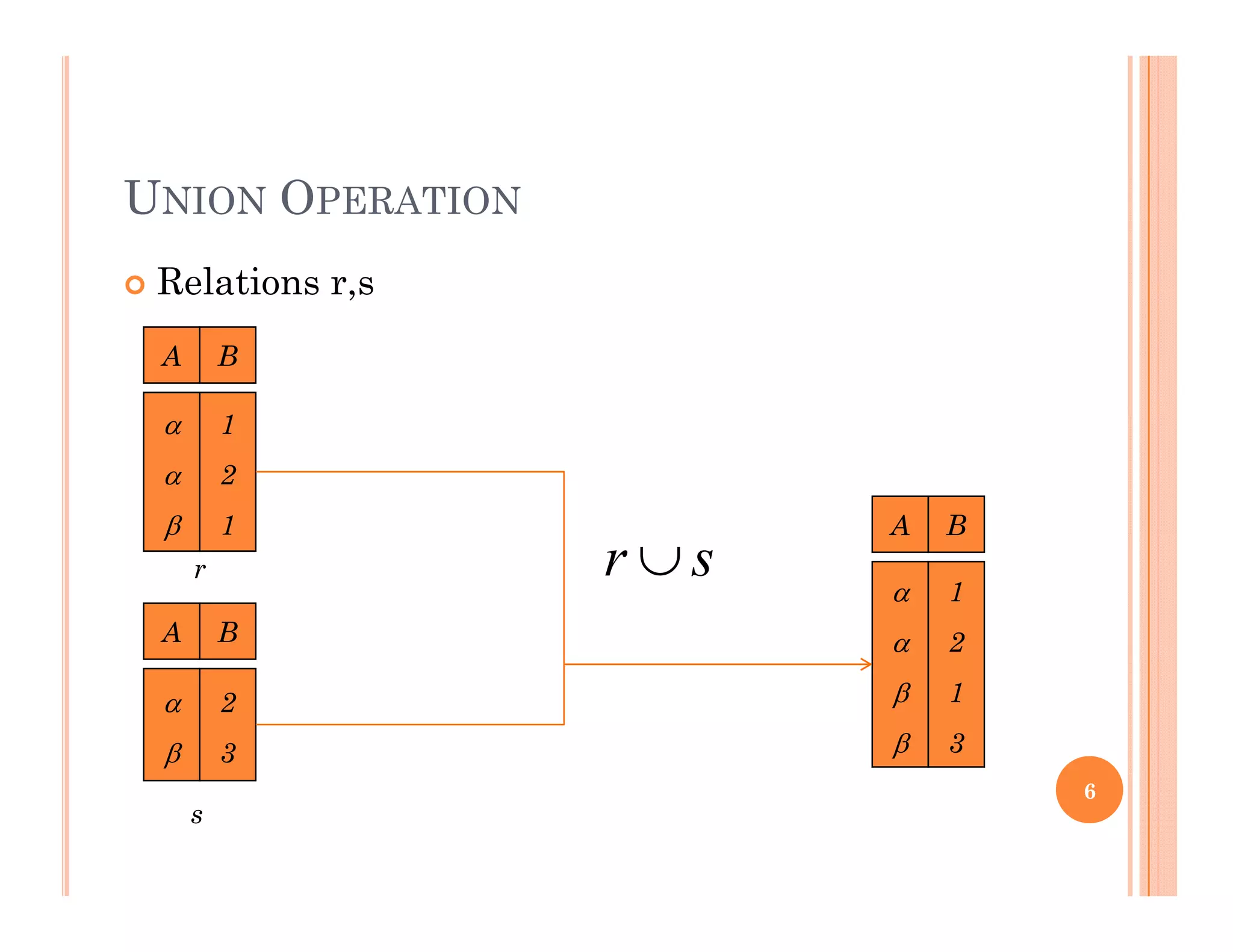
UNION OPERATION
 Relations r,s,
A B
1


1
2
1 A B
A B
r


1
2
sr 


2
3


1
3
6
s
SET DIFFERENCE OPERATION
 Relations r,s,
A B



1
2
1
A B
sr  1
A B
r


1
1
A B


2
3
7
 3
s
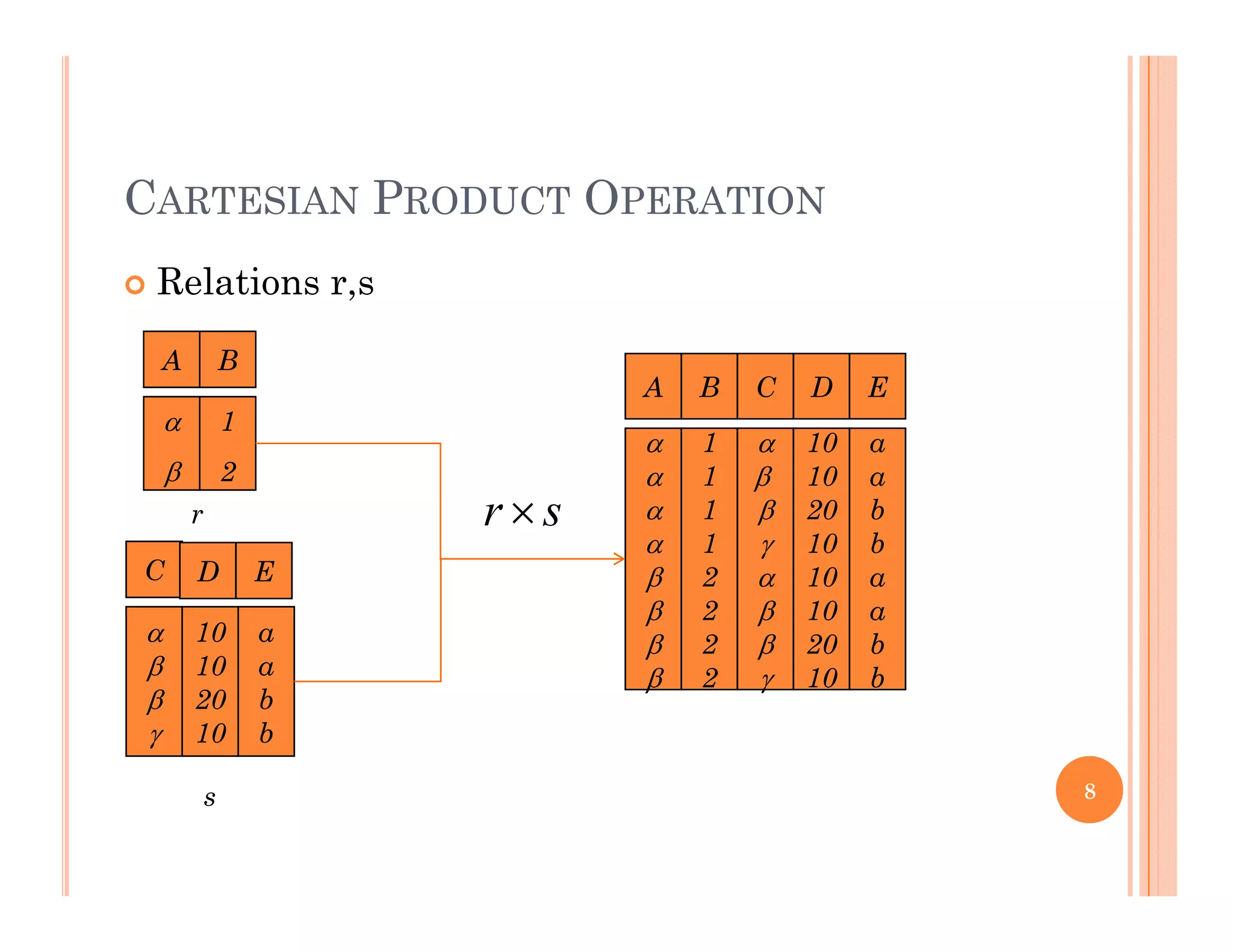
CARTESIAN PRODUCT OPERATION
 Relations r,s,
A B
1
A B C D E


1
2
r



1
1
1
1



10
10
20
10
a
a
b
b
sr 
C D
 10
E
a




1
2
2
2




10
10
10
20
b
a
a
b



10
20
10
a
b
b

 2

 10 b
8s
RENAME OPERATION
 Allows us to name, and therefore to refer to, the
results of relational-algebra expressions.
 Allows us to refer to a relation by more than one
name.
 Example:
 x (E)
returns the expression E under the name x
 If a relational-algebra expression E has arity n, then
returns the result of expression E under the name x,
)(),...,,( 21
EnAAAx
p ,
and with the attributes renamed to A1 , A2 , …., An . 9
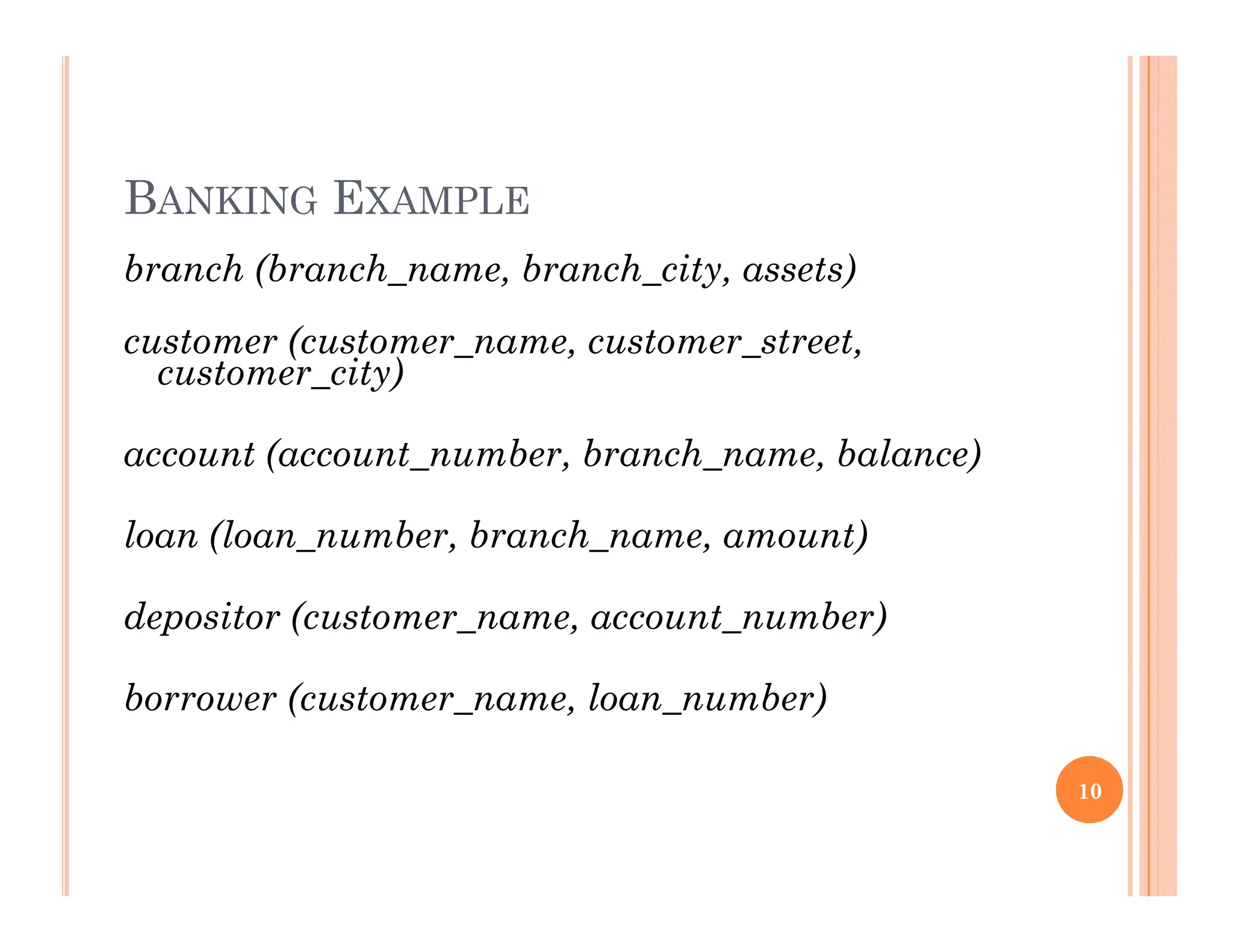
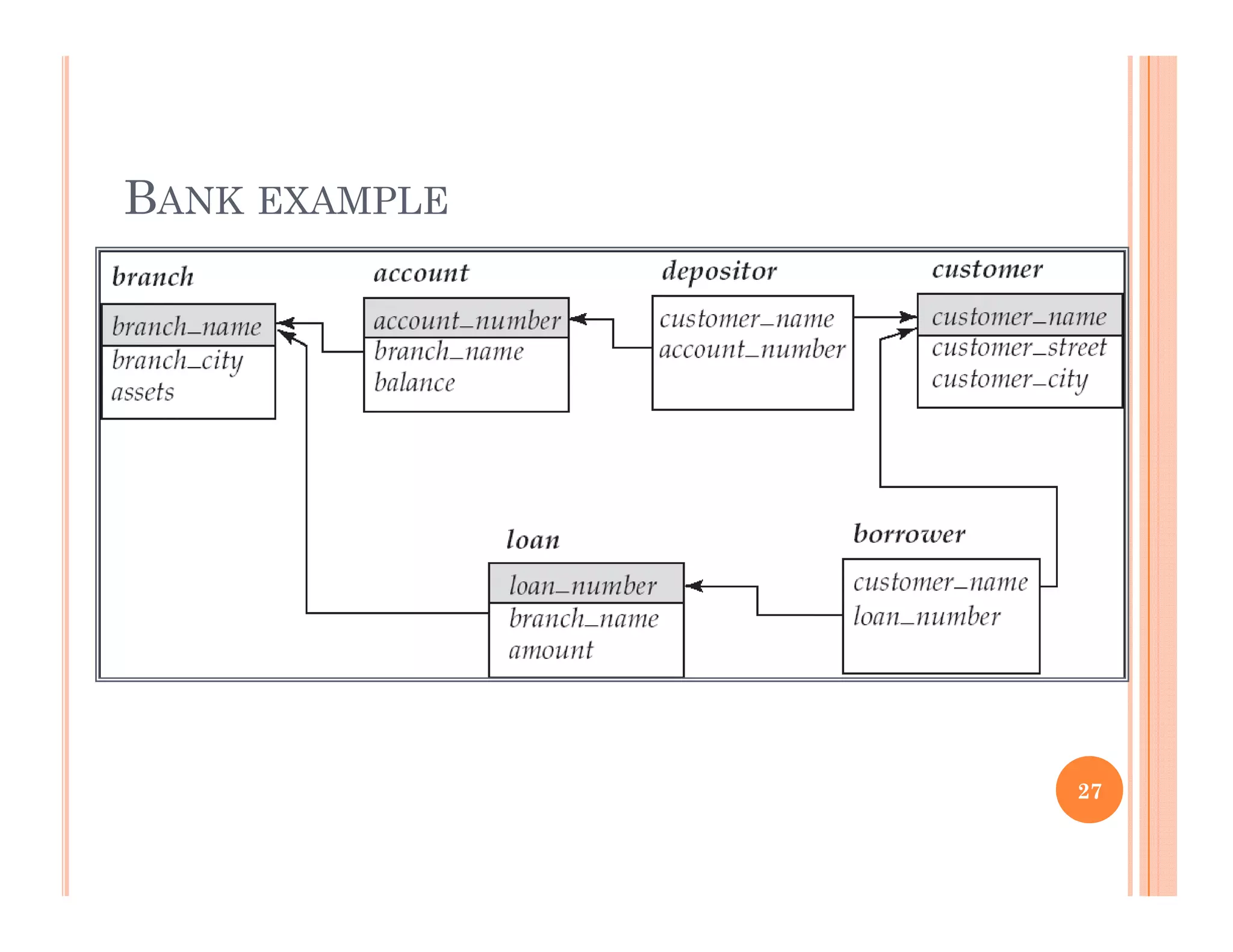
BANKING EXAMPLE
branch (branch_name, branch_city, assets)
customer (customer_name, customer_street,
customer_city)
account (account_number, branch_name, balance)
loan (loan number branch name amount)loan (loan_number, branch_name, amount)
depositor (customer_name, account_number)
borrower (customer_name, loan_number)
10
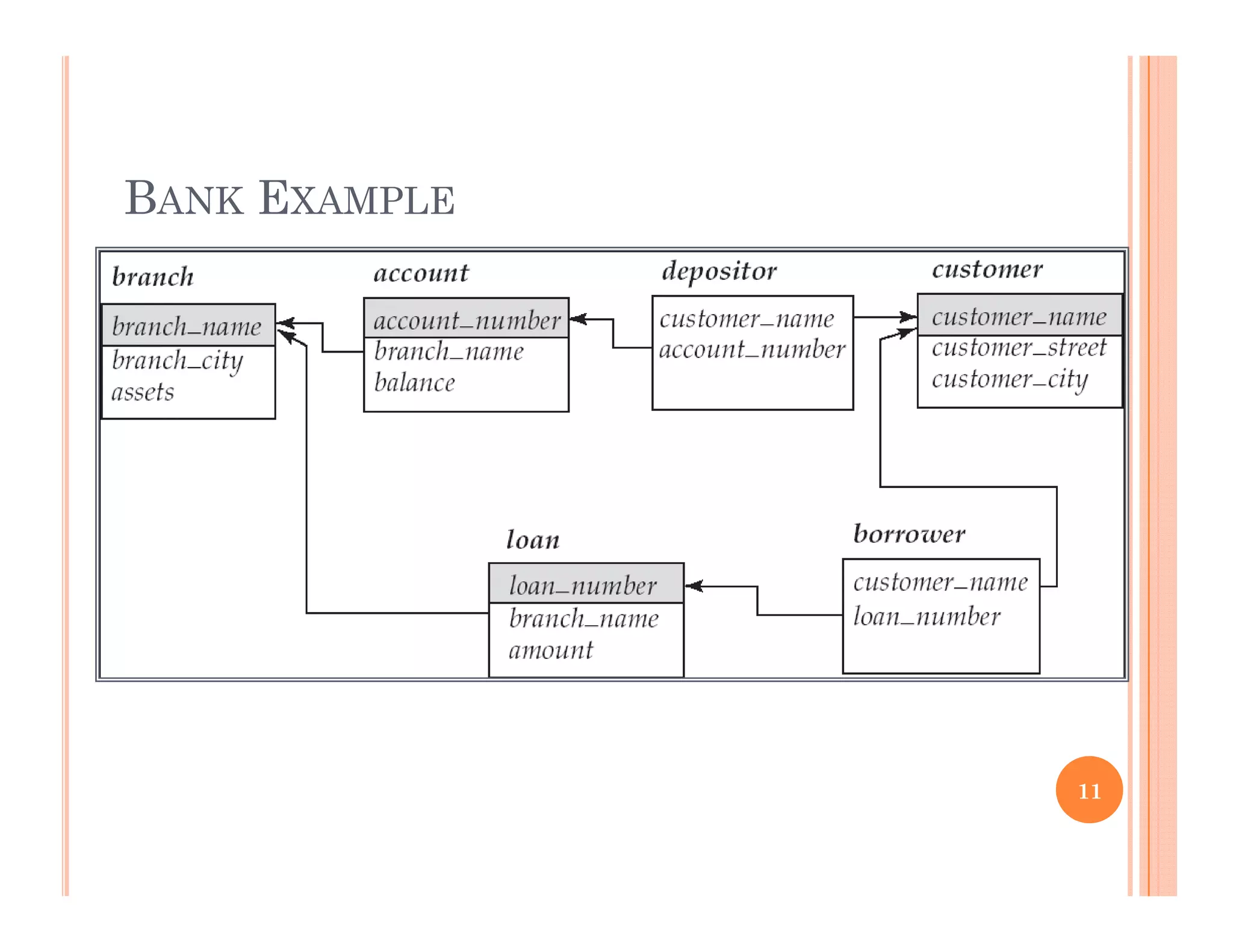
BANK EXAMPLE
11
EXAMPLE QUERIES
 Find all loans of over Rs 2000
 Find the loan number for each loan of an amount
h R 2000
)(2000 loanamount
greater than Rs 2000
 Find the names of all customers who have a loan
))(( 2000_ loanamountnoloan 
 Find the names of all customers who have a loan,
an account, or both, from the bank
)()( borrowerdepositor namecustomernamecustomer   )()( __ p namecustomernamecustomer
12
EXAMPLE QUERIES
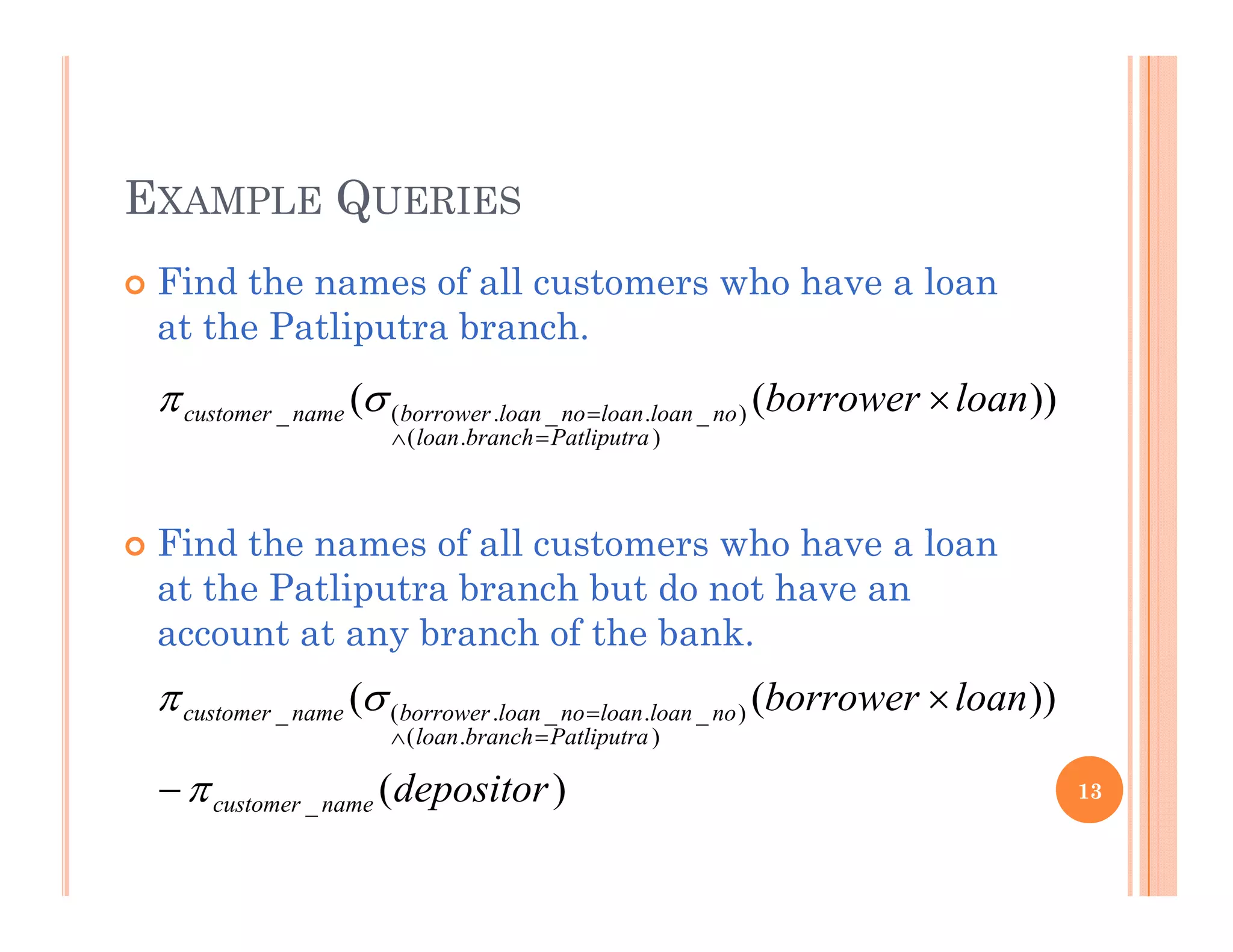
 Find the names of all customers who have a loan
at the Patliputra branch.
))(( )( loanborrowernoloanloannoloanborrowernamecustomer 
Fi d th f ll t h h l
))((
).(
)_._.(_
Patliputrabranchloan
noloanloannoloanborrowernamecustomer


 Find the names of all customers who have a loan
at the Patliputra branch but do not have an
account at any branch of the bank.
)(
))((
).(
)_._.(_
d i
loanborrower
Patliputrabranchloan
noloanloannoloanborrowernamecustomer  


13)(_ depositornamecustomer
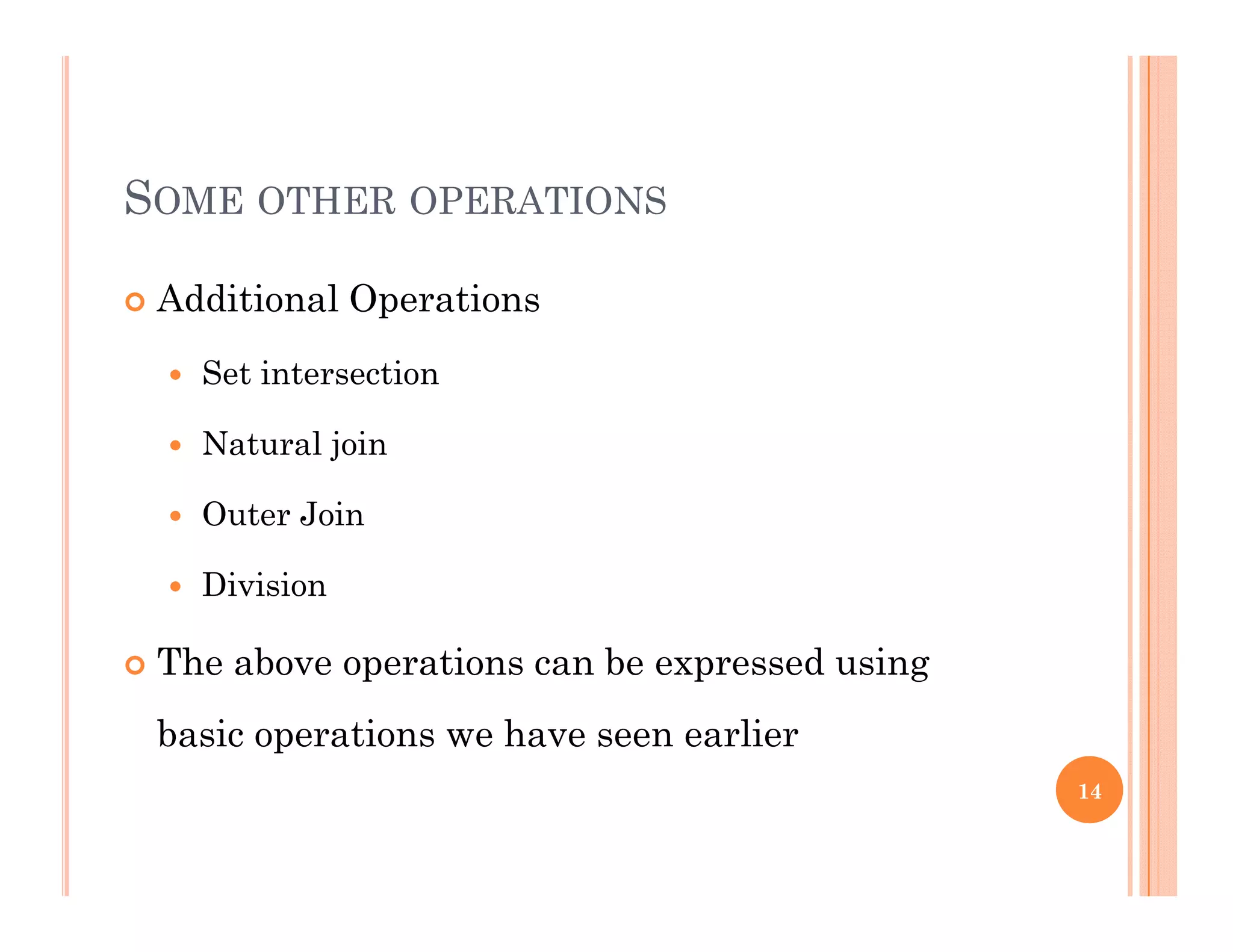
SOME OTHER OPERATIONS
 Additional Operations Additional Operations
 Set intersection
 Natural join
 Outer Join
 Division
Th b ti b d i The above operations can be expressed using
basic operations we have seen earlier
14
SET INTERSECTION OPERATION
 Relations r,s,
A B
 2
A B
 1
 3
s


2
1
r
A B
 2
r ∩ s
15
SET INTERSECTION OPERATION (CONTD.)
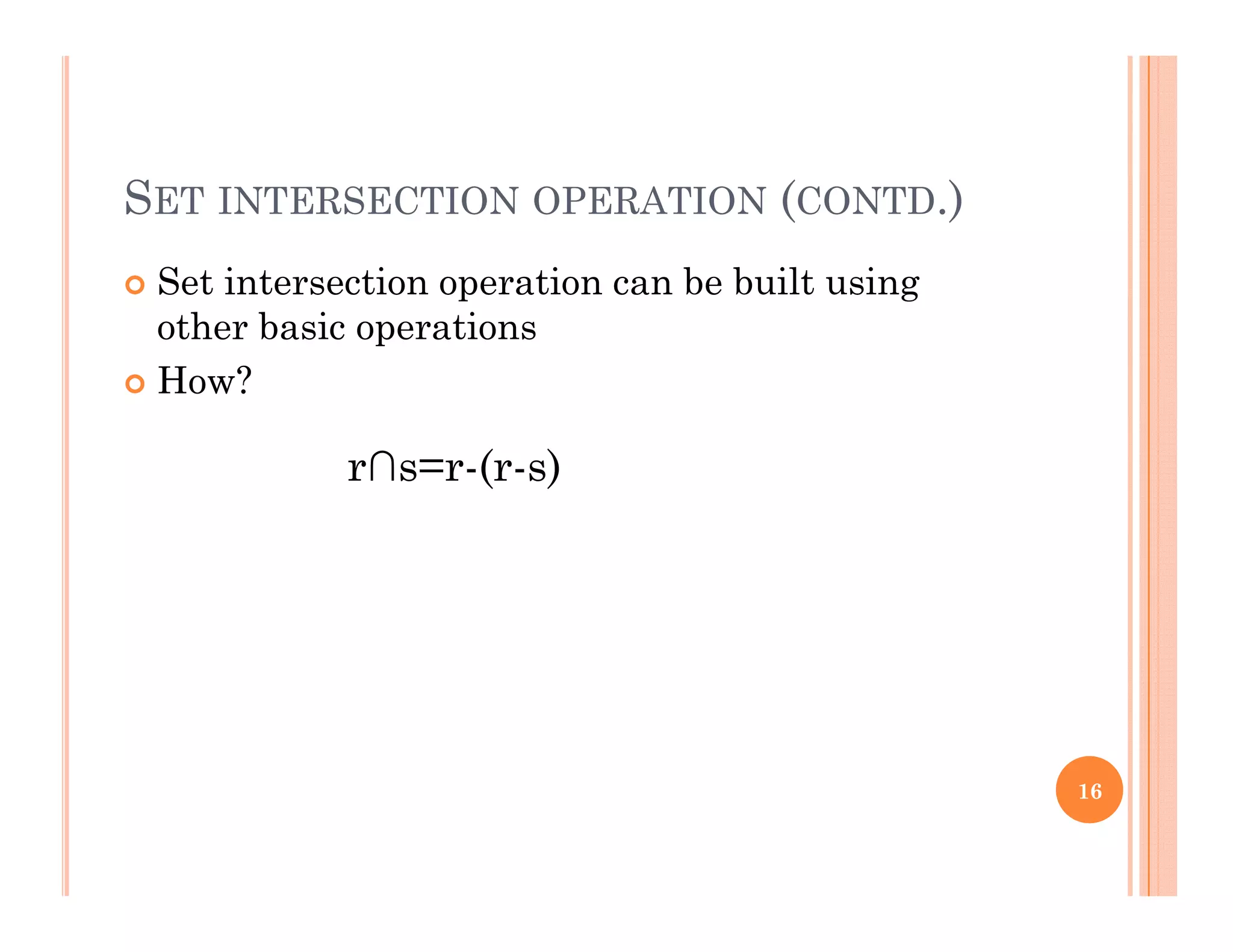
 Set intersection operation can be built usingp g
other basic operations
 How?
r∩s=r-(r-s)
16
NATURAL JOIN OPERATION
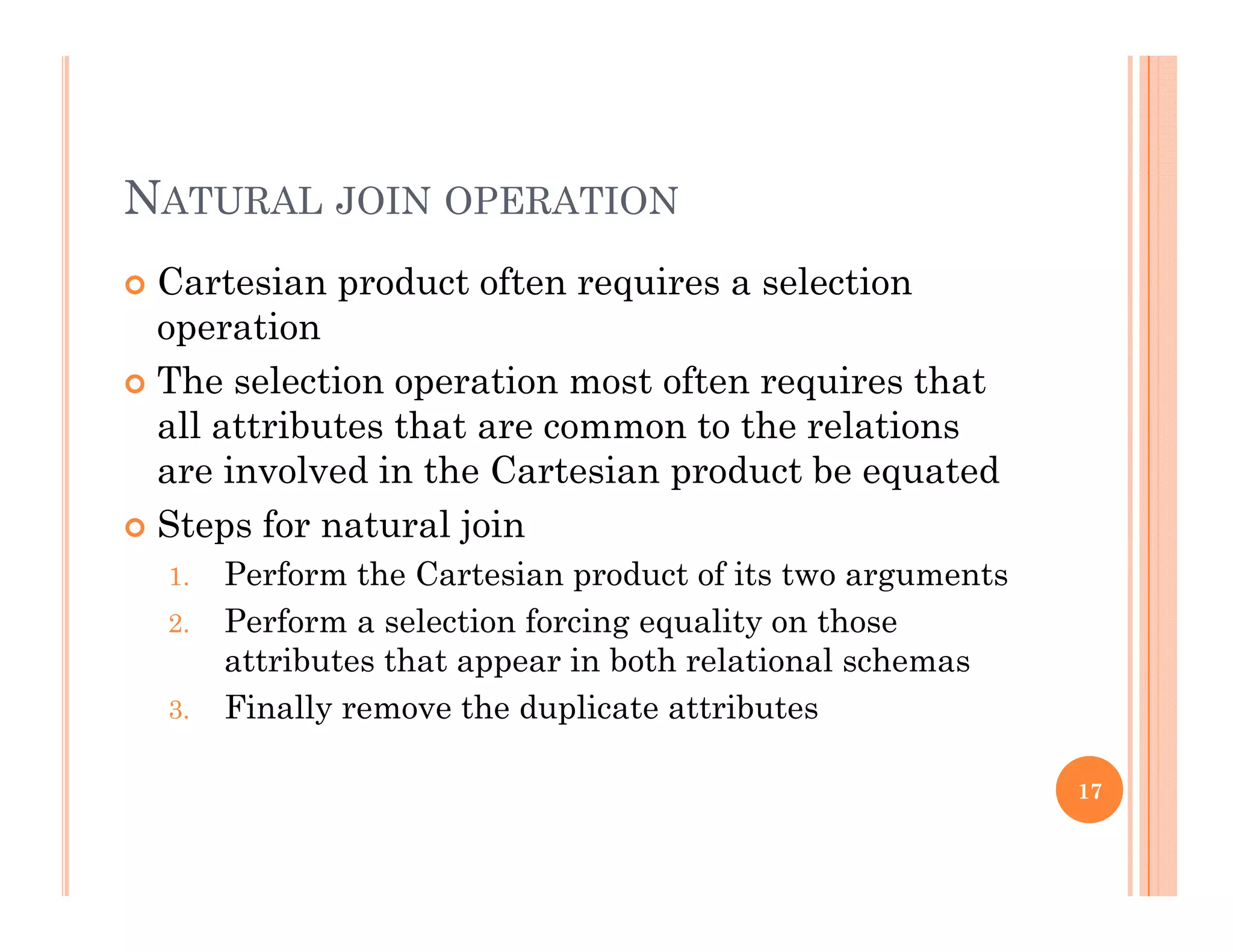
 Cartesian product often requires a selectionp q
operation
 The selection operation most often requires that
ll tt ib t th t t th l tiall attributes that are common to the relations
are involved in the Cartesian product be equated
 Steps for natural join Steps for natural join
1. Perform the Cartesian product of its two arguments
2. Perform a selection forcing equality on those
tt ib t th t i b th l ti l hattributes that appear in both relational schemas
3. Finally remove the duplicate attributes
17
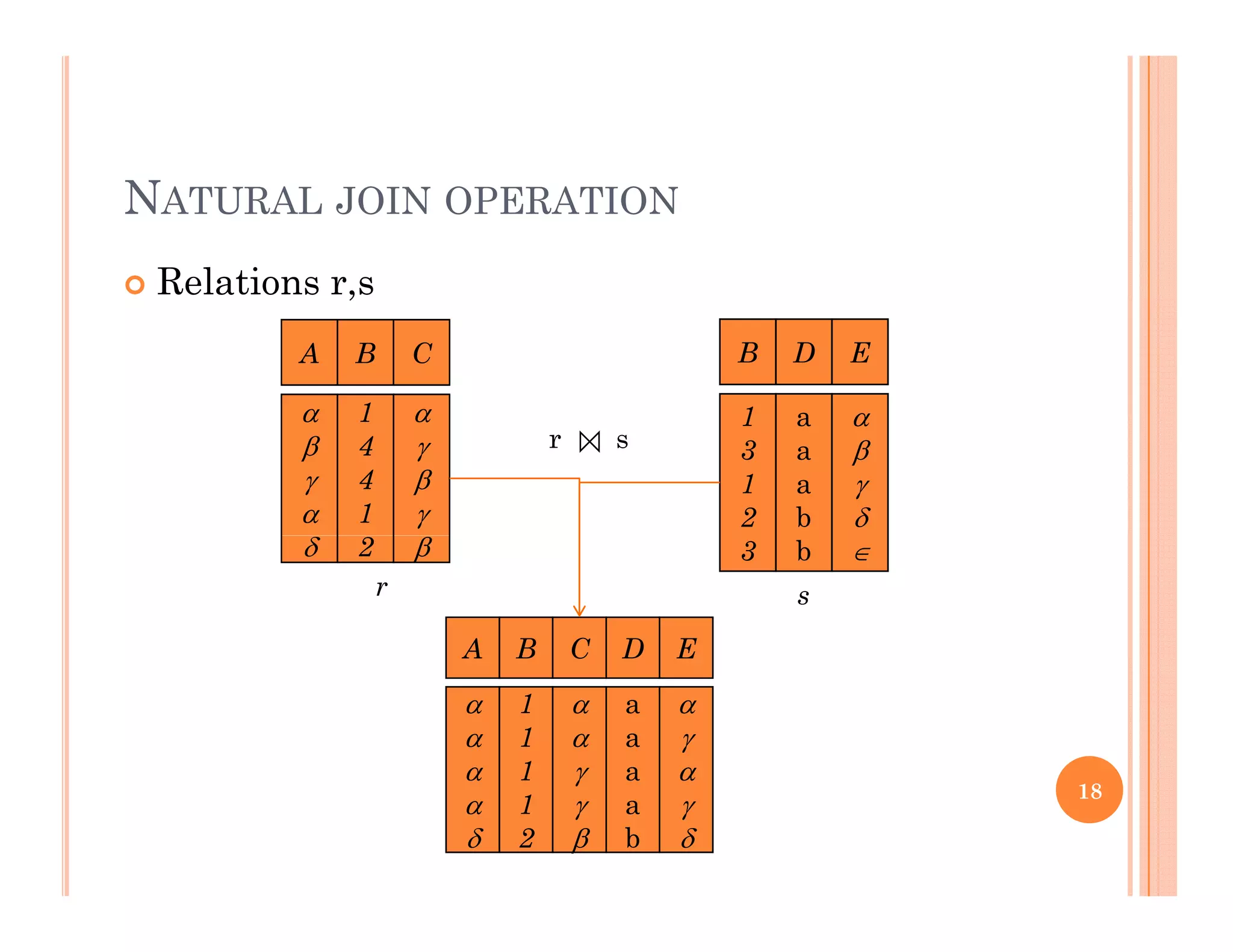
NATURAL JOIN OPERATION
 Relations r,s,
A B
 1
C

B
1
D
a
E




1
4
4
1




1
3
1
2
a
a
a
b




r s
 2  3 b 
r s
A B C D EA B



1
1
1
C D



a
a
a
E





1
1
2



a
a
b



18
NATURAL JOIN OPERATION (CONTD.)
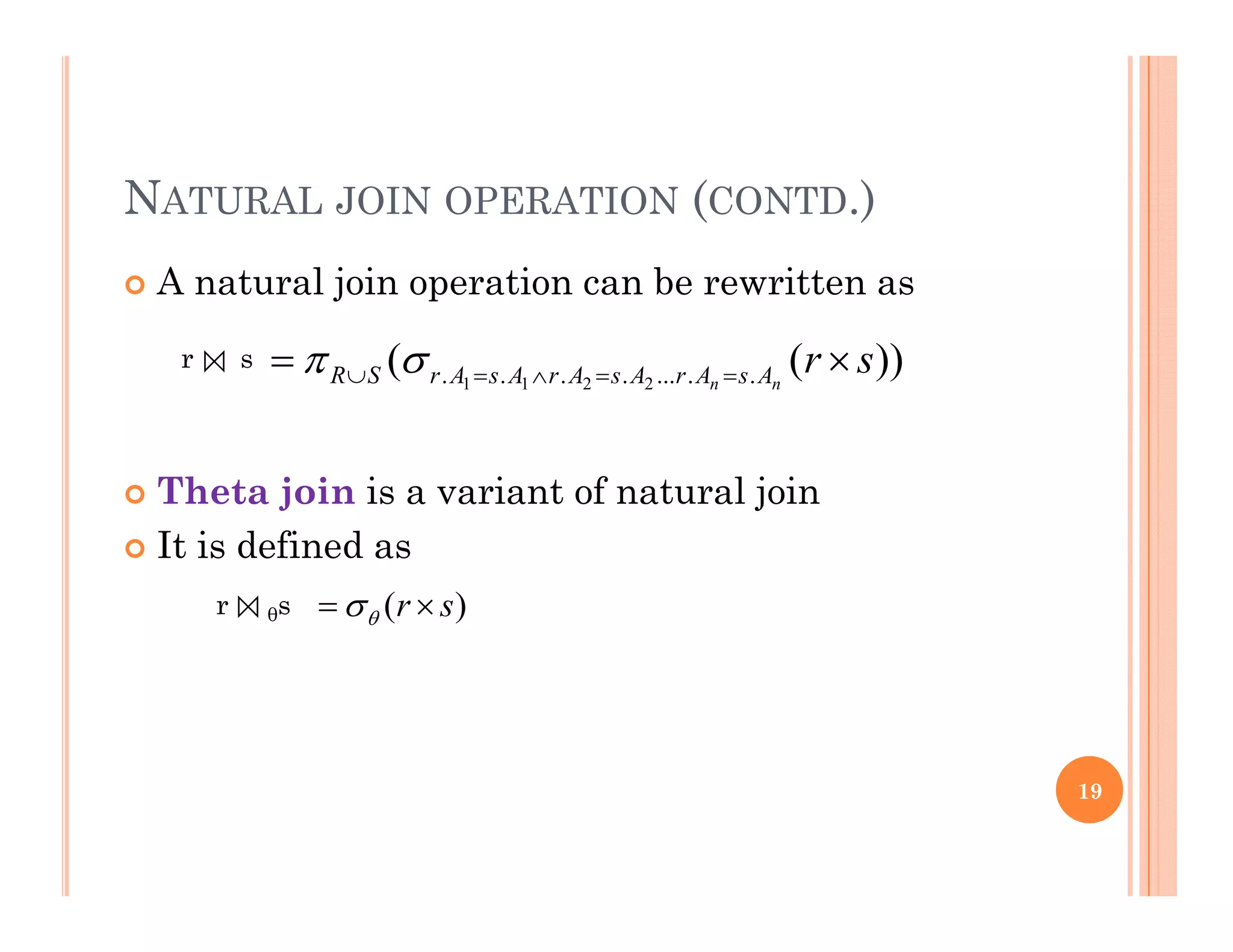
 A natural join operation can be rewritten asj p
))(( ......... 2211
srnn AsArAsArAsArSR   r s
 Theta join is a variant of natural join
It i d fi d It is defined as
)( sr  r θs
19
ASSIGNMENT OPERATION
 It is convenient at times to write relational
algebra expression by assigning parts of it to
temporary relation variables
Th i t ti k lik i t The assignment operation works like assignment
in programming languages
 We can rewrite asr s We can rewrite as
temp1← r х s
))1(......... 2211
tempnn AsArAsArAsAr temp2←
)2(tempsrresult←
20
OUTER JOIN OPERATION
 An extension of the join operation that avoidsj p
loss of information
 Computes the join and then adds tuples form one
l ti th t d t t h t l i th threlation that does not match tuples in the other
relation to the result of the join.
 Uses null values: Uses null values:
 null signifies that the value is unknown or does not
exist
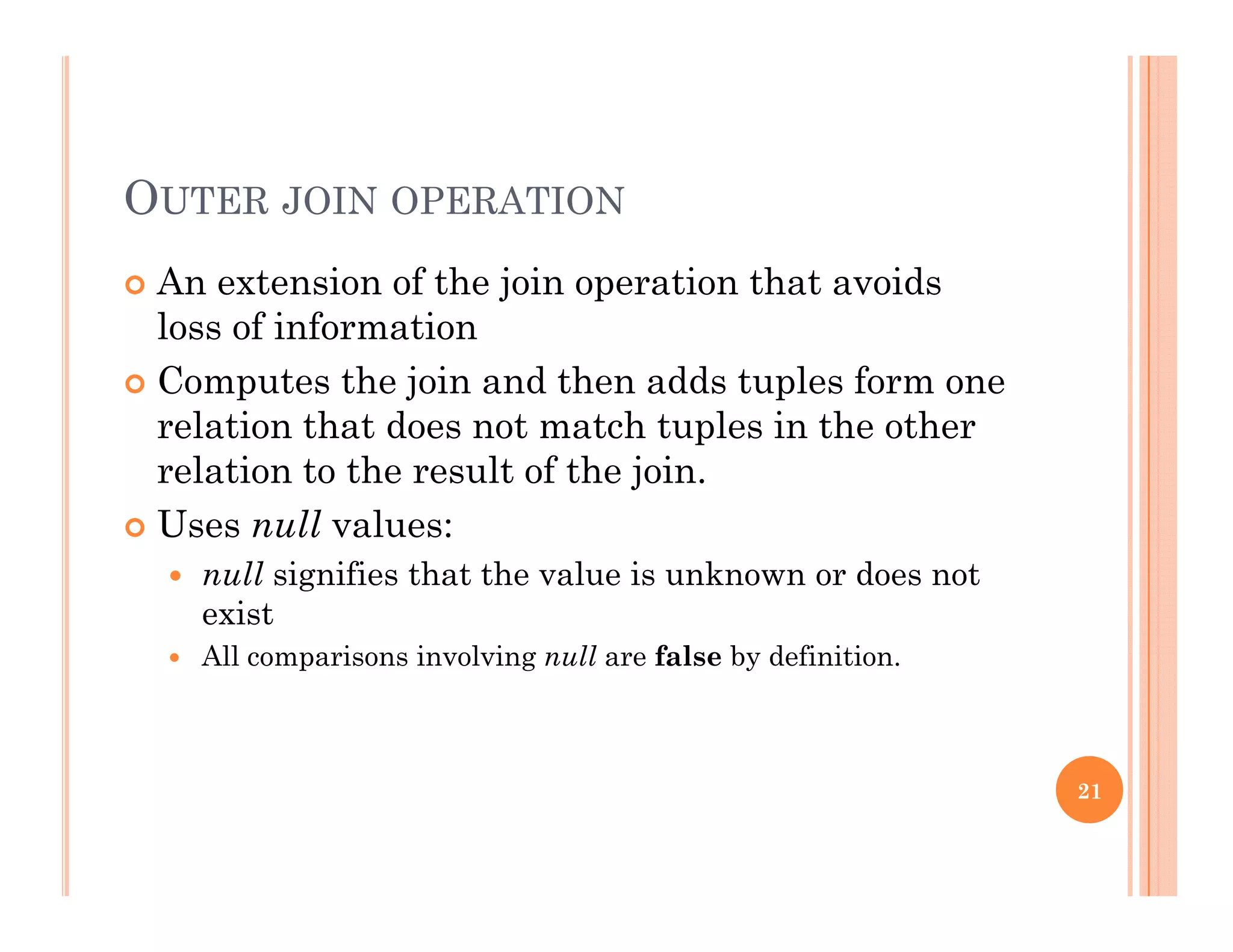
 All comparisons involving null are false by definition All comparisons involving null are false by definition.
21
DIFFERENT FORMS OF OUTER JOIN
 Left outer joinj
 Includes the tuples from the left relation that did not
match with any tuples in the right relation
 Pads the tuples with null values for all other Pads the tuples with null values for all other
attributes from the right relation
 Adds them to the result of the natural join
 Similarly we can define-
 Right outer join
F ll t j i Full outer join
 We can rewrite asr s
r s U (r-πR(r s)) x {(null, …, null)}
22
( R( )) {( , , )}
Here the constant relation {(null,…,null)} is on schema S-R
NULL VALUE
 It is possible for tuples to have a null value,p p ,
denoted by null, for some of their attributes
 null signifies an unknown value or that a value
does not exist.
 The result of any arithmetic expression involving
ll i llnull is null.
 Aggregate functions simply ignore null values (as
in SQL)in SQL)
 For duplicate elimination and grouping, null is
treated like any other value, and two nulls aret eated e a y ot e va ue, a d two u s a e
assumed to be the same (as in SQL)
23
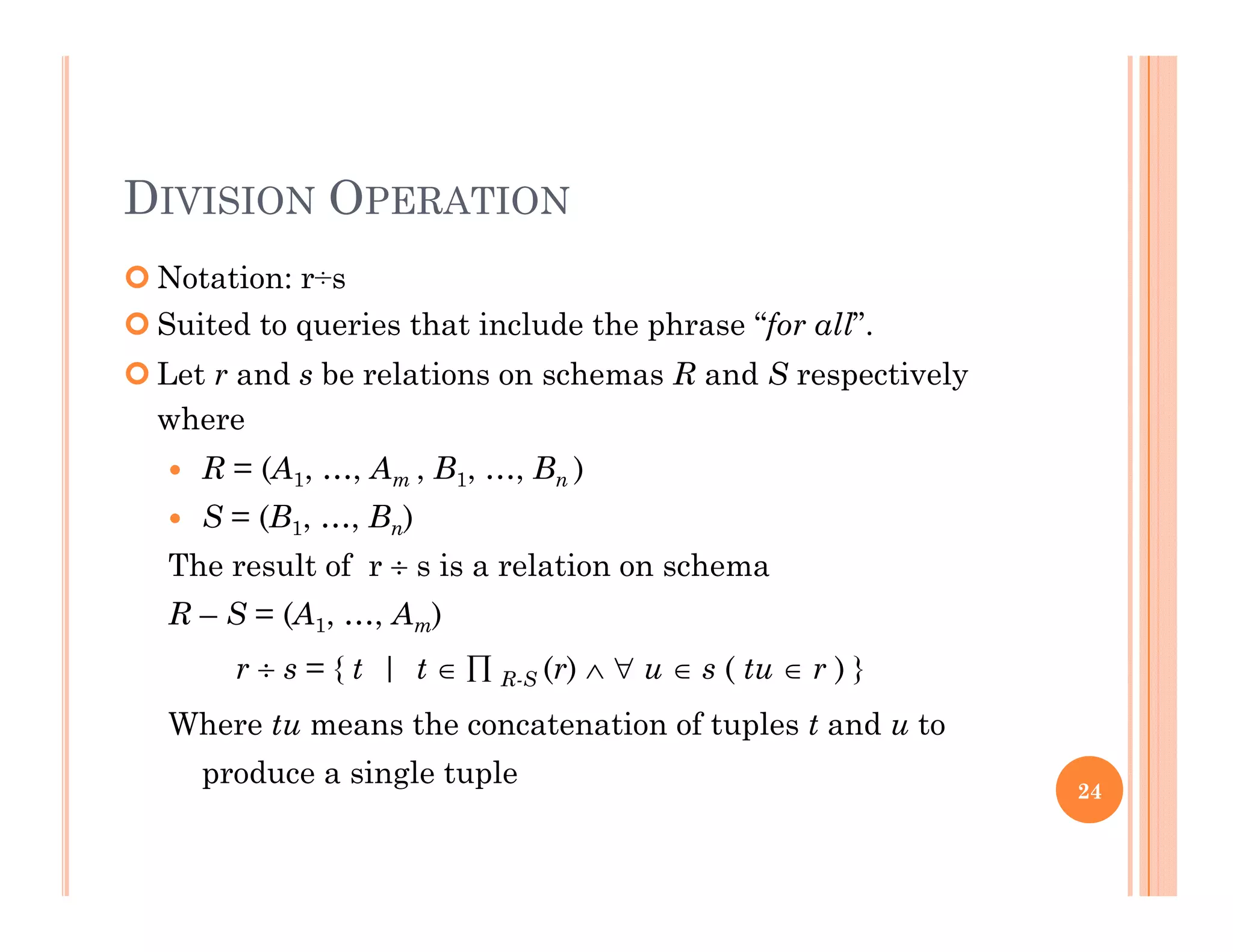
DIVISION OPERATION
 Notation: r÷s
 Suited to queries that include the phrase “for all”.
 Let r and s be relations on schemas R and S respectively
wherewhere
 R = (A1, …, Am , B1, …, Bn )
 S = (B1, …, Bn)
The result of r  s is a relation on schema
R – S = (A1, …, Am)
{  ( ) ( ) }r  s = { t | t   R-S (r)   u  s ( tu  r ) }
Where tu means the concatenation of tuples t and u to
produce a single tupleproduce a single tuple 24
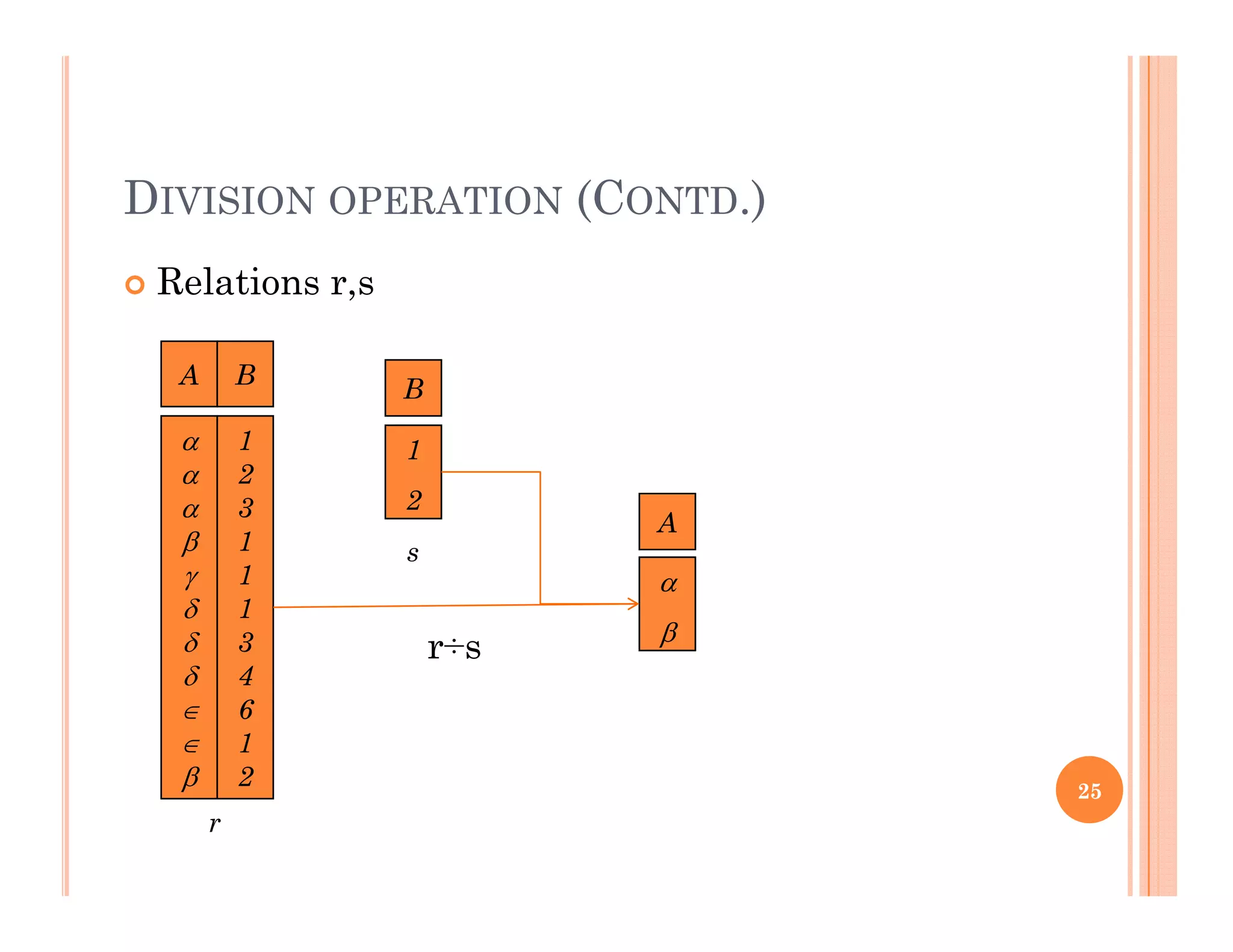
DIVISION OPERATION (CONTD.)
 Relations r,s,
B
A B
1
2




1
2
3
1
A




1
1
1
3
s


r÷s




4
6
1
2
r s
 2
r
25
DIVISION OPERATION (CONTD.)
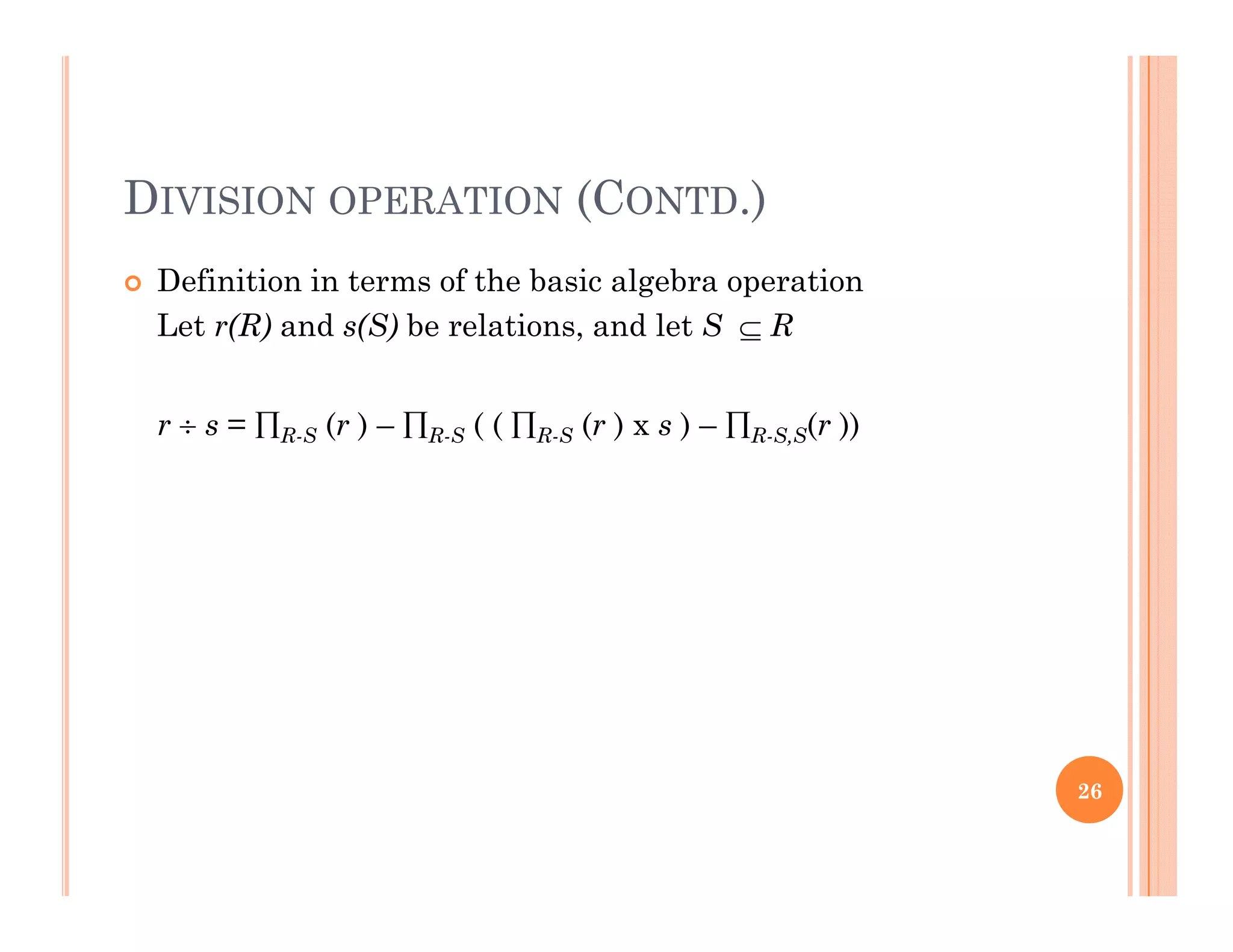
 Definition in terms of the basic algebra operationg p
Let r(R) and s(S) be relations, and let S  R
 ( )  ( (  ( ) )  ( ))r  s = R-S (r ) – R-S ( ( R-S (r ) x s ) – R-S,S(r ))
26
BANK EXAMPLE
27
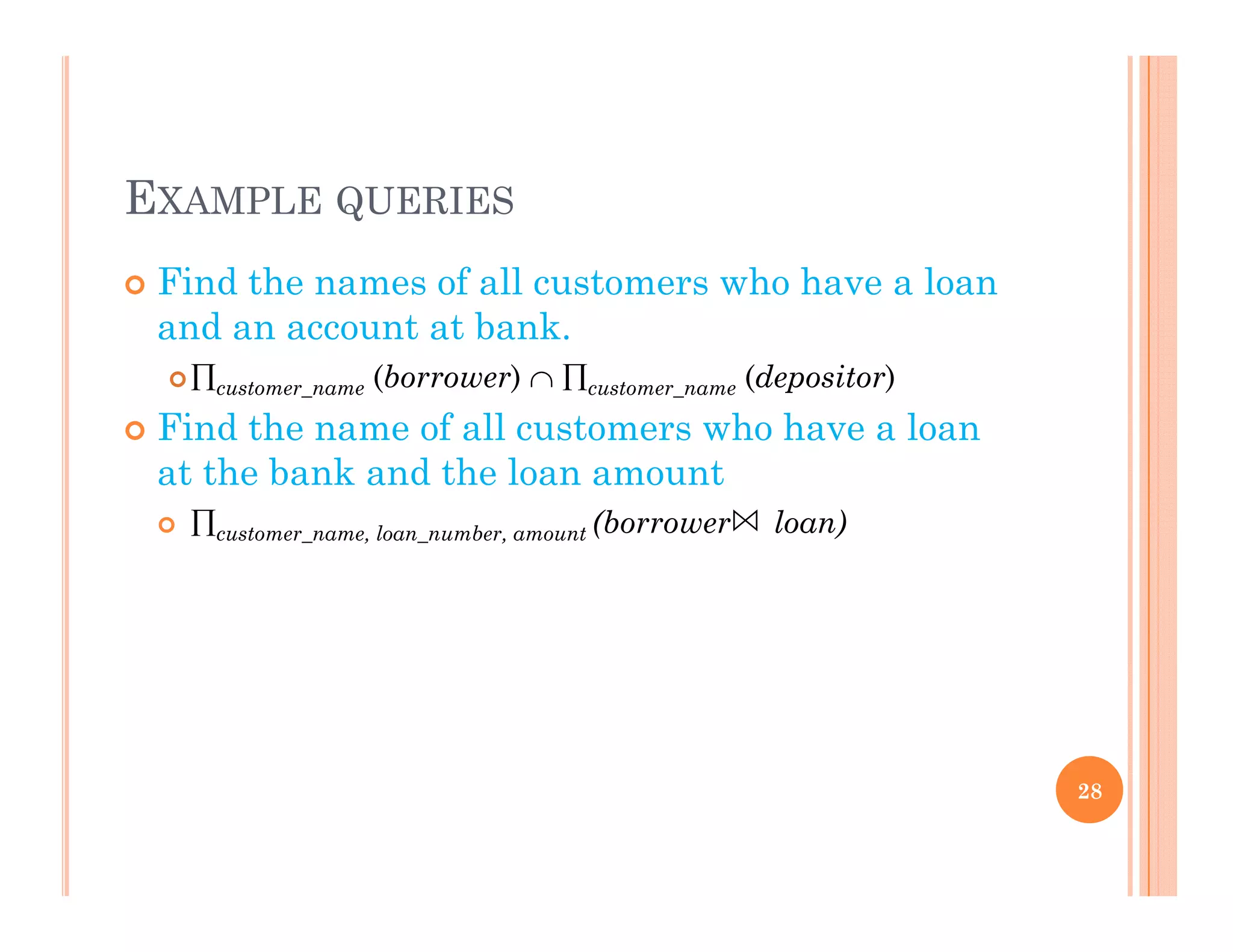
EXAMPLE QUERIES
 Find the names of all customers who have a loan
and an account at bank.
customer_name (borrower)  customer_name (depositor)
Fi d h f ll h h l Find the name of all customers who have a loan
at the bank and the loan amount
 customer name loan number amount (borrower loan)customer_name, loan_number, amount ( )
28
EXAMPLE QUERIES (CONTD.)
 Find the largest account balance in the bankg
 balance (account) – account.balance ( σaccount.balance <d.balance
(account x ρd account))
29
EXAMPLE QUERIES (CONTD.)
 Find the name of customers who have an account at
all the branches located in “Patna” city.
customer_name,branch_name (depositor account)
 branch_name (σbranch_city=“Patna” (branch))
30
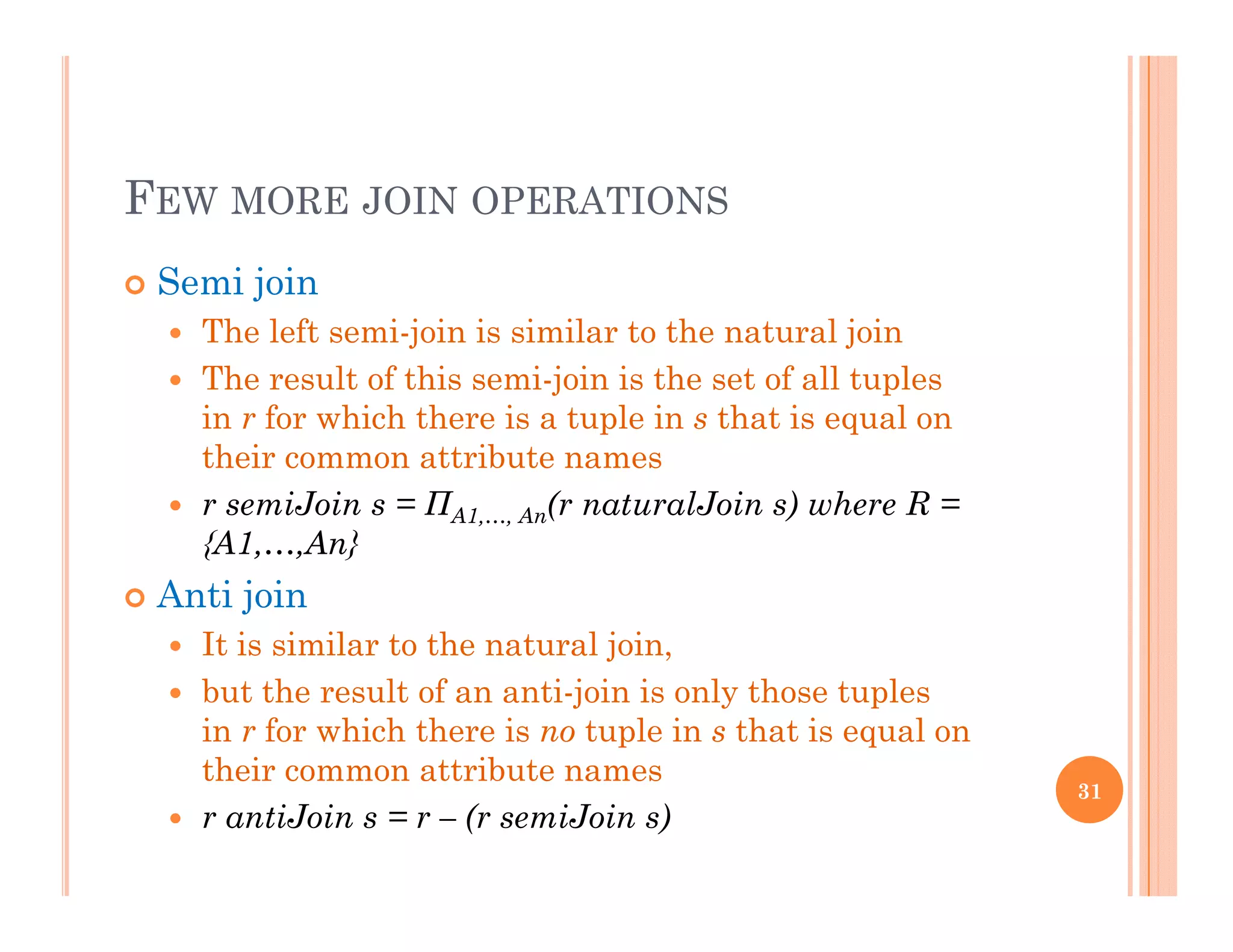
FEW MORE JOIN OPERATIONS
 Semi joinj
 The left semi-join is similar to the natural join
 The result of this semi-join is the set of all tuples
in r for which there is a tuple in s that is equal onin r for which there is a tuple in s that is equal on
their common attribute names
 r semiJoin s = ΠA1,…, An(r naturalJoin s) where R =
{A1 A }{A1,…,An}
 Anti join
 It is similar to the natural join,s s a o e a a jo ,
 but the result of an anti-join is only those tuples
in r for which there is no tuple in s that is equal on
their common attribute namestheir common attribute names
 r antiJoin s = r – (r semiJoin s)
31
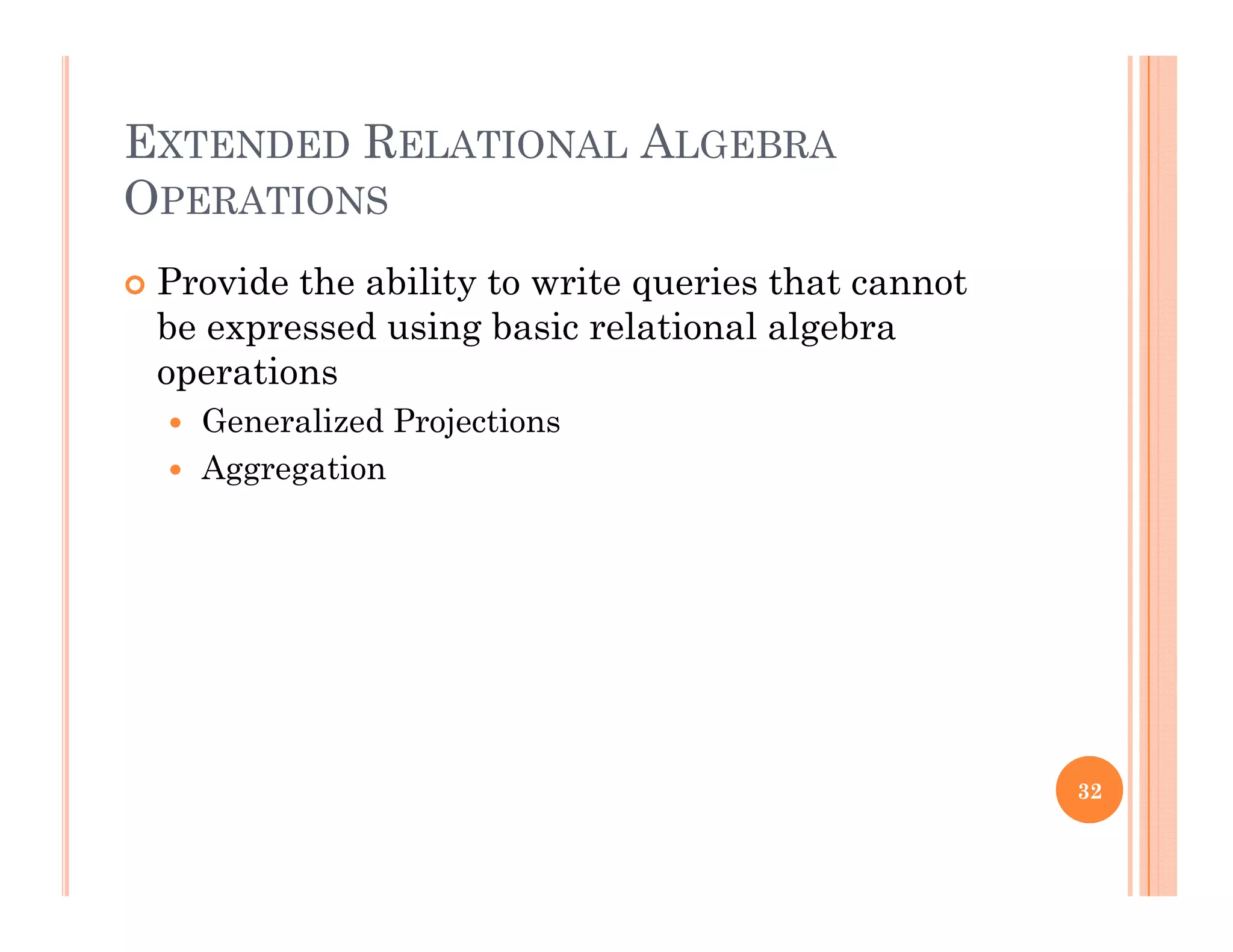
EXTENDED RELATIONAL ALGEBRA
OPERATIONS
 Provide the ability to write queries that cannoty q
be expressed using basic relational algebra
operations
G li d P j ti Generalized Projections
 Aggregation
32
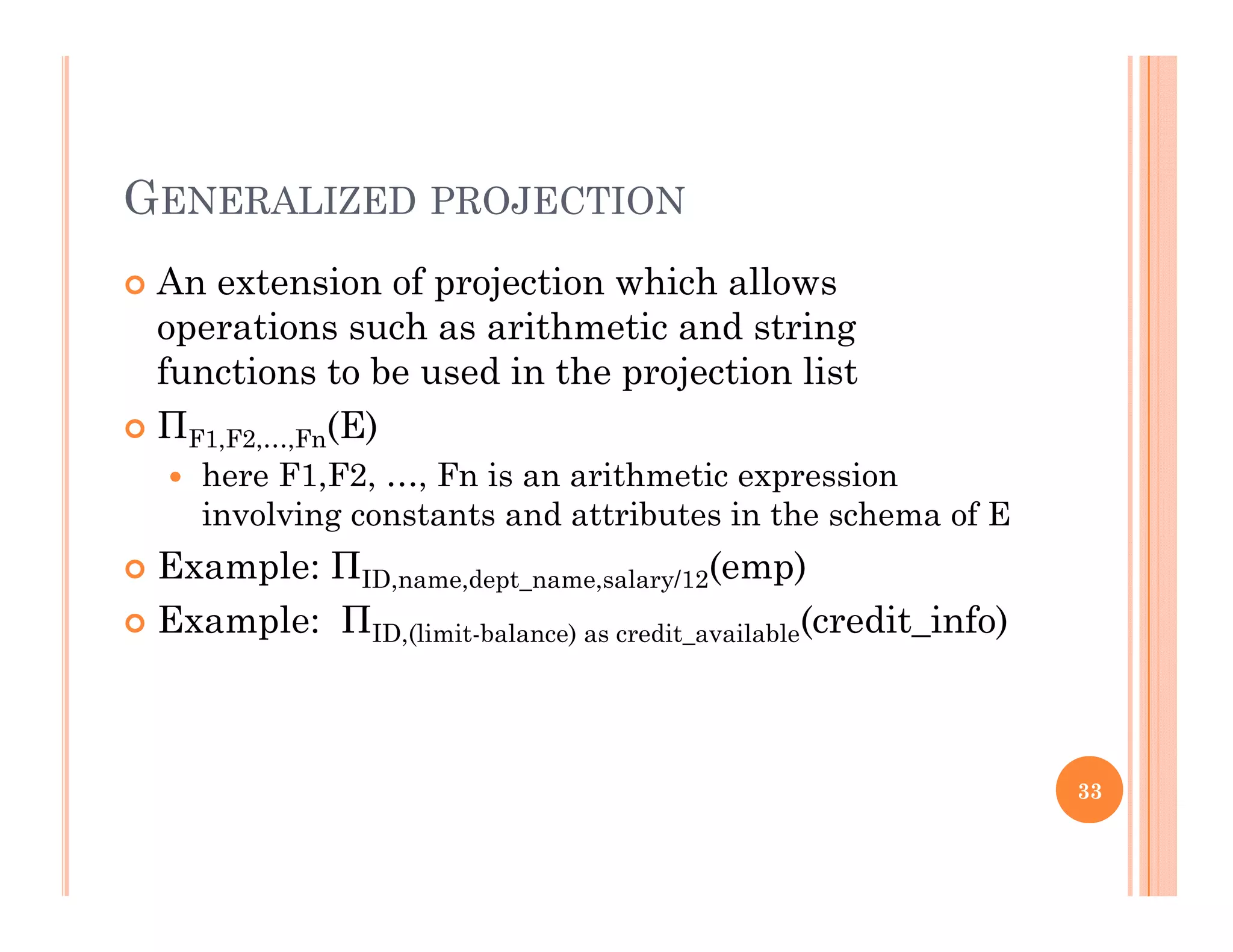
GENERALIZED PROJECTION
 An extension of projection which allowsp j
operations such as arithmetic and string
functions to be used in the projection list
Π (E) ΠF1,F2,…,Fn(E)
 here F1,F2, …, Fn is an arithmetic expression
involving constants and attributes in the schema of E
 Example: ΠID,name,dept_name,salary/12(emp)
 Example: ΠID,(limit-balance) as credit_available(credit_info)
33
AGGREGATION
 Aggregate functions take a collection of valuesgg g
and return a single value in result
 E.g. sum, avg, count, max, min, etc.
M l i h ll i hi h Multisets: the collections on which aggregate
function operates can have multiple occurrences
of a value; the order in which the values appear; pp
is not relevant
 g sum(salary)(instructor)
Caligraphic G
34
MODIFICATION OF THE DATABASE
 The content of the database may be modifiedy
using the following operations:
 Deletion
 Insertion
 Updating
 All th ti d i th All these operations are expressed using the
assignment operator.
35
DELETION
 A delete request is expressed similarly to aq p y
query, except instead of displaying tuples to the
user, the selected tuples are removed from the
databasedatabase.
 Can delete only whole tuples; cannot delete
values on only particular attributes
 A deletion is expressed in relational algebra by:
r  r – E
where r is a relation and E is a relational algebra
query.
36
BANK EXAMPLE
37
DELETE EXAMPLE
 Delete all account records in the “Patliputra” branch.p
 r1  branch_name=“Patliputra” (account depositor)
 account  account –  account_number, branch_name, balance (r1 )
d i d i  ( 1 ) depositor  depositor -  customer_name,account_number (r1 )
 Delete all loan records with amount in the range of 0 to 50 Delete all loan records with amount in the range of 0 to 50
 r2  amount>=0 and amount <= 50 (loan borrower)
 loan  loan – loan no branch name amount (r2)loan_no,branch_name,amount ( )
 borrower  borrower – customer_name,loan_no (r2)
38
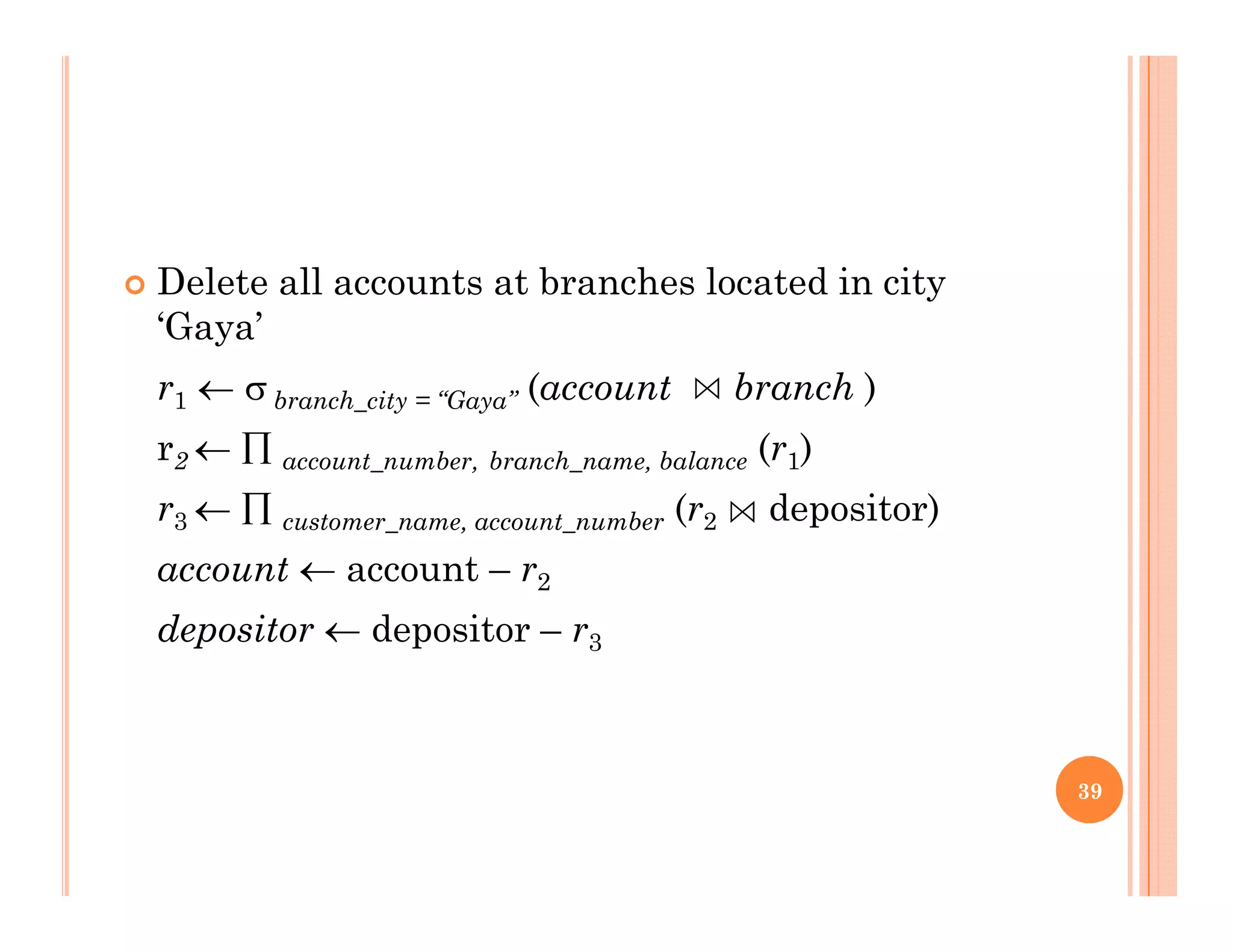
 Delete all accounts at branches located in cityy
‘Gaya’
r1  branch_city = “Gaya” (account branch )
r2   account_number, branch_name, balance (r1)
r3   customer_name, account_number (r2 depositor)
account  account – r2
depositor  depositor – r3
39
INSERTION
 To insert data into a relation, we either:,
 specify a tuple to be inserted or
 write a query whose result is a set of tuples to
be inserted
 In relational algebra, an insertion is expressed
by:by:
r  r  E
where r is a relation and E is a relational algebrag
expression.
 The insertion of a single tuple is expressed by
l tti E b t t l ti t i iletting E be a constant relation containing one
tuple.
40
INSERT EXAMPLE
 Insert information in the database specifying that
Sumit has Rs 1200 in account A-973 at the Patliputra
branch.
account  account  {(“A-973”, “Patliputra”, 1200)}{( , p , )}
depositor  depositor  {(“Sumit”, “A-973”)}
 Provide as a gift for all loan customers in the
Patliputra branch a Rs 200 savings account Let thePatliputra branch, a Rs 200 savings account. Let the
loan number serve as the account number for the new
savings account.
 ( (b l ))r1  (branch_name = “Patliputra” (borrower loan))
r2  (loan_number, branch_name, (r1))
account  account  (r2 x {(200)})( 2 {( )})
depositor  depositor  customer_name, loan_number (r1)
41
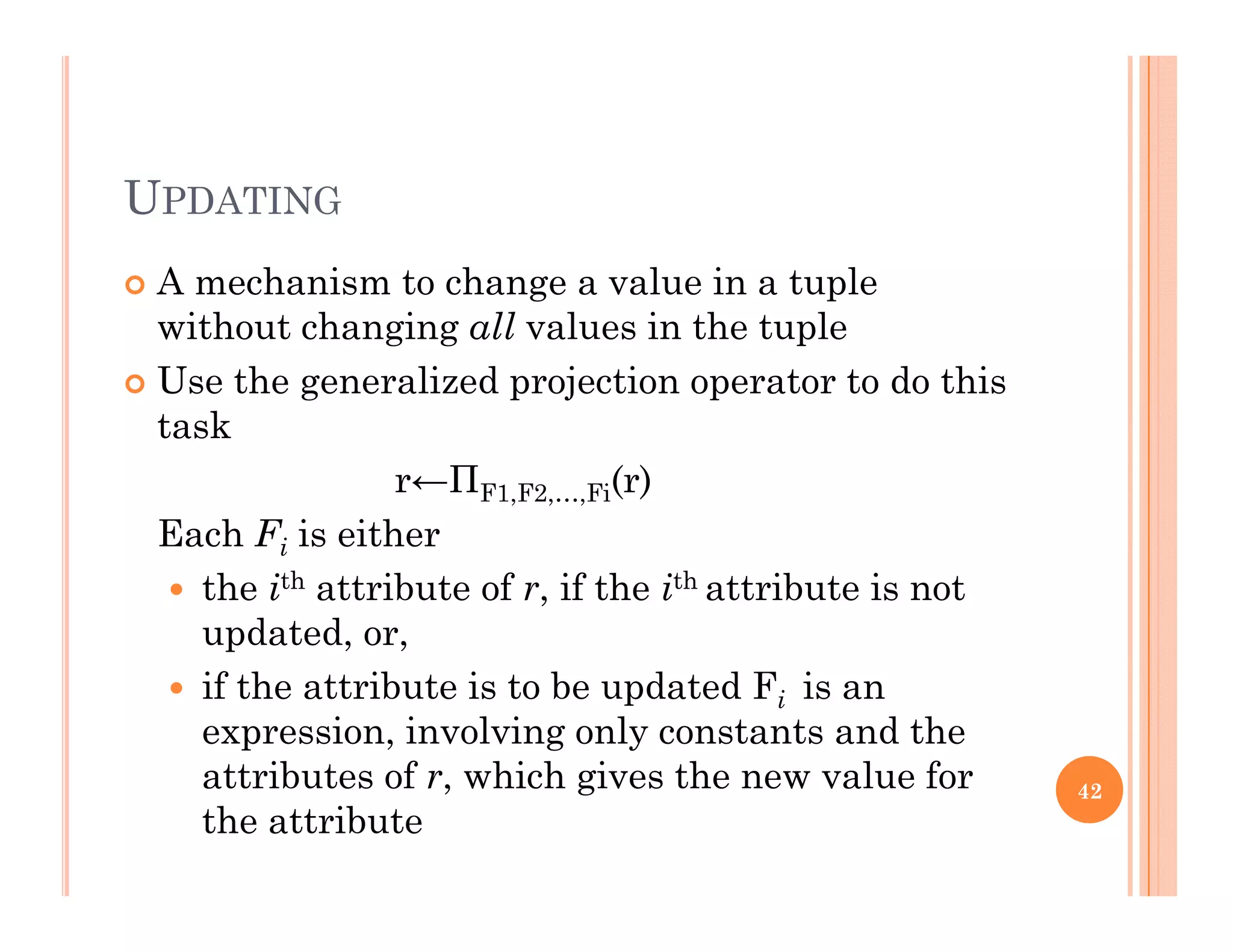
UPDATING
 A mechanism to change a value in a tupleg p
without changing all values in the tuple
 Use the generalized projection operator to do this
t ktask
r←ΠF1,F2,…,Fi(r)
Each F is eitherEach Fi is either
 the ith attribute of r, if the ith attribute is not
updated, or,
 if the attribute is to be updated Fi is an
expression, involving only constants and the
attributes of r which gives the new value forattributes of r, which gives the new value for
the attribute
42
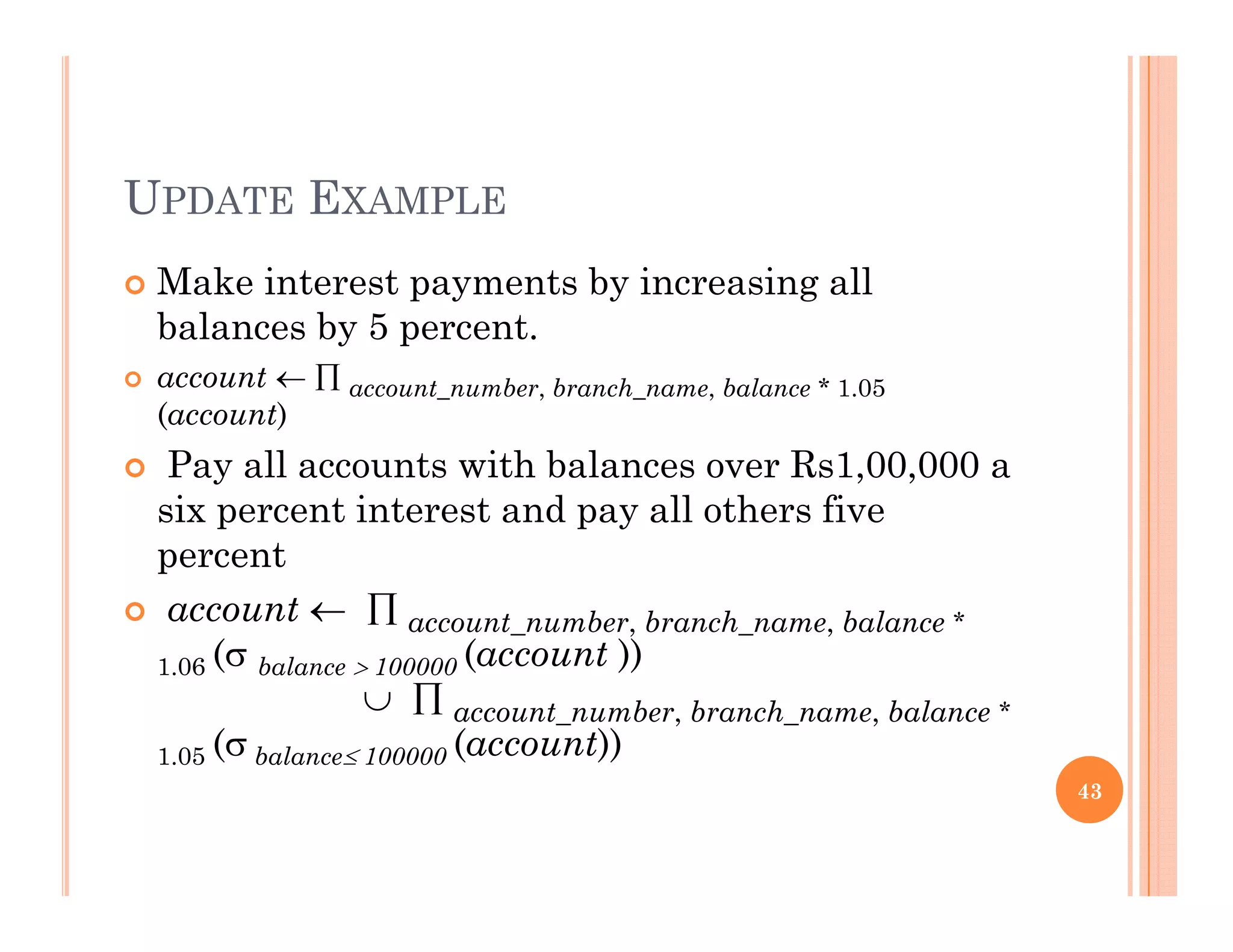
UPDATE EXAMPLE
 Make interest payments by increasing allp y y g
balances by 5 percent.
 account   account_number, branch_name, balance * 1.05
(account)(account)
 Pay all accounts with balances over Rs1,00,000 a
six percent interest and pay all others five
percent
 account   account_number, branch_name, balance *
( (account ))1.06 ( balance  100000 (account ))
  account_number, branch_name, balance *
1.05 ( balance 100000 (account))
43

Cs501 rel algebra

  • 1.
    CS501: DATABASE ANDDATA MINING Relational Algebra1
  • 2.
    QUERY LANGUAGES  Languagein which user requests informationg g q from the database.  Categories of languages  Procedural  Non-procedural, or declarative  “Pure” languages: Pure languages:  Relational algebra (Procedural)  Tuple relational calculus (Non-procedural)  Domain relational calculus (Non-procedural)  Pure languages form underlying basis of query languages that people uselanguages that people use. 2
  • 3.
    RELATIONAL ALGEBRA  Procedurallanguageg g  Six basic operators  Selection:   Projection:   Union:   Set difference: – Set difference: –  Cartesian product: x  Rename:   The operators take one or two relations as inputs and produce a new relation as a result. 3
  • 4.
    SELECTION OPERATION  Relationr A B C D     1 5 7 7     12 23 3 10 )()5()( rDBA  A B C D     1 23 7 10 4
  • 5.
    PROJECTION OPERATION  Relationr A B C    10 20 30 1 1 1 A C A C )(, rCA   30 40 1 2   1 1 =   1 1   1 2  2 5
  • 6.
    UNION OPERATION  Relationsr,s, A B 1   1 2 1 A B A B r   1 2 sr    2 3   1 3 6 s
  • 7.
    SET DIFFERENCE OPERATION Relations r,s, A B    1 2 1 A B sr  1 A B r   1 1 A B   2 3 7  3 s
  • 8.
    CARTESIAN PRODUCT OPERATION Relations r,s, A B 1 A B C D E   1 2 r    1 1 1 1    10 10 20 10 a a b b sr  C D  10 E a     1 2 2 2     10 10 10 20 b a a b    10 20 10 a b b   2   10 b 8s
  • 9.
    RENAME OPERATION  Allowsus to name, and therefore to refer to, the results of relational-algebra expressions.  Allows us to refer to a relation by more than one name.  Example:  x (E) returns the expression E under the name x  If a relational-algebra expression E has arity n, then returns the result of expression E under the name x, )(),...,,( 21 EnAAAx p , and with the attributes renamed to A1 , A2 , …., An . 9
  • 10.
    BANKING EXAMPLE branch (branch_name,branch_city, assets) customer (customer_name, customer_street, customer_city) account (account_number, branch_name, balance) loan (loan number branch name amount)loan (loan_number, branch_name, amount) depositor (customer_name, account_number) borrower (customer_name, loan_number) 10
  • 11.
  • 12.
    EXAMPLE QUERIES  Findall loans of over Rs 2000  Find the loan number for each loan of an amount h R 2000 )(2000 loanamount greater than Rs 2000  Find the names of all customers who have a loan ))(( 2000_ loanamountnoloan   Find the names of all customers who have a loan, an account, or both, from the bank )()( borrowerdepositor namecustomernamecustomer   )()( __ p namecustomernamecustomer 12
  • 13.
    EXAMPLE QUERIES  Findthe names of all customers who have a loan at the Patliputra branch. ))(( )( loanborrowernoloanloannoloanborrowernamecustomer  Fi d th f ll t h h l ))(( ).( )_._.(_ Patliputrabranchloan noloanloannoloanborrowernamecustomer    Find the names of all customers who have a loan at the Patliputra branch but do not have an account at any branch of the bank. )( ))(( ).( )_._.(_ d i loanborrower Patliputrabranchloan noloanloannoloanborrowernamecustomer     13)(_ depositornamecustomer
  • 14.
    SOME OTHER OPERATIONS Additional Operations Additional Operations  Set intersection  Natural join  Outer Join  Division Th b ti b d i The above operations can be expressed using basic operations we have seen earlier 14
  • 15.
    SET INTERSECTION OPERATION Relations r,s, A B  2 A B  1  3 s   2 1 r A B  2 r ∩ s 15
  • 16.
    SET INTERSECTION OPERATION(CONTD.)  Set intersection operation can be built usingp g other basic operations  How? r∩s=r-(r-s) 16
  • 17.
    NATURAL JOIN OPERATION Cartesian product often requires a selectionp q operation  The selection operation most often requires that ll tt ib t th t t th l tiall attributes that are common to the relations are involved in the Cartesian product be equated  Steps for natural join Steps for natural join 1. Perform the Cartesian product of its two arguments 2. Perform a selection forcing equality on those tt ib t th t i b th l ti l hattributes that appear in both relational schemas 3. Finally remove the duplicate attributes 17
  • 18.
    NATURAL JOIN OPERATION Relations r,s, A B  1 C  B 1 D a E     1 4 4 1     1 3 1 2 a a a b     r s  2  3 b  r s A B C D EA B    1 1 1 C D    a a a E      1 1 2    a a b    18
  • 19.
    NATURAL JOIN OPERATION(CONTD.)  A natural join operation can be rewritten asj p ))(( ......... 2211 srnn AsArAsArAsArSR   r s  Theta join is a variant of natural join It i d fi d It is defined as )( sr  r θs 19
  • 20.
    ASSIGNMENT OPERATION  Itis convenient at times to write relational algebra expression by assigning parts of it to temporary relation variables Th i t ti k lik i t The assignment operation works like assignment in programming languages  We can rewrite asr s We can rewrite as temp1← r х s ))1(......... 2211 tempnn AsArAsArAsAr temp2← )2(tempsrresult← 20
  • 21.
    OUTER JOIN OPERATION An extension of the join operation that avoidsj p loss of information  Computes the join and then adds tuples form one l ti th t d t t h t l i th threlation that does not match tuples in the other relation to the result of the join.  Uses null values: Uses null values:  null signifies that the value is unknown or does not exist  All comparisons involving null are false by definition All comparisons involving null are false by definition. 21
  • 22.
    DIFFERENT FORMS OFOUTER JOIN  Left outer joinj  Includes the tuples from the left relation that did not match with any tuples in the right relation  Pads the tuples with null values for all other Pads the tuples with null values for all other attributes from the right relation  Adds them to the result of the natural join  Similarly we can define-  Right outer join F ll t j i Full outer join  We can rewrite asr s r s U (r-πR(r s)) x {(null, …, null)} 22 ( R( )) {( , , )} Here the constant relation {(null,…,null)} is on schema S-R
  • 23.
    NULL VALUE  Itis possible for tuples to have a null value,p p , denoted by null, for some of their attributes  null signifies an unknown value or that a value does not exist.  The result of any arithmetic expression involving ll i llnull is null.  Aggregate functions simply ignore null values (as in SQL)in SQL)  For duplicate elimination and grouping, null is treated like any other value, and two nulls aret eated e a y ot e va ue, a d two u s a e assumed to be the same (as in SQL) 23
  • 24.
    DIVISION OPERATION  Notation:r÷s  Suited to queries that include the phrase “for all”.  Let r and s be relations on schemas R and S respectively wherewhere  R = (A1, …, Am , B1, …, Bn )  S = (B1, …, Bn) The result of r  s is a relation on schema R – S = (A1, …, Am) {  ( ) ( ) }r  s = { t | t   R-S (r)   u  s ( tu  r ) } Where tu means the concatenation of tuples t and u to produce a single tupleproduce a single tuple 24
  • 25.
    DIVISION OPERATION (CONTD.) Relations r,s, B A B 1 2     1 2 3 1 A     1 1 1 3 s   r÷s     4 6 1 2 r s  2 r 25
  • 26.
    DIVISION OPERATION (CONTD.) Definition in terms of the basic algebra operationg p Let r(R) and s(S) be relations, and let S  R  ( )  ( (  ( ) )  ( ))r  s = R-S (r ) – R-S ( ( R-S (r ) x s ) – R-S,S(r )) 26
  • 27.
  • 28.
    EXAMPLE QUERIES  Findthe names of all customers who have a loan and an account at bank. customer_name (borrower)  customer_name (depositor) Fi d h f ll h h l Find the name of all customers who have a loan at the bank and the loan amount  customer name loan number amount (borrower loan)customer_name, loan_number, amount ( ) 28
  • 29.
    EXAMPLE QUERIES (CONTD.) Find the largest account balance in the bankg  balance (account) – account.balance ( σaccount.balance <d.balance (account x ρd account)) 29
  • 30.
    EXAMPLE QUERIES (CONTD.) Find the name of customers who have an account at all the branches located in “Patna” city. customer_name,branch_name (depositor account)  branch_name (σbranch_city=“Patna” (branch)) 30
  • 31.
    FEW MORE JOINOPERATIONS  Semi joinj  The left semi-join is similar to the natural join  The result of this semi-join is the set of all tuples in r for which there is a tuple in s that is equal onin r for which there is a tuple in s that is equal on their common attribute names  r semiJoin s = ΠA1,…, An(r naturalJoin s) where R = {A1 A }{A1,…,An}  Anti join  It is similar to the natural join,s s a o e a a jo ,  but the result of an anti-join is only those tuples in r for which there is no tuple in s that is equal on their common attribute namestheir common attribute names  r antiJoin s = r – (r semiJoin s) 31
  • 32.
    EXTENDED RELATIONAL ALGEBRA OPERATIONS Provide the ability to write queries that cannoty q be expressed using basic relational algebra operations G li d P j ti Generalized Projections  Aggregation 32
  • 33.
    GENERALIZED PROJECTION  Anextension of projection which allowsp j operations such as arithmetic and string functions to be used in the projection list Π (E) ΠF1,F2,…,Fn(E)  here F1,F2, …, Fn is an arithmetic expression involving constants and attributes in the schema of E  Example: ΠID,name,dept_name,salary/12(emp)  Example: ΠID,(limit-balance) as credit_available(credit_info) 33
  • 34.
    AGGREGATION  Aggregate functionstake a collection of valuesgg g and return a single value in result  E.g. sum, avg, count, max, min, etc. M l i h ll i hi h Multisets: the collections on which aggregate function operates can have multiple occurrences of a value; the order in which the values appear; pp is not relevant  g sum(salary)(instructor) Caligraphic G 34
  • 35.
    MODIFICATION OF THEDATABASE  The content of the database may be modifiedy using the following operations:  Deletion  Insertion  Updating  All th ti d i th All these operations are expressed using the assignment operator. 35
  • 36.
    DELETION  A deleterequest is expressed similarly to aq p y query, except instead of displaying tuples to the user, the selected tuples are removed from the databasedatabase.  Can delete only whole tuples; cannot delete values on only particular attributes  A deletion is expressed in relational algebra by: r  r – E where r is a relation and E is a relational algebra query. 36
  • 37.
  • 38.
    DELETE EXAMPLE  Deleteall account records in the “Patliputra” branch.p  r1  branch_name=“Patliputra” (account depositor)  account  account –  account_number, branch_name, balance (r1 ) d i d i  ( 1 ) depositor  depositor -  customer_name,account_number (r1 )  Delete all loan records with amount in the range of 0 to 50 Delete all loan records with amount in the range of 0 to 50  r2  amount>=0 and amount <= 50 (loan borrower)  loan  loan – loan no branch name amount (r2)loan_no,branch_name,amount ( )  borrower  borrower – customer_name,loan_no (r2) 38
  • 39.
     Delete allaccounts at branches located in cityy ‘Gaya’ r1  branch_city = “Gaya” (account branch ) r2   account_number, branch_name, balance (r1) r3   customer_name, account_number (r2 depositor) account  account – r2 depositor  depositor – r3 39
  • 40.
    INSERTION  To insertdata into a relation, we either:,  specify a tuple to be inserted or  write a query whose result is a set of tuples to be inserted  In relational algebra, an insertion is expressed by:by: r  r  E where r is a relation and E is a relational algebrag expression.  The insertion of a single tuple is expressed by l tti E b t t l ti t i iletting E be a constant relation containing one tuple. 40
  • 41.
    INSERT EXAMPLE  Insertinformation in the database specifying that Sumit has Rs 1200 in account A-973 at the Patliputra branch. account  account  {(“A-973”, “Patliputra”, 1200)}{( , p , )} depositor  depositor  {(“Sumit”, “A-973”)}  Provide as a gift for all loan customers in the Patliputra branch a Rs 200 savings account Let thePatliputra branch, a Rs 200 savings account. Let the loan number serve as the account number for the new savings account.  ( (b l ))r1  (branch_name = “Patliputra” (borrower loan)) r2  (loan_number, branch_name, (r1)) account  account  (r2 x {(200)})( 2 {( )}) depositor  depositor  customer_name, loan_number (r1) 41
  • 42.
    UPDATING  A mechanismto change a value in a tupleg p without changing all values in the tuple  Use the generalized projection operator to do this t ktask r←ΠF1,F2,…,Fi(r) Each F is eitherEach Fi is either  the ith attribute of r, if the ith attribute is not updated, or,  if the attribute is to be updated Fi is an expression, involving only constants and the attributes of r which gives the new value forattributes of r, which gives the new value for the attribute 42
  • 43.
    UPDATE EXAMPLE  Makeinterest payments by increasing allp y y g balances by 5 percent.  account   account_number, branch_name, balance * 1.05 (account)(account)  Pay all accounts with balances over Rs1,00,000 a six percent interest and pay all others five percent  account   account_number, branch_name, balance * ( (account ))1.06 ( balance  100000 (account ))   account_number, branch_name, balance * 1.05 ( balance 100000 (account)) 43