Relapse Prevention Counseling
Strategies for SUD Clients
Presented by:
Lawrence T. Pender, ACRPS
Senior CENAPS Trainer
www.rolandwilliamsconsulting.com
The Biggest Relapse Warning Sign of
All...
• Addicts overestimate their recovery and
underestimate the power of their addiction.
– Roland Williams
www.rolandwilliamsconsulting.com
Effective Clinicians
• You will be effective if the client walks away
from the session feeling:
– You care about them, and…..
– You know what you’re talking about
“Nobody cares how much you know until they know how
much you care”… Theodore Roosevelt
www.rolandwilliamsconsulting.com
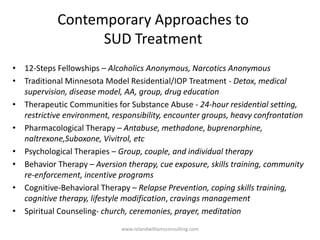
Contemporary Approaches to
SUD Treatment
• 12-Steps Fellowships – Alcoholics Anonymous, Narcotics Anonymous
• Traditional Minnesota Model Residential/IOP Treatment - Detox, medical
supervision, disease model, AA, group, drug education
• Therapeutic Communities for Substance Abuse - 24-hour residential setting,
restrictive environment, responsibility, encounter groups, heavy confrontation
• Pharmacological Therapy – Antabuse, methadone, buprenorphine,
naltrexone,Suboxone, Vivitrol, etc
• Psychological Therapies – Group, couple, and individual therapy
• Behavior Therapy – Aversion therapy, cue exposure, skills training, community
re-enforcement, incentive programs
• Cognitive-Behavioral Therapy – Relapse Prevention, coping skills training,
cognitive therapy, lifestyle modification, cravings management
• Spiritual Counseling- church, ceremonies, prayer, meditation
www.rolandwilliamsconsulting.com
Why Relapse Prevention?
• The primary goal of addictions treatment, as
in other areas of medicine, is to help the client
to achieve and maintain long-term remission
of the disease. In the addictions field there
has been continuing and growing concern
among clinicians about the rates of relapse in
the client population. For this reason, it is
important to understand the issue of relapse
and relapse prevention.
www.rolandwilliamsconsulting.com
What is a Relapse?
• To fall back or revert to a former state , regress after a
period of recovery from illness, to slip back to bad ways.
• A tendency to revert back to old self-defeating behavior.
• Relapse was initially viewed as use of alcohol, then
expanded to include the use of any sedatives. In the 1960’s
it was expanded to include use of any mind altering
substances.
• In the 1980’s relapse started to be viewed as a process, not
the event of drinking and drugging.
www.rolandwilliamsconsulting.com
Important Points about Relapse
• You can’t relapse if you’re not in recovery
• Is a process not an event
• Usually begins with something other than the
drug of choice
• Often is the result of something the addict is
not talking about
• Does not mean the person lost their recovery
• Can be studied and avoided
www.rolandwilliamsconsulting.com
What Contributes to Relapse?
• AFFECTIVE VARIABLES: + and – mood states have an impact on
relapse
• BEHAVIORAL VARIABLES: few effective ways to deal with situations
that threaten sobriety. There is a positive correlation between
abstinence and the acquisition of coping skills. Clients need to be
taught alternative coping skills to increase ability to manage high
risk situations.
• COGNITIVE VARIABLES: attitude towards addiction and recovery.
–Self-efficacy or the persons perception of his or her ability to cope with
prospective high risk situation.
–Outcome expectancy or anticipated effects of picking-up.
– Management strategies that determine whether a lapse will eventuate
into a full blown relapse.
–Decision making.
–Level of cognitive functioning.
–Learning differences.
–Head Trauma.
www.rolandwilliamsconsulting.com
ENVIRONMENTAL AND RELATIONSHIP VARIABLES:
 The lack of social and family stability.
 Primary relationships with people who are addicted. (partners)
 Social pressure to use.
 Major life changes.
 Lack of productive work, school roles, involvement in leisure or
recreational activities.
PHYSIOLOGICAL VARIABLES:
 craving and conditioned responses elicited by environmental cues.
 Brain chemistry.
 Diet, medications, illness or physical pain.
 Severity of dependence.
 H.A.L.T.
www.rolandwilliamsconsulting.com
PSYCHIATRIC VARIABLES:
 A second compulsive DO.
 PTSD-combat, rape, child sexual abuse, parental violence
 Coexisting psychiatric disorder.
SPIRITUAL VARIABLES:
 Self-centeredness
 Guilt
 Shame
 Lack of meaning for life
 Feeling empty.
www.rolandwilliamsconsulting.com
Family Influence
Family can provide an important and positive role in
recovery or family can sabotage recovery.
Relapse affects the family in several ways. The effects
are mediated by:
•The nature of relapse (length, severity,
medical/behavioral/legal and or economic problems it
causes).
•Family members’ perception of recovery and relapse,
and reason for relapse.
www.rolandwilliamsconsulting.com
The Counselor’s Role
• The counselors knowledge of addiction, recovery and
relapse are variables affecting the relapse process.
• Failure to thoroughly educate their clients about the
relapse process and ways to avoid it.
• Poor therapeutic relationship-not engaging the client,
canceling appointments.
• Negative feelings towards the client.
• Enabling-minimizing or buying into clients defenses.
• Failure to make an appropriate referral such as mental
health
www.rolandwilliamsconsulting.com
Effective Counseling Techniques for RPC
• Active listening
• Introduce and utilize the stress scale
• Bookmarking issues
• Using T.F.U.A’s
• Appropriate confrontation
• Encouragement
• Shame reduction
www.rolandwilliamsconsulting.com
STAGES OF CHANGE
• Pre-Contemplation
• Contemplation
• Preparation
• Action
• Maintenance
www.rolandwilliamsconsulting.com
Client Types
• Transitionary Client
– Resistant, adversarial, in denial
• Primary Client
– Motivated, seeks and wants help
• Relapse Prone Client
– Has recovery skills/knowledge but continues to
relapse
• Dual and Multiple Diagnosis Client
– Has mental health and/or physical illness in
addition to Substance Use Disorder
www.rolandwilliamsconsulting.com
Developmental Model of Addiction
• Experimentation: “I’ll give it a try”
• Social use: “I can take if or leave it, I have no problems”
• Situational Misuse: Drugs and alcohol “in certain
situations make me a better man”
• Problem Use: “I use to cope with everyday life issues, and
I’m starting to have problems as a result”
• Dependence: “I continue to use despite known negative
consequences, I experience loss of control, blackouts,
tolerance and withdrawal, and more and more problems”
www.rolandwilliamsconsulting.com
Factors Associated with Recovery
Positive factors:
• Social support networks
• Stable living situation
• Safe, structured environment
• Sense of purpose – job/hobbies
• Therapeutic discussion
• Practical help
• Insight & awareness
• Physical well-being
• Medication (maximum effectiveness,
minimal inconvenience and side-
effects
• Hope
Negative factors:
• Difficulties with any of the
positive factors
• Excessive stress
• Interpersonal conflict
• Process addictions
• Persistent symptoms
www.rolandwilliamsconsulting.com
Different Models of RPC
• Daley
• Marlatt
• Williams/Dumonte
• CBT
• Gorski
www.rolandwilliamsconsulting.com
The CENAPS Model of Relapse Prevention Planning
By Terrence Gorski
The CENAPS relapse process begins when the individual begins to become
dysfunctional in recovery and ends in chemical use.
Assumption of the CENAPS Model of relapse:
1. Recovery is the process of learning how to live a meaningful and comfortable life
without drugs.
2. Abstinence is a prerequisite for recovery.
3. Abstinence alone is insufficient for full recovery to occur.
4. The relapse progression begins long before the person starts using.
5. Relapse begins with internal and external dysfunction.
6. The dysfunction causes such severe pain and life problems that self-medication may
seem like a positive option. The client perceives four options: insanity, suicide,
physical collapse or self-medication.
7. Use is the last stop on the relapse progression.
8. The client is usually out of control before drug use begins.
www.rolandwilliamsconsulting.com
The CENAPS Model of Relapse Prevention Planning
By Terrence Gorski
Implications of the CENAPS Model
1. Treatment must focus on more than simply teaching the client how not to use.
2. The long term task of recovery needs to be explained to the client so that he has a
road map to recovery.
3. Treatments needs to follow client over a long term continuum of recovery, for a
minimum of 3 to 5 years and it must be easily accessible to client who gets stuck at
some point in the recovery process.
4. People in recovery must learn to recognize and manage early warning signs.
5. Relapse needs to be viewed as a normal and natural part of recovery.
6. Specialized relapse prevention techniques needs to be developed for client
rethreads that have been unable to maintain abstinence.
www.rolandwilliamsconsulting.com
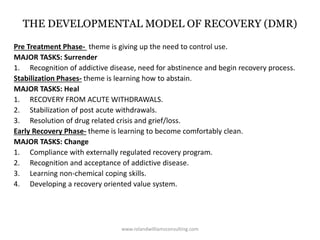
THE DEVELOPMENTAL MODEL OF RECOVERY (DMR)
Pre Treatment Phase- theme is giving up the need to control use.
MAJOR TASKS: Surrender
1. Recognition of addictive disease, need for abstinence and begin recovery process.
Stabilization Phases- theme is learning how to abstain.
MAJOR TASKS: Heal
1. RECOVERY FROM ACUTE WITHDRAWALS.
2. Stabilization of post acute withdrawals.
3. Resolution of drug related crisis and grief/loss.
Early Recovery Phase- theme is learning to become comfortably clean.
MAJOR TASKS: Change
1. Compliance with externally regulated recovery program.
2. Recognition and acceptance of addictive disease.
3. Learning non-chemical coping skills.
4. Developing a recovery oriented value system.
www.rolandwilliamsconsulting.com
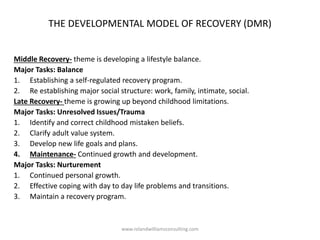
THE DEVELOPMENTAL MODEL OF RECOVERY (DMR)
Middle Recovery- theme is developing a lifestyle balance.
Major Tasks: Balance
1. Establishing a self-regulated recovery program.
2. Re establishing major social structure: work, family, intimate, social.
Late Recovery- theme is growing up beyond childhood limitations.
Major Tasks: Unresolved Issues/Trauma
1. Identify and correct childhood mistaken beliefs.
2. Clarify adult value system.
3. Develop new life goals and plans.
4. Maintenance- Continued growth and development.
Major Tasks: Nurturement
1. Continued personal growth.
2. Effective coping with day to day life problems and transitions.
3. Maintain a recovery program.
www.rolandwilliamsconsulting.com
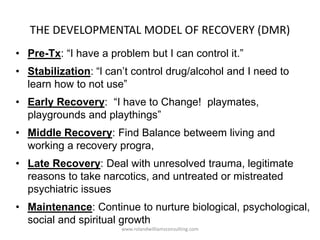
THE DEVELOPMENTAL MODEL OF RECOVERY (DMR)
• Pre-Tx: “I have a problem but I can control it.”
• Stabilization: “l can’t control drug/alcohol and I need to
learn how to not use”
• Early Recovery: “I have to Change! playmates,
playgrounds and playthings”
• Middle Recovery: Find Balance betweem living and
working a recovery progra,
• Late Recovery: Deal with unresolved trauma, legitimate
reasons to take narcotics, and untreated or mistreated
psychiatric issues
• Maintenance: Continue to nurture biological, psychological,
social and spiritual growth
www.rolandwilliamsconsulting.com
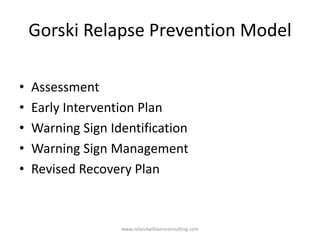
Gorski Relapse Prevention Model
• Assessment
• Early Intervention Plan
• Warning Sign Identification
• Warning Sign Management
• Revised Recovery Plan
www.rolandwilliamsconsulting.com
Early Intervention Planning
• What will it look like when you start to bail out
of the treatment process?
• What can I do to reel you back in?
• Who should I call?
• Do you have any high risk situations coming
up in the next 6 weeks?
• Letter writing from sober self to _________
www.rolandwilliamsconsulting.com
CENAPS RELAPSE PREVENTION PLAN
This model incorporates a nine step process.
1. Stabilization: bring relapser back to detox. Identify and manage PAW
2. Assessment: of the presenting problems, current relapse dynamic, relapse
history, levels of treatment completed, unresolved DMR issues, factors
effecting recovery and personality style.
3. Relapse education: recovery process, warning signs and understand relapse
patterns.
4. Warning sign identification: construct individualized list.
5. Warning sign management: teach client to interrupt the dynamic, develop
three strategies for each warning sign.
6. Review Recovery Program: address problems that surfaced during
assessment, client may need more meetings, a sponsor or therapy.
www.rolandwilliamsconsulting.com
CENAPS RELAPSE PREVENTION PLAN
7. Inventory training: Gorski recommends two daily inventory procedures. First
establish a morning routine of outlining a plan for the day. Secondly, in the
evening, review the tasks of the day to see what went well and what needs
improvement.
8. Involvement of significant others: assess key players.(Significant others)
request what he would like from invited intervenors.
9. Follow-up: up date relapse prevention plan as needed.
www.rolandwilliamsconsulting.com
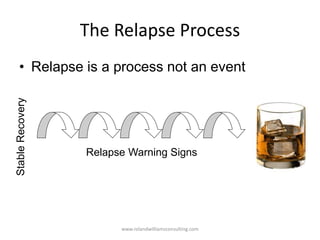
The Relapse Process
• Relapse is a process not an event
Relapse Warning Signs
StableRecovery
www.rolandwilliamsconsulting.com
DEFINING RECOVERY
• Recovery is a process, not an event
• Most people who try to get clean fail
• Recovery is difficult
• Recovery is
– Biological
– Psychological
– Social
– Spiritual
• Recovery is “taking good care of yourself”
www.rolandwilliamsconsulting.com
Sentence Completion Exercise
I know my Recovery is in trouble when I….
1.
2.
3.
4.
5.
6.
7.
8.
9.
10. www.rolandwilliamsconsulting.com
Warning SignTitle: Superman
• Description
– I know my recovery is in trouble when I: Say
Yes to everything
• When I experience this warning sign:
– I tend to think: I’m the only one who can do it
– I tend to feel: Pressured and Powerful
– I have an urge to: Fix it
– What I usually do is: Bite off more than I can
chew and get overwhelmed
www.rolandwilliamsconsulting.com
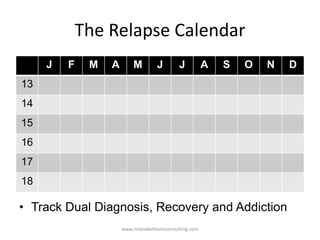
The Relapse Calendar
J F M A M J J A S O N D
13
14
15
16
17
18
• Track Dual Diagnosis, Recovery and Addiction
www.rolandwilliamsconsulting.com
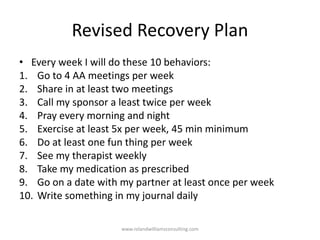
Revised Recovery Plan
• Every week I will do these 10 behaviors:
1. Go to 4 AA meetings per week
2. Share in at least two meetings
3. Call my sponsor a least twice per week
4. Pray every morning and night
5. Exercise at least 5x per week, 45 min minimum
6. Do at least one fun thing per week
7. See my therapist weekly
8. Take my medication as prescribed
9. Go on a date with my partner at least once per week
10. Write something in my journal daily
www.rolandwilliamsconsulting.com
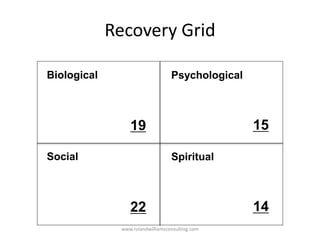
Recovery Grid
Biological Psychological
19 15
Social Spiritual
22 14
www.rolandwilliamsconsulting.com
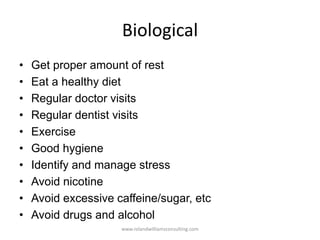
Biological
• Get proper amount of rest
• Eat a healthy diet
• Regular doctor visits
• Regular dentist visits
• Exercise
• Good hygiene
• Identify and manage stress
• Avoid nicotine
• Avoid excessive caffeine/sugar, etc
• Avoid drugs and alcohol
www.rolandwilliamsconsulting.com
Psychological
• See a therapist
• Follow therapists advice
• Identify, express and manage feelings
• Identify and manage stress
• Identify and work on core issues
• Intellectual challenge
• Avoid negativity
• Develop a sense of purpose and meaning
• Recognize cognitive distortions
• Have good self esteem
www.rolandwilliamsconsulting.com
Social
• Willing and able to be in a healthy romantic relationship
• Partner is willing and able to be in a healthy relationship
• Able to love and trust others
• Able to be lovable and trustworthy
• Working with mentor
• Having fun
• Sober Support System
• Healthy family relationships
• Giving something back to society
• Relationship with self
• Positive friends
• Work life is fulfilling
www.rolandwilliamsconsulting.com
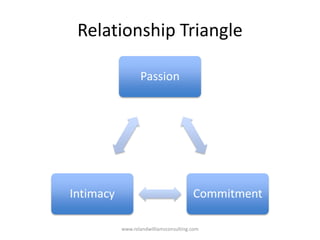
Relationship Triangle
Passion
CommitmentIntimacy
www.rolandwilliamsconsulting.com
Spiritual
• Prayer
• Meditation
• Reading Spiritual literature
• Fellowship w/ Spiritual people
• Attending Spiritual services
• Morals, values and integrity
• Honesty in all your affairs
• Practice humility
• Communing with nature
• Donating time and money
www.rolandwilliamsconsulting.com
CENAPS UTILIZES COGNITIVE
BEHAIORAL THERAPY FOR RELAPSE
PREVENTION COUNSELING
www.rolandwilliamsconsulting.com
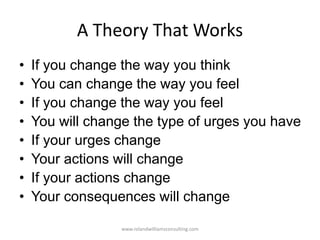
A Theory That Works
• If you change the way you think
• You can change the way you feel
• If you change the way you feel
• You will change the type of urges you have
• If your urges change
• Your actions will change
• If your actions change
• Your consequences will change
www.rolandwilliamsconsulting.com
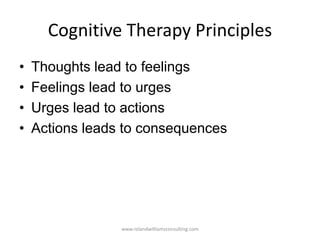
Cognitive Therapy Principles
• Thoughts lead to feelings
• Feelings lead to urges
• Urges lead to actions
• Actions leads to consequences
www.rolandwilliamsconsulting.com
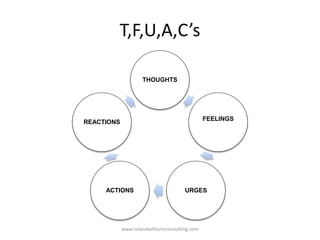
T,F,U,A,C’s
THOUGHTS
FEELINGS
URGESACTIONS
REACTIONS
www.rolandwilliamsconsulting.com
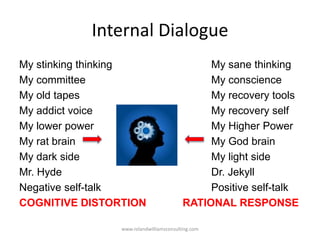
Internal Dialogue
My stinking thinking My sane thinking
My committee My conscience
My old tapes My recovery tools
My addict voice My recovery self
My lower power My Higher Power
My rat brain My God brain
My dark side My light side
Mr. Hyde Dr. Jekyll
Negative self-talk Positive self-talk
COGNITIVE DISTORTION RATIONAL RESPONSE
www.rolandwilliamsconsulting.com
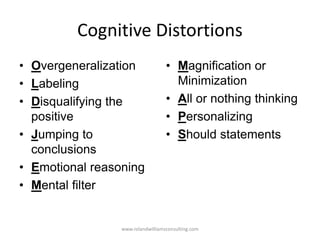
Cognitive Distortions
• Overgeneralization
• Labeling
• Disqualifying the
positive
• Jumping to
conclusions
• Emotional reasoning
• Mental filter
• Magnification or
Minimization
• All or nothing thinking
• Personalizing
• Should statements
www.rolandwilliamsconsulting.com
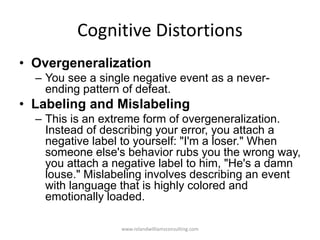
Cognitive Distortions
• Overgeneralization
– You see a single negative event as a never-
ending pattern of defeat.
• Labeling and Mislabeling
– This is an extreme form of overgeneralization.
Instead of describing your error, you attach a
negative label to yourself: "I'm a loser." When
someone else's behavior rubs you the wrong way,
you attach a negative label to him, "He's a damn
louse." Mislabeling involves describing an event
with language that is highly colored and
emotionally loaded.
www.rolandwilliamsconsulting.com
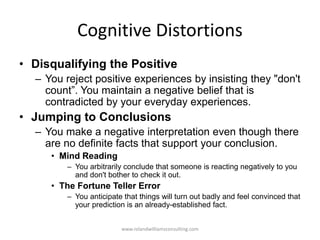
Cognitive Distortions
• Disqualifying the Positive
– You reject positive experiences by insisting they "don't
count”. You maintain a negative belief that is
contradicted by your everyday experiences.
• Jumping to Conclusions
– You make a negative interpretation even though there
are no definite facts that support your conclusion.
• Mind Reading
– You arbitrarily conclude that someone is reacting negatively to you
and don't bother to check it out.
• The Fortune Teller Error
– You anticipate that things will turn out badly and feel convinced that
your prediction is an already-established fact.
www.rolandwilliamsconsulting.com
Cognitive Distortions
• Emotional Reasoning
– You assume that your negative emotions
necessarily reflect the way things really are: "I feel
it, therefore it must be true.”
• Mental Filter
– You pick out a single negative detail and dwell on
it exclusively so that your vision of all reality
becomes darkened, like the drop of ink that
discolors the entire beaker of water.
www.rolandwilliamsconsulting.com
Cognitive Distortions
• Magnification (Catastrophizing) or
Minimization
– You exaggerate the importance of things (such as
your goof-up or someone else's achievement), or
you inappropriately shrink things until they appear
tiny (your own desirable qualities or the other
fellow's imperfections). This is also called the
"binocular trick.”
• All-or-Nothing Thinking
– You see things in black and white categories. If
your performance falls short of perfect, you see
yourself as a total failure.
www.rolandwilliamsconsulting.com
Cognitive Distortions
• Personalization
– You see yourself as the cause of some negative
external event for which, in fact, you were not
primarily responsible.
• Should Statements
– You try to motivate yourself with shoulds and
shouldn’t, as if you had to be whipped and punished
before you could be expected to do anything. "Musts"
and "oughts" are also offenders. The emotional
consequence is guilt. When you direct should
statements toward others, you feel anger, frustration,
and resentment.
www.rolandwilliamsconsulting.com
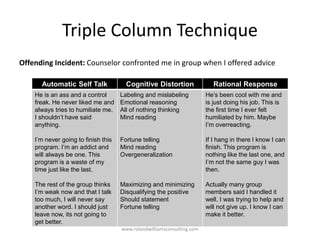
Triple Column Technique
Offending Incident: Counselor confronted me in group when I offered advice
Automatic Self Talk Cognitive Distortion Rational Response
He is an ass and a control
freak. He never liked me and
always tries to humiliate me.
I shouldn’t have said
anything.
I’m never going to finish this
program. I’m an addict and
will always be one. This
program is a waste of my
time just like the last.
The rest of the group thinks
I’m weak now and that I talk
too much, I will never say
another word. I should just
leave now, its not going to
get better.
Labeling and mislabeling
Emotional reasoning
All of nothing thinking
Mind reading
Fortune telling
Mind reading
Overgeneralization
Maximizing and minimizing
Disqualifying the positive
Should statement
Fortune telling
He’s been cool with me and
is just doing his job. This is
the first time I ever felt
humiliated by him. Maybe
I’m overreacting.
If I hang in there I know I can
finish. This program is
nothing like the last one, and
I’m not the same guy I was
then.
Actually many group
members said I handled it
well. I was trying to help and
will not give up. I know I can
make it better.
www.rolandwilliamsconsulting.com
Closure
• What stood out for you the most about this
training?
• What if anything are you going to do
differently?
Thank You !
www.rolandwilliamsconsulting.com

Relapse Prevention Counseling Strategies for SUD Clients

  • 1.
    Relapse Prevention Counseling Strategiesfor SUD Clients Presented by: Lawrence T. Pender, ACRPS Senior CENAPS Trainer www.rolandwilliamsconsulting.com
  • 2.
    The Biggest RelapseWarning Sign of All... • Addicts overestimate their recovery and underestimate the power of their addiction. – Roland Williams www.rolandwilliamsconsulting.com
  • 3.
    Effective Clinicians • Youwill be effective if the client walks away from the session feeling: – You care about them, and….. – You know what you’re talking about “Nobody cares how much you know until they know how much you care”… Theodore Roosevelt www.rolandwilliamsconsulting.com
  • 4.
    Contemporary Approaches to SUDTreatment • 12-Steps Fellowships – Alcoholics Anonymous, Narcotics Anonymous • Traditional Minnesota Model Residential/IOP Treatment - Detox, medical supervision, disease model, AA, group, drug education • Therapeutic Communities for Substance Abuse - 24-hour residential setting, restrictive environment, responsibility, encounter groups, heavy confrontation • Pharmacological Therapy – Antabuse, methadone, buprenorphine, naltrexone,Suboxone, Vivitrol, etc • Psychological Therapies – Group, couple, and individual therapy • Behavior Therapy – Aversion therapy, cue exposure, skills training, community re-enforcement, incentive programs • Cognitive-Behavioral Therapy – Relapse Prevention, coping skills training, cognitive therapy, lifestyle modification, cravings management • Spiritual Counseling- church, ceremonies, prayer, meditation www.rolandwilliamsconsulting.com
  • 5.
    Why Relapse Prevention? •The primary goal of addictions treatment, as in other areas of medicine, is to help the client to achieve and maintain long-term remission of the disease. In the addictions field there has been continuing and growing concern among clinicians about the rates of relapse in the client population. For this reason, it is important to understand the issue of relapse and relapse prevention. www.rolandwilliamsconsulting.com
  • 6.
    What is aRelapse? • To fall back or revert to a former state , regress after a period of recovery from illness, to slip back to bad ways. • A tendency to revert back to old self-defeating behavior. • Relapse was initially viewed as use of alcohol, then expanded to include the use of any sedatives. In the 1960’s it was expanded to include use of any mind altering substances. • In the 1980’s relapse started to be viewed as a process, not the event of drinking and drugging. www.rolandwilliamsconsulting.com
  • 7.
    Important Points aboutRelapse • You can’t relapse if you’re not in recovery • Is a process not an event • Usually begins with something other than the drug of choice • Often is the result of something the addict is not talking about • Does not mean the person lost their recovery • Can be studied and avoided www.rolandwilliamsconsulting.com
  • 8.
    What Contributes toRelapse? • AFFECTIVE VARIABLES: + and – mood states have an impact on relapse • BEHAVIORAL VARIABLES: few effective ways to deal with situations that threaten sobriety. There is a positive correlation between abstinence and the acquisition of coping skills. Clients need to be taught alternative coping skills to increase ability to manage high risk situations. • COGNITIVE VARIABLES: attitude towards addiction and recovery. –Self-efficacy or the persons perception of his or her ability to cope with prospective high risk situation. –Outcome expectancy or anticipated effects of picking-up. – Management strategies that determine whether a lapse will eventuate into a full blown relapse. –Decision making. –Level of cognitive functioning. –Learning differences. –Head Trauma. www.rolandwilliamsconsulting.com
  • 9.
    ENVIRONMENTAL AND RELATIONSHIPVARIABLES:  The lack of social and family stability.  Primary relationships with people who are addicted. (partners)  Social pressure to use.  Major life changes.  Lack of productive work, school roles, involvement in leisure or recreational activities. PHYSIOLOGICAL VARIABLES:  craving and conditioned responses elicited by environmental cues.  Brain chemistry.  Diet, medications, illness or physical pain.  Severity of dependence.  H.A.L.T. www.rolandwilliamsconsulting.com
  • 10.
    PSYCHIATRIC VARIABLES:  Asecond compulsive DO.  PTSD-combat, rape, child sexual abuse, parental violence  Coexisting psychiatric disorder. SPIRITUAL VARIABLES:  Self-centeredness  Guilt  Shame  Lack of meaning for life  Feeling empty. www.rolandwilliamsconsulting.com
  • 11.
    Family Influence Family canprovide an important and positive role in recovery or family can sabotage recovery. Relapse affects the family in several ways. The effects are mediated by: •The nature of relapse (length, severity, medical/behavioral/legal and or economic problems it causes). •Family members’ perception of recovery and relapse, and reason for relapse. www.rolandwilliamsconsulting.com
  • 12.
    The Counselor’s Role •The counselors knowledge of addiction, recovery and relapse are variables affecting the relapse process. • Failure to thoroughly educate their clients about the relapse process and ways to avoid it. • Poor therapeutic relationship-not engaging the client, canceling appointments. • Negative feelings towards the client. • Enabling-minimizing or buying into clients defenses. • Failure to make an appropriate referral such as mental health www.rolandwilliamsconsulting.com
  • 13.
    Effective Counseling Techniquesfor RPC • Active listening • Introduce and utilize the stress scale • Bookmarking issues • Using T.F.U.A’s • Appropriate confrontation • Encouragement • Shame reduction www.rolandwilliamsconsulting.com
  • 14.
    STAGES OF CHANGE •Pre-Contemplation • Contemplation • Preparation • Action • Maintenance www.rolandwilliamsconsulting.com
  • 15.
    Client Types • TransitionaryClient – Resistant, adversarial, in denial • Primary Client – Motivated, seeks and wants help • Relapse Prone Client – Has recovery skills/knowledge but continues to relapse • Dual and Multiple Diagnosis Client – Has mental health and/or physical illness in addition to Substance Use Disorder www.rolandwilliamsconsulting.com
  • 16.
    Developmental Model ofAddiction • Experimentation: “I’ll give it a try” • Social use: “I can take if or leave it, I have no problems” • Situational Misuse: Drugs and alcohol “in certain situations make me a better man” • Problem Use: “I use to cope with everyday life issues, and I’m starting to have problems as a result” • Dependence: “I continue to use despite known negative consequences, I experience loss of control, blackouts, tolerance and withdrawal, and more and more problems” www.rolandwilliamsconsulting.com
  • 17.
    Factors Associated withRecovery Positive factors: • Social support networks • Stable living situation • Safe, structured environment • Sense of purpose – job/hobbies • Therapeutic discussion • Practical help • Insight & awareness • Physical well-being • Medication (maximum effectiveness, minimal inconvenience and side- effects • Hope Negative factors: • Difficulties with any of the positive factors • Excessive stress • Interpersonal conflict • Process addictions • Persistent symptoms www.rolandwilliamsconsulting.com
  • 18.
    Different Models ofRPC • Daley • Marlatt • Williams/Dumonte • CBT • Gorski www.rolandwilliamsconsulting.com
  • 19.
    The CENAPS Modelof Relapse Prevention Planning By Terrence Gorski The CENAPS relapse process begins when the individual begins to become dysfunctional in recovery and ends in chemical use. Assumption of the CENAPS Model of relapse: 1. Recovery is the process of learning how to live a meaningful and comfortable life without drugs. 2. Abstinence is a prerequisite for recovery. 3. Abstinence alone is insufficient for full recovery to occur. 4. The relapse progression begins long before the person starts using. 5. Relapse begins with internal and external dysfunction. 6. The dysfunction causes such severe pain and life problems that self-medication may seem like a positive option. The client perceives four options: insanity, suicide, physical collapse or self-medication. 7. Use is the last stop on the relapse progression. 8. The client is usually out of control before drug use begins. www.rolandwilliamsconsulting.com
  • 20.
    The CENAPS Modelof Relapse Prevention Planning By Terrence Gorski Implications of the CENAPS Model 1. Treatment must focus on more than simply teaching the client how not to use. 2. The long term task of recovery needs to be explained to the client so that he has a road map to recovery. 3. Treatments needs to follow client over a long term continuum of recovery, for a minimum of 3 to 5 years and it must be easily accessible to client who gets stuck at some point in the recovery process. 4. People in recovery must learn to recognize and manage early warning signs. 5. Relapse needs to be viewed as a normal and natural part of recovery. 6. Specialized relapse prevention techniques needs to be developed for client rethreads that have been unable to maintain abstinence. www.rolandwilliamsconsulting.com
  • 21.
    THE DEVELOPMENTAL MODELOF RECOVERY (DMR) Pre Treatment Phase- theme is giving up the need to control use. MAJOR TASKS: Surrender 1. Recognition of addictive disease, need for abstinence and begin recovery process. Stabilization Phases- theme is learning how to abstain. MAJOR TASKS: Heal 1. RECOVERY FROM ACUTE WITHDRAWALS. 2. Stabilization of post acute withdrawals. 3. Resolution of drug related crisis and grief/loss. Early Recovery Phase- theme is learning to become comfortably clean. MAJOR TASKS: Change 1. Compliance with externally regulated recovery program. 2. Recognition and acceptance of addictive disease. 3. Learning non-chemical coping skills. 4. Developing a recovery oriented value system. www.rolandwilliamsconsulting.com
  • 22.
    THE DEVELOPMENTAL MODELOF RECOVERY (DMR) Middle Recovery- theme is developing a lifestyle balance. Major Tasks: Balance 1. Establishing a self-regulated recovery program. 2. Re establishing major social structure: work, family, intimate, social. Late Recovery- theme is growing up beyond childhood limitations. Major Tasks: Unresolved Issues/Trauma 1. Identify and correct childhood mistaken beliefs. 2. Clarify adult value system. 3. Develop new life goals and plans. 4. Maintenance- Continued growth and development. Major Tasks: Nurturement 1. Continued personal growth. 2. Effective coping with day to day life problems and transitions. 3. Maintain a recovery program. www.rolandwilliamsconsulting.com
  • 23.
    THE DEVELOPMENTAL MODELOF RECOVERY (DMR) • Pre-Tx: “I have a problem but I can control it.” • Stabilization: “l can’t control drug/alcohol and I need to learn how to not use” • Early Recovery: “I have to Change! playmates, playgrounds and playthings” • Middle Recovery: Find Balance betweem living and working a recovery progra, • Late Recovery: Deal with unresolved trauma, legitimate reasons to take narcotics, and untreated or mistreated psychiatric issues • Maintenance: Continue to nurture biological, psychological, social and spiritual growth www.rolandwilliamsconsulting.com
  • 24.
    Gorski Relapse PreventionModel • Assessment • Early Intervention Plan • Warning Sign Identification • Warning Sign Management • Revised Recovery Plan www.rolandwilliamsconsulting.com
  • 25.
    Early Intervention Planning •What will it look like when you start to bail out of the treatment process? • What can I do to reel you back in? • Who should I call? • Do you have any high risk situations coming up in the next 6 weeks? • Letter writing from sober self to _________ www.rolandwilliamsconsulting.com
  • 26.
    CENAPS RELAPSE PREVENTIONPLAN This model incorporates a nine step process. 1. Stabilization: bring relapser back to detox. Identify and manage PAW 2. Assessment: of the presenting problems, current relapse dynamic, relapse history, levels of treatment completed, unresolved DMR issues, factors effecting recovery and personality style. 3. Relapse education: recovery process, warning signs and understand relapse patterns. 4. Warning sign identification: construct individualized list. 5. Warning sign management: teach client to interrupt the dynamic, develop three strategies for each warning sign. 6. Review Recovery Program: address problems that surfaced during assessment, client may need more meetings, a sponsor or therapy. www.rolandwilliamsconsulting.com
  • 27.
    CENAPS RELAPSE PREVENTIONPLAN 7. Inventory training: Gorski recommends two daily inventory procedures. First establish a morning routine of outlining a plan for the day. Secondly, in the evening, review the tasks of the day to see what went well and what needs improvement. 8. Involvement of significant others: assess key players.(Significant others) request what he would like from invited intervenors. 9. Follow-up: up date relapse prevention plan as needed. www.rolandwilliamsconsulting.com
  • 28.
    The Relapse Process •Relapse is a process not an event Relapse Warning Signs StableRecovery www.rolandwilliamsconsulting.com
  • 29.
    DEFINING RECOVERY • Recoveryis a process, not an event • Most people who try to get clean fail • Recovery is difficult • Recovery is – Biological – Psychological – Social – Spiritual • Recovery is “taking good care of yourself” www.rolandwilliamsconsulting.com
  • 30.
    Sentence Completion Exercise Iknow my Recovery is in trouble when I…. 1. 2. 3. 4. 5. 6. 7. 8. 9. 10. www.rolandwilliamsconsulting.com
  • 31.
    Warning SignTitle: Superman •Description – I know my recovery is in trouble when I: Say Yes to everything • When I experience this warning sign: – I tend to think: I’m the only one who can do it – I tend to feel: Pressured and Powerful – I have an urge to: Fix it – What I usually do is: Bite off more than I can chew and get overwhelmed www.rolandwilliamsconsulting.com
  • 32.
    The Relapse Calendar JF M A M J J A S O N D 13 14 15 16 17 18 • Track Dual Diagnosis, Recovery and Addiction www.rolandwilliamsconsulting.com
  • 33.
    Revised Recovery Plan •Every week I will do these 10 behaviors: 1. Go to 4 AA meetings per week 2. Share in at least two meetings 3. Call my sponsor a least twice per week 4. Pray every morning and night 5. Exercise at least 5x per week, 45 min minimum 6. Do at least one fun thing per week 7. See my therapist weekly 8. Take my medication as prescribed 9. Go on a date with my partner at least once per week 10. Write something in my journal daily www.rolandwilliamsconsulting.com
  • 34.
    Recovery Grid Biological Psychological 1915 Social Spiritual 22 14 www.rolandwilliamsconsulting.com
  • 35.
    Biological • Get properamount of rest • Eat a healthy diet • Regular doctor visits • Regular dentist visits • Exercise • Good hygiene • Identify and manage stress • Avoid nicotine • Avoid excessive caffeine/sugar, etc • Avoid drugs and alcohol www.rolandwilliamsconsulting.com
  • 36.
    Psychological • See atherapist • Follow therapists advice • Identify, express and manage feelings • Identify and manage stress • Identify and work on core issues • Intellectual challenge • Avoid negativity • Develop a sense of purpose and meaning • Recognize cognitive distortions • Have good self esteem www.rolandwilliamsconsulting.com
  • 37.
    Social • Willing andable to be in a healthy romantic relationship • Partner is willing and able to be in a healthy relationship • Able to love and trust others • Able to be lovable and trustworthy • Working with mentor • Having fun • Sober Support System • Healthy family relationships • Giving something back to society • Relationship with self • Positive friends • Work life is fulfilling www.rolandwilliamsconsulting.com
  • 38.
  • 39.
    Spiritual • Prayer • Meditation •Reading Spiritual literature • Fellowship w/ Spiritual people • Attending Spiritual services • Morals, values and integrity • Honesty in all your affairs • Practice humility • Communing with nature • Donating time and money www.rolandwilliamsconsulting.com
  • 40.
    CENAPS UTILIZES COGNITIVE BEHAIORALTHERAPY FOR RELAPSE PREVENTION COUNSELING www.rolandwilliamsconsulting.com
  • 41.
    A Theory ThatWorks • If you change the way you think • You can change the way you feel • If you change the way you feel • You will change the type of urges you have • If your urges change • Your actions will change • If your actions change • Your consequences will change www.rolandwilliamsconsulting.com
  • 42.
    Cognitive Therapy Principles •Thoughts lead to feelings • Feelings lead to urges • Urges lead to actions • Actions leads to consequences www.rolandwilliamsconsulting.com
  • 43.
  • 44.
    Internal Dialogue My stinkingthinking My sane thinking My committee My conscience My old tapes My recovery tools My addict voice My recovery self My lower power My Higher Power My rat brain My God brain My dark side My light side Mr. Hyde Dr. Jekyll Negative self-talk Positive self-talk COGNITIVE DISTORTION RATIONAL RESPONSE www.rolandwilliamsconsulting.com
  • 45.
    Cognitive Distortions • Overgeneralization •Labeling • Disqualifying the positive • Jumping to conclusions • Emotional reasoning • Mental filter • Magnification or Minimization • All or nothing thinking • Personalizing • Should statements www.rolandwilliamsconsulting.com
  • 46.
    Cognitive Distortions • Overgeneralization –You see a single negative event as a never- ending pattern of defeat. • Labeling and Mislabeling – This is an extreme form of overgeneralization. Instead of describing your error, you attach a negative label to yourself: "I'm a loser." When someone else's behavior rubs you the wrong way, you attach a negative label to him, "He's a damn louse." Mislabeling involves describing an event with language that is highly colored and emotionally loaded. www.rolandwilliamsconsulting.com
  • 47.
    Cognitive Distortions • Disqualifyingthe Positive – You reject positive experiences by insisting they "don't count”. You maintain a negative belief that is contradicted by your everyday experiences. • Jumping to Conclusions – You make a negative interpretation even though there are no definite facts that support your conclusion. • Mind Reading – You arbitrarily conclude that someone is reacting negatively to you and don't bother to check it out. • The Fortune Teller Error – You anticipate that things will turn out badly and feel convinced that your prediction is an already-established fact. www.rolandwilliamsconsulting.com
  • 48.
    Cognitive Distortions • EmotionalReasoning – You assume that your negative emotions necessarily reflect the way things really are: "I feel it, therefore it must be true.” • Mental Filter – You pick out a single negative detail and dwell on it exclusively so that your vision of all reality becomes darkened, like the drop of ink that discolors the entire beaker of water. www.rolandwilliamsconsulting.com
  • 49.
    Cognitive Distortions • Magnification(Catastrophizing) or Minimization – You exaggerate the importance of things (such as your goof-up or someone else's achievement), or you inappropriately shrink things until they appear tiny (your own desirable qualities or the other fellow's imperfections). This is also called the "binocular trick.” • All-or-Nothing Thinking – You see things in black and white categories. If your performance falls short of perfect, you see yourself as a total failure. www.rolandwilliamsconsulting.com
  • 50.
    Cognitive Distortions • Personalization –You see yourself as the cause of some negative external event for which, in fact, you were not primarily responsible. • Should Statements – You try to motivate yourself with shoulds and shouldn’t, as if you had to be whipped and punished before you could be expected to do anything. "Musts" and "oughts" are also offenders. The emotional consequence is guilt. When you direct should statements toward others, you feel anger, frustration, and resentment. www.rolandwilliamsconsulting.com
  • 51.
    Triple Column Technique OffendingIncident: Counselor confronted me in group when I offered advice Automatic Self Talk Cognitive Distortion Rational Response He is an ass and a control freak. He never liked me and always tries to humiliate me. I shouldn’t have said anything. I’m never going to finish this program. I’m an addict and will always be one. This program is a waste of my time just like the last. The rest of the group thinks I’m weak now and that I talk too much, I will never say another word. I should just leave now, its not going to get better. Labeling and mislabeling Emotional reasoning All of nothing thinking Mind reading Fortune telling Mind reading Overgeneralization Maximizing and minimizing Disqualifying the positive Should statement Fortune telling He’s been cool with me and is just doing his job. This is the first time I ever felt humiliated by him. Maybe I’m overreacting. If I hang in there I know I can finish. This program is nothing like the last one, and I’m not the same guy I was then. Actually many group members said I handled it well. I was trying to help and will not give up. I know I can make it better. www.rolandwilliamsconsulting.com
  • 52.
    Closure • What stoodout for you the most about this training? • What if anything are you going to do differently? Thank You ! www.rolandwilliamsconsulting.com