Relapse Prevention
Dr. Dawn-Elise Snipes PhD, LPC-MHSP, LMHC, NCC
Executive Director AllCEUs
Objectives
 Define relapse in terms of addiction as well as mental
health
 Examine relapse prevention techniques
 Explore needs of the person: Psychosocial and Maslovian
What is Relapse
 Relapse is the return to addictive behaviors or the
recurrence of mood disorders
 Relapse often starts long before the person uses again
 Get caught up in day-in-day-out
 Start acting “mindlessly”
 Stop going to meetings/counseling/church/lifeline
 Begins running out of energy to do new behaviors
 Frustration, irritability and exhaustion set in
 Caveat…an extreme stressor can prompt “immediate
relapse”
Extreme Stressors
 Those things that overwhelm an individuals ability to
cope
 Thrust them into the fight or flight
 New coping skills and support resources may not even be
considered, or only half-heartedly
 Have clients identify or practice dealing with these types
of situations in group
 Divorce
 Death
 Job Loss
 Diagnosis of a terminal or chronic illness (Cancer, ALS, HIV)
Beginner Tools for Extreme Stress
 Get support… You are outnumbered!
 Self-soothing/De-Escalation
 Systematic Desensitization
 Cognitive Behavioral Therapy
 CPT Note Card
 I feel… because ……
 What am I upset about
 What are the FACTS for and against this belief
 Am I using all or nothing thinking or jumping to conclusions
 I need to call _______ to get an objective perspective or
what would _____ do
Psychosocial Needs
 Represent tasks that must be accomplished or needs that must
be met as the people grow up
 These tasks help people learn self-control, confidence and
esteem
 Problems in achieving these tasks/needs can lead to problems
in development
 Problems later in life may cause people to question their
earlier conclusions
 These tasks are not linear and final
 Part of the treatment process is helping people learn how to
“parent” themselves.
 Clinicians initially take the part of the parental figure
modeling how to resolve issues
Psychosocial Needs
 Trust vs. Mistrust
 If people receive consistent, predictable and reliable care,
they will develop a sense of trust/faith in themselves and
others
 They will be able to feel secure even when threatened.
 This leads to developing hope that as new crises arise,
there is a real possibility that other people will be there
are a source of support, they have the strength to endure
and their intuition is correct.
 I can trust myself (thoughts, intuition)
 I can trust those around me
 Example: Child abuse survivor
Psychosocial Needs
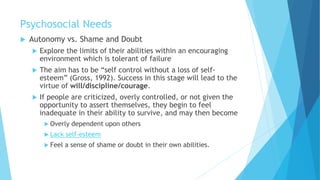
 Autonomy vs. Shame and Doubt
 Explore the limits of their abilities within an encouraging
environment which is tolerant of failure
 The aim has to be “self control without a loss of self-
esteem” (Gross, 1992). Success in this stage will lead to the
virtue of will/discipline/courage.
 If people are criticized, overly controlled, or not given the
opportunity to assert themselves, they begin to feel
inadequate in their ability to survive, and may then become
 Overly dependent upon others
 Lack self-esteem
 Feel a sense of shame or doubt in their own abilities.
Psychosocial Needs
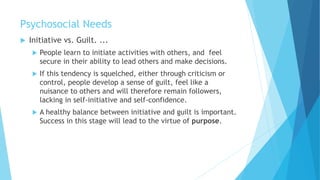
 Initiative vs. Guilt. ...
 People learn to initiate activities with others, and feel
secure in their ability to lead others and make decisions.
 If this tendency is squelched, either through criticism or
control, people develop a sense of guilt, feel like a
nuisance to others and will therefore remain followers,
lacking in self-initiative and self-confidence.
 A healthy balance between initiative and guilt is important.
Success in this stage will lead to the virtue of purpose.
Psychosocial Needs
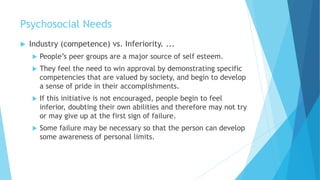
 Industry (competence) vs. Inferiority. ...
 People’s peer groups are a major source of self esteem.
 They feel the need to win approval by demonstrating specific
competencies that are valued by society, and begin to develop
a sense of pride in their accomplishments.
 If this initiative is not encouraged, people begin to feel
inferior, doubting their own abilities and therefore may not try
or may give up at the first sign of failure.
 Some failure may be necessary so that the person can develop
some awareness of personal limits.
Psychosocial Needs
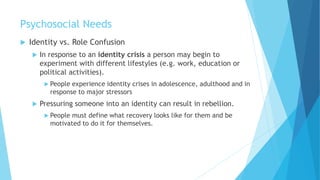
 Identity vs. Role Confusion
 In response to an identity crisis a person may begin to
experiment with different lifestyles (e.g. work, education or
political activities).
 People experience identity crises in adolescence, adulthood and in
response to major stressors
 Pressuring someone into an identity can result in rebellion.
 People must define what recovery looks like for them and be
motivated to do it for themselves.
Psychosocial Needs
 Intimacy vs. Isolation
 Sharing of ourselves and being accepted and loved for who we
are
 Successful in this stage can lead to a sense of commitment,
safety, and care within a relationship.
 Avoiding intimacy, fearing commitment and relationships can
lead to isolation, loneliness, and sometimes depression.
 Exploring past relationships is often a task for therapy
 Relapse prevention involves
 Increasing awareness of what healthy relationships look like
 Reminding themselves that what happened in the past with a
different person is not necessarily going to happen again.
Maslow
 Biological
 Housing (create safety and remove/address triggers)
 How can they make the best of what they have
 Safe routes to and from work
 Make their home or room a safe haven
 What are the negative and positive triggers and solutions in
their current environment
 People
 Times of day/week
 Things
Maslow
 Biological
 Medical Care (Eliminate vulnerabilities)
 Chronic pain
 Mental Health
 Substance Abuse (Buprenorphine, Antabuse, Methadone, SSRIs)
 Food and water, sleep (Create a recovery environment)
 Self care is a new skill for many clients, go slow
 Routine…routine…routine
Maslow
 Safety
 From physical or psychological injury by self or others
 From peer pressure
 Relationships
 Nurturing
 Encouraging of sober behaviors
 (honesty, hope, faith, courage, discipline, integrity)
Self-Esteem
 A sense of pride in who they are
 Acceptance of strengths and weaknesses
 Lack of self-esteem can lead to a need for external
validation
 Self-Esteem workbooks abound to develop positive self
esteem
 Eradicating harsh, self-critical self-talk is the second part
 Be aware of the imposter phenomenon.
Mindfulness
 Relapse often begins when mindfulness ends
 Mindfulness is being aware of
 Who you are
 How you feel (emotionally, mentally, physically)
 What you want (and what you actually need)
 Are you eating because you are hungry or stressed
 What not getting wants met mean to you
 Activities
 Morning and evening journals
 Behavior Interruption esp. regarding substitute addictions
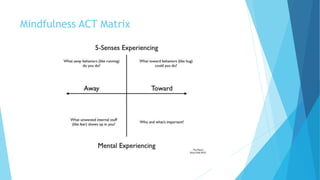
Mindfulness ACT Matrix
Summary
 Relapse prevention begins with remaining aware of your wants,
and needs
 Relapse begins when the old behaviors start to surface
 Avoidance
 Minimization
 Rationalization
 Denial
 Numbing
 People need to learn how to self-govern as a part of recovery
 People need to learn how to meet their basic needs and how
these needs impact their recovery.

Relapse Prevention with the Addicted Offender

  • 2.
    Relapse Prevention Dr. Dawn-EliseSnipes PhD, LPC-MHSP, LMHC, NCC Executive Director AllCEUs
  • 3.
    Objectives  Define relapsein terms of addiction as well as mental health  Examine relapse prevention techniques  Explore needs of the person: Psychosocial and Maslovian
  • 4.
    What is Relapse Relapse is the return to addictive behaviors or the recurrence of mood disorders  Relapse often starts long before the person uses again  Get caught up in day-in-day-out  Start acting “mindlessly”  Stop going to meetings/counseling/church/lifeline  Begins running out of energy to do new behaviors  Frustration, irritability and exhaustion set in  Caveat…an extreme stressor can prompt “immediate relapse”
  • 5.
    Extreme Stressors  Thosethings that overwhelm an individuals ability to cope  Thrust them into the fight or flight  New coping skills and support resources may not even be considered, or only half-heartedly  Have clients identify or practice dealing with these types of situations in group  Divorce  Death  Job Loss  Diagnosis of a terminal or chronic illness (Cancer, ALS, HIV)
  • 6.
    Beginner Tools forExtreme Stress  Get support… You are outnumbered!  Self-soothing/De-Escalation  Systematic Desensitization  Cognitive Behavioral Therapy  CPT Note Card  I feel… because ……  What am I upset about  What are the FACTS for and against this belief  Am I using all or nothing thinking or jumping to conclusions  I need to call _______ to get an objective perspective or what would _____ do
  • 7.
    Psychosocial Needs  Representtasks that must be accomplished or needs that must be met as the people grow up  These tasks help people learn self-control, confidence and esteem  Problems in achieving these tasks/needs can lead to problems in development  Problems later in life may cause people to question their earlier conclusions  These tasks are not linear and final  Part of the treatment process is helping people learn how to “parent” themselves.  Clinicians initially take the part of the parental figure modeling how to resolve issues
  • 8.
    Psychosocial Needs  Trustvs. Mistrust  If people receive consistent, predictable and reliable care, they will develop a sense of trust/faith in themselves and others  They will be able to feel secure even when threatened.  This leads to developing hope that as new crises arise, there is a real possibility that other people will be there are a source of support, they have the strength to endure and their intuition is correct.  I can trust myself (thoughts, intuition)  I can trust those around me  Example: Child abuse survivor
  • 9.
    Psychosocial Needs  Autonomyvs. Shame and Doubt  Explore the limits of their abilities within an encouraging environment which is tolerant of failure  The aim has to be “self control without a loss of self- esteem” (Gross, 1992). Success in this stage will lead to the virtue of will/discipline/courage.  If people are criticized, overly controlled, or not given the opportunity to assert themselves, they begin to feel inadequate in their ability to survive, and may then become  Overly dependent upon others  Lack self-esteem  Feel a sense of shame or doubt in their own abilities.
  • 10.
    Psychosocial Needs  Initiativevs. Guilt. ...  People learn to initiate activities with others, and feel secure in their ability to lead others and make decisions.  If this tendency is squelched, either through criticism or control, people develop a sense of guilt, feel like a nuisance to others and will therefore remain followers, lacking in self-initiative and self-confidence.  A healthy balance between initiative and guilt is important. Success in this stage will lead to the virtue of purpose.
  • 11.
    Psychosocial Needs  Industry(competence) vs. Inferiority. ...  People’s peer groups are a major source of self esteem.  They feel the need to win approval by demonstrating specific competencies that are valued by society, and begin to develop a sense of pride in their accomplishments.  If this initiative is not encouraged, people begin to feel inferior, doubting their own abilities and therefore may not try or may give up at the first sign of failure.  Some failure may be necessary so that the person can develop some awareness of personal limits.
  • 12.
    Psychosocial Needs  Identityvs. Role Confusion  In response to an identity crisis a person may begin to experiment with different lifestyles (e.g. work, education or political activities).  People experience identity crises in adolescence, adulthood and in response to major stressors  Pressuring someone into an identity can result in rebellion.  People must define what recovery looks like for them and be motivated to do it for themselves.
  • 13.
    Psychosocial Needs  Intimacyvs. Isolation  Sharing of ourselves and being accepted and loved for who we are  Successful in this stage can lead to a sense of commitment, safety, and care within a relationship.  Avoiding intimacy, fearing commitment and relationships can lead to isolation, loneliness, and sometimes depression.  Exploring past relationships is often a task for therapy  Relapse prevention involves  Increasing awareness of what healthy relationships look like  Reminding themselves that what happened in the past with a different person is not necessarily going to happen again.
  • 14.
    Maslow  Biological  Housing(create safety and remove/address triggers)  How can they make the best of what they have  Safe routes to and from work  Make their home or room a safe haven  What are the negative and positive triggers and solutions in their current environment  People  Times of day/week  Things
  • 15.
    Maslow  Biological  MedicalCare (Eliminate vulnerabilities)  Chronic pain  Mental Health  Substance Abuse (Buprenorphine, Antabuse, Methadone, SSRIs)  Food and water, sleep (Create a recovery environment)  Self care is a new skill for many clients, go slow  Routine…routine…routine
  • 16.
    Maslow  Safety  Fromphysical or psychological injury by self or others  From peer pressure  Relationships  Nurturing  Encouraging of sober behaviors  (honesty, hope, faith, courage, discipline, integrity)
  • 17.
    Self-Esteem  A senseof pride in who they are  Acceptance of strengths and weaknesses  Lack of self-esteem can lead to a need for external validation  Self-Esteem workbooks abound to develop positive self esteem  Eradicating harsh, self-critical self-talk is the second part  Be aware of the imposter phenomenon.
  • 18.
    Mindfulness  Relapse oftenbegins when mindfulness ends  Mindfulness is being aware of  Who you are  How you feel (emotionally, mentally, physically)  What you want (and what you actually need)  Are you eating because you are hungry or stressed  What not getting wants met mean to you  Activities  Morning and evening journals  Behavior Interruption esp. regarding substitute addictions
  • 19.
  • 20.
    Summary  Relapse preventionbegins with remaining aware of your wants, and needs  Relapse begins when the old behaviors start to surface  Avoidance  Minimization  Rationalization  Denial  Numbing  People need to learn how to self-govern as a part of recovery  People need to learn how to meet their basic needs and how these needs impact their recovery.