Reinvent Your School
Library Space
1April 21, 2016
• Library Services
• Purpose/Process/Principal
• Design
A
G
E
N
D
A
2
LIBRARY SERVICES
Next Generation Learning Environment
REINVENT YOUR SCHOOL LIBRARY SPACE
3
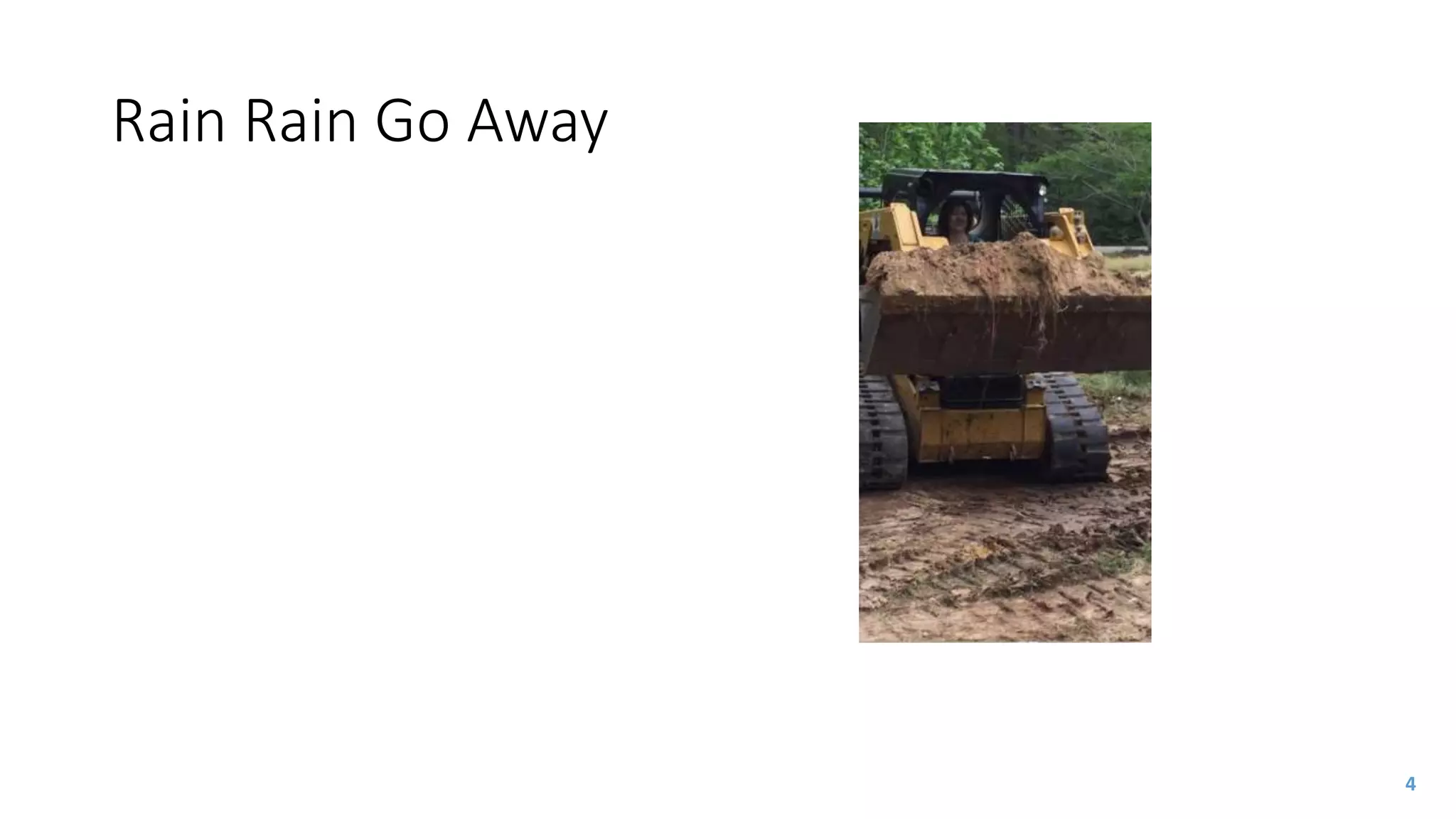
Rain Rain Go Away
4
5
6
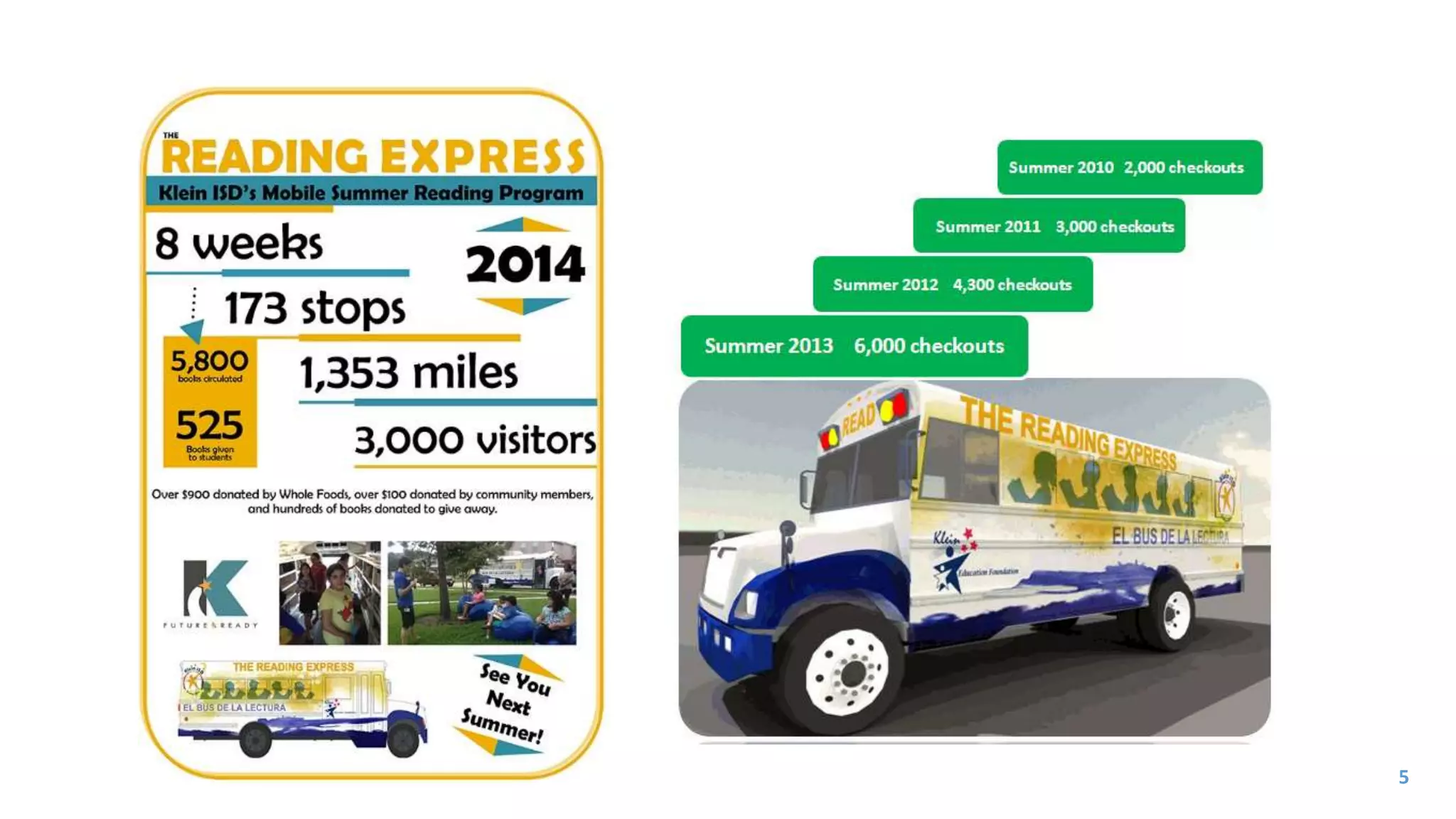
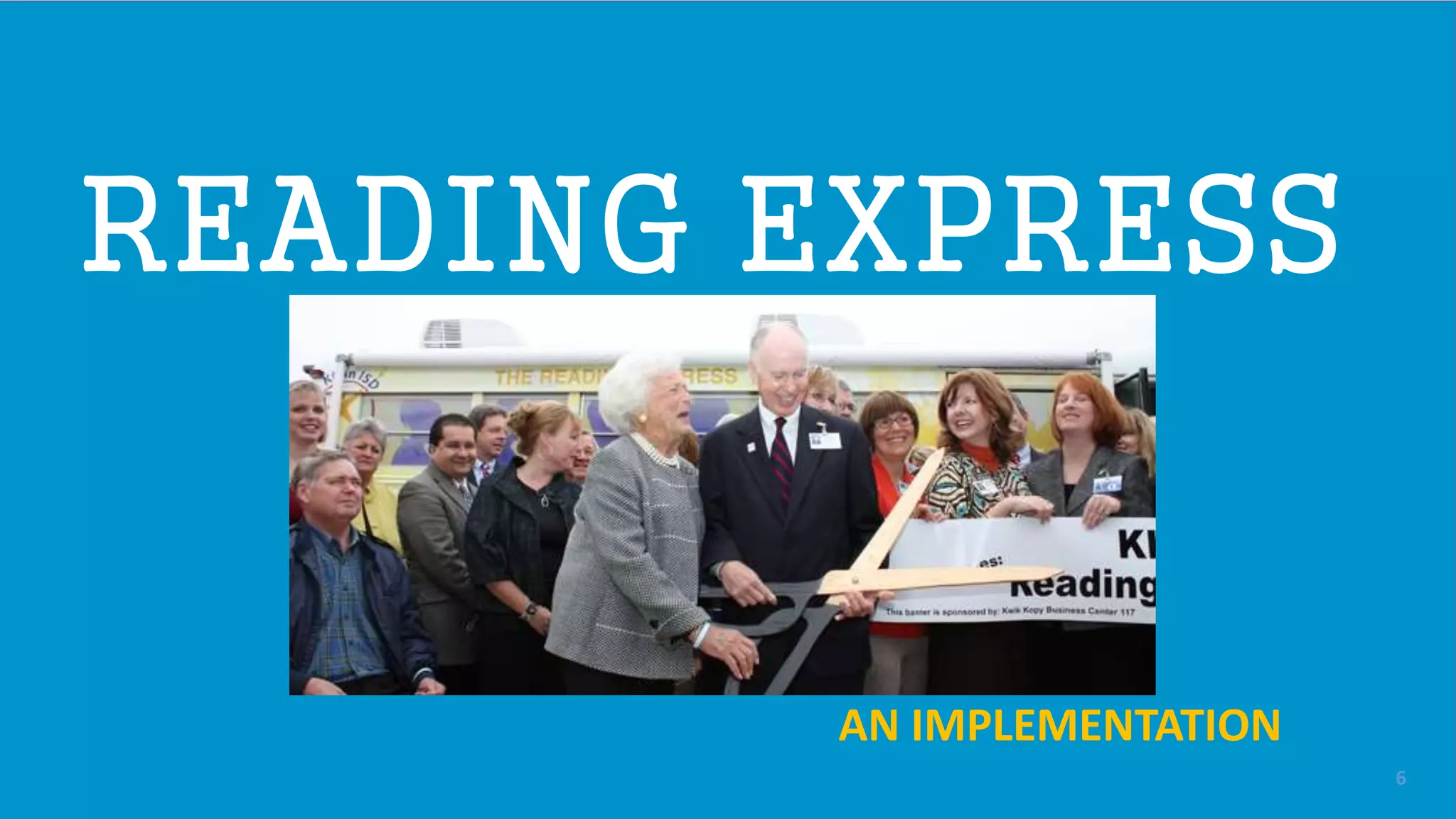
READING EXPRESS
AN IMPLEMENTATION
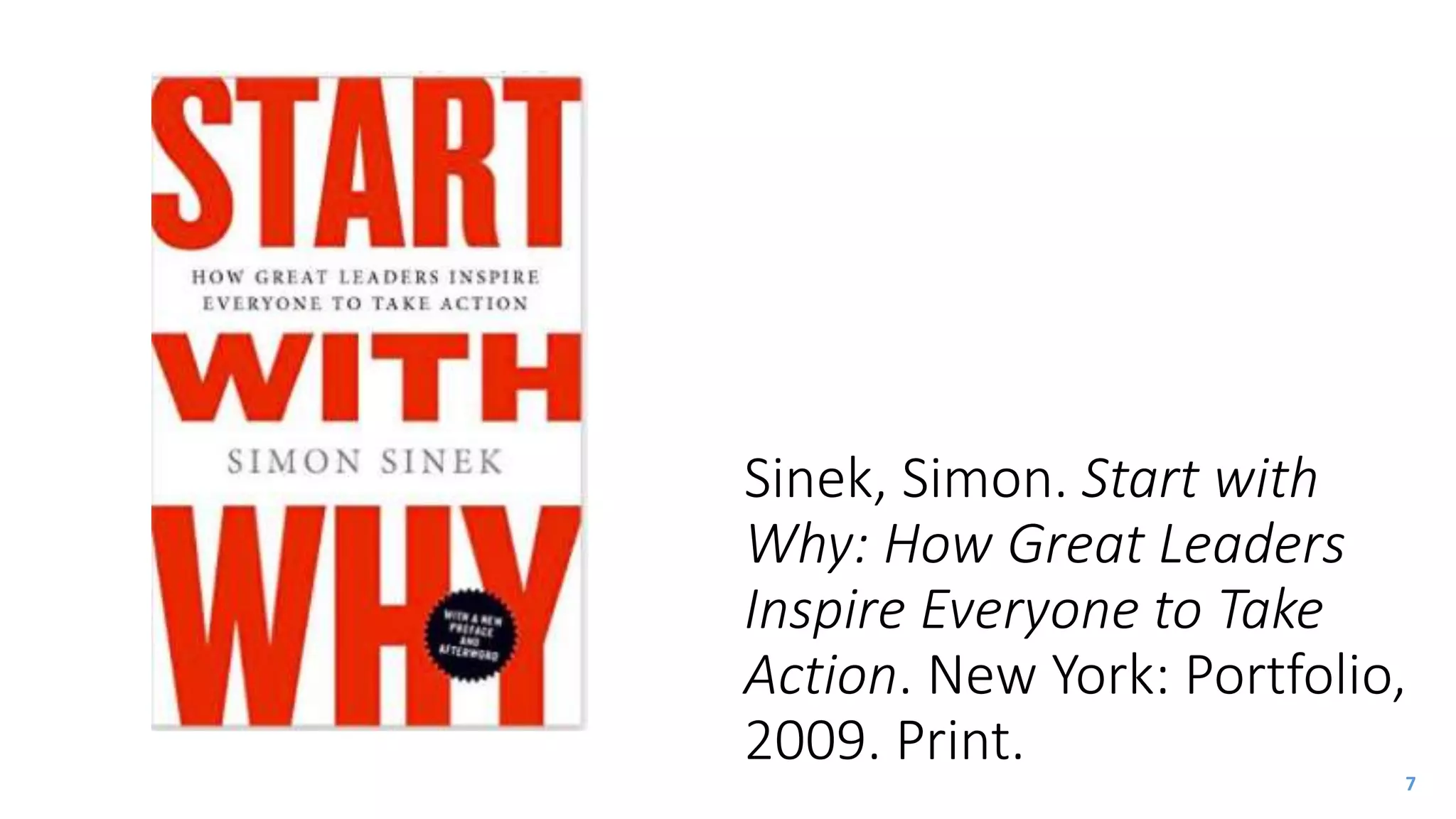
Sinek, Simon. Start with
Why: How Great Leaders
Inspire Everyone to Take
Action. New York: Portfolio,
2009. Print.
7
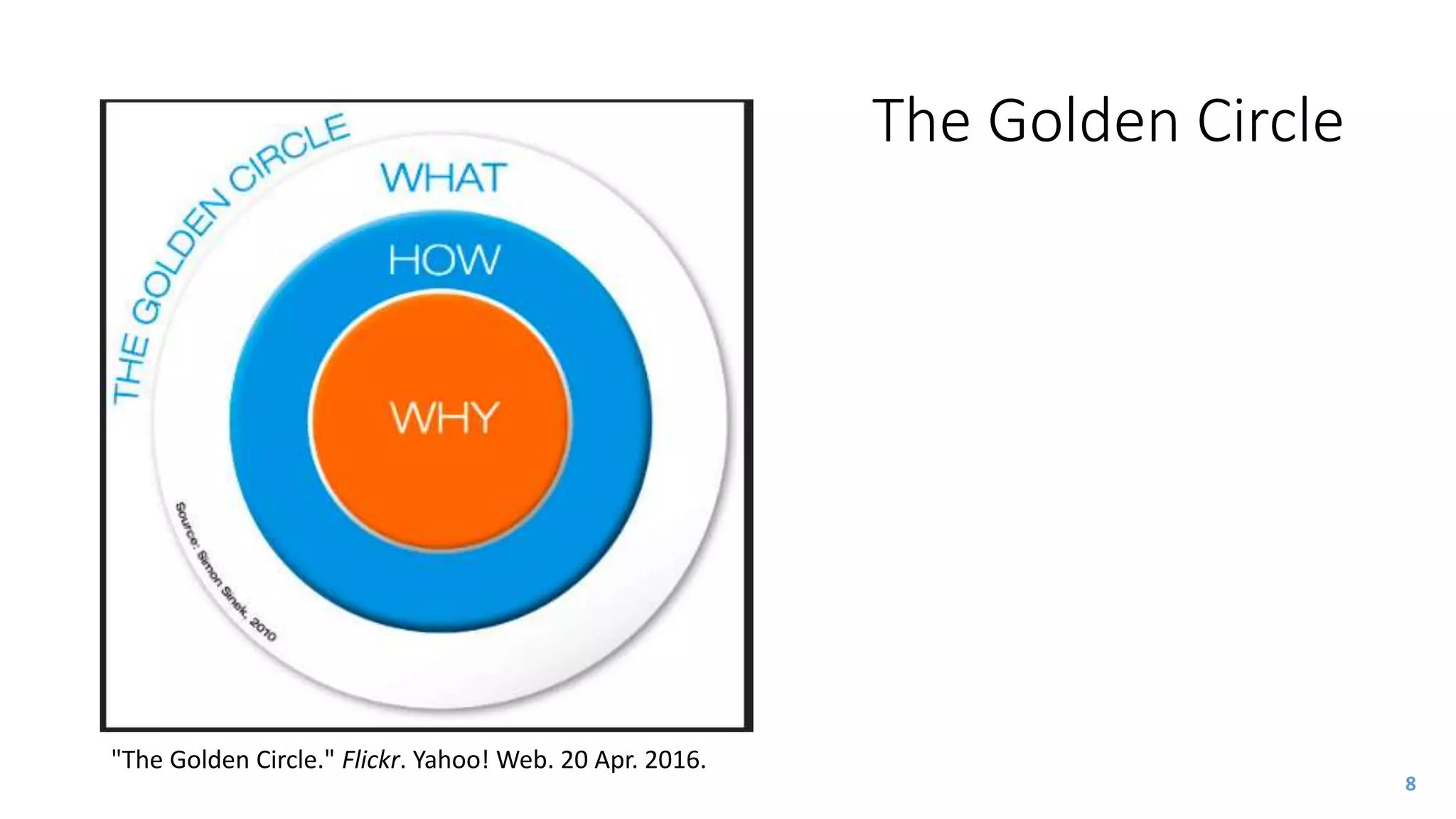
The Golden Circle
8
"The Golden Circle." Flickr. Yahoo! Web. 20 Apr. 2016.
• The shift of the library from a place of consumption to a place of creation – the “Participatory
Library”
• Makerspaces (low tech to high tech – knitting circles, lego leagues, robotics,
hackerspaces, Minecraft/similar, 3-d printing, clean and messy)
• Programs promoting writing (NaNoWriMo (National Novel Writing Month), collection
and curating local history, “storycore” oral histories, more)
• Media creation labs
• Different spaces and/or services for different groups
• Re-design of staff resources to support active service models (roaming and one-desk)
• Design of flexible physical spaces to adapt to new needs over time
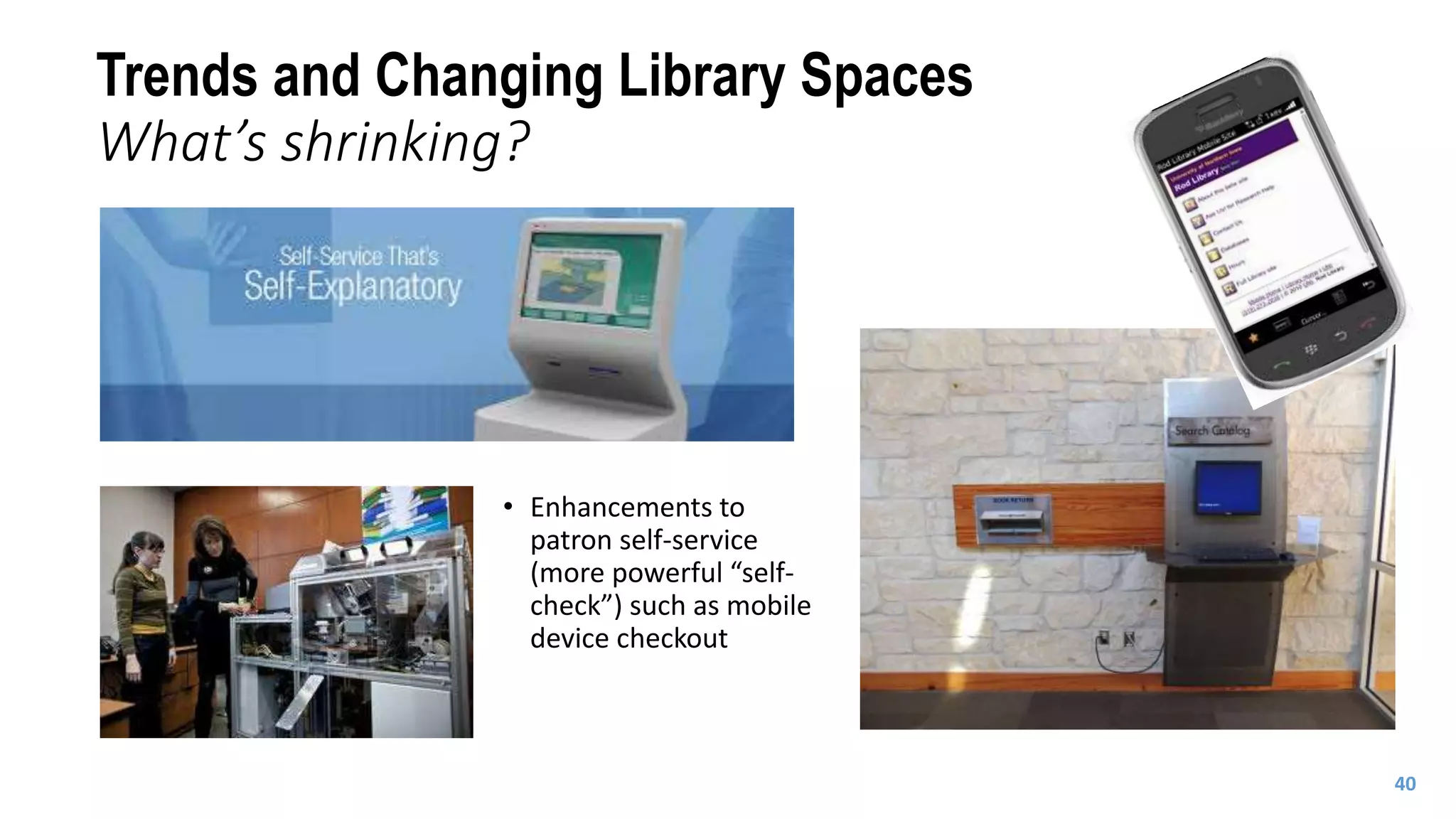
• Enhancements to patron self-service (more powerful “self check”)
• Technology “showrooming” (a place for the public to see and experience new technology
devices – an expansion of the ‘technology pettign zoo” idea)
9
Trends and Changing Library Spaces
New and Growing Spaces and Expectations
Pivot Points
Include leaders in professional learning
Drive change with librarians
Enact tiered visioning
Nurture content-specific PLCs
Support real risk-taking
10
Learning Outcomes
11
 Knowledge
 Information Processes
 Technology
 Reading
 Independent learning
 Developing self-concept and personal agency
 Attitudes that value information and learning
Next Generation Learning Environment
REINVENT YOUR SCHOOL LIBRARY SPACE
PURPOSE / PROCESS / PRINCIPAL
12
REFORMING SCHOOL CULTURE:
FOSTERING INNOVATIVE
LEARNING ENVIRONMENTS
From an archive of resources to an
Active Learning Commons
13
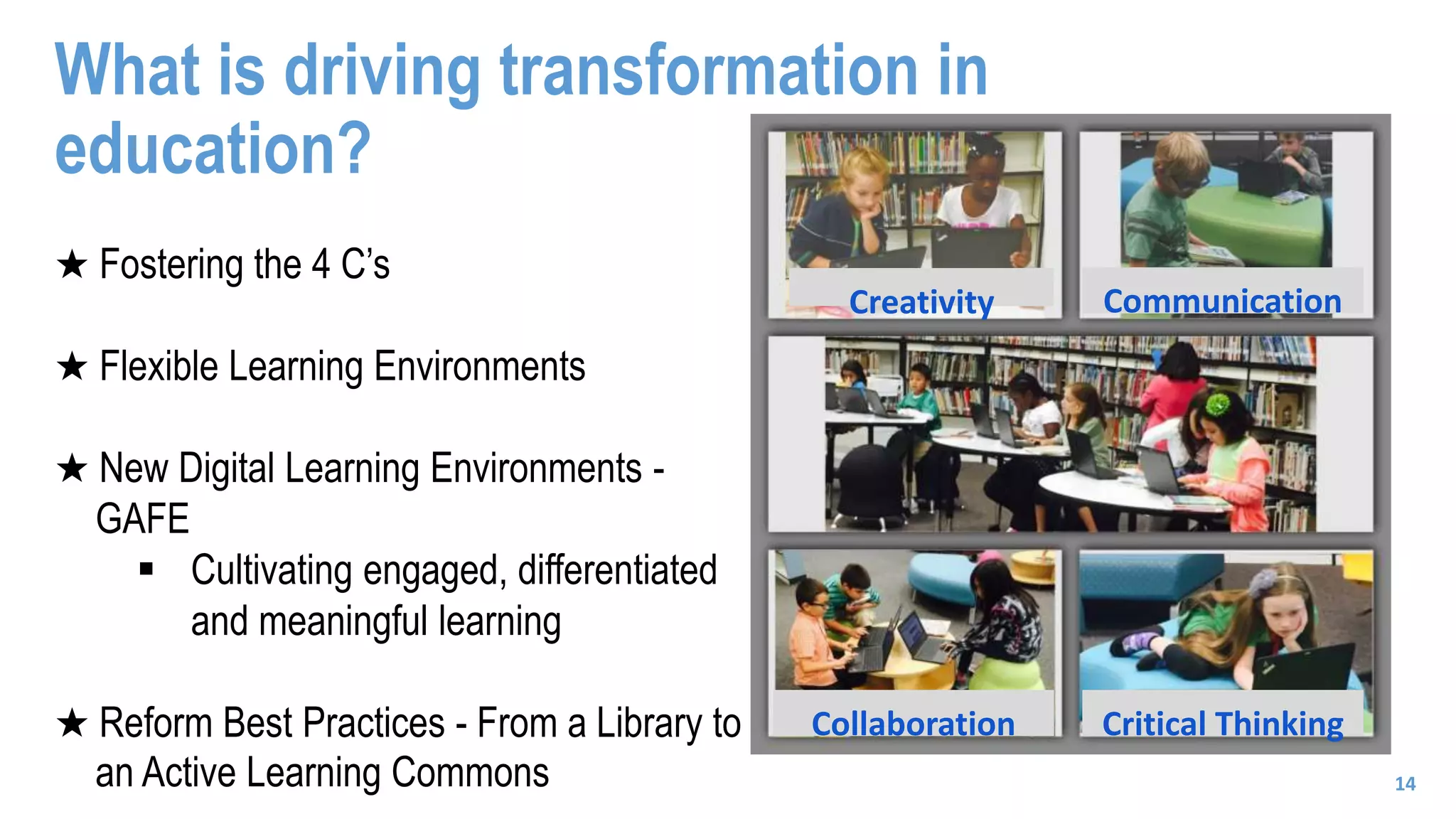
★ Fostering the 4 C’s
★ Flexible Learning Environments
★ New Digital Learning Environments -
GAFE
 Cultivating engaged, differentiated
and meaningful learning
★ Reform Best Practices - From a Library to
an Active Learning Commons
Collaboration Critical Thinking
CommunicationCreativity
14
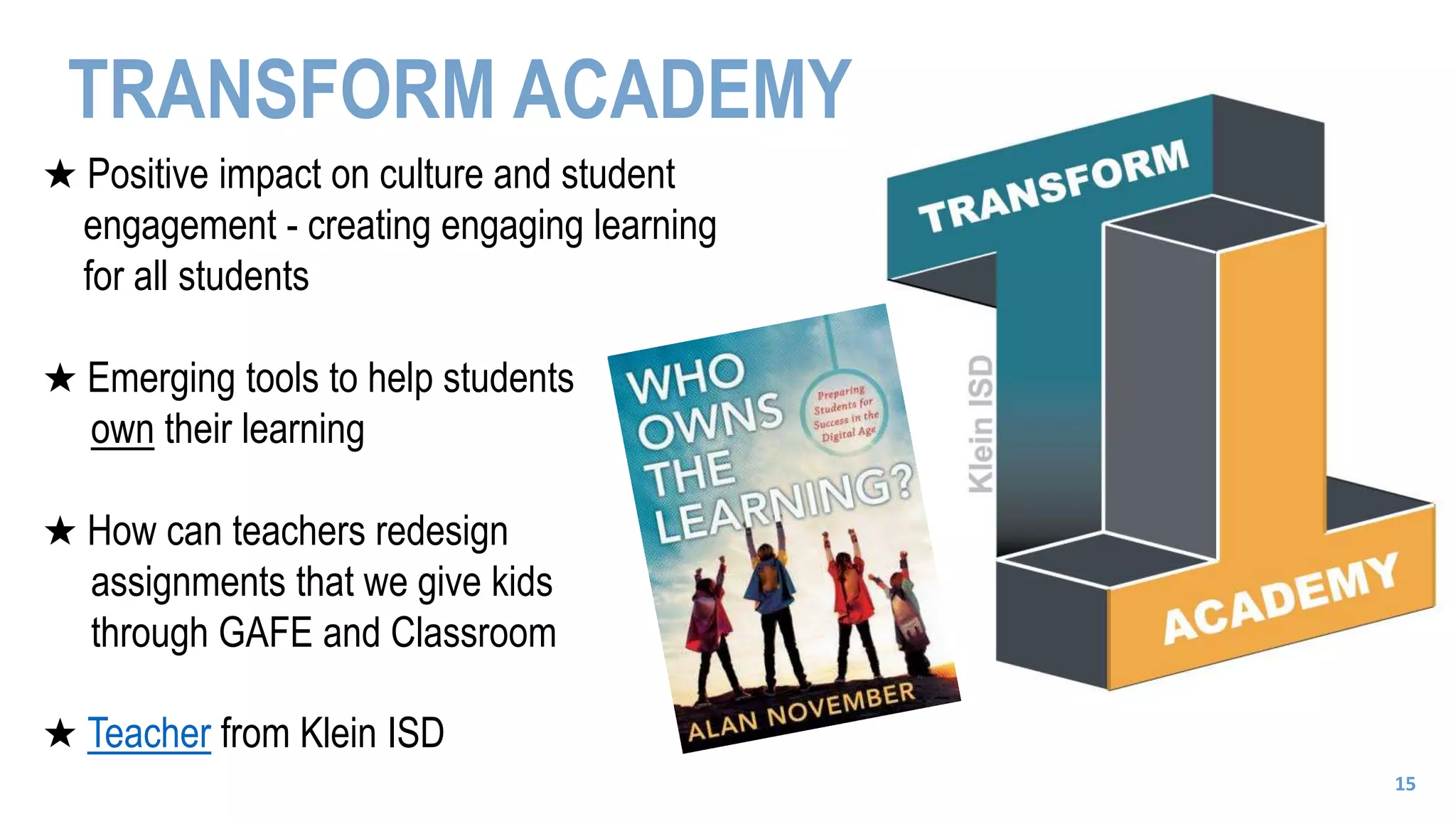
TRANSFORM ACADEMY
★ Positive impact on culture and student
engagement - creating engaging learning
for all students
★ Emerging tools to help students
own their learning
★ How can teachers redesign
assignments that we give kids
through GAFE and Classroom
★ Teacher from Klein ISD
15
LEARNING OUTCOMES/TARGETS
IN THE DISTRICT’S MISSION STATEMENT, THE SCHOOL BOARD HAS CHARGED US WITH
CREATING ENGAGING LEARNING EXPERIENCES FOR STUDENTS.
• RESEARCH THE USE OF LEADING EDGE TECHNOLOGIES FOR KLEIN CLASSROOMS
USING A PROJECT BASED LEARNING APPROACH AND PILOT THE USE WITH STUDENTS.
• FACILITATE INTERACTIVE, ENGAGING AND FUTURE-READY CLASSROOMS THAT
SUPPORT HIGH LEVELS OF LEARNING FOR ALL STUDENTS.
• THE ROLE OF THE PRINCIPAL IS TO BE A LEAD LEARNER DOING THE SAME LEARNING
AS THE TEACHER SO THEY FEEL COMFORTABLE TAKING RISKS IN A NEW
ENVIRONMENT
16
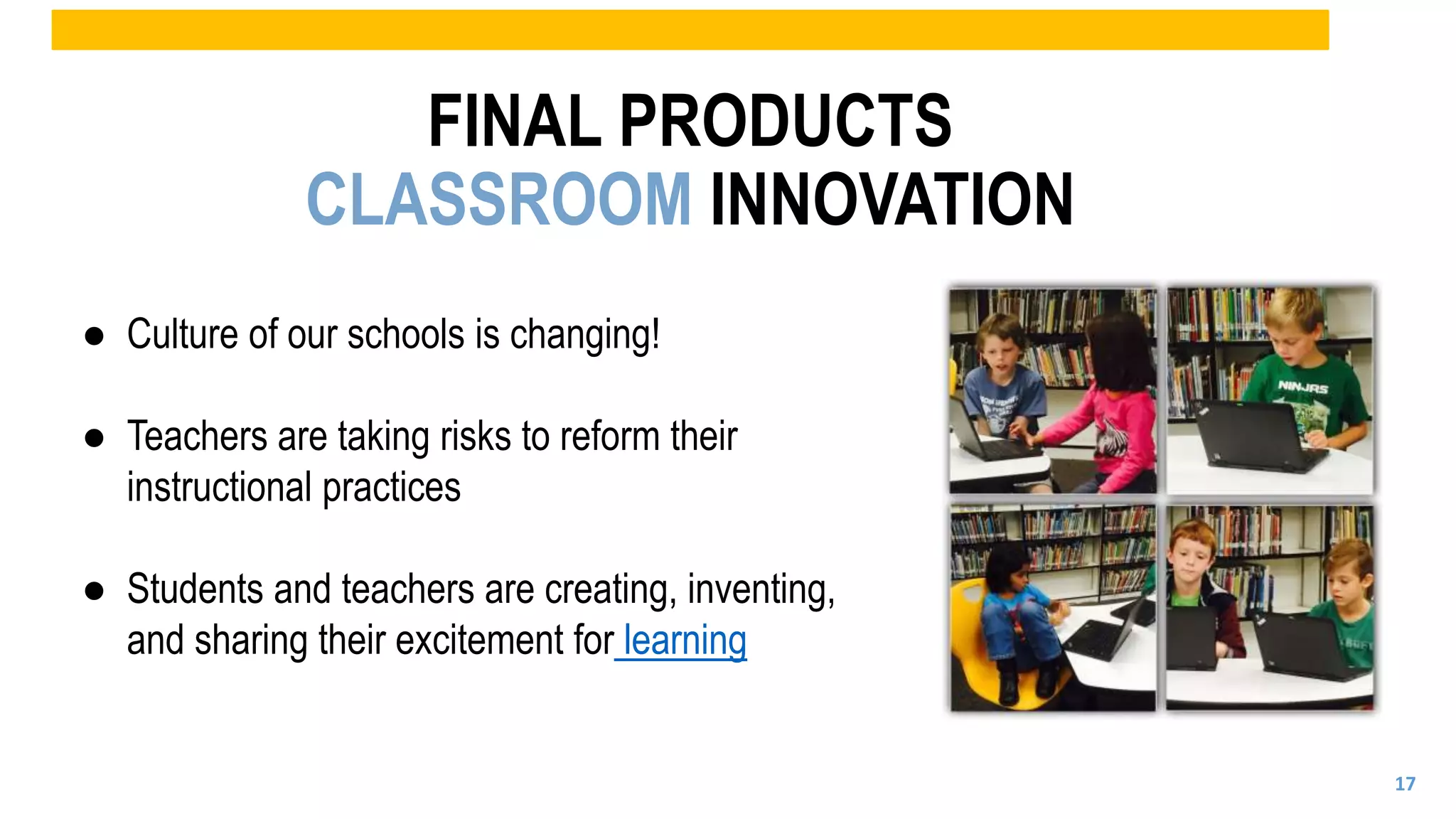
● Culture of our schools is changing!
● Teachers are taking risks to reform their
instructional practices
● Students and teachers are creating, inventing,
and sharing their excitement for learning
FINAL PRODUCTS
CLASSROOM INNOVATION
17
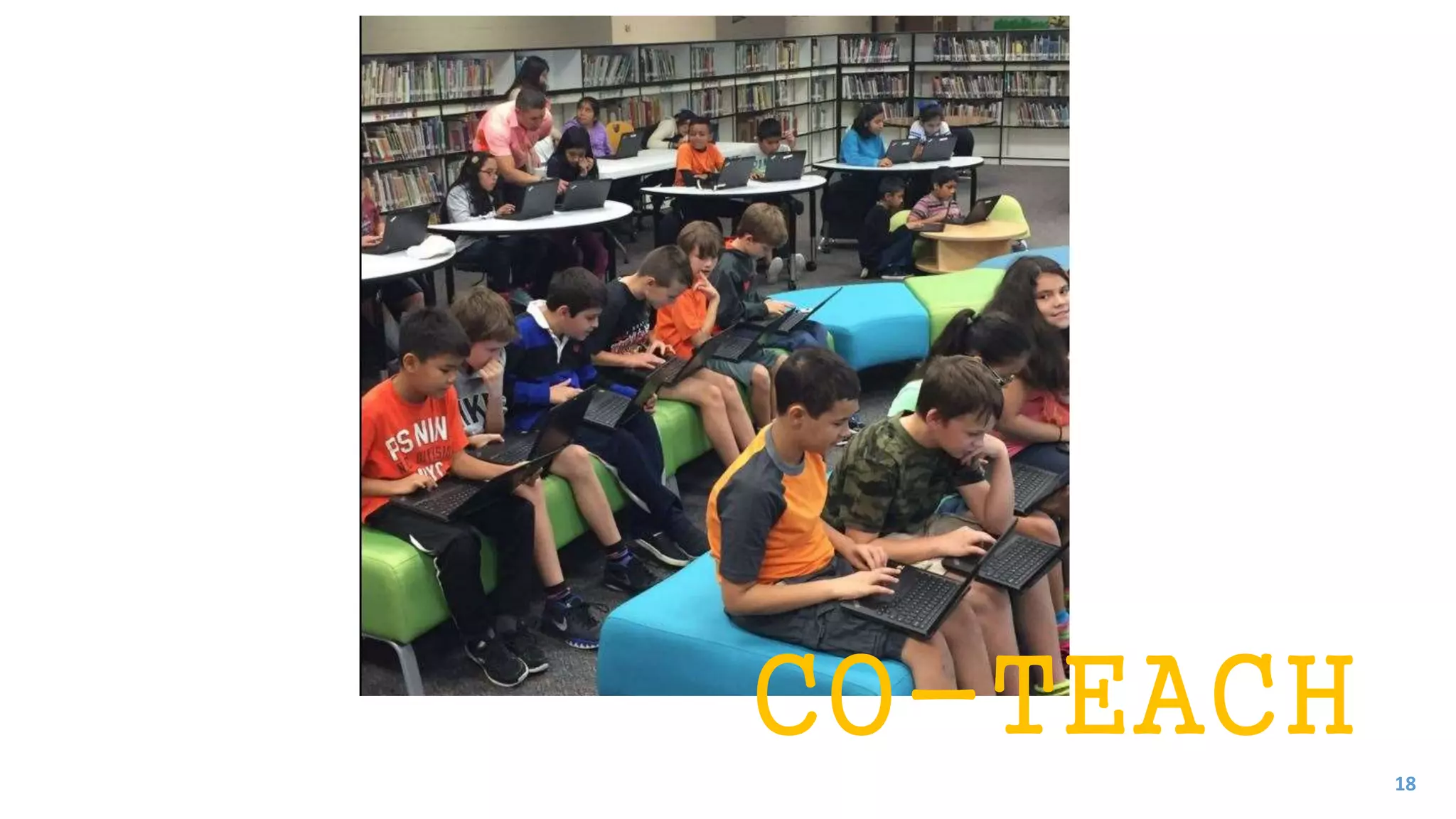
CO-TEACH
18
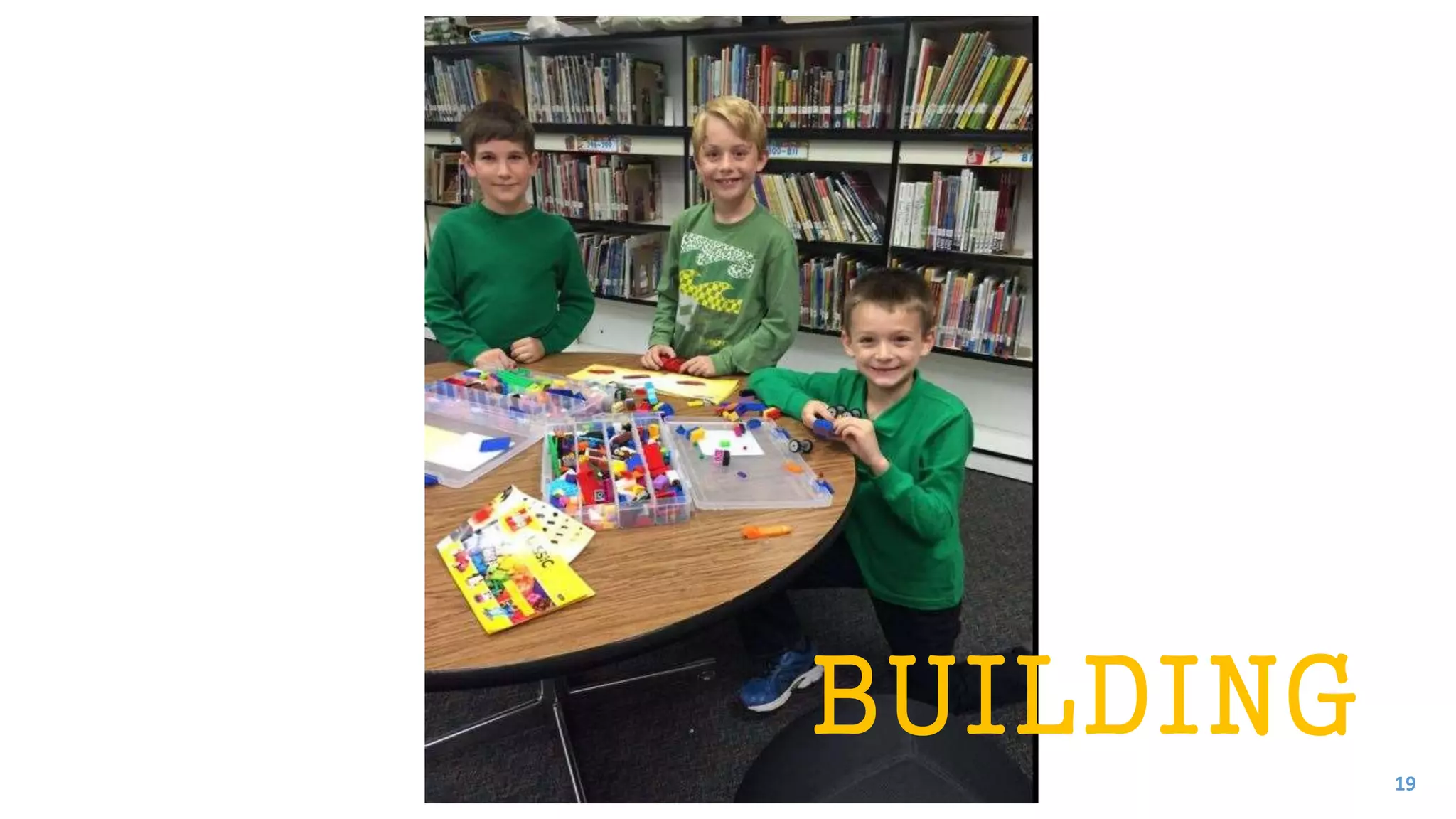
BUILDING
19
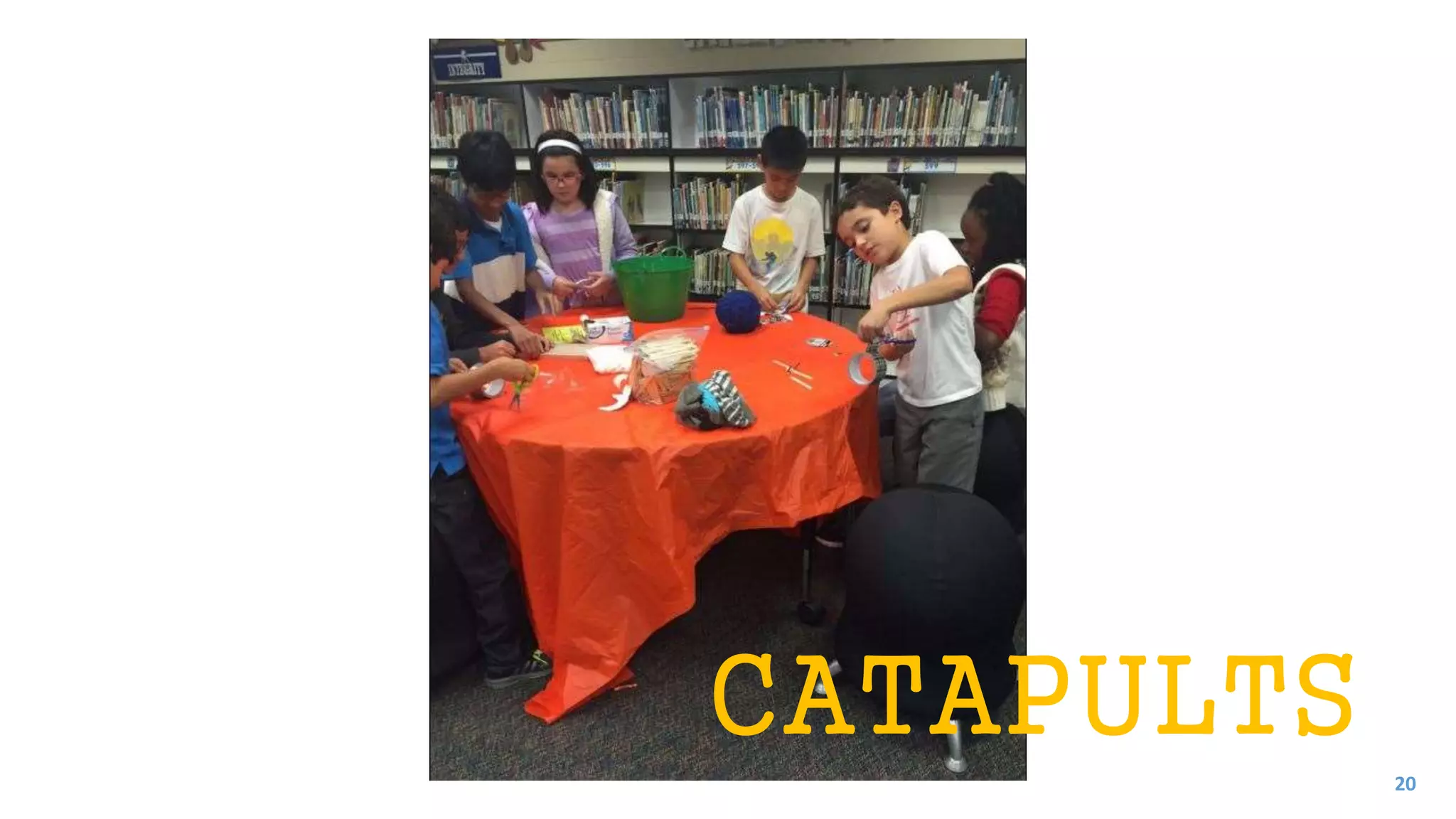
CATAPULTS
20
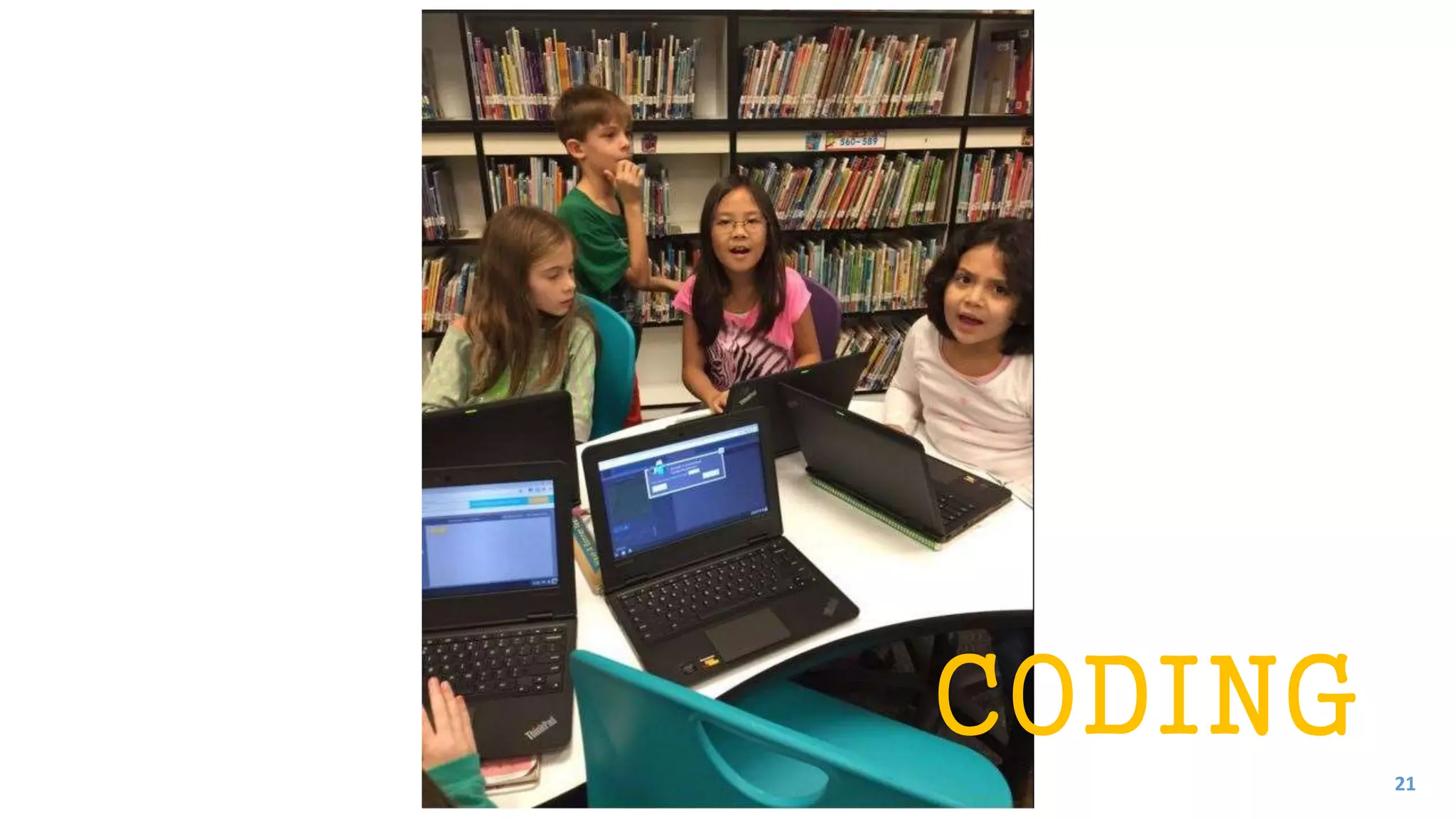
CODING
21
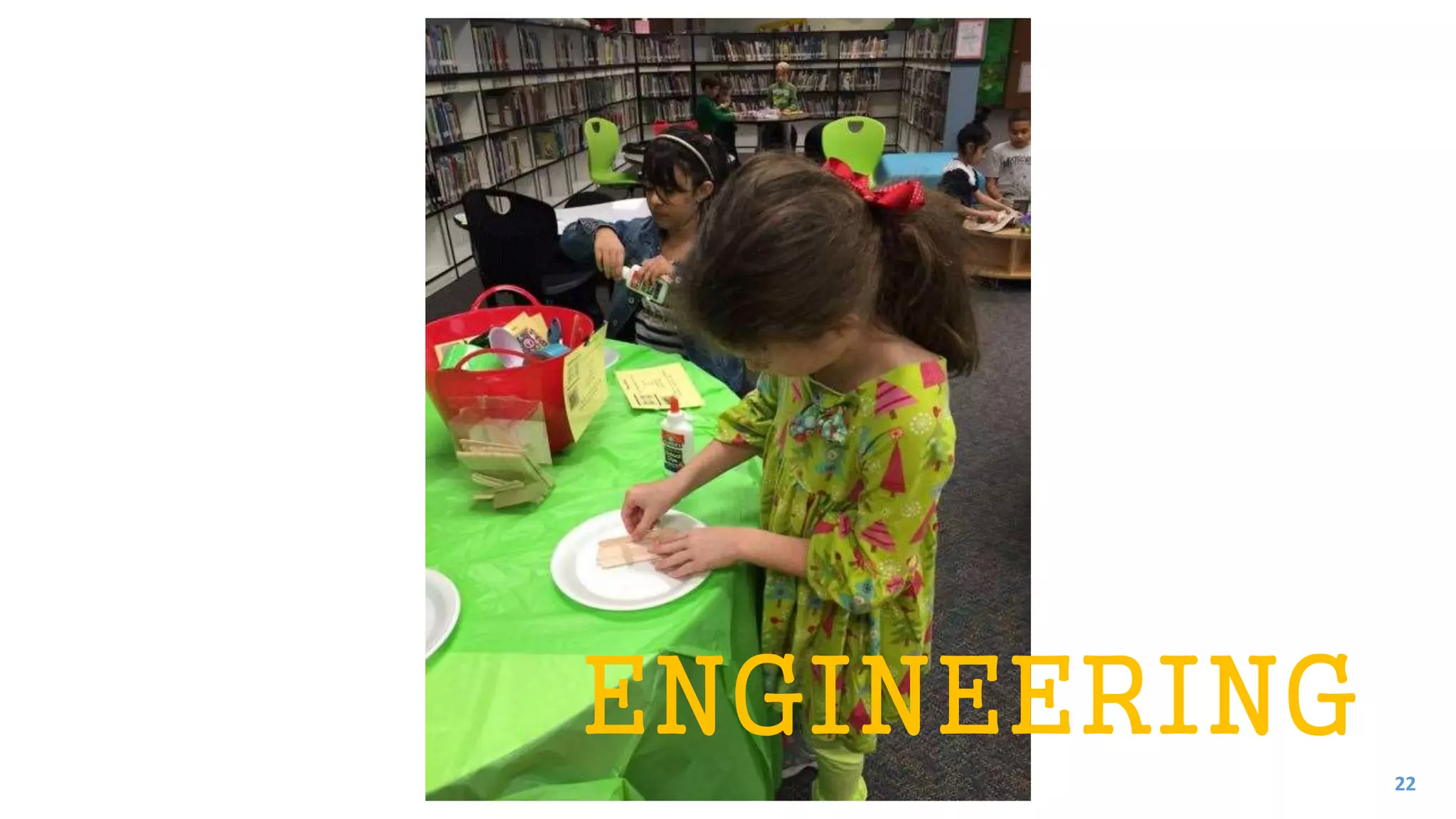
ENGINEERING
22
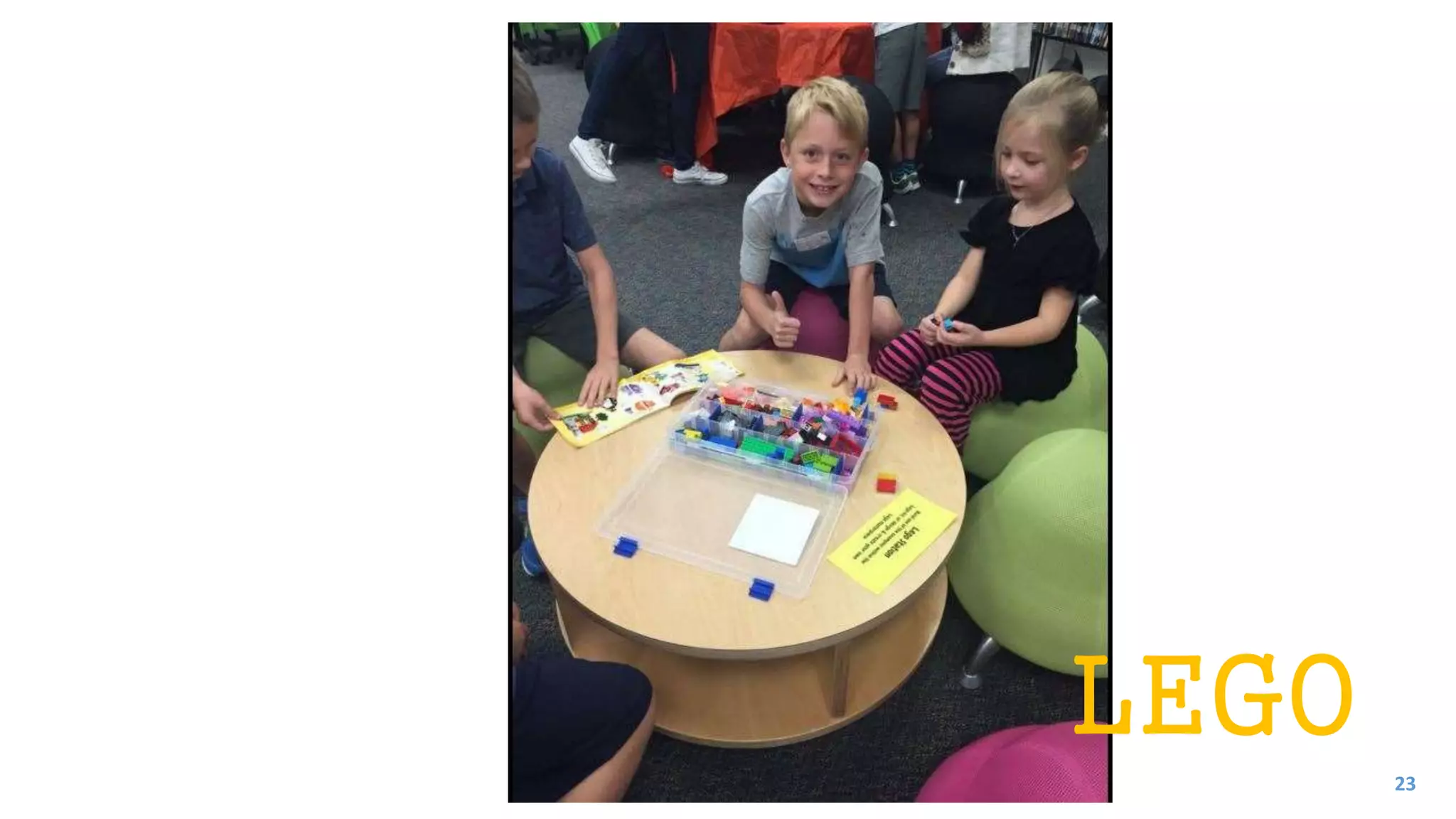
LEGO
23
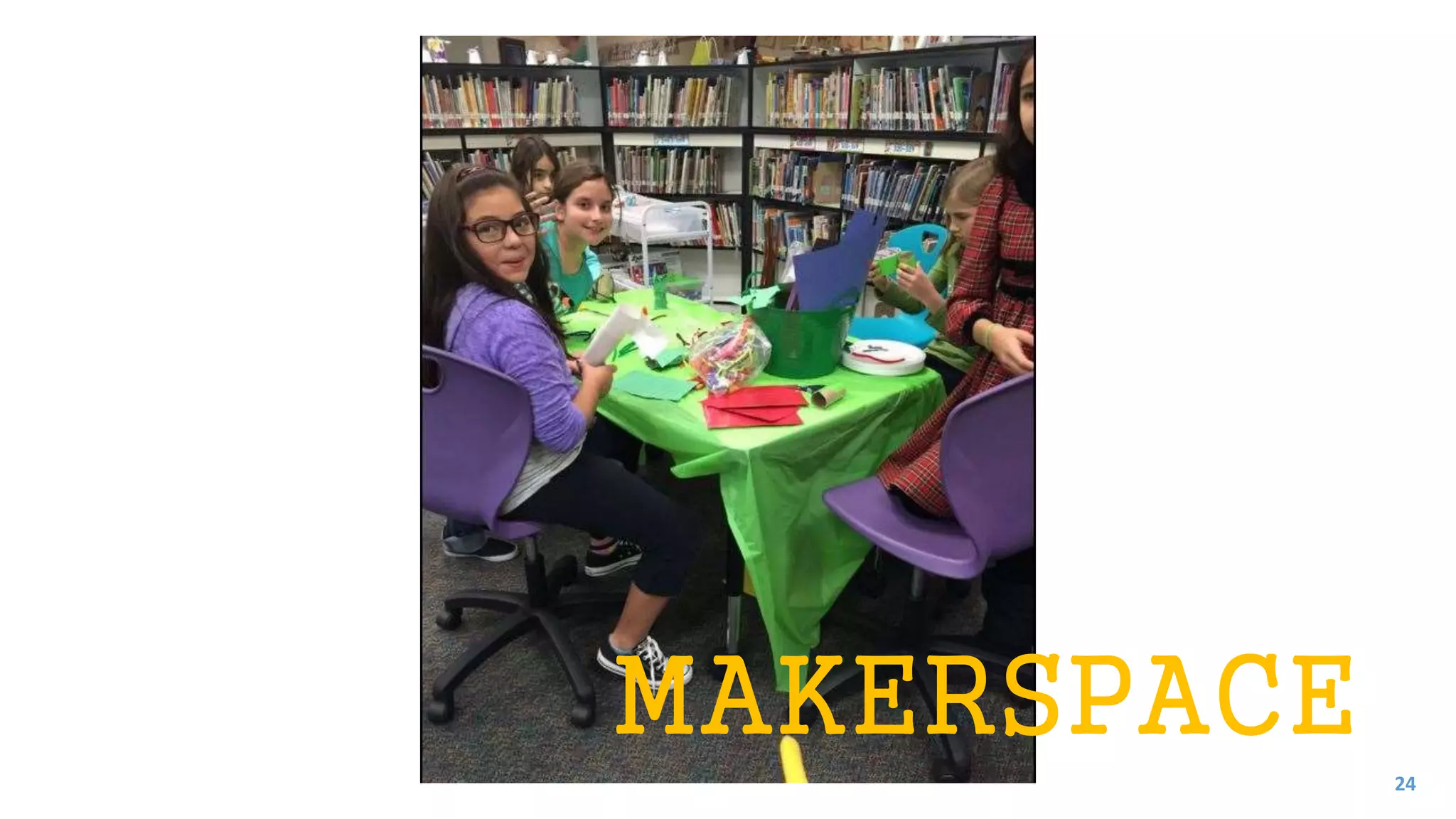
MAKERSPACE
24
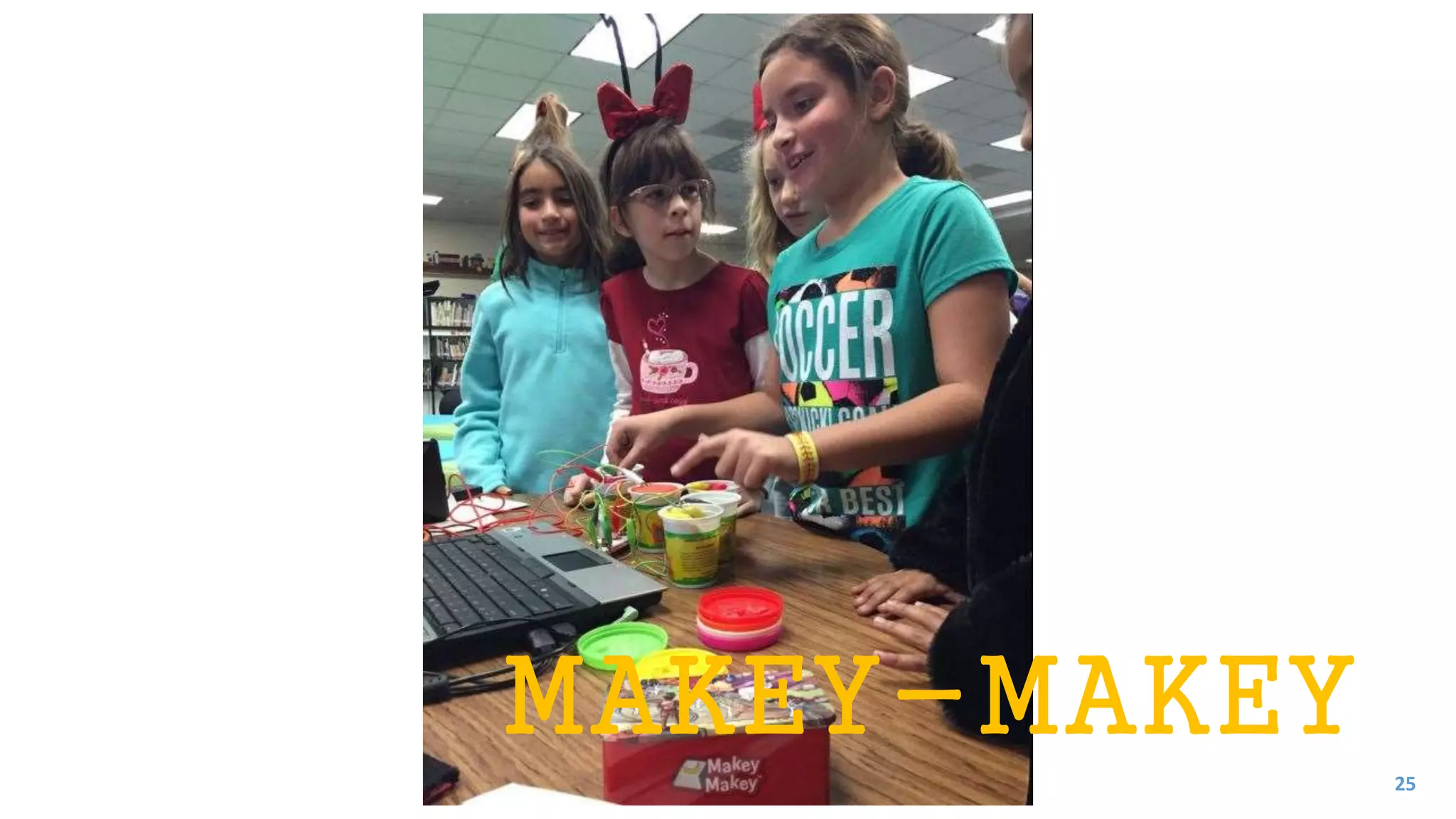
MAKEY-MAKEY
25
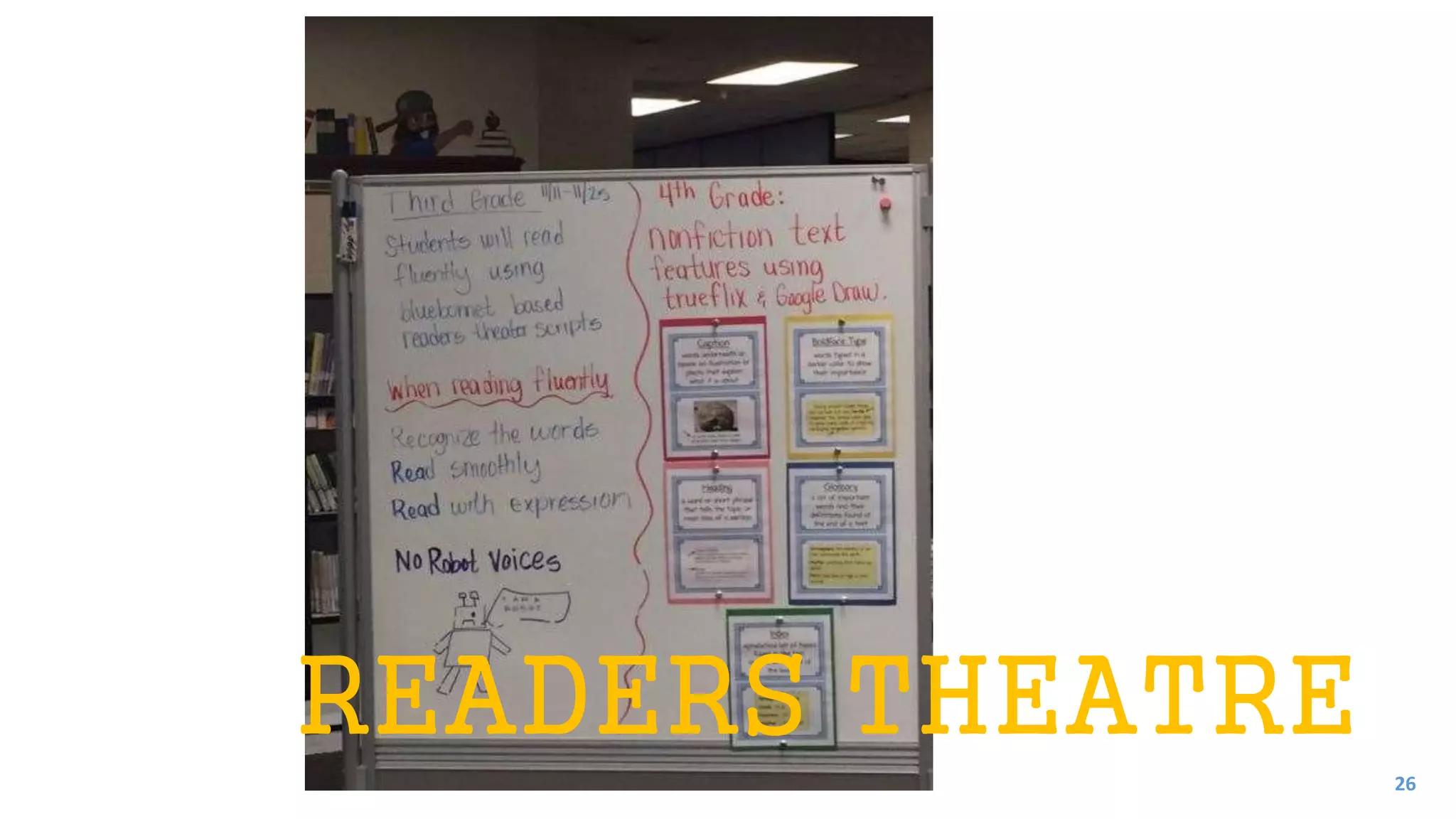
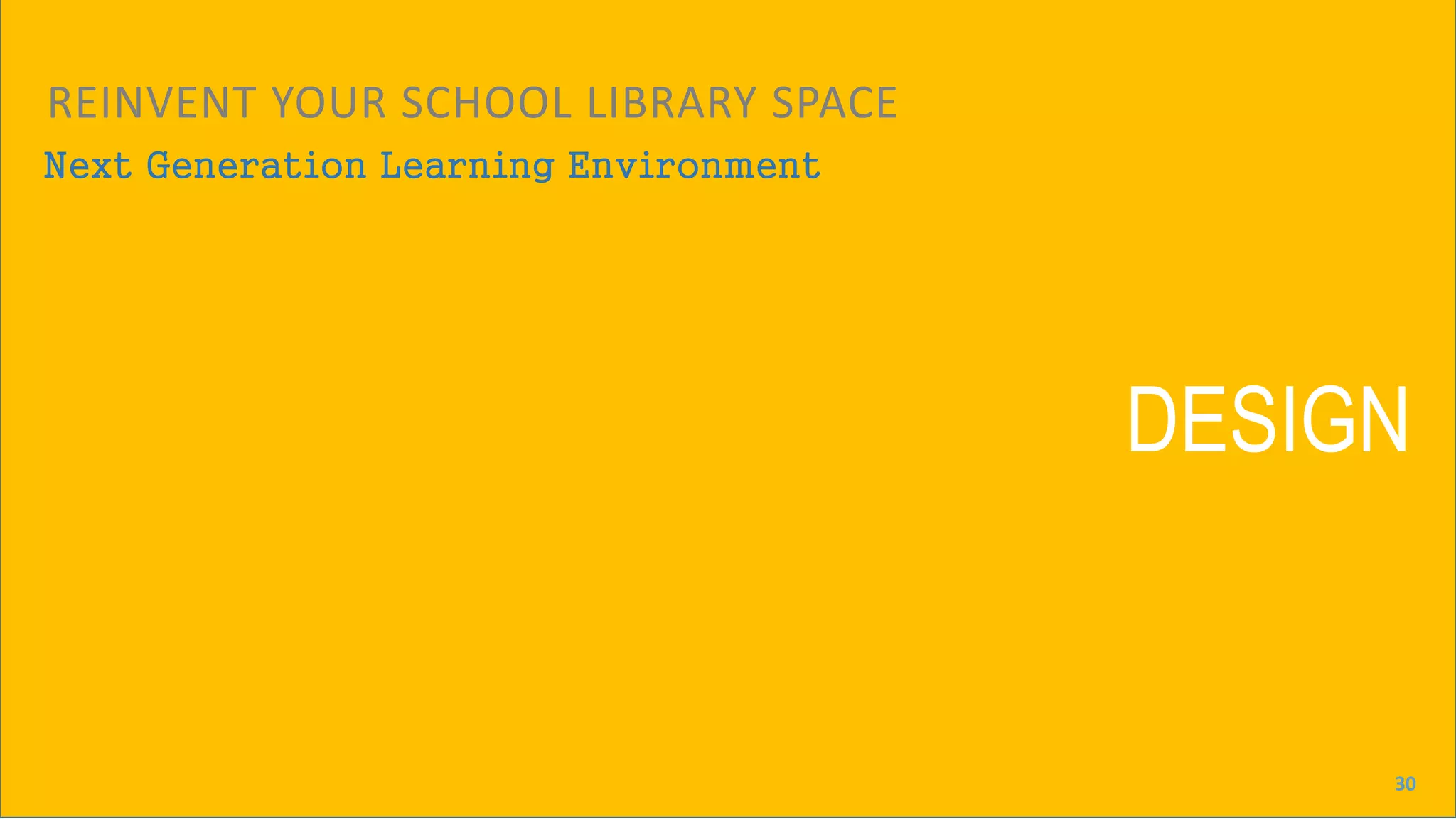
READERS THEATRE
26
READERS THEATRE
27
TOUCHSCREEN
28
A TRANSFORMATION
Dayna’s / Brill library video
(Jason’s video)
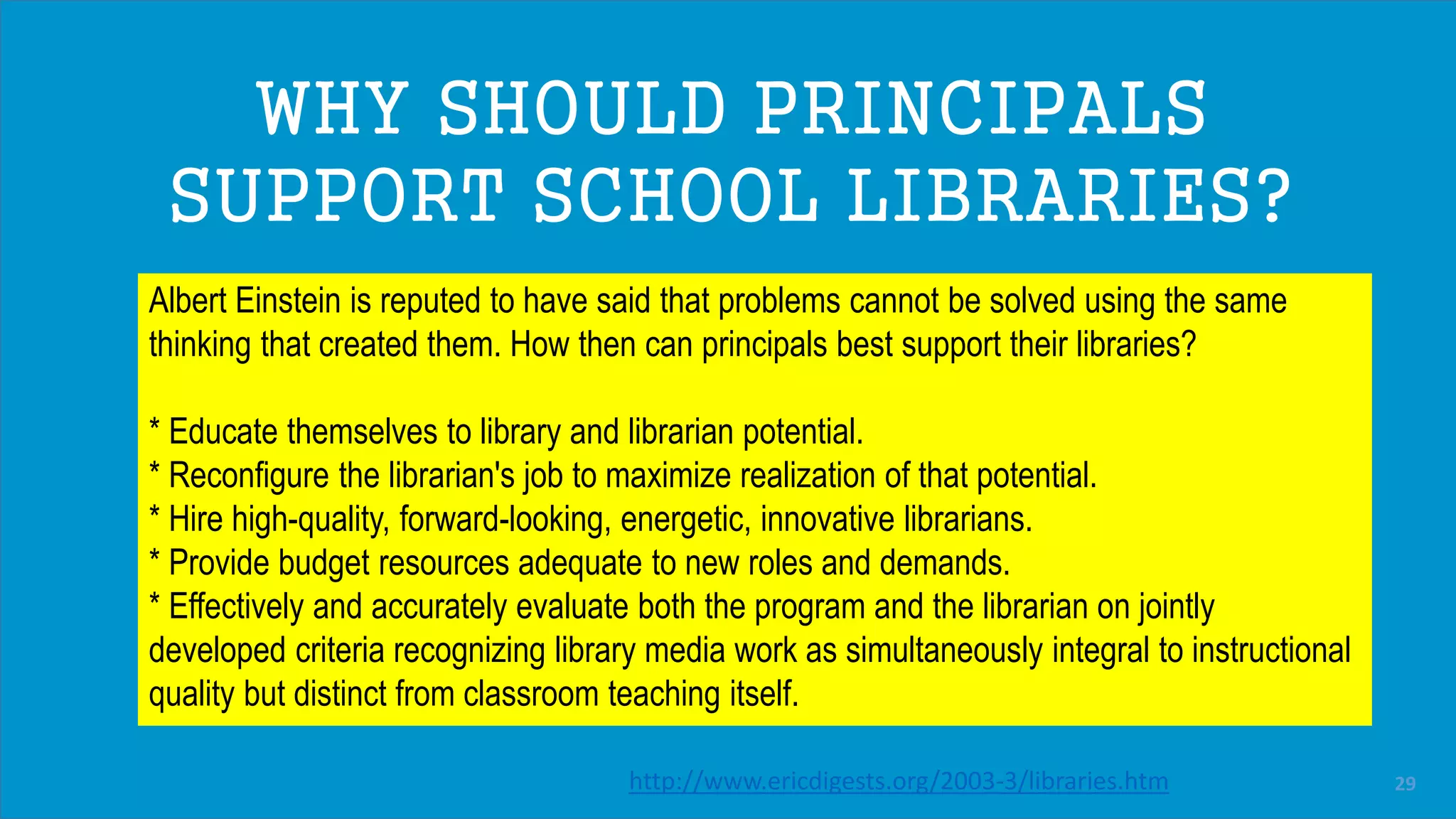
Albert Einstein is reputed to have said that problems cannot be solved using the same
thinking that created them. How then can principals best support their libraries?
* Educate themselves to library and librarian potential.
* Reconfigure the librarian's job to maximize realization of that potential.
* Hire high-quality, forward-looking, energetic, innovative librarians.
* Provide budget resources adequate to new roles and demands.
* Effectively and accurately evaluate both the program and the librarian on jointly
developed criteria recognizing library media work as simultaneously integral to instructional
quality but distinct from classroom teaching itself.
WHY SHOULD PRINCIPALS
SUPPORT SCHOOL LIBRARIES?
http://www.ericdigests.org/2003-3/libraries.htm 29
DESIGN
Next Generation Learning Environment
REINVENT YOUR SCHOOL LIBRARY SPACE
30
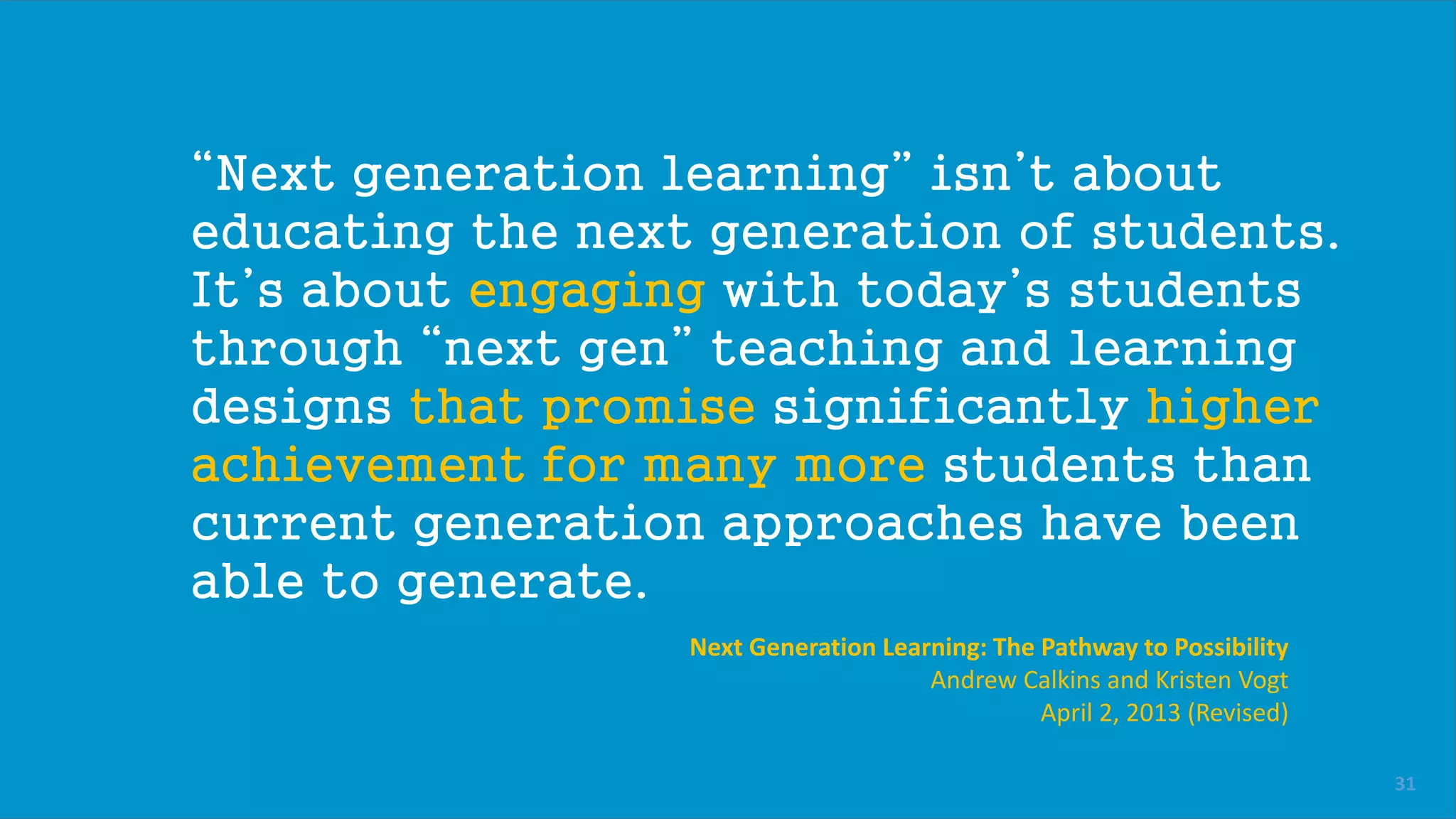
“Next generation learning” isn’t about
educating the next generation of students.
It’s about engaging with today’s students
through “next gen” teaching and learning
designs that promise significantly higher
achievement for many more students than
current generation approaches have been
able to generate.
Next Generation Learning: The Pathway to Possibility
Andrew Calkins and Kristen Vogt
April 2, 2013 (Revised)
31
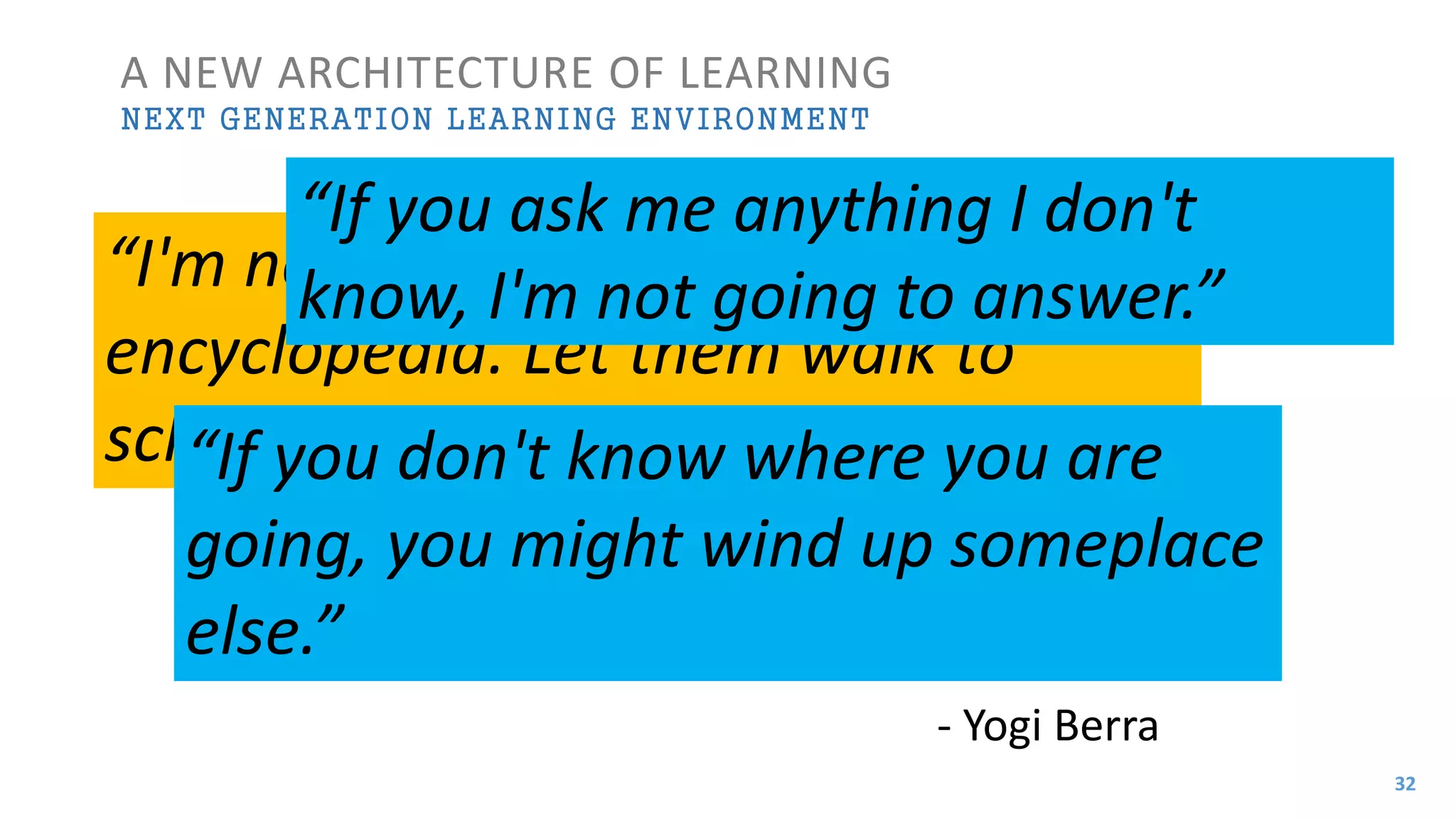
“I'm not going to buy my kids an
encyclopedia. Let them walk to
school like I did.”
A NEW ARCHITECTURE OF LEARNING
NEXT GENERATION LEARNING ENVIRONMENT
- Yogi Berra
“If you don't know where you are
going, you might wind up someplace
else.”
“If you ask me anything I don't
know, I'm not going to answer.”
32
What are Next Generation Learning Commons?...
“Also known as “scholars' commons”, “information commons”, or “digital commons”, are
educational spaces, similar to libraries and classrooms that share space for information
technology, remote or online education, tutoring, collaboration, content creation, meetings and reading
or study.[1][2]” Wiki
Next Generation Learning Environment
REINVENT YOUR SCHOOL LIBRARY SPACE
Why the name “Learning Commons” ? - “It became clear that the focus of the
transformed traditional library should be on learning in its many manifestations, whether formal or
informal, and the word “commons” could reflect a shift from a top-down organizational structure to the
flat networked world where the clients, both teachers and students, consider themselves to be in
command of knowledge building.” - ALA
33
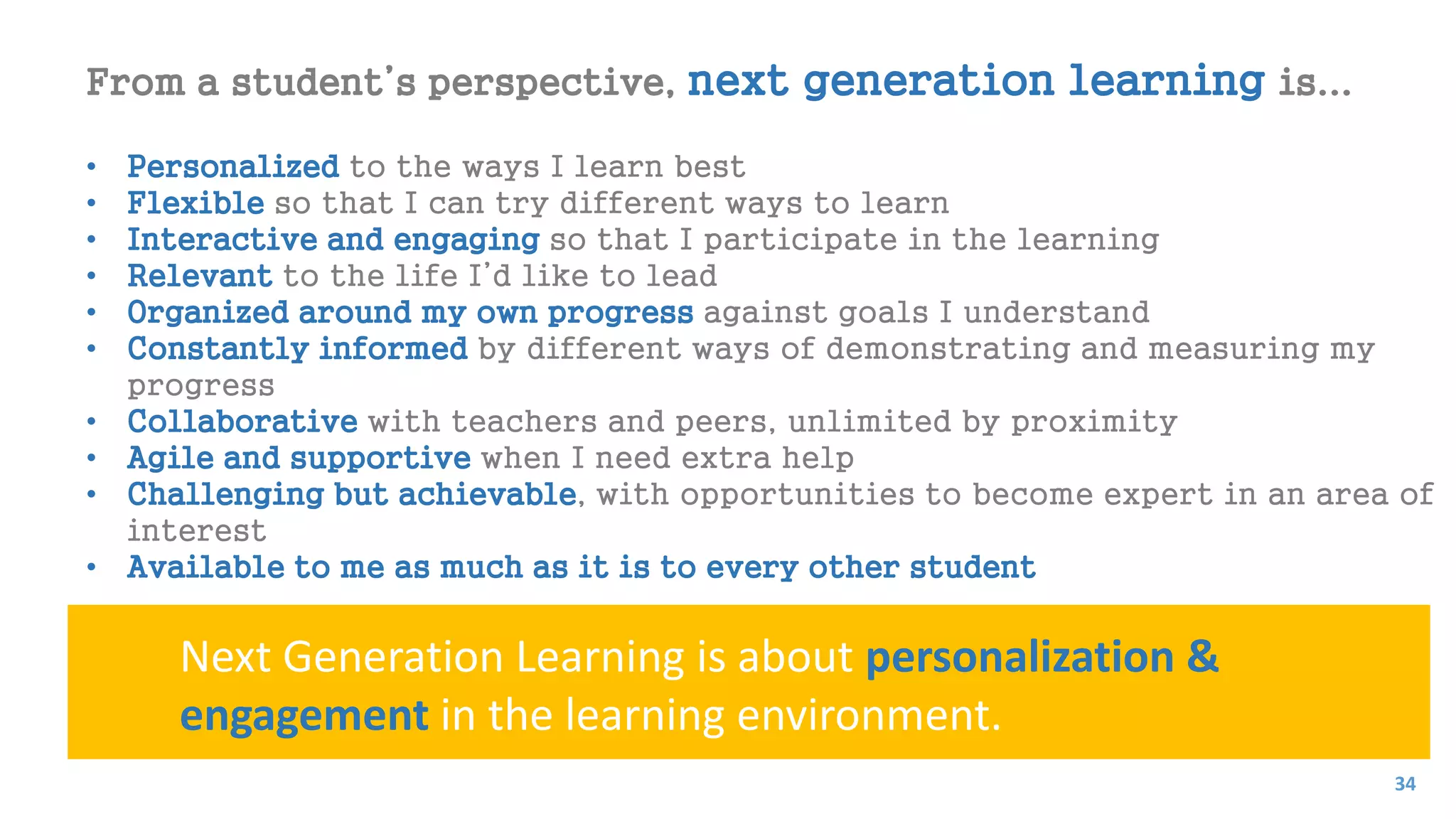
From a student’s perspective, next generation learning is...
• Personalized to the ways I learn best
• Flexible so that I can try different ways to learn
• Interactive and engaging so that I participate in the learning
• Relevant to the life I’d like to lead
• Organized around my own progress against goals I understand
• Constantly informed by different ways of demonstrating and measuring my
progress
• Collaborative with teachers and peers, unlimited by proximity
• Agile and supportive when I need extra help
• Challenging but achievable, with opportunities to become expert in an area of
interest
• Available to me as much as it is to every other student
Next Generation Learning is about personalization &
engagement in the learning environment.
34
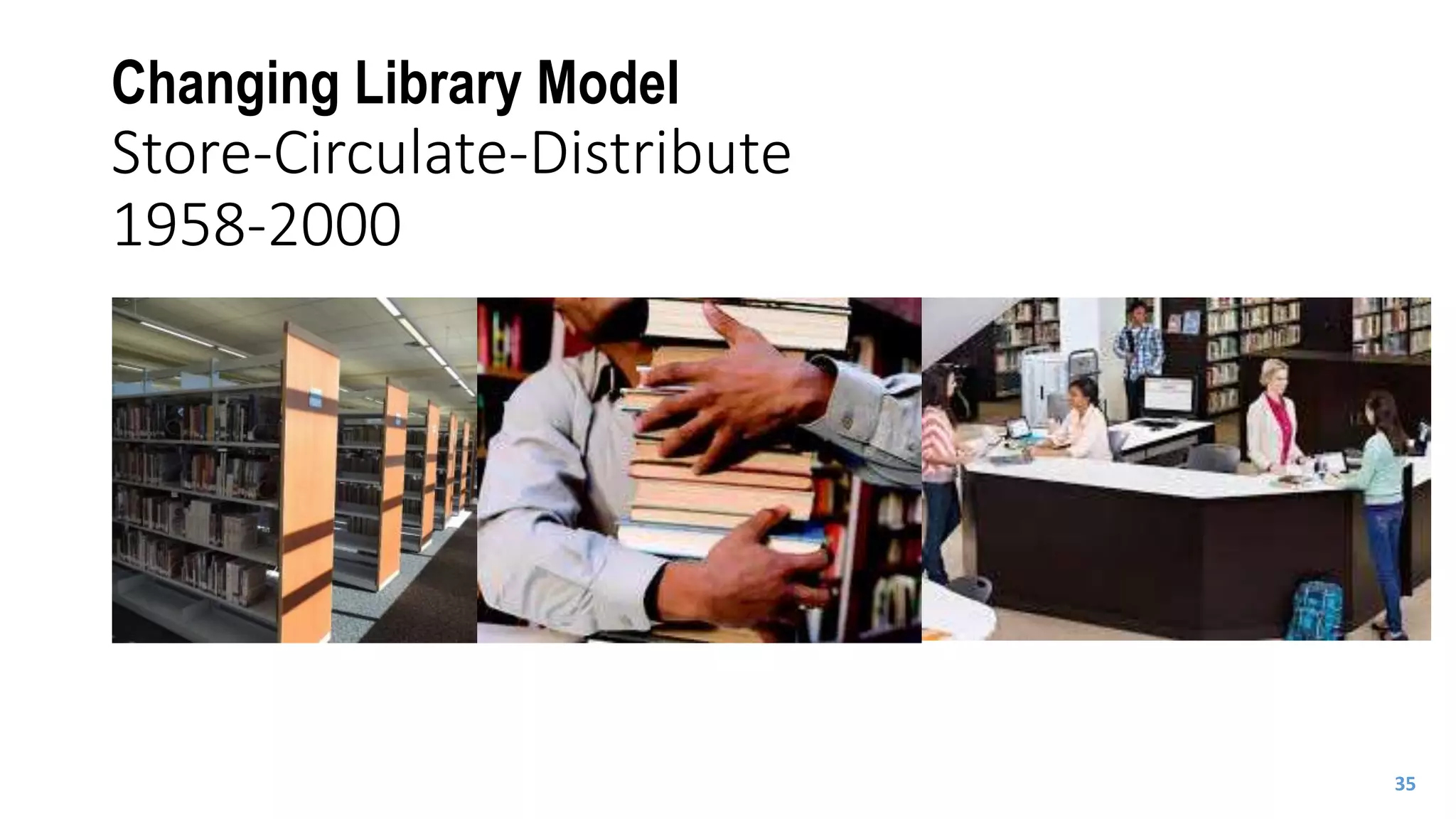
Changing Library Model
Store-Circulate-Distribute
1958-2000
35
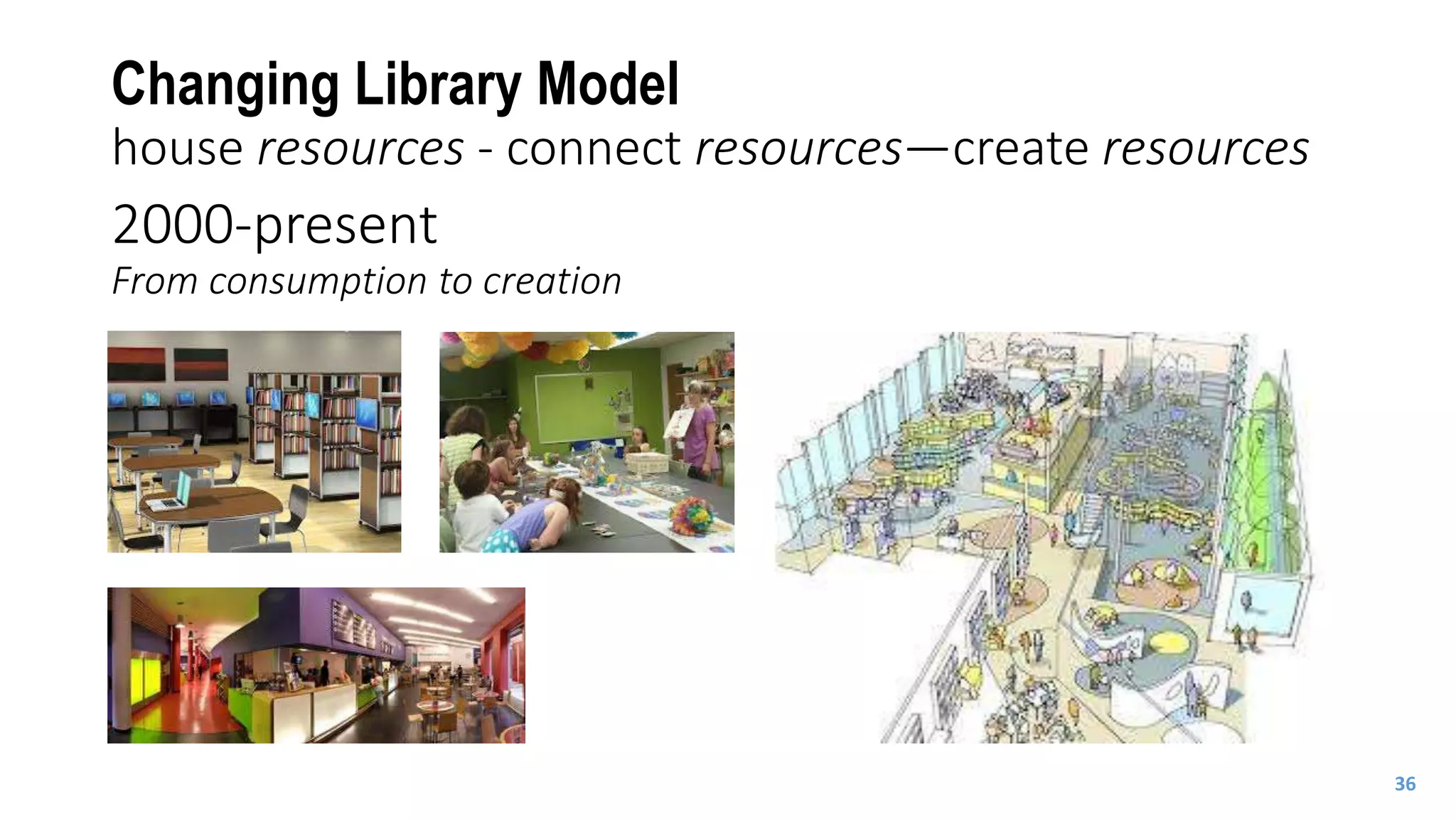
Changing Library Model
house resources - connect resources—create resources
2000-present
From consumption to creation
36
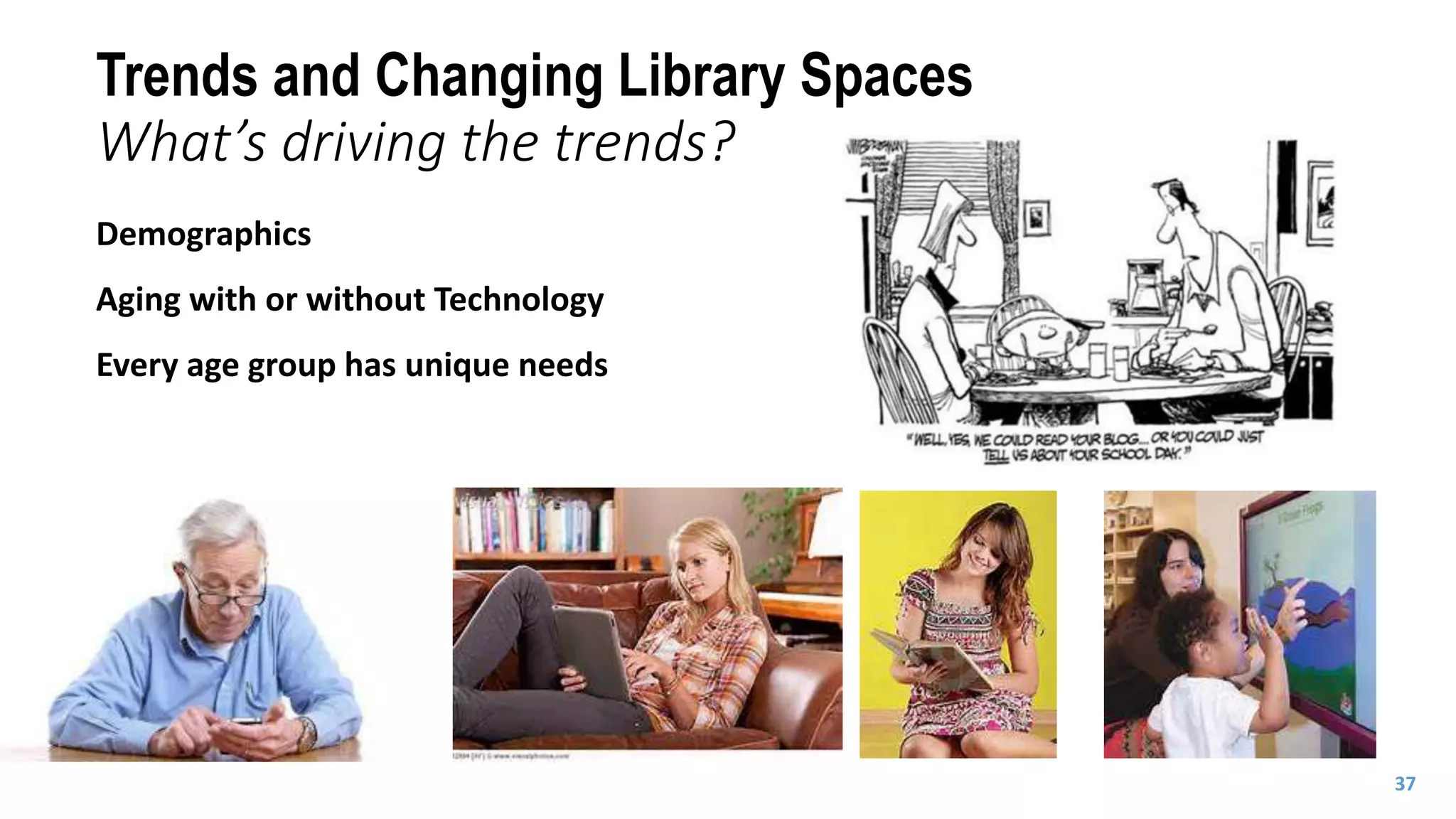
Trends and Changing Library Spaces
What’s driving the trends?
Demographics
Aging with or without Technology
Every age group has unique needs
37
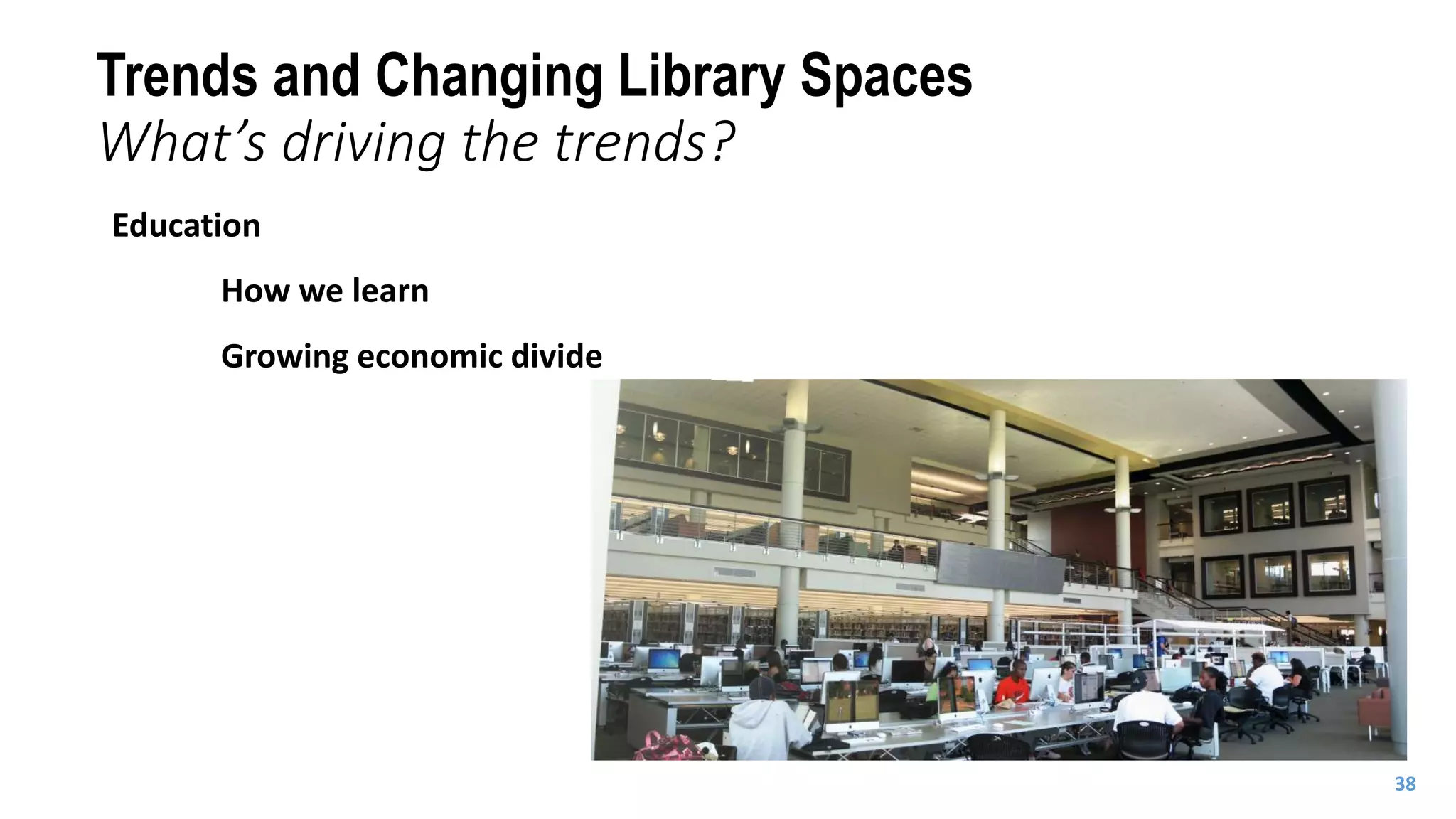
Education
How we learn
Growing economic divide
Trends and Changing Library Spaces
What’s driving the trends?
38
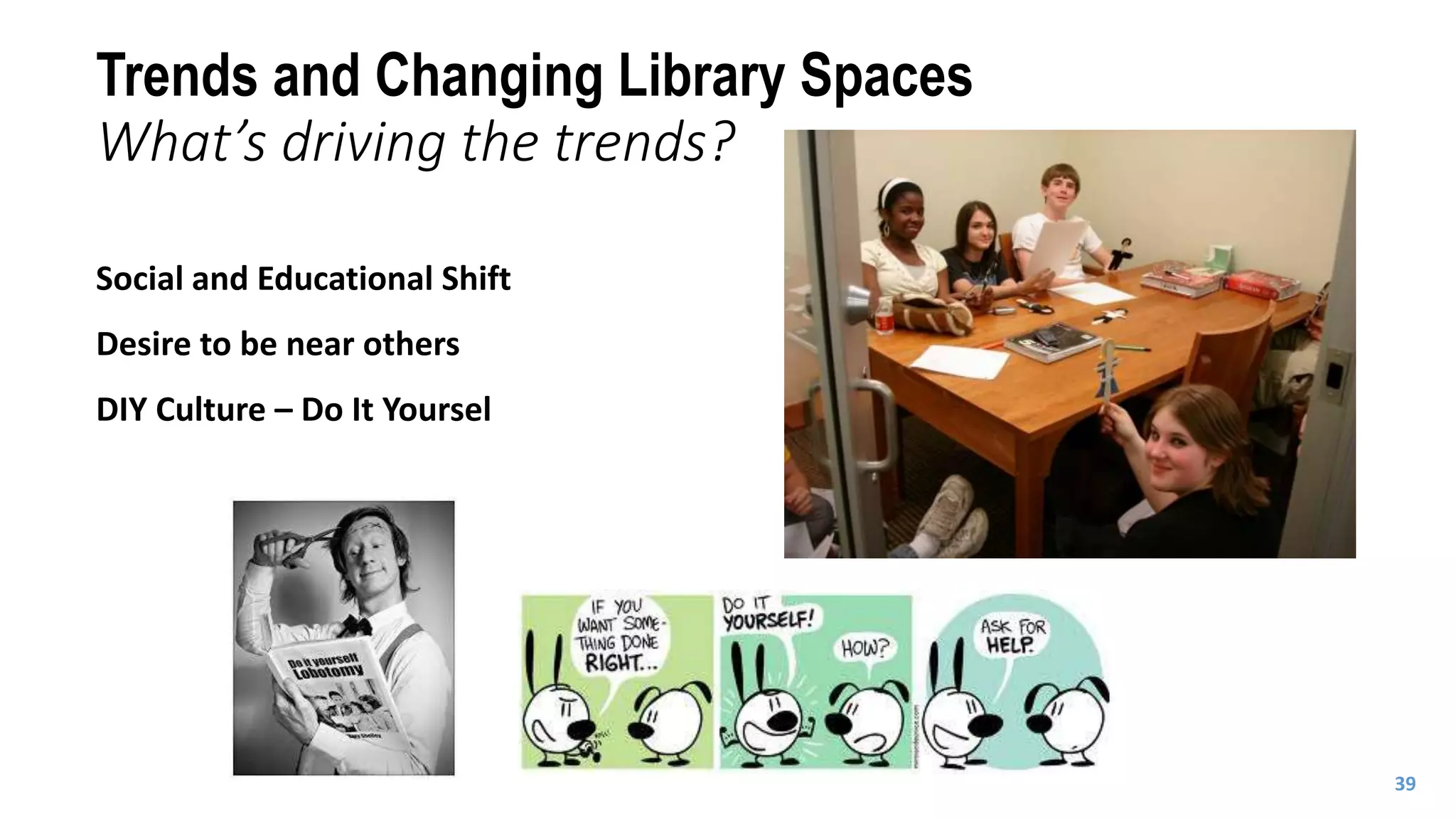
Social and Educational Shift
Desire to be near others
DIY Culture – Do It Yoursel
Trends and Changing Library Spaces
What’s driving the trends?
39
Trends and Changing Library Spaces
What’s shrinking?
• Enhancements to
patron self-service
(more powerful “self-
check”) such as mobile
device checkout
40
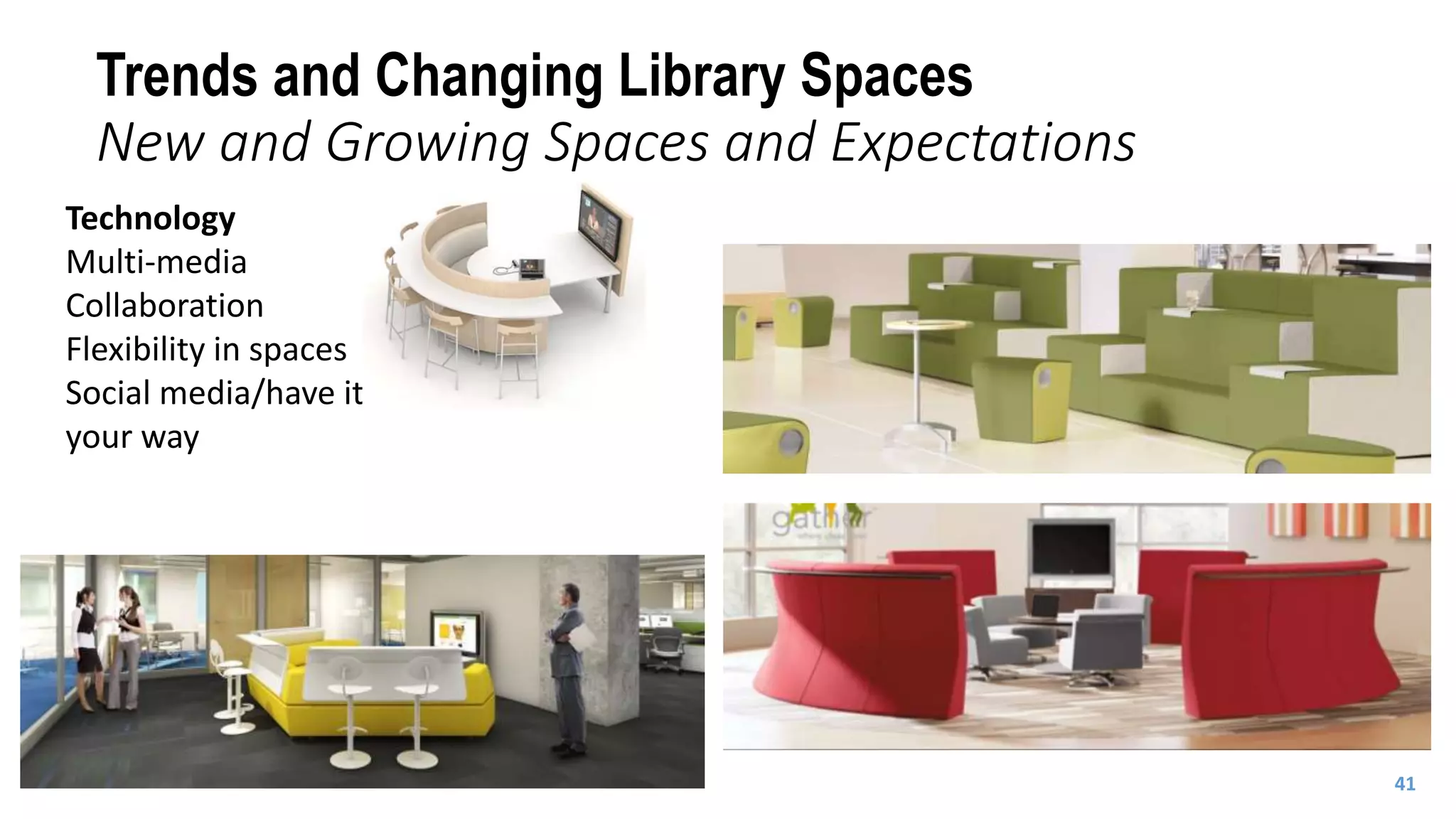
Technology
Multi-media
Collaboration
Flexibility in spaces
Social media/have it
your way
Trends and Changing Library Spaces
New and Growing Spaces and Expectations
41
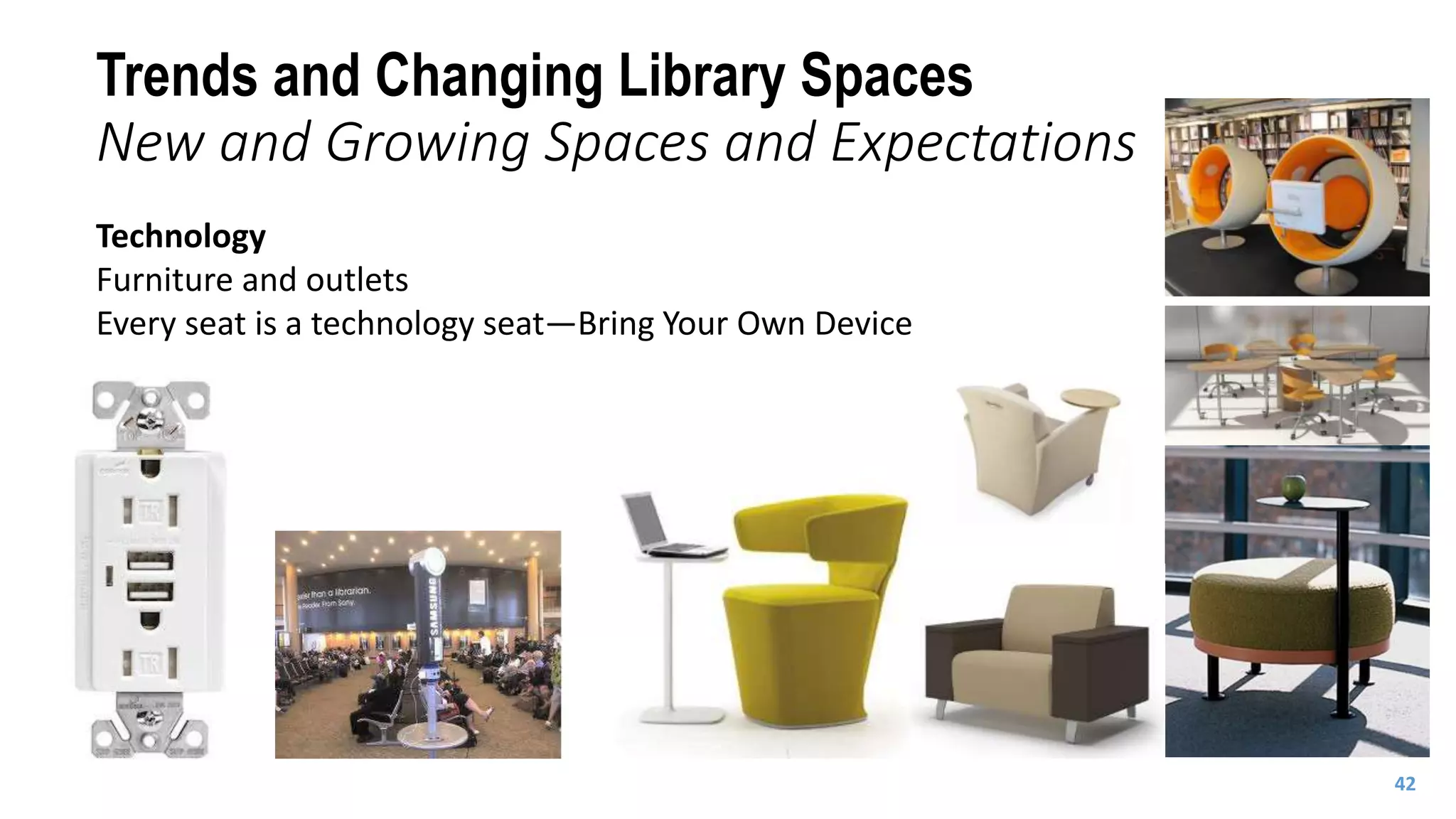
Technology
Furniture and outlets
Every seat is a technology seat—Bring Your Own Device
Trends and Changing Library Spaces
New and Growing Spaces and Expectations
42
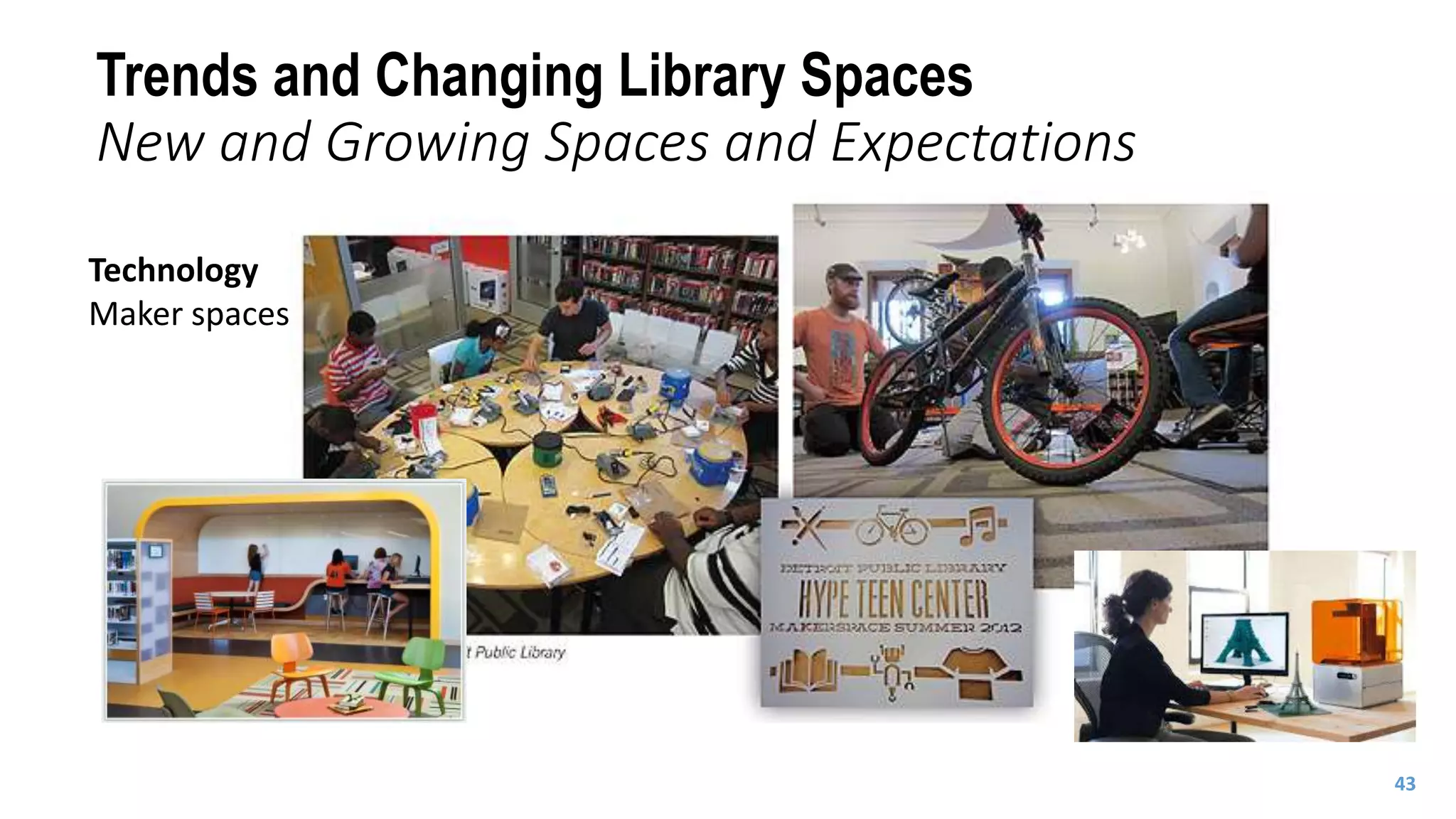
Technology
Maker spaces
Trends and Changing Library Spaces
New and Growing Spaces and Expectations
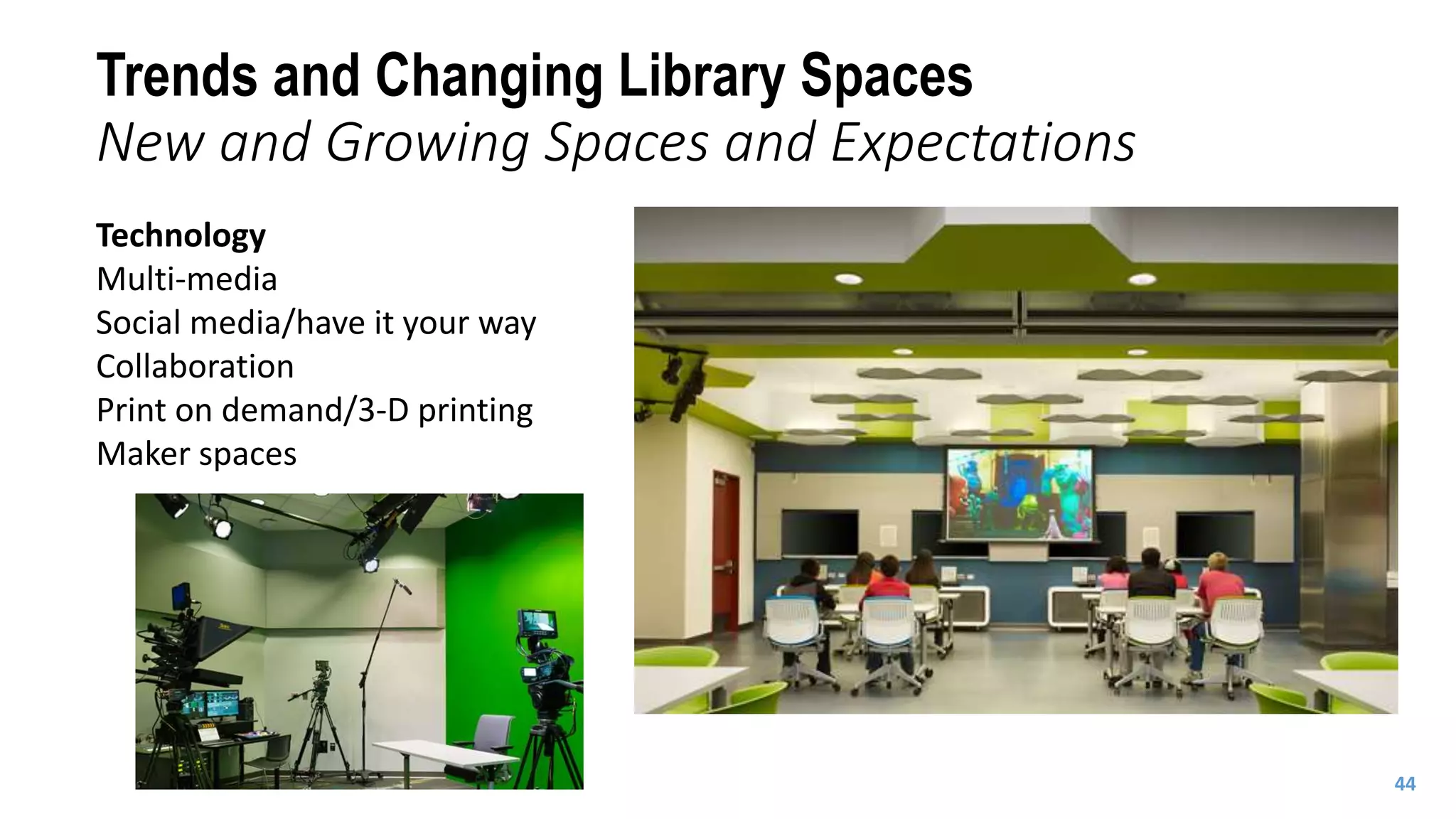
43
Technology
Multi-media
Social media/have it your way
Collaboration
Print on demand/3-D printing
Maker spaces
Trends and Changing Library Spaces
New and Growing Spaces and Expectations
44
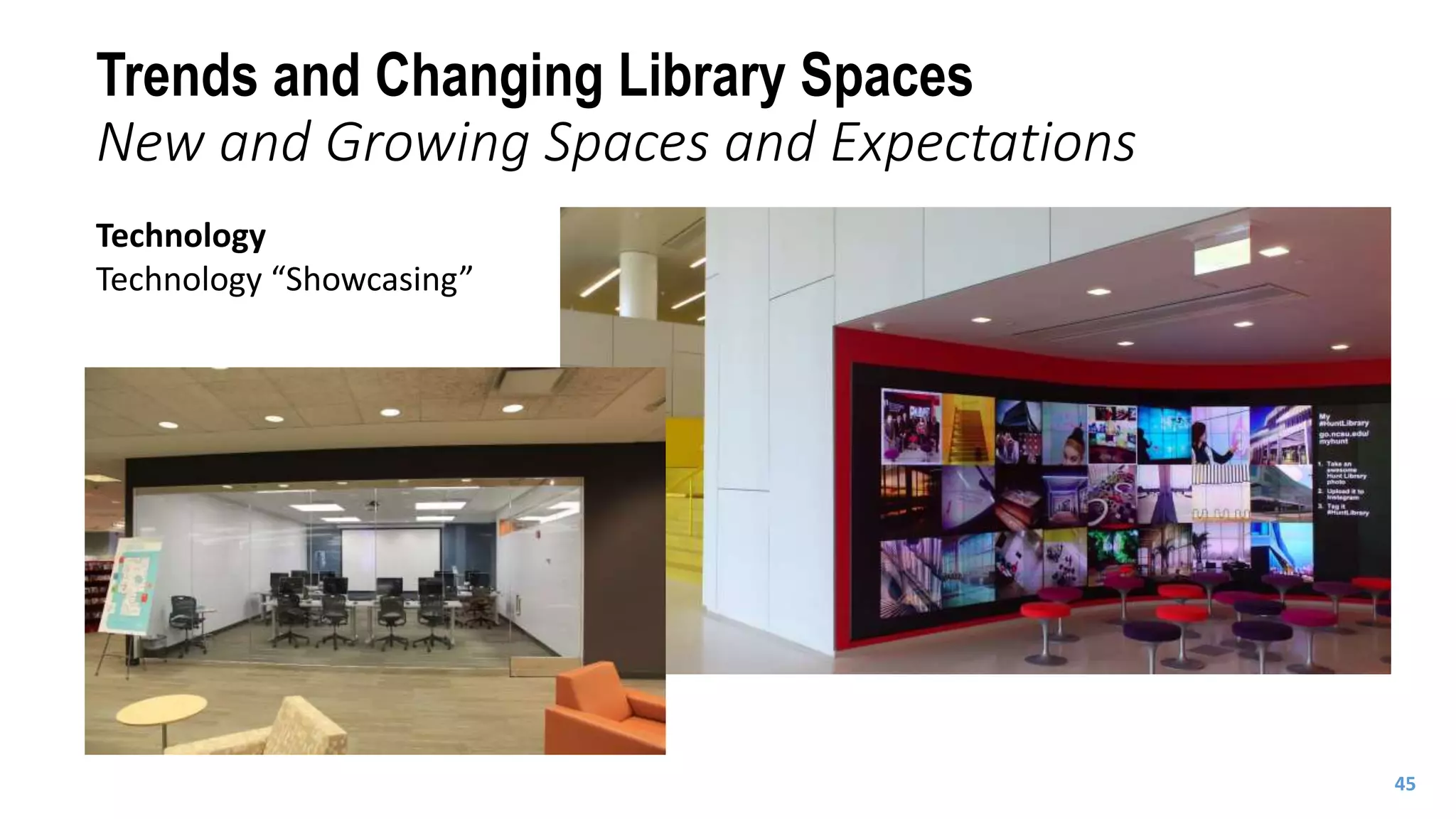
Technology
Technology “Showcasing”
Trends and Changing Library Spaces
New and Growing Spaces and Expectations
45
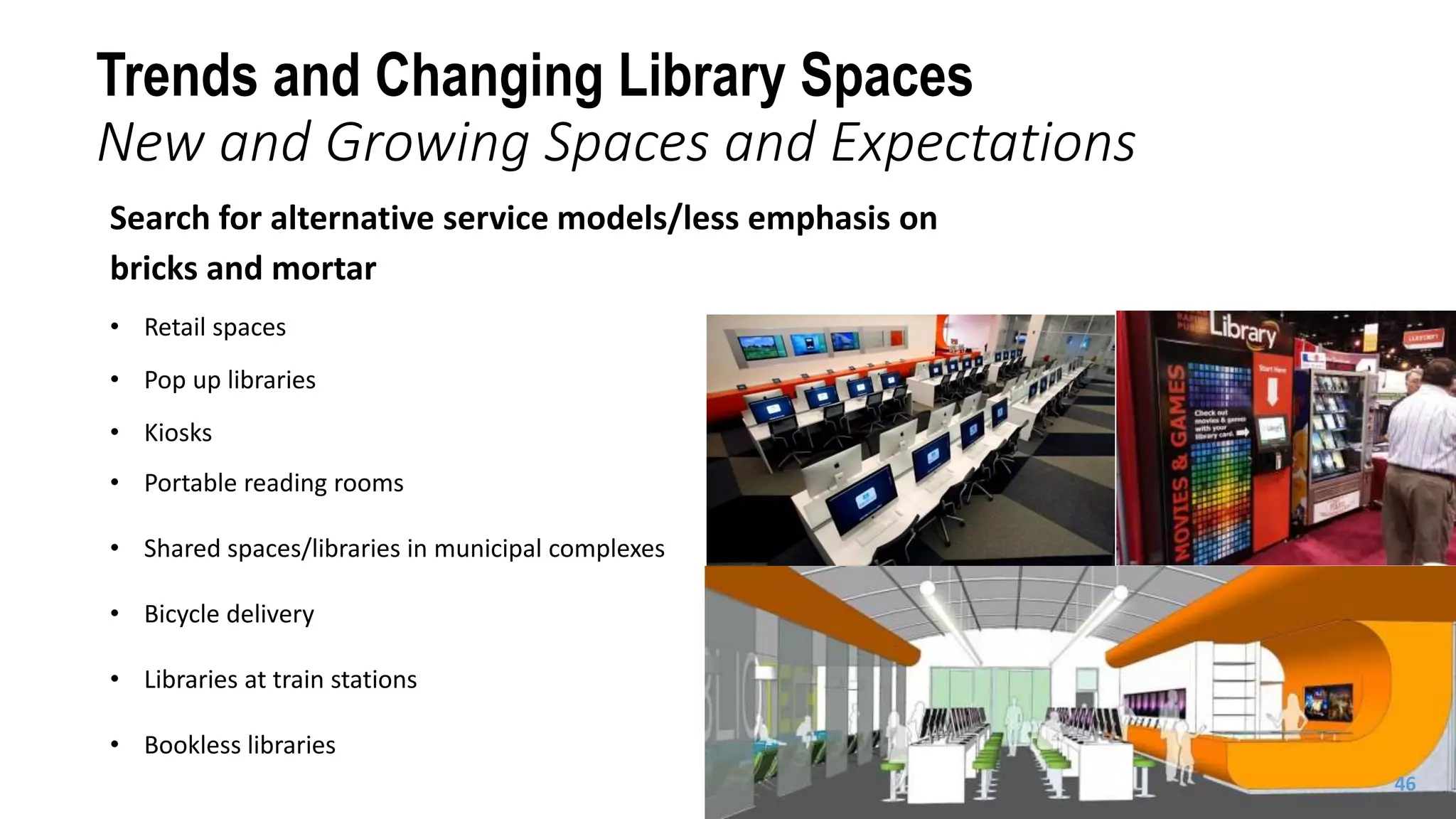
Search for alternative service models/less emphasis on
bricks and mortar
• Retail spaces
• Pop up libraries
• Kiosks
• Portable reading rooms
• Shared spaces/libraries in municipal complexes
• Bicycle delivery
• Libraries at train stations
• Bookless libraries
Trends and Changing Library Spaces
New and Growing Spaces and Expectations
46
IMAGES
A TOUR OF INDUSTRY
47
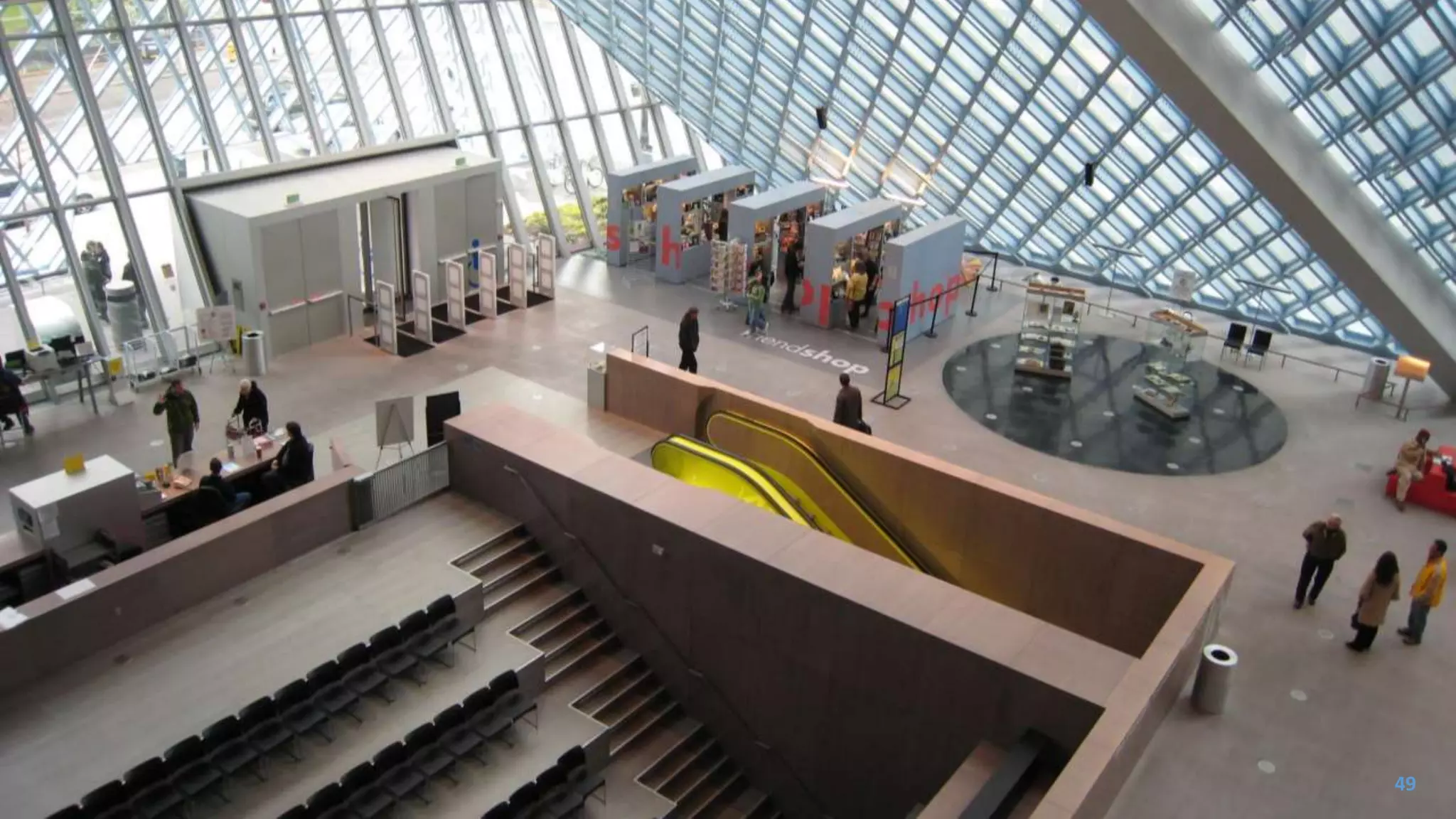
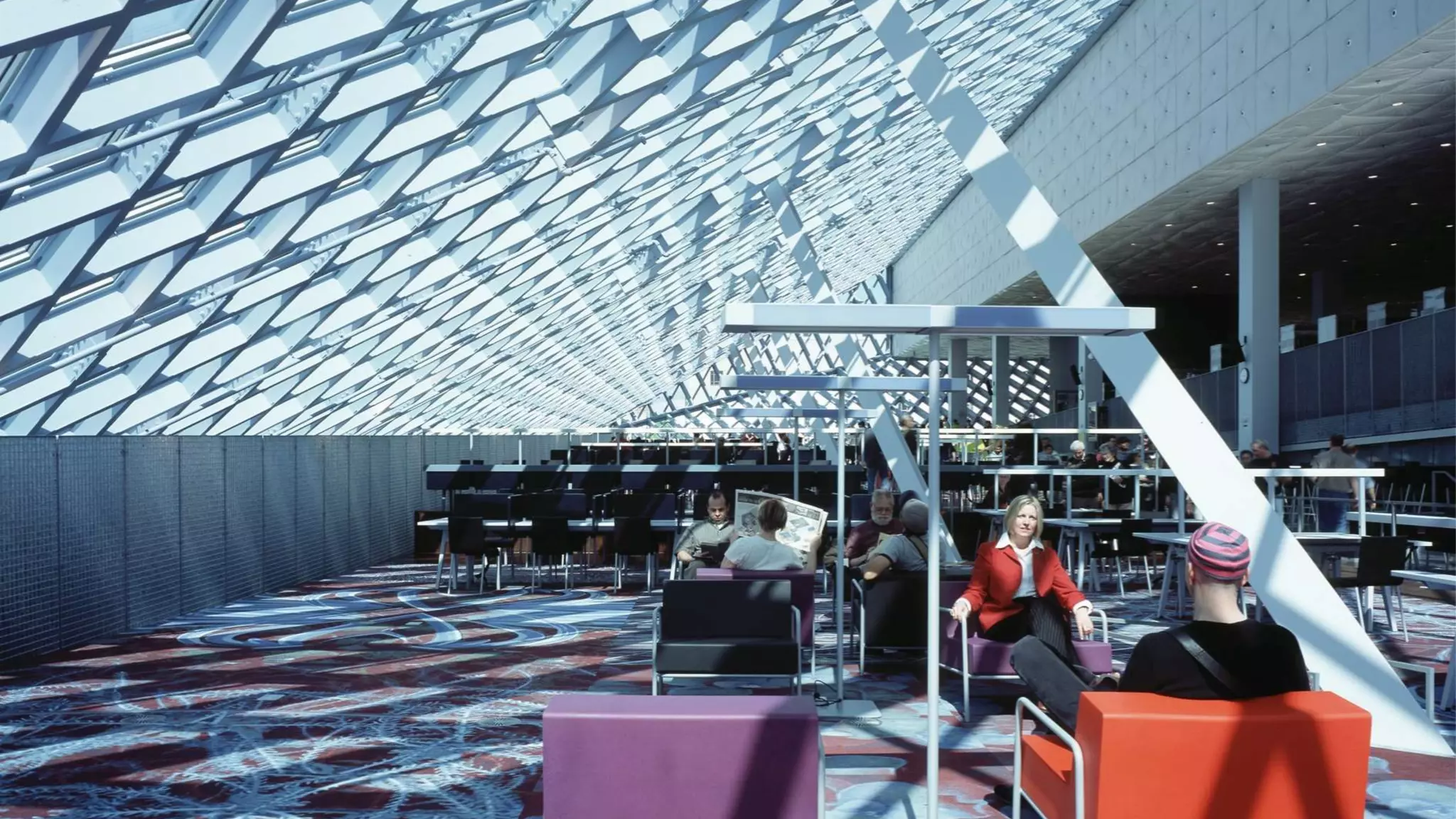
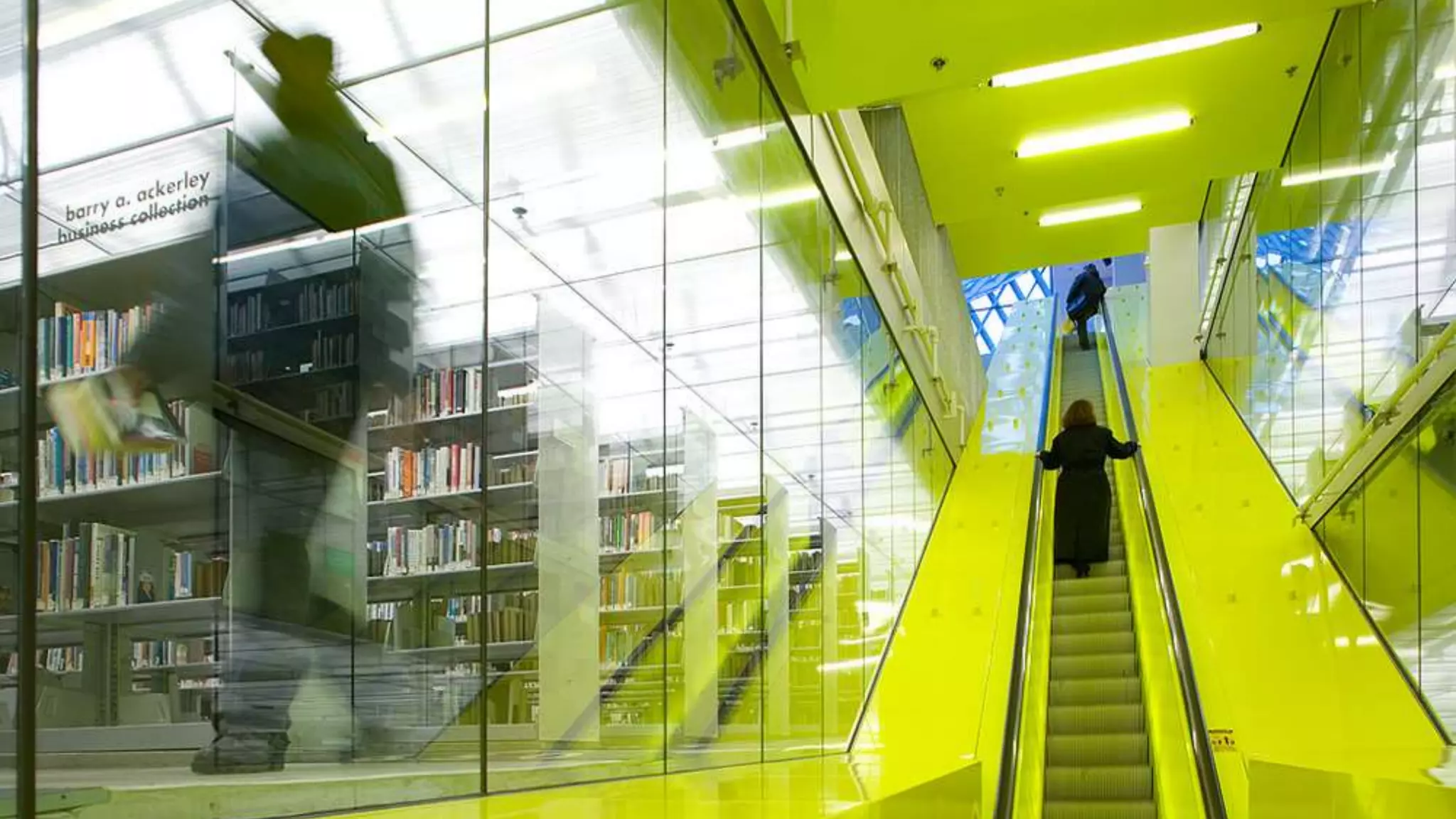
Seattle Central LibrarySeattle Public Library 48
49
50
51
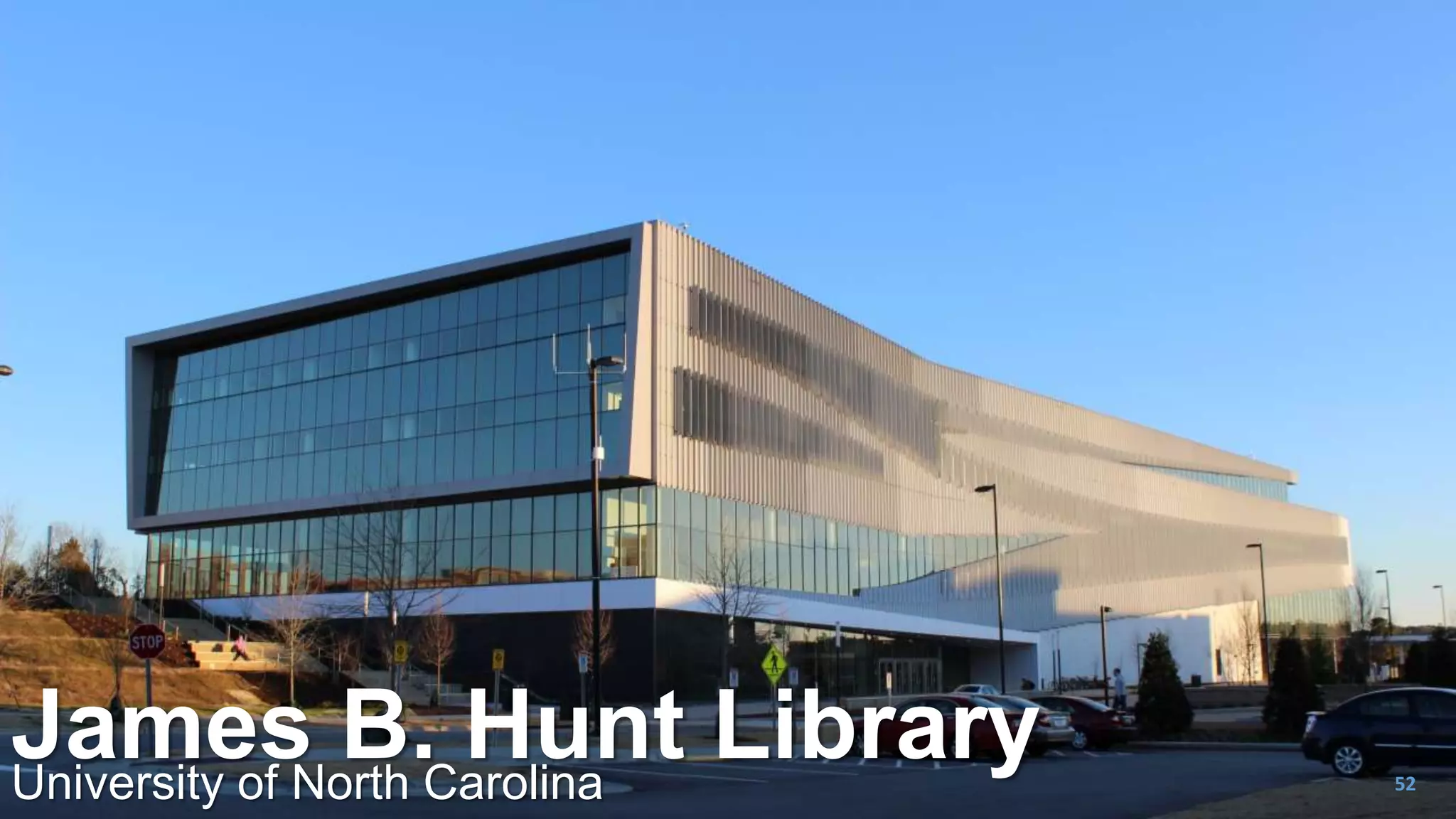
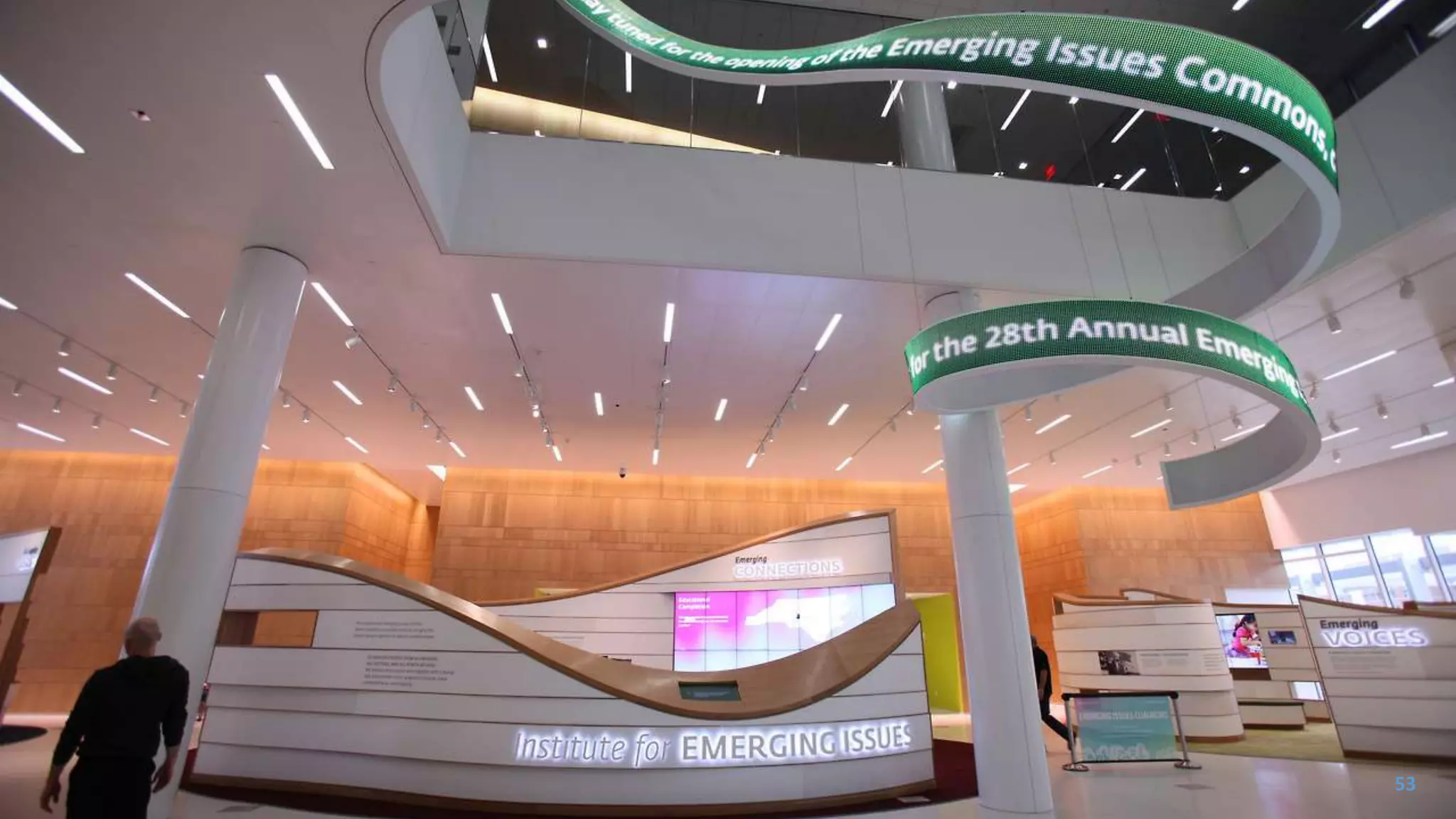
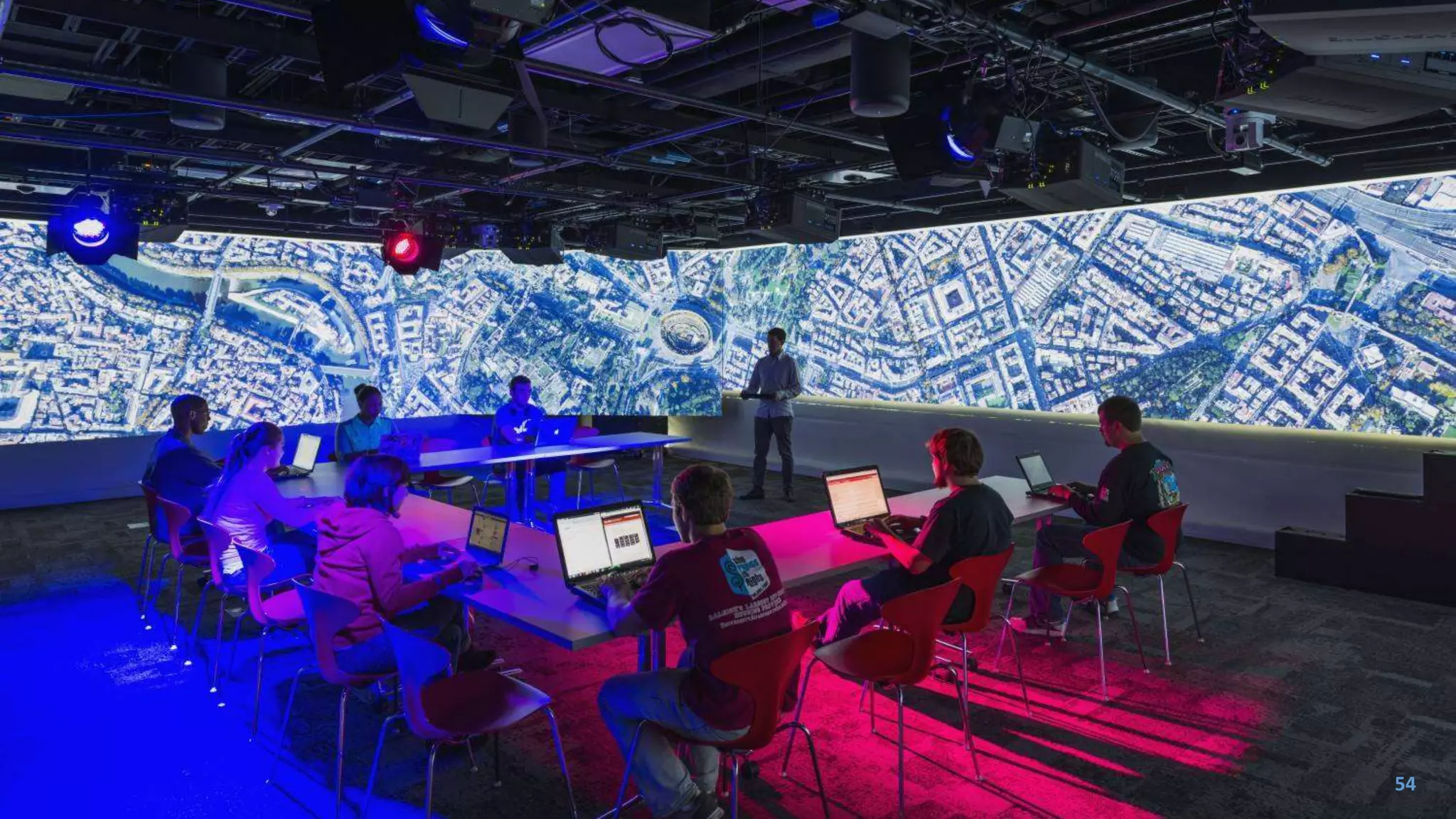
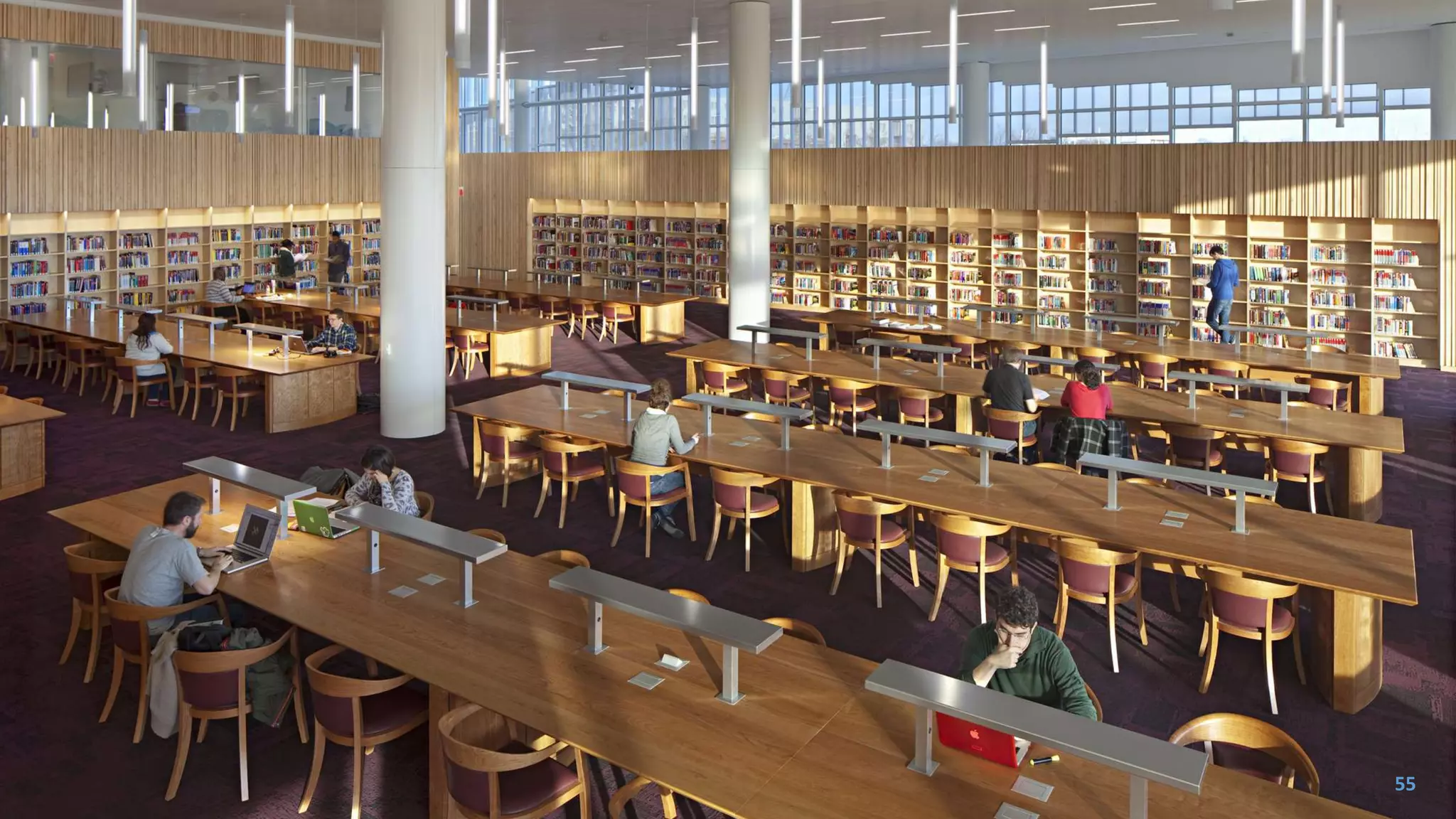
James B. Hunt LibraryUniversity of North Carolina 52
53
54
55
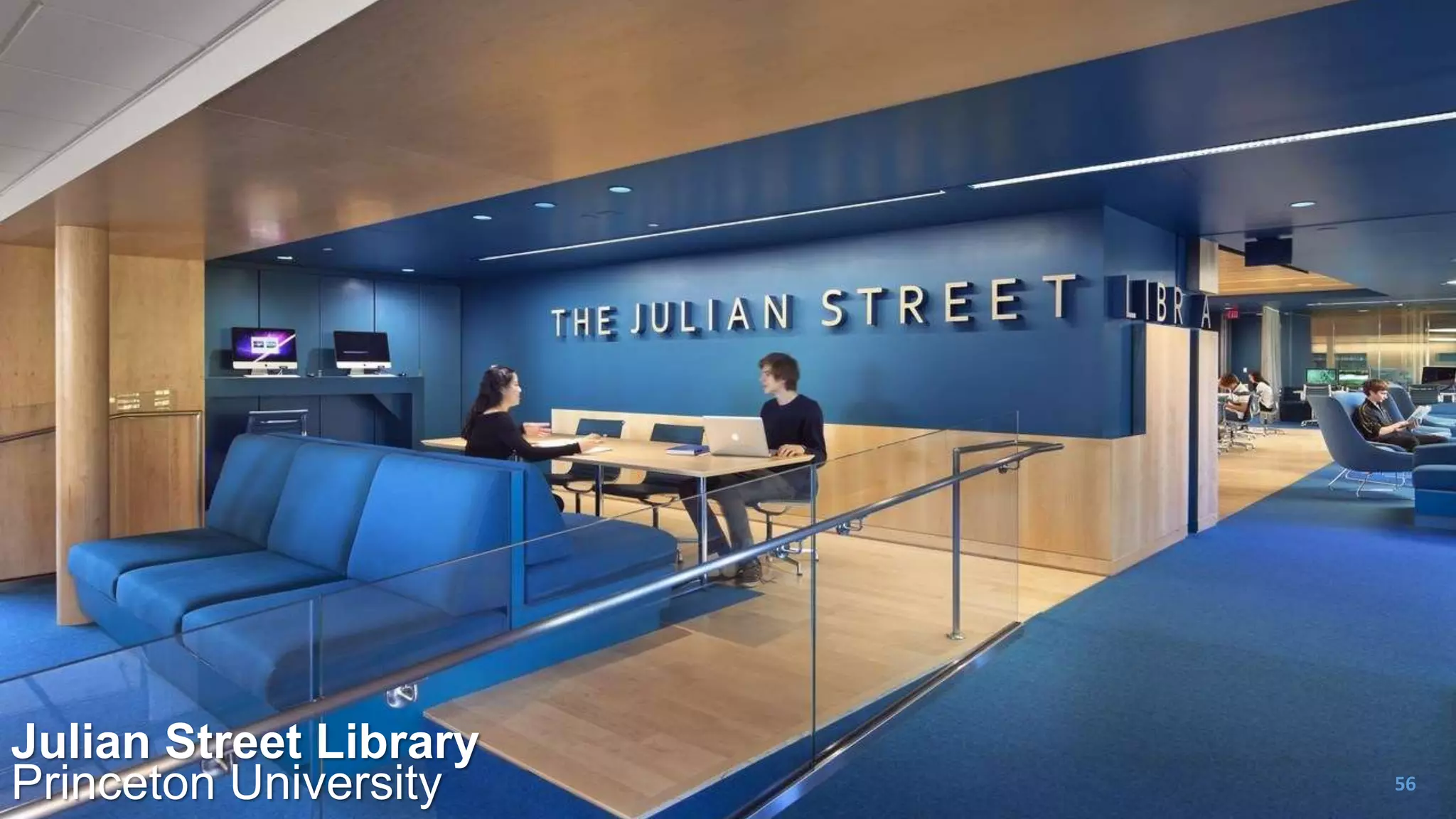
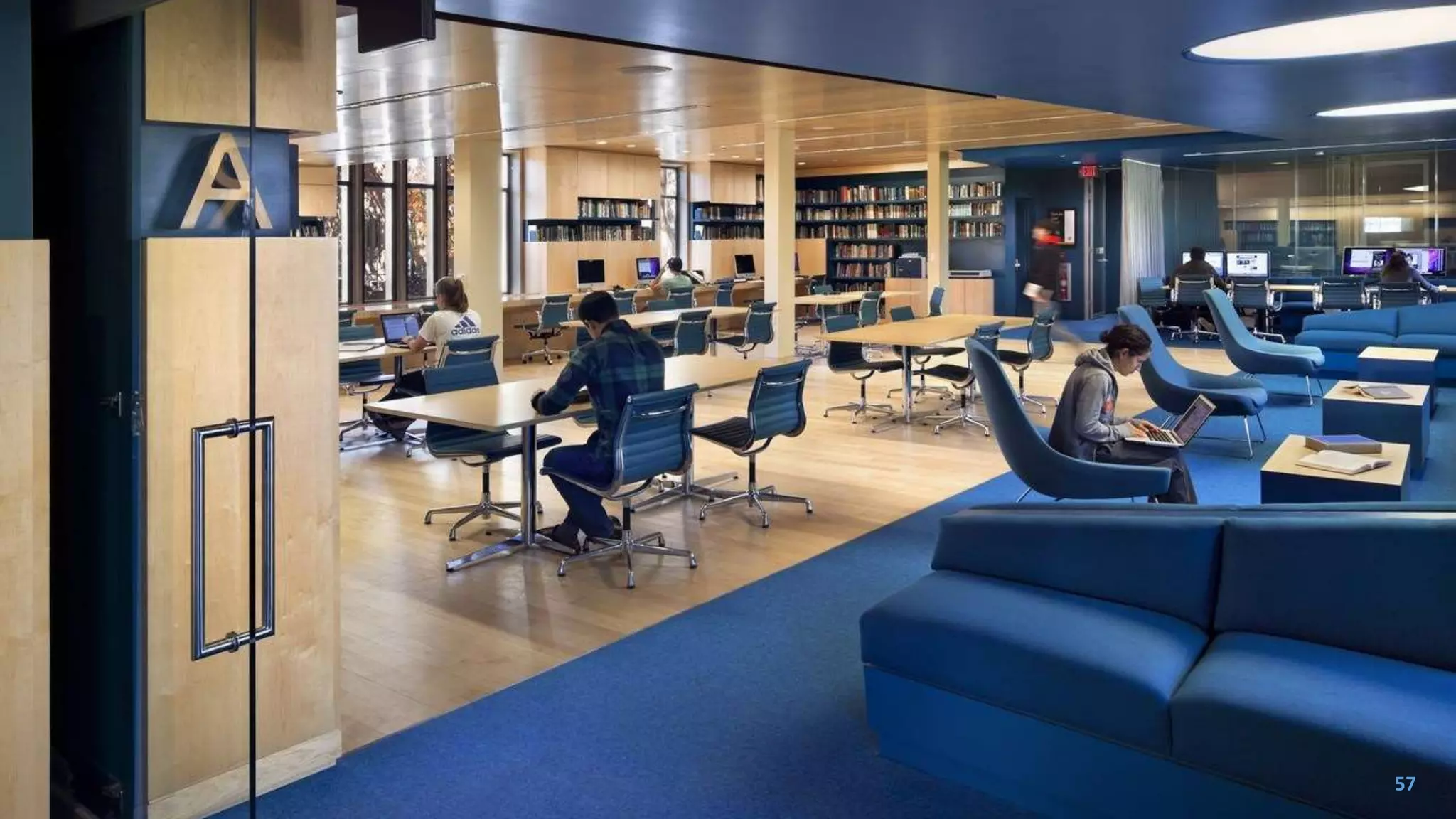
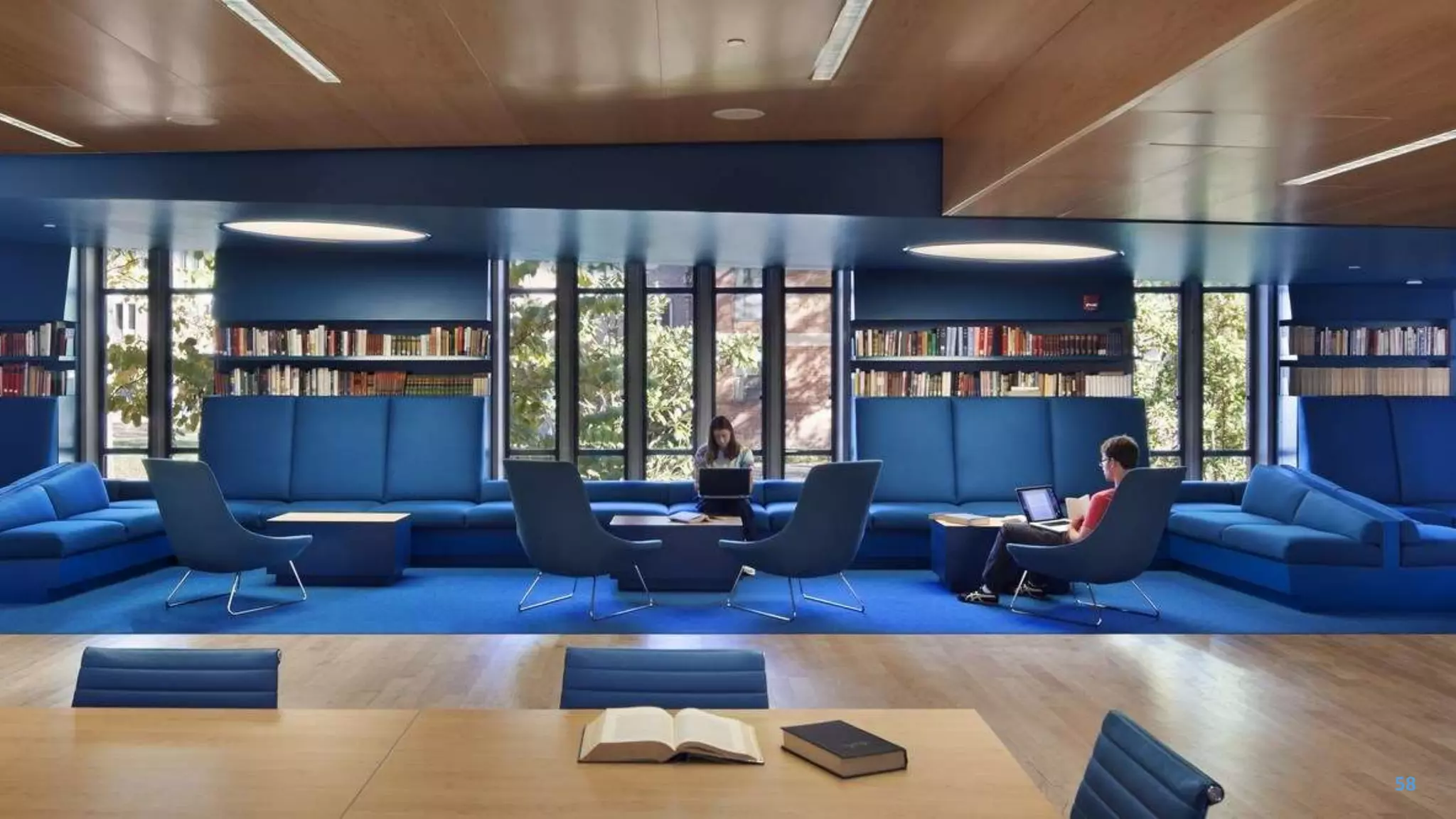
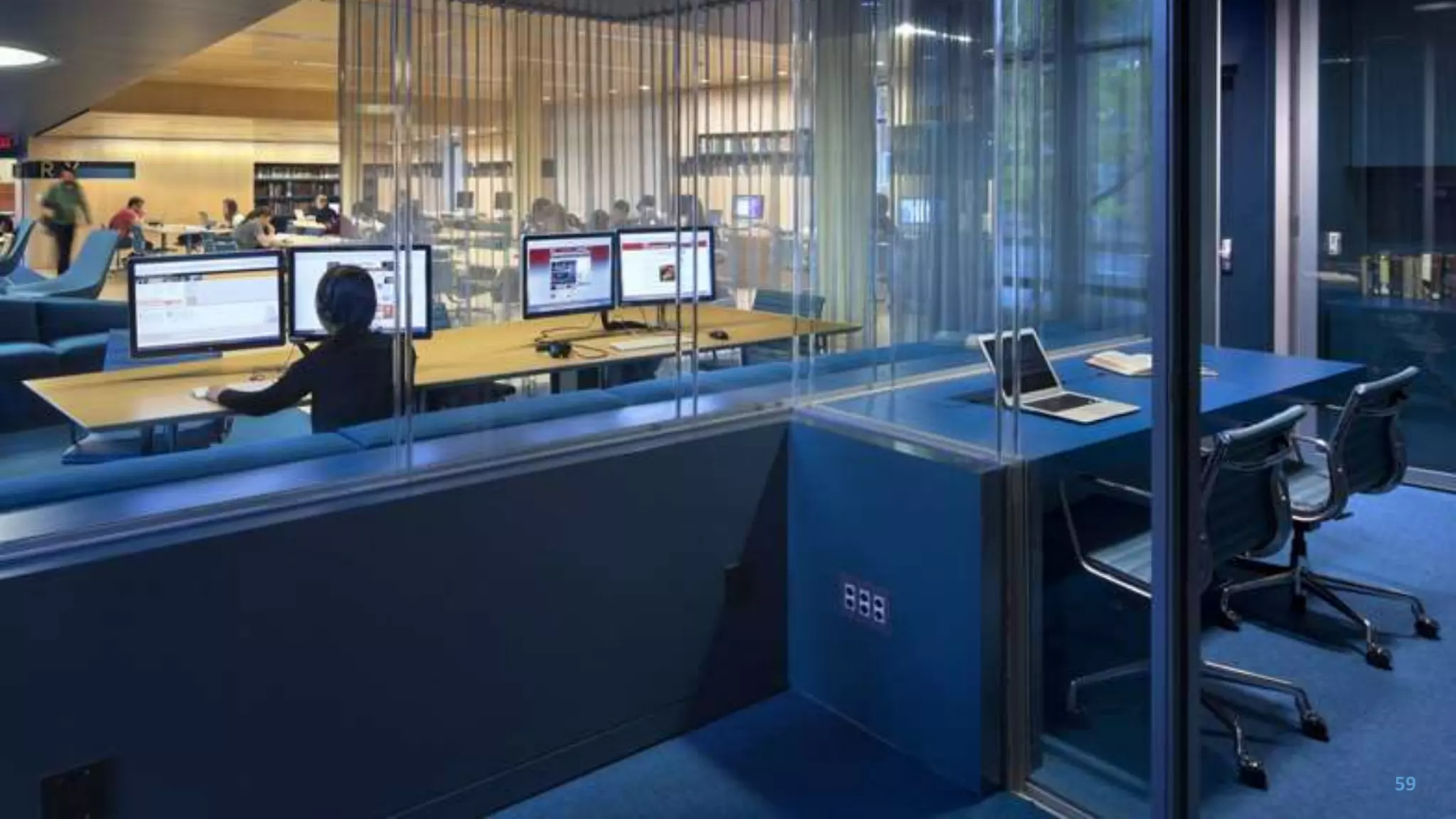
Julian Street Library
Princeton University 56
57
58
59
So .............. where are you on
your Learning Commons
journey?
60
2016 TLA Annual Conference - Texas Library Association
THANK YOU!
61

Reinvent Your School Library Space

  • 1.
    Reinvent Your School LibrarySpace 1April 21, 2016
  • 2.
    • Library Services •Purpose/Process/Principal • Design A G E N D A 2
  • 3.
    LIBRARY SERVICES Next GenerationLearning Environment REINVENT YOUR SCHOOL LIBRARY SPACE 3
  • 4.
  • 5.
  • 6.
  • 7.
    Sinek, Simon. Startwith Why: How Great Leaders Inspire Everyone to Take Action. New York: Portfolio, 2009. Print. 7
  • 8.
    The Golden Circle 8 "TheGolden Circle." Flickr. Yahoo! Web. 20 Apr. 2016.
  • 9.
    • The shiftof the library from a place of consumption to a place of creation – the “Participatory Library” • Makerspaces (low tech to high tech – knitting circles, lego leagues, robotics, hackerspaces, Minecraft/similar, 3-d printing, clean and messy) • Programs promoting writing (NaNoWriMo (National Novel Writing Month), collection and curating local history, “storycore” oral histories, more) • Media creation labs • Different spaces and/or services for different groups • Re-design of staff resources to support active service models (roaming and one-desk) • Design of flexible physical spaces to adapt to new needs over time • Enhancements to patron self-service (more powerful “self check”) • Technology “showrooming” (a place for the public to see and experience new technology devices – an expansion of the ‘technology pettign zoo” idea) 9 Trends and Changing Library Spaces New and Growing Spaces and Expectations
  • 10.
    Pivot Points Include leadersin professional learning Drive change with librarians Enact tiered visioning Nurture content-specific PLCs Support real risk-taking 10
  • 11.
    Learning Outcomes 11  Knowledge Information Processes  Technology  Reading  Independent learning  Developing self-concept and personal agency  Attitudes that value information and learning
  • 12.
    Next Generation LearningEnvironment REINVENT YOUR SCHOOL LIBRARY SPACE PURPOSE / PROCESS / PRINCIPAL 12
  • 13.
    REFORMING SCHOOL CULTURE: FOSTERINGINNOVATIVE LEARNING ENVIRONMENTS From an archive of resources to an Active Learning Commons 13
  • 14.
    ★ Fostering the4 C’s ★ Flexible Learning Environments ★ New Digital Learning Environments - GAFE  Cultivating engaged, differentiated and meaningful learning ★ Reform Best Practices - From a Library to an Active Learning Commons Collaboration Critical Thinking CommunicationCreativity 14
  • 15.
    TRANSFORM ACADEMY ★ Positiveimpact on culture and student engagement - creating engaging learning for all students ★ Emerging tools to help students own their learning ★ How can teachers redesign assignments that we give kids through GAFE and Classroom ★ Teacher from Klein ISD 15
  • 16.
    LEARNING OUTCOMES/TARGETS IN THEDISTRICT’S MISSION STATEMENT, THE SCHOOL BOARD HAS CHARGED US WITH CREATING ENGAGING LEARNING EXPERIENCES FOR STUDENTS. • RESEARCH THE USE OF LEADING EDGE TECHNOLOGIES FOR KLEIN CLASSROOMS USING A PROJECT BASED LEARNING APPROACH AND PILOT THE USE WITH STUDENTS. • FACILITATE INTERACTIVE, ENGAGING AND FUTURE-READY CLASSROOMS THAT SUPPORT HIGH LEVELS OF LEARNING FOR ALL STUDENTS. • THE ROLE OF THE PRINCIPAL IS TO BE A LEAD LEARNER DOING THE SAME LEARNING AS THE TEACHER SO THEY FEEL COMFORTABLE TAKING RISKS IN A NEW ENVIRONMENT 16
  • 17.
    ● Culture ofour schools is changing! ● Teachers are taking risks to reform their instructional practices ● Students and teachers are creating, inventing, and sharing their excitement for learning FINAL PRODUCTS CLASSROOM INNOVATION 17
  • 18.
  • 19.
  • 20.
  • 21.
  • 22.
  • 23.
  • 24.
  • 25.
  • 26.
  • 27.
  • 28.
  • 29.
    A TRANSFORMATION Dayna’s /Brill library video (Jason’s video) Albert Einstein is reputed to have said that problems cannot be solved using the same thinking that created them. How then can principals best support their libraries? * Educate themselves to library and librarian potential. * Reconfigure the librarian's job to maximize realization of that potential. * Hire high-quality, forward-looking, energetic, innovative librarians. * Provide budget resources adequate to new roles and demands. * Effectively and accurately evaluate both the program and the librarian on jointly developed criteria recognizing library media work as simultaneously integral to instructional quality but distinct from classroom teaching itself. WHY SHOULD PRINCIPALS SUPPORT SCHOOL LIBRARIES? http://www.ericdigests.org/2003-3/libraries.htm 29
  • 30.
    DESIGN Next Generation LearningEnvironment REINVENT YOUR SCHOOL LIBRARY SPACE 30
  • 31.
    “Next generation learning”isn’t about educating the next generation of students. It’s about engaging with today’s students through “next gen” teaching and learning designs that promise significantly higher achievement for many more students than current generation approaches have been able to generate. Next Generation Learning: The Pathway to Possibility Andrew Calkins and Kristen Vogt April 2, 2013 (Revised) 31
  • 32.
    “I'm not goingto buy my kids an encyclopedia. Let them walk to school like I did.” A NEW ARCHITECTURE OF LEARNING NEXT GENERATION LEARNING ENVIRONMENT - Yogi Berra “If you don't know where you are going, you might wind up someplace else.” “If you ask me anything I don't know, I'm not going to answer.” 32
  • 33.
    What are NextGeneration Learning Commons?... “Also known as “scholars' commons”, “information commons”, or “digital commons”, are educational spaces, similar to libraries and classrooms that share space for information technology, remote or online education, tutoring, collaboration, content creation, meetings and reading or study.[1][2]” Wiki Next Generation Learning Environment REINVENT YOUR SCHOOL LIBRARY SPACE Why the name “Learning Commons” ? - “It became clear that the focus of the transformed traditional library should be on learning in its many manifestations, whether formal or informal, and the word “commons” could reflect a shift from a top-down organizational structure to the flat networked world where the clients, both teachers and students, consider themselves to be in command of knowledge building.” - ALA 33
  • 34.
    From a student’sperspective, next generation learning is... • Personalized to the ways I learn best • Flexible so that I can try different ways to learn • Interactive and engaging so that I participate in the learning • Relevant to the life I’d like to lead • Organized around my own progress against goals I understand • Constantly informed by different ways of demonstrating and measuring my progress • Collaborative with teachers and peers, unlimited by proximity • Agile and supportive when I need extra help • Challenging but achievable, with opportunities to become expert in an area of interest • Available to me as much as it is to every other student Next Generation Learning is about personalization & engagement in the learning environment. 34
  • 35.
  • 36.
    Changing Library Model houseresources - connect resources—create resources 2000-present From consumption to creation 36
  • 37.
    Trends and ChangingLibrary Spaces What’s driving the trends? Demographics Aging with or without Technology Every age group has unique needs 37
  • 38.
    Education How we learn Growingeconomic divide Trends and Changing Library Spaces What’s driving the trends? 38
  • 39.
    Social and EducationalShift Desire to be near others DIY Culture – Do It Yoursel Trends and Changing Library Spaces What’s driving the trends? 39
  • 40.
    Trends and ChangingLibrary Spaces What’s shrinking? • Enhancements to patron self-service (more powerful “self- check”) such as mobile device checkout 40
  • 41.
    Technology Multi-media Collaboration Flexibility in spaces Socialmedia/have it your way Trends and Changing Library Spaces New and Growing Spaces and Expectations 41
  • 42.
    Technology Furniture and outlets Everyseat is a technology seat—Bring Your Own Device Trends and Changing Library Spaces New and Growing Spaces and Expectations 42
  • 43.
    Technology Maker spaces Trends andChanging Library Spaces New and Growing Spaces and Expectations 43
  • 44.
    Technology Multi-media Social media/have ityour way Collaboration Print on demand/3-D printing Maker spaces Trends and Changing Library Spaces New and Growing Spaces and Expectations 44
  • 45.
    Technology Technology “Showcasing” Trends andChanging Library Spaces New and Growing Spaces and Expectations 45
  • 46.
    Search for alternativeservice models/less emphasis on bricks and mortar • Retail spaces • Pop up libraries • Kiosks • Portable reading rooms • Shared spaces/libraries in municipal complexes • Bicycle delivery • Libraries at train stations • Bookless libraries Trends and Changing Library Spaces New and Growing Spaces and Expectations 46
  • 47.
    IMAGES A TOUR OFINDUSTRY 47
  • 48.
  • 49.
  • 50.
  • 51.
  • 52.
    James B. HuntLibraryUniversity of North Carolina 52
  • 53.
  • 54.
  • 55.
  • 56.
  • 57.
  • 58.
  • 59.
  • 60.
    So .............. whereare you on your Learning Commons journey? 60
  • 61.
    2016 TLA AnnualConference - Texas Library Association THANK YOU! 61

Editor's Notes

  • #7 Next Generation Learning: The Pathway to Possibility Andrew Calkins and Kristen Vogt April 2, 2013 (Revised)
  • #14 Slide 1 - intro, what’s the purpose for reforming school culture? As campus leaders, we want to create a learning environment that promotes innovation and creativity that challenges all learners
  • #15 Slide 6 - What is the driving our transformation in learning? Everything we do we focus on what’s best for students and focus on the 4 Cs……. Additionally, we envisioned flexible learning spaces that support the 4 Cs Leading technology tools, such as GAFE and Classroom have allowed our teachers to effectively differentiate learning, while creating a student-centered, high-tech environment where students are owning their learning in a high engagement setting Finally, principals are pursuing their passion and reforming best practices right inside our schools, such as transforming a library of archived resources and traditions, into an active learning commons with a makerspace that enriches students through S T E A M without the pressure of receiving a grade, and instead, inspired to create, make, and present their work through innovation
  • #16 Slide 7 - Klein ISD focused district-wide through a collaborative effort, called the Transform Academy. It’s purposed was to create a positive impact on culture and student engagement, to make learning meaningful, and higher level in a non-traditional classroom setting. Teachers researched emerging tools to help students take ownership for their learning, which ultimately increases achievement, increases attendance in school, and decreases student discipline. Collectively in PLC and job embedded training, teachers are redesigning their instructional practices and project-based learning to effectively using digital tools through the use of GAFE and Classroom to deliver instruction with innovation and productivity, creating future-ready learners. Take a look at this short video from one of the transform academy teachers…..
  • #17 What were our intended outcomes of Transform, from the principal’s perspective, and the teachers? Together, we supported our distritct’s mission statement with creating engaging learning experiences for all students. The team of principals and teachers researched leading edge technologies for our classrooms using a PBL approach to pilot with our students. We facilitated interactive, engaging and future-ready lessons, through teaching our TEKS, that support high levels of learning for all students in a creative, collaborative setting. Intended outcomes of student learning were measured through formative assessments, such as rubrics, and checkpoints along the way. The students are also accountable for measuring and tracking their progress, and growth through their learning process. As a principal, my job is to be the lead learner on my campus, by reading, researching, engaging in classroom lessons, reflecting with teachers in PLC, and studying data with all stakeholders. I want my teachers to feel comfortable to take risks in a new-style learning environment. The outcomes so far are simply AMAZING! 3 teachers, have spread their positive virus throughout our entire campus of 72 teachers, and now district-wide through site visits, and collaborating through sharing through Google Drive.
  • #18 So what are some of the results of our work? The culture of the school has totally changed! Teachers and students are conferencing, collaborating and creating instructional opportunities that are meaningful, memorable, and intriguing for students. It’s beyond paper and pencil, and now inventing, sharing, and creating are what our students are accomplishing. Take a look at a final video from my campus.
  • #30 Next Generation Learning: The Pathway to Possibility Andrew Calkins and Kristen Vogt April 2, 2013 (Revised)
  • #32 Next Generation Learning: The Pathway to Possibility Andrew Calkins and Kristen Vogt April 2, 2013 (Revised)
  • #48 Next Generation Learning: The Pathway to Possibility Andrew Calkins and Kristen Vogt April 2, 2013 (Revised)
  • #61 Next Generation Learning: The Pathway to Possibility Andrew Calkins and Kristen Vogt April 2, 2013 (Revised)