LIBRARIES IN SPACE
Jen LaMaster
Brebeuf Jesuit Preparatory School, Indianapolis
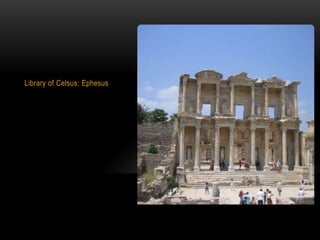
Library of Celsus: Ephesus
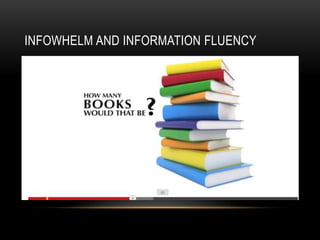
INFOWHELM AND INFORMATION FLUENCY
SO WHAT DO WE DO?
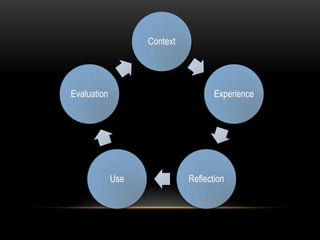
Context

Evaluation

Experience

Use

Reflection
CONTEXT
• What communities are present in the school?

• How are they articulated now, 3 years from now?
15years from now?
• Interactive strategies to build relationships between
stakeholders. This is the new job of the librarian…
• Imagine….
If someone walked into your library right now,
what 3 things would stick in their minds?
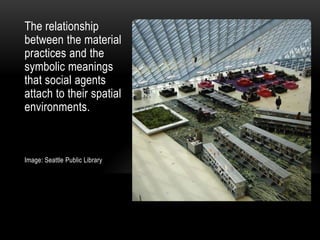
The relationship
between the material
practices and the
symbolic meanings
that social agents
attach to their spatial
environments.

Image: Seattle Public Library
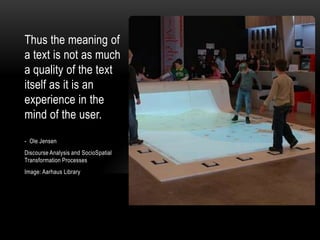
Thus the meaning of
a text is not as much
a quality of the text
itself as it is an
experience in the
mind of the user.
- Ole Jensen
Discourse Analysis and SocioSpatial
Transformation Processes
Image: Aarhaus Library
• Imagine…
How do you connect the dots between your work and
student learning?

Between your work and school mission?
Between your work and those things that keep your
Principal and AP up at night?
SO HOW DID WE GET HERE?
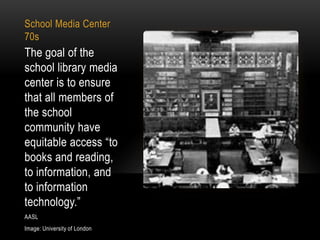
School Media Center
70s

The goal of the
school library media
center is to ensure
that all members of
the school
community have
equitable access “to
books and reading,
to information, and
to information
technology.”
AASL
Image: University of London
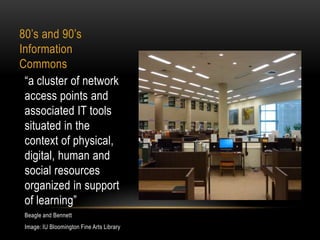
80‟s and 90‟s
Information
Commons
“a cluster of network
access points and
associated IT tools
situated in the
context of physical,
digital, human and
social resources
organized in support
of learning”
Beagle and Bennett

Image: IU Bloomington Fine Arts Library
EXPERIENCE
• Physical

• Virtual
• Communal
• The Learning Commons
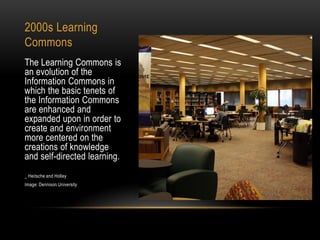
2000s Learning
Commons
The Learning Commons is
an evolution of the
Information Commons in
which the basic tenets of
the Information Commons
are enhanced and
expanded upon in order to
create and environment
more centered on the
creations of knowledge
and self-directed learning.
_ Heitsche and Holley
Image: Dennison University
THE PHYSICAL
• The practical workings within…

• Computer hardware/software, furnishings, designated
spaces and traditional collections
• Early libraries created to support the reader, then as
they grew the focus was on supporting the
collections… now shifting back to focus on the learners.
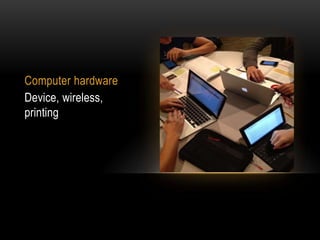
Computer hardware
Device, wireless,
printing
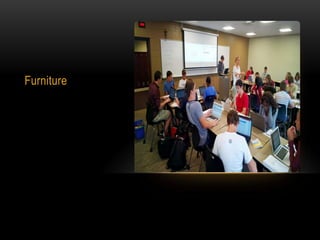
Furniture
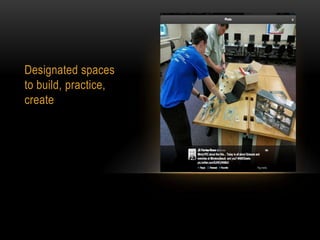
Designated spaces
to build, practice,
create
THE VIRTUAL
• Beyond four walls and a roof…
• Digital library collections, online tools, electronic learning tools
and Web presences (portal, website, social media)
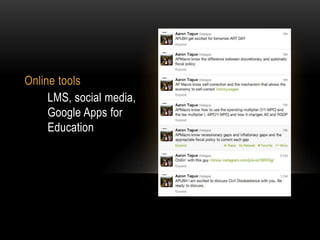
Online tools
LMS, social media,
Google Apps for
Education
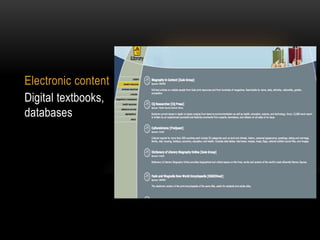
Electronic content
Digital textbooks,
databases
THE COMMUNAL
• “Sites and places are never just locations. They are always
sites for something and someone. „Spirit of the Place‟ subjected
meaning that is contextually located in the community.”
Rob Shields “Places on the Margins”

• Workshops, tutoring programs, research collaborations, mission
and identity, IT support
Mission and Identity

Image: JSEA
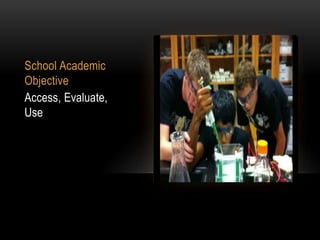
School Academic
Objective
Access, Evaluate,
Use
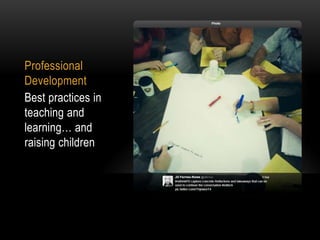
Professional
Development
Best practices in
teaching and
learning… and
raising children
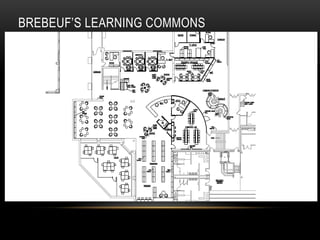
BREBEUF‟S LEARNING COMMONS
• Remember – a media booth does not turn a student
into a scholar… that begins to happen when pedagogy,
design and reconceptualized library services come
together
• Learning is not training… it is understanding and insight
REFLECTION
• What‟s it take?
• Democratic Planning Processes – lots of stakeholder
voices must be heard

• Time
• Surveys of need
Imagine…
• How will you make sure everyone who walks into your
library sees the focus on students? Not stuff, not the
view… students.
WORKS
•

Educause,”7 things You Should Know About the Modern Learning Commons”
http://net.educause.edu/ir/library/pdf/eli7071.pdf

•

AASL. Standards for the 21 st Century Learner. http://www.ala.org/aasl/standardsguidelines#standards

•

Heitsch, E and Holley, R. “The Information and Learning Commons: Some Reflections” New
Reciew of Academic Librarianship, 17:64-77, 2011

•

Beagle, Donald Robert. The Information Commons Handbook. New York: Neal-Schuman, 2006.
Print.

•

Donald Beagle (2010): The Emergent Information Commons: Philosophy, Models, and 21st
Century Learning Paradigms, Journal of Library Administration, 50:1, 7-26

•

Bennett, Scott. “The Information or the Learning Commons: Which Will We Have?” The Journal
of Academic Librarianship 34.3 (2008): 183–85. Print.

•

Worm-Petersen, Kasper. “Democratization of Design.” GRASP (11/7/13)
http://grasp.dk/democratization-of-design/
•

Eidson, Diana. “The Celsus Library at Ephasus: Spatial Rhetoric, Literacy and Hegemony
in the Eastern Roman Empire.” Advances in the History of Rhetoric (2013) Vol 16, Issue 2.

•

Shields, Robert. Places on the Margin: Alternative Geographies of Modernity.
London:Routledge (1992).

•

Healey, Patricia. “The communicative Work of Development Plans, Environment and
Planning.” Planning and Design. 1993, Col 20 (1), p 83-105.

•

Jensen, Ole. Discourse Analysis and Sociospatial Transformation Processes. School of
Architecture, Planning and Landscape, Global Urban Research Unity. Electronc Working
Paper 28. http://www.ncl.ac.uk/guru/assets/documents/ewp28.pdf

•

Most photos personally owned. Examples of school libraries over time:
• 1970‟s: University of London Medical Library http://www.ucl.ac.uk/library/medicalhistory/clinical-later.shtml
• Information Common: IU Bloomington Fine Arts Library
http://commons.wikimedia.org/wiki/File:IUB_-_Fine_Arts_Library_-_P1100227.JPG
• Learning Commons: Denison University http://www.designgroup.us.com/ourwork/libraries/images/denison_university/04_dul.jpg

Libraries in Space

  • 1.
    LIBRARIES IN SPACE JenLaMaster Brebeuf Jesuit Preparatory School, Indianapolis
  • 2.
  • 3.
  • 4.
    SO WHAT DOWE DO?
  • 5.
  • 6.
    CONTEXT • What communitiesare present in the school? • How are they articulated now, 3 years from now? 15years from now? • Interactive strategies to build relationships between stakeholders. This is the new job of the librarian…
  • 7.
    • Imagine…. If someonewalked into your library right now, what 3 things would stick in their minds?
  • 8.
    The relationship between thematerial practices and the symbolic meanings that social agents attach to their spatial environments. Image: Seattle Public Library
  • 9.
    Thus the meaningof a text is not as much a quality of the text itself as it is an experience in the mind of the user. - Ole Jensen Discourse Analysis and SocioSpatial Transformation Processes Image: Aarhaus Library
  • 10.
    • Imagine… How doyou connect the dots between your work and student learning? Between your work and school mission? Between your work and those things that keep your Principal and AP up at night?
  • 11.
    SO HOW DIDWE GET HERE?
  • 12.
    School Media Center 70s Thegoal of the school library media center is to ensure that all members of the school community have equitable access “to books and reading, to information, and to information technology.” AASL Image: University of London
  • 13.
    80‟s and 90‟s Information Commons “acluster of network access points and associated IT tools situated in the context of physical, digital, human and social resources organized in support of learning” Beagle and Bennett Image: IU Bloomington Fine Arts Library
  • 14.
    EXPERIENCE • Physical • Virtual •Communal • The Learning Commons
  • 15.
    2000s Learning Commons The LearningCommons is an evolution of the Information Commons in which the basic tenets of the Information Commons are enhanced and expanded upon in order to create and environment more centered on the creations of knowledge and self-directed learning. _ Heitsche and Holley Image: Dennison University
  • 16.
    THE PHYSICAL • Thepractical workings within… • Computer hardware/software, furnishings, designated spaces and traditional collections • Early libraries created to support the reader, then as they grew the focus was on supporting the collections… now shifting back to focus on the learners.
  • 17.
  • 18.
  • 19.
  • 20.
    THE VIRTUAL • Beyondfour walls and a roof… • Digital library collections, online tools, electronic learning tools and Web presences (portal, website, social media)
  • 21.
    Online tools LMS, socialmedia, Google Apps for Education
  • 22.
  • 23.
    THE COMMUNAL • “Sitesand places are never just locations. They are always sites for something and someone. „Spirit of the Place‟ subjected meaning that is contextually located in the community.” Rob Shields “Places on the Margins” • Workshops, tutoring programs, research collaborations, mission and identity, IT support
  • 24.
  • 25.
  • 26.
    Professional Development Best practices in teachingand learning… and raising children
  • 27.
  • 28.
    • Remember –a media booth does not turn a student into a scholar… that begins to happen when pedagogy, design and reconceptualized library services come together • Learning is not training… it is understanding and insight
  • 29.
    REFLECTION • What‟s ittake? • Democratic Planning Processes – lots of stakeholder voices must be heard • Time • Surveys of need
  • 30.
    Imagine… • How willyou make sure everyone who walks into your library sees the focus on students? Not stuff, not the view… students.
  • 31.
    WORKS • Educause,”7 things YouShould Know About the Modern Learning Commons” http://net.educause.edu/ir/library/pdf/eli7071.pdf • AASL. Standards for the 21 st Century Learner. http://www.ala.org/aasl/standardsguidelines#standards • Heitsch, E and Holley, R. “The Information and Learning Commons: Some Reflections” New Reciew of Academic Librarianship, 17:64-77, 2011 • Beagle, Donald Robert. The Information Commons Handbook. New York: Neal-Schuman, 2006. Print. • Donald Beagle (2010): The Emergent Information Commons: Philosophy, Models, and 21st Century Learning Paradigms, Journal of Library Administration, 50:1, 7-26 • Bennett, Scott. “The Information or the Learning Commons: Which Will We Have?” The Journal of Academic Librarianship 34.3 (2008): 183–85. Print. • Worm-Petersen, Kasper. “Democratization of Design.” GRASP (11/7/13) http://grasp.dk/democratization-of-design/
  • 32.
    • Eidson, Diana. “TheCelsus Library at Ephasus: Spatial Rhetoric, Literacy and Hegemony in the Eastern Roman Empire.” Advances in the History of Rhetoric (2013) Vol 16, Issue 2. • Shields, Robert. Places on the Margin: Alternative Geographies of Modernity. London:Routledge (1992). • Healey, Patricia. “The communicative Work of Development Plans, Environment and Planning.” Planning and Design. 1993, Col 20 (1), p 83-105. • Jensen, Ole. Discourse Analysis and Sociospatial Transformation Processes. School of Architecture, Planning and Landscape, Global Urban Research Unity. Electronc Working Paper 28. http://www.ncl.ac.uk/guru/assets/documents/ewp28.pdf • Most photos personally owned. Examples of school libraries over time: • 1970‟s: University of London Medical Library http://www.ucl.ac.uk/library/medicalhistory/clinical-later.shtml • Information Common: IU Bloomington Fine Arts Library http://commons.wikimedia.org/wiki/File:IUB_-_Fine_Arts_Library_-_P1100227.JPG • Learning Commons: Denison University http://www.designgroup.us.com/ourwork/libraries/images/denison_university/04_dul.jpg

Editor's Notes

  • #3 Library as retainer of cultural memory… Meanings of the community in the past, present and future. It’s a library and a tomb. A meeting space and a story board. A symbol of current power and past lives.
  • #7 Discourse Communities – a group of people with shared values, goals, assumptions and ways of communicating. This is deeper than Students, Faculty, Parents, Jesuit. These are your stakeholders.
  • #8 Reflect independently… pair and share. Write out on Post It Paper on wall
  • #9 Hopefully in the reporting out people have listed examples of material practices and symbolic meanings….DiscussText is the result of interpretation… dependent on the subject that makes the interpretation. We do this too – but our challenge is to be neutral. Not let our interpretations of “library” interfer with community needs.
  • #10 What do you see here… how is the experience lived in this picture? How is the experience lived in the mind of your users in your space? How do you connect the dots between what your interpretation of the experience and the experience in the mind of the users?
  • #18 Bring in 1:1 Computer issues
  • #23 Again… increased access with 1:1 programs
  • #31 Go back to first sheets on what does someone see when they first walk in the door?