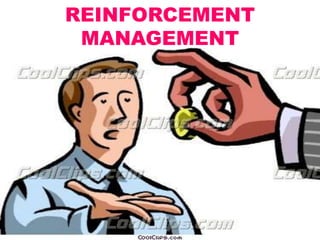
REINFORCEMENT
MANAGEMENT
HISTORY OF REINFORCEMENT
MANAGEMENT
The term reinforcement was
introduced by Pavlov in 1903.
The concept of reinforcement
means getting the work
completed by giving some
incentives or rewards to the
certain person.
REINFORCEMENT MEANING
• The term reinforcement means to
strengthen, and is used in psychology to
refer to anything stimulus which
strengthens, encouraging the designated
behavior, or increases the probability of a
specific response.
• For example, if you want your dog to sit on
command, you may give him a treat every
time he sits for you. The dog will eventually
come to understand that sitting when told to
will result in a treat. This treat is reinforcing
because he likes it and will result in him
sitting when instructed to do so.
TYPES OF REINFORCEMENT:
• Positive Reinforcement
• Negative Reinforcement
• Punishment
Reinforcement
• Extinction Reinforcement
Positive Reinforcement
Giving a positive response
when an individual shows
positive and required behavior.
Think of it as adding something
in order to increase a response.
The most common types of
positive reinforcement or praise
and rewards.
• For example: Immediately
praising an employee for coming
early for job. This will increase
probability of outstanding
behavior occurring again.
Reward is a positive
reinforcement.
Negative Reinforcement
Negative reinforcement as
taking something negative away in order to
increase a response. It is a more effective
tool for motivating employee behavior.
Negative reinforcement encourages
employees to perform better so they can
have an unpleasant condition removed from
their work environment. It is one type of
motivational behavior defined by B.F.
Skinner.
For Example: Driving in heavy traffic is a
negative condition for most of us. You leave
home earlier than usual one morning, and don't
run into heavy traffic. You leave home earlier
again the next morning and again you avoid
heavy traffic. Your behavior of leaving home
earlier is strengthened by the consequence of the
avoidance of heavy traffic.
Picking up the paper in the morning after it has
been delivered at the same time every day .
Punishment Reinforcement:
Punishment refers to adding something
aversive in order to decrease a behavior.
• For example: Disciplining (e.g. spanking)
Suspending an employee for breaking the
organizational rules. Punishment can be equalized
by positive reinforcement from alternative source.
Negative reinforcement
involves the removal of a
negative condition in
order to strengthen a
behavior.
Punishment involves
either presenting or
taking away a stimulus
in order to weaken a
behavior.
Extinction Reinforcement
When you remove
something in order to decrease a
behavior, this is called extinction.
You are taking something away so
that a response is decreased.
• For Example: If an employee no
longer receives praise and
admiration for his good work, he
may feel that his behavior is
generating no fruitful consequence.
Extinction may unintentionally
lower desirable behavior.
Why organizations use Reinforcement
Management
 To increase productivity
To reduce absenteeism
To increase safety behaviors
To reduce lost time due to
injuries.
FACTOR GIVEN BY REINFORCEMENT
MANAGEMENT TO EMPLOYEES
Bonus
 Gifts
Holiday
Trip
Incentives
Extra facilities.
CONCLUSION
Reinforcement is a key
element in the successful outcome,
for students and for employees
who working in the organization.
reinforcement-121213042847-phpapp02.pdf

reinforcement-121213042847-phpapp02.pdf

  • 2.
  • 3.
    HISTORY OF REINFORCEMENT MANAGEMENT Theterm reinforcement was introduced by Pavlov in 1903. The concept of reinforcement means getting the work completed by giving some incentives or rewards to the certain person.
  • 5.
    REINFORCEMENT MEANING • Theterm reinforcement means to strengthen, and is used in psychology to refer to anything stimulus which strengthens, encouraging the designated behavior, or increases the probability of a specific response. • For example, if you want your dog to sit on command, you may give him a treat every time he sits for you. The dog will eventually come to understand that sitting when told to will result in a treat. This treat is reinforcing because he likes it and will result in him sitting when instructed to do so.
  • 6.
    TYPES OF REINFORCEMENT: •Positive Reinforcement • Negative Reinforcement • Punishment Reinforcement • Extinction Reinforcement
  • 7.
    Positive Reinforcement Giving apositive response when an individual shows positive and required behavior. Think of it as adding something in order to increase a response. The most common types of positive reinforcement or praise and rewards. • For example: Immediately praising an employee for coming early for job. This will increase probability of outstanding behavior occurring again. Reward is a positive reinforcement.
  • 8.
    Negative Reinforcement Negative reinforcementas taking something negative away in order to increase a response. It is a more effective tool for motivating employee behavior. Negative reinforcement encourages employees to perform better so they can have an unpleasant condition removed from their work environment. It is one type of motivational behavior defined by B.F. Skinner. For Example: Driving in heavy traffic is a negative condition for most of us. You leave home earlier than usual one morning, and don't run into heavy traffic. You leave home earlier again the next morning and again you avoid heavy traffic. Your behavior of leaving home earlier is strengthened by the consequence of the avoidance of heavy traffic. Picking up the paper in the morning after it has been delivered at the same time every day .
  • 9.
    Punishment Reinforcement: Punishment refersto adding something aversive in order to decrease a behavior. • For example: Disciplining (e.g. spanking) Suspending an employee for breaking the organizational rules. Punishment can be equalized by positive reinforcement from alternative source. Negative reinforcement involves the removal of a negative condition in order to strengthen a behavior. Punishment involves either presenting or taking away a stimulus in order to weaken a behavior.
  • 10.
    Extinction Reinforcement When youremove something in order to decrease a behavior, this is called extinction. You are taking something away so that a response is decreased. • For Example: If an employee no longer receives praise and admiration for his good work, he may feel that his behavior is generating no fruitful consequence. Extinction may unintentionally lower desirable behavior.
  • 11.
    Why organizations useReinforcement Management  To increase productivity To reduce absenteeism To increase safety behaviors To reduce lost time due to injuries.
  • 12.
    FACTOR GIVEN BYREINFORCEMENT MANAGEMENT TO EMPLOYEES Bonus  Gifts Holiday Trip Incentives Extra facilities.
  • 13.
    CONCLUSION Reinforcement is akey element in the successful outcome, for students and for employees who working in the organization.