Response to Intervention
www.interventioncentral.org
Response to Intervention:
An Introduction for Middle &
High Schools
Jim Wright
www.interventioncentral.org
Response to Intervention
www.interventioncentral.org
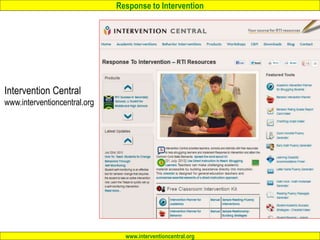
Intervention Central
www.interventioncentral.org
Response to Intervention
www.interventioncentral.org
Workshop PPTs and handout available at:
http://www.interventioncentral.org/rtiaudit
Response to Intervention
www.interventioncentral.org
RTI: Introduction
Academic Failure: Student Risk Factors. What issue(s)
contributing to student academic delays present the
greatest challenge(s) to your school or district?
Academic Interventions in Middle and High School. What
are examples of classroom interventions used at the middle
or high school level?
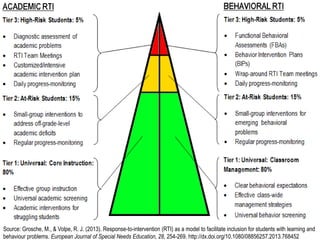
RTI Tiers. What do the 3 levels, or ‘tiers’, of RTI look like and
what students do they serve?
Teacher as ‘First Responder’. What is the role of the
teacher in organizing and implementing classroom
interventions?
Response to Intervention
www.interventioncentral.org 5
RTI Tiers. What do the 3 levels, or
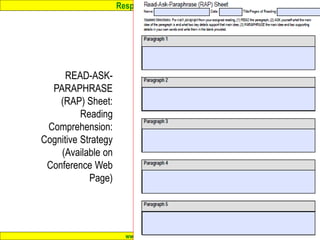
‘tiers’, of RTI look like and what
students do they serve?
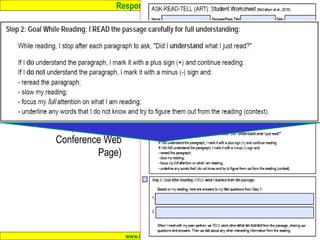
Response to Intervention
www.interventioncentral.org 6
School Instructional Time: The Irreplaceable Resource
“In the average school system, there are 330
minutes in the instructional day, 1,650 minutes in
the instructional week, and 56,700 minutes in the
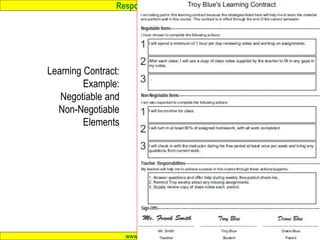
instructional year. Except in unusual circumstances,
these are the only minutes we have to provide
effective services for students. …Each minute
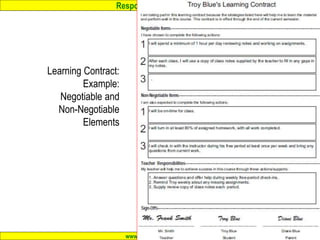
counts and schools cannot afford to support
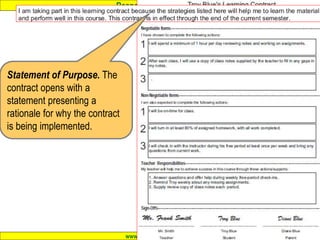
inefficient models of service delivery.”
p. 177
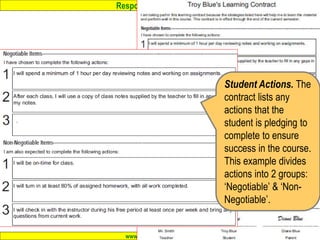
Source: Batsche, G. M., Castillo, J. M., Dixon, D. N., & Forde, S. (2008). Best practices in problem analysis. In A. Thomas & J.
Grimes (Eds.), Best practices in school psychology V (pp. 177-193).
Response to Intervention
www.interventioncentral.org 7
Essential Elements of RTI (Fairbanks, Sugai, Guardino, & Lathrop, 2007)
1. A “continuum of evidence-based services available to
all students" that range from universal to highly
individualized & intensive
2. “Decision points to determine if students are
performing significantly below the level of their peers
in academic and social behavior domains"
3. “Ongoing monitoring of student progress"
4. “Employment of more intensive or different
interventions when students do not improve in
response" to lesser interventions
5. “Evaluation for special education services if students
do not respond to intervention instruction"
Source: Fairbanks, S., Sugai, G., Guardino, S., & Lathrop, M. (2007). Response to intervention: Examining classroom behavior
support in second grade. Exceptional Children, 73, p. 289.
Response to Intervention
www.interventioncentral.org
Source: Grosche, M., & Volpe, R. J. (2013). Response-to-intervention (RTI) as a model to facilitate inclusion for students with learning and
behaviour problems. European Journal of Special Needs Education, 28, 254-269. http://dx.doi.org/10.1080/08856257.2013.768452
Response to Intervention
www.interventioncentral.org
Academic Failure: Student Risk
Factors. What issue(s) contributing
to student academic delays present
the greatest challenge(s) to your
school or district?
9
Response to Intervention
www.interventioncentral.org
• Middle and high schools have limited resources
to implement RTI.
They should, therefore, consider and prioritize
those risk factors that appear to impact students
most. This information can help each school to
better focus its RTI efforts.
10
The Struggling Student: Possible Risk Factors
Response to Intervention
www.interventioncentral.org
The Struggling Student: Possible Risk Factors
11
1. Lack of Basic Skills. Lacks the basic
academic skills (e.g., reading fluency)
necessary to keep up with
demanding MS/HS work.
2. Limited Use of Cognitive Strategies.
Struggles to correctly identify and use
appropriate higher-level thinking
(‘cognitive’) strategies required for success in
content-area coursework.
Response to Intervention
www.interventioncentral.org 12
3. Deficient ‘Academic Survival’ Skills. Has
the necessary academic potential but
shows significant gaps in academic
survival skills (e.g., homework routine, time
management, organization, etc.).
4. Learned Helplessness. Has zero confidence
in ability to attain academic success by
increasing effort and adopting
improved practices.
The Struggling Student: Possible Risk Factors
Response to Intervention
www.interventioncentral.org
13
5. Poor Motivation. Has the necessary
academic potential but fails to see an
adequate ‘pay-off’ for doing the assigned
work.
6. Social/Emotional/Behavioral Difficulties.
Experiences academic failure because of
social/emotional factors other than motivation (e.g.,
anxiety, ADHD, Oppositional Defiant Disorder).
The Struggling Student: Possible Risk Factors
Response to Intervention
www.interventioncentral.org 14
7. Limited Personal Connections. Lacks
sustaining connections with significant
adults (e.g., teachers) in the school
setting.
8. Home Pressures. Struggles because
of preoccupation with ‘home’ situation:
e.g., transportation, family illness, childcare,
housekeeping.
The Struggling Student: Possible Risk Factors
Response to Intervention
www.interventioncentral.org
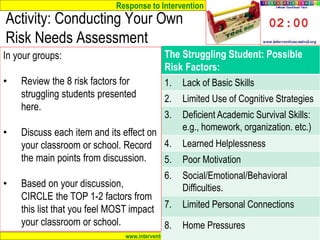
The Struggling Student: Possible
Risk Factors:
1. Lack of Basic Skills
2. Limited Use of Cognitive Strategies
3. Deficient Academic Survival Skills:
e.g., homework, organization. etc.)
4. Learned Helplessness
5. Poor Motivation
6. Social/Emotional/Behavioral
Difficulties.
7. Limited Personal Connections
8. Home Pressures
Activity: Conducting Your Own
Risk Needs Assessment
In your groups:
• Review the 8 risk factors for
struggling students presented
here.
• Discuss each item and its effect on
your classroom or school. Record
the main points from discussion.
• Based on your discussion,
CIRCLE the TOP 1-2 factors from
this list that you feel MOST impact
your classroom or school.
Response to Intervention
www.interventioncentral.org 16
The At-Risk Student. What is the
profile of the at-risk student?
Response to Intervention
www.interventioncentral.org 17
Secondary Students: Unique Challenges…
Struggling learners in middle and high school often:
have significant deficits in basic academic skills
lack higher-level problem-solving strategies and
concepts
present with issues of school motivation
show social/emotional concerns that interfere with
academics
have difficulty with attendance
may be in a process of disengaging from learning even
as adults in school expect that those students will move
toward being ‘self-managing’ learners.
Response to Intervention
www.interventioncentral.org
Tamara & Jack: Contrasting Learners
18
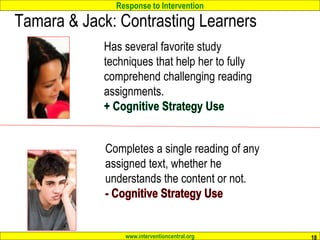
Has several favorite study
techniques that help her to fully
comprehend challenging reading
assignments.
Completes a single reading of any
assigned text, whether he
understands the content or not.
Response to Intervention
www.interventioncentral.org
Tamara & Jack: Contrasting Learners
19
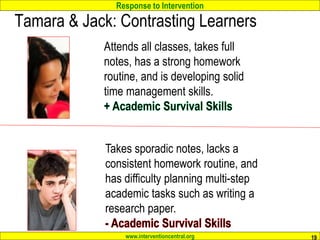
Attends all classes, takes full
notes, has a strong homework
routine, and is developing solid
time management skills.
Takes sporadic notes, lacks a
consistent homework routine, and
has difficulty planning multi-step
academic tasks such as writing a
research paper.
Response to Intervention
www.interventioncentral.org
Tamara & Jack: Contrasting Learners
20
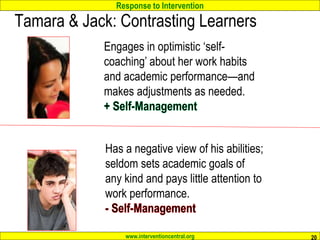
Engages in optimistic ‘self-
coaching’ about her work habits
and academic performance—and
makes adjustments as needed.
Has a negative view of his abilities;
seldom sets academic goals of
any kind and pays little attention to
work performance.
Response to Intervention
www.interventioncentral.org
Tamara & Jack: Contrasting Learners
21
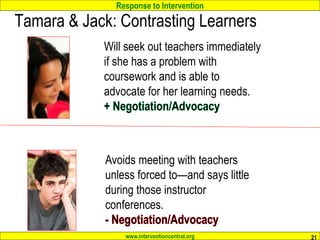
Will seek out teachers immediately
if she has a problem with
coursework and is able to
advocate for her learning needs.
Avoids meeting with teachers
unless forced to—and says little
during those instructor
conferences.
Response to Intervention
www.interventioncentral.org
Student-Directed Strategies for Academic Success
1. Cognitive strategy use
2. Academic survival skills (a.k.a. ‘executive
functioning skills’)
3. Self-coaching
4. Negotiation/advocacy
22
Response to Intervention
www.interventioncentral.org
Self-Regulation: Motivation…With a Plan
“Self-regulation of learning involves
learners setting goals, selecting appropriate
learning strategies, maintaining motivation,
engaging in self-monitoring, and evaluating
their own academic progress.” p. 451
23
Source: Bembenutty, H. (2011). Meaningful and maladaptive homework practices: The role of self-efficacy and self-regulation. Journal of
Advanced Academics, 22, 448-473.
Response to Intervention
www.interventioncentral.org
What is ‘learned helplessness’
and how can this condition
undermine student motivation?
24
Response to Intervention
www.interventioncentral.org
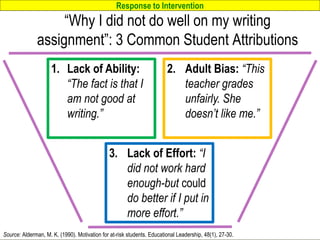
“Why I did not do well on my writing
assignment”: 3 Common Student Attributions
25
Source: Alderman, M. K. (1990). Motivation for at-risk students. Educational Leadership, 48(1), 27-30.
1. Lack of Ability:
“The fact is that I
am not good at
writing.”
2. Adult Bias: “This
teacher grades
unfairly. She
doesn’t like me.”
3. Lack of Effort: “I
did not work hard
enough-but could
do better if I put in
more effort.”
Response to Intervention
www.interventioncentral.org
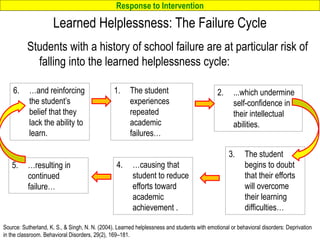
Learned Helplessness: The Failure Cycle
Students with a history of school failure are at particular risk of
falling into the learned helplessness cycle:
26
Source: Sutherland, K. S., & Singh, N. N. (2004). Learned helplessness and students with emotional or behavioral disorders: Deprivation
in the classroom. Behavioral Disorders, 29(2), 169–181.
1. The student
experiences
repeated
academic
failures…
2. ...which undermine
self-confidence in
their intellectual
abilities.
3. The student
begins to doubt
that their efforts
will overcome
their learning
difficulties…
4. …causing that
student to reduce
efforts toward
academic
achievement .
5. …resulting in
continued
failure…
6. …and reinforcing
the student’s
belief that they
lack the ability to
learn.
Response to Intervention
www.interventioncentral.org
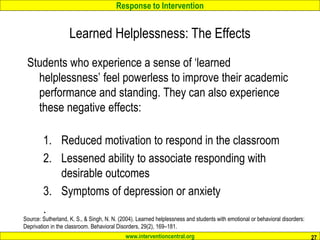
Students who experience a sense of ‘learned
helplessness’ feel powerless to improve their academic
performance and standing. They can also experience
these negative effects:
1. Reduced motivation to respond in the classroom
2. Lessened ability to associate responding with
desirable outcomes
3. Symptoms of depression or anxiety
.
27
Source: Sutherland, K. S., & Singh, N. N. (2004). Learned helplessness and students with emotional or behavioral disorders:
Deprivation in the classroom. Behavioral Disorders, 29(2), 169–181.
Learned Helplessness: The Effects
Response to Intervention
www.interventioncentral.org 28
Sources: Dweck, C. S. (2006). Mindset: The new psychology of success. New York: Ballantine.
Sutherland, K. S., & Singh, N. N. (2004). Learned helplessness and students with emotional or behavioral disorders: Deprivation in the
classroom. Behavioral Disorders, 29(2), 169–181.
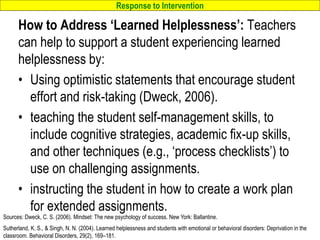
How to Address ‘Learned Helplessness’: Teachers
can help to support a student experiencing learned
helplessness by:
• Using optimistic statements that encourage student
effort and risk-taking (Dweck, 2006).
• teaching the student self-management skills, to
include cognitive strategies, academic fix-up skills,
and other techniques (e.g., ‘process checklists’) to
use on challenging assignments.
• instructing the student in how to create a work plan
for extended assignments.
Response to Intervention
www.interventioncentral.org
Academic Interventions in
Middle and High School. What
are examples of ‘self-management’
classroom interventions used at the
middle or high school level?
29
Response to Intervention
www.interventioncentral.org
How to…Promote: Reading Comprehension
30
Response to Intervention
www.interventioncentral.org
Reading Comprehension ‘Fix-Up’ Skills: A Toolkit (Cont.)
• Linking Pronouns to Referents (Hedin & Conderman, 2010).
Some readers lose the connection between pronouns and the
nouns that they refer to (known as ‘referents’)—especially
when reading challenging text. The student is encouraged to
circle pronouns in the reading, to explicitly identify each
pronoun’s referent, and (optionally) to write next to the pronoun
the name of its referent. For example, the student may add the
referent to a pronoun in this sentence from a biology text: “The
Cambrian Period is the first geological age that has large
numbers of multi-celled organisms associated with it Cambrian
Period.”
31
Response to Intervention
www.interventioncentral.org 32
Reading Comprehension: Self-Management Strategies
• RETAIN TEXT INFORMATION WITH PARAPHRASING (RAP).
The student is trained to use a 3-step cognitive strategy when
reading each paragraph of an informational-text passage: (1)
READ the paragraph; (2) ASK oneself what the main idea of the
paragraph is and what two key details support that main idea; (3)
PARAPHRASE the main idea and two supporting details into one's
own words. This 3-step strategy is easily memorized using the
acronym RAP (read-ask-paraphrase). OPTIONAL BUT
RECOMMENDED: Create an organizer sheet with spaces for the
student to record main idea and supporting details of multiple
paragraphs—to be used with the RAP strategy-to be used as an
organizer and verifiable work product.
Source: Hagaman, J. L., Casey, K. J., & Reid, R. (2010). The effects of the paraphrasing strategy on the reading
comprehension of young students. Remedial and Special Education, 33, 110-123.
Response to Intervention
www.interventioncentral.org
READ-ASK-
PARAPHRASE
(RAP) Sheet:
Reading
Comprehension:
Cognitive Strategy
(Available on
Conference Web
Page)
Response to Intervention
www.interventioncentral.org 34
Reading Comprehension: Self-Management Strategies
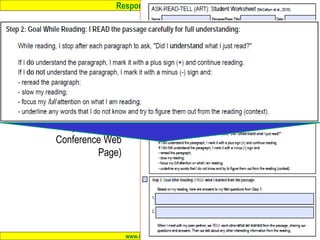
• CREATE A PLAN FOR ASSIGNED READINGS (ART). A means to develop
self-monitoring skills in comprehension is to teach students a cognitive
strategy : ART: Ask-Read-Tell (McCallum et al., 2010). For challenging
passages, the student is trained to apply a 3-step ART sequence, which
maps to the pre-reading/reading/post-reading timeline:
1. ASK: Before reading the text, the student looks over the title of the passage,
asks what the topic is likely to be, considers what he or she already knows
about that topic, and generates 2 questions that the student hopes to
answer through reading.
2. READ: While reading, the student stops after each paragraph to query
whether he or she has adequately understood that section of the passage
and, if necessary, applies comprehension fix-up skills.
3. TELL: After reading, the student attempts to answer the 2 questions posed
earlier based on the content just read.
Source: McCallum, R. S., Krohn, K. R., Skinner, C. H., Hilton-Prillhart, A., Hopkins, M. Waller, S., & Polite, F. (2010). Improving
reading comprehension of at-risk high-school students: The art of reading program. Psychology in the Schools, 48(1), 78-86.
Response to Intervention
www.interventioncentral.org
ASK-READ-TELL
(ART): Reading
Comprehension:
Cognitive Strategy
(Available on
Conference Web
Page)
Response to Intervention
www.interventioncentral.org 36
How To…Promote Academic Self-
Management: Work Planning Skills
Response to Intervention
www.interventioncentral.org
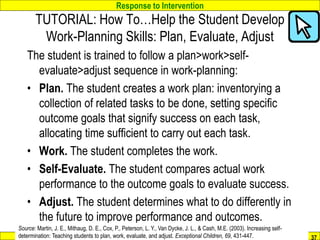
The student is trained to follow a plan>work>self-
evaluate>adjust sequence in work-planning:
• Plan. The student creates a work plan: inventorying a
collection of related tasks to be done, setting specific
outcome goals that signify success on each task,
allocating time sufficient to carry out each task.
• Work. The student completes the work.
• Self-Evaluate. The student compares actual work
performance to the outcome goals to evaluate success.
• Adjust. The student determines what to do differently in
the future to improve performance and outcomes.
37
Source: Martin, J. E., Mithaug, D. E., Cox, P., Peterson, L. Y., Van Dycke, J. L., & Cash, M.E. (2003). Increasing self-
determination: Teaching students to plan, work, evaluate, and adjust. Exceptional Children, 69, 431-447.
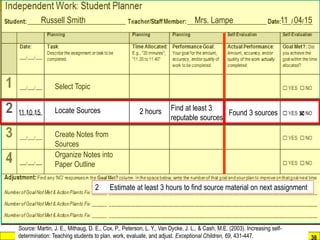
TUTORIAL: How To…Help the Student Develop
Work-Planning Skills: Plan, Evaluate, Adjust
Response to Intervention
www.interventioncentral.org 38
Source: Martin, J. E., Mithaug, D. E., Cox, P., Peterson, L. Y., Van Dycke, J. L., & Cash, M.E. (2003). Increasing self-
determination: Teaching students to plan, work, evaluate, and adjust. Exceptional Children, 69, 431-447.
Russell Smith Mrs. Lampe 11 04 15
11 10 15
Select Topic
Locate Sources
Create Notes from
Sources
Organize Notes into
Paper Outline
Find at least 3
reputable sources
2 hours Found 3 sources 
2 Estimate at least 3 hours to find source material on next assignment
Response to Intervention
www.interventioncentral.org 39
How To…Promote Academic Self-
Management: The Learning Contract
Response to Intervention
www.interventioncentral.org
Learning Contracts: Put Student Promises in Writing…
• Description. A learning contract is a voluntary,
student-completed document that outlines
actions the learner promises to take in a course
to achieve academic success.
• This contract is signed by the student, the
instructor, and (optionally) the parent.
40
Sources: Frank, T., & Scharff, L. F. V. (2013). Learning contracts in undergraduate courses: Impacts on student behaviors and academic
performance. Journal of the Scholarship of Teaching and Learning, 13(4), 36-53.
Greenwood, S. C., & McCabe, P. P. (2008). How learning contracts motivate students. Middle School Journal, 39(5), 13-22.
Response to Intervention
www.interventioncentral.org
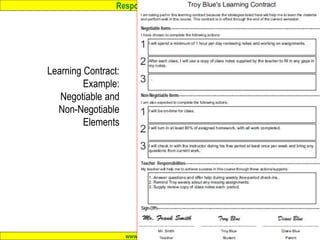
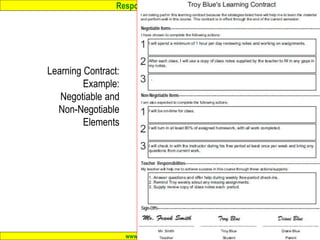
Learning Contract:
Example:
Negotiable and
Non-Negotiable
Elements
41
Response to Intervention
www.interventioncentral.org
Learning Contracts: Put Student Promises in Writing…
Benefits. Learning contracts:
• provide academic structure and support,
• motivate struggling learners by having them
pledge publicly to engage in specific, positive
study and learning behaviors, and
• serve as a vehicle to bring teachers and
students to agreement on what course goals are
important and how to achieve them.
42
Sources: Frank, T., & Scharff, L. F. V. (2013). Learning contracts in undergraduate courses: Impacts on student behaviors and academic
performance. Journal of the Scholarship of Teaching and Learning, 13(4), 36-53.
Greenwood, S. C., & McCabe, P. P. (2008). How learning contracts motivate students. Middle School Journal, 39(5), 13-22.
Response to Intervention
www.interventioncentral.org
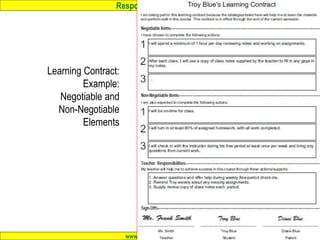
Learning Contract:
Example:
Negotiable and
Non-Negotiable
Elements
43
Response to Intervention
www.interventioncentral.org 44
Statement of Purpose. The
contract opens with a
statement presenting a
rationale for why the contract
is being implemented.
Response to Intervention
www.interventioncentral.org
Learning Contract:
Example:
Negotiable and
Non-Negotiable
Elements
45
Response to Intervention
www.interventioncentral.org 46
Student Actions. The
contract lists any
actions that the
student is pledging to
complete to ensure
success in the course.
This example divides
actions into 2 groups:
‘Negotiable’ & ‘Non-
Negotiable’.
Response to Intervention
www.interventioncentral.org
Learning Contract:
Example:
Negotiable and
Non-Negotiable
Elements
47
Response to Intervention
www.interventioncentral.org 48
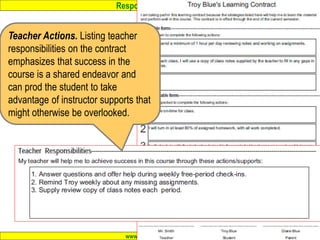
Teacher Actions. Listing teacher
responsibilities on the contract
emphasizes that success in the
course is a shared endeavor and
can prod the student to take
advantage of instructor supports that
might otherwise be overlooked.
Response to Intervention
www.interventioncentral.org
Learning Contract:
Example:
Negotiable and
Non-Negotiable
Elements
49
Response to Intervention
www.interventioncentral.org
Learning Contract:
Example:
Negotiable and
Non-Negotiable
Elements
50
Response to Intervention
www.interventioncentral.org 51
How To…Promote Academic Self-
Management: Academic Survival Skills
Checklists
Response to Intervention
www.interventioncentral.org
The Problem That This Tool Addresses:
Academic Survival Skills Checklist
Students who would achieve success on the ambitious
Common Core State Standards must first cultivate a set of
general 'academic survival skills' that they can apply to any
coursework (DiPerna, 2006).
Examples of academic survival skills include the ability to
study effectively, be organized, and manage time well.
When academic survival skills are described in global terms,
though, it can be difficult to define them. For example, two
teachers may have different understandings about what the
term 'study skills' means.
52
Source: DiPerna, J. C. (2006). Academic enablers and student achievement: Implications for assessment and intervention
services in the schools. Psychology in the Schools, 43, 7-17.
Response to Intervention
www.interventioncentral.org
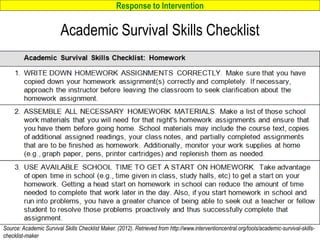
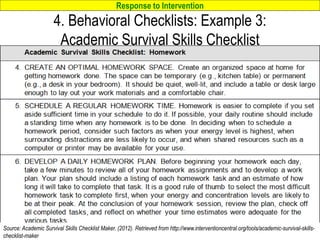
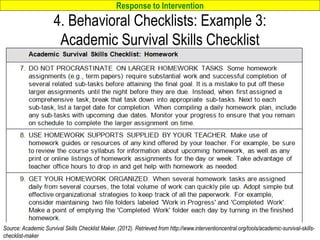
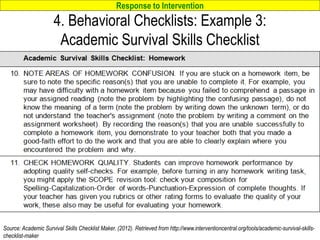
Academic Survival Skills Checklist: What It Is…
• The teacher selects a global skill (e.g.,
homework completion; independent seatwork).
The teacher then breaks the global skill down
into a checklist of component sub-skills. An
observer (e.g., teacher, another adult, or even
the student) can then use the checklist to note
whether a student successfully displays each of
the sub-skills on a given day.
53
Response to Intervention
www.interventioncentral.org 54
Source: Academic Survival Skills Checklist Maker. (2012). Retrieved from http://www.interventioncentral.org/tools/academic-survival-skills-
checklist-maker
Academic Survival Skills Checklist
Response to Intervention
www.interventioncentral.org 55
Source: Academic Survival Skills Checklist Maker. (2012). Retrieved from http://www.interventioncentral.org/tools/academic-survival-skills-
checklist-maker
4. Behavioral Checklists: Example 3:
Academic Survival Skills Checklist
Response to Intervention
www.interventioncentral.org 56
Source: Academic Survival Skills Checklist Maker. (2012). Retrieved from http://www.interventioncentral.org/tools/academic-survival-skills-
checklist-maker
4. Behavioral Checklists: Example 3:
Academic Survival Skills Checklist
Response to Intervention
www.interventioncentral.org 57
Source: Academic Survival Skills Checklist Maker. (2012). Retrieved from http://www.interventioncentral.org/tools/academic-survival-skills-
checklist-maker
4. Behavioral Checklists: Example 3:
Academic Survival Skills Checklist
Response to Intervention
www.interventioncentral.org
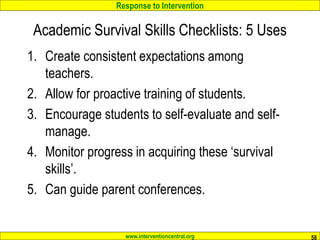
Academic Survival Skills Checklists: 5 Uses
1. Create consistent expectations among
teachers.
2. Allow for proactive training of students.
3. Encourage students to self-evaluate and self-
manage.
4. Monitor progress in acquiring these ‘survival
skills’.
5. Can guide parent conferences.
58
Response to Intervention
www.interventioncentral.org
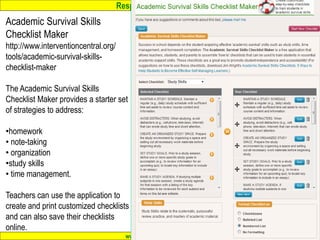
Academic Survival Skills
Checklist Maker
http://www.interventioncentral.org/
tools/academic-survival-skills-
checklist-maker
The Academic Survival Skills
Checklist Maker provides a starter set
of strategies to address:
•homework
• note-taking
• organization
•study skills
• time management.
Teachers can use the application to
create and print customized checklists
and can also save their checklists
online.
Response to Intervention
www.interventioncentral.org
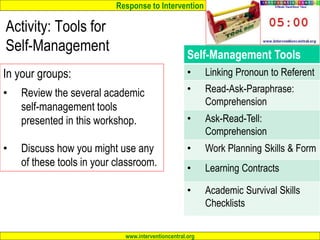
Self-Management Tools
• Linking Pronoun to Referent
• Read-Ask-Paraphrase:
Comprehension
• Ask-Read-Tell:
Comprehension
• Work Planning Skills & Form
• Learning Contracts
• Academic Survival Skills
Checklists
Activity: Tools for
Self-Management
In your groups:
• Review the several academic
self-management tools
presented in this workshop.
• Discuss how you might use any
of these tools in your classroom.
Response to Intervention
www.interventioncentral.org
RTI: Tier 1: Core Instruction
61
Response to Intervention
www.interventioncentral.org
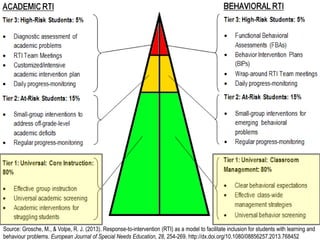
Source: Grosche, M., & Volpe, R. J. (2013). Response-to-intervention (RTI) as a model to facilitate inclusion for students with learning and
behaviour problems. European Journal of Special Needs Education, 28, 254-269. http://dx.doi.org/10.1080/08856257.2013.768452
Response to Intervention
www.interventioncentral.org
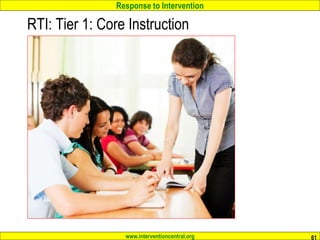
RTI: Tier 1: Core Instruction
• Strong core instruction is the foundation of RTI.
When teachers are able successfully to teach across the
full range of classroom ability levels, individualized
academic interventions are not needed.
Strong instruction includes making optimal use of
instructional time, integrating direct-instruction
elements into lessons, and providing accommodations &
supports as appropriate.
63
Response to Intervention
www.interventioncentral.org
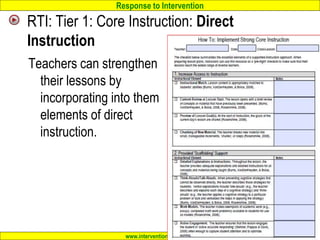
RTI: Tier 1: Core Instruction: Direct
Instruction
Teachers can strengthen
their lessons by
incorporating into them
elements of direct
instruction.
64
Response to Intervention
www.interventioncentral.org
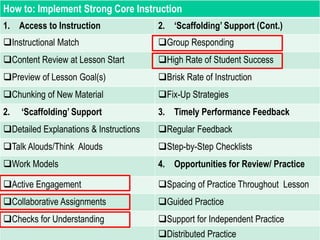
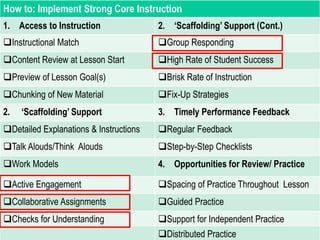
How to: Implement Strong Core Instruction
1. Access to Instruction 2. ‘Scaffolding’ Support (Cont.)
Instructional Match Group Responding
Content Review at Lesson Start High Rate of Student Success
Preview of Lesson Goal(s) Brisk Rate of Instruction
Chunking of New Material Fix-Up Strategies
2. ‘Scaffolding’ Support 3. Timely Performance Feedback
Detailed Explanations & Instructions Regular Feedback
Talk Alouds/Think Alouds Step-by-Step Checklists
Work Models 4. Opportunities for Review/ Practice
Active Engagement Spacing of Practice Throughout Lesson
Collaborative Assignments Guided Practice
Checks for Understanding Support for Independent Practice
Distributed Practice
Response to Intervention
www.interventioncentral.org
Motivating Students Through Collaboration:
Numbered Heads Together
The Need. Teacher questioning during whole-group instruction is
a key way for instructors to monitor student understanding of
content. When questioning:
– instructors should use a mix of closed-response queries (i.e.,
limited number of correct responses) and open-response
questions (i.e., wide range of acceptable answers, opinions,
or judgments).
– students should have enough wait-time to formulate an
adequate answer.,
– the teacher should provide targeted performance feedback
(Maheady et al., 2006).
Response to Intervention
www.interventioncentral.org
Motivating Students Through Collaboration:
Numbered Heads Together
• Solution. Numbered Heads Together is an instructional
technique build upon peer collaboration that provides
the supports and structure necessary to promote
effective teacher questioning and student responding
(Maheady et al., 2006). This technique can be useful for
students with emotional/behavioral disorders (EBD)
(Hunter & Haydon, 2013).
Response to Intervention
www.interventioncentral.org
Motivating Students Through Collaboration:
Numbered Heads Together
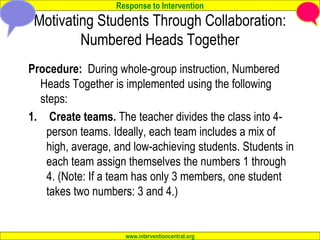
Procedure: During whole-group instruction, Numbered
Heads Together is implemented using the following
steps:
1. Create teams. The teacher divides the class into 4-
person teams. Ideally, each team includes a mix of
high, average, and low-achieving students. Students in
each team assign themselves the numbers 1 through
4. (Note: If a team has only 3 members, one student
takes two numbers: 3 and 4.)
Response to Intervention
www.interventioncentral.org
Motivating Students Through Collaboration:
Numbered Heads Together
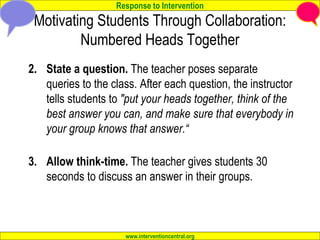
2. State a question. The teacher poses separate
queries to the class. After each question, the instructor
tells students to "put your heads together, think of the
best answer you can, and make sure that everybody in
your group knows that answer.“
3. Allow think-time. The teacher gives students 30
seconds to discuss an answer in their groups.
Response to Intervention
www.interventioncentral.org
Motivating Students Through Collaboration:
Numbered Heads Together
4. Elicit student responses. The teacher randomly
selects a number from 1-4 and says, "All number [1, 2,
3, or 4] students who know the answer, raise your
hand." The teacher then calls on one student with
hand raised and asks him or her to give the answer.
The teacher next says, "How many [1, 2, 3, or 4]
students think that that answer is correct? Raise your
hand." [Optional: The teacher can call on additional
students with hand raised to elaborate on a previous
student's answer.]
Response to Intervention
www.interventioncentral.org
How to: Implement Strong Core Instruction
1. Access to Instruction 2. ‘Scaffolding’ Support (Cont.)
Instructional Match Group Responding
Content Review at Lesson Start High Rate of Student Success
Preview of Lesson Goal(s) Brisk Rate of Instruction
Chunking of New Material Fix-Up Strategies
2. ‘Scaffolding’ Support 3. Timely Performance Feedback
Detailed Explanations & Instructions Regular Feedback
Talk Alouds/Think Alouds Step-by-Step Checklists
Work Models 4. Opportunities for Review/ Practice
Active Engagement Spacing of Practice Throughout Lesson
Collaborative Assignments Guided Practice
Checks for Understanding Support for Independent Practice
Distributed Practice
Response to Intervention
www.interventioncentral.org
RTI: Tier 1: Classroom Intervention
72
Response to Intervention
www.interventioncentral.org
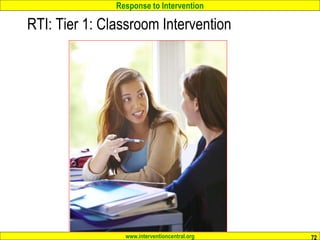
RTI: Tier 1: Classroom Intervention
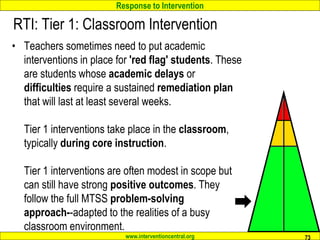
• Teachers sometimes need to put academic
interventions in place for 'red flag' students. These
are students whose academic delays or
difficulties require a sustained remediation plan
that will last at least several weeks.
Tier 1 interventions take place in the classroom,
typically during core instruction.
Tier 1 interventions are often modest in scope but
can still have strong positive outcomes. They
follow the full MTSS problem-solving
approach--adapted to the realities of a busy
classroom environment.
73
Response to Intervention
www.interventioncentral.org
At Tier 1, problem-solving occurs when the teacher
meets briefly with a team (e.g., grade-level team,
instructional team, department) or a consultant.
The teacher defines the student problem(s), selects
intervention(s), decides how to monitor the
intervention, and documents the intervention plan—
with the guidance of the team or consultant
The teacher meets again with team or consultant
several weeks later to check on the status of the
intervention.
74
Tier 1 Intervention Plans: Essentials…
Response to Intervention
www.interventioncentral.org 75
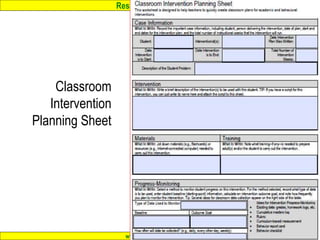
Classroom
Intervention
Planning Sheet
Response to Intervention
www.interventioncentral.org
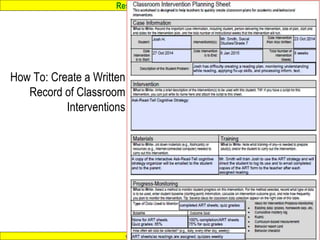
How To: Create a Written
Record of Classroom
Interventions
76
Response to Intervention
www.interventioncentral.org
Creating a Written Record of Classroom Interventions: Form
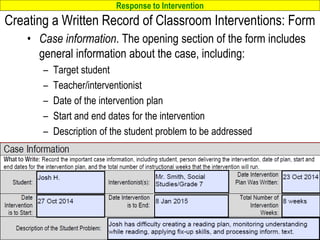
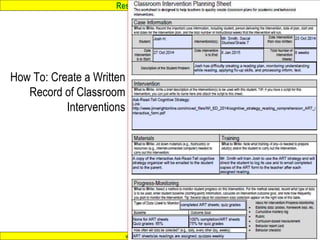
• Case information. The opening section of the form includes
general information about the case, including:
– Target student
– Teacher/interventionist
– Date of the intervention plan
– Start and end dates for the intervention
– Description of the student problem to be addressed
77
Response to Intervention
www.interventioncentral.org
ASK-READ-TELL
(ART): Reading
Comprehension:
Cognitive Strategy
(Available on
Conference Web
Page)
Response to Intervention
www.interventioncentral.org
Creating a Written Record of Classroom Interventions: Form
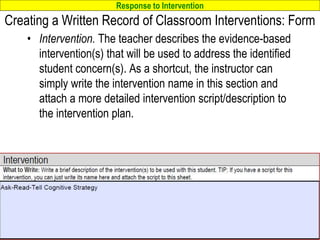
• Intervention. The teacher describes the evidence-based
intervention(s) that will be used to address the identified
student concern(s). As a shortcut, the instructor can
simply write the intervention name in this section and
attach a more detailed intervention script/description to
the intervention plan.
79
Response to Intervention
www.interventioncentral.org
Creating a Written Record of Classroom Interventions: Form
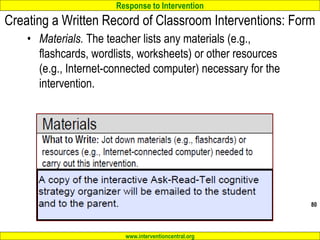
• Materials. The teacher lists any materials (e.g.,
flashcards, wordlists, worksheets) or other resources
(e.g., Internet-connected computer) necessary for the
intervention.
80
Response to Intervention
www.interventioncentral.org
Creating a Written Record of Classroom Interventions: Form
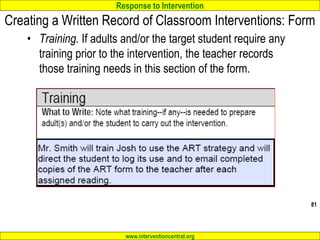
• Training. If adults and/or the target student require any
training prior to the intervention, the teacher records
those training needs in this section of the form.
81
Response to Intervention
www.interventioncentral.org
Creating a Written Record of Classroom Interventions: Form
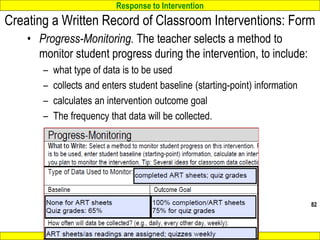
• Progress-Monitoring. The teacher selects a method to
monitor student progress during the intervention, to include:
– what type of data is to be used
– collects and enters student baseline (starting-point) information
– calculates an intervention outcome goal
– The frequency that data will be collected.
82
Response to Intervention
www.interventioncentral.org
How To: Create a Written
Record of Classroom
Interventions
83
Response to Intervention
www.interventioncentral.org
Tier 1: Why Document Classroom Interventions?
With increased school accountability, teachers may want to
write down classroom intervention plans to document:
• steps agreed upon at a student or parent-student
conference.
• teacher intervention efforts for the school RTI Team.
• the history of classroom intervention attempts for a CSE or
Section 504 Committee referral.
• the need for possible changes in a student’s 504 plan, IEP,
or special-education programming.
84
Response to Intervention
www.interventioncentral.org
RTI: Tier 2: Supplemental Intervention
85
Response to Intervention
www.interventioncentral.org
RTI: Tier 2: Supplemental Intervention
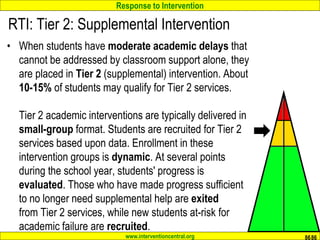
• When students have moderate academic delays that
cannot be addressed by classroom support alone, they
are placed in Tier 2 (supplemental) intervention. About
10-15% of students may qualify for Tier 2 services.
Tier 2 academic interventions are typically delivered in
small-group format. Students are recruited for Tier 2
services based upon data. Enrollment in these
intervention groups is dynamic. At several points
during the school year, students' progress is
evaluated. Those who have made progress sufficient
to no longer need supplemental help are exited
from Tier 2 services, while new students at-risk for
academic failure are recruited.
86
86
Response to Intervention
www.interventioncentral.org
RTI: Tier 2: The Problem It Was Meant to Solve…
• Waves of students in many schools share similar types of
academic deficits (e.g., reading fluency).
• Such deficits put these students ‘off-grade-level’ in the target
skill, requiring a substantial period of remediation to close
the gap with grade-peers.
• Because resources are limited, an efficient first approach to
help these learners is to correctly identify them, group them
and provide ‘standard-treatment protocol’ (pre-packaged)
interventions tailored to common student concerns.
• Tier 2 is the level of RTI intervention where schools figure
out how to match students emerging as at-risk with effective
group-based interventions.
87
Response to Intervention
www.interventioncentral.org
Tier 2/3 Interventions: Quality Indicators
Each Tier 2/3 intervention plan shows evidence that:
• Instructional programs or practices are ‘evidence-based’.
• The intervention has been selected because it logically addressed the
area(s) of academic deficit for the target student (e.g., an intervention to
address reading fluency was chosen for a student whose primary deficit
was in reading fluency).
• All students enrolled in the Tier 2/3 intervention group have the same
shared intervention need.
• The student-teacher ratio in the group provides adequate student support:
Tier 2 up to 7 students; Tier 3 up to 3 students.
• The intervention provides contact time adequate to the student academic
deficit. Tier 2 interventions occur a minimum of 3-5 times per week in
sessions of 30 mins or more; Tier 3 interventions occur daily in sessions of
30 mins or more (Burns & Gibbons, 2008).
88
Response to Intervention
www.interventioncentral.org
RTI: Tier 3: Intensive Intervention
89
Response to Intervention
www.interventioncentral.org
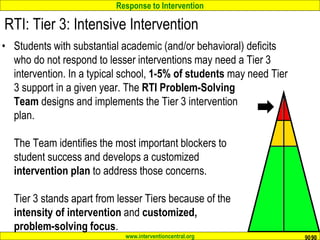
RTI: Tier 3: Intensive Intervention
• Students with substantial academic (and/or behavioral) deficits
who do not respond to lesser interventions may need a Tier 3
intervention. In a typical school, 1-5% of students may need Tier
3 support in a given year. The RTI Problem-Solving
Team designs and implements the Tier 3 intervention
plan.
The Team identifies the most important blockers to
student success and develops a customized
intervention plan to address those concerns.
Tier 3 stands apart from lesser Tiers because of the
intensity of intervention and customized,
problem-solving focus.
90
90
90
Response to Intervention
www.interventioncentral.org 91
How Is the RTI Problem-Solving
Team Like a MASH Unit?
• The RTI Team must deal with complex situations with
limited resources and tight timelines, often being forced to
select from among numerous ‘intervention targets’ (e.g.,
attendance, motivation, basic skill deficits, higher-level
deficits in cognitive strategies) when working with
struggling students.
• The ‘problem-solving’ approach is flexible, allowing the
RTI Team quickly to sift through a complex student case
to identify and address the most important ‘blockers’ to
academic success.
• Timelines for success are often short-term (e.g., to get the
student to pass a course or curb behaviors so she can
stay in the classroom), measured in weeks or months.
Response to Intervention
www.interventioncentral.org
Response to Intervention
www.interventioncentral.org 93
RTI Problem-Solving
Team Roles (Online)
• Facilitator
• Recorder
• Time Keeper
• Case Manager
• Coordinator
Response to Intervention
www.interventioncentral.org
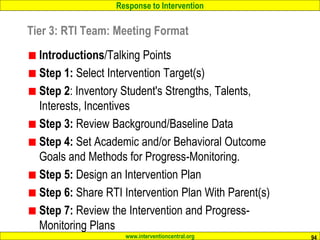
Introductions/Talking Points
Step 1: Select Intervention Target(s)
Step 2: Inventory Student's Strengths, Talents,
Interests, Incentives
Step 3: Review Background/Baseline Data
Step 4: Set Academic and/or Behavioral Outcome
Goals and Methods for Progress-Monitoring.
Step 5: Design an Intervention Plan
Step 6: Share RTI Intervention Plan With Parent(s)
Step 7: Review the Intervention and Progress-
Monitoring Plans
94
Tier 3: RTI Team: Meeting Format
Response to Intervention
www.interventioncentral.org
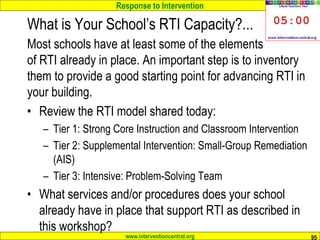
What is Your School’s RTI Capacity?...
Most schools have at least some of the elements
of RTI already in place. An important step is to inventory
them to provide a good starting point for advancing RTI in
your building.
• Review the RTI model shared today:
– Tier 1: Strong Core Instruction and Classroom Intervention
– Tier 2: Supplemental Intervention: Small-Group Remediation
(AIS)
– Tier 3: Intensive: Problem-Solving Team
• What services and/or procedures does your school
already have in place that support RTI as described in
this workshop?
95
Response to Intervention
www.interventioncentral.org
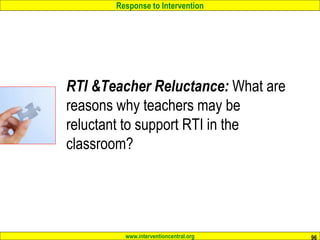
RTI &Teacher Reluctance: What are
reasons why teachers may be
reluctant to support RTI in the
classroom?
96
Response to Intervention
www.interventioncentral.org
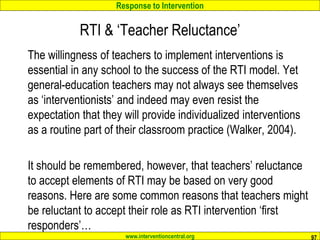
RTI & ‘Teacher Reluctance’
The willingness of teachers to implement interventions is
essential in any school to the success of the RTI model. Yet
general-education teachers may not always see themselves
as ‘interventionists’ and indeed may even resist the
expectation that they will provide individualized interventions
as a routine part of their classroom practice (Walker, 2004).
It should be remembered, however, that teachers’ reluctance
to accept elements of RTI may be based on very good
reasons. Here are some common reasons that teachers might
be reluctant to accept their role as RTI intervention ‘first
responders’…
97
Response to Intervention
www.interventioncentral.org 98
Engaging the Reluctant Teacher: 7 Reasons Why
Instructors May Resist Implementing Classroom RTI
Interventions
1. Lack of Skills. Teachers lack the skills necessary to
successfully implement academic or behavioral
interventions in their content-area classrooms.
2. Not My Job. Teachers define their job as providing
content-area instruction. They do not believe that
providing classwide or individual academic and
behavioral interventions falls within their job
description.
Response to Intervention
www.interventioncentral.org 99
Engaging the Reluctant Teacher: 7 Reasons Why
Instructors May Resist Implementing Classroom RTI
Interventions(Cont.)
3. No Time. Teachers do not believe that they have
sufficient time available in classroom instruction to
implement academic or behavioral interventions.
4. ‘Status Quo’ Bias. Teachers are comfortable with the
current situation and do not sense a need to change
their professional routines.
Response to Intervention
www.interventioncentral.org 100
Engaging the Reluctant Teacher: 7 Reasons Why
Instructors May Resist Implementing Classroom RTI
Interventions (Cont.)
5. Loss of Classroom Control. Teachers worry that if
they depart from their standard instructional practices
to adopt new classwide or individual academic or
behavior intervention strategies, they may lose control
of the classroom.
6. ‘Undeserving Students’. Teachers are unwilling to
invest the required effort to provide academic or
behavioral interventions for unmotivated students
because they would rather put that time into providing
additional attention to well-behaved, motivated
students who are ‘more deserving’.
Response to Intervention
www.interventioncentral.org 101
Engaging the Reluctant Teacher: 7 Reasons Why
Instructors May Resist Implementing Classroom RTI
Interventions (Cont.)
7. The Magic of Special Education. Content-area
teachers regard special education services as ‘magic’.
According to this view, interventions provided to
struggling students in the general-education
classroom alone will be inadequate, and only special
education services have the power to truly benefit
those students.
Response to Intervention
www.interventioncentral.org 102
Engaging the Reluctant Teacher: Seven Reasons Why Instructors
May Resist Implementing Classroom RTI Interventions
1. Lack of Skills. Teachers lack the skills necessary to successfully implement academic or
behavioral interventions in their content-area classrooms.
2. Not My Job. Teachers define their job as providing content-area instruction. They do not
believe that providing classwide or individual academic and behavioral interventions falls
within their job description.
3. No Time. Teachers do not believe that they have sufficient time available in classroom
instruction to implement academic or behavioral interventions.
4. ‘Status Quo’ Bias. Teachers are comfortable with the current situation and do not sense a
need to change their professional routines.
5. Loss of Classroom Control. Teachers worry that if they depart from their standard
instructional practices to adopt new classwide or individual academic or behavior
intervention strategies, they may lose control of the classroom.
6. ‘Undeserving Students’. Teachers are unwilling to invest the required effort to provide
academic or behavioral interventions for unmotivated students because they would rather
put that time into providing additional attention to well-behaved, motivated students who are
‘more deserving’.
7. The Magic of Special Education. Content-area teachers regard special education
services as ‘magic’. According to this view, interventions provided to struggling students in
the general-education classroom alone will be inadequate, and only special education
services have the power to truly benefit those students.
Response to Intervention
www.interventioncentral.org 103
The Non-Responding Student. How
does a school or district judge when a
student is not benefiting from RTI and
needs to be reviewed by CSE?
Response to Intervention
www.interventioncentral.org 104
RTI Assumption: Struggling Students Are ‘Typical’
Until Proven Otherwise…
RTI logic assumes that:
– A student who begins to struggle in general education is typical,
and that
– It is general education’s responsibility to find the instructional
strategies that will unlock the student’s learning potential
Only when the student shows through well-
documented interventions that he or she has ‘failed
to respond to intervention’ does RTI begin to
investigate the possibility that the student may have
a learning disability or other special education
condition.
Response to Intervention
www.interventioncentral.org 105
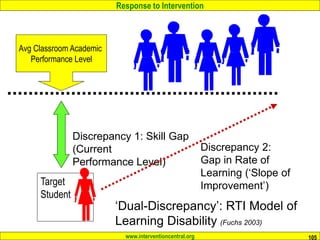
Target
Student
Discrepancy 1: Skill Gap
(Current
Performance Level)
Avg Classroom Academic
Performance Level
‘Dual-Discrepancy’: RTI Model of
Learning Disability (Fuchs 2003)
Discrepancy 2:
Gap in Rate of
Learning (‘Slope of
Improvement’)
Response to Intervention
www.interventioncentral.org
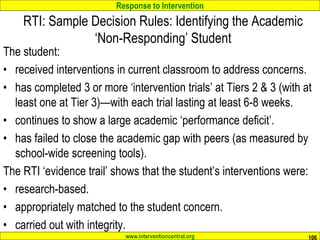
RTI: Sample Decision Rules: Identifying the Academic
‘Non-Responding’ Student
The student:
• received interventions in current classroom to address concerns.
• has completed 3 or more ‘intervention trials’ at Tiers 2 & 3 (with at
least one at Tier 3)—with each trial lasting at least 6-8 weeks.
• continues to show a large academic ‘performance deficit’.
• has failed to close the academic gap with peers (as measured by
school-wide screening tools).
The RTI ‘evidence trail’ shows that the student’s interventions were:
• research-based.
• appropriately matched to the student concern.
• carried out with integrity.
106
Response to Intervention
www.interventioncentral.org
RTI: Questions?
• What is one RTI question you still have
after this workshop?
107

High school qualification to be adapted by students

  • 1.
    Response to Intervention www.interventioncentral.org Responseto Intervention: An Introduction for Middle & High Schools Jim Wright www.interventioncentral.org
  • 2.
  • 3.
    Response to Intervention www.interventioncentral.org WorkshopPPTs and handout available at: http://www.interventioncentral.org/rtiaudit
  • 4.
    Response to Intervention www.interventioncentral.org RTI:Introduction Academic Failure: Student Risk Factors. What issue(s) contributing to student academic delays present the greatest challenge(s) to your school or district? Academic Interventions in Middle and High School. What are examples of classroom interventions used at the middle or high school level? RTI Tiers. What do the 3 levels, or ‘tiers’, of RTI look like and what students do they serve? Teacher as ‘First Responder’. What is the role of the teacher in organizing and implementing classroom interventions?
  • 5.
    Response to Intervention www.interventioncentral.org5 RTI Tiers. What do the 3 levels, or ‘tiers’, of RTI look like and what students do they serve?
  • 6.
    Response to Intervention www.interventioncentral.org6 School Instructional Time: The Irreplaceable Resource “In the average school system, there are 330 minutes in the instructional day, 1,650 minutes in the instructional week, and 56,700 minutes in the instructional year. Except in unusual circumstances, these are the only minutes we have to provide effective services for students. …Each minute counts and schools cannot afford to support inefficient models of service delivery.” p. 177 Source: Batsche, G. M., Castillo, J. M., Dixon, D. N., & Forde, S. (2008). Best practices in problem analysis. In A. Thomas & J. Grimes (Eds.), Best practices in school psychology V (pp. 177-193).
  • 7.
    Response to Intervention www.interventioncentral.org7 Essential Elements of RTI (Fairbanks, Sugai, Guardino, & Lathrop, 2007) 1. A “continuum of evidence-based services available to all students" that range from universal to highly individualized & intensive 2. “Decision points to determine if students are performing significantly below the level of their peers in academic and social behavior domains" 3. “Ongoing monitoring of student progress" 4. “Employment of more intensive or different interventions when students do not improve in response" to lesser interventions 5. “Evaluation for special education services if students do not respond to intervention instruction" Source: Fairbanks, S., Sugai, G., Guardino, S., & Lathrop, M. (2007). Response to intervention: Examining classroom behavior support in second grade. Exceptional Children, 73, p. 289.
  • 8.
    Response to Intervention www.interventioncentral.org Source:Grosche, M., & Volpe, R. J. (2013). Response-to-intervention (RTI) as a model to facilitate inclusion for students with learning and behaviour problems. European Journal of Special Needs Education, 28, 254-269. http://dx.doi.org/10.1080/08856257.2013.768452
  • 9.
    Response to Intervention www.interventioncentral.org AcademicFailure: Student Risk Factors. What issue(s) contributing to student academic delays present the greatest challenge(s) to your school or district? 9
  • 10.
    Response to Intervention www.interventioncentral.org •Middle and high schools have limited resources to implement RTI. They should, therefore, consider and prioritize those risk factors that appear to impact students most. This information can help each school to better focus its RTI efforts. 10 The Struggling Student: Possible Risk Factors
  • 11.
    Response to Intervention www.interventioncentral.org TheStruggling Student: Possible Risk Factors 11 1. Lack of Basic Skills. Lacks the basic academic skills (e.g., reading fluency) necessary to keep up with demanding MS/HS work. 2. Limited Use of Cognitive Strategies. Struggles to correctly identify and use appropriate higher-level thinking (‘cognitive’) strategies required for success in content-area coursework.
  • 12.
    Response to Intervention www.interventioncentral.org12 3. Deficient ‘Academic Survival’ Skills. Has the necessary academic potential but shows significant gaps in academic survival skills (e.g., homework routine, time management, organization, etc.). 4. Learned Helplessness. Has zero confidence in ability to attain academic success by increasing effort and adopting improved practices. The Struggling Student: Possible Risk Factors
  • 13.
    Response to Intervention www.interventioncentral.org 13 5.Poor Motivation. Has the necessary academic potential but fails to see an adequate ‘pay-off’ for doing the assigned work. 6. Social/Emotional/Behavioral Difficulties. Experiences academic failure because of social/emotional factors other than motivation (e.g., anxiety, ADHD, Oppositional Defiant Disorder). The Struggling Student: Possible Risk Factors
  • 14.
    Response to Intervention www.interventioncentral.org14 7. Limited Personal Connections. Lacks sustaining connections with significant adults (e.g., teachers) in the school setting. 8. Home Pressures. Struggles because of preoccupation with ‘home’ situation: e.g., transportation, family illness, childcare, housekeeping. The Struggling Student: Possible Risk Factors
  • 15.
    Response to Intervention www.interventioncentral.org TheStruggling Student: Possible Risk Factors: 1. Lack of Basic Skills 2. Limited Use of Cognitive Strategies 3. Deficient Academic Survival Skills: e.g., homework, organization. etc.) 4. Learned Helplessness 5. Poor Motivation 6. Social/Emotional/Behavioral Difficulties. 7. Limited Personal Connections 8. Home Pressures Activity: Conducting Your Own Risk Needs Assessment In your groups: • Review the 8 risk factors for struggling students presented here. • Discuss each item and its effect on your classroom or school. Record the main points from discussion. • Based on your discussion, CIRCLE the TOP 1-2 factors from this list that you feel MOST impact your classroom or school.
  • 16.
    Response to Intervention www.interventioncentral.org16 The At-Risk Student. What is the profile of the at-risk student?
  • 17.
    Response to Intervention www.interventioncentral.org17 Secondary Students: Unique Challenges… Struggling learners in middle and high school often: have significant deficits in basic academic skills lack higher-level problem-solving strategies and concepts present with issues of school motivation show social/emotional concerns that interfere with academics have difficulty with attendance may be in a process of disengaging from learning even as adults in school expect that those students will move toward being ‘self-managing’ learners.
  • 18.
    Response to Intervention www.interventioncentral.org Tamara& Jack: Contrasting Learners 18 Has several favorite study techniques that help her to fully comprehend challenging reading assignments. Completes a single reading of any assigned text, whether he understands the content or not.
  • 19.
    Response to Intervention www.interventioncentral.org Tamara& Jack: Contrasting Learners 19 Attends all classes, takes full notes, has a strong homework routine, and is developing solid time management skills. Takes sporadic notes, lacks a consistent homework routine, and has difficulty planning multi-step academic tasks such as writing a research paper.
  • 20.
    Response to Intervention www.interventioncentral.org Tamara& Jack: Contrasting Learners 20 Engages in optimistic ‘self- coaching’ about her work habits and academic performance—and makes adjustments as needed. Has a negative view of his abilities; seldom sets academic goals of any kind and pays little attention to work performance.
  • 21.
    Response to Intervention www.interventioncentral.org Tamara& Jack: Contrasting Learners 21 Will seek out teachers immediately if she has a problem with coursework and is able to advocate for her learning needs. Avoids meeting with teachers unless forced to—and says little during those instructor conferences.
  • 22.
    Response to Intervention www.interventioncentral.org Student-DirectedStrategies for Academic Success 1. Cognitive strategy use 2. Academic survival skills (a.k.a. ‘executive functioning skills’) 3. Self-coaching 4. Negotiation/advocacy 22
  • 23.
    Response to Intervention www.interventioncentral.org Self-Regulation:Motivation…With a Plan “Self-regulation of learning involves learners setting goals, selecting appropriate learning strategies, maintaining motivation, engaging in self-monitoring, and evaluating their own academic progress.” p. 451 23 Source: Bembenutty, H. (2011). Meaningful and maladaptive homework practices: The role of self-efficacy and self-regulation. Journal of Advanced Academics, 22, 448-473.
  • 24.
    Response to Intervention www.interventioncentral.org Whatis ‘learned helplessness’ and how can this condition undermine student motivation? 24
  • 25.
    Response to Intervention www.interventioncentral.org “WhyI did not do well on my writing assignment”: 3 Common Student Attributions 25 Source: Alderman, M. K. (1990). Motivation for at-risk students. Educational Leadership, 48(1), 27-30. 1. Lack of Ability: “The fact is that I am not good at writing.” 2. Adult Bias: “This teacher grades unfairly. She doesn’t like me.” 3. Lack of Effort: “I did not work hard enough-but could do better if I put in more effort.”
  • 26.
    Response to Intervention www.interventioncentral.org LearnedHelplessness: The Failure Cycle Students with a history of school failure are at particular risk of falling into the learned helplessness cycle: 26 Source: Sutherland, K. S., & Singh, N. N. (2004). Learned helplessness and students with emotional or behavioral disorders: Deprivation in the classroom. Behavioral Disorders, 29(2), 169–181. 1. The student experiences repeated academic failures… 2. ...which undermine self-confidence in their intellectual abilities. 3. The student begins to doubt that their efforts will overcome their learning difficulties… 4. …causing that student to reduce efforts toward academic achievement . 5. …resulting in continued failure… 6. …and reinforcing the student’s belief that they lack the ability to learn.
  • 27.
    Response to Intervention www.interventioncentral.org Studentswho experience a sense of ‘learned helplessness’ feel powerless to improve their academic performance and standing. They can also experience these negative effects: 1. Reduced motivation to respond in the classroom 2. Lessened ability to associate responding with desirable outcomes 3. Symptoms of depression or anxiety . 27 Source: Sutherland, K. S., & Singh, N. N. (2004). Learned helplessness and students with emotional or behavioral disorders: Deprivation in the classroom. Behavioral Disorders, 29(2), 169–181. Learned Helplessness: The Effects
  • 28.
    Response to Intervention www.interventioncentral.org28 Sources: Dweck, C. S. (2006). Mindset: The new psychology of success. New York: Ballantine. Sutherland, K. S., & Singh, N. N. (2004). Learned helplessness and students with emotional or behavioral disorders: Deprivation in the classroom. Behavioral Disorders, 29(2), 169–181. How to Address ‘Learned Helplessness’: Teachers can help to support a student experiencing learned helplessness by: • Using optimistic statements that encourage student effort and risk-taking (Dweck, 2006). • teaching the student self-management skills, to include cognitive strategies, academic fix-up skills, and other techniques (e.g., ‘process checklists’) to use on challenging assignments. • instructing the student in how to create a work plan for extended assignments.
  • 29.
    Response to Intervention www.interventioncentral.org AcademicInterventions in Middle and High School. What are examples of ‘self-management’ classroom interventions used at the middle or high school level? 29
  • 30.
    Response to Intervention www.interventioncentral.org Howto…Promote: Reading Comprehension 30
  • 31.
    Response to Intervention www.interventioncentral.org ReadingComprehension ‘Fix-Up’ Skills: A Toolkit (Cont.) • Linking Pronouns to Referents (Hedin & Conderman, 2010). Some readers lose the connection between pronouns and the nouns that they refer to (known as ‘referents’)—especially when reading challenging text. The student is encouraged to circle pronouns in the reading, to explicitly identify each pronoun’s referent, and (optionally) to write next to the pronoun the name of its referent. For example, the student may add the referent to a pronoun in this sentence from a biology text: “The Cambrian Period is the first geological age that has large numbers of multi-celled organisms associated with it Cambrian Period.” 31
  • 32.
    Response to Intervention www.interventioncentral.org32 Reading Comprehension: Self-Management Strategies • RETAIN TEXT INFORMATION WITH PARAPHRASING (RAP). The student is trained to use a 3-step cognitive strategy when reading each paragraph of an informational-text passage: (1) READ the paragraph; (2) ASK oneself what the main idea of the paragraph is and what two key details support that main idea; (3) PARAPHRASE the main idea and two supporting details into one's own words. This 3-step strategy is easily memorized using the acronym RAP (read-ask-paraphrase). OPTIONAL BUT RECOMMENDED: Create an organizer sheet with spaces for the student to record main idea and supporting details of multiple paragraphs—to be used with the RAP strategy-to be used as an organizer and verifiable work product. Source: Hagaman, J. L., Casey, K. J., & Reid, R. (2010). The effects of the paraphrasing strategy on the reading comprehension of young students. Remedial and Special Education, 33, 110-123.
  • 33.
    Response to Intervention www.interventioncentral.org READ-ASK- PARAPHRASE (RAP)Sheet: Reading Comprehension: Cognitive Strategy (Available on Conference Web Page)
  • 34.
    Response to Intervention www.interventioncentral.org34 Reading Comprehension: Self-Management Strategies • CREATE A PLAN FOR ASSIGNED READINGS (ART). A means to develop self-monitoring skills in comprehension is to teach students a cognitive strategy : ART: Ask-Read-Tell (McCallum et al., 2010). For challenging passages, the student is trained to apply a 3-step ART sequence, which maps to the pre-reading/reading/post-reading timeline: 1. ASK: Before reading the text, the student looks over the title of the passage, asks what the topic is likely to be, considers what he or she already knows about that topic, and generates 2 questions that the student hopes to answer through reading. 2. READ: While reading, the student stops after each paragraph to query whether he or she has adequately understood that section of the passage and, if necessary, applies comprehension fix-up skills. 3. TELL: After reading, the student attempts to answer the 2 questions posed earlier based on the content just read. Source: McCallum, R. S., Krohn, K. R., Skinner, C. H., Hilton-Prillhart, A., Hopkins, M. Waller, S., & Polite, F. (2010). Improving reading comprehension of at-risk high-school students: The art of reading program. Psychology in the Schools, 48(1), 78-86.
  • 35.
    Response to Intervention www.interventioncentral.org ASK-READ-TELL (ART):Reading Comprehension: Cognitive Strategy (Available on Conference Web Page)
  • 36.
    Response to Intervention www.interventioncentral.org36 How To…Promote Academic Self- Management: Work Planning Skills
  • 37.
    Response to Intervention www.interventioncentral.org Thestudent is trained to follow a plan>work>self- evaluate>adjust sequence in work-planning: • Plan. The student creates a work plan: inventorying a collection of related tasks to be done, setting specific outcome goals that signify success on each task, allocating time sufficient to carry out each task. • Work. The student completes the work. • Self-Evaluate. The student compares actual work performance to the outcome goals to evaluate success. • Adjust. The student determines what to do differently in the future to improve performance and outcomes. 37 Source: Martin, J. E., Mithaug, D. E., Cox, P., Peterson, L. Y., Van Dycke, J. L., & Cash, M.E. (2003). Increasing self- determination: Teaching students to plan, work, evaluate, and adjust. Exceptional Children, 69, 431-447. TUTORIAL: How To…Help the Student Develop Work-Planning Skills: Plan, Evaluate, Adjust
  • 38.
    Response to Intervention www.interventioncentral.org38 Source: Martin, J. E., Mithaug, D. E., Cox, P., Peterson, L. Y., Van Dycke, J. L., & Cash, M.E. (2003). Increasing self- determination: Teaching students to plan, work, evaluate, and adjust. Exceptional Children, 69, 431-447. Russell Smith Mrs. Lampe 11 04 15 11 10 15 Select Topic Locate Sources Create Notes from Sources Organize Notes into Paper Outline Find at least 3 reputable sources 2 hours Found 3 sources  2 Estimate at least 3 hours to find source material on next assignment
  • 39.
    Response to Intervention www.interventioncentral.org39 How To…Promote Academic Self- Management: The Learning Contract
  • 40.
    Response to Intervention www.interventioncentral.org LearningContracts: Put Student Promises in Writing… • Description. A learning contract is a voluntary, student-completed document that outlines actions the learner promises to take in a course to achieve academic success. • This contract is signed by the student, the instructor, and (optionally) the parent. 40 Sources: Frank, T., & Scharff, L. F. V. (2013). Learning contracts in undergraduate courses: Impacts on student behaviors and academic performance. Journal of the Scholarship of Teaching and Learning, 13(4), 36-53. Greenwood, S. C., & McCabe, P. P. (2008). How learning contracts motivate students. Middle School Journal, 39(5), 13-22.
  • 41.
    Response to Intervention www.interventioncentral.org LearningContract: Example: Negotiable and Non-Negotiable Elements 41
  • 42.
    Response to Intervention www.interventioncentral.org LearningContracts: Put Student Promises in Writing… Benefits. Learning contracts: • provide academic structure and support, • motivate struggling learners by having them pledge publicly to engage in specific, positive study and learning behaviors, and • serve as a vehicle to bring teachers and students to agreement on what course goals are important and how to achieve them. 42 Sources: Frank, T., & Scharff, L. F. V. (2013). Learning contracts in undergraduate courses: Impacts on student behaviors and academic performance. Journal of the Scholarship of Teaching and Learning, 13(4), 36-53. Greenwood, S. C., & McCabe, P. P. (2008). How learning contracts motivate students. Middle School Journal, 39(5), 13-22.
  • 43.
    Response to Intervention www.interventioncentral.org LearningContract: Example: Negotiable and Non-Negotiable Elements 43
  • 44.
    Response to Intervention www.interventioncentral.org44 Statement of Purpose. The contract opens with a statement presenting a rationale for why the contract is being implemented.
  • 45.
    Response to Intervention www.interventioncentral.org LearningContract: Example: Negotiable and Non-Negotiable Elements 45
  • 46.
    Response to Intervention www.interventioncentral.org46 Student Actions. The contract lists any actions that the student is pledging to complete to ensure success in the course. This example divides actions into 2 groups: ‘Negotiable’ & ‘Non- Negotiable’.
  • 47.
    Response to Intervention www.interventioncentral.org LearningContract: Example: Negotiable and Non-Negotiable Elements 47
  • 48.
    Response to Intervention www.interventioncentral.org48 Teacher Actions. Listing teacher responsibilities on the contract emphasizes that success in the course is a shared endeavor and can prod the student to take advantage of instructor supports that might otherwise be overlooked.
  • 49.
    Response to Intervention www.interventioncentral.org LearningContract: Example: Negotiable and Non-Negotiable Elements 49
  • 50.
    Response to Intervention www.interventioncentral.org LearningContract: Example: Negotiable and Non-Negotiable Elements 50
  • 51.
    Response to Intervention www.interventioncentral.org51 How To…Promote Academic Self- Management: Academic Survival Skills Checklists
  • 52.
    Response to Intervention www.interventioncentral.org TheProblem That This Tool Addresses: Academic Survival Skills Checklist Students who would achieve success on the ambitious Common Core State Standards must first cultivate a set of general 'academic survival skills' that they can apply to any coursework (DiPerna, 2006). Examples of academic survival skills include the ability to study effectively, be organized, and manage time well. When academic survival skills are described in global terms, though, it can be difficult to define them. For example, two teachers may have different understandings about what the term 'study skills' means. 52 Source: DiPerna, J. C. (2006). Academic enablers and student achievement: Implications for assessment and intervention services in the schools. Psychology in the Schools, 43, 7-17.
  • 53.
    Response to Intervention www.interventioncentral.org AcademicSurvival Skills Checklist: What It Is… • The teacher selects a global skill (e.g., homework completion; independent seatwork). The teacher then breaks the global skill down into a checklist of component sub-skills. An observer (e.g., teacher, another adult, or even the student) can then use the checklist to note whether a student successfully displays each of the sub-skills on a given day. 53
  • 54.
    Response to Intervention www.interventioncentral.org54 Source: Academic Survival Skills Checklist Maker. (2012). Retrieved from http://www.interventioncentral.org/tools/academic-survival-skills- checklist-maker Academic Survival Skills Checklist
  • 55.
    Response to Intervention www.interventioncentral.org55 Source: Academic Survival Skills Checklist Maker. (2012). Retrieved from http://www.interventioncentral.org/tools/academic-survival-skills- checklist-maker 4. Behavioral Checklists: Example 3: Academic Survival Skills Checklist
  • 56.
    Response to Intervention www.interventioncentral.org56 Source: Academic Survival Skills Checklist Maker. (2012). Retrieved from http://www.interventioncentral.org/tools/academic-survival-skills- checklist-maker 4. Behavioral Checklists: Example 3: Academic Survival Skills Checklist
  • 57.
    Response to Intervention www.interventioncentral.org57 Source: Academic Survival Skills Checklist Maker. (2012). Retrieved from http://www.interventioncentral.org/tools/academic-survival-skills- checklist-maker 4. Behavioral Checklists: Example 3: Academic Survival Skills Checklist
  • 58.
    Response to Intervention www.interventioncentral.org AcademicSurvival Skills Checklists: 5 Uses 1. Create consistent expectations among teachers. 2. Allow for proactive training of students. 3. Encourage students to self-evaluate and self- manage. 4. Monitor progress in acquiring these ‘survival skills’. 5. Can guide parent conferences. 58
  • 59.
    Response to Intervention www.interventioncentral.org AcademicSurvival Skills Checklist Maker http://www.interventioncentral.org/ tools/academic-survival-skills- checklist-maker The Academic Survival Skills Checklist Maker provides a starter set of strategies to address: •homework • note-taking • organization •study skills • time management. Teachers can use the application to create and print customized checklists and can also save their checklists online.
  • 60.
    Response to Intervention www.interventioncentral.org Self-ManagementTools • Linking Pronoun to Referent • Read-Ask-Paraphrase: Comprehension • Ask-Read-Tell: Comprehension • Work Planning Skills & Form • Learning Contracts • Academic Survival Skills Checklists Activity: Tools for Self-Management In your groups: • Review the several academic self-management tools presented in this workshop. • Discuss how you might use any of these tools in your classroom.
  • 61.
  • 62.
    Response to Intervention www.interventioncentral.org Source:Grosche, M., & Volpe, R. J. (2013). Response-to-intervention (RTI) as a model to facilitate inclusion for students with learning and behaviour problems. European Journal of Special Needs Education, 28, 254-269. http://dx.doi.org/10.1080/08856257.2013.768452
  • 63.
    Response to Intervention www.interventioncentral.org RTI:Tier 1: Core Instruction • Strong core instruction is the foundation of RTI. When teachers are able successfully to teach across the full range of classroom ability levels, individualized academic interventions are not needed. Strong instruction includes making optimal use of instructional time, integrating direct-instruction elements into lessons, and providing accommodations & supports as appropriate. 63
  • 64.
    Response to Intervention www.interventioncentral.org RTI:Tier 1: Core Instruction: Direct Instruction Teachers can strengthen their lessons by incorporating into them elements of direct instruction. 64
  • 65.
    Response to Intervention www.interventioncentral.org Howto: Implement Strong Core Instruction 1. Access to Instruction 2. ‘Scaffolding’ Support (Cont.) Instructional Match Group Responding Content Review at Lesson Start High Rate of Student Success Preview of Lesson Goal(s) Brisk Rate of Instruction Chunking of New Material Fix-Up Strategies 2. ‘Scaffolding’ Support 3. Timely Performance Feedback Detailed Explanations & Instructions Regular Feedback Talk Alouds/Think Alouds Step-by-Step Checklists Work Models 4. Opportunities for Review/ Practice Active Engagement Spacing of Practice Throughout Lesson Collaborative Assignments Guided Practice Checks for Understanding Support for Independent Practice Distributed Practice
  • 66.
    Response to Intervention www.interventioncentral.org MotivatingStudents Through Collaboration: Numbered Heads Together The Need. Teacher questioning during whole-group instruction is a key way for instructors to monitor student understanding of content. When questioning: – instructors should use a mix of closed-response queries (i.e., limited number of correct responses) and open-response questions (i.e., wide range of acceptable answers, opinions, or judgments). – students should have enough wait-time to formulate an adequate answer., – the teacher should provide targeted performance feedback (Maheady et al., 2006).
  • 67.
    Response to Intervention www.interventioncentral.org MotivatingStudents Through Collaboration: Numbered Heads Together • Solution. Numbered Heads Together is an instructional technique build upon peer collaboration that provides the supports and structure necessary to promote effective teacher questioning and student responding (Maheady et al., 2006). This technique can be useful for students with emotional/behavioral disorders (EBD) (Hunter & Haydon, 2013).
  • 68.
    Response to Intervention www.interventioncentral.org MotivatingStudents Through Collaboration: Numbered Heads Together Procedure: During whole-group instruction, Numbered Heads Together is implemented using the following steps: 1. Create teams. The teacher divides the class into 4- person teams. Ideally, each team includes a mix of high, average, and low-achieving students. Students in each team assign themselves the numbers 1 through 4. (Note: If a team has only 3 members, one student takes two numbers: 3 and 4.)
  • 69.
    Response to Intervention www.interventioncentral.org MotivatingStudents Through Collaboration: Numbered Heads Together 2. State a question. The teacher poses separate queries to the class. After each question, the instructor tells students to "put your heads together, think of the best answer you can, and make sure that everybody in your group knows that answer.“ 3. Allow think-time. The teacher gives students 30 seconds to discuss an answer in their groups.
  • 70.
    Response to Intervention www.interventioncentral.org MotivatingStudents Through Collaboration: Numbered Heads Together 4. Elicit student responses. The teacher randomly selects a number from 1-4 and says, "All number [1, 2, 3, or 4] students who know the answer, raise your hand." The teacher then calls on one student with hand raised and asks him or her to give the answer. The teacher next says, "How many [1, 2, 3, or 4] students think that that answer is correct? Raise your hand." [Optional: The teacher can call on additional students with hand raised to elaborate on a previous student's answer.]
  • 71.
    Response to Intervention www.interventioncentral.org Howto: Implement Strong Core Instruction 1. Access to Instruction 2. ‘Scaffolding’ Support (Cont.) Instructional Match Group Responding Content Review at Lesson Start High Rate of Student Success Preview of Lesson Goal(s) Brisk Rate of Instruction Chunking of New Material Fix-Up Strategies 2. ‘Scaffolding’ Support 3. Timely Performance Feedback Detailed Explanations & Instructions Regular Feedback Talk Alouds/Think Alouds Step-by-Step Checklists Work Models 4. Opportunities for Review/ Practice Active Engagement Spacing of Practice Throughout Lesson Collaborative Assignments Guided Practice Checks for Understanding Support for Independent Practice Distributed Practice
  • 72.
  • 73.
    Response to Intervention www.interventioncentral.org RTI:Tier 1: Classroom Intervention • Teachers sometimes need to put academic interventions in place for 'red flag' students. These are students whose academic delays or difficulties require a sustained remediation plan that will last at least several weeks. Tier 1 interventions take place in the classroom, typically during core instruction. Tier 1 interventions are often modest in scope but can still have strong positive outcomes. They follow the full MTSS problem-solving approach--adapted to the realities of a busy classroom environment. 73
  • 74.
    Response to Intervention www.interventioncentral.org AtTier 1, problem-solving occurs when the teacher meets briefly with a team (e.g., grade-level team, instructional team, department) or a consultant. The teacher defines the student problem(s), selects intervention(s), decides how to monitor the intervention, and documents the intervention plan— with the guidance of the team or consultant The teacher meets again with team or consultant several weeks later to check on the status of the intervention. 74 Tier 1 Intervention Plans: Essentials…
  • 75.
    Response to Intervention www.interventioncentral.org75 Classroom Intervention Planning Sheet
  • 76.
    Response to Intervention www.interventioncentral.org HowTo: Create a Written Record of Classroom Interventions 76
  • 77.
    Response to Intervention www.interventioncentral.org Creatinga Written Record of Classroom Interventions: Form • Case information. The opening section of the form includes general information about the case, including: – Target student – Teacher/interventionist – Date of the intervention plan – Start and end dates for the intervention – Description of the student problem to be addressed 77
  • 78.
    Response to Intervention www.interventioncentral.org ASK-READ-TELL (ART):Reading Comprehension: Cognitive Strategy (Available on Conference Web Page)
  • 79.
    Response to Intervention www.interventioncentral.org Creatinga Written Record of Classroom Interventions: Form • Intervention. The teacher describes the evidence-based intervention(s) that will be used to address the identified student concern(s). As a shortcut, the instructor can simply write the intervention name in this section and attach a more detailed intervention script/description to the intervention plan. 79
  • 80.
    Response to Intervention www.interventioncentral.org Creatinga Written Record of Classroom Interventions: Form • Materials. The teacher lists any materials (e.g., flashcards, wordlists, worksheets) or other resources (e.g., Internet-connected computer) necessary for the intervention. 80
  • 81.
    Response to Intervention www.interventioncentral.org Creatinga Written Record of Classroom Interventions: Form • Training. If adults and/or the target student require any training prior to the intervention, the teacher records those training needs in this section of the form. 81
  • 82.
    Response to Intervention www.interventioncentral.org Creatinga Written Record of Classroom Interventions: Form • Progress-Monitoring. The teacher selects a method to monitor student progress during the intervention, to include: – what type of data is to be used – collects and enters student baseline (starting-point) information – calculates an intervention outcome goal – The frequency that data will be collected. 82
  • 83.
    Response to Intervention www.interventioncentral.org HowTo: Create a Written Record of Classroom Interventions 83
  • 84.
    Response to Intervention www.interventioncentral.org Tier1: Why Document Classroom Interventions? With increased school accountability, teachers may want to write down classroom intervention plans to document: • steps agreed upon at a student or parent-student conference. • teacher intervention efforts for the school RTI Team. • the history of classroom intervention attempts for a CSE or Section 504 Committee referral. • the need for possible changes in a student’s 504 plan, IEP, or special-education programming. 84
  • 85.
  • 86.
    Response to Intervention www.interventioncentral.org RTI:Tier 2: Supplemental Intervention • When students have moderate academic delays that cannot be addressed by classroom support alone, they are placed in Tier 2 (supplemental) intervention. About 10-15% of students may qualify for Tier 2 services. Tier 2 academic interventions are typically delivered in small-group format. Students are recruited for Tier 2 services based upon data. Enrollment in these intervention groups is dynamic. At several points during the school year, students' progress is evaluated. Those who have made progress sufficient to no longer need supplemental help are exited from Tier 2 services, while new students at-risk for academic failure are recruited. 86 86
  • 87.
    Response to Intervention www.interventioncentral.org RTI:Tier 2: The Problem It Was Meant to Solve… • Waves of students in many schools share similar types of academic deficits (e.g., reading fluency). • Such deficits put these students ‘off-grade-level’ in the target skill, requiring a substantial period of remediation to close the gap with grade-peers. • Because resources are limited, an efficient first approach to help these learners is to correctly identify them, group them and provide ‘standard-treatment protocol’ (pre-packaged) interventions tailored to common student concerns. • Tier 2 is the level of RTI intervention where schools figure out how to match students emerging as at-risk with effective group-based interventions. 87
  • 88.
    Response to Intervention www.interventioncentral.org Tier2/3 Interventions: Quality Indicators Each Tier 2/3 intervention plan shows evidence that: • Instructional programs or practices are ‘evidence-based’. • The intervention has been selected because it logically addressed the area(s) of academic deficit for the target student (e.g., an intervention to address reading fluency was chosen for a student whose primary deficit was in reading fluency). • All students enrolled in the Tier 2/3 intervention group have the same shared intervention need. • The student-teacher ratio in the group provides adequate student support: Tier 2 up to 7 students; Tier 3 up to 3 students. • The intervention provides contact time adequate to the student academic deficit. Tier 2 interventions occur a minimum of 3-5 times per week in sessions of 30 mins or more; Tier 3 interventions occur daily in sessions of 30 mins or more (Burns & Gibbons, 2008). 88
  • 89.
  • 90.
    Response to Intervention www.interventioncentral.org RTI:Tier 3: Intensive Intervention • Students with substantial academic (and/or behavioral) deficits who do not respond to lesser interventions may need a Tier 3 intervention. In a typical school, 1-5% of students may need Tier 3 support in a given year. The RTI Problem-Solving Team designs and implements the Tier 3 intervention plan. The Team identifies the most important blockers to student success and develops a customized intervention plan to address those concerns. Tier 3 stands apart from lesser Tiers because of the intensity of intervention and customized, problem-solving focus. 90 90 90
  • 91.
    Response to Intervention www.interventioncentral.org91 How Is the RTI Problem-Solving Team Like a MASH Unit? • The RTI Team must deal with complex situations with limited resources and tight timelines, often being forced to select from among numerous ‘intervention targets’ (e.g., attendance, motivation, basic skill deficits, higher-level deficits in cognitive strategies) when working with struggling students. • The ‘problem-solving’ approach is flexible, allowing the RTI Team quickly to sift through a complex student case to identify and address the most important ‘blockers’ to academic success. • Timelines for success are often short-term (e.g., to get the student to pass a course or curb behaviors so she can stay in the classroom), measured in weeks or months.
  • 92.
  • 93.
    Response to Intervention www.interventioncentral.org93 RTI Problem-Solving Team Roles (Online) • Facilitator • Recorder • Time Keeper • Case Manager • Coordinator
  • 94.
    Response to Intervention www.interventioncentral.org Introductions/TalkingPoints Step 1: Select Intervention Target(s) Step 2: Inventory Student's Strengths, Talents, Interests, Incentives Step 3: Review Background/Baseline Data Step 4: Set Academic and/or Behavioral Outcome Goals and Methods for Progress-Monitoring. Step 5: Design an Intervention Plan Step 6: Share RTI Intervention Plan With Parent(s) Step 7: Review the Intervention and Progress- Monitoring Plans 94 Tier 3: RTI Team: Meeting Format
  • 95.
    Response to Intervention www.interventioncentral.org Whatis Your School’s RTI Capacity?... Most schools have at least some of the elements of RTI already in place. An important step is to inventory them to provide a good starting point for advancing RTI in your building. • Review the RTI model shared today: – Tier 1: Strong Core Instruction and Classroom Intervention – Tier 2: Supplemental Intervention: Small-Group Remediation (AIS) – Tier 3: Intensive: Problem-Solving Team • What services and/or procedures does your school already have in place that support RTI as described in this workshop? 95
  • 96.
    Response to Intervention www.interventioncentral.org RTI&Teacher Reluctance: What are reasons why teachers may be reluctant to support RTI in the classroom? 96
  • 97.
    Response to Intervention www.interventioncentral.org RTI& ‘Teacher Reluctance’ The willingness of teachers to implement interventions is essential in any school to the success of the RTI model. Yet general-education teachers may not always see themselves as ‘interventionists’ and indeed may even resist the expectation that they will provide individualized interventions as a routine part of their classroom practice (Walker, 2004). It should be remembered, however, that teachers’ reluctance to accept elements of RTI may be based on very good reasons. Here are some common reasons that teachers might be reluctant to accept their role as RTI intervention ‘first responders’… 97
  • 98.
    Response to Intervention www.interventioncentral.org98 Engaging the Reluctant Teacher: 7 Reasons Why Instructors May Resist Implementing Classroom RTI Interventions 1. Lack of Skills. Teachers lack the skills necessary to successfully implement academic or behavioral interventions in their content-area classrooms. 2. Not My Job. Teachers define their job as providing content-area instruction. They do not believe that providing classwide or individual academic and behavioral interventions falls within their job description.
  • 99.
    Response to Intervention www.interventioncentral.org99 Engaging the Reluctant Teacher: 7 Reasons Why Instructors May Resist Implementing Classroom RTI Interventions(Cont.) 3. No Time. Teachers do not believe that they have sufficient time available in classroom instruction to implement academic or behavioral interventions. 4. ‘Status Quo’ Bias. Teachers are comfortable with the current situation and do not sense a need to change their professional routines.
  • 100.
    Response to Intervention www.interventioncentral.org100 Engaging the Reluctant Teacher: 7 Reasons Why Instructors May Resist Implementing Classroom RTI Interventions (Cont.) 5. Loss of Classroom Control. Teachers worry that if they depart from their standard instructional practices to adopt new classwide or individual academic or behavior intervention strategies, they may lose control of the classroom. 6. ‘Undeserving Students’. Teachers are unwilling to invest the required effort to provide academic or behavioral interventions for unmotivated students because they would rather put that time into providing additional attention to well-behaved, motivated students who are ‘more deserving’.
  • 101.
    Response to Intervention www.interventioncentral.org101 Engaging the Reluctant Teacher: 7 Reasons Why Instructors May Resist Implementing Classroom RTI Interventions (Cont.) 7. The Magic of Special Education. Content-area teachers regard special education services as ‘magic’. According to this view, interventions provided to struggling students in the general-education classroom alone will be inadequate, and only special education services have the power to truly benefit those students.
  • 102.
    Response to Intervention www.interventioncentral.org102 Engaging the Reluctant Teacher: Seven Reasons Why Instructors May Resist Implementing Classroom RTI Interventions 1. Lack of Skills. Teachers lack the skills necessary to successfully implement academic or behavioral interventions in their content-area classrooms. 2. Not My Job. Teachers define their job as providing content-area instruction. They do not believe that providing classwide or individual academic and behavioral interventions falls within their job description. 3. No Time. Teachers do not believe that they have sufficient time available in classroom instruction to implement academic or behavioral interventions. 4. ‘Status Quo’ Bias. Teachers are comfortable with the current situation and do not sense a need to change their professional routines. 5. Loss of Classroom Control. Teachers worry that if they depart from their standard instructional practices to adopt new classwide or individual academic or behavior intervention strategies, they may lose control of the classroom. 6. ‘Undeserving Students’. Teachers are unwilling to invest the required effort to provide academic or behavioral interventions for unmotivated students because they would rather put that time into providing additional attention to well-behaved, motivated students who are ‘more deserving’. 7. The Magic of Special Education. Content-area teachers regard special education services as ‘magic’. According to this view, interventions provided to struggling students in the general-education classroom alone will be inadequate, and only special education services have the power to truly benefit those students.
  • 103.
    Response to Intervention www.interventioncentral.org103 The Non-Responding Student. How does a school or district judge when a student is not benefiting from RTI and needs to be reviewed by CSE?
  • 104.
    Response to Intervention www.interventioncentral.org104 RTI Assumption: Struggling Students Are ‘Typical’ Until Proven Otherwise… RTI logic assumes that: – A student who begins to struggle in general education is typical, and that – It is general education’s responsibility to find the instructional strategies that will unlock the student’s learning potential Only when the student shows through well- documented interventions that he or she has ‘failed to respond to intervention’ does RTI begin to investigate the possibility that the student may have a learning disability or other special education condition.
  • 105.
    Response to Intervention www.interventioncentral.org105 Target Student Discrepancy 1: Skill Gap (Current Performance Level) Avg Classroom Academic Performance Level ‘Dual-Discrepancy’: RTI Model of Learning Disability (Fuchs 2003) Discrepancy 2: Gap in Rate of Learning (‘Slope of Improvement’)
  • 106.
    Response to Intervention www.interventioncentral.org RTI:Sample Decision Rules: Identifying the Academic ‘Non-Responding’ Student The student: • received interventions in current classroom to address concerns. • has completed 3 or more ‘intervention trials’ at Tiers 2 & 3 (with at least one at Tier 3)—with each trial lasting at least 6-8 weeks. • continues to show a large academic ‘performance deficit’. • has failed to close the academic gap with peers (as measured by school-wide screening tools). The RTI ‘evidence trail’ shows that the student’s interventions were: • research-based. • appropriately matched to the student concern. • carried out with integrity. 106
  • 107.
    Response to Intervention www.interventioncentral.org RTI:Questions? • What is one RTI question you still have after this workshop? 107