REGULATORY AFFAIRS:
DEPARTMENT MODELS
AND STRUCTURES
M A R C H , 2 0 1 6
P R E V I E W O F
REGULATORY
AFFAIRS
REPORT OVERVIEW
WHAT YOU WILL LEARN
How you can use this report
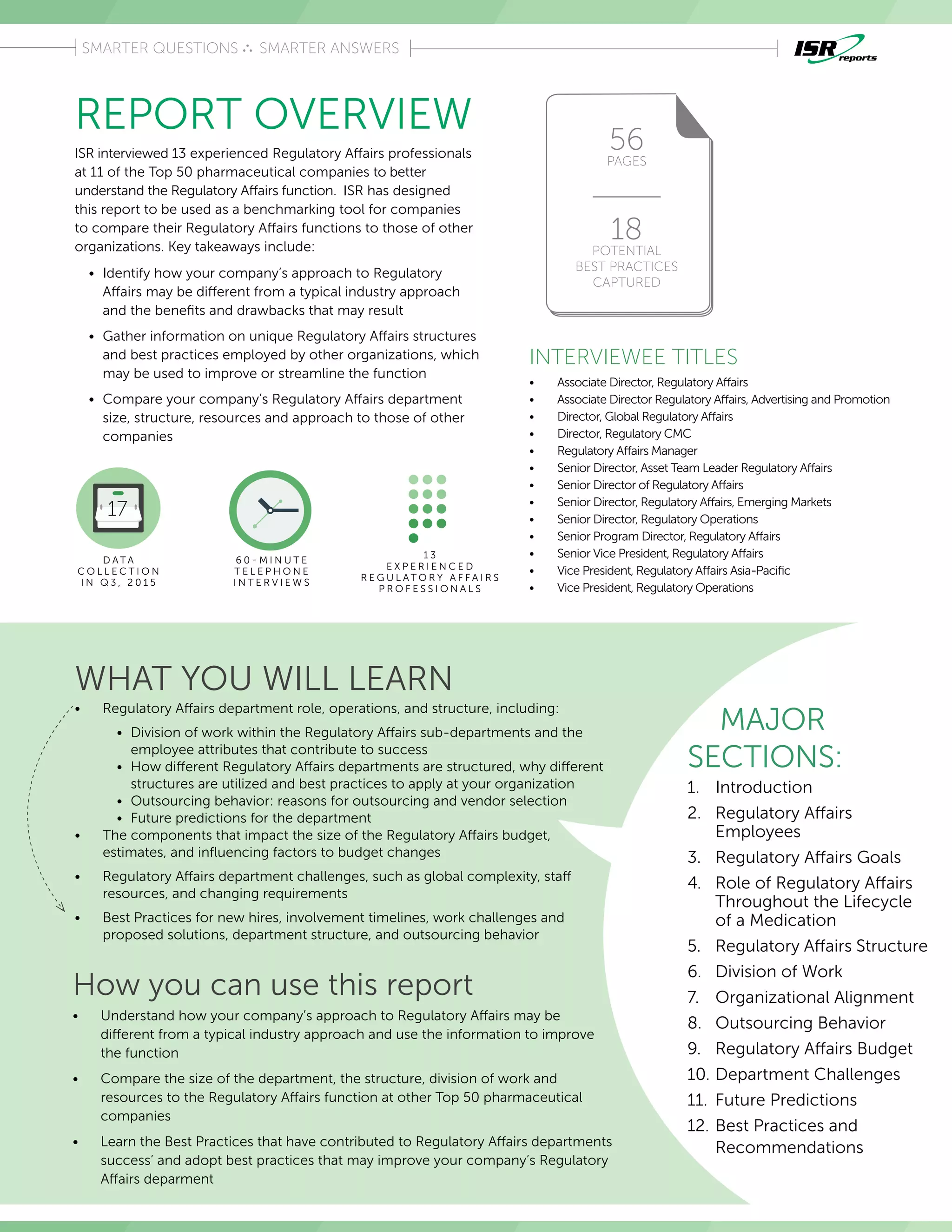
ISR interviewed 13 experienced Regulatory Affairs professionals
at 11 of the Top 50 pharmaceutical companies to better
understand the Regulatory Affairs function. ISR has designed
this report to be used as a benchmarking tool for companies
to compare their Regulatory Affairs functions to those of other
organizations. Key takeaways include:
•	 Identify how your company’s approach to Regulatory
Affairs may be different from a typical industry approach
and the benefits and drawbacks that may result
•	 Gather information on unique Regulatory Affairs structures
and best practices employed by other organizations, which
may be used to improve or streamline the function
•	 Compare your company’s Regulatory Affairs department
size, structure, resources and approach to those of other
companies
56
PAGES
18
POTENTIAL
BEST PRACTICES
CAPTURED
INTERVIEWEE TITLES
MAJOR
SECTIONS:
1.	 Introduction
2.	 Regulatory Affairs
Employees
3.	 Regulatory Affairs Goals
4.	 Role of Regulatory Affairs
Throughout the Lifecycle
of a Medication
5.	 Regulatory Affairs Structure
6.	 Division of Work
7.	 Organizational Alignment
8.	 Outsourcing Behavior
9.	 Regulatory Affairs Budget
10.	Department Challenges
11.	 Future Predictions
12.	Best Practices and
Recommendations
•	 Regulatory Affairs department role, operations, and structure, including:
•	 Division of work within the Regulatory Affairs sub-departments and the
employee attributes that contribute to success
•	 How different Regulatory Affairs departments are structured, why different
structures are utilized and best practices to apply at your organization
•	 Outsourcing behavior: reasons for outsourcing and vendor selection
•	 Future predictions for the department
•	 The components that impact the size of the Regulatory Affairs budget,
estimates, and influencing factors to budget changes
•	 Regulatory Affairs department challenges, such as global complexity, staff
resources, and changing requirements
•	 Best Practices for new hires, involvement timelines, work challenges and
proposed solutions, department structure, and outsourcing behavior
•	 Understand how your company’s approach to Regulatory Affairs may be
different from a typical industry approach and use the information to improve
the function
•	 Compare the size of the department, the structure, division of work and
resources to the Regulatory Affairs function at other Top 50 pharmaceutical
companies
•	 Learn the Best Practices that have contributed to Regulatory Affairs departments
success’ and adopt best practices that may improve your company’s Regulatory
Affairs deparment
Introduction
SMARTER QUESTIONS SMARTER ANSWERS
•	 Associate Director, Regulatory Affairs
•	 Associate Director Regulatory Affairs, Advertising and Promotion
•	 Director, Global Regulatory Affairs
•	 Director, Regulatory CMC
•	 Regulatory Affairs Manager
•	 Senior Director, Asset Team Leader Regulatory Affairs
•	 Senior Director of Regulatory Affairs
•	 Senior Director, Regulatory Affairs, Emerging Markets
•	 Senior Director, Regulatory Operations
•	 Senior Program Director, Regulatory Affairs
•	 Senior Vice President, Regulatory Affairs
•	 Vice President, Regulatory Affairs Asia-Pacific
•	 Vice President, Regulatory Operations
D A T A
C O L L E C T I O N
I N Q 3 , 2 0 1 5
6 0 - M I N U T E
T E L E P H O N E
I N T E R V I E W S
1 3
E X P E R I E N C E D
R E G U L A T O R Y A F F A I R S
P R O F E S S I O N A L S
Introduction
SMARTER QUESTIONS SMARTER ANSWERS
TABLE OF CONTENTS
For full table of contents, sample pages, and ordering information,
please download the full preview at: https://goo.gl/o9lTif
Introduction
SMARTER QUESTIONS SMARTER ANSWERS
UNDERSTANDING THE REGULATORY AFFAIRS FUNCTION
Regulatory Affairs: Department Models and Structures 11www.ISRreports.com ©2016
Employee Qualities
SCIENTIFIC
KNOWLEDGE
EXPERT
KNOWLEDGE
COMMUNICATE
AGILITY
STRATEGIC
THINKING
PERSEVERE
FORWARD THINKING
NEGOTIATE
HARDWORKING
Since Regulatory Affairs professionals are involved in product
development from the earliest stages through post-marketing, the
qualities of the employees must span a broad range of scientific
information—from understanding molecule production to clinical
knowledge� A Regulatory Affairs employee must be able to speak
scientifically, pick up new information quickly, have a deep
understanding of product development, be able to interpret and explain
regulatory guidelines, challenge the status quo, assess risk, and apply risk
assessment to the regulatory strategy� This requires good planning, time
management, and attention to detail�
As the primary liaisons between a biopharmaceutical company and the regulatory bodies, the
ability to communicate—both in writing and verbally—is at the core of a strong Regulatory
Affairs employee� Further, interpersonal skills such as questioning and listening, problem
solving, and the ability to synthesize and simplify complex data skills are key� Perhaps the
most common theme from respondents was that regulatory personnel must have strong
negotiating skills and perseverance in order to put all of their other qualities into action�
REGULATORY
AFFAIRS
EMPLOYEES
“Quite difficult to attract
the right talent�”
Top 50 Pharma
S A M P L E P A G E :
REGULATORY
AFFAIRS
EMPLOYEE
QUALITIES
Communication is considered
one of the core skills required
for success in Regulatory Affairs.
The role requires written and
verbal communication between
a biopharmaceutical company
and the regulatory bodies.
Employees must be able to
speak scientifically and be able to
interpret and explain regulatory
guidelines and strategy.
C L O S E R L O O K
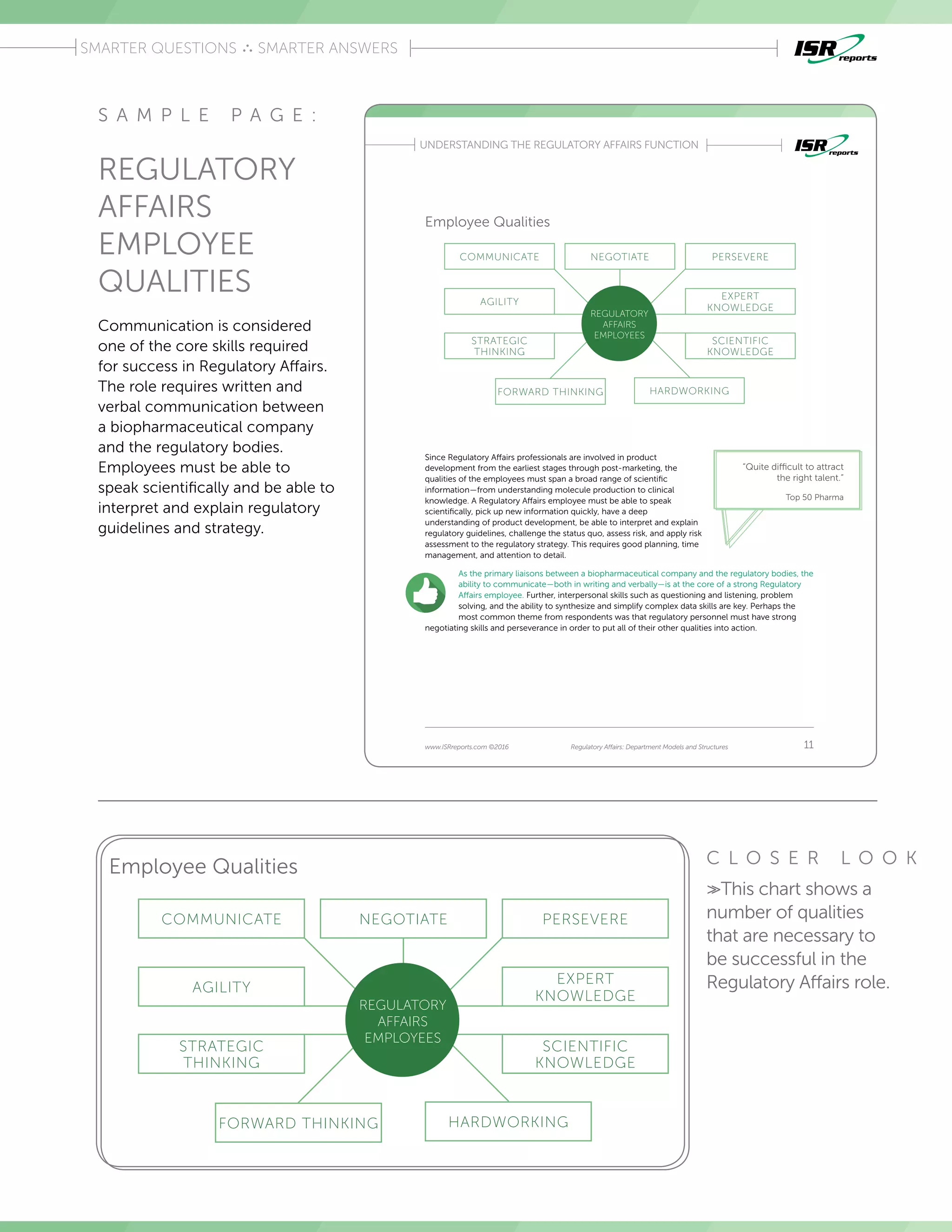
>>This chart shows a
number of qualities
that are necessary to
be successful in the
Regulatory Affairs role.
UNDERSTANDING THE REGULATORY AFFAIRS FUNCTION
Employee Qualities
SCIENTIFIC
KNOWLEDGE
EXPERT
KNOWLEDGE
COMMUNICATE
AGILITY
STRATEGIC
THINKING
PERSEVERE
FORWARD THINKING
NEGOTIATE
HARDWORKING
Since Regulatory Affairs professionals are involved in product
REGULATORY
AFFAIRS
EMPLOYEES
Introduction
SMARTER QUESTIONS SMARTER ANSWERS
Introduction
REGULATORY AFFARIS DEPARTMENT BENCHMARKING
Regulatory Affairs: Department Models and Structures 23www.ISRreports.com ©2016
Regulatory Affairs Structure
According to research participants, Regulatory Affairs departments vary considerably in size and
structure from business to business� In this section, ISR will illustrate typical structures for a Regulatory
Affairs department at Top 50 pharma companies and call out some reported benefits and/or drawbacks
to the different structures as described by interviewees�
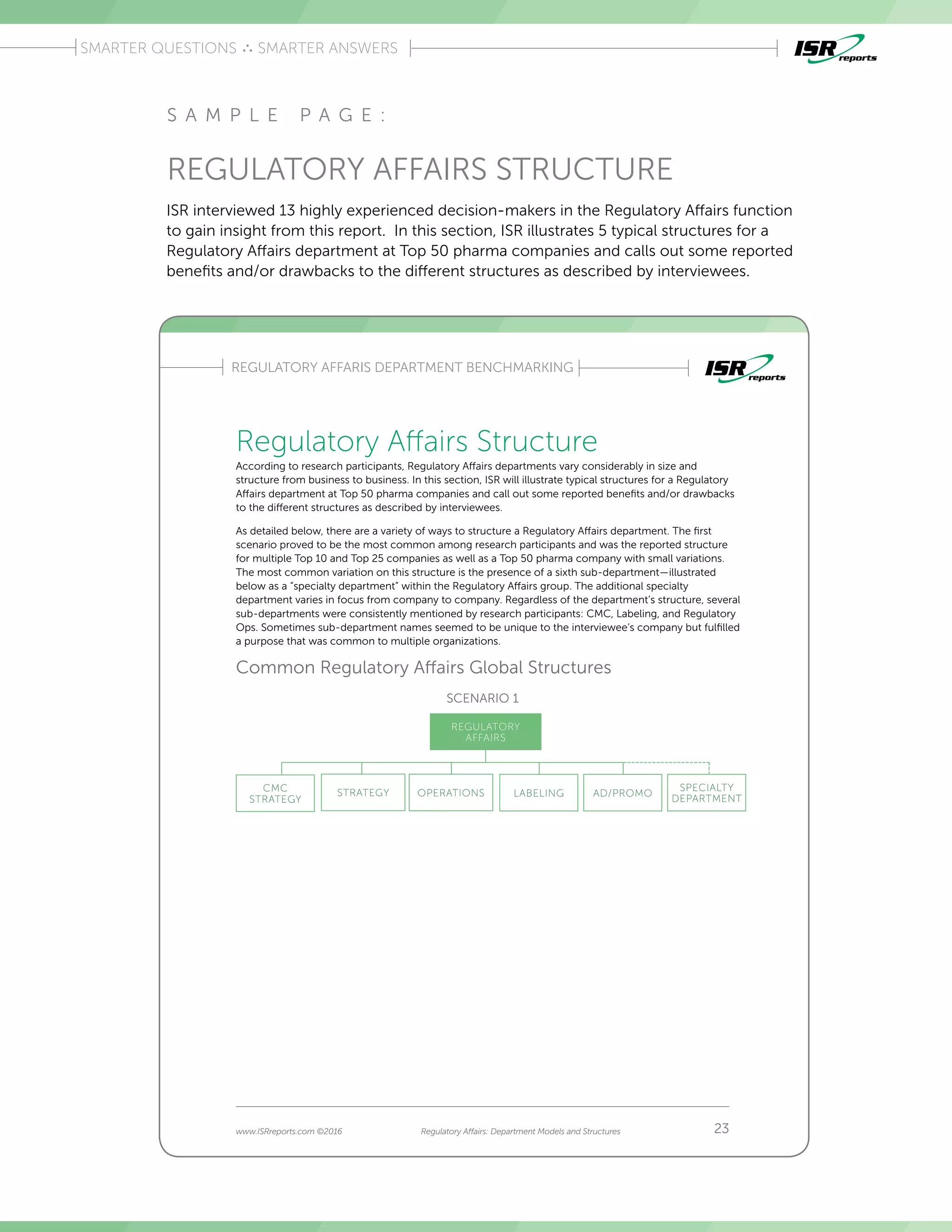
As detailed below, there are a variety of ways to structure a Regulatory Affairs department� The first
scenario proved to be the most common among research participants and was the reported structure
for multiple Top 10 and Top 25 companies as well as a Top 50 pharma company with small variations�
The most common variation on this structure is the presence of a sixth sub-department—illustrated
below as a “specialty department” within the Regulatory Affairs group� The additional specialty
department varies in focus from company to company� Regardless of the department’s structure, several
sub-departments were consistently mentioned by research participants: CMC, Labeling, and Regulatory
Ops� Sometimes sub-department names seemed to be unique to the interviewee’s company but fulfilled
a purpose that was common to multiple organizations�
Common Regulatory Affairs Global Structures
REGULATORY
AFFAIRS
CMC
STRATEGY
STRATEGY OPERATIONS LABELING AD/PROMO
SPECIALTY
DEPARTMENT
SCENARIO 1
REGULATORY
AFFAIRS
REGIONAL
HEAD
THERAPEUTIC
AREA HEAD
CMC LABELING PUBLISHING
LOCAL
AFFILIATE
LOCAL
AFFILIATE
COUNTRY
MANAGER
SCENARIO 2
S A M P L E P A G E :
REGULATORY AFFAIRS STRUCTURE
ISR interviewed 13 highly experienced decision-makers in the Regulatory Affairs function
to gain insight from this report. In this section, ISR illustrates 5 typical structures for a
Regulatory Affairs department at Top 50 pharma companies and calls out some reported
benefits and/or drawbacks to the different structures as described by interviewees.
Introduction
SMARTER QUESTIONS SMARTER ANSWERS
For full table of contents, sample pages, and ordering information,
please download the full preview at: https://goo.gl/o9lTif
Introduction
SMARTER QUESTIONS SMARTER ANSWERS
ORDERING INFORMATION
Industry Standard Research (ISR) is the premier, full service market research provider to the pharma and pharma services
industries.  With over a decade of experience in the industry, ISR delivers an unmatched level of domain expertise. 
 
For more information about our off-the-shelf intelligence and custom research offerings, please visit our Web site at
www.ISRreports.com, email info@ISRreports.com, or follow us on twitter @ISRreports.
ABOUT INDUSTRY STANDARD RESEARCH
>> R E G I S T E R N O W
>>Receive $250 instant credit towards any ISR report
>>Earn 10% credit towards all future purchases
>>Receive advanced notifications on ISR’s latest reports and
free resources
SAVE ON THIS,
OR ANY ISR REPORT, BY
CREATING A
FREE ACCOUNT
For full table of contents, sample pages, and ordering information,
please download the full preview at: https://goo.gl/o9lTif
Introduction
SMARTER QUESTIONS SMARTER ANSWERS
www.ISRreports.com ©2013 | Preview of: Benchmarking the Pharma Industry’s HEOR Functions 8
act with confidence
www.ISRreports.com ©2015 | Preview of: Epithelial Ovarian Cancer: Disease and Pipeline Analysis 10
act with confidence
www.ISRreports.com ©2013 | Preview of: Benchmarking the Pharma Industry’s HEOR Functions 10
act with confidence
www.ISRreports.com ©2014 | Preview of: Benchmarking European Investigator Payments 10
act with confidence
www.ISRreports.com ©2013 | Preview of: Benchmarking the Pharma Industry’s HEOR Functions 10
act with confidence
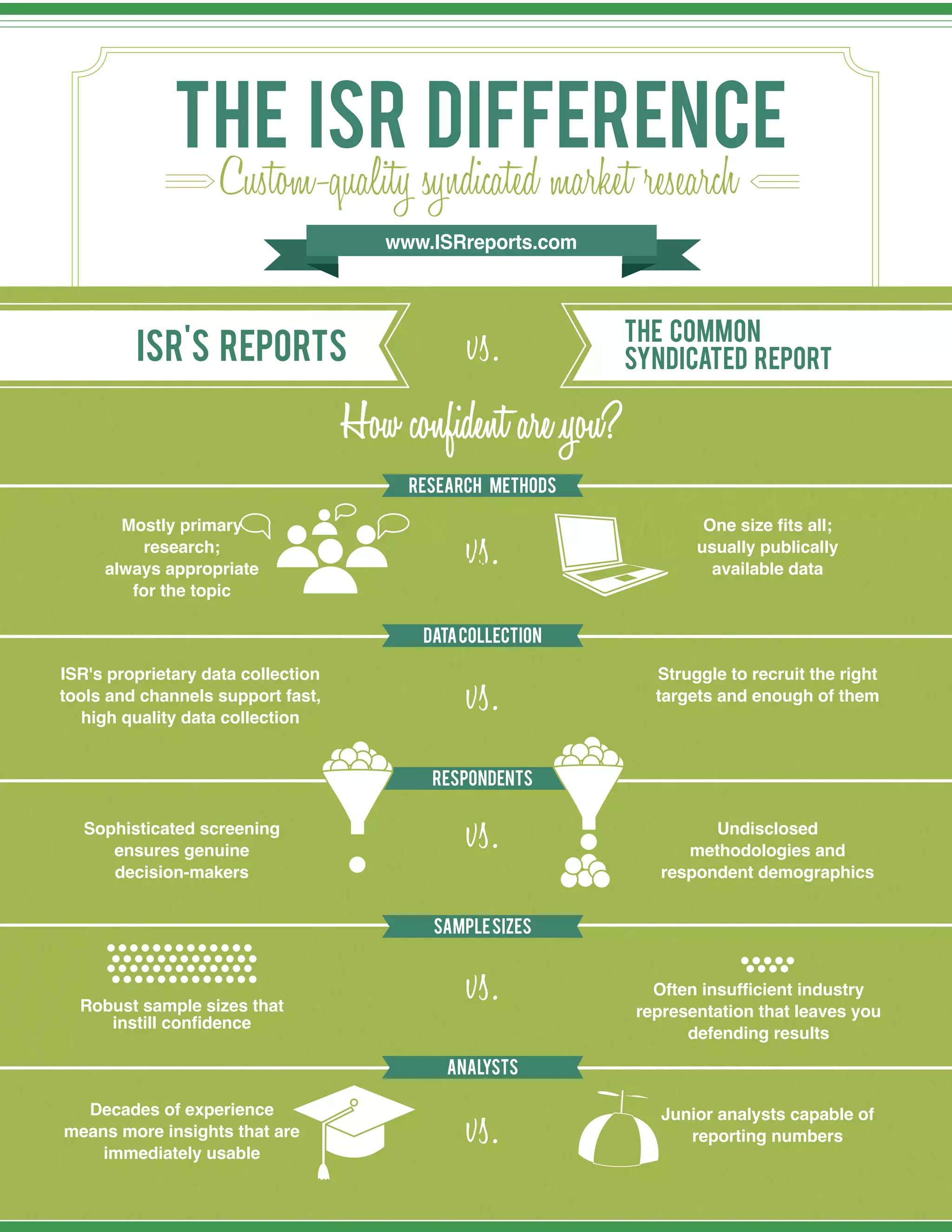
The ISR Difference
Custom-quality syndicated market research
www.ISRreports.com
ISR's Reports
The Common
Syndicated Reportvs.
How confident are you?
vs.
DataCollection
ISR's proprietary data collection
tools and channels support fast,
high quality data collection
Struggle to recruit the right
targets and enough of them
vs.
SampleSizes
Robust sample sizes that
instill confidence
Often insufficient industry
representation that leaves you
defending results
vs.vs.
Research methods
Mostly primary
research;
always appropriate
for the topic
One size fits all;
usually publically
available data
vs.vs.
Respondents
Sophisticated screening
ensures genuine
decision-makers
Undisclosed
methodologies and
respondent demographics
vs.vs.
Analysts
Decades of experience
means more insights that are
immediately usable
Junior analysts capable of
reporting numbers

Regulatory Affairs: Department Models and Structures

  • 1.
    REGULATORY AFFAIRS: DEPARTMENT MODELS ANDSTRUCTURES M A R C H , 2 0 1 6 P R E V I E W O F REGULATORY AFFAIRS
  • 2.
    REPORT OVERVIEW WHAT YOUWILL LEARN How you can use this report ISR interviewed 13 experienced Regulatory Affairs professionals at 11 of the Top 50 pharmaceutical companies to better understand the Regulatory Affairs function. ISR has designed this report to be used as a benchmarking tool for companies to compare their Regulatory Affairs functions to those of other organizations. Key takeaways include: • Identify how your company’s approach to Regulatory Affairs may be different from a typical industry approach and the benefits and drawbacks that may result • Gather information on unique Regulatory Affairs structures and best practices employed by other organizations, which may be used to improve or streamline the function • Compare your company’s Regulatory Affairs department size, structure, resources and approach to those of other companies 56 PAGES 18 POTENTIAL BEST PRACTICES CAPTURED INTERVIEWEE TITLES MAJOR SECTIONS: 1. Introduction 2. Regulatory Affairs Employees 3. Regulatory Affairs Goals 4. Role of Regulatory Affairs Throughout the Lifecycle of a Medication 5. Regulatory Affairs Structure 6. Division of Work 7. Organizational Alignment 8. Outsourcing Behavior 9. Regulatory Affairs Budget 10. Department Challenges 11. Future Predictions 12. Best Practices and Recommendations • Regulatory Affairs department role, operations, and structure, including: • Division of work within the Regulatory Affairs sub-departments and the employee attributes that contribute to success • How different Regulatory Affairs departments are structured, why different structures are utilized and best practices to apply at your organization • Outsourcing behavior: reasons for outsourcing and vendor selection • Future predictions for the department • The components that impact the size of the Regulatory Affairs budget, estimates, and influencing factors to budget changes • Regulatory Affairs department challenges, such as global complexity, staff resources, and changing requirements • Best Practices for new hires, involvement timelines, work challenges and proposed solutions, department structure, and outsourcing behavior • Understand how your company’s approach to Regulatory Affairs may be different from a typical industry approach and use the information to improve the function • Compare the size of the department, the structure, division of work and resources to the Regulatory Affairs function at other Top 50 pharmaceutical companies • Learn the Best Practices that have contributed to Regulatory Affairs departments success’ and adopt best practices that may improve your company’s Regulatory Affairs deparment Introduction SMARTER QUESTIONS SMARTER ANSWERS • Associate Director, Regulatory Affairs • Associate Director Regulatory Affairs, Advertising and Promotion • Director, Global Regulatory Affairs • Director, Regulatory CMC • Regulatory Affairs Manager • Senior Director, Asset Team Leader Regulatory Affairs • Senior Director of Regulatory Affairs • Senior Director, Regulatory Affairs, Emerging Markets • Senior Director, Regulatory Operations • Senior Program Director, Regulatory Affairs • Senior Vice President, Regulatory Affairs • Vice President, Regulatory Affairs Asia-Pacific • Vice President, Regulatory Operations D A T A C O L L E C T I O N I N Q 3 , 2 0 1 5 6 0 - M I N U T E T E L E P H O N E I N T E R V I E W S 1 3 E X P E R I E N C E D R E G U L A T O R Y A F F A I R S P R O F E S S I O N A L S
  • 3.
    Introduction SMARTER QUESTIONS SMARTERANSWERS TABLE OF CONTENTS For full table of contents, sample pages, and ordering information, please download the full preview at: https://goo.gl/o9lTif
  • 4.
    Introduction SMARTER QUESTIONS SMARTERANSWERS UNDERSTANDING THE REGULATORY AFFAIRS FUNCTION Regulatory Affairs: Department Models and Structures 11www.ISRreports.com ©2016 Employee Qualities SCIENTIFIC KNOWLEDGE EXPERT KNOWLEDGE COMMUNICATE AGILITY STRATEGIC THINKING PERSEVERE FORWARD THINKING NEGOTIATE HARDWORKING Since Regulatory Affairs professionals are involved in product development from the earliest stages through post-marketing, the qualities of the employees must span a broad range of scientific information—from understanding molecule production to clinical knowledge� A Regulatory Affairs employee must be able to speak scientifically, pick up new information quickly, have a deep understanding of product development, be able to interpret and explain regulatory guidelines, challenge the status quo, assess risk, and apply risk assessment to the regulatory strategy� This requires good planning, time management, and attention to detail� As the primary liaisons between a biopharmaceutical company and the regulatory bodies, the ability to communicate—both in writing and verbally—is at the core of a strong Regulatory Affairs employee� Further, interpersonal skills such as questioning and listening, problem solving, and the ability to synthesize and simplify complex data skills are key� Perhaps the most common theme from respondents was that regulatory personnel must have strong negotiating skills and perseverance in order to put all of their other qualities into action� REGULATORY AFFAIRS EMPLOYEES “Quite difficult to attract the right talent�” Top 50 Pharma S A M P L E P A G E : REGULATORY AFFAIRS EMPLOYEE QUALITIES Communication is considered one of the core skills required for success in Regulatory Affairs. The role requires written and verbal communication between a biopharmaceutical company and the regulatory bodies. Employees must be able to speak scientifically and be able to interpret and explain regulatory guidelines and strategy. C L O S E R L O O K >>This chart shows a number of qualities that are necessary to be successful in the Regulatory Affairs role. UNDERSTANDING THE REGULATORY AFFAIRS FUNCTION Employee Qualities SCIENTIFIC KNOWLEDGE EXPERT KNOWLEDGE COMMUNICATE AGILITY STRATEGIC THINKING PERSEVERE FORWARD THINKING NEGOTIATE HARDWORKING Since Regulatory Affairs professionals are involved in product REGULATORY AFFAIRS EMPLOYEES
  • 5.
    Introduction SMARTER QUESTIONS SMARTERANSWERS Introduction REGULATORY AFFARIS DEPARTMENT BENCHMARKING Regulatory Affairs: Department Models and Structures 23www.ISRreports.com ©2016 Regulatory Affairs Structure According to research participants, Regulatory Affairs departments vary considerably in size and structure from business to business� In this section, ISR will illustrate typical structures for a Regulatory Affairs department at Top 50 pharma companies and call out some reported benefits and/or drawbacks to the different structures as described by interviewees� As detailed below, there are a variety of ways to structure a Regulatory Affairs department� The first scenario proved to be the most common among research participants and was the reported structure for multiple Top 10 and Top 25 companies as well as a Top 50 pharma company with small variations� The most common variation on this structure is the presence of a sixth sub-department—illustrated below as a “specialty department” within the Regulatory Affairs group� The additional specialty department varies in focus from company to company� Regardless of the department’s structure, several sub-departments were consistently mentioned by research participants: CMC, Labeling, and Regulatory Ops� Sometimes sub-department names seemed to be unique to the interviewee’s company but fulfilled a purpose that was common to multiple organizations� Common Regulatory Affairs Global Structures REGULATORY AFFAIRS CMC STRATEGY STRATEGY OPERATIONS LABELING AD/PROMO SPECIALTY DEPARTMENT SCENARIO 1 REGULATORY AFFAIRS REGIONAL HEAD THERAPEUTIC AREA HEAD CMC LABELING PUBLISHING LOCAL AFFILIATE LOCAL AFFILIATE COUNTRY MANAGER SCENARIO 2 S A M P L E P A G E : REGULATORY AFFAIRS STRUCTURE ISR interviewed 13 highly experienced decision-makers in the Regulatory Affairs function to gain insight from this report. In this section, ISR illustrates 5 typical structures for a Regulatory Affairs department at Top 50 pharma companies and calls out some reported benefits and/or drawbacks to the different structures as described by interviewees.
  • 6.
    Introduction SMARTER QUESTIONS SMARTERANSWERS For full table of contents, sample pages, and ordering information, please download the full preview at: https://goo.gl/o9lTif
  • 7.
    Introduction SMARTER QUESTIONS SMARTERANSWERS ORDERING INFORMATION Industry Standard Research (ISR) is the premier, full service market research provider to the pharma and pharma services industries.  With over a decade of experience in the industry, ISR delivers an unmatched level of domain expertise.    For more information about our off-the-shelf intelligence and custom research offerings, please visit our Web site at www.ISRreports.com, email info@ISRreports.com, or follow us on twitter @ISRreports. ABOUT INDUSTRY STANDARD RESEARCH >> R E G I S T E R N O W >>Receive $250 instant credit towards any ISR report >>Earn 10% credit towards all future purchases >>Receive advanced notifications on ISR’s latest reports and free resources SAVE ON THIS, OR ANY ISR REPORT, BY CREATING A FREE ACCOUNT For full table of contents, sample pages, and ordering information, please download the full preview at: https://goo.gl/o9lTif
  • 8.
    Introduction SMARTER QUESTIONS SMARTERANSWERS www.ISRreports.com ©2013 | Preview of: Benchmarking the Pharma Industry’s HEOR Functions 8 act with confidence www.ISRreports.com ©2015 | Preview of: Epithelial Ovarian Cancer: Disease and Pipeline Analysis 10 act with confidence www.ISRreports.com ©2013 | Preview of: Benchmarking the Pharma Industry’s HEOR Functions 10 act with confidence www.ISRreports.com ©2014 | Preview of: Benchmarking European Investigator Payments 10 act with confidence www.ISRreports.com ©2013 | Preview of: Benchmarking the Pharma Industry’s HEOR Functions 10 act with confidence The ISR Difference Custom-quality syndicated market research www.ISRreports.com ISR's Reports The Common Syndicated Reportvs. How confident are you? vs. DataCollection ISR's proprietary data collection tools and channels support fast, high quality data collection Struggle to recruit the right targets and enough of them vs. SampleSizes Robust sample sizes that instill confidence Often insufficient industry representation that leaves you defending results vs.vs. Research methods Mostly primary research; always appropriate for the topic One size fits all; usually publically available data vs.vs. Respondents Sophisticated screening ensures genuine decision-makers Undisclosed methodologies and respondent demographics vs.vs. Analysts Decades of experience means more insights that are immediately usable Junior analysts capable of reporting numbers