Regulation Analysis using
Restricted Boltzmann Machines
Network Modeling Seminar, 10/1/2013
Patrick Michl
Page 21/10/2013 |
Author
Department
Agenda
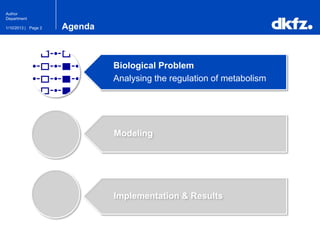
Biological Problem
Analysing the regulation of metabolism
Modeling
Implementation & Results
Page 31/10/2013 |
Author
Department Biological Problem
Analysing the regulation of metabolism
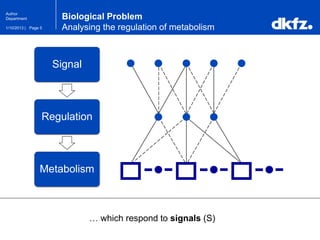
Signal
Regulation
Metabolism
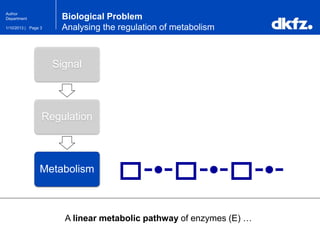
A linear metabolic pathway of enzymes (E) …
Page 41/10/2013 |
Author
Department Biological Problem
Analysing the regulation of metabolism
Signal
Regulation
Metabolism
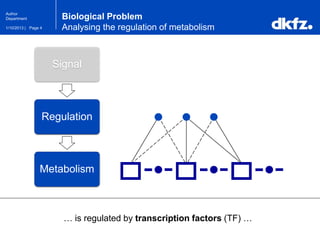
… is regulated by transcription factors (TF) …
Page 51/10/2013 |
Author
Department Biological Problem
Analysing the regulation of metabolism
Signal
Regulation
Metabolism
… which respond to signals (S)
Page 61/10/2013 |
Author
Department
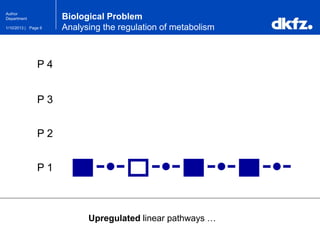
P 4
P 3
P 2
P 1
Biological Problem
Analysing the regulation of metabolism
Upregulated linear pathways …
Page 71/10/2013 |
Author
Department
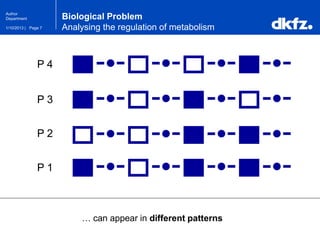
P 4
P 3
P 2
P 1
Biological Problem
Analysing the regulation of metabolism
… can appear in different patterns
Page 81/10/2013 |
Author
Department Biological Problem
Analysing the regulation of metabolism
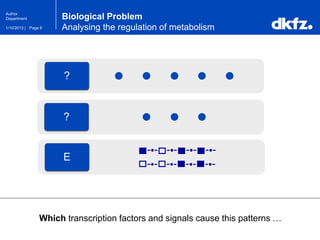
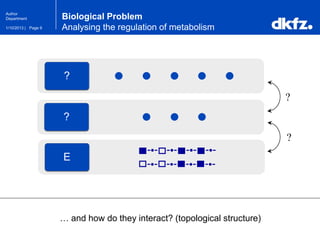
Which transcription factors and signals cause this patterns …
?
E
?
Page 91/10/2013 |
Author
Department Biological Problem
Analysing the regulation of metabolism
… and how do they interact? (topological structure)
?
E
?
?
?
Page 101/10/2013 |
Author
Department
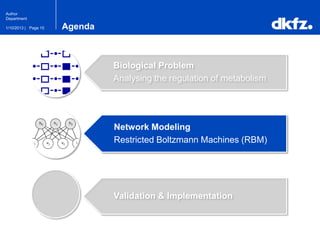
Agenda
Biological Problem
Analysing the regulation of metabolism
Network Modeling
Restricted Boltzmann Machines (RBM)
Validation & Implementation
Page 111/10/2013 |
Author
Department Network Modeling
Restricted Boltzmann Machines (RBM)
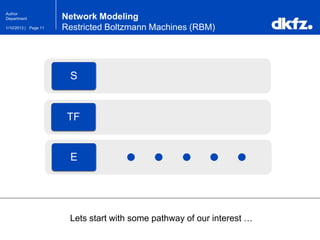
Lets start with some pathway of our interest …
S
E
TF
Page 121/10/2013 |
Author
Department Network Modeling
Restricted Boltzmann Machines (RBM)
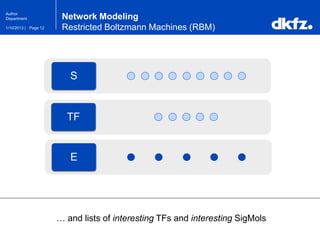
… and lists of interesting TFs and interesting SigMols
S
E
TF
Page 131/10/2013 |
Author
Department Network Modeling
Restricted Boltzmann Machines (RBM)
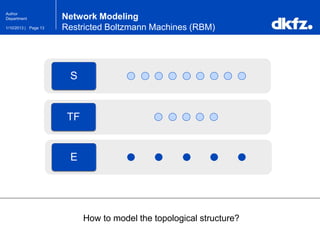
How to model the topological structure?
S
E
TF
Page 141/10/2013 |
Author
Department
Graphical Models
Graphical Models can preserve topological structures …
Network Modeling
Restricted Boltzmann Machines (RBM)
Page 151/10/2013 |
Author
Department
Graphical Models
Directed Graph Undirected Graph…
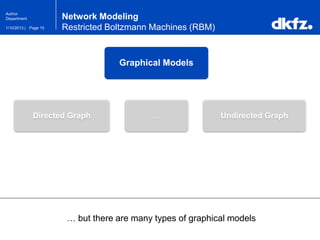
… but there are many types of graphical models
Network Modeling
Restricted Boltzmann Machines (RBM)
Page 161/10/2013 |
Author
Department
Graphical Models
Directed Graph
Bayesian Networks
Undirected Graph…
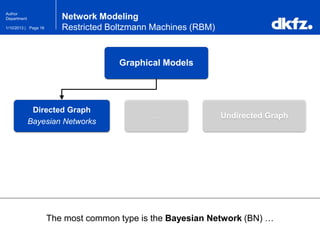
The most common type is the Bayesian Network (BN) …
Network Modeling
Restricted Boltzmann Machines (RBM)
Page 171/10/2013 |
Author
Department
Bayesian Networks
Bayesian Networks use joint probabilities …
Network Modeling
Restricted Boltzmann Machines (RBM)
a b
a b c P[a,b,c]
0 0 0 0.1
0 0 1 0.9
0 1 0 0.5
0 1 1 0.5
1 0 0 …
… … … …
c
?
Page 181/10/2013 |
Author
Department
Bayesian Networks
… to represents conditional dependencies in an acyclic graph …
Network Modeling
Restricted Boltzmann Machines (RBM)
a b
a b c P[a,b,c]
0 0 0 0.1
0 0 1 0.9
0 1 0 0.5
0 1 1 0.5
1 0 0 …
… … … …
c
Page 191/10/2013 |
Author
Department
Bayesian Networks
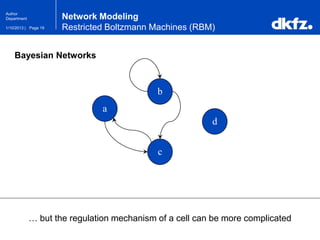
… but the regulation mechanism of a cell can be more complicated
Network Modeling
Restricted Boltzmann Machines (RBM)
a
b
c
d
Page 201/10/2013 |
Author
Department
Graphical Models
Directed Graph
Bayesian Networks
Undirected Graph
Markov Random Fields
…
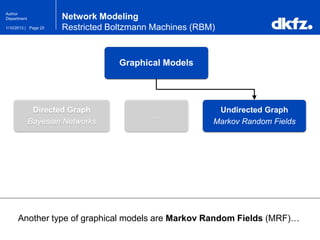
Another type of graphical models are Markov Random Fields (MRF)…
Network Modeling
Restricted Boltzmann Machines (RBM)
Page 211/10/2013 |
Author
Department
Markov Random Fields
Motivation (Ising Model)
A set of magnetic dipoles (spins)
is arranged in a graph (lattice)
where neighbors are
coupled with a given strengt
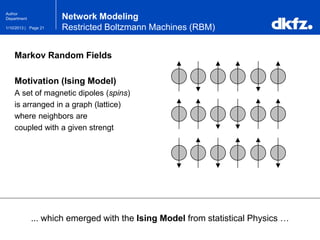
... which emerged with the Ising Model from statistical Physics …
Network Modeling
Restricted Boltzmann Machines (RBM)
Page 221/10/2013 |
Author
Department
Markov Random Fields
Motivation (Ising Model)
A set of magnetic dipoles (spins)
is arranged in a graph (lattice)
where neighbors are
coupled with a given strengt
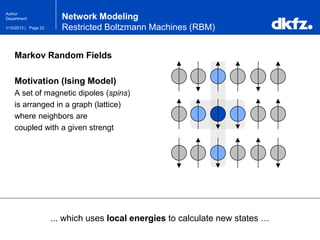
... which uses local energies to calculate new states …
Network Modeling
Restricted Boltzmann Machines (RBM)
Page 231/10/2013 |
Author
Department
Markov Random Fields
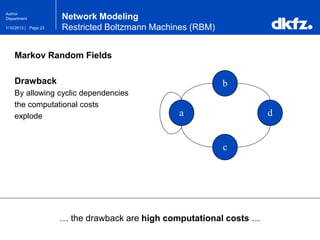
Drawback
By allowing cyclic dependencies
the computational costs
explode
… the drawback are high computational costs …
Network Modeling
Restricted Boltzmann Machines (RBM)
a
b
c
d
Page 241/10/2013 |
Author
Department
Graphical Models
Directed Graph
Bayesian Networks
Undirected Graph
Markov Random Fields
Restricted Boltzmann
Machines (RBM)
…
…
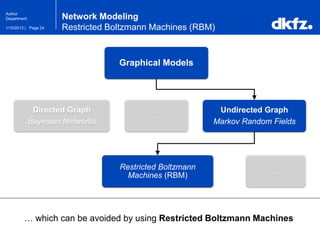
… which can be avoided by using Restricted Boltzmann Machines
Network Modeling
Restricted Boltzmann Machines (RBM)
Page 251/10/2013 |
Author
Department
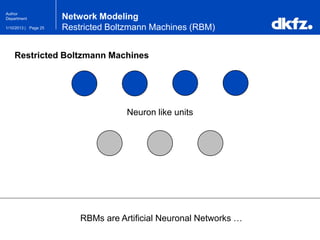
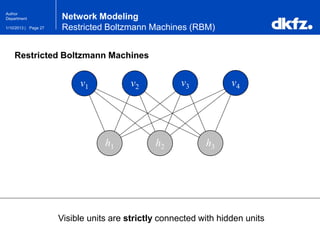
RBMs are Artificial Neuronal Networks …
Neuron like units
Network Modeling
Restricted Boltzmann Machines (RBM)
Restricted Boltzmann Machines
Page 261/10/2013 |
Author
Department
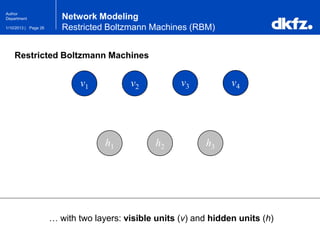
… with two layers: visible units (v) and hidden units (h)
h1
v1 v2 v3 v4
h2 h3
Network Modeling
Restricted Boltzmann Machines (RBM)
Restricted Boltzmann Machines
Page 271/10/2013 |
Author
Department
Visible units are strictly connected with hidden units
h1
v1 v2 v3 v4
h2 h3
Network Modeling
Restricted Boltzmann Machines (RBM)
Restricted Boltzmann Machines
Page 281/10/2013 |
Author
Department
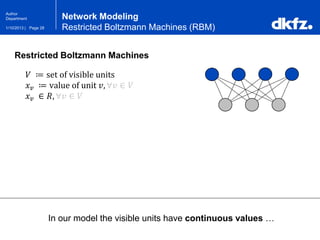
In our model the visible units have continuous values …
Network Modeling
Restricted Boltzmann Machines (RBM)
Restricted Boltzmann Machines
𝑉 ≔ set of visible units
𝑥 𝑣 ≔ value of unit 𝑣, ∀𝑣 ∈ 𝑉
𝑥 𝑣 ∈ 𝑅, ∀𝑣 ∈ 𝑉
Page 291/10/2013 |
Author
Department
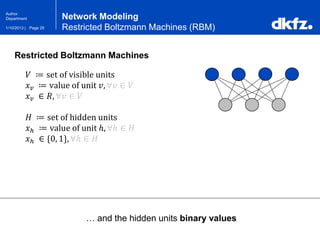
… and the hidden units binary values
Network Modeling
Restricted Boltzmann Machines (RBM)
𝑉 ≔ set of visible units
𝑥 𝑣 ≔ value of unit 𝑣, ∀𝑣 ∈ 𝑉
𝑥 𝑣 ∈ 𝑅, ∀𝑣 ∈ 𝑉
𝐻 ≔ set of hidden units
𝑥ℎ ≔ value of unit ℎ, ∀ℎ ∈ 𝐻
𝑥ℎ ∈ {0, 1}, ∀ℎ ∈ 𝐻
Restricted Boltzmann Machines
Page 301/10/2013 |
Author
Department
Restricted Boltzmann Machines
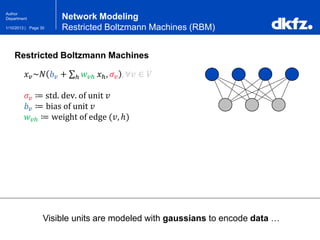
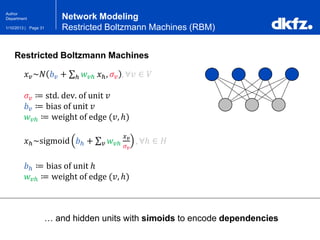
Visible units are modeled with gaussians to encode data …
Network Modeling
Restricted Boltzmann Machines (RBM)
𝑥 𝑣~𝑁 𝑏 𝑣 + 𝑤 𝑣ℎℎ 𝑥ℎ, 𝜎𝑣 , ∀𝑣 ∈ 𝑉
𝜎𝑣 ≔ std. dev. of unit 𝑣
𝑏 𝑣 ≔ bias of unit 𝑣
𝑤 𝑣ℎ ≔ weight of edge (𝑣, ℎ)
Page 311/10/2013 |
Author
Department
… and hidden units with simoids to encode dependencies
Network Modeling
Restricted Boltzmann Machines (RBM)
𝑥 𝑣~𝑁 𝑏 𝑣 + 𝑤 𝑣ℎℎ 𝑥ℎ, 𝜎𝑣 , ∀𝑣 ∈ 𝑉
𝜎𝑣 ≔ std. dev. of unit 𝑣
𝑏 𝑣 ≔ bias of unit 𝑣
𝑤 𝑣ℎ ≔ weight of edge (𝑣, ℎ)
𝑥ℎ~sigmoid 𝑏ℎ + 𝑤 𝑣ℎ𝑣
𝑥 𝑣
𝜎 𝑣
, ∀ℎ ∈ 𝐻
𝑏ℎ ≔ bias of unit ℎ
𝑤 𝑣ℎ ≔ weight of edge (𝑣, ℎ)
Restricted Boltzmann Machines
Page 321/10/2013 |
Author
Department
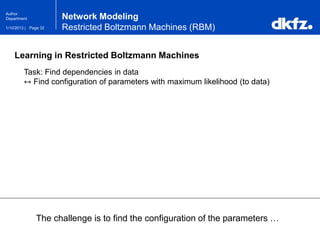
The challenge is to find the configuration of the parameters …
Network Modeling
Restricted Boltzmann Machines (RBM)
Task: Find dependencies in data
↔ Find configuration of parameters with maximum likelihood (to data)
Learning in Restricted Boltzmann Machines
Page 331/10/2013 |
Author
Department
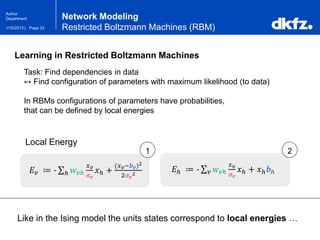
Like in the Ising model the units states correspond to local energies …
Local Energy
Network Modeling
Restricted Boltzmann Machines (RBM)
𝐸ℎ ≔ - 𝑤 𝑣ℎ𝑣
𝑥 𝑣
𝜎 𝑣
𝑥ℎ + 𝑥ℎ 𝑏ℎ𝐸 𝑣 ≔ - 𝑤 𝑣ℎℎ
𝑥 𝑣
𝜎 𝑣
𝑥ℎ +
(𝑥 𝑣−𝑏 𝑣)2
2𝜎 𝑣
2
Task: Find dependencies in data
↔ Find configuration of parameters with maximum likelihood (to data)
In RBMs configurations of parameters have probabilities,
that can be defined by local energies
1 2
Learning in Restricted Boltzmann Machines
Page 341/10/2013 |
Author
Department
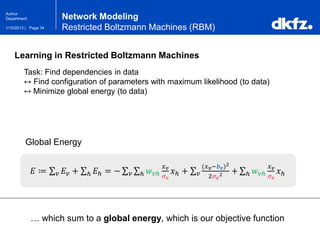
… which sum to a global energy, which is our objective function
Global Energy
Network Modeling
Restricted Boltzmann Machines (RBM)
𝐸 ≔ 𝐸 𝑣𝑣 + 𝐸ℎℎ = − 𝑤 𝑣ℎℎ𝑣
𝑥 𝑣
𝜎 𝑣
𝑥ℎ +
(𝑥 𝑣−𝑏 𝑣)2
2𝜎 𝑣
2 +𝑣 𝑤 𝑣ℎ
𝑥 𝑣
𝜎 𝑣
𝑥ℎℎ
Task: Find dependencies in data
↔ Find configuration of parameters with maximum likelihood (to data)
↔ Minimize global energy (to data)
Learning in Restricted Boltzmann Machines
Page 351/10/2013 |
Author
Department
Learning in Restricted Boltzmann Machines
The optimization can be done using stochastic gradient descent …
Network Modeling
Restricted Boltzmann Machines (RBM)
Task: Find dependencies in data
↔ Find configuration of parameters with maximum likelihood (to data)
↔ Minimize global energy (to data)
↔ Perform stochastic gradient descent on 𝜎𝑣, 𝑏 𝑣, 𝑏ℎ, 𝑤 𝑣ℎ (to data)
Page 361/10/2013 |
Author
Department
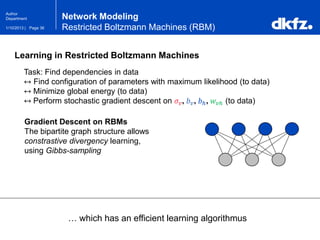
… which has an efficient learning algorithmus
Network Modeling
Restricted Boltzmann Machines (RBM)
Task: Find dependencies in data
↔ Find configuration of parameters with maximum likelihood (to data)
↔ Minimize global energy (to data)
↔ Perform stochastic gradient descent on 𝜎𝑣, 𝑏 𝑣, 𝑏ℎ, 𝑤 𝑣ℎ (to data)
Gradient Descent on RBMs
The bipartite graph structure allows
constrastive divergency learning,
using Gibbs-sampling
Learning in Restricted Boltzmann Machines
Page 371/10/2013 |
Author
Department
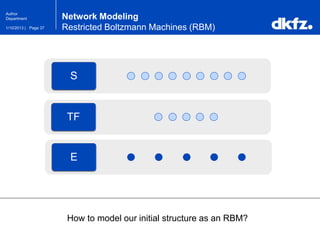
How to model our initial structure as an RBM?
Network Modeling
Restricted Boltzmann Machines (RBM)
S
E
TF
Page 381/10/2013 |
Author
Department
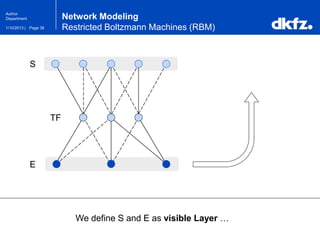
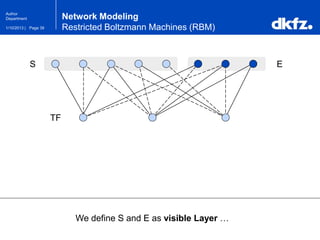
We define S and E as visible Layer …
S
E
TF
Network Modeling
Restricted Boltzmann Machines (RBM)
Page 391/10/2013 |
Author
Department
S E
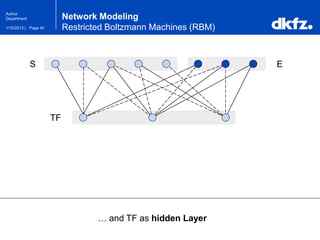
We define S and E as visible Layer …
TF
Network Modeling
Restricted Boltzmann Machines (RBM)
Page 401/10/2013 |
Author
Department
S E
… and TF as hidden Layer
TF
Network Modeling
Restricted Boltzmann Machines (RBM)
Page 411/10/2013 |
Author
Department
Agenda
Biological Problem
Analysing the regulation of metabolism
Network Modeling
Restricted Boltzmann Machines (RBM)
Implementation & Results
python::metapath
Page 421/10/2013 |
Author
Department
Results
Validation of the results
• Information about the true regulation
• Information about the descriptive power of the data
Page 431/10/2013 |
Author
Department
Results
Validation of the results
• Information about the true regulation
• Information about the descriptive power of the data
Without this infomation validation can only be done, using simulated data!
Page 441/10/2013 |
Author
Department
Results
Simulation 1
First of all we need to understand how the modell handles
dependencies and noise
To demonstrate this we create very simple data with a simple structure
Page 451/10/2013 |
Author
Department
Simulation 1
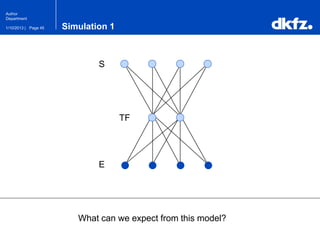
What can we expect from this model?
S
E
TF
Page 461/10/2013 |
Author
Department
Simulation 1
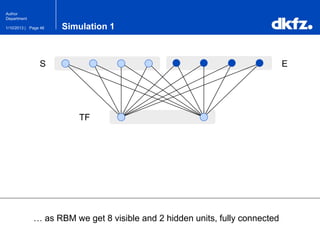
… as RBM we get 8 visible and 2 hidden units, fully connected
S E
TF
Page 471/10/2013 |
Author
Department
Simulation 1
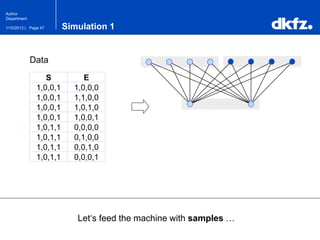
Let‘s feed the machine with samples …
S E
1,0,0,1 1,0,0,0
1,0,0,1 1,1,0,0
1,0,0,1 1,0,1,0
1,0,0,1 1,0,0,1
1,0,1,1 0,0,0,0
1,0,1,1 0,1,0,0
1,0,1,1 0,0,1,0
1,0,1,1 0,0,0,1
Data
Page 481/10/2013 |
Author
Department
Simulation 1
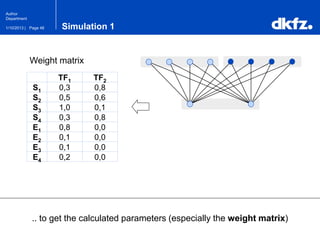
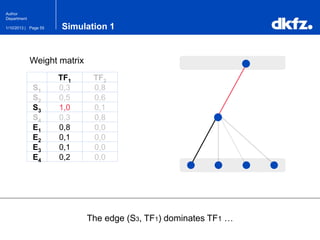
.. to get the calculated parameters (especially the weight matrix)
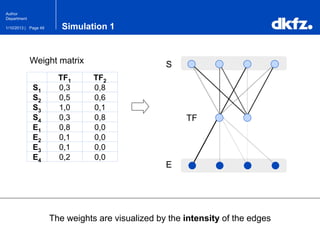
Weight matrix
TF1 TF2
S1 0,3 0,8
S2 0,5 0,6
S3 1,0 0,1
S4 0,3 0,8
E1 0,8 0,0
E2 0,1 0,0
E3 0,1 0,0
E4 0,2 0,0
Page 491/10/2013 |
Author
Department
Simulation 1
The weights are visualized by the intensity of the edges
S
E
TF
TF1 TF2
S1 0,3 0,8
S2 0,5 0,6
S3 1,0 0,1
S4 0,3 0,8
E1 0,8 0,0
E2 0,1 0,0
E3 0,1 0,0
E4 0,2 0,0
Weight matrix
Page 501/10/2013 |
Author
Department
Simulation 1
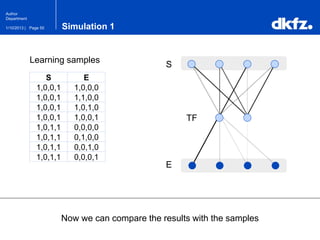
Now we can compare the results with the samples
S E
1,0,0,1 1,0,0,0
1,0,0,1 1,1,0,0
1,0,0,1 1,0,1,0
1,0,0,1 1,0,0,1
1,0,1,1 0,0,0,0
1,0,1,1 0,1,0,0
1,0,1,1 0,0,1,0
1,0,1,1 0,0,0,1
Learning samples
S
E
TF
Page 511/10/2013 |
Author
Department
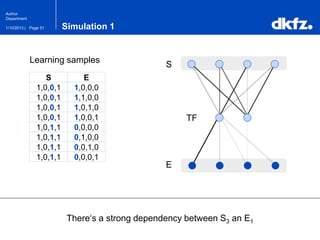
Simulation 1
There‘s a strong dependency between S3 an E1
S E
1,0,0,1 1,0,0,0
1,0,0,1 1,1,0,0
1,0,0,1 1,0,1,0
1,0,0,1 1,0,0,1
1,0,1,1 0,0,0,0
1,0,1,1 0,1,0,0
1,0,1,1 0,0,1,0
1,0,1,1 0,0,0,1
Learning samples
S
E
TF
Page 521/10/2013 |
Author
Department
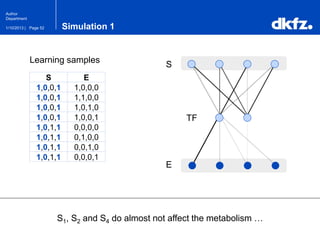
Simulation 1
S1, S2 and S4 do almost not affect the metabolism …
S E
1,0,0,1 1,0,0,0
1,0,0,1 1,1,0,0
1,0,0,1 1,0,1,0
1,0,0,1 1,0,0,1
1,0,1,1 0,0,0,0
1,0,1,1 0,1,0,0
1,0,1,1 0,0,1,0
1,0,1,1 0,0,0,1
Learning samples
S
E
TF
Page 531/10/2013 |
Author
Department
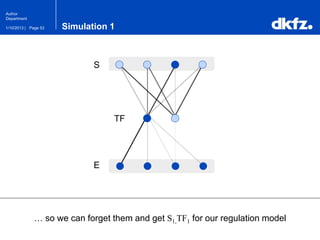
Simulation 1
… so we can forget them and get S1,TF1 for our regulation model
S
E
TF
Page 541/10/2013 |
Author
Department
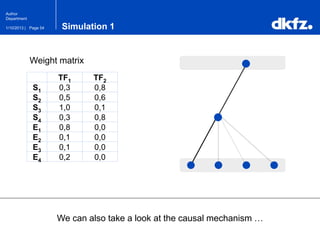
Simulation 1
We can also take a look at the causal mechanism …
TF1 TF2
S1 0,3 0,8
S2 0,5 0,6
S3 1,0 0,1
S4 0,3 0,8
E1 0,8 0,0
E2 0,1 0,0
E3 0,1 0,0
E4 0,2 0,0
Weight matrix
Page 551/10/2013 |
Author
Department
Simulation 1
The edge (S3, TF1) dominates TF1 …
TF1 TF2
S1 0,3 0,8
S2 0,5 0,6
S3 1,0 0,1
S4 0,3 0,8
E1 0,8 0,0
E2 0,1 0,0
E3 0,1 0,0
E4 0,2 0,0
Weight matrix
Page 561/10/2013 |
Author
Department
Simulation 1
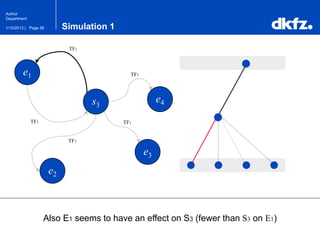
Also E1 seems to have an effect on S3 (fewer than S3 on E1)
s3
e1
e2
e3
e4
TF1
TF1
TF1
TF1
TF1
Page 571/10/2013 |
Author
Department
Results
Comparing to Bayesian Networks
For this purpose we simulate data in three steps
Of course we want to compare the method with Bayesian Networks
Page 581/10/2013 |
Author
Department
Results
Comparing to Bayesian Networks
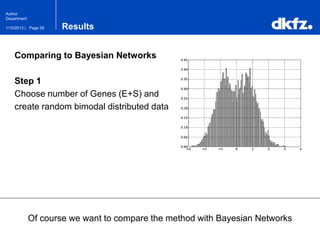
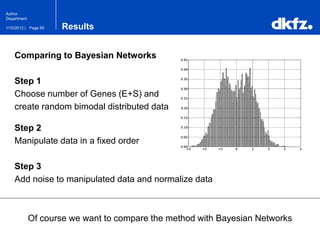
Step 1
Choose number of Genes (E+S) and
create random bimodal distributed data
Of course we want to compare the method with Bayesian Networks
Page 591/10/2013 |
Author
Department
Results
Comparing to Bayesian Networks
Step 1
Choose number of Genes (E+S) and
create random bimodal distributed data
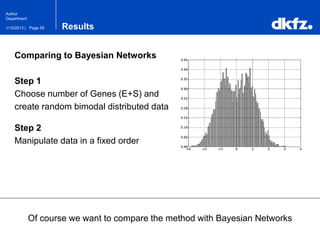
Step 2
Manipulate data in a fixed order
Of course we want to compare the method with Bayesian Networks
Page 601/10/2013 |
Author
Department
Results
Comparing to Bayesian Networks
Step 1
Choose number of Genes (E+S) and
create random bimodal distributed data
Step 2
Manipulate data in a fixed order
Step 3
Add noise to manipulated data and normalize data
Of course we want to compare the method with Bayesian Networks
Page 611/10/2013 |
Author
Department
Results
Comparing to Bayesian Networks
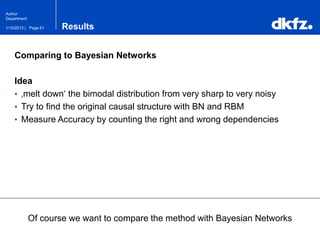
Idea
• ‚melt down‘ the bimodal distribution from very sharp to very noisy
• Try to find the original causal structure with BN and RBM
• Measure Accuracy by counting the right and wrong dependencies
Of course we want to compare the method with Bayesian Networks
Page 621/10/2013 |
Author
Department
Simulation 2
Results
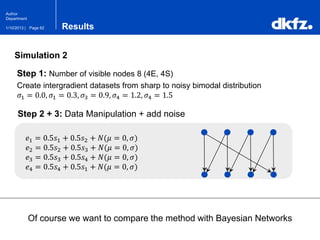
𝑒1 = 0.5𝑠1 + 0.5𝑠2 + 𝑁(𝜇 = 0, 𝜎)
𝑒2 = 0.5𝑠2 + 0.5𝑠3 + 𝑁(𝜇 = 0, 𝜎)
𝑒3 = 0.5𝑠3 + 0.5𝑠4 + 𝑁(𝜇 = 0, 𝜎)
𝑒4 = 0.5𝑠4 + 0.5𝑠1 + 𝑁(𝜇 = 0, 𝜎)
Of course we want to compare the method with Bayesian Networks
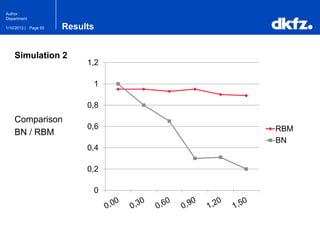
Step 1: Number of visible nodes 8 (4E, 4S)
Create intergradient datasets from sharp to noisy bimodal distribution
𝜎1 = 0.0, 𝜎1 = 0.3, 𝜎3 = 0.9, 𝜎4 = 1.2, 𝜎4 = 1.5
Step 2 + 3: Data Manipulation + add noise
Page 631/10/2013 |
Author
Department
Results
Simulation 2
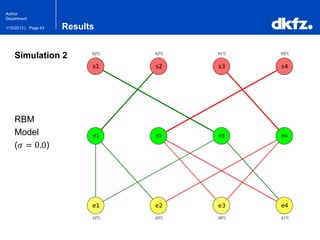
RBM
Model
(𝜎 = 0.0)
Page 641/10/2013 |
Author
Department
Results
Simulation 2
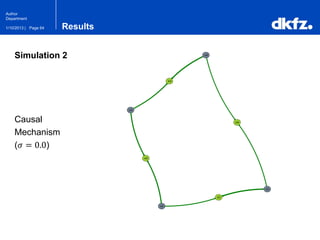
Causal
Mechanism
(𝜎 = 0.0)
Page 651/10/2013 |
Author
Department
Results
Simulation 2
Comparison
BN / RBM
0
0,2
0,4
0,6
0,8
1
1,2
RBM
BN
Page 661/10/2013 |
Author
Department
Conclusion
Conclusion
• RBMs are more stable against noise compared to BNs.
It has to be assumed that RBMs have high predictive power regarding
the regulation mechanisms of cells
• The drawback are high computational costs
Since RBMs are getting more popular (Face recognition / Voice
recognition, Image transformation). Many new improvements in facing
the computational costs have been made.
Page 671/10/2013 |
Author
Department
Acknowledgement
eilsLABS
PD Dr. Rainer König
Prof. Dr Roland Eils
Network Modeling Group

Regulation Analysis using Restricted Boltzmann Machines

  • 1.
    Regulation Analysis using RestrictedBoltzmann Machines Network Modeling Seminar, 10/1/2013 Patrick Michl
  • 2.
    Page 21/10/2013 | Author Department Agenda BiologicalProblem Analysing the regulation of metabolism Modeling Implementation & Results
  • 3.
    Page 31/10/2013 | Author DepartmentBiological Problem Analysing the regulation of metabolism Signal Regulation Metabolism A linear metabolic pathway of enzymes (E) …
  • 4.
    Page 41/10/2013 | Author DepartmentBiological Problem Analysing the regulation of metabolism Signal Regulation Metabolism … is regulated by transcription factors (TF) …
  • 5.
    Page 51/10/2013 | Author DepartmentBiological Problem Analysing the regulation of metabolism Signal Regulation Metabolism … which respond to signals (S)
  • 6.
    Page 61/10/2013 | Author Department P4 P 3 P 2 P 1 Biological Problem Analysing the regulation of metabolism Upregulated linear pathways …
  • 7.
    Page 71/10/2013 | Author Department P4 P 3 P 2 P 1 Biological Problem Analysing the regulation of metabolism … can appear in different patterns
  • 8.
    Page 81/10/2013 | Author DepartmentBiological Problem Analysing the regulation of metabolism Which transcription factors and signals cause this patterns … ? E ?
  • 9.
    Page 91/10/2013 | Author DepartmentBiological Problem Analysing the regulation of metabolism … and how do they interact? (topological structure) ? E ? ? ?
  • 10.
    Page 101/10/2013 | Author Department Agenda BiologicalProblem Analysing the regulation of metabolism Network Modeling Restricted Boltzmann Machines (RBM) Validation & Implementation
  • 11.
    Page 111/10/2013 | Author DepartmentNetwork Modeling Restricted Boltzmann Machines (RBM) Lets start with some pathway of our interest … S E TF
  • 12.
    Page 121/10/2013 | Author DepartmentNetwork Modeling Restricted Boltzmann Machines (RBM) … and lists of interesting TFs and interesting SigMols S E TF
  • 13.
    Page 131/10/2013 | Author DepartmentNetwork Modeling Restricted Boltzmann Machines (RBM) How to model the topological structure? S E TF
  • 14.
    Page 141/10/2013 | Author Department GraphicalModels Graphical Models can preserve topological structures … Network Modeling Restricted Boltzmann Machines (RBM)
  • 15.
    Page 151/10/2013 | Author Department GraphicalModels Directed Graph Undirected Graph… … but there are many types of graphical models Network Modeling Restricted Boltzmann Machines (RBM)
  • 16.
    Page 161/10/2013 | Author Department GraphicalModels Directed Graph Bayesian Networks Undirected Graph… The most common type is the Bayesian Network (BN) … Network Modeling Restricted Boltzmann Machines (RBM)
  • 17.
    Page 171/10/2013 | Author Department BayesianNetworks Bayesian Networks use joint probabilities … Network Modeling Restricted Boltzmann Machines (RBM) a b a b c P[a,b,c] 0 0 0 0.1 0 0 1 0.9 0 1 0 0.5 0 1 1 0.5 1 0 0 … … … … … c ?
  • 18.
    Page 181/10/2013 | Author Department BayesianNetworks … to represents conditional dependencies in an acyclic graph … Network Modeling Restricted Boltzmann Machines (RBM) a b a b c P[a,b,c] 0 0 0 0.1 0 0 1 0.9 0 1 0 0.5 0 1 1 0.5 1 0 0 … … … … … c
  • 19.
    Page 191/10/2013 | Author Department BayesianNetworks … but the regulation mechanism of a cell can be more complicated Network Modeling Restricted Boltzmann Machines (RBM) a b c d
  • 20.
    Page 201/10/2013 | Author Department GraphicalModels Directed Graph Bayesian Networks Undirected Graph Markov Random Fields … Another type of graphical models are Markov Random Fields (MRF)… Network Modeling Restricted Boltzmann Machines (RBM)
  • 21.
    Page 211/10/2013 | Author Department MarkovRandom Fields Motivation (Ising Model) A set of magnetic dipoles (spins) is arranged in a graph (lattice) where neighbors are coupled with a given strengt ... which emerged with the Ising Model from statistical Physics … Network Modeling Restricted Boltzmann Machines (RBM)
  • 22.
    Page 221/10/2013 | Author Department MarkovRandom Fields Motivation (Ising Model) A set of magnetic dipoles (spins) is arranged in a graph (lattice) where neighbors are coupled with a given strengt ... which uses local energies to calculate new states … Network Modeling Restricted Boltzmann Machines (RBM)
  • 23.
    Page 231/10/2013 | Author Department MarkovRandom Fields Drawback By allowing cyclic dependencies the computational costs explode … the drawback are high computational costs … Network Modeling Restricted Boltzmann Machines (RBM) a b c d
  • 24.
    Page 241/10/2013 | Author Department GraphicalModels Directed Graph Bayesian Networks Undirected Graph Markov Random Fields Restricted Boltzmann Machines (RBM) … … … which can be avoided by using Restricted Boltzmann Machines Network Modeling Restricted Boltzmann Machines (RBM)
  • 25.
    Page 251/10/2013 | Author Department RBMsare Artificial Neuronal Networks … Neuron like units Network Modeling Restricted Boltzmann Machines (RBM) Restricted Boltzmann Machines
  • 26.
    Page 261/10/2013 | Author Department …with two layers: visible units (v) and hidden units (h) h1 v1 v2 v3 v4 h2 h3 Network Modeling Restricted Boltzmann Machines (RBM) Restricted Boltzmann Machines
  • 27.
    Page 271/10/2013 | Author Department Visibleunits are strictly connected with hidden units h1 v1 v2 v3 v4 h2 h3 Network Modeling Restricted Boltzmann Machines (RBM) Restricted Boltzmann Machines
  • 28.
    Page 281/10/2013 | Author Department Inour model the visible units have continuous values … Network Modeling Restricted Boltzmann Machines (RBM) Restricted Boltzmann Machines 𝑉 ≔ set of visible units 𝑥 𝑣 ≔ value of unit 𝑣, ∀𝑣 ∈ 𝑉 𝑥 𝑣 ∈ 𝑅, ∀𝑣 ∈ 𝑉
  • 29.
    Page 291/10/2013 | Author Department …and the hidden units binary values Network Modeling Restricted Boltzmann Machines (RBM) 𝑉 ≔ set of visible units 𝑥 𝑣 ≔ value of unit 𝑣, ∀𝑣 ∈ 𝑉 𝑥 𝑣 ∈ 𝑅, ∀𝑣 ∈ 𝑉 𝐻 ≔ set of hidden units 𝑥ℎ ≔ value of unit ℎ, ∀ℎ ∈ 𝐻 𝑥ℎ ∈ {0, 1}, ∀ℎ ∈ 𝐻 Restricted Boltzmann Machines
  • 30.
    Page 301/10/2013 | Author Department RestrictedBoltzmann Machines Visible units are modeled with gaussians to encode data … Network Modeling Restricted Boltzmann Machines (RBM) 𝑥 𝑣~𝑁 𝑏 𝑣 + 𝑤 𝑣ℎℎ 𝑥ℎ, 𝜎𝑣 , ∀𝑣 ∈ 𝑉 𝜎𝑣 ≔ std. dev. of unit 𝑣 𝑏 𝑣 ≔ bias of unit 𝑣 𝑤 𝑣ℎ ≔ weight of edge (𝑣, ℎ)
  • 31.
    Page 311/10/2013 | Author Department …and hidden units with simoids to encode dependencies Network Modeling Restricted Boltzmann Machines (RBM) 𝑥 𝑣~𝑁 𝑏 𝑣 + 𝑤 𝑣ℎℎ 𝑥ℎ, 𝜎𝑣 , ∀𝑣 ∈ 𝑉 𝜎𝑣 ≔ std. dev. of unit 𝑣 𝑏 𝑣 ≔ bias of unit 𝑣 𝑤 𝑣ℎ ≔ weight of edge (𝑣, ℎ) 𝑥ℎ~sigmoid 𝑏ℎ + 𝑤 𝑣ℎ𝑣 𝑥 𝑣 𝜎 𝑣 , ∀ℎ ∈ 𝐻 𝑏ℎ ≔ bias of unit ℎ 𝑤 𝑣ℎ ≔ weight of edge (𝑣, ℎ) Restricted Boltzmann Machines
  • 32.
    Page 321/10/2013 | Author Department Thechallenge is to find the configuration of the parameters … Network Modeling Restricted Boltzmann Machines (RBM) Task: Find dependencies in data ↔ Find configuration of parameters with maximum likelihood (to data) Learning in Restricted Boltzmann Machines
  • 33.
    Page 331/10/2013 | Author Department Likein the Ising model the units states correspond to local energies … Local Energy Network Modeling Restricted Boltzmann Machines (RBM) 𝐸ℎ ≔ - 𝑤 𝑣ℎ𝑣 𝑥 𝑣 𝜎 𝑣 𝑥ℎ + 𝑥ℎ 𝑏ℎ𝐸 𝑣 ≔ - 𝑤 𝑣ℎℎ 𝑥 𝑣 𝜎 𝑣 𝑥ℎ + (𝑥 𝑣−𝑏 𝑣)2 2𝜎 𝑣 2 Task: Find dependencies in data ↔ Find configuration of parameters with maximum likelihood (to data) In RBMs configurations of parameters have probabilities, that can be defined by local energies 1 2 Learning in Restricted Boltzmann Machines
  • 34.
    Page 341/10/2013 | Author Department …which sum to a global energy, which is our objective function Global Energy Network Modeling Restricted Boltzmann Machines (RBM) 𝐸 ≔ 𝐸 𝑣𝑣 + 𝐸ℎℎ = − 𝑤 𝑣ℎℎ𝑣 𝑥 𝑣 𝜎 𝑣 𝑥ℎ + (𝑥 𝑣−𝑏 𝑣)2 2𝜎 𝑣 2 +𝑣 𝑤 𝑣ℎ 𝑥 𝑣 𝜎 𝑣 𝑥ℎℎ Task: Find dependencies in data ↔ Find configuration of parameters with maximum likelihood (to data) ↔ Minimize global energy (to data) Learning in Restricted Boltzmann Machines
  • 35.
    Page 351/10/2013 | Author Department Learningin Restricted Boltzmann Machines The optimization can be done using stochastic gradient descent … Network Modeling Restricted Boltzmann Machines (RBM) Task: Find dependencies in data ↔ Find configuration of parameters with maximum likelihood (to data) ↔ Minimize global energy (to data) ↔ Perform stochastic gradient descent on 𝜎𝑣, 𝑏 𝑣, 𝑏ℎ, 𝑤 𝑣ℎ (to data)
  • 36.
    Page 361/10/2013 | Author Department …which has an efficient learning algorithmus Network Modeling Restricted Boltzmann Machines (RBM) Task: Find dependencies in data ↔ Find configuration of parameters with maximum likelihood (to data) ↔ Minimize global energy (to data) ↔ Perform stochastic gradient descent on 𝜎𝑣, 𝑏 𝑣, 𝑏ℎ, 𝑤 𝑣ℎ (to data) Gradient Descent on RBMs The bipartite graph structure allows constrastive divergency learning, using Gibbs-sampling Learning in Restricted Boltzmann Machines
  • 37.
    Page 371/10/2013 | Author Department Howto model our initial structure as an RBM? Network Modeling Restricted Boltzmann Machines (RBM) S E TF
  • 38.
    Page 381/10/2013 | Author Department Wedefine S and E as visible Layer … S E TF Network Modeling Restricted Boltzmann Machines (RBM)
  • 39.
    Page 391/10/2013 | Author Department SE We define S and E as visible Layer … TF Network Modeling Restricted Boltzmann Machines (RBM)
  • 40.
    Page 401/10/2013 | Author Department SE … and TF as hidden Layer TF Network Modeling Restricted Boltzmann Machines (RBM)
  • 41.
    Page 411/10/2013 | Author Department Agenda BiologicalProblem Analysing the regulation of metabolism Network Modeling Restricted Boltzmann Machines (RBM) Implementation & Results python::metapath
  • 42.
    Page 421/10/2013 | Author Department Results Validationof the results • Information about the true regulation • Information about the descriptive power of the data
  • 43.
    Page 431/10/2013 | Author Department Results Validationof the results • Information about the true regulation • Information about the descriptive power of the data Without this infomation validation can only be done, using simulated data!
  • 44.
    Page 441/10/2013 | Author Department Results Simulation1 First of all we need to understand how the modell handles dependencies and noise To demonstrate this we create very simple data with a simple structure
  • 45.
    Page 451/10/2013 | Author Department Simulation1 What can we expect from this model? S E TF
  • 46.
    Page 461/10/2013 | Author Department Simulation1 … as RBM we get 8 visible and 2 hidden units, fully connected S E TF
  • 47.
    Page 471/10/2013 | Author Department Simulation1 Let‘s feed the machine with samples … S E 1,0,0,1 1,0,0,0 1,0,0,1 1,1,0,0 1,0,0,1 1,0,1,0 1,0,0,1 1,0,0,1 1,0,1,1 0,0,0,0 1,0,1,1 0,1,0,0 1,0,1,1 0,0,1,0 1,0,1,1 0,0,0,1 Data
  • 48.
    Page 481/10/2013 | Author Department Simulation1 .. to get the calculated parameters (especially the weight matrix) Weight matrix TF1 TF2 S1 0,3 0,8 S2 0,5 0,6 S3 1,0 0,1 S4 0,3 0,8 E1 0,8 0,0 E2 0,1 0,0 E3 0,1 0,0 E4 0,2 0,0
  • 49.
    Page 491/10/2013 | Author Department Simulation1 The weights are visualized by the intensity of the edges S E TF TF1 TF2 S1 0,3 0,8 S2 0,5 0,6 S3 1,0 0,1 S4 0,3 0,8 E1 0,8 0,0 E2 0,1 0,0 E3 0,1 0,0 E4 0,2 0,0 Weight matrix
  • 50.
    Page 501/10/2013 | Author Department Simulation1 Now we can compare the results with the samples S E 1,0,0,1 1,0,0,0 1,0,0,1 1,1,0,0 1,0,0,1 1,0,1,0 1,0,0,1 1,0,0,1 1,0,1,1 0,0,0,0 1,0,1,1 0,1,0,0 1,0,1,1 0,0,1,0 1,0,1,1 0,0,0,1 Learning samples S E TF
  • 51.
    Page 511/10/2013 | Author Department Simulation1 There‘s a strong dependency between S3 an E1 S E 1,0,0,1 1,0,0,0 1,0,0,1 1,1,0,0 1,0,0,1 1,0,1,0 1,0,0,1 1,0,0,1 1,0,1,1 0,0,0,0 1,0,1,1 0,1,0,0 1,0,1,1 0,0,1,0 1,0,1,1 0,0,0,1 Learning samples S E TF
  • 52.
    Page 521/10/2013 | Author Department Simulation1 S1, S2 and S4 do almost not affect the metabolism … S E 1,0,0,1 1,0,0,0 1,0,0,1 1,1,0,0 1,0,0,1 1,0,1,0 1,0,0,1 1,0,0,1 1,0,1,1 0,0,0,0 1,0,1,1 0,1,0,0 1,0,1,1 0,0,1,0 1,0,1,1 0,0,0,1 Learning samples S E TF
  • 53.
    Page 531/10/2013 | Author Department Simulation1 … so we can forget them and get S1,TF1 for our regulation model S E TF
  • 54.
    Page 541/10/2013 | Author Department Simulation1 We can also take a look at the causal mechanism … TF1 TF2 S1 0,3 0,8 S2 0,5 0,6 S3 1,0 0,1 S4 0,3 0,8 E1 0,8 0,0 E2 0,1 0,0 E3 0,1 0,0 E4 0,2 0,0 Weight matrix
  • 55.
    Page 551/10/2013 | Author Department Simulation1 The edge (S3, TF1) dominates TF1 … TF1 TF2 S1 0,3 0,8 S2 0,5 0,6 S3 1,0 0,1 S4 0,3 0,8 E1 0,8 0,0 E2 0,1 0,0 E3 0,1 0,0 E4 0,2 0,0 Weight matrix
  • 56.
    Page 561/10/2013 | Author Department Simulation1 Also E1 seems to have an effect on S3 (fewer than S3 on E1) s3 e1 e2 e3 e4 TF1 TF1 TF1 TF1 TF1
  • 57.
    Page 571/10/2013 | Author Department Results Comparingto Bayesian Networks For this purpose we simulate data in three steps Of course we want to compare the method with Bayesian Networks
  • 58.
    Page 581/10/2013 | Author Department Results Comparingto Bayesian Networks Step 1 Choose number of Genes (E+S) and create random bimodal distributed data Of course we want to compare the method with Bayesian Networks
  • 59.
    Page 591/10/2013 | Author Department Results Comparingto Bayesian Networks Step 1 Choose number of Genes (E+S) and create random bimodal distributed data Step 2 Manipulate data in a fixed order Of course we want to compare the method with Bayesian Networks
  • 60.
    Page 601/10/2013 | Author Department Results Comparingto Bayesian Networks Step 1 Choose number of Genes (E+S) and create random bimodal distributed data Step 2 Manipulate data in a fixed order Step 3 Add noise to manipulated data and normalize data Of course we want to compare the method with Bayesian Networks
  • 61.
    Page 611/10/2013 | Author Department Results Comparingto Bayesian Networks Idea • ‚melt down‘ the bimodal distribution from very sharp to very noisy • Try to find the original causal structure with BN and RBM • Measure Accuracy by counting the right and wrong dependencies Of course we want to compare the method with Bayesian Networks
  • 62.
    Page 621/10/2013 | Author Department Simulation2 Results 𝑒1 = 0.5𝑠1 + 0.5𝑠2 + 𝑁(𝜇 = 0, 𝜎) 𝑒2 = 0.5𝑠2 + 0.5𝑠3 + 𝑁(𝜇 = 0, 𝜎) 𝑒3 = 0.5𝑠3 + 0.5𝑠4 + 𝑁(𝜇 = 0, 𝜎) 𝑒4 = 0.5𝑠4 + 0.5𝑠1 + 𝑁(𝜇 = 0, 𝜎) Of course we want to compare the method with Bayesian Networks Step 1: Number of visible nodes 8 (4E, 4S) Create intergradient datasets from sharp to noisy bimodal distribution 𝜎1 = 0.0, 𝜎1 = 0.3, 𝜎3 = 0.9, 𝜎4 = 1.2, 𝜎4 = 1.5 Step 2 + 3: Data Manipulation + add noise
  • 63.
  • 64.
  • 65.
    Page 651/10/2013 | Author Department Results Simulation2 Comparison BN / RBM 0 0,2 0,4 0,6 0,8 1 1,2 RBM BN
  • 66.
    Page 661/10/2013 | Author Department Conclusion Conclusion •RBMs are more stable against noise compared to BNs. It has to be assumed that RBMs have high predictive power regarding the regulation mechanisms of cells • The drawback are high computational costs Since RBMs are getting more popular (Face recognition / Voice recognition, Image transformation). Many new improvements in facing the computational costs have been made.
  • 67.
    Page 671/10/2013 | Author Department Acknowledgement eilsLABS PDDr. Rainer König Prof. Dr Roland Eils Network Modeling Group