REGULAR VERBS
WEBQUEST BY HERNAN PEREZ
REGULAR VERBS


                   TASK   PROCESS
INTRODUCTION
INTRODUCTION


       Today, we are going to review the regular
        verbs starting with A, enjoy, learn, and
                       practice.
HOME
TASK
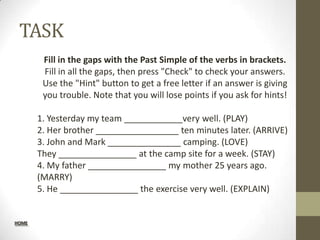
        Fill in the gaps with the Past Simple of the verbs in brackets.
        Fill in all the gaps, then press "Check" to check your answers.
        Use the "Hint" button to get a free letter if an answer is giving
        you trouble. Note that you will lose points if you ask for hints!

       1. Yesterday my team ____________very well. (PLAY)
       2. Her brother _________________ ten minutes later. (ARRIVE)
       3. John and Mark _______________ camping. (LOVE)
       They ________________ at the camp site for a week. (STAY)
       4. My father ________________ my mother 25 years ago.
       (MARRY)
       5. He ________________ the exercise very well. (EXPLAIN)


HOME
PROCESS
       Selling Rules For Regular Verbs

       Most regular verbs simply add -ed and -ing to the simple form (base form).

       Examples:

       Listen    listened listening
       Work      worked working

       If a verb ends in a single vowel followed by a single consonant (VC), and the
       vowel has a strong stress, the final consonant is doubled before adding -ed or -
       ing.

       [Note: All words of one syllable have a strong stress on the vowel.]

       Examples:

       Stop      stopped stopping
HOME                                                                          NEXT
PROCESS

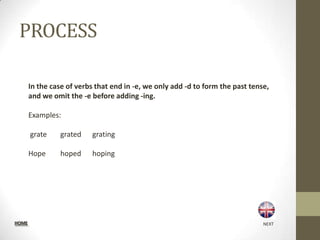
       In the case of verbs that end in -e, we only add -d to form the past tense,
       and we omit the -e before adding -ing.

       Examples:

       grate    grated    grating

       Hope     hoped     hoping


HOME                                                                            NEXT
PROCESS
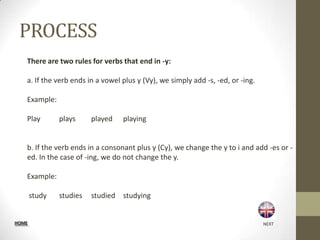
   There are two rules for verbs that end in -y:

   a. If the verb ends in a vowel plus y (Vy), we simply add -s, -ed, or -ing.

   Example:

   Play        plays     played   playing


   b. If the verb ends in a consonant plus y (Cy), we change the y to i and add -es or -
   ed. In the case of -ing, we do not change the y.

   Example:

       study   studies   studied studying


HOME                                                                             NEXT
PROCESS

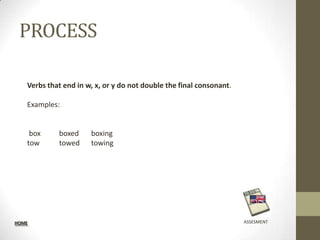
   Verbs that end in w, x, or y do not double the final consonant.

   Examples:


    box     boxed     boxing
   tow      towed     towing


HOME                                                                 ASSESMENT
ASSESMENT

       1. Identify regular verbs rules.

       2. Practice simple past using regular verbs.

       3. Learn some regular verbs.


HOME

Regular verbs webquest

  • 1.
  • 2.
    REGULAR VERBS TASK PROCESS INTRODUCTION
  • 3.
    INTRODUCTION Today, we are going to review the regular verbs starting with A, enjoy, learn, and practice. HOME
  • 4.
    TASK Fill in the gaps with the Past Simple of the verbs in brackets. Fill in all the gaps, then press "Check" to check your answers. Use the "Hint" button to get a free letter if an answer is giving you trouble. Note that you will lose points if you ask for hints! 1. Yesterday my team ____________very well. (PLAY) 2. Her brother _________________ ten minutes later. (ARRIVE) 3. John and Mark _______________ camping. (LOVE) They ________________ at the camp site for a week. (STAY) 4. My father ________________ my mother 25 years ago. (MARRY) 5. He ________________ the exercise very well. (EXPLAIN) HOME
  • 5.
    PROCESS Selling Rules For Regular Verbs Most regular verbs simply add -ed and -ing to the simple form (base form). Examples: Listen listened listening Work worked working If a verb ends in a single vowel followed by a single consonant (VC), and the vowel has a strong stress, the final consonant is doubled before adding -ed or - ing. [Note: All words of one syllable have a strong stress on the vowel.] Examples: Stop stopped stopping HOME NEXT
  • 6.
    PROCESS In the case of verbs that end in -e, we only add -d to form the past tense, and we omit the -e before adding -ing. Examples: grate grated grating Hope hoped hoping HOME NEXT
  • 7.
    PROCESS There are two rules for verbs that end in -y: a. If the verb ends in a vowel plus y (Vy), we simply add -s, -ed, or -ing. Example: Play plays played playing b. If the verb ends in a consonant plus y (Cy), we change the y to i and add -es or - ed. In the case of -ing, we do not change the y. Example: study studies studied studying HOME NEXT
  • 8.
    PROCESS Verbs that end in w, x, or y do not double the final consonant. Examples: box boxed boxing tow towed towing HOME ASSESMENT
  • 9.
    ASSESMENT 1. Identify regular verbs rules. 2. Practice simple past using regular verbs. 3. Learn some regular verbs. HOME