Past Simple
1. The past simple is used to talk about a specific action or event that began and ended in the past. It is generally
used with adverbs of time such as “last year”, “yesterday”, “last night”…
Examples:
Tom stayed at home last night.
Kate worked last Saturday.
I didn’t go to the party yesterday.
Did they walk to school this morning?
2. The past simple is used to talk about a series of actions that occurred in the past.
Examples:
I received the good news and immediately called my husband.
He studied for an hour in the morning, worked all afternoon and didn’t return home until
10 at night.
Uses
. We also use the past simple for repeated actions or habits in the past.
Examples:
We always traveled to Cancun for vacation when we were young.
He walked 5 kilometers every day to work.
4. The past simple is also used for narrations or actions that occurred over a long period of time in
the past.
Examples:
I worked for many years in a museum.
She didn’t eat meat for years.
5. We use the past simple to speak about facts or things in the past in general.
Examples:
The Aztec lived in Mexico.
I played the guitar when I was a child.
Form
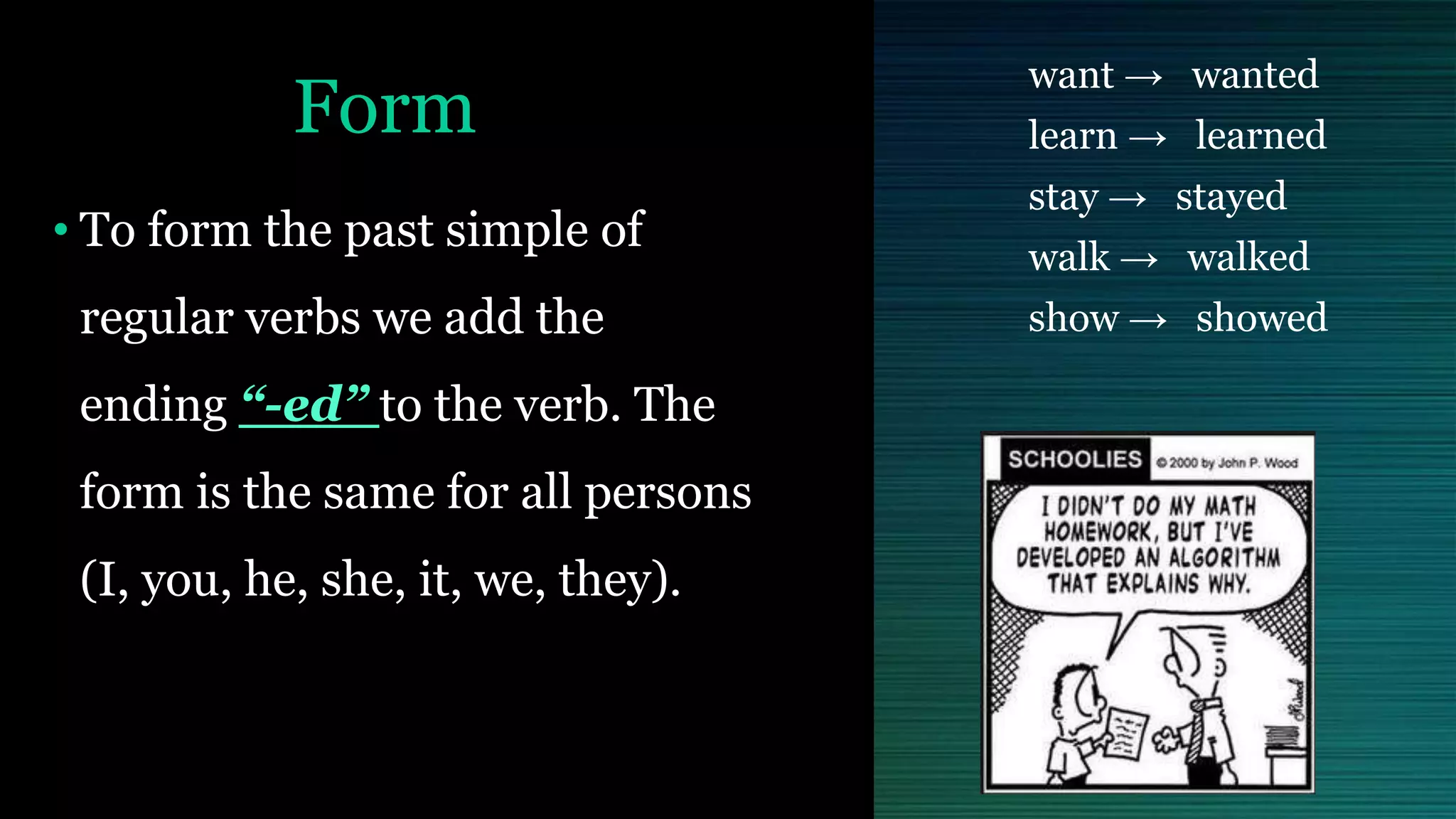
• To form the past simple of
regular verbs we add the
ending “-ed” to the verb. The
form is the same for all persons
(I, you, he, she, it, we, they).
want → wanted
learn → learned
stay → stayed
walk → walked
show → showed
Exceptions
. For verbs that end in “e”, we only need to add
“-d”:
Examples:
change → changed
believe → believed
2. If the verb ends in a short vowel plus a
consonant (except “y” o “w”), we double the
final consonant:
Examples:
stop → stopped
commit → committed
3. When the verb ends in a consonant
and “y”, the “y” becomes an “i”:
Examples:
study → studied
try → tried
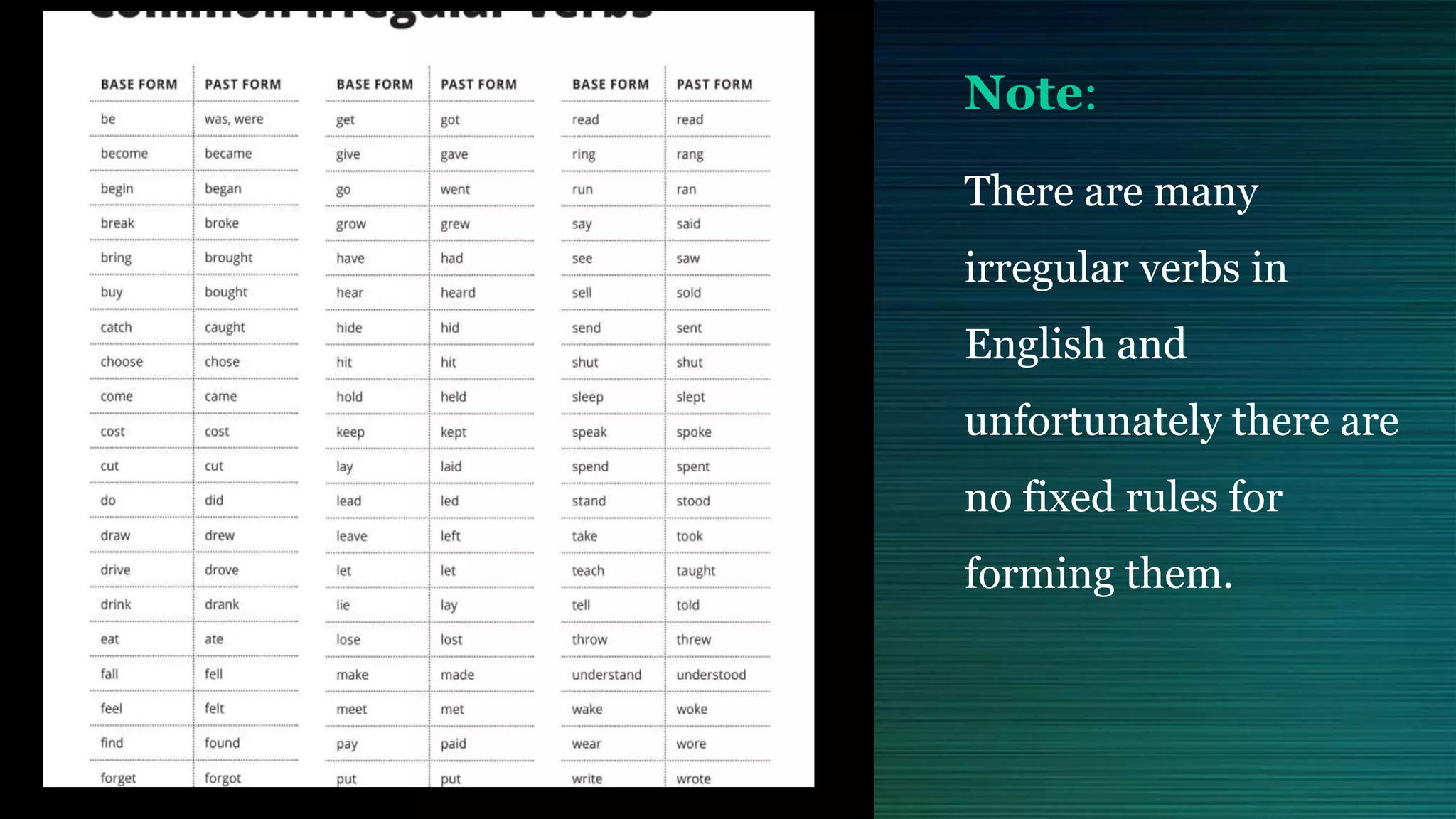
Note:
There are many
irregular verbs in
English and
unfortunately there are
no fixed rules for
forming them.
The pronunciation of the ending “-ed” is different depending on the
letter with which the verb ends. In general though, the “e” is silent.
• 1. For those verbs which end in
“p”, “f”, “k” o “s” (voiceless
consonants, except “t”), we
pronounce the “-ed” as a “t”.
• looked [lukt]
• kissed [kisst]
• 2. For those verbs which end
in “b”, “g”, “l”, “m”, “n”,
“v”, “z” (voiced consonants,
except “d”) or a vowel, we
pronounce only the “d”.
• yelled [jeld]
• cleaned [klind]
3. Verbs that end in “d” o “t”,
we pronounce the “e” as an
“i”.
Examples:
• ended [endid]
• waited [weitid]
Structure
Affirmative
Sentences
• Subject + principal
verb…
• I wanted to dance.
• They learned
English
Negative Sentences
• Subject + auxiliary
verb (to do) + “not”
+ principal verb (in
infinitive)…
• I didn’t want to
dance.
• They didn’t learn
English.
Interrogative
Sentences
Auxiliary verb (to do)
+ subject + principal
verb…?
• Did you want to
dance?
• Did you believe
him?
Structure
Negative Sentences
To be:
Interrogative
Sentences
To be:
• Subject + “to be” +
“not”…
• She wasn’t a doctor.
• The keys weren’t in the
drawer.
“To be” + subject…?
• Was she a doctor?
• Were the keys in the
drawer?

Past simple

  • 1.
  • 2.
    1. The pastsimple is used to talk about a specific action or event that began and ended in the past. It is generally used with adverbs of time such as “last year”, “yesterday”, “last night”… Examples: Tom stayed at home last night. Kate worked last Saturday. I didn’t go to the party yesterday. Did they walk to school this morning? 2. The past simple is used to talk about a series of actions that occurred in the past. Examples: I received the good news and immediately called my husband. He studied for an hour in the morning, worked all afternoon and didn’t return home until 10 at night. Uses
  • 3.
    . We alsouse the past simple for repeated actions or habits in the past. Examples: We always traveled to Cancun for vacation when we were young. He walked 5 kilometers every day to work. 4. The past simple is also used for narrations or actions that occurred over a long period of time in the past. Examples: I worked for many years in a museum. She didn’t eat meat for years. 5. We use the past simple to speak about facts or things in the past in general. Examples: The Aztec lived in Mexico. I played the guitar when I was a child.
  • 4.
    Form • To formthe past simple of regular verbs we add the ending “-ed” to the verb. The form is the same for all persons (I, you, he, she, it, we, they). want → wanted learn → learned stay → stayed walk → walked show → showed
  • 5.
    Exceptions . For verbsthat end in “e”, we only need to add “-d”: Examples: change → changed believe → believed
  • 6.
    2. If theverb ends in a short vowel plus a consonant (except “y” o “w”), we double the final consonant: Examples: stop → stopped commit → committed
  • 7.
    3. When theverb ends in a consonant and “y”, the “y” becomes an “i”: Examples: study → studied try → tried
  • 8.
    Note: There are many irregularverbs in English and unfortunately there are no fixed rules for forming them.
  • 9.
    The pronunciation ofthe ending “-ed” is different depending on the letter with which the verb ends. In general though, the “e” is silent. • 1. For those verbs which end in “p”, “f”, “k” o “s” (voiceless consonants, except “t”), we pronounce the “-ed” as a “t”. • looked [lukt] • kissed [kisst] • 2. For those verbs which end in “b”, “g”, “l”, “m”, “n”, “v”, “z” (voiced consonants, except “d”) or a vowel, we pronounce only the “d”. • yelled [jeld] • cleaned [klind] 3. Verbs that end in “d” o “t”, we pronounce the “e” as an “i”. Examples: • ended [endid] • waited [weitid]
  • 10.
    Structure Affirmative Sentences • Subject +principal verb… • I wanted to dance. • They learned English Negative Sentences • Subject + auxiliary verb (to do) + “not” + principal verb (in infinitive)… • I didn’t want to dance. • They didn’t learn English. Interrogative Sentences Auxiliary verb (to do) + subject + principal verb…? • Did you want to dance? • Did you believe him?
  • 11.
    Structure Negative Sentences To be: Interrogative Sentences Tobe: • Subject + “to be” + “not”… • She wasn’t a doctor. • The keys weren’t in the drawer. “To be” + subject…? • Was she a doctor? • Were the keys in the drawer?