REGION 4A
CALABARZ
ON:
Objective:
At the end of the discussion
we will be able to:
• Learn about CALABARZON
and its rich history
• Uncover the culture of the
people from their food,
language, religion, industries,
historical sites, beliefs, and
festivals; and
• Discover how they value and
preserve their unique culture
and beliefs.
Introduction:
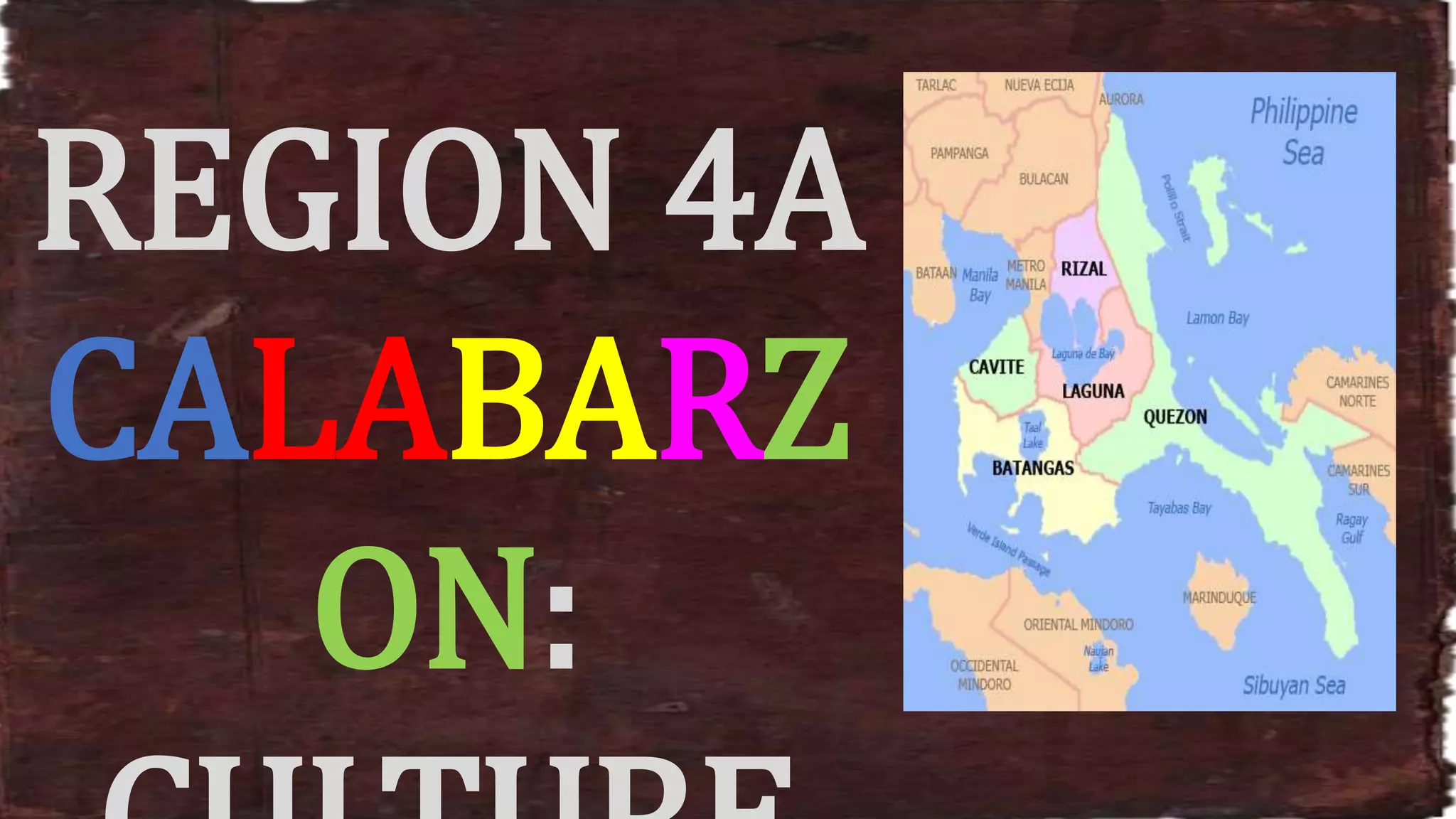
CALABARZON is formally known as
“Southern Tagalog Mainland” and
designated as Region IV-A. The region
comprises five provinces: Cavite, Laguna,
Batangas, Rizal, and Quezon.
CALABARZON is the most populous
region in the Philippines, having
14,414,774 inhabitants in 2015, and is
also the country's second most densely
populated after NCR. Prior to its creation
as a region, CALABARZON, together with
MIMAROPA, formed the historical region
known as Southern Tagalog, until they
were separated in 2002 by virtue of
Executive Order No. 103.
CALABARZON plays a huge part
Food and Beverages
• They specializes in cooking
seafood especially cavitenos,
• They all like eating in banana
leaves.
The people of CALABARZON
like to use coconuts on their
dish.
• They like hard drinks, from
alcohol to coffee
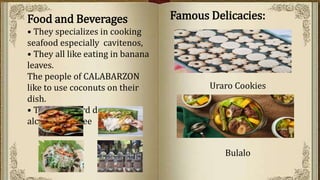
Famous Delicacies:
Uraro Cookies
Bulalo
Famous Delicacies:
Pichi Pichi
Buko Pie
Pancit habhab or Pancit Lucban
Lomi
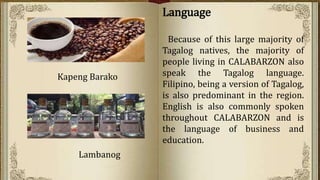
Kapeng Barako
Lambanog
Language
Because of this large majority of
Tagalog natives, the majority of
people living in CALABARZON also
speak the Tagalog language.
Filipino, being a version of Tagalog,
is also predominant in the region.
English is also commonly spoken
throughout CALABARZON and is
the language of business and
education.
Religion
Majority of the religion in the
region is composed of Roman
Catholic. But since the region is
populated and really diverse,
people in the region became
members of different religions
such as, Born Again Christians,
Iglesia Ni Cristo, Baptist,
Jehovah’s Witnesses, Churh of
Christ of Latter Day Saints,
Methodists, and Muslims.
Cultural heritage
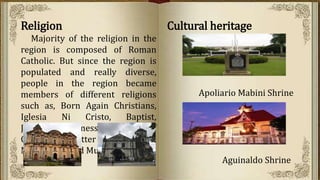
Apoliario Mabini Shrine
Aguinaldo Shrine
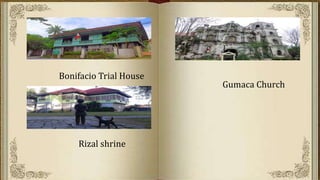
Bonifacio Trial House
Rizal shrine
Gumaca Church
Industries
It is known as the industrial
powerhouse of the
Philippines CALABARZON has
a big supply base of semi-
processed industrial raw
materials and industrial
components coming from its
31 world-class industrial
estates and economic zones
(ecozones).
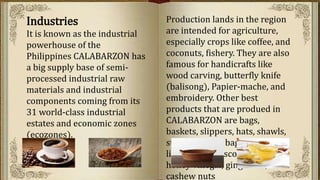
Production lands in the region
are intended for agriculture,
especially crops like coffee, and
coconuts, fishery. They are also
famous for handicrafts like
wood carving, butterfly knife
(balisong), Papier-mache, and
embroidery. Other best
products that are produed in
CALABARZON are bags,
baskets, slippers, hats, shawls,
storages, wine bags, and food
like tablea, muscovado, coffee,
honey vinegar, ginger tea,
cashew nuts
• In Rizal, they have a dance
called “Panganga”
• Rain at the day of the marriage
is a sign of luck
• In wedding, your principal
sponsors (ninong/ninang)
must not be from a broken
marriage.
Beliefs
Marriage
• They put a veil on the
bride that connects to the
groom.
• The groom gives unity
coin or “Arrahe” to the
bride.
• They practice
“Pamamanhikan”
Death and Burial
• Infants whether family
member or not are passed
above the coffin before the
burial.
• They place their dead
relatives in a hollow tree.
• Do not scratch your head
when someone is dead in
order not to get lice “kuto”
• You need to break the
necklace worn by the dead
person so that no one in the
Pregnancy
• A pregnant woman should
avoid being tripped to avoid her
baby from getting cleft palate
• Avoid standing in front of the
door for normal delivery.
• The clothing that is used when
the baby was born must be kept
because it brings luck for the
family.
• Avoid eating eggplant in order
for the child not to get dark skin
color. And avoid eating velvet
apples in order for the baby not
Anting-anting
• Cavitenos believes in the
power of the “anting-anting”,
they believes that the
“anting – anting” can protect
you in any harm/disaster.
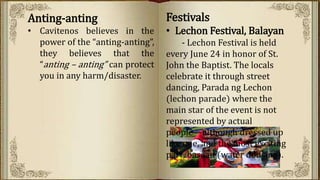
Festivals
• Lechon Festival, Balayan
- Lechon Festival is held
every June 24 in honor of St.
John the Baptist. The locals
celebrate it through street
dancing, Parada ng Lechon
(lechon parade) where the
main star of the event is not
represented by actual
people—although dressed up
like one, and the most exciting
part, basaan (water dousing).
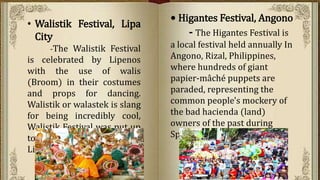
• Higantes Festival, Angono
- The Higantes Festival is
a local festival held annually In
Angono, Rizal, Philippines,
where hundreds of giant
papier-mâché puppets are
paraded, representing the
common people's mockery of
the bad hacienda (land)
owners of the past during
Spanish colonial rule
• Walistik Festival, Lipa
City
-The Walistik Festival
is celebrated by Lipenos
with the use of walis
(Broom) in their costumes
and props for dancing.
Walistik or walastek is slang
for being incredibly cool,
Walistik Festival was put up
to challenge the creativity of
Lipenos.
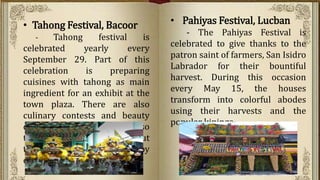
• Tahong Festival, Bacoor
- Tahong festival is
celebrated yearly every
September 29. Part of this
celebration is preparing
cuisines with tahong as main
ingredient for an exhibit at the
town plaza. There are also
culinary contests and beauty
contest. The celebration also
tends to inform people about
the culture of tahong by
conducting seminars.
• Pahiyas Festival, Lucban
- The Pahiyas Festival is
celebrated to give thanks to the
patron saint of farmers, San Isidro
Labrador for their bountiful
harvest. During this occasion
every May 15, the houses
transform into colorful abodes
using their harvests and the
popular kipings.
REFRENCES:
Dominado, J. (2016 July 26).
Region 4a:Culture.
https://prezi.com/rllbzzuwycmk/
region-4a-culture/
Blogspot(2011 July 28).Region 4a:
CALABARZON.
https://philippinesthebeautywithi
n.blogspot.com/2011/07/region-
4a-calabarzon.html?m=1
Conclusion:
The southern tagalong region
is a region that has much to offer,
from their rich history, tasty foods,
extraordinary beliefs, up to their
uplifting festivals. The people of
the region despite the
modernization and cultural
diversity still practice and try to
preserve these traditions and
beliefs.
Even though most of us share
similar beliefs when in term in
religion , individuals from Region
4A have a significant influence on
.
THANK YOU
FOR
LISTENING

Region 4a CALABARZON (1).pptx

  • 1.
  • 2.
    Objective: At the endof the discussion we will be able to: • Learn about CALABARZON and its rich history • Uncover the culture of the people from their food, language, religion, industries, historical sites, beliefs, and festivals; and • Discover how they value and preserve their unique culture and beliefs. Introduction: CALABARZON is formally known as “Southern Tagalog Mainland” and designated as Region IV-A. The region comprises five provinces: Cavite, Laguna, Batangas, Rizal, and Quezon. CALABARZON is the most populous region in the Philippines, having 14,414,774 inhabitants in 2015, and is also the country's second most densely populated after NCR. Prior to its creation as a region, CALABARZON, together with MIMAROPA, formed the historical region known as Southern Tagalog, until they were separated in 2002 by virtue of Executive Order No. 103. CALABARZON plays a huge part
  • 3.
    Food and Beverages •They specializes in cooking seafood especially cavitenos, • They all like eating in banana leaves. The people of CALABARZON like to use coconuts on their dish. • They like hard drinks, from alcohol to coffee Famous Delicacies: Uraro Cookies Bulalo
  • 4.
    Famous Delicacies: Pichi Pichi BukoPie Pancit habhab or Pancit Lucban Lomi
  • 5.
    Kapeng Barako Lambanog Language Because ofthis large majority of Tagalog natives, the majority of people living in CALABARZON also speak the Tagalog language. Filipino, being a version of Tagalog, is also predominant in the region. English is also commonly spoken throughout CALABARZON and is the language of business and education.
  • 6.
    Religion Majority of thereligion in the region is composed of Roman Catholic. But since the region is populated and really diverse, people in the region became members of different religions such as, Born Again Christians, Iglesia Ni Cristo, Baptist, Jehovah’s Witnesses, Churh of Christ of Latter Day Saints, Methodists, and Muslims. Cultural heritage Apoliario Mabini Shrine Aguinaldo Shrine
  • 7.
    Bonifacio Trial House Rizalshrine Gumaca Church
  • 8.
    Industries It is knownas the industrial powerhouse of the Philippines CALABARZON has a big supply base of semi- processed industrial raw materials and industrial components coming from its 31 world-class industrial estates and economic zones (ecozones). Production lands in the region are intended for agriculture, especially crops like coffee, and coconuts, fishery. They are also famous for handicrafts like wood carving, butterfly knife (balisong), Papier-mache, and embroidery. Other best products that are produed in CALABARZON are bags, baskets, slippers, hats, shawls, storages, wine bags, and food like tablea, muscovado, coffee, honey vinegar, ginger tea, cashew nuts
  • 9.
    • In Rizal,they have a dance called “Panganga” • Rain at the day of the marriage is a sign of luck • In wedding, your principal sponsors (ninong/ninang) must not be from a broken marriage. Beliefs Marriage • They put a veil on the bride that connects to the groom. • The groom gives unity coin or “Arrahe” to the bride. • They practice “Pamamanhikan”
  • 10.
    Death and Burial •Infants whether family member or not are passed above the coffin before the burial. • They place their dead relatives in a hollow tree. • Do not scratch your head when someone is dead in order not to get lice “kuto” • You need to break the necklace worn by the dead person so that no one in the Pregnancy • A pregnant woman should avoid being tripped to avoid her baby from getting cleft palate • Avoid standing in front of the door for normal delivery. • The clothing that is used when the baby was born must be kept because it brings luck for the family. • Avoid eating eggplant in order for the child not to get dark skin color. And avoid eating velvet apples in order for the baby not
  • 11.
    Anting-anting • Cavitenos believesin the power of the “anting-anting”, they believes that the “anting – anting” can protect you in any harm/disaster. Festivals • Lechon Festival, Balayan - Lechon Festival is held every June 24 in honor of St. John the Baptist. The locals celebrate it through street dancing, Parada ng Lechon (lechon parade) where the main star of the event is not represented by actual people—although dressed up like one, and the most exciting part, basaan (water dousing).
  • 12.
    • Higantes Festival,Angono - The Higantes Festival is a local festival held annually In Angono, Rizal, Philippines, where hundreds of giant papier-mâché puppets are paraded, representing the common people's mockery of the bad hacienda (land) owners of the past during Spanish colonial rule • Walistik Festival, Lipa City -The Walistik Festival is celebrated by Lipenos with the use of walis (Broom) in their costumes and props for dancing. Walistik or walastek is slang for being incredibly cool, Walistik Festival was put up to challenge the creativity of Lipenos.
  • 13.
    • Tahong Festival,Bacoor - Tahong festival is celebrated yearly every September 29. Part of this celebration is preparing cuisines with tahong as main ingredient for an exhibit at the town plaza. There are also culinary contests and beauty contest. The celebration also tends to inform people about the culture of tahong by conducting seminars. • Pahiyas Festival, Lucban - The Pahiyas Festival is celebrated to give thanks to the patron saint of farmers, San Isidro Labrador for their bountiful harvest. During this occasion every May 15, the houses transform into colorful abodes using their harvests and the popular kipings.
  • 14.
    REFRENCES: Dominado, J. (2016July 26). Region 4a:Culture. https://prezi.com/rllbzzuwycmk/ region-4a-culture/ Blogspot(2011 July 28).Region 4a: CALABARZON. https://philippinesthebeautywithi n.blogspot.com/2011/07/region- 4a-calabarzon.html?m=1 Conclusion: The southern tagalong region is a region that has much to offer, from their rich history, tasty foods, extraordinary beliefs, up to their uplifting festivals. The people of the region despite the modernization and cultural diversity still practice and try to preserve these traditions and beliefs. Even though most of us share similar beliefs when in term in religion , individuals from Region 4A have a significant influence on
  • 15.