Chapter 7:
Globalization and
Media:
Creating the Global
Village
THE COMMUNICATIONS
MEDIA
THE COMMUNICATIONS MEDIA
The term communication is derived from the Latin word communis, meaning common.
In general, communication refers to the reciprocal exchange of information, ideas,
facts, opinions, beliefs, feelings and attitudes through verbal or non- verbal means
between two people or within a group.
COMMUNICATION
DEFINITION COMMUNICATION
• Communication is a process by which information is exchanged
between individuals through a common system of symbol and signs of
behaviour. - Webster's Dictionary
• Communication is interchange of thoughts, opinions or
information by speech, writing or signs.
- Robert Andersion
Communication as:
•A process through which individuals mutually exchange their ideas,
values, thoughts, feelings and actions with one or more people.
•The transfer of information from the sender to the receiver so that it is
understood in the right context.
•The process of initiating, transmitting and receiving information.
•The means making the transfer of information productive and goal
oriented.
THE COMMUNICATIONS MEDIA
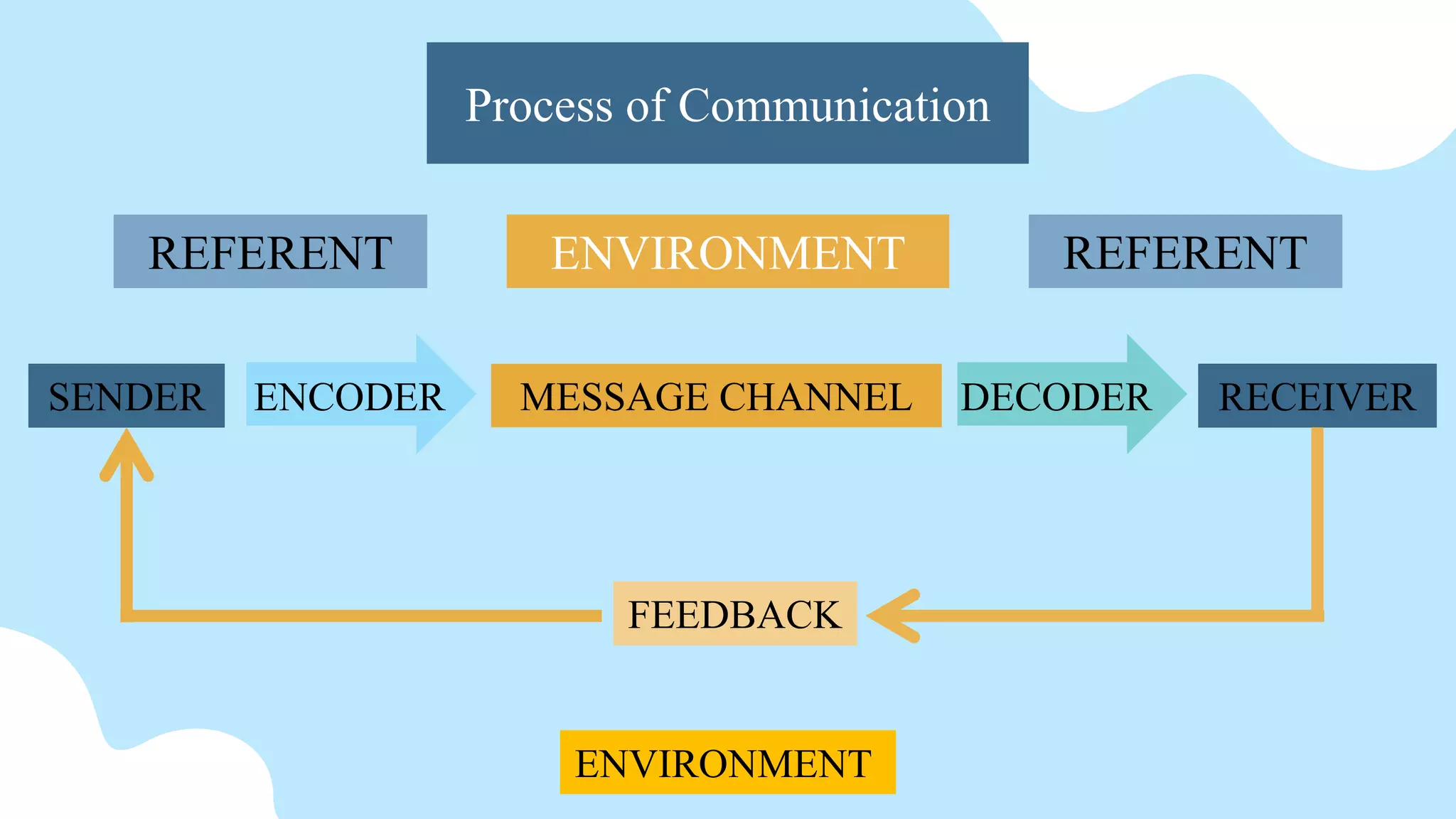
Process of Communication
REFERENT ENVIRONMENT
SENDER MESSAGE CHANNEL RECEIVER
REFERENT
ENCODER DECODER
FEEDBACK
ENVIRONMENT
ELEMENTS OF THE COMMUNICATION
REFERANT
• A referent motivates the sender (or receiver) to share information (message, objects,
sounds, sights, time schedule, ideas, perceptions, sensation, emotion, odour, etc.) that may
initiate communication.
SENDER
• A sender is a person who encodes & sends the message to the expected receiver through an
appropriate channel.
• A sender is the source of the message that is generated to be delivered to the receiver after
appropriate stimulus from the referent.
MESSAGE
• The message is the content of communication and may contain verbal, nonverbal or
symbolic language.
• Perception and personal factors of the sender and receiver may sometimes distort this
element and the intended outcome of communication may not be achieved.
CHANNEL
• A channel is a medium through which a message is sent or received between two or more
people.
• Several channels can be used to send or receive the message, i.e. seeing, hearing, touching,
smelling, and tasting.
ELEMENTS OF THE COMMUNICATION
CHANNEL
Classifications of Channels of Communication:
• VISUAL CHANNEL - Facial expression, body language, posture, gestures, pictures and
written words, electronic mails, mass media, etc.
• AUDITORY CHANNEL - Spoken words, sounds, telephone or mobile communications,
delivering audio content (radio, voicemail), etc.
• TACTILE CHANNEL - Touch sensations, therapeutic touch, etc.
• COMBINED CHANNEL - Audiovisual media, consoling a person with touch & spoken
words.
RECIEVER
• A receiver is an individual or a group of individuals intended to receive, decode and
interpret the message sent by the sender/source of message. A receiver also known as
decoder.
• He is expected to have the ability and skills to receive, decode and interpret the message.
ELEMENTS OF THE COMMUNICATION
FEEDBACK
• It is a return message sent by the receiver to the sender.
• It is most essential element of the communication process as it shows that the receiver has
understood the primary message sent by the sender and the communication process is now
consider complete.
CONFOUNDING ELEMENTS
• These elements are not a direct part of the flow of the communication process but
influence the communication process significantly in-directed.
• These elements are interpersonal variables of the sender and the receiver and the
environment where the communication process take place.
TELEVISION AND VIOLENCE
• Does watching a lot of television lead people to commit violent acts?
• Some media contents are not suitable for children. Limiting children’s access to such
content can be difficult.
• Many of these studies have found a casual relationship between the viewing of violence on
television and later aggressive behaviour (e.g., Kaplan and Singer)
• The most common explanation is that television violence produces a form of social
learning.
ELI RUBINSTEIN (1991)
• Have found that the children’s behaviors were related to what they saw on television.
• They imitated aggressive behavior and pretend to be characters in their favourite programs.
“Information is
power”
GEORGE ORWELL
• Addressed an issue in his famous book 1984.
• Which portrays a society in which everyone is consistently watched on the two-way
television.
• The book presents a terrifying vision of the potential power of the media when used by a
dictator to control the thoughts and behavior of the population.
• In many countries in which freedom of the press is guaranteed, there are still many
problems related to access to the media and their power to attract large audiences.
• In a democratic society, television and other media can be a two-edged sword, conferring
power on those in the spotlight but also subjecting them to sometimes embarrassing public
scrutiny.
• The public has a stake, therefore in determining whether the media are adequately and
even-handedly investigating the actions of the powerful and the famous (Kornblum, 1994)
TELEVISION AND VIOLENCE
MEDIA POWER
AND
ITS LIMITS
MEDIA POWER AND ITS LIMITS
TECHNOLOGICAL LIMITS
• The audience of media consumers is becoming ever more diverse and fickle, hence, ever
more difficult to reach as a mass audience. Even in societies like China, in which in the
media are agencies of the state and may broadcast only material that has been approved by
political leaders, new technologies promise to make it more difficult to control the flow of
information.
SOCIAL LIMITS
Two step flow of communication
• The messages communicated by the media are evaluated by certain respected individuals.
OPINION LEADERS
• Who in turn influence the attitudes and behavior of others.
THE MASS MEDIA
THE MASS MEDIA
The MASS MEDIA also referred to as mass communication may be defined as a
special kind of social communication characterized by a unique audience,
communication experience, and communicator.
The term “media” comes from Latin, meaning “middle”, suggesting that media
serve to connect people.
MASS
COMMUNICATION
the imparting or exchanging
of information on a large
scale to a wide range of
people.
THE MASS MEDIA
MASS
MEDIA
AUDIENCE
-usually large, heterogeneous,
and anonymous.
-Media content is for public
rather than private (one on
one) consumption.
COMMUNICATION
EXPERIENCE
- usually public, rapid, and transient.
- Media coverage of important events occurs
either “live” or shortly thereafter.
- Media content is also transient-the focus on
one news event doesn’t last very long.
COMMUNICATOR
- often just one person talking to
others through electronic media,
- A cross-cultural view of broadcasting
reveals that the members of society
dictate what is news, how it is
presented, and what interpretations are
given.
THE MASS MEDIA
• Broadly, any written or
pictorial form of
communication produced
mechanically or
electronically using
printing, photocopying,
or digital methods from
which multiple copies
can be made through
automated processes.
PRINT
•Broadcast media is the most
expedient means to transmit
information immediately to
the widest possible
audience.
•covers a wide spectrum of
different communication
methods such as television,
radio, newspapers,
magazines and any other
materialssupplied by
the media and press.
BROADCAST
•Become a powerful tool
since the day it was
introduced to the world.
•Films in today's generation
have managed to cover a lot
of controversial topics.
These topics mainly include
religion, terror attacks,
transgender, homosexuality,
child labor, poverty etc.
CINEMA
Three major forms of TRADITIONAL MASS MEDIA: print, broadcast, and
cinema.
EFFECTS OF MASS MEDIA
The mass media have an enormous EFFECT on our attitudes and
behavior:
• Dominant medium.
• Television makes children more passive and less likely to use their
imagination.
• Provokes plenty of criticism.
• Liberal “cultural elite”.
• Violence and the mass media.
In sum, television and other mass media have enriched our lives with entertaining and
educational programming. The media also increase our exposure to diverse cultures
and provoke discussion of current issues. At the same time, the power of the media-
especially television-to shape how we think remains highly controversial.
IMPORTANCE OF MASS MEDIA
Mass media are important because:
• They reflect and create cultural values and interest or mediated culture.
Media are important from yet another vantage point. McLuhan (1963 cited by
Knox, 2006) emphasized that “The medium is the message”. By this he meant
that the way in which content is delivered is, in itself, a message about the
culture we live in.
• Can be a tool for advocacies in both for business and social concerns.
• Serves as a means of entertainment.
Knox (1990; 2006), as cited by Abelos (2014), summarized several functions of
mass media as follows:
FUNCTIONS OF MASS MEDIA
WARNING
• A primary function of mass media is the ability to warm of impending danger.
COMPANIONSHIP
• Televison has produced new category of friend: the media friend. These are
people known to viewers who feel a sense of friendship with the performer,
newscaster and field reporters.
STATUS CONFERRAL
• A latent function of mass media is to confer status on those individuals who are
given high visibility. Unknown individuals can become households names withina
few weeks and some will figure permanently once media attention is given to them.
AGENDA SETTING
• Media also set a cultural agenda for what important
REALITY CONSTRUCTION
• While agenda setting is concerned with emphasizing what is important, reality
construction focuses on the interpretion and meaning of a media event.
SURVEILLANCE
• Surveillance, another function of the mass media, refers to the collection and
distribution of information both within and outside a society. The evening television
news is an overview of the happenings of the day. News reporters scan the
environment for new events and report then in print or over the airwaves.
SOCIALIZATION AND EDUCATION
• Media also involve socialization or the transmission of social heritage to the audience.
FUNCTIONS OF MASS MEDIA
PROPAGANDA
• Merton (1986) defined propaganda as “any and all set of symbols which influences
opinion, belief or action on issues regarded by the community as controversial.” He
emphasized that the term propaganda, in the mind of public, tends to imply a deceit or
fraud. Merton observed that the most effective propaganda is not to tell people how to
feel, but to provide them with selective facts and allow them to draw their own
conclusions. Facts are easy to understand, have an attention-getting value, and are easy
to spread by word of mouth. However, the availability of the video camera and digital
cameras proved people on each side of an issue the tolls to present the “facts”.
MAINSTREAMING
• Mainstreaming refers to a common outlook and set of values that exposure to television
tends to cultivate (Gerbner, 1976). When heavy viewers, there trends to be a
commonality of outlook among the heavy viewers. These views are promoted by network
executives to dictate cultural values. The network executives required by advertisers to
promote these values or lose revenues.
FUNCTIONS OF MASS MEDIA
ENTERTAINMENT
• The entertainment function of television is the purposeful development of programming
for the sole function of providing entertainment for viewers. Any artistic, cultural, or
educational value is secondary.
ADVERTISING
• The fundamental economic purpose of mass media is to sell an audience to advertisers
who can induce the audience to buy products. The primary target audience is the
“affluent, fairly well educated, and relatively young. In effect, mass media exist for
corporations, which market their product through the media. Because advertisers must
induce buying behavior on the part of the media consumer, they sometimes use
doublespeak-ways of expressing ideas that mislead, confuse, deceive and manipulate.
MEDIA ETHICS AND
ETHICAL PRINCIPLES
MEDIA ETHICS & ETHICAL PRINCIPLES
ETHICS
• is a system of principles, a morality or code of conduct. It is the values and rules of life
recognized by an individual, group, or culture seeking guidelines to human conduct, and
what is good or bad, right or wrong.
• Professional communication recognize the value of fundamental standards of ethical
behavior. In addition, media audiences have come to expect certain fundamental ethical
standards. Among these are accuracy, objectivity, balance, accurate representation, and
truth.
ACCURACY
• The bedrock of ethics is accuracy, the reporting of information in context that allows
people to understand and comprehend the truth. For public relations professionals,
reporters, and editors, being accused of inaccuracy is one of the worst charges that can be
leveled. However, accuracy is not simple truth but reporting of information in a context
that allows people to discern the truth.
MEDIA ETHICS & ETHICAL PRINCIPLES
OBJECTIVITY
• is reporting facts without bias or prejudice, including a deliberate attempt to avoid
interpretation, to be fully unbiased is an admirable but unattainable goal. From births on,
society a person’s view of the world. However, need to be aware of their biases and then
report and produces an objective a story as possible.
FAIRNESS AND BALANCE
• Fairness and balance providing equal or nearly equal coverage of various points of view
in a controversy. Fairness and balance often go hand in hand with accuracy and
objectivity. Reporters attempt to investigate the many sides of a story.
TRUTH
• Although journalists cannot always ensure that their stories are true, they can make an
extra effort to be truthful and to avoid lying.
MEDIA ETHICS & ETHICAL PRINCIPLES
INTEFRITY OF SOURCES
• A journalist’s story is only as good as his or her source.
• Reporters who became too loyal to sources risk the possibility of being blinded and
missing important cues to stories.
AVOIDING CONFLICT OF INTERESST
• Outside business, social and personal activities and contacts can subtly influence the
ability of mass media professionals to conduct objective reporting, this is called conflict of
interest. The lack of objectivity these reporters experience originates in a conflict of
interest-the conflict between trying to do one’s job effectively, and a belief system that
adheres to the moral rightness of a cause or a desire to promote one’s own interest
(Abelos, 2014).
JOURNALISM
• As a profession has been slow to establish a mandatory and enforces code because of a fear
that it might in some way infringe upon freedom of the press guaranteed by the
MEDIA ETHICS & ETHICAL PRINCIPLES
FREEDOM OF THE PRESS or FREEDOM OF THE MEDIA
• is the principle that communication and expression through various media, including
printed and electronic media, especially published materials, should be considered a right
to be exercised freely.
THREE ETHICAL PHILOSOPHIES
The following are the philosophical jargons relative to the understanding of the principles
cited:
DEONTOLOGICAL ETHICS
• Deontology is the ethics of duty. According to this philosophy, it is the person’s duty to do
what is right. Some actions are always right; some are always wrong. There exists in
nature (or for those with religious faith, in divined revelation) a fixed set of principles or
laws, from which there should be no deviation. The end never justifies the means. That is
why some refer to this kind of ethical philosophy as absolutism or legalism (Brooks et al.,
1999).
DEONTOLOGICAL ETHICS
• One such absolutist was Immanuel Kant (1724-1804). Kant proposed the categorical
imperative that states that you should do only those things that you would be willing to
have everyone follow as universal law. Once you make that decision, you regard it as
“categorical” and without exception, and it is imperative that you do it (Brooks, 1999).
• The absolutist journalist is concerned only with whether an event is newsworthy. If it is
interesting, timely, significant or important, it is to be reported, regardless of the
consequences. The duty of the journalist is to report the news, period. American broadcast
journalist Walter Cronkite (1916-2009) once said that if journalist worried about what all
the possible consequences could be for reporting something, they would never report
anything (Brooks, et al., 1999).
• The deontological philosophy is attractive to many journalists because it assumes the need
for full disclosure. Nothing newsworthy is withheld from the public. In the end, these
journalists believe that publishing without fear for the consequences or without favor for
one group’s interest over another’s is the highest ethical principle. Journalists are unethical
only when they withhold the news.
TELEOLOGICAL ETHICS
• Teleological ethics hold that what makes an act ethical is not the act itself but the
consequences of the act. The end can and often does justify the means. This philosophy
makes ethics more relativistic than absolutist or legalistic.
• Some journalists would not hesitate to do the same. Some would require some conditions
be in place before they will steal or to use deceit, but they would do it nonetheless. Their
purpose is to be the watchdog of government, to protect the common good, to keep the
public fully informed. What they must do to accomplish these goals, they argue, is clearly
ethical.
SITUATION ETHICS
• When asked whether the end justifies the means, persons subscribing to situation ethics
would reply that it all depends.
• Complete relativists, or antinomians, hold that there are no laws and only one operative
principle. That principle is that every person and every ethical dilemma by applying
principles held by others or principles that apply in other case is unethical. The only way
to be ethical is view each situation as unique and to solve the ethical problem entirely on
its own merits.
JOHN MERRILL’S DEONTELICS
John Merril is a journalist scholar and ethics coined deontological and teleological
ethics. To act responsibly, journalist must consider more than just ethics of the act and be
aware that some acts are of their very nature.
LOVE OF NEIGHBOR
Joseph Fletcher, author of Situation Ethics based his philosophy on love of
neighbor as articulated in the golden rule and the maxim, “You shall love your neighbor as
yourself.”
SOLVING ETHICAL
DILEMMAS
SOLVING ETHICAL DILEMMAS
ETHICAL DILEMMA
• Is a problem in decision making process between two possible options, neither of which
is absolutely acceptable from an ethical perspective.
• Ethical Dilemma is when one is faced with a binary or multiple options of choice, or a
confusion of understanding, based on ethics or the lack of it.
SOLVING ETHICAL DILEMMAS
• Determine whether there is an ethical issue or/and dilemma.
- Is there a conflict of values, or rights, or professional responsibilities?
• Identify the key values and principles involved.
- What meanings and limitations are typically attached to these competing values?
• Rank the values or ethical principles which – in your professional judgment – are most
relevant to the issue or dilemma.
- What reasons can you provide for prioritizing one competing value/principle over
another?
• Develop an action plan that is consistent with the ethical priorities that have been
determined as central to the dilemma.
- Have you conferred with clients and colleagues, as appropriate, about the potential
risks and consequences of alternative courses of action?
- Can you support or justify your action plan with the values/principles on which
the plan is based?
• Implement your plan, utilizing the most appropriate practice skills and competencies.
- How will you make use of core social work skills such as sensitive
communication, skillful negotiation, and cultural competence?
• Reflect on the outcome of this ethical decision making process.
- How would you evaluate the consequences of this process for those
involved: client(s), professional(s), and agency(ies)?
SOLVING ETHICAL DILEMMAS
SOLVING ETHICAL DILEMMAS AMONG JOURNALIST
• The objective of journalism sometimes conflict with journalistic ethics. In such cases, the
individual journalist or organization must decide which should be prioritized. Since the
goal of journalism is to distribute information, the ethical considerations of privacy and
confidentiality restrict the distribution of certain information, and many ethical issues in
journalism center on the tension between privacy and disclosure.
The following are Challenges faced by Journalists:
1. How to report more responsibly on hate speech and intolerance
- Journalists face the balance of distinguishing one from the other, in order to avoid
censoring speech merely because it is offensive.
2. The ethics behind publishing viral photographs of violence and death.
- As journalists continue to report on phenomena like the Syrian conflict, mass
migration and the refugee crisis, they’ll continue to confront dilemmas when
considering ethics in photography.
SOLVING ETHICAL DILEMMAS
3. Dealing properly with sources and verifying online news
- The report includes an extensive guide on how journalists can best deal with their
sources of information.
SOLVING ETHICAL DILEMMAS
DR. RALPH POTTER
Ralph B. Potter, Jr. was a professor of social ethics at Harvard University between
1965 and 2003 (Cheeseman, 2010). During 1999, Potter realized an ethical predicament
concerning the build-up of nuclear weapons. He was going to use this subject for his
doctoral paper by establishing a Christian standpoint on the view of the nuclear arms policy.
This was the theoretical groundwork for his contribution to ethics, the Potter Box. (Backus
& Ferraris, 2004).
K
POTTER BOX
The Potter Box is a categorized, step-by-step process that can be used for ethical
decision-making. It can be visualized as a box divided by four sections labelled Facts,
Values, Principles, and Loyalties.
SOLVING ETHICAL DILEMMAS
• APPRAISING THE SITUATION
- Need all the facts from a variety of sources. Reaching a decision without trying to
know all the facts makes any ethical decision impossible.
• IDENTIFYING VALUES
- By being clear in what values are impotant to you, you have a solid way to evaluate
potential actions.
• APPEALING TO ETHICAL PRINCIPLES
- The principles are not choosing the one that serves your personal interest. To be
ethical, you may have to choose the principle or principles that are far from expedient.
• CHOOSING LOYALTIES
- Who or what are you loyal to in your situation?
Establishing this will clarify your thinking and help set a clear direction for how to act
accordingly.
ETHICAL PROBLEMS OF
GLOBAL JOURNALLIST
• Global journalism is a news style that encompasses a global outlook and considers issues
that transcend national boundaries like climate change, focusing on news that are
intercontinental and the relationships between nation states.
• Is a new kind of news reporting which is very well suited for the increasing
interconnectedness of our world today.
• The Global Journalist in the 21st Century systematically assesses the demographics,
education, socialization, professional attitudes and working conditions of journalists in
various countries aroundthe world.
According to Everette E. Dennis, Executive Director of the Freedom Forum Media
Studies Center, “Journalists demean themselves and damage their credibility when they
misrepresent themselves and their works to news sources and, in turn, to the public at large.
ETHICAL PROBLEMS OF GLOBAL JOURNALLIST
ETHICAL PROBLEMS FACED BY MEDIA PEOPLE
• DECEIT
- Deception can take place by either fabricating information or omitting important
information. In journalism deceit covers a wide range of practices. Media people
use deceit most often in consumer reporting.
• CONFLICTS OF INTEREST
- Arises when someone who is expected to act impartially has a personal stake in an
issue
• FRIENDSHIP
- According to Professor Paul Fisher friendship is the greatest obstacle to the flow
of information. Because it is impossible to ascertain.
• PAYOLA
- No one would condone accepting payment for writing a story other than from
one's employer.
• FREEBIES
- Taking items such as free tickets or dinners for the journalist's personal gain.
• CHECKBOOK JOURNALISM
- The practice of paying large amounts of money for exclusive rights to material for
newspaper stories, especially personal ones.
• PARTICIPATION IN THE NEWS
- The problem is compounded when editors and even news organizations are involved
in the community projects. May the editor join the religious sally? May the station
support the political rally?
• ADVERTISING PRESSURE
- Advertisers can also bring pressure to bear upon owners and editors. A big advertiser
may threaten to stop advertising unless you run a news report of something good which
the advertiser has just done.
• INVASION OF PRIVACY
- A privacy tort occurs when person or entity breaches the duty to leave another person
alone. When reporters intrude on a person's privacy and cause emotional or monetary
injury, they may be forced to pay damages.
ETHICAL PROBLEMS FACED BY MEDIA PEOPLE
ETHICAL PROBLEMS OF GLOBAL JOURNALLIST
• WITHHOLDING INFORMATION
- Journalism ethics include the principle of "limitation of harm". This often involves
the withholding of certain details from reports such as the names of minor children,
crime victims' names or information not materially related to particular news reports
release of which might, for example, harm someone's reputation.
• PLAGIARISM
- Plagiarism uses has severe consequences for journalists. Being suspended for
plagiarism would be considered minor punishment. It is far more likely that the
plagiarizing journalist would be fired.
THE RELATIONSHIP
BETWEEN
GLOBALIZATION AND
POPULAR MUSIC
The process by which businesses or other organizations develop
International influence or start operating on an international scale.
Process of international integration arising from the interchange of
world views, products, ideas, and other aspects of culture
GLOBALIZATION
POPULAR MUSIC
Popular Music (Pop Music) is any commercially oriented music
principally intended to be received and appreciated by a wide audience,
generally in literate, technologically advanced societies dominated
by urban culture. These forms and styles can be enjoyed and performed
by people with little or no musical training.
Popular Music is generally described as very commercial friendly,
marketable and memorable, with either vocals, lyrics, instruments, or
a combination of all three creating catchy choruses or verses.
Evolution of Popular Music
Here are the technological music tools such as gramophone ,
digital audiotape, compact disc, and MP3 player provide a
convenient environment for people to listen to music
GRAMOPHONE DIGITAL AUDIO TAPE COMPACT DICS MOVING PICTURE EXPERTS
GROUP LAYER-3 AUDIO
GRAMMY AWARD WINNERS 1958 - 2019
Year Title Singer/Songwriter
1958 Volare Domenico Modugno
1959 The Battle of New Orleans Johnny Horton
1960
Theme of Exodus
Instrumental
(Various Artists)
1961 Moon River Henry Mancini
1962 What Kind of Fool Am I? Sammy Davis Jr.
1963 Days of Wine and Roses Henry Mancini
1964 Hello, Dolly! Louis Armstrong
1965 The Shadow of Your Smile Tony Bennett
1966 Michelle The Beatles
1967 Up, Up, and Away The 5th Dimension
1968 Little Green Apples O. C. Smith
1969 Games People Play Joe South
1970 Bridge over Troubled Water Simon & Garfunkel
1971
You've Got a Friend
James Taylor & Carole
King
Year Title Singer/Songwriter
1972 The First Time Ever I Saw Your
Face
Roberta Flack
1973 Killing Me Softly with His Song Roberta Flack
1974 The Way We Were Barbra Streisand
1975 Send in the Clowns Judy Collins
1976 I Write the Songs Barry Manilow
1977 Evergreen (Love Theme from A
Star Is Born)/
You Light Up My Life (Tie)
Barbra Streisand/
Debby Boone
1978 Just the Way You Are Billy Joel
1979 What a Fool Believes The Doobie Brothers
1980 Sailing Christopher Cross
1981 Bette Davis Eyes Kim Carnes
1982 Always on My Mind Willie Nelson
1983 Every Breath You Take The Police
1984 What's Love Got to Do with It Tina Turner
1985 We Are the World USA for Africa
POPULAR MUSIC EXPANSION & TRANSCULTURE
• Audiences today are seeking for amusement and leisure; the pop music industry
produces and packages pop music carefully in order to fulfill the consumer’s
requirements. The interaction of global pop music down the cultural and economic
boundaries. In other words, globalization provides new opportunities for the pop
music industry to expand the world market and gain huge profit.
• Social media as a powerful weapon increase the communication and interaction
between pop star and the public. People can get to know their icon’s life through
the television shows, magazines, Twitter and Youtube. In this way, pop music fans
feel closer to their idols resulting bigger support
MUSIC
Is an art of sound in time that expresses ideas and emotions
in significant forms through the elements of rhythm,
melody, harmony, and color.
“Music is Universal Language” this means that even if two people do
not
speak each other’s language, they can at least appreciate music
together.
ETHNOMUSICOLOGY
• is the study of music from the cultural and social aspects of the people who
make it. It encompasses distinct theoretical and methodical approaches that
emphasize cultural, social, material, cognitive, biological, and other dimensions or
contexts of musical behavior, instead of only its isolated sound component.
FOUR MAJOR CONCERNS OF ETHNOMUSICOLOGY
1. Idea about music
2. Social structure of music
3. Characteristics of the music itself
4. Material culture of music
RELIGION AND THE
MASS MEDIA
RELIGION AND THE MASS MEDIA
• The media have come to play an ever more prominent role in social and
cultural life since the emergence of the so-called "mass media" in the late
nineteenth century. Before that time, even though the media through which
social and cultural knowledge were shared (oral transmission, ritual
performance, writing, visual representation, and printing) were vital, they were
more tacit and transparent to the processes they enabled.
• The paradoxes do not end here. By exposing the public to an enormous variety
of religious “truths”, media religion reinforces religious privatization and the
general consumerist trend in religious, and religion comes to be seen as one of
many “private, leisure-time activities.
MASS MEDIA IMAGES OF MARRIAGE
& THE FAMILY
• It influences when and where family members eat, work, socialize, and relax---
, it shapes domestic time and space and the basic rhythms of family life.
Television also “mediates, focuses, promotes, or suppresses family interaction.
• Television—especially free television---has been praised for entertaining ,
informing, and educating us, but medium has also been and blamed for
virtually all of society’s ills. It has been accused of wrecking the family ,
causing divorces, destroying children’s minds, promoting family violence,
and both over stimulating and dulling sexual desire.
THANK YOU!

CHAPTER-7.pptx

  • 1.
  • 2.
  • 3.
    THE COMMUNICATIONS MEDIA Theterm communication is derived from the Latin word communis, meaning common. In general, communication refers to the reciprocal exchange of information, ideas, facts, opinions, beliefs, feelings and attitudes through verbal or non- verbal means between two people or within a group. COMMUNICATION DEFINITION COMMUNICATION • Communication is a process by which information is exchanged between individuals through a common system of symbol and signs of behaviour. - Webster's Dictionary • Communication is interchange of thoughts, opinions or information by speech, writing or signs. - Robert Andersion
  • 4.
    Communication as: •A processthrough which individuals mutually exchange their ideas, values, thoughts, feelings and actions with one or more people. •The transfer of information from the sender to the receiver so that it is understood in the right context. •The process of initiating, transmitting and receiving information. •The means making the transfer of information productive and goal oriented. THE COMMUNICATIONS MEDIA
  • 5.
    Process of Communication REFERENTENVIRONMENT SENDER MESSAGE CHANNEL RECEIVER REFERENT ENCODER DECODER FEEDBACK ENVIRONMENT
  • 7.
    ELEMENTS OF THECOMMUNICATION REFERANT • A referent motivates the sender (or receiver) to share information (message, objects, sounds, sights, time schedule, ideas, perceptions, sensation, emotion, odour, etc.) that may initiate communication. SENDER • A sender is a person who encodes & sends the message to the expected receiver through an appropriate channel. • A sender is the source of the message that is generated to be delivered to the receiver after appropriate stimulus from the referent. MESSAGE • The message is the content of communication and may contain verbal, nonverbal or symbolic language. • Perception and personal factors of the sender and receiver may sometimes distort this element and the intended outcome of communication may not be achieved.
  • 8.
    CHANNEL • A channelis a medium through which a message is sent or received between two or more people. • Several channels can be used to send or receive the message, i.e. seeing, hearing, touching, smelling, and tasting. ELEMENTS OF THE COMMUNICATION CHANNEL Classifications of Channels of Communication: • VISUAL CHANNEL - Facial expression, body language, posture, gestures, pictures and written words, electronic mails, mass media, etc. • AUDITORY CHANNEL - Spoken words, sounds, telephone or mobile communications, delivering audio content (radio, voicemail), etc. • TACTILE CHANNEL - Touch sensations, therapeutic touch, etc. • COMBINED CHANNEL - Audiovisual media, consoling a person with touch & spoken words.
  • 9.
    RECIEVER • A receiveris an individual or a group of individuals intended to receive, decode and interpret the message sent by the sender/source of message. A receiver also known as decoder. • He is expected to have the ability and skills to receive, decode and interpret the message. ELEMENTS OF THE COMMUNICATION FEEDBACK • It is a return message sent by the receiver to the sender. • It is most essential element of the communication process as it shows that the receiver has understood the primary message sent by the sender and the communication process is now consider complete. CONFOUNDING ELEMENTS • These elements are not a direct part of the flow of the communication process but influence the communication process significantly in-directed. • These elements are interpersonal variables of the sender and the receiver and the environment where the communication process take place.
  • 10.
    TELEVISION AND VIOLENCE •Does watching a lot of television lead people to commit violent acts? • Some media contents are not suitable for children. Limiting children’s access to such content can be difficult. • Many of these studies have found a casual relationship between the viewing of violence on television and later aggressive behaviour (e.g., Kaplan and Singer) • The most common explanation is that television violence produces a form of social learning. ELI RUBINSTEIN (1991) • Have found that the children’s behaviors were related to what they saw on television. • They imitated aggressive behavior and pretend to be characters in their favourite programs. “Information is power”
  • 11.
    GEORGE ORWELL • Addressedan issue in his famous book 1984. • Which portrays a society in which everyone is consistently watched on the two-way television. • The book presents a terrifying vision of the potential power of the media when used by a dictator to control the thoughts and behavior of the population. • In many countries in which freedom of the press is guaranteed, there are still many problems related to access to the media and their power to attract large audiences. • In a democratic society, television and other media can be a two-edged sword, conferring power on those in the spotlight but also subjecting them to sometimes embarrassing public scrutiny. • The public has a stake, therefore in determining whether the media are adequately and even-handedly investigating the actions of the powerful and the famous (Kornblum, 1994) TELEVISION AND VIOLENCE
  • 12.
  • 13.
    MEDIA POWER ANDITS LIMITS TECHNOLOGICAL LIMITS • The audience of media consumers is becoming ever more diverse and fickle, hence, ever more difficult to reach as a mass audience. Even in societies like China, in which in the media are agencies of the state and may broadcast only material that has been approved by political leaders, new technologies promise to make it more difficult to control the flow of information. SOCIAL LIMITS Two step flow of communication • The messages communicated by the media are evaluated by certain respected individuals. OPINION LEADERS • Who in turn influence the attitudes and behavior of others.
  • 14.
  • 15.
    THE MASS MEDIA TheMASS MEDIA also referred to as mass communication may be defined as a special kind of social communication characterized by a unique audience, communication experience, and communicator. The term “media” comes from Latin, meaning “middle”, suggesting that media serve to connect people. MASS COMMUNICATION the imparting or exchanging of information on a large scale to a wide range of people.
  • 16.
    THE MASS MEDIA MASS MEDIA AUDIENCE -usuallylarge, heterogeneous, and anonymous. -Media content is for public rather than private (one on one) consumption. COMMUNICATION EXPERIENCE - usually public, rapid, and transient. - Media coverage of important events occurs either “live” or shortly thereafter. - Media content is also transient-the focus on one news event doesn’t last very long. COMMUNICATOR - often just one person talking to others through electronic media, - A cross-cultural view of broadcasting reveals that the members of society dictate what is news, how it is presented, and what interpretations are given.
  • 17.
    THE MASS MEDIA •Broadly, any written or pictorial form of communication produced mechanically or electronically using printing, photocopying, or digital methods from which multiple copies can be made through automated processes. PRINT •Broadcast media is the most expedient means to transmit information immediately to the widest possible audience. •covers a wide spectrum of different communication methods such as television, radio, newspapers, magazines and any other materialssupplied by the media and press. BROADCAST •Become a powerful tool since the day it was introduced to the world. •Films in today's generation have managed to cover a lot of controversial topics. These topics mainly include religion, terror attacks, transgender, homosexuality, child labor, poverty etc. CINEMA Three major forms of TRADITIONAL MASS MEDIA: print, broadcast, and cinema.
  • 18.
    EFFECTS OF MASSMEDIA The mass media have an enormous EFFECT on our attitudes and behavior: • Dominant medium. • Television makes children more passive and less likely to use their imagination. • Provokes plenty of criticism. • Liberal “cultural elite”. • Violence and the mass media. In sum, television and other mass media have enriched our lives with entertaining and educational programming. The media also increase our exposure to diverse cultures and provoke discussion of current issues. At the same time, the power of the media- especially television-to shape how we think remains highly controversial.
  • 19.
    IMPORTANCE OF MASSMEDIA Mass media are important because: • They reflect and create cultural values and interest or mediated culture. Media are important from yet another vantage point. McLuhan (1963 cited by Knox, 2006) emphasized that “The medium is the message”. By this he meant that the way in which content is delivered is, in itself, a message about the culture we live in. • Can be a tool for advocacies in both for business and social concerns. • Serves as a means of entertainment.
  • 20.
    Knox (1990; 2006),as cited by Abelos (2014), summarized several functions of mass media as follows: FUNCTIONS OF MASS MEDIA WARNING • A primary function of mass media is the ability to warm of impending danger. COMPANIONSHIP • Televison has produced new category of friend: the media friend. These are people known to viewers who feel a sense of friendship with the performer, newscaster and field reporters. STATUS CONFERRAL • A latent function of mass media is to confer status on those individuals who are given high visibility. Unknown individuals can become households names withina few weeks and some will figure permanently once media attention is given to them.
  • 21.
    AGENDA SETTING • Mediaalso set a cultural agenda for what important REALITY CONSTRUCTION • While agenda setting is concerned with emphasizing what is important, reality construction focuses on the interpretion and meaning of a media event. SURVEILLANCE • Surveillance, another function of the mass media, refers to the collection and distribution of information both within and outside a society. The evening television news is an overview of the happenings of the day. News reporters scan the environment for new events and report then in print or over the airwaves. SOCIALIZATION AND EDUCATION • Media also involve socialization or the transmission of social heritage to the audience. FUNCTIONS OF MASS MEDIA
  • 22.
    PROPAGANDA • Merton (1986)defined propaganda as “any and all set of symbols which influences opinion, belief or action on issues regarded by the community as controversial.” He emphasized that the term propaganda, in the mind of public, tends to imply a deceit or fraud. Merton observed that the most effective propaganda is not to tell people how to feel, but to provide them with selective facts and allow them to draw their own conclusions. Facts are easy to understand, have an attention-getting value, and are easy to spread by word of mouth. However, the availability of the video camera and digital cameras proved people on each side of an issue the tolls to present the “facts”. MAINSTREAMING • Mainstreaming refers to a common outlook and set of values that exposure to television tends to cultivate (Gerbner, 1976). When heavy viewers, there trends to be a commonality of outlook among the heavy viewers. These views are promoted by network executives to dictate cultural values. The network executives required by advertisers to promote these values or lose revenues. FUNCTIONS OF MASS MEDIA
  • 23.
    FUNCTIONS OF MASSMEDIA ENTERTAINMENT • The entertainment function of television is the purposeful development of programming for the sole function of providing entertainment for viewers. Any artistic, cultural, or educational value is secondary. ADVERTISING • The fundamental economic purpose of mass media is to sell an audience to advertisers who can induce the audience to buy products. The primary target audience is the “affluent, fairly well educated, and relatively young. In effect, mass media exist for corporations, which market their product through the media. Because advertisers must induce buying behavior on the part of the media consumer, they sometimes use doublespeak-ways of expressing ideas that mislead, confuse, deceive and manipulate.
  • 24.
  • 25.
    MEDIA ETHICS &ETHICAL PRINCIPLES ETHICS • is a system of principles, a morality or code of conduct. It is the values and rules of life recognized by an individual, group, or culture seeking guidelines to human conduct, and what is good or bad, right or wrong. • Professional communication recognize the value of fundamental standards of ethical behavior. In addition, media audiences have come to expect certain fundamental ethical standards. Among these are accuracy, objectivity, balance, accurate representation, and truth. ACCURACY • The bedrock of ethics is accuracy, the reporting of information in context that allows people to understand and comprehend the truth. For public relations professionals, reporters, and editors, being accused of inaccuracy is one of the worst charges that can be leveled. However, accuracy is not simple truth but reporting of information in a context that allows people to discern the truth.
  • 26.
    MEDIA ETHICS &ETHICAL PRINCIPLES OBJECTIVITY • is reporting facts without bias or prejudice, including a deliberate attempt to avoid interpretation, to be fully unbiased is an admirable but unattainable goal. From births on, society a person’s view of the world. However, need to be aware of their biases and then report and produces an objective a story as possible. FAIRNESS AND BALANCE • Fairness and balance providing equal or nearly equal coverage of various points of view in a controversy. Fairness and balance often go hand in hand with accuracy and objectivity. Reporters attempt to investigate the many sides of a story. TRUTH • Although journalists cannot always ensure that their stories are true, they can make an extra effort to be truthful and to avoid lying.
  • 27.
    MEDIA ETHICS &ETHICAL PRINCIPLES INTEFRITY OF SOURCES • A journalist’s story is only as good as his or her source. • Reporters who became too loyal to sources risk the possibility of being blinded and missing important cues to stories. AVOIDING CONFLICT OF INTERESST • Outside business, social and personal activities and contacts can subtly influence the ability of mass media professionals to conduct objective reporting, this is called conflict of interest. The lack of objectivity these reporters experience originates in a conflict of interest-the conflict between trying to do one’s job effectively, and a belief system that adheres to the moral rightness of a cause or a desire to promote one’s own interest (Abelos, 2014). JOURNALISM • As a profession has been slow to establish a mandatory and enforces code because of a fear that it might in some way infringe upon freedom of the press guaranteed by the
  • 28.
    MEDIA ETHICS &ETHICAL PRINCIPLES FREEDOM OF THE PRESS or FREEDOM OF THE MEDIA • is the principle that communication and expression through various media, including printed and electronic media, especially published materials, should be considered a right to be exercised freely. THREE ETHICAL PHILOSOPHIES The following are the philosophical jargons relative to the understanding of the principles cited: DEONTOLOGICAL ETHICS • Deontology is the ethics of duty. According to this philosophy, it is the person’s duty to do what is right. Some actions are always right; some are always wrong. There exists in nature (or for those with religious faith, in divined revelation) a fixed set of principles or laws, from which there should be no deviation. The end never justifies the means. That is why some refer to this kind of ethical philosophy as absolutism or legalism (Brooks et al., 1999).
  • 29.
    DEONTOLOGICAL ETHICS • Onesuch absolutist was Immanuel Kant (1724-1804). Kant proposed the categorical imperative that states that you should do only those things that you would be willing to have everyone follow as universal law. Once you make that decision, you regard it as “categorical” and without exception, and it is imperative that you do it (Brooks, 1999). • The absolutist journalist is concerned only with whether an event is newsworthy. If it is interesting, timely, significant or important, it is to be reported, regardless of the consequences. The duty of the journalist is to report the news, period. American broadcast journalist Walter Cronkite (1916-2009) once said that if journalist worried about what all the possible consequences could be for reporting something, they would never report anything (Brooks, et al., 1999). • The deontological philosophy is attractive to many journalists because it assumes the need for full disclosure. Nothing newsworthy is withheld from the public. In the end, these journalists believe that publishing without fear for the consequences or without favor for one group’s interest over another’s is the highest ethical principle. Journalists are unethical only when they withhold the news.
  • 30.
    TELEOLOGICAL ETHICS • Teleologicalethics hold that what makes an act ethical is not the act itself but the consequences of the act. The end can and often does justify the means. This philosophy makes ethics more relativistic than absolutist or legalistic. • Some journalists would not hesitate to do the same. Some would require some conditions be in place before they will steal or to use deceit, but they would do it nonetheless. Their purpose is to be the watchdog of government, to protect the common good, to keep the public fully informed. What they must do to accomplish these goals, they argue, is clearly ethical.
  • 31.
    SITUATION ETHICS • Whenasked whether the end justifies the means, persons subscribing to situation ethics would reply that it all depends. • Complete relativists, or antinomians, hold that there are no laws and only one operative principle. That principle is that every person and every ethical dilemma by applying principles held by others or principles that apply in other case is unethical. The only way to be ethical is view each situation as unique and to solve the ethical problem entirely on its own merits. JOHN MERRILL’S DEONTELICS John Merril is a journalist scholar and ethics coined deontological and teleological ethics. To act responsibly, journalist must consider more than just ethics of the act and be aware that some acts are of their very nature. LOVE OF NEIGHBOR Joseph Fletcher, author of Situation Ethics based his philosophy on love of neighbor as articulated in the golden rule and the maxim, “You shall love your neighbor as yourself.”
  • 32.
  • 33.
    SOLVING ETHICAL DILEMMAS ETHICALDILEMMA • Is a problem in decision making process between two possible options, neither of which is absolutely acceptable from an ethical perspective. • Ethical Dilemma is when one is faced with a binary or multiple options of choice, or a confusion of understanding, based on ethics or the lack of it. SOLVING ETHICAL DILEMMAS • Determine whether there is an ethical issue or/and dilemma. - Is there a conflict of values, or rights, or professional responsibilities? • Identify the key values and principles involved. - What meanings and limitations are typically attached to these competing values? • Rank the values or ethical principles which – in your professional judgment – are most relevant to the issue or dilemma. - What reasons can you provide for prioritizing one competing value/principle over another?
  • 34.
    • Develop anaction plan that is consistent with the ethical priorities that have been determined as central to the dilemma. - Have you conferred with clients and colleagues, as appropriate, about the potential risks and consequences of alternative courses of action? - Can you support or justify your action plan with the values/principles on which the plan is based? • Implement your plan, utilizing the most appropriate practice skills and competencies. - How will you make use of core social work skills such as sensitive communication, skillful negotiation, and cultural competence? • Reflect on the outcome of this ethical decision making process. - How would you evaluate the consequences of this process for those involved: client(s), professional(s), and agency(ies)? SOLVING ETHICAL DILEMMAS
  • 35.
    SOLVING ETHICAL DILEMMASAMONG JOURNALIST • The objective of journalism sometimes conflict with journalistic ethics. In such cases, the individual journalist or organization must decide which should be prioritized. Since the goal of journalism is to distribute information, the ethical considerations of privacy and confidentiality restrict the distribution of certain information, and many ethical issues in journalism center on the tension between privacy and disclosure. The following are Challenges faced by Journalists: 1. How to report more responsibly on hate speech and intolerance - Journalists face the balance of distinguishing one from the other, in order to avoid censoring speech merely because it is offensive. 2. The ethics behind publishing viral photographs of violence and death. - As journalists continue to report on phenomena like the Syrian conflict, mass migration and the refugee crisis, they’ll continue to confront dilemmas when considering ethics in photography. SOLVING ETHICAL DILEMMAS
  • 36.
    3. Dealing properlywith sources and verifying online news - The report includes an extensive guide on how journalists can best deal with their sources of information. SOLVING ETHICAL DILEMMAS DR. RALPH POTTER Ralph B. Potter, Jr. was a professor of social ethics at Harvard University between 1965 and 2003 (Cheeseman, 2010). During 1999, Potter realized an ethical predicament concerning the build-up of nuclear weapons. He was going to use this subject for his doctoral paper by establishing a Christian standpoint on the view of the nuclear arms policy. This was the theoretical groundwork for his contribution to ethics, the Potter Box. (Backus & Ferraris, 2004). K POTTER BOX The Potter Box is a categorized, step-by-step process that can be used for ethical decision-making. It can be visualized as a box divided by four sections labelled Facts, Values, Principles, and Loyalties.
  • 37.
    SOLVING ETHICAL DILEMMAS •APPRAISING THE SITUATION - Need all the facts from a variety of sources. Reaching a decision without trying to know all the facts makes any ethical decision impossible. • IDENTIFYING VALUES - By being clear in what values are impotant to you, you have a solid way to evaluate potential actions. • APPEALING TO ETHICAL PRINCIPLES - The principles are not choosing the one that serves your personal interest. To be ethical, you may have to choose the principle or principles that are far from expedient. • CHOOSING LOYALTIES - Who or what are you loyal to in your situation? Establishing this will clarify your thinking and help set a clear direction for how to act accordingly.
  • 38.
  • 39.
    • Global journalismis a news style that encompasses a global outlook and considers issues that transcend national boundaries like climate change, focusing on news that are intercontinental and the relationships between nation states. • Is a new kind of news reporting which is very well suited for the increasing interconnectedness of our world today. • The Global Journalist in the 21st Century systematically assesses the demographics, education, socialization, professional attitudes and working conditions of journalists in various countries aroundthe world. According to Everette E. Dennis, Executive Director of the Freedom Forum Media Studies Center, “Journalists demean themselves and damage their credibility when they misrepresent themselves and their works to news sources and, in turn, to the public at large. ETHICAL PROBLEMS OF GLOBAL JOURNALLIST
  • 40.
    ETHICAL PROBLEMS FACEDBY MEDIA PEOPLE • DECEIT - Deception can take place by either fabricating information or omitting important information. In journalism deceit covers a wide range of practices. Media people use deceit most often in consumer reporting. • CONFLICTS OF INTEREST - Arises when someone who is expected to act impartially has a personal stake in an issue • FRIENDSHIP - According to Professor Paul Fisher friendship is the greatest obstacle to the flow of information. Because it is impossible to ascertain. • PAYOLA - No one would condone accepting payment for writing a story other than from one's employer. • FREEBIES - Taking items such as free tickets or dinners for the journalist's personal gain.
  • 41.
    • CHECKBOOK JOURNALISM -The practice of paying large amounts of money for exclusive rights to material for newspaper stories, especially personal ones. • PARTICIPATION IN THE NEWS - The problem is compounded when editors and even news organizations are involved in the community projects. May the editor join the religious sally? May the station support the political rally? • ADVERTISING PRESSURE - Advertisers can also bring pressure to bear upon owners and editors. A big advertiser may threaten to stop advertising unless you run a news report of something good which the advertiser has just done. • INVASION OF PRIVACY - A privacy tort occurs when person or entity breaches the duty to leave another person alone. When reporters intrude on a person's privacy and cause emotional or monetary injury, they may be forced to pay damages. ETHICAL PROBLEMS FACED BY MEDIA PEOPLE
  • 42.
    ETHICAL PROBLEMS OFGLOBAL JOURNALLIST • WITHHOLDING INFORMATION - Journalism ethics include the principle of "limitation of harm". This often involves the withholding of certain details from reports such as the names of minor children, crime victims' names or information not materially related to particular news reports release of which might, for example, harm someone's reputation. • PLAGIARISM - Plagiarism uses has severe consequences for journalists. Being suspended for plagiarism would be considered minor punishment. It is far more likely that the plagiarizing journalist would be fired.
  • 43.
  • 44.
    The process bywhich businesses or other organizations develop International influence or start operating on an international scale. Process of international integration arising from the interchange of world views, products, ideas, and other aspects of culture GLOBALIZATION
  • 45.
    POPULAR MUSIC Popular Music(Pop Music) is any commercially oriented music principally intended to be received and appreciated by a wide audience, generally in literate, technologically advanced societies dominated by urban culture. These forms and styles can be enjoyed and performed by people with little or no musical training. Popular Music is generally described as very commercial friendly, marketable and memorable, with either vocals, lyrics, instruments, or a combination of all three creating catchy choruses or verses.
  • 46.
    Evolution of PopularMusic Here are the technological music tools such as gramophone , digital audiotape, compact disc, and MP3 player provide a convenient environment for people to listen to music GRAMOPHONE DIGITAL AUDIO TAPE COMPACT DICS MOVING PICTURE EXPERTS GROUP LAYER-3 AUDIO
  • 47.
    GRAMMY AWARD WINNERS1958 - 2019 Year Title Singer/Songwriter 1958 Volare Domenico Modugno 1959 The Battle of New Orleans Johnny Horton 1960 Theme of Exodus Instrumental (Various Artists) 1961 Moon River Henry Mancini 1962 What Kind of Fool Am I? Sammy Davis Jr. 1963 Days of Wine and Roses Henry Mancini 1964 Hello, Dolly! Louis Armstrong 1965 The Shadow of Your Smile Tony Bennett 1966 Michelle The Beatles 1967 Up, Up, and Away The 5th Dimension 1968 Little Green Apples O. C. Smith 1969 Games People Play Joe South 1970 Bridge over Troubled Water Simon & Garfunkel 1971 You've Got a Friend James Taylor & Carole King Year Title Singer/Songwriter 1972 The First Time Ever I Saw Your Face Roberta Flack 1973 Killing Me Softly with His Song Roberta Flack 1974 The Way We Were Barbra Streisand 1975 Send in the Clowns Judy Collins 1976 I Write the Songs Barry Manilow 1977 Evergreen (Love Theme from A Star Is Born)/ You Light Up My Life (Tie) Barbra Streisand/ Debby Boone 1978 Just the Way You Are Billy Joel 1979 What a Fool Believes The Doobie Brothers 1980 Sailing Christopher Cross 1981 Bette Davis Eyes Kim Carnes 1982 Always on My Mind Willie Nelson 1983 Every Breath You Take The Police 1984 What's Love Got to Do with It Tina Turner 1985 We Are the World USA for Africa
  • 49.
    POPULAR MUSIC EXPANSION& TRANSCULTURE • Audiences today are seeking for amusement and leisure; the pop music industry produces and packages pop music carefully in order to fulfill the consumer’s requirements. The interaction of global pop music down the cultural and economic boundaries. In other words, globalization provides new opportunities for the pop music industry to expand the world market and gain huge profit. • Social media as a powerful weapon increase the communication and interaction between pop star and the public. People can get to know their icon’s life through the television shows, magazines, Twitter and Youtube. In this way, pop music fans feel closer to their idols resulting bigger support
  • 50.
    MUSIC Is an artof sound in time that expresses ideas and emotions in significant forms through the elements of rhythm, melody, harmony, and color. “Music is Universal Language” this means that even if two people do not speak each other’s language, they can at least appreciate music together.
  • 51.
    ETHNOMUSICOLOGY • is thestudy of music from the cultural and social aspects of the people who make it. It encompasses distinct theoretical and methodical approaches that emphasize cultural, social, material, cognitive, biological, and other dimensions or contexts of musical behavior, instead of only its isolated sound component. FOUR MAJOR CONCERNS OF ETHNOMUSICOLOGY 1. Idea about music 2. Social structure of music 3. Characteristics of the music itself 4. Material culture of music
  • 52.
  • 53.
    RELIGION AND THEMASS MEDIA • The media have come to play an ever more prominent role in social and cultural life since the emergence of the so-called "mass media" in the late nineteenth century. Before that time, even though the media through which social and cultural knowledge were shared (oral transmission, ritual performance, writing, visual representation, and printing) were vital, they were more tacit and transparent to the processes they enabled. • The paradoxes do not end here. By exposing the public to an enormous variety of religious “truths”, media religion reinforces religious privatization and the general consumerist trend in religious, and religion comes to be seen as one of many “private, leisure-time activities.
  • 54.
    MASS MEDIA IMAGESOF MARRIAGE & THE FAMILY • It influences when and where family members eat, work, socialize, and relax--- , it shapes domestic time and space and the basic rhythms of family life. Television also “mediates, focuses, promotes, or suppresses family interaction. • Television—especially free television---has been praised for entertaining , informing, and educating us, but medium has also been and blamed for virtually all of society’s ills. It has been accused of wrecking the family , causing divorces, destroying children’s minds, promoting family violence, and both over stimulating and dulling sexual desire.
  • 55.