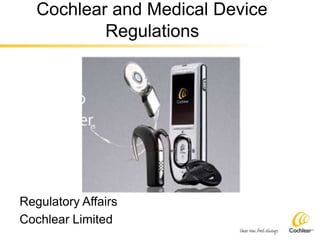
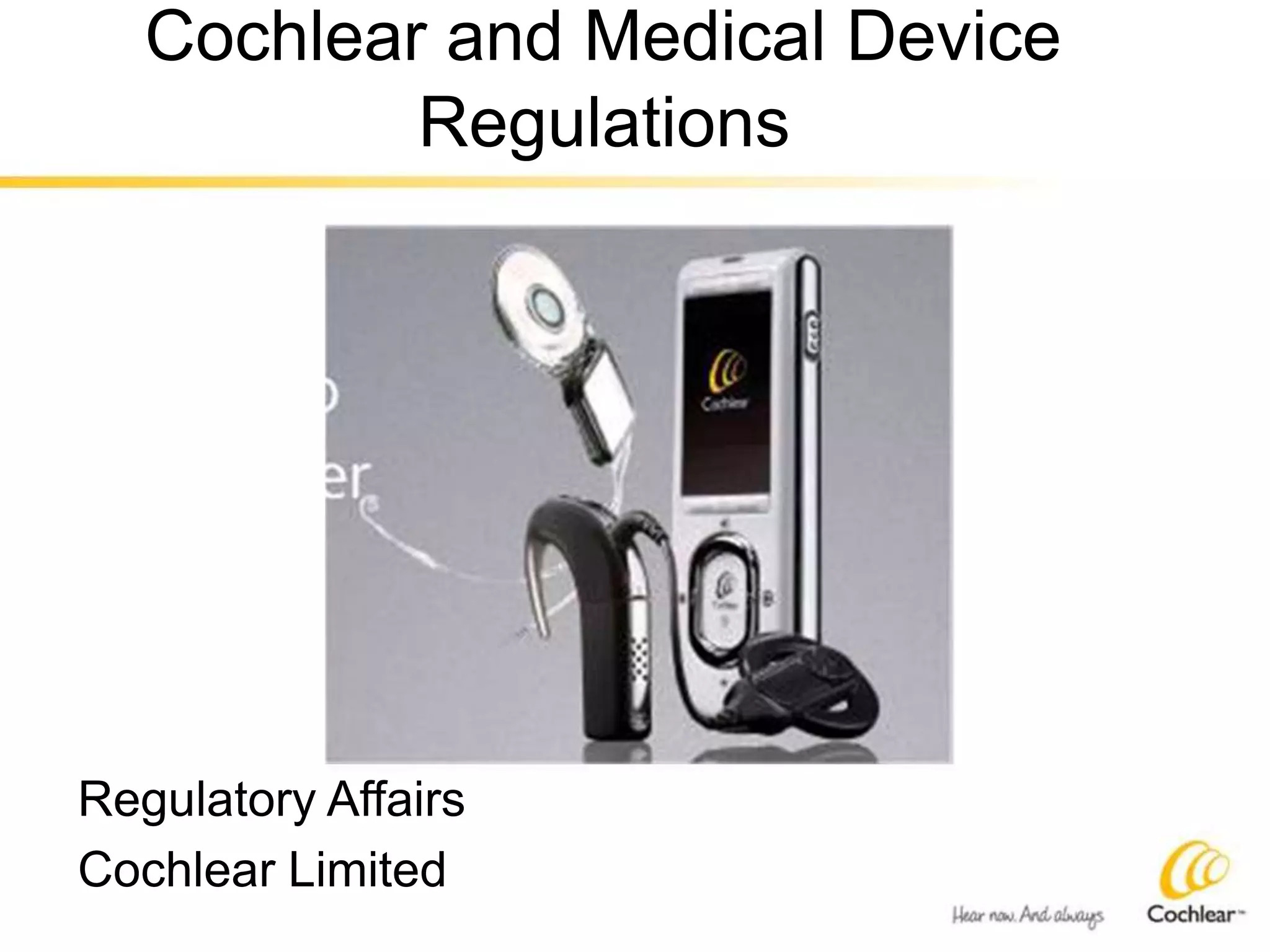
Cochlear and Medical Device
Regulations
Regulatory Affairs
Cochlear Limited
Why are you here?
• To acquire knowledge of the core of medical
device regulations
• To develop a consistent understanding of the
regulations
• To have reinforced how the regulations affects
your role
• To have an opportunity to have any uncertainties
regarding medical device regulations clarified
Modules
• Medical Device Regulation Basics
• Medical Device Standards
• Quality Management System Audits
• Product Approvals and management of changes
• Postmarket surveillance
An Overview of the Landscape:
Who are the Regulatory
Agencies
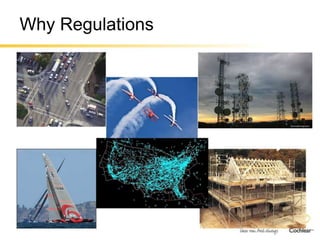
Why Regulations
Regulations
Regulation is
"controlling human or societal behavior by rules or
restrictions.“
Regulation mandated by a state attempts to
• produce outcomes which might not otherwise occur,
• produce or prevent outcomes in different places to
what might otherwise occur, or
• produce or prevent outcomes in different timescales
than would otherwise occur .
Regulators’ perspectives - TGA
Vision:
• We aim to be recognised as a world leader in
advancing and protecting public health and the
environment through scientific and regulatory
excellence.
Mission:
• We will develop and implement appropriate national
regulatory policies and controls for medicines, medical
devices, blood, blood products, tissues, chemicals and
gene technology.
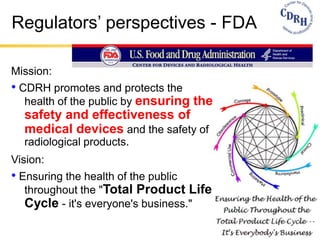
Regulators’ perspectives - FDA
Mission:
• CDRH promotes and protects the
health of the public by ensuring the
safety and effectiveness of
medical devices and the safety of
radiological products.
Vision:
• Ensuring the health of the public
throughout the "Total Product Life
Cycle - it's everyone's business."
Regulators’ perspectives:
PMDA, Japan
PMDA continues to improve the public health
and safety of our nation by reviewing
applications for marketing approval of
pharmaceuticals and medical devices,
conducting safety measures, and providing
relief to people who have suffered from
adverse drug reactions.
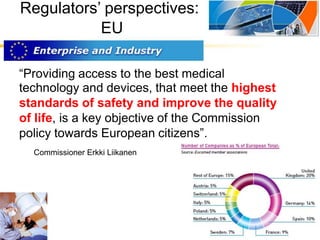
Regulators’ perspectives:
EU
“Providing access to the best medical
technology and devices, that meet the highest
standards of safety and improve the quality
of life, is a key objective of the Commission
policy towards European citizens”.
Commissioner Erkki Liikanen
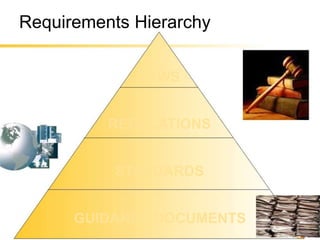
Requirements Hierarchy
LAWS
REGULATIONS
STANDARDS
GUIDANCE DOCUMENTS
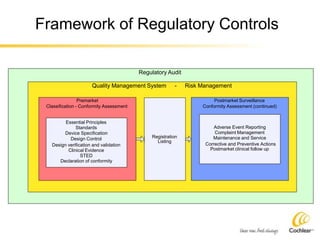
Framework of Regulatory Controls
Regulatory Audit
Quality Management System -
Premarket
Classification - Conformity Assessment
Essential Principles
Standards
Device Specification
Registration
Risk Management
Postmarket Surveillance
Conformity Assessment (continued)
Adverse Event Reporting
Complaint Management
Design Control
Design verification and validation
Clinical Evidence
STED
Declaration of conformity
Listing
Maintenance and Service
Corrective and Preventive Actions
Postmarket clinical follow up
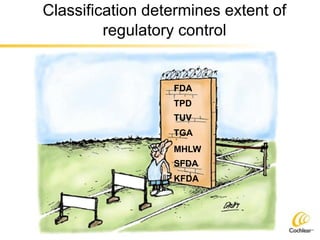
Classification determines extent of
regulatory control
FDA
TPD
TUV
TGA
MHLW
SFDA
KFDA
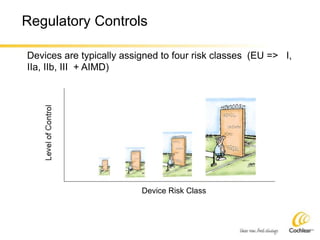
Regulatory Controls
Devices are typically assigned to four risk classes (EU => I,
IIa, IIb, III + AIMD)
Device Risk Class
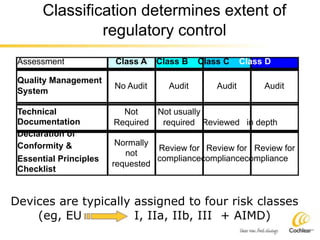
Classification determines extent of
regulatory control
Assessment
Quality Management
System
Technical
Class A Class B Class C Class D
No Audit Audit Audit Audit
Not Not usually
Documentation
Declaration of
Conformity &
Essential Principles
Checklist
Required
Normally
not
requested
required Reviewed in depth
Review for Review for Review for
compliancecompliancecompliance
Devices are typically assigned to four risk classes
(eg, EU I, IIa, IIb, III + AIMD)
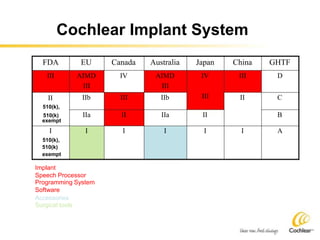
Cochlear Implant System
FDA EU Canada Australia Japan China GHTF
III AIMD IV AIMD IV III D
III III
II IIb III IIb III II C
510(k),
510(k) IIa II IIa II B
exempt
I I I I I I A
510(k),
510(k)
exempt
Implant
Speech Processor
Programming System
Software
Accessories
Surgical tools
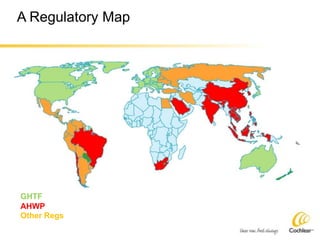
A Regulatory Map
GHTF
AHWP
Other Regs
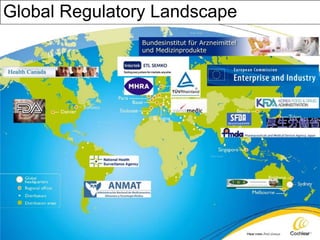
Global Regulatory Landscape
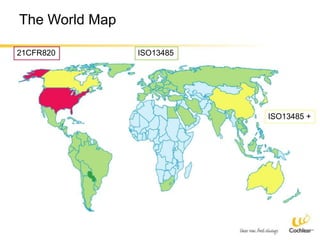
The World Map
21CFR820 ISO13485
ISO13485 +
Key Regulations for Cochlear
Regulations
1. Therapeutic Goods (Medical Devices) Regulations 2002 (Statutory Rules 2002 No. 236), Therapeutic Goods
Administration, Australia
2. Uniform Recall Procedure for Therapeutic Goods 2004 edition (Australia)
3. Food and Drug Administration, USA Title 21, Code of Federal Regulations
Part 820: Quality System Regulation.
Part 11 Electronic Records, Electronic Signatures
Part 806 Medical Devices, Reports of Corrections and Removals
Part 803 Medical Device Reporting
Part 812 Investigational Device Exemptions
Part 814 Premarket Approval of Medical Devices
4. MHLW (Ministry of Health, Labour, and Welfare, Japan) Ordinance no. 169 (revised GMP, Japan) based on
PAL (Pharmaceutical Affairs Law, Japan) [Law No. 145, as of August 10, 1960; Law No. 87 as of July 26,
2005]
5. Active Implantable Medical Device Directive (AIMD) 90/385/EEC (including 2007 rev), Europe
6. Medical Device Directive (MDD) 93/42/EEC (including 2007 rev), Europe
7. Medical Device Regulations (SOR/98-282) 1998, Department of Justice, Canada
8. Regulations for the Supervision and Administration of Medical Devices, State Food and Drug Administration
(SFDA), China
9. Medical Devices Regulation, KFDA. Korea Food and Drug Administration, Korea
10. Medical Devices Regulation, Taiwan Department of Health DoH, Taiwan

Reg summary

  • 1.
    Cochlear and MedicalDevice Regulations Regulatory Affairs Cochlear Limited
  • 2.
    Why are youhere? • To acquire knowledge of the core of medical device regulations • To develop a consistent understanding of the regulations • To have reinforced how the regulations affects your role • To have an opportunity to have any uncertainties regarding medical device regulations clarified
  • 3.
    Modules • Medical DeviceRegulation Basics • Medical Device Standards • Quality Management System Audits • Product Approvals and management of changes • Postmarket surveillance
  • 4.
    An Overview ofthe Landscape: Who are the Regulatory Agencies
  • 5.
  • 6.
    Regulations Regulation is "controlling humanor societal behavior by rules or restrictions.“ Regulation mandated by a state attempts to • produce outcomes which might not otherwise occur, • produce or prevent outcomes in different places to what might otherwise occur, or • produce or prevent outcomes in different timescales than would otherwise occur .
  • 7.
    Regulators’ perspectives -TGA Vision: • We aim to be recognised as a world leader in advancing and protecting public health and the environment through scientific and regulatory excellence. Mission: • We will develop and implement appropriate national regulatory policies and controls for medicines, medical devices, blood, blood products, tissues, chemicals and gene technology.
  • 8.
    Regulators’ perspectives -FDA Mission: • CDRH promotes and protects the health of the public by ensuring the safety and effectiveness of medical devices and the safety of radiological products. Vision: • Ensuring the health of the public throughout the "Total Product Life Cycle - it's everyone's business."
  • 9.
    Regulators’ perspectives: PMDA, Japan PMDAcontinues to improve the public health and safety of our nation by reviewing applications for marketing approval of pharmaceuticals and medical devices, conducting safety measures, and providing relief to people who have suffered from adverse drug reactions.
  • 10.
    Regulators’ perspectives: EU “Providing accessto the best medical technology and devices, that meet the highest standards of safety and improve the quality of life, is a key objective of the Commission policy towards European citizens”. Commissioner Erkki Liikanen
  • 11.
  • 12.
    Framework of RegulatoryControls Regulatory Audit Quality Management System - Premarket Classification - Conformity Assessment Essential Principles Standards Device Specification Registration Risk Management Postmarket Surveillance Conformity Assessment (continued) Adverse Event Reporting Complaint Management Design Control Design verification and validation Clinical Evidence STED Declaration of conformity Listing Maintenance and Service Corrective and Preventive Actions Postmarket clinical follow up
  • 13.
    Classification determines extentof regulatory control FDA TPD TUV TGA MHLW SFDA KFDA
  • 14.
    Regulatory Controls Devices aretypically assigned to four risk classes (EU => I, IIa, IIb, III + AIMD) Device Risk Class
  • 15.
    Classification determines extentof regulatory control Assessment Quality Management System Technical Class A Class B Class C Class D No Audit Audit Audit Audit Not Not usually Documentation Declaration of Conformity & Essential Principles Checklist Required Normally not requested required Reviewed in depth Review for Review for Review for compliancecompliancecompliance Devices are typically assigned to four risk classes (eg, EU I, IIa, IIb, III + AIMD)
  • 16.
    Cochlear Implant System FDAEU Canada Australia Japan China GHTF III AIMD IV AIMD IV III D III III II IIb III IIb III II C 510(k), 510(k) IIa II IIa II B exempt I I I I I I A 510(k), 510(k) exempt Implant Speech Processor Programming System Software Accessories Surgical tools
  • 17.
  • 18.
  • 19.
    The World Map 21CFR820ISO13485 ISO13485 +
  • 20.
    Key Regulations forCochlear Regulations 1. Therapeutic Goods (Medical Devices) Regulations 2002 (Statutory Rules 2002 No. 236), Therapeutic Goods Administration, Australia 2. Uniform Recall Procedure for Therapeutic Goods 2004 edition (Australia) 3. Food and Drug Administration, USA Title 21, Code of Federal Regulations Part 820: Quality System Regulation. Part 11 Electronic Records, Electronic Signatures Part 806 Medical Devices, Reports of Corrections and Removals Part 803 Medical Device Reporting Part 812 Investigational Device Exemptions Part 814 Premarket Approval of Medical Devices 4. MHLW (Ministry of Health, Labour, and Welfare, Japan) Ordinance no. 169 (revised GMP, Japan) based on PAL (Pharmaceutical Affairs Law, Japan) [Law No. 145, as of August 10, 1960; Law No. 87 as of July 26, 2005] 5. Active Implantable Medical Device Directive (AIMD) 90/385/EEC (including 2007 rev), Europe 6. Medical Device Directive (MDD) 93/42/EEC (including 2007 rev), Europe 7. Medical Device Regulations (SOR/98-282) 1998, Department of Justice, Canada 8. Regulations for the Supervision and Administration of Medical Devices, State Food and Drug Administration (SFDA), China 9. Medical Devices Regulation, KFDA. Korea Food and Drug Administration, Korea 10. Medical Devices Regulation, Taiwan Department of Health DoH, Taiwan