With case report of MDS
presenting as anemia
Approach to Myelodysplastic Syndrome
(MDS) & Overview of Treatment
Dr. Jaykumar Sejpal,
Medical Advisor, Oncology.
Scope of presentation
 Clinical presentation
 Diagnostic workup
 Management approach
 Choosing agent for treatment
Clinical presentation
 64 year-old male
 Presented with new-onset decreased exercise
tolerance of two months duration
 Also complaint of fatigue, weakness & occasional
dizziness
 Past Medical History:
 Hypertension
 Negative previous hematologic disorder
 Treated with iron supplements
 Physical Examination:
 No hepatosplenomegaly
Complete Blood Count
Macrocytic anemia
 Peripheral Smear:
 RBC: Ansisocytosis and
macrocytosis
 No poikilocytosis
 WBC:
 Predominantly mature
neutrophils and
lymphocytes
 No dyspoiesis
 No blasts
 WBC 2 x 10³ /μL
 RBC 1.84 x 10 6 /μL
 Hgb 5.1 g/dL
 Hct 19.5 %
 MCV 127 fL
 Platelet 1,10,000 /μL
 Differential:
 55% PMN, 32% Lymph,
12% Mono, 1% Eos
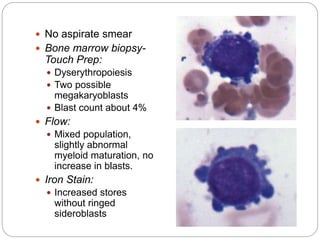
 No aspirate smear
 Bone marrow biopsy-
Touch Prep:
 Dyserythropoiesis
 Two possible
megakaryoblasts
 Blast count about 4%
 Flow:
 Mixed population,
slightly abnormal
myeloid maturation, no
increase in blasts.
 Iron Stain:
 Increased stores
without ringed
sideroblasts
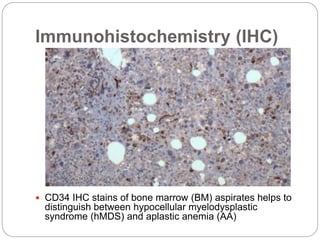
Immunohistochemistry (IHC)
 CD34 IHC stains of bone marrow (BM) aspirates helps to
distinguish between hypocellular myelodysplastic
syndrome (hMDS) and aplastic anemia (AA)
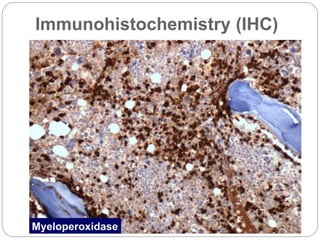
Immunohistochemistry (IHC)
Cytogenetics
 Multiple Complex Abnormalities:
 Monosomy 2,5,7 and 15
 Trisomy 8
 Unbalanced translocation b/t 17p and 2q
 Additional chromosomic material of unknown origin
replacing 7q (of the remaining 7) and on 17q and
12p
Differential Diagnosis
 Chronic Myeloproliferative Disorders
 No splenomegaly, no leukoerythroblastic smear
 Acute Myeloid Leukemia
 Blasts <5%, cytogentics
 Myelodysplastic Syndrome (MDS)
 Cytogenetic, BM blasts, peripheral smear
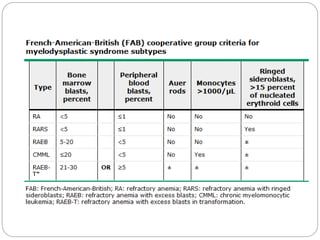
MDS
FAB Classification
 RA: Refractory anemia
 RARS: refractory anemia with ringed sideroblasts
 RAEB: refractory anemia with excess blasts
 CMML: Chronic myelomonocytic leukemia
 RAEB-T: refractory anemia with excess blasts in
transformation
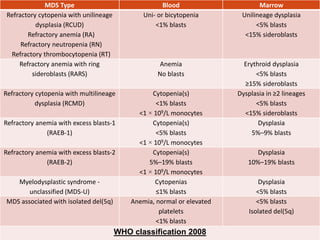
MDS Type Blood Marrow
Refractory cytopenia with unilineage
dysplasia (RCUD)
Refractory anemia (RA)
Refractory neutropenia (RN)
Refractory thrombocytopenia (RT)
Uni- or bicytopenia
<1% blasts
Unilineage dysplasia
<5% blasts
<15% sideroblasts
Refractory anemia with ring
sideroblasts (RARS)
Anemia
No blasts
Erythroid dysplasia
<5% blasts
≥15% sideroblasts
Refractory cytopenia with multilineage
dysplasia (RCMD)
Cytopenia(s)
<1% blasts
<1 × 10⁹/L monocytes
Dysplasia in ≥2 lineages
<5% blasts
<15% sideroblasts
Refractory anemia with excess blasts-1
(RAEB-1)
Cytopenia(s)
<5% blasts
<1 × 10⁹/L monocytes
Dysplasia
5%–9% blasts
Refractory anemia with excess blasts-2
(RAEB-2)
Cytopenia(s)
5%–19% blasts
<1 × 10⁹/L monocytes
Dysplasia
10%–19% blasts
Myelodysplastic syndrome -
unclassified (MDS-U)
Cytopenias
≤1% blasts
Dysplasia
<5% blasts
MDS associated with isolated del(5q) Anemia, normal or elevated
platelets
<1% blasts
<5% blasts
Isolated del(5q)
WHO classification 2008
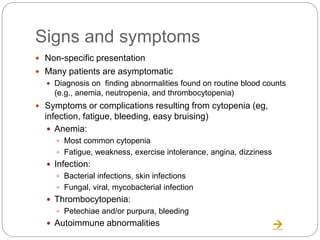
Signs and symptoms
 Non-specific presentation
 Many patients are asymptomatic
 Diagnosis on finding abnormalities found on routine blood counts
(e.g., anemia, neutropenia, and thrombocytopenia)
 Symptoms or complications resulting from cytopenia (eg,
infection, fatigue, bleeding, easy bruising)
 Anemia:
 Most common cytopenia
 Fatigue, weakness, exercise intolerance, angina, dizziness
 Infection:
 Bacterial infections, skin infections
 Fungal, viral, mycobacterial infection
 Thrombocytopenia:
 Petechiae and/or purpura, bleeding
 Autoimmune abnormalities 
Evaluation
 Myelodysplastic syndrome (MDS) is characterized by abnormal
cell morphology (dysplasia) and quantitative changes in one or
more of the blood and bone marrow elements (ie, red cells,
granulocytes, platelets)
 Complete blood count
 Anemia
 Leukopenia
 Thrombocytopenia
 Periphreral blood smear
 Dysplastic blood cells
 Bone marrow aspirate/ biopsy
 Evaluation of the blasts and other cells
 Fibrosis of marrow
 Genetic features [del(7q), del(5q), del(13q),del(11q),
del(12p),del(9q)]
 Distinguishes between MDS and acute myeloid leukemia (AML)
 Prognostic
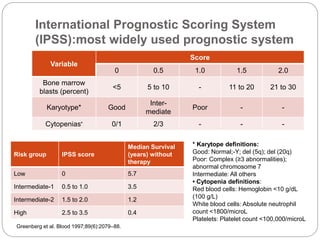
International Prognostic Scoring System
(IPSS):most widely used prognostic system
Variable
Score
0 0.5 1.0 1.5 2.0
Bone marrow
blasts (percent)
<5 5 to 10 - 11 to 20 21 to 30
Karyotype* Good
Inter-
mediate
Poor - -
Cytopenias• 0/1 2/3 - - -
Risk group IPSS score
Median Survival
(years) without
therapy
Low 0 5.7
Intermediate-1 0.5 to 1.0 3.5
Intermediate-2 1.5 to 2.0 1.2
High 2.5 to 3.5 0.4
* Karytope definitions:
Good: Normal;-Y; del (5q); del (20q)
Poor: Complex (≥3 abnormalities);
abnormal chromosome 7
Intermediate: All others
• Cytopenia definitions:
Red blood cells: Hemoglobin <10 g/dL
(100 g/L)
White blood cells: Absolute neutrophil
count <1800/microL
Platelets: Platelet count <100,000/microL
Greenberg et al. Blood 1997;89(6):2079–88.
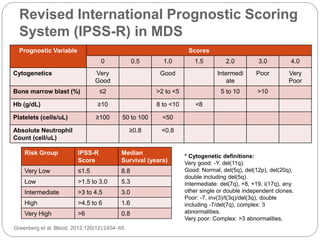
Revised International Prognostic Scoring
System (IPSS-R) in MDS
Prognostic Variable Scores
0 0.5 1.0 1.5 2.0 3.0 4.0
Cytogenetics Very
Good
Good Intermedi
ate
Poor Very
Poor
Bone marrow blast (%) ≤2 >2 to <5 5 to 10 >10
Hb (g/dL) ≥10 8 to <10 <8
Platelets (cells/uL) ≥100 50 to 100 <50
Absolute Neutrophil
Count (cell/uL)
≥0.8 <0.8
Risk Group IPSS-R
Score
Median
Survival (years)
Very Low ≤1.5 8.8
Low >1.5 to 3.0 5.3
Intermediate >3 to 4.5 3.0
High >4.5 to 6 1.6
Very High >6 0.8
Greenberg et al. Blood. 2012;120(12):2454–65.
* Cytogenetic definitions:
Very good: -Y, del(11q).
Good: Normal, del(5q), del(12p), del(20q),
double including del(5q).
Intermediate: del(7q), +8, +19, i(17q), any
other single or double independent clones.
Poor: -7, inv(3)/t(3q)/del(3q), double
including -7/del(7q), complex: 3
abnormalities.
Very poor: Complex: >3 abnormalities.
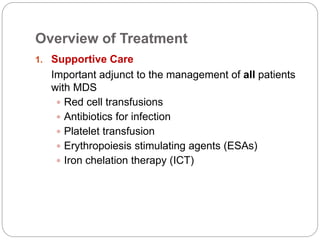
Overview of Treatment
1. Supportive Care
Important adjunct to the management of all patients
with MDS
 Red cell transfusions
 Antibiotics for infection
 Platelet transfusion
 Erythropoiesis stimulating agents (ESAs)
 Iron chelation therapy (ICT)
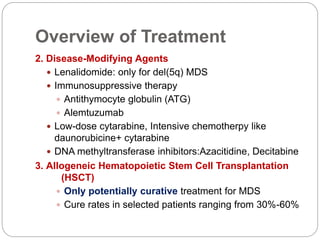
Overview of Treatment
2. Disease-Modifying Agents
 Lenalidomide: only for del(5q) MDS
 Immunosuppressive therapy
 Antithymocyte globulin (ATG)
 Alemtuzumab
 Low-dose cytarabine, Intensive chemotherpy like
daunorubicine+ cytarabine
 DNA methyltransferase inhibitors:Azacitidine, Decitabine
3. Allogeneic Hematopoietic Stem Cell Transplantation
(HSCT)
 Only potentially curative treatment for MDS
 Cure rates in selected patients ranging from 30%-60%
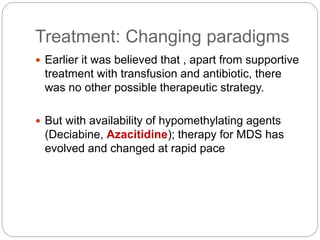
Treatment: Changing paradigms
 Earlier it was believed that , apart from supportive
treatment with transfusion and antibiotic, there
was no other possible therapeutic strategy.
 But with availability of hypomethylating agents
(Deciabine, Azacitidine); therapy for MDS has
evolved and changed at rapid pace
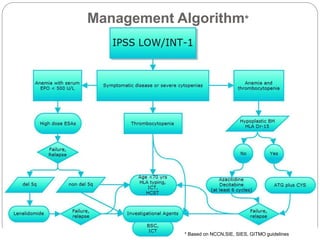
Management Algorithm*
* Based on NCCN,SIE, SIES, GITMO guidelines
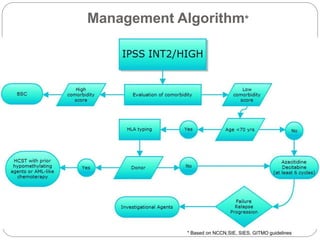
Management Algorithm*
* Based on NCCN,SIE, SIES, GITMO guidelines
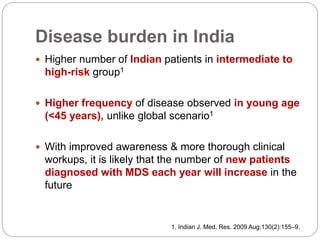
Disease burden in India
 Higher number of Indian patients in intermediate to
high-risk group1
 Higher frequency of disease observed in young age
(<45 years), unlike global scenario1
 With improved awareness & more thorough clinical
workups, it is likely that the number of new patients
diagnosed with MDS each year will increase in the
future
1. Indian J. Med. Res. 2009 Aug;130(2):155–9.
Limitations of currently available treatment
in India
 Supportive care & most of the medical therapies do not
prolong survival in MDS
 Allogeneic HSCT
 Only treatment for MDS with the potential for cure
 Limitations
 Possible in ~5% patients only
 Lack of donor availability
 High costs
 Co morbidities in elderly, poor performance status-
ineligible for transplant
DNA methyltransferase inhibitors
 Also called hypomethylating agents
 Azacitidine
 Decitabine
 Constitute an essential tool in the treatment of
myelodysplastic syndrome (MDS)
 Allowed the treatment of higher-risk elderly and frail
patients, who in the past were treated exclusively with
the best supportive care
 Although do not achieves final cure,
 Induce an improvement in hematopoiesis &
 Azacitidine, a demonstrated prolonged overall survival
Comparison of HMAs for
treatment of MDS
Comparison between Decitabine and Azacitidine for
MDS: A Meta-analysis with 1,392 Subjects
 Clinical choice between HMAs is not clear
 One more meta-analysis was performed to
compare survival advantage of decitabine and
azacitidine in patients with MDS.
 Eleven trials with a total of 1392 patients with
MDS (decitabine, n = 768; azacitidine, n = 624)
were included for analysis.
Mixue et al Clinical Lymphoma,Myeloma and Leukemia (2014).
Comparison between Decitabine and
Azacitidine for MDS: A Meta-analysis with
1,392 Subjects
 Azacitidine vs BSC
 Significantly improved overall survival (hazard ratio [HR],
0.69; 95% CI, 0.54-0.87)
 Significantly delayed and time to acute myeloid leukemia
transformation (HR, 0.51; 95% CI, 0.35-0.74).
 But these benefits were not found with decitabine.
 Among patients with higher risk (IPSS >=3) or older >75
years, treatment with azacitidine was a favorable factor,
whereas decitabine showed no advantage.
 Therefore, with higher overall response rates and better
survival benefits, azacitidine is recommended as the
first-line hypomethylating agent for MDS, especially in
elderly patients or those with high risk.
Mixue et al Clinical Lymphoma,Myeloma and Leukemia (2014).
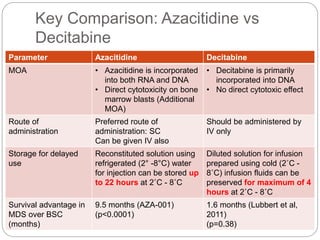
Key Comparison: Azacitidine vs
Decitabine
Parameter Azacitidine Decitabine
MOA • Azacitidine is incorporated
into both RNA and DNA
• Direct cytotoxicity on bone
marrow blasts (Additional
MOA)
• Decitabine is primarily
incorporated into DNA
• No direct cytotoxic effect
Route of
administration
Preferred route of
administration: SC
Can be given IV also
Should be administered by
IV only
Storage for delayed
use
Reconstituted solution using
refrigerated (2° -8°C) water
for injection can be stored up
to 22 hours at 2˚C - 8˚C
Diluted solution for infusion
prepared using cold (2˚C -
8˚C) infusion fluids can be
preserved for maximum of 4
hours at 2˚C - 8˚C
Survival advantage in
MDS over BSC
(months)
9.5 months (AZA-001)
(p<0.0001)
1.6 months (Lubbert et al,
2011)
(p=0.38)
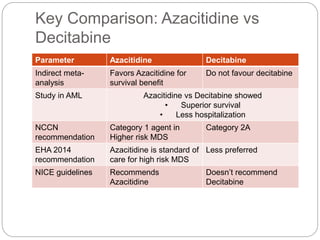
Key Comparison: Azacitidine vs
Decitabine
Parameter Azacitidine Decitabine
Indirect meta-
analysis
Favors Azacitidine for
survival benefit
Do not favour decitabine
Study in AML Azacitidine vs Decitabine showed
• Superior survival
• Less hospitalization
NCCN
recommendation
Category 1 agent in
Higher risk MDS
Category 2A
EHA 2014
recommendation
Azacitidine is standard of
care for high risk MDS
Less preferred
NICE guidelines Recommends
Azacitidine
Doesn’t recommend
Decitabine
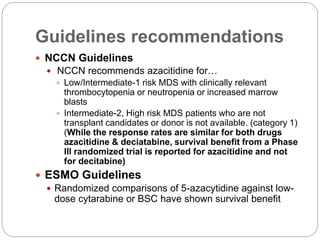
Guidelines recommendations
 NCCN Guidelines
 NCCN recommends azacitidine for…
 Low/Intermediate-1 risk MDS with clinically relevant
thrombocytopenia or neutropenia or increased marrow
blasts
 Intermediate-2, High risk MDS patients who are not
transplant candidates or donor is not available. (category 1)
(While the response rates are similar for both drugs
azacitidine & deciatabine, survival benefit from a Phase
lll randomized trial is reported for azacitidine and not
for decitabine)
 ESMO Guidelines
 Randomized comparisons of 5-azacytidine against low-
dose cytarabine or BSC have shown survival benefit
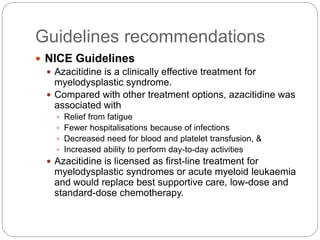
 NICE Guidelines
 Azacitidine is a clinically effective treatment for
myelodysplastic syndrome.
 Compared with other treatment options, azacitidine was
associated with
 Relief from fatigue
 Fewer hospitalisations because of infections
 Decreased need for blood and platelet transfusion, &
 Increased ability to perform day-to-day activities
 Azacitidine is licensed as first-line treatment for
myelodysplastic syndromes or acute myeloid leukaemia
and would replace best supportive care, low-dose and
standard-dose chemotherapy.
Guidelines recommendations
Summary
 HMAs are most essential group for treatment of myelodysplastic
syndrome (MDS)
 For MDS patients who are not eligible for transplant; NCCN
recommends azacitidine as prefrred category 1 agent
 Only chemotherapeutic agent showing survival benefits in MDS
 Azacitidine vs supportive care or coventional care
 Significant survival benefit
 Delays progression to AML
 Reduces transfusion burden
 Improves Quality of Life parameters
 Convenient administration by SC route
 Fewer infection-related hospitalizations, decreases need for blood
and platelet transfusion
 Superior choice over decitabine
 Strong recommendations for azacitidine by guidelines like NCCN,
NICE, ESMO
Thank You

Refractory anemia case report mds

  • 1.
    With case reportof MDS presenting as anemia Approach to Myelodysplastic Syndrome (MDS) & Overview of Treatment Dr. Jaykumar Sejpal, Medical Advisor, Oncology.
  • 2.
    Scope of presentation Clinical presentation  Diagnostic workup  Management approach  Choosing agent for treatment
  • 3.
    Clinical presentation  64year-old male  Presented with new-onset decreased exercise tolerance of two months duration  Also complaint of fatigue, weakness & occasional dizziness  Past Medical History:  Hypertension  Negative previous hematologic disorder  Treated with iron supplements  Physical Examination:  No hepatosplenomegaly
  • 4.
    Complete Blood Count Macrocyticanemia  Peripheral Smear:  RBC: Ansisocytosis and macrocytosis  No poikilocytosis  WBC:  Predominantly mature neutrophils and lymphocytes  No dyspoiesis  No blasts  WBC 2 x 10³ /μL  RBC 1.84 x 10 6 /μL  Hgb 5.1 g/dL  Hct 19.5 %  MCV 127 fL  Platelet 1,10,000 /μL  Differential:  55% PMN, 32% Lymph, 12% Mono, 1% Eos
  • 5.
     No aspiratesmear  Bone marrow biopsy- Touch Prep:  Dyserythropoiesis  Two possible megakaryoblasts  Blast count about 4%  Flow:  Mixed population, slightly abnormal myeloid maturation, no increase in blasts.  Iron Stain:  Increased stores without ringed sideroblasts
  • 6.
    Immunohistochemistry (IHC)  CD34IHC stains of bone marrow (BM) aspirates helps to distinguish between hypocellular myelodysplastic syndrome (hMDS) and aplastic anemia (AA)
  • 7.
  • 8.
    Cytogenetics  Multiple ComplexAbnormalities:  Monosomy 2,5,7 and 15  Trisomy 8  Unbalanced translocation b/t 17p and 2q  Additional chromosomic material of unknown origin replacing 7q (of the remaining 7) and on 17q and 12p
  • 9.
    Differential Diagnosis  ChronicMyeloproliferative Disorders  No splenomegaly, no leukoerythroblastic smear  Acute Myeloid Leukemia  Blasts <5%, cytogentics  Myelodysplastic Syndrome (MDS)  Cytogenetic, BM blasts, peripheral smear
  • 10.
    MDS FAB Classification  RA:Refractory anemia  RARS: refractory anemia with ringed sideroblasts  RAEB: refractory anemia with excess blasts  CMML: Chronic myelomonocytic leukemia  RAEB-T: refractory anemia with excess blasts in transformation
  • 12.
    MDS Type BloodMarrow Refractory cytopenia with unilineage dysplasia (RCUD) Refractory anemia (RA) Refractory neutropenia (RN) Refractory thrombocytopenia (RT) Uni- or bicytopenia <1% blasts Unilineage dysplasia <5% blasts <15% sideroblasts Refractory anemia with ring sideroblasts (RARS) Anemia No blasts Erythroid dysplasia <5% blasts ≥15% sideroblasts Refractory cytopenia with multilineage dysplasia (RCMD) Cytopenia(s) <1% blasts <1 × 10⁹/L monocytes Dysplasia in ≥2 lineages <5% blasts <15% sideroblasts Refractory anemia with excess blasts-1 (RAEB-1) Cytopenia(s) <5% blasts <1 × 10⁹/L monocytes Dysplasia 5%–9% blasts Refractory anemia with excess blasts-2 (RAEB-2) Cytopenia(s) 5%–19% blasts <1 × 10⁹/L monocytes Dysplasia 10%–19% blasts Myelodysplastic syndrome - unclassified (MDS-U) Cytopenias ≤1% blasts Dysplasia <5% blasts MDS associated with isolated del(5q) Anemia, normal or elevated platelets <1% blasts <5% blasts Isolated del(5q) WHO classification 2008
  • 13.
    Signs and symptoms Non-specific presentation  Many patients are asymptomatic  Diagnosis on finding abnormalities found on routine blood counts (e.g., anemia, neutropenia, and thrombocytopenia)  Symptoms or complications resulting from cytopenia (eg, infection, fatigue, bleeding, easy bruising)  Anemia:  Most common cytopenia  Fatigue, weakness, exercise intolerance, angina, dizziness  Infection:  Bacterial infections, skin infections  Fungal, viral, mycobacterial infection  Thrombocytopenia:  Petechiae and/or purpura, bleeding  Autoimmune abnormalities 
  • 14.
    Evaluation  Myelodysplastic syndrome(MDS) is characterized by abnormal cell morphology (dysplasia) and quantitative changes in one or more of the blood and bone marrow elements (ie, red cells, granulocytes, platelets)  Complete blood count  Anemia  Leukopenia  Thrombocytopenia  Periphreral blood smear  Dysplastic blood cells  Bone marrow aspirate/ biopsy  Evaluation of the blasts and other cells  Fibrosis of marrow  Genetic features [del(7q), del(5q), del(13q),del(11q), del(12p),del(9q)]  Distinguishes between MDS and acute myeloid leukemia (AML)  Prognostic
  • 15.
    International Prognostic ScoringSystem (IPSS):most widely used prognostic system Variable Score 0 0.5 1.0 1.5 2.0 Bone marrow blasts (percent) <5 5 to 10 - 11 to 20 21 to 30 Karyotype* Good Inter- mediate Poor - - Cytopenias• 0/1 2/3 - - - Risk group IPSS score Median Survival (years) without therapy Low 0 5.7 Intermediate-1 0.5 to 1.0 3.5 Intermediate-2 1.5 to 2.0 1.2 High 2.5 to 3.5 0.4 * Karytope definitions: Good: Normal;-Y; del (5q); del (20q) Poor: Complex (≥3 abnormalities); abnormal chromosome 7 Intermediate: All others • Cytopenia definitions: Red blood cells: Hemoglobin <10 g/dL (100 g/L) White blood cells: Absolute neutrophil count <1800/microL Platelets: Platelet count <100,000/microL Greenberg et al. Blood 1997;89(6):2079–88.
  • 16.
    Revised International PrognosticScoring System (IPSS-R) in MDS Prognostic Variable Scores 0 0.5 1.0 1.5 2.0 3.0 4.0 Cytogenetics Very Good Good Intermedi ate Poor Very Poor Bone marrow blast (%) ≤2 >2 to <5 5 to 10 >10 Hb (g/dL) ≥10 8 to <10 <8 Platelets (cells/uL) ≥100 50 to 100 <50 Absolute Neutrophil Count (cell/uL) ≥0.8 <0.8 Risk Group IPSS-R Score Median Survival (years) Very Low ≤1.5 8.8 Low >1.5 to 3.0 5.3 Intermediate >3 to 4.5 3.0 High >4.5 to 6 1.6 Very High >6 0.8 Greenberg et al. Blood. 2012;120(12):2454–65. * Cytogenetic definitions: Very good: -Y, del(11q). Good: Normal, del(5q), del(12p), del(20q), double including del(5q). Intermediate: del(7q), +8, +19, i(17q), any other single or double independent clones. Poor: -7, inv(3)/t(3q)/del(3q), double including -7/del(7q), complex: 3 abnormalities. Very poor: Complex: >3 abnormalities.
  • 17.
    Overview of Treatment 1.Supportive Care Important adjunct to the management of all patients with MDS  Red cell transfusions  Antibiotics for infection  Platelet transfusion  Erythropoiesis stimulating agents (ESAs)  Iron chelation therapy (ICT)
  • 18.
    Overview of Treatment 2.Disease-Modifying Agents  Lenalidomide: only for del(5q) MDS  Immunosuppressive therapy  Antithymocyte globulin (ATG)  Alemtuzumab  Low-dose cytarabine, Intensive chemotherpy like daunorubicine+ cytarabine  DNA methyltransferase inhibitors:Azacitidine, Decitabine 3. Allogeneic Hematopoietic Stem Cell Transplantation (HSCT)  Only potentially curative treatment for MDS  Cure rates in selected patients ranging from 30%-60%
  • 19.
    Treatment: Changing paradigms Earlier it was believed that , apart from supportive treatment with transfusion and antibiotic, there was no other possible therapeutic strategy.  But with availability of hypomethylating agents (Deciabine, Azacitidine); therapy for MDS has evolved and changed at rapid pace
  • 20.
    Management Algorithm* * Basedon NCCN,SIE, SIES, GITMO guidelines
  • 21.
    Management Algorithm* * Basedon NCCN,SIE, SIES, GITMO guidelines
  • 22.
    Disease burden inIndia  Higher number of Indian patients in intermediate to high-risk group1  Higher frequency of disease observed in young age (<45 years), unlike global scenario1  With improved awareness & more thorough clinical workups, it is likely that the number of new patients diagnosed with MDS each year will increase in the future 1. Indian J. Med. Res. 2009 Aug;130(2):155–9.
  • 23.
    Limitations of currentlyavailable treatment in India  Supportive care & most of the medical therapies do not prolong survival in MDS  Allogeneic HSCT  Only treatment for MDS with the potential for cure  Limitations  Possible in ~5% patients only  Lack of donor availability  High costs  Co morbidities in elderly, poor performance status- ineligible for transplant
  • 24.
    DNA methyltransferase inhibitors Also called hypomethylating agents  Azacitidine  Decitabine  Constitute an essential tool in the treatment of myelodysplastic syndrome (MDS)  Allowed the treatment of higher-risk elderly and frail patients, who in the past were treated exclusively with the best supportive care  Although do not achieves final cure,  Induce an improvement in hematopoiesis &  Azacitidine, a demonstrated prolonged overall survival
  • 25.
    Comparison of HMAsfor treatment of MDS
  • 26.
    Comparison between Decitabineand Azacitidine for MDS: A Meta-analysis with 1,392 Subjects  Clinical choice between HMAs is not clear  One more meta-analysis was performed to compare survival advantage of decitabine and azacitidine in patients with MDS.  Eleven trials with a total of 1392 patients with MDS (decitabine, n = 768; azacitidine, n = 624) were included for analysis. Mixue et al Clinical Lymphoma,Myeloma and Leukemia (2014).
  • 27.
    Comparison between Decitabineand Azacitidine for MDS: A Meta-analysis with 1,392 Subjects  Azacitidine vs BSC  Significantly improved overall survival (hazard ratio [HR], 0.69; 95% CI, 0.54-0.87)  Significantly delayed and time to acute myeloid leukemia transformation (HR, 0.51; 95% CI, 0.35-0.74).  But these benefits were not found with decitabine.  Among patients with higher risk (IPSS >=3) or older >75 years, treatment with azacitidine was a favorable factor, whereas decitabine showed no advantage.  Therefore, with higher overall response rates and better survival benefits, azacitidine is recommended as the first-line hypomethylating agent for MDS, especially in elderly patients or those with high risk. Mixue et al Clinical Lymphoma,Myeloma and Leukemia (2014).
  • 28.
    Key Comparison: Azacitidinevs Decitabine Parameter Azacitidine Decitabine MOA • Azacitidine is incorporated into both RNA and DNA • Direct cytotoxicity on bone marrow blasts (Additional MOA) • Decitabine is primarily incorporated into DNA • No direct cytotoxic effect Route of administration Preferred route of administration: SC Can be given IV also Should be administered by IV only Storage for delayed use Reconstituted solution using refrigerated (2° -8°C) water for injection can be stored up to 22 hours at 2˚C - 8˚C Diluted solution for infusion prepared using cold (2˚C - 8˚C) infusion fluids can be preserved for maximum of 4 hours at 2˚C - 8˚C Survival advantage in MDS over BSC (months) 9.5 months (AZA-001) (p<0.0001) 1.6 months (Lubbert et al, 2011) (p=0.38)
  • 29.
    Key Comparison: Azacitidinevs Decitabine Parameter Azacitidine Decitabine Indirect meta- analysis Favors Azacitidine for survival benefit Do not favour decitabine Study in AML Azacitidine vs Decitabine showed • Superior survival • Less hospitalization NCCN recommendation Category 1 agent in Higher risk MDS Category 2A EHA 2014 recommendation Azacitidine is standard of care for high risk MDS Less preferred NICE guidelines Recommends Azacitidine Doesn’t recommend Decitabine
  • 30.
    Guidelines recommendations  NCCNGuidelines  NCCN recommends azacitidine for…  Low/Intermediate-1 risk MDS with clinically relevant thrombocytopenia or neutropenia or increased marrow blasts  Intermediate-2, High risk MDS patients who are not transplant candidates or donor is not available. (category 1) (While the response rates are similar for both drugs azacitidine & deciatabine, survival benefit from a Phase lll randomized trial is reported for azacitidine and not for decitabine)  ESMO Guidelines  Randomized comparisons of 5-azacytidine against low- dose cytarabine or BSC have shown survival benefit
  • 31.
     NICE Guidelines Azacitidine is a clinically effective treatment for myelodysplastic syndrome.  Compared with other treatment options, azacitidine was associated with  Relief from fatigue  Fewer hospitalisations because of infections  Decreased need for blood and platelet transfusion, &  Increased ability to perform day-to-day activities  Azacitidine is licensed as first-line treatment for myelodysplastic syndromes or acute myeloid leukaemia and would replace best supportive care, low-dose and standard-dose chemotherapy. Guidelines recommendations
  • 32.
    Summary  HMAs aremost essential group for treatment of myelodysplastic syndrome (MDS)  For MDS patients who are not eligible for transplant; NCCN recommends azacitidine as prefrred category 1 agent  Only chemotherapeutic agent showing survival benefits in MDS  Azacitidine vs supportive care or coventional care  Significant survival benefit  Delays progression to AML  Reduces transfusion burden  Improves Quality of Life parameters  Convenient administration by SC route  Fewer infection-related hospitalizations, decreases need for blood and platelet transfusion  Superior choice over decitabine  Strong recommendations for azacitidine by guidelines like NCCN, NICE, ESMO
  • 33.

Editor's Notes

  • #11 Ring sideroblasts are named so because of the arrangement of the iron granules in a ring form in mitochondria around the nucleus
  • #12 Auer rods are clumps of azurophilic granular material that form elongated needles seen in the cytoplasm of leukemic blasts.
  • #14 autoimmune conditions in patients with MDS were chronic rheumatic heart disease (7 percent), rheumatoid arthritis (6 percent), pernicious anemia (6 percent), psoriasis (2 percent), and polymyalgia rheumatica (2 percent) A minute red or purple spot on the surface of the skin as the result of tiny hemorrhages of blood vessels in the skin Any of several blood diseases causing subcutaneous bleeding
  • #21 Shown is the strategy for treatment choices for patients with IPSS lower-risk MDS according to type of cytopenias and with sequential treatment in case of relapse/resistance after first-line therapy. EPO indicates erythropoietin; ICT, iron chelation therapy; HSCT, hematopoietic stem cell transplant; ESA, erythropoietic stimulating agents; and BSC, best supportive care.