Reducing The Distance Between Data & Knowledge: Realizing the Promise of HIT and Biomedical InformaticsPhilip R.O. Payne, Ph.D.Associate Professor & Chair, Department of Biomedical InformaticsExecutive Director, Center for IT Innovations in HealthcareCo-Director, Center for Clinical and Translational Science, Biomedical Informatics ProgramCo-Director, Comprehensive Cancer Center, Biomedical Informatics Shared ResourceOSU Center for Personalize HealthcareNational ConferenceOctober 6, 2011
OutlineProblem StatementThe Promise of HIT and Biomedical InformaticsCreating a Learning Healthcare SystemGenerating KnowledgeStrategies and Future DirectionsHITBiomedical InformaticsCulturalDiscussion2
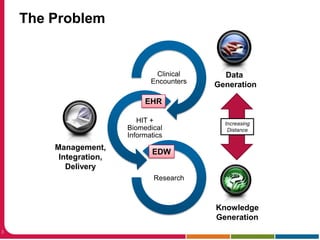
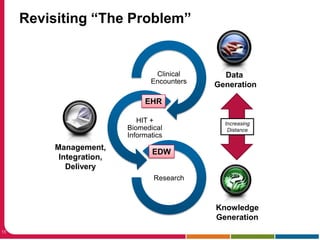
The ProblemData GenerationEHRIncreasingDistanceManagement,Integration,DeliveryEDWKnowledgeGeneration3
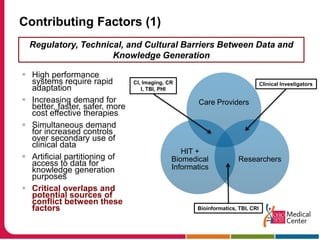
Contributing Factors (1)Regulatory, Technical, and Cultural Barriers Between Data and Knowledge GenerationHigh performance systems require rapid adaptationIncreasing demand for better, faster, safer, more cost effective therapiesSimultaneous demand for increased controls over secondary use of clinical dataArtificial partitioning of access to data for knowledge generation purposesCritical overlaps and potential sources of conflict between these factorsCI, Imaging, CRI, TBI, PHI Clinical InvestigatorsBioinformatics, TBI, CRI
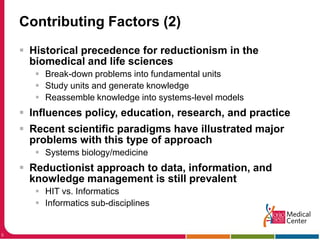
Contributing Factors (2)5Historical precedence for reductionism in the biomedical and life sciencesBreak-down problems into fundamental unitsStudy units and generate knowledgeReassemble knowledge into systems-level modelsInfluences policy, education, research, and practiceRecent scientific paradigms have illustrated major problems with this type of approachSystems biology/medicineReductionist approach to data, information, and knowledge management is still prevalentHIT vs. InformaticsInformatics sub-disciplines
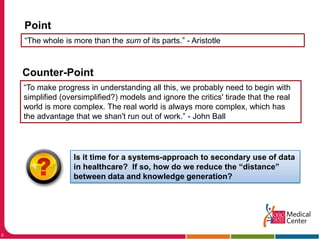
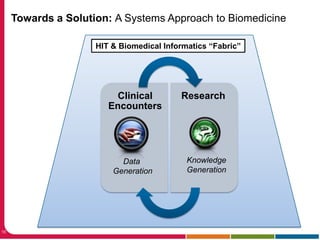
Pointโ€œThe whole is more than the sum of its parts.โ€ - AristotleCounter-Pointโ€œTo make progress in understanding all this, we probably need to begin with simplified (oversimplified?) models and ignore the critics' tirade that the real world is more complex. The real world is always more complex, which has the advantage that we shan't run out of work.โ€ - John BallIs it time for a systems-approach to secondary use of data in healthcare?  If so, how do we reduce the โ€œdistanceโ€ between data and knowledge generation?
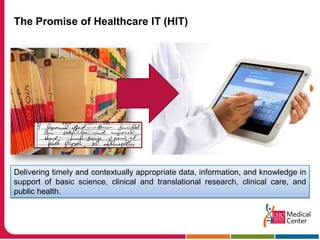
The Promise of Healthcare IT (HIT)Delivering timely and contextually appropriate data, information, and knowledge in support of basic science, clinical and translational research, clinical care, and public health.
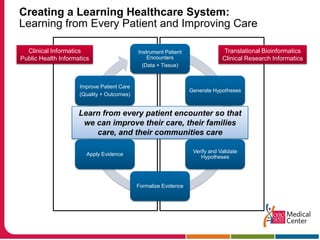
Creating a Learning Healthcare System: Learning from Every Patient and Improving CareClinical InformaticsPublic Health InformaticsTranslational BioinformaticsClinical Research InformaticsLearn from every patient encounter so that we can improve their care, their families care, and their communities care
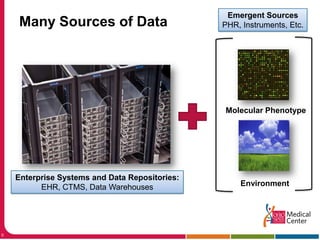
Many Sources of Data9Emergent SourcesPHR, Instruments, Etc.Molecular PhenotypeEnterprise Systems and Data Repositories:EHR, CTMS, Data WarehousesEnvironment
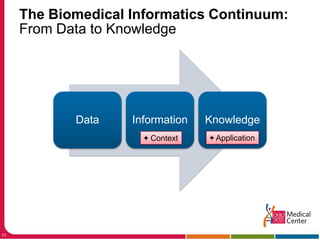
The Biomedical Informatics Continuum: From Data to Knowledge10+ Application+ Context
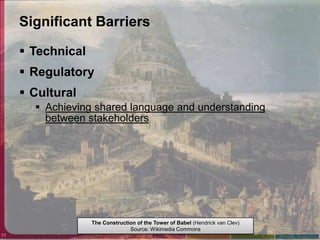
Significant Barriers11Technical
Regulatory
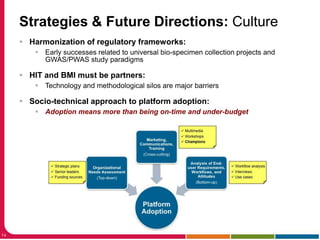
Cultural
Achieving shared language and understanding between stakeholdersThe Construction of the Tower of Babel (Hendrick van Clev) Source: Wikimedia Commons
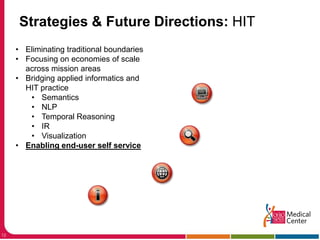
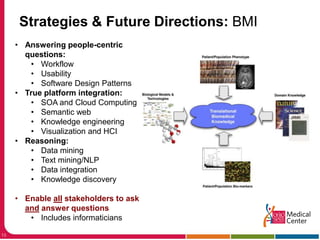
Strategies & Future Directions: HIT12Eliminating traditional boundaries
Focusing on economies of scale across mission areas
Bridging applied informatics and HIT practice

Reducing The Distance Between Data & Knowledge

  • 1.
    Reducing The DistanceBetween Data & Knowledge: Realizing the Promise of HIT and Biomedical InformaticsPhilip R.O. Payne, Ph.D.Associate Professor & Chair, Department of Biomedical InformaticsExecutive Director, Center for IT Innovations in HealthcareCo-Director, Center for Clinical and Translational Science, Biomedical Informatics ProgramCo-Director, Comprehensive Cancer Center, Biomedical Informatics Shared ResourceOSU Center for Personalize HealthcareNational ConferenceOctober 6, 2011
  • 2.
    OutlineProblem StatementThe Promiseof HIT and Biomedical InformaticsCreating a Learning Healthcare SystemGenerating KnowledgeStrategies and Future DirectionsHITBiomedical InformaticsCulturalDiscussion2
  • 3.
  • 4.
    Contributing Factors (1)Regulatory,Technical, and Cultural Barriers Between Data and Knowledge GenerationHigh performance systems require rapid adaptationIncreasing demand for better, faster, safer, more cost effective therapiesSimultaneous demand for increased controls over secondary use of clinical dataArtificial partitioning of access to data for knowledge generation purposesCritical overlaps and potential sources of conflict between these factorsCI, Imaging, CRI, TBI, PHI Clinical InvestigatorsBioinformatics, TBI, CRI
  • 5.
    Contributing Factors (2)5Historicalprecedence for reductionism in the biomedical and life sciencesBreak-down problems into fundamental unitsStudy units and generate knowledgeReassemble knowledge into systems-level modelsInfluences policy, education, research, and practiceRecent scientific paradigms have illustrated major problems with this type of approachSystems biology/medicineReductionist approach to data, information, and knowledge management is still prevalentHIT vs. InformaticsInformatics sub-disciplines
  • 6.
    Pointโ€œThe whole ismore than the sum of its parts.โ€ - AristotleCounter-Pointโ€œTo make progress in understanding all this, we probably need to begin with simplified (oversimplified?) models and ignore the critics' tirade that the real world is more complex. The real world is always more complex, which has the advantage that we shan't run out of work.โ€ - John BallIs it time for a systems-approach to secondary use of data in healthcare? If so, how do we reduce the โ€œdistanceโ€ between data and knowledge generation?
  • 7.
    The Promise ofHealthcare IT (HIT)Delivering timely and contextually appropriate data, information, and knowledge in support of basic science, clinical and translational research, clinical care, and public health.
  • 8.
    Creating a LearningHealthcare System: Learning from Every Patient and Improving CareClinical InformaticsPublic Health InformaticsTranslational BioinformaticsClinical Research InformaticsLearn from every patient encounter so that we can improve their care, their families care, and their communities care
  • 9.
    Many Sources ofData9Emergent SourcesPHR, Instruments, Etc.Molecular PhenotypeEnterprise Systems and Data Repositories:EHR, CTMS, Data WarehousesEnvironment
  • 10.
    The Biomedical InformaticsContinuum: From Data to Knowledge10+ Application+ Context
  • 11.
  • 12.
  • 13.
  • 14.
    Achieving shared languageand understanding between stakeholdersThe Construction of the Tower of Babel (Hendrick van Clev) Source: Wikimedia Commons
  • 15.
    Strategies & FutureDirections: HIT12Eliminating traditional boundaries
  • 16.
    Focusing on economiesof scale across mission areas
  • 17.

Editor's Notes

  • #2ย The clinical template should be used for presentation to a clinical audience and focused on clinical topics. Examples include clinical grand rounds, clinical conferences and seminars and internal clinical meetings.