Professor Azeem Majeed Professor of Primary Care Faculty of Medicine, Imperial College London, UK. e-health & the digital economy Imperial College London http://www1.imperial.ac.uk/medicine/people/a.majeed/
 
Why e-health? Increasing burden of care (e.g. increased life expectancy, long term conditions, range of treatment options) Rising healthcare costs Continuing health systems inefficiencies Variations in quality of care High prevalence of medical errors Greater public scrutiny of government spending Patients and the public want a greater say in decisions about their health & healthcare
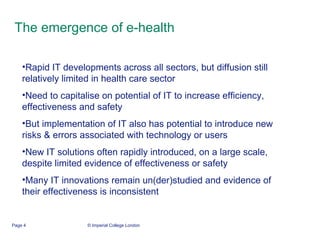
The emergence of e-health Rapid IT developments across all sectors, but diffusion still relatively limited in health care sector  Need to capitalise on potential of IT to increase efficiency, effectiveness and safety But implementation of IT also has potential to introduce new risks & errors associated with technology or users  New IT solutions often rapidly introduced, on a large scale, despite limited evidence of effectiveness or safety Many IT innovations remain un(der)studied and evidence of their effectiveness is inconsistent
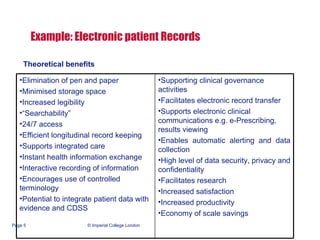
Theoretical benefits Example: Electronic patient Records Elimination of pen and paper  Minimised storage space Increased legibility “ Searchability” 24/7 access Efficient longitudinal record keeping Supports integrated care Instant health information exchange Interactive recording of information  Encourages use of controlled terminology Potential to integrate patient data with evidence and CDSS Supporting clinical governance activities Facilitates electronic record transfer Supports electronic clinical communications e.g. e-Prescribing, results viewing Enables automatic alerting and data collection High level of data security, privacy and confidentiality Facilitates research Increased satisfaction Increased productivity Economy of scale savings
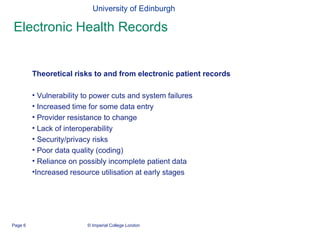
Electronic Health Records Theoretical risks to and from electronic patient records Vulnerability to power cuts and system failures Increased time for some data entry Provider resistance to change Lack of interoperability Security/privacy risks Poor data quality (coding) Reliance on possibly incomplete patient data  Increased resource utilisation at early stages University of Edinburgh
Main over-arching findings Ripe environment for heathcare IT Potential to ameliorate burden of care caused by changing health demographics, proliferation of treatments & rising costs Rising public expectations for service quality and efficiency Rapid advances in IT  European lead in eHealth industry Vast and expanding body of literature is poorly indexed, appraised and ordered Variable quality of evidence + inconsistent outcome measures limit interpretation Vast gap between theoretical and empirically demonstrated benefits Inadequate attention to human and socio-cultural factors
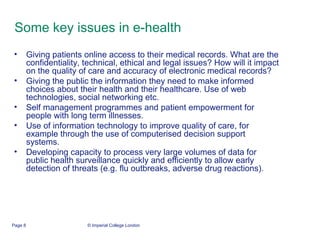
Some key issues in e-health  Giving patients online access to their medical records. What are the confidentiality, technical, ethical and legal issues? How will it impact on the quality of care and accuracy of electronic medical records?  Giving the public the information they need to make informed choices about their health and their healthcare. Use of web technologies, social networking etc.  Self management programmes and patient empowerment for people with long term illnesses.  Use of information technology to improve quality of care, for example through the use of computerised decision support systems.  Developing capacity to process very large volumes of data for public health surveillance quickly and efficiently to allow early detection of threats (e.g. flu outbreaks, adverse drug reactions).

Wealth of Networks

  • 1.
    Professor Azeem MajeedProfessor of Primary Care Faculty of Medicine, Imperial College London, UK. e-health & the digital economy Imperial College London http://www1.imperial.ac.uk/medicine/people/a.majeed/
  • 2.
  • 3.
    Why e-health? Increasingburden of care (e.g. increased life expectancy, long term conditions, range of treatment options) Rising healthcare costs Continuing health systems inefficiencies Variations in quality of care High prevalence of medical errors Greater public scrutiny of government spending Patients and the public want a greater say in decisions about their health & healthcare
  • 4.
    The emergence ofe-health Rapid IT developments across all sectors, but diffusion still relatively limited in health care sector Need to capitalise on potential of IT to increase efficiency, effectiveness and safety But implementation of IT also has potential to introduce new risks & errors associated with technology or users New IT solutions often rapidly introduced, on a large scale, despite limited evidence of effectiveness or safety Many IT innovations remain un(der)studied and evidence of their effectiveness is inconsistent
  • 5.
    Theoretical benefits Example:Electronic patient Records Elimination of pen and paper Minimised storage space Increased legibility “ Searchability” 24/7 access Efficient longitudinal record keeping Supports integrated care Instant health information exchange Interactive recording of information Encourages use of controlled terminology Potential to integrate patient data with evidence and CDSS Supporting clinical governance activities Facilitates electronic record transfer Supports electronic clinical communications e.g. e-Prescribing, results viewing Enables automatic alerting and data collection High level of data security, privacy and confidentiality Facilitates research Increased satisfaction Increased productivity Economy of scale savings
  • 6.
    Electronic Health RecordsTheoretical risks to and from electronic patient records Vulnerability to power cuts and system failures Increased time for some data entry Provider resistance to change Lack of interoperability Security/privacy risks Poor data quality (coding) Reliance on possibly incomplete patient data Increased resource utilisation at early stages University of Edinburgh
  • 7.
    Main over-arching findingsRipe environment for heathcare IT Potential to ameliorate burden of care caused by changing health demographics, proliferation of treatments & rising costs Rising public expectations for service quality and efficiency Rapid advances in IT European lead in eHealth industry Vast and expanding body of literature is poorly indexed, appraised and ordered Variable quality of evidence + inconsistent outcome measures limit interpretation Vast gap between theoretical and empirically demonstrated benefits Inadequate attention to human and socio-cultural factors
  • 8.
    Some key issuesin e-health Giving patients online access to their medical records. What are the confidentiality, technical, ethical and legal issues? How will it impact on the quality of care and accuracy of electronic medical records? Giving the public the information they need to make informed choices about their health and their healthcare. Use of web technologies, social networking etc. Self management programmes and patient empowerment for people with long term illnesses. Use of information technology to improve quality of care, for example through the use of computerised decision support systems. Developing capacity to process very large volumes of data for public health surveillance quickly and efficiently to allow early detection of threats (e.g. flu outbreaks, adverse drug reactions).