Head office: 3nd floor, Krishna Reddy Buildings, OPP: ICICI ATM, Ramalingapuram, Nellore
www.pvrtechnology.com, E-Mail: pvrieeeprojects@gmail.com, Ph: 81432 71457
Reducing Fragmentation for In-line Deduplication
Backup Storage via Exploiting Backup History
And Cache Knowledge
ABSTRACT
In backup systems, the chunks of each backup are physically scattered after
deduplication, which causes a challenging fragmentation problem. We observe that
the fragmentation comes into sparse and out-of-order containers. The sparse
container decreases restore performance and garbage collection efficiency, while
the out-of-order container decreases restore performance if the restore cache is
small. In order to reduce the fragmentation, we propose History-Aware Rewriting
algorithm (HAR) and Cache-Aware Filter (CAF). HAR exploits historical
information in backup systems to accurately identify and reduce sparse containers,
and CAF exploits restore cache knowledge to identify the out-of-order containers
that hurt restore performance. CAF efficiently complements HAR in datasets
where out-of-order containers are dominant. To reduce the metadata overhead of
the garbage collection, we further propose a Container-Marker Algorithm (CMA)
to identify valid containers instead of valid chunks. Our extensive experimental
results from real-world datasets show HAR significantly improves the restore
performance by 2.84-175.36at a cost of only rewriting 0.5-2.03% data
Existing System:
Head office: 3nd floor, Krishna Reddy Buildings, OPP: ICICI ATM, Ramalingapuram, Nellore
www.pvrtechnology.com, E-Mail: pvrieeeprojects@gmail.com, Ph: 81432 71457
In backup systems, the chunks of each backup are physically scattered after
deduplication, which causes a challenging fragmentation problem. We observe that
the fragmentation comes into sparse and out-of-order containers. The sparse
container decreases restore performance and garbage collection efficiency, while
the out-of-order container decreases restore performance if the restore cache is
small. In order to reduce the fragmentation
Proposed System
we propose History-Aware Rewriting algorithm (HAR) and Cache-Aware Filter
(CAF). HAR exploits historical information in backup systems to accurately
identify and reduce sparse containers, and CAF exploits restore cache knowledge
to identify the out-of-order containers that hurt restore performance. CAF
efficiently complements HAR in datasets where out-of-order containers are
dominant. To reduce the metadata overhead of the garbage collection, we further
propose a Container-Marker Algorithm (CMA) to identify valid containers instead
of valid chunks. Our extensive experimental results from real-world datasets show
HAR significantly improves the restore performance by 2.84-175.36at a cost of
only rewriting 0.5-2.03% data.
propose a hybrid rewriting algorithm as complements of HAR to reduce the
negative impacts of out-of-order containers. HAR, as well as OPT, improves
restore performance by 2.84- 175.36 at an acceptable cost in deduplication ratio.
HAR outperforms the state-of-the-art work in terms of both deduplication ratio and
restore performance. The hybrid scheme is helpful to further improve restore
performance in datasets where out-of-order containers are dominant. To avoid a
significant decrease of deduplication ratio in the hybrid scheme, we develop a
Cache-Aware Filter (CAF) to exploit cache knowledge. With the help of CAF, the
hybrid scheme significantly improves the deduplication ratio without decreasing
the restore performance. Note that CAF can be used as an optimization of existing
rewriting algorithms.
Head office: 3nd floor, Krishna Reddy Buildings, OPP: ICICI ATM, Ramalingapuram, Nellore
www.pvrtechnology.com, E-Mail: pvrieeeprojects@gmail.com, Ph: 81432 71457
MODULES
Architecture:
MODULES
 Storage system
 Data Deduplication
 chunk fragmentation,
Head office: 3nd floor, Krishna Reddy Buildings, OPP: ICICI ATM, Ramalingapuram, Nellore
www.pvrtechnology.com, E-Mail: pvrieeeprojects@gmail.com, Ph: 81432 71457
 performance evaluation
Storage system
Cloud storage is a model of data storage where the digital data is stored in
logical pools, the physical storage spans multiple servers (and often locations),
and the physical environment is typically owned and managed by a hosting
company. These cloud storage providers are responsible for keeping the data
available and accessible, and the physical environment protected and running.
People and organizations buy or lease storage capacity from the providers to
store end user, organization, or application data
Data Deduplication
multiple backups, the chunks of a backup unfortunately become physically
scattered in different containers, which is known as fragmentation. The negative
impacts of the fragmentation are two-fold. First, the fragmentation severely
decreases restore performance. The infrequent restore is important and the main
concern from users Moreover, data replication, which is important for disaster
recovery, requires reconstructions of original backup streams from
deduplication systems and thus suffers from a performance problem similar to
the restore operation. Second, the fragmentation results in invalid chunks (not
referenced by any backups) becoming physically scattered in different
Head office: 3nd floor, Krishna Reddy Buildings, OPP: ICICI ATM, Ramalingapuram, Nellore
www.pvrtechnology.com, E-Mail: pvrieeeprojects@gmail.com, Ph: 81432 71457
containers when users delete expired backups. Existing garbage collection
solutions first identify valid chunks and the containers holding only a few valid
chunks (i.e., reference management Then, a merging operation is required to
copy the valid chunks in the identified containers to new containers Finally, the
identified containers are reclaimed. Unfortunately, the metadata space overhead
of reference management is proportional to the number of chunks, and the
merging operation is the most timeconsuming phase in garbage collection We
observe that the fragmentation comes in two categories of containers: sparse
containers and out-of-order containers, which have different negative impacts
and require dedicated solutions.
Chunk fragmentation
The fragmentation problem in deduplication systems has received many
attentions. iDedup eliminates sequential and duplicate chunks in the context of
primary storage systems. Nam et al. propose a quantitative metric to measure the
fragmentation level of deduplication systems , and a selective deduplication
scheme for backup workloads. SAR stores hot chunks in SSD to accelerate
reads. RevDedup employs a hybrid inline and out-of-line deduplication scheme
to improve restore performance of latest backups. The Context-Based Rewriting
algorithm (CBR) [17] and the capping algorithm (Capping) are recently proposed
rewriting algorithms to address the fragmentation problem. Both of them buffer
a small part of the on-going backup stream during a backup, and identify
fragmented chunks within the buffer (generally 10-20 MB). For example,
Capping divides the backup stream into fixed-sized segments (e.g., 20 MB), and
conjectures the fragmentation within each segment. Capping limits the
Head office: 3nd floor, Krishna Reddy Buildings, OPP: ICICI ATM, Ramalingapuram, Nellore
www.pvrtechnology.com, E-Mail: pvrieeeprojects@gmail.com, Ph: 81432 71457
maximum number (say T) of containers a segment can refer to. Suppose a new
segment refers to N containers and N > T, the chunks in the N �T containers that
hold the least chunks in the segment are rewritten. Reference management for
the garbage collection is complicated since each chunk can be referenced by
multiple backups. The offline approaches traverse all fingerprints (including the
fingerprint index and recipes) when the system is idle. For example, Botelho et
al. [14] build a perfect hash vector as a compact representation of all chunks.
Since recipes need to occupy significantly large storage space , the traversing
operation is timeconsuming. The inline approaches maintain additional
metadata during backup to facilitate the garbage collection. Maintaining a
reference counter for each chunk is expensive and error-prone . Grouped Mark-
and- Sweep (GMS) uses a bitmap to mark which chunks in a container are used
by a backup.
performance evaluation
Four datasets, including Kernel, VMDK, RDB, and Synthetic, are used for
evaluation. Their characteristics are listed in Table 1. Each backup stream is
divided into variable-sized chunks via Content-Defined Chunking . Kernel,
downloaded from the web is a commonly used public dataset [. It consists of
258 consecutive versions of unpacked Linux codes. Each version is 412:78 MB on
average. Two consecutive versions are generally 99% identical except when
there are major revision upgrades. There are only a few self-references and
hence sparse containers are dominant. VMDK is from a virtual machine
installed Ubuntu 12.04LTS, which is a common use-case in real-world . We
compiled source code, patched the system, and ran an HTTP server on the
Head office: 3nd floor, Krishna Reddy Buildings, OPP: ICICI ATM, Ramalingapuram, Nellore
www.pvrtechnology.com, E-Mail: pvrieeeprojects@gmail.com, Ph: 81432 71457
virtual machine. VMDK consists of 126 full backups. Each full backup is 15:36
GB in size on average, and 90-98% identical to its adjacent backups. Each backup
contains about 15% self-referred chunks. Out-of-order containers are dominant
and sparse containers are less severe. RDB consists of snapshots of a Redis
database The database has 5 million records, 5 GB in space. We ran YCSB to
update the database in a Zipfian distribution. The update ratio is of 1% on
average. After each run, we archived the uncompressed dump.rdb file that is the
on-disk snapshot of the database. Finally, we got 212 versions of snapshots.
There is no self-reference and hence sparse containers are dominant. Synthetic
was generated according to existing approaches We simulated common
operations of file systems, such as file creation/deletion/modification. We
finally obtained a 4:5 TB dataset with 400 versions. There is no self-reference in
Synthetic and sparse containers are dominant.
History-Aware Rewriting Algorithm
Head office: 3nd floor, Krishna Reddy Buildings, OPP: ICICI ATM, Ramalingapuram, Nellore
www.pvrtechnology.com, E-Mail: pvrieeeprojects@gmail.com, Ph: 81432 71457
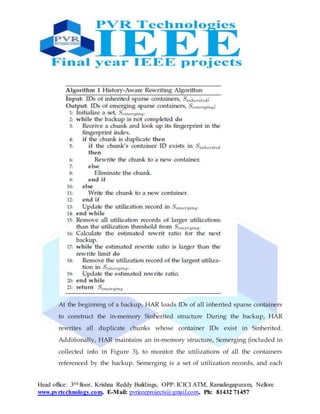
At the beginning of a backup, HAR loads IDs of all inherited sparse containers
to construct the in-memory Sinherited structure During the backup, HAR
rewrites all duplicate chunks whose container IDs exist in Sinherited.
Additionally, HAR maintains an in-memory structure, Semerging (included in
collected info in Figure 3), to monitor the utilizations of all the containers
referenced by the backup. Semerging is a set of utilization records, and each
Head office: 3nd floor, Krishna Reddy Buildings, OPP: ICICI ATM, Ramalingapuram, Nellore
www.pvrtechnology.com, E-Mail: pvrieeeprojects@gmail.com, Ph: 81432 71457
record consists of a container ID and the current utilization of the container.
After the backup concludes, HAR removes the records of higher utilizations
than the utilization threshold from Semerging. Semerging then contains IDs of
all emerging sparse containers. In most cases, Semerging can be flushed directly
to disks as the Sinherited of the next backup, because the size of Semerging is
generally small due to our second observation. However, there are two spikes in
. A large number of emerging sparse containers indicates that we have many
fragmented chunks to be rewritten in next backup. It would change the
performance bottleneck to data writing and hurt the backup performance that is
of top priority . To address this problem, HAR sets a rewrite limit, such as 5%, to
avoid too much rewrites in next backup. HAR uses the rewrite limit to
determine whether there are too many sparse containers in Semerging. (1) HAR
calculates an estimated rewrite ratio (defined as the size of rewritten data
divided by the backup size) for the next backup. Specifically, HAR first
calculates the
System Configuration:
HARDWARE REQUIREMENTS:
Hardware - Pentium
Speed - 1.1 GHz
RAM - 1GB
Head office: 3nd floor, Krishna Reddy Buildings, OPP: ICICI ATM, Ramalingapuram, Nellore
www.pvrtechnology.com, E-Mail: pvrieeeprojects@gmail.com, Ph: 81432 71457
Hard Disk - 20 GB
Floppy Drive - 1.44 MB
Key Board - Standard Windows Keyboard
Mouse - Two or Three Button Mouse
Monitor - SVGA
SOFTWARE REQUIREMENTS:
Operating System : Windows
Technology : Java and J2EE
Web Technologies : Html, JavaScript, CSS
IDE : My Eclipse
Web Server : Tomcat
Tool kit : Android Phone
Database : My SQL
Java Version : J2SDK1.5

Reducing fragmentation for in line deduplication

  • 1.
    Head office: 3ndfloor, Krishna Reddy Buildings, OPP: ICICI ATM, Ramalingapuram, Nellore www.pvrtechnology.com, E-Mail: pvrieeeprojects@gmail.com, Ph: 81432 71457 Reducing Fragmentation for In-line Deduplication Backup Storage via Exploiting Backup History And Cache Knowledge ABSTRACT In backup systems, the chunks of each backup are physically scattered after deduplication, which causes a challenging fragmentation problem. We observe that the fragmentation comes into sparse and out-of-order containers. The sparse container decreases restore performance and garbage collection efficiency, while the out-of-order container decreases restore performance if the restore cache is small. In order to reduce the fragmentation, we propose History-Aware Rewriting algorithm (HAR) and Cache-Aware Filter (CAF). HAR exploits historical information in backup systems to accurately identify and reduce sparse containers, and CAF exploits restore cache knowledge to identify the out-of-order containers that hurt restore performance. CAF efficiently complements HAR in datasets where out-of-order containers are dominant. To reduce the metadata overhead of the garbage collection, we further propose a Container-Marker Algorithm (CMA) to identify valid containers instead of valid chunks. Our extensive experimental results from real-world datasets show HAR significantly improves the restore performance by 2.84-175.36at a cost of only rewriting 0.5-2.03% data Existing System:
  • 2.
    Head office: 3ndfloor, Krishna Reddy Buildings, OPP: ICICI ATM, Ramalingapuram, Nellore www.pvrtechnology.com, E-Mail: pvrieeeprojects@gmail.com, Ph: 81432 71457 In backup systems, the chunks of each backup are physically scattered after deduplication, which causes a challenging fragmentation problem. We observe that the fragmentation comes into sparse and out-of-order containers. The sparse container decreases restore performance and garbage collection efficiency, while the out-of-order container decreases restore performance if the restore cache is small. In order to reduce the fragmentation Proposed System we propose History-Aware Rewriting algorithm (HAR) and Cache-Aware Filter (CAF). HAR exploits historical information in backup systems to accurately identify and reduce sparse containers, and CAF exploits restore cache knowledge to identify the out-of-order containers that hurt restore performance. CAF efficiently complements HAR in datasets where out-of-order containers are dominant. To reduce the metadata overhead of the garbage collection, we further propose a Container-Marker Algorithm (CMA) to identify valid containers instead of valid chunks. Our extensive experimental results from real-world datasets show HAR significantly improves the restore performance by 2.84-175.36at a cost of only rewriting 0.5-2.03% data. propose a hybrid rewriting algorithm as complements of HAR to reduce the negative impacts of out-of-order containers. HAR, as well as OPT, improves restore performance by 2.84- 175.36 at an acceptable cost in deduplication ratio. HAR outperforms the state-of-the-art work in terms of both deduplication ratio and restore performance. The hybrid scheme is helpful to further improve restore performance in datasets where out-of-order containers are dominant. To avoid a significant decrease of deduplication ratio in the hybrid scheme, we develop a Cache-Aware Filter (CAF) to exploit cache knowledge. With the help of CAF, the hybrid scheme significantly improves the deduplication ratio without decreasing the restore performance. Note that CAF can be used as an optimization of existing rewriting algorithms.
  • 3.
    Head office: 3ndfloor, Krishna Reddy Buildings, OPP: ICICI ATM, Ramalingapuram, Nellore www.pvrtechnology.com, E-Mail: pvrieeeprojects@gmail.com, Ph: 81432 71457 MODULES Architecture: MODULES  Storage system  Data Deduplication  chunk fragmentation,
  • 4.
    Head office: 3ndfloor, Krishna Reddy Buildings, OPP: ICICI ATM, Ramalingapuram, Nellore www.pvrtechnology.com, E-Mail: pvrieeeprojects@gmail.com, Ph: 81432 71457  performance evaluation Storage system Cloud storage is a model of data storage where the digital data is stored in logical pools, the physical storage spans multiple servers (and often locations), and the physical environment is typically owned and managed by a hosting company. These cloud storage providers are responsible for keeping the data available and accessible, and the physical environment protected and running. People and organizations buy or lease storage capacity from the providers to store end user, organization, or application data Data Deduplication multiple backups, the chunks of a backup unfortunately become physically scattered in different containers, which is known as fragmentation. The negative impacts of the fragmentation are two-fold. First, the fragmentation severely decreases restore performance. The infrequent restore is important and the main concern from users Moreover, data replication, which is important for disaster recovery, requires reconstructions of original backup streams from deduplication systems and thus suffers from a performance problem similar to the restore operation. Second, the fragmentation results in invalid chunks (not referenced by any backups) becoming physically scattered in different
  • 5.
    Head office: 3ndfloor, Krishna Reddy Buildings, OPP: ICICI ATM, Ramalingapuram, Nellore www.pvrtechnology.com, E-Mail: pvrieeeprojects@gmail.com, Ph: 81432 71457 containers when users delete expired backups. Existing garbage collection solutions first identify valid chunks and the containers holding only a few valid chunks (i.e., reference management Then, a merging operation is required to copy the valid chunks in the identified containers to new containers Finally, the identified containers are reclaimed. Unfortunately, the metadata space overhead of reference management is proportional to the number of chunks, and the merging operation is the most timeconsuming phase in garbage collection We observe that the fragmentation comes in two categories of containers: sparse containers and out-of-order containers, which have different negative impacts and require dedicated solutions. Chunk fragmentation The fragmentation problem in deduplication systems has received many attentions. iDedup eliminates sequential and duplicate chunks in the context of primary storage systems. Nam et al. propose a quantitative metric to measure the fragmentation level of deduplication systems , and a selective deduplication scheme for backup workloads. SAR stores hot chunks in SSD to accelerate reads. RevDedup employs a hybrid inline and out-of-line deduplication scheme to improve restore performance of latest backups. The Context-Based Rewriting algorithm (CBR) [17] and the capping algorithm (Capping) are recently proposed rewriting algorithms to address the fragmentation problem. Both of them buffer a small part of the on-going backup stream during a backup, and identify fragmented chunks within the buffer (generally 10-20 MB). For example, Capping divides the backup stream into fixed-sized segments (e.g., 20 MB), and conjectures the fragmentation within each segment. Capping limits the
  • 6.
    Head office: 3ndfloor, Krishna Reddy Buildings, OPP: ICICI ATM, Ramalingapuram, Nellore www.pvrtechnology.com, E-Mail: pvrieeeprojects@gmail.com, Ph: 81432 71457 maximum number (say T) of containers a segment can refer to. Suppose a new segment refers to N containers and N > T, the chunks in the N �T containers that hold the least chunks in the segment are rewritten. Reference management for the garbage collection is complicated since each chunk can be referenced by multiple backups. The offline approaches traverse all fingerprints (including the fingerprint index and recipes) when the system is idle. For example, Botelho et al. [14] build a perfect hash vector as a compact representation of all chunks. Since recipes need to occupy significantly large storage space , the traversing operation is timeconsuming. The inline approaches maintain additional metadata during backup to facilitate the garbage collection. Maintaining a reference counter for each chunk is expensive and error-prone . Grouped Mark- and- Sweep (GMS) uses a bitmap to mark which chunks in a container are used by a backup. performance evaluation Four datasets, including Kernel, VMDK, RDB, and Synthetic, are used for evaluation. Their characteristics are listed in Table 1. Each backup stream is divided into variable-sized chunks via Content-Defined Chunking . Kernel, downloaded from the web is a commonly used public dataset [. It consists of 258 consecutive versions of unpacked Linux codes. Each version is 412:78 MB on average. Two consecutive versions are generally 99% identical except when there are major revision upgrades. There are only a few self-references and hence sparse containers are dominant. VMDK is from a virtual machine installed Ubuntu 12.04LTS, which is a common use-case in real-world . We compiled source code, patched the system, and ran an HTTP server on the
  • 7.
    Head office: 3ndfloor, Krishna Reddy Buildings, OPP: ICICI ATM, Ramalingapuram, Nellore www.pvrtechnology.com, E-Mail: pvrieeeprojects@gmail.com, Ph: 81432 71457 virtual machine. VMDK consists of 126 full backups. Each full backup is 15:36 GB in size on average, and 90-98% identical to its adjacent backups. Each backup contains about 15% self-referred chunks. Out-of-order containers are dominant and sparse containers are less severe. RDB consists of snapshots of a Redis database The database has 5 million records, 5 GB in space. We ran YCSB to update the database in a Zipfian distribution. The update ratio is of 1% on average. After each run, we archived the uncompressed dump.rdb file that is the on-disk snapshot of the database. Finally, we got 212 versions of snapshots. There is no self-reference and hence sparse containers are dominant. Synthetic was generated according to existing approaches We simulated common operations of file systems, such as file creation/deletion/modification. We finally obtained a 4:5 TB dataset with 400 versions. There is no self-reference in Synthetic and sparse containers are dominant. History-Aware Rewriting Algorithm
  • 8.
    Head office: 3ndfloor, Krishna Reddy Buildings, OPP: ICICI ATM, Ramalingapuram, Nellore www.pvrtechnology.com, E-Mail: pvrieeeprojects@gmail.com, Ph: 81432 71457 At the beginning of a backup, HAR loads IDs of all inherited sparse containers to construct the in-memory Sinherited structure During the backup, HAR rewrites all duplicate chunks whose container IDs exist in Sinherited. Additionally, HAR maintains an in-memory structure, Semerging (included in collected info in Figure 3), to monitor the utilizations of all the containers referenced by the backup. Semerging is a set of utilization records, and each
  • 9.
    Head office: 3ndfloor, Krishna Reddy Buildings, OPP: ICICI ATM, Ramalingapuram, Nellore www.pvrtechnology.com, E-Mail: pvrieeeprojects@gmail.com, Ph: 81432 71457 record consists of a container ID and the current utilization of the container. After the backup concludes, HAR removes the records of higher utilizations than the utilization threshold from Semerging. Semerging then contains IDs of all emerging sparse containers. In most cases, Semerging can be flushed directly to disks as the Sinherited of the next backup, because the size of Semerging is generally small due to our second observation. However, there are two spikes in . A large number of emerging sparse containers indicates that we have many fragmented chunks to be rewritten in next backup. It would change the performance bottleneck to data writing and hurt the backup performance that is of top priority . To address this problem, HAR sets a rewrite limit, such as 5%, to avoid too much rewrites in next backup. HAR uses the rewrite limit to determine whether there are too many sparse containers in Semerging. (1) HAR calculates an estimated rewrite ratio (defined as the size of rewritten data divided by the backup size) for the next backup. Specifically, HAR first calculates the System Configuration: HARDWARE REQUIREMENTS: Hardware - Pentium Speed - 1.1 GHz RAM - 1GB
  • 10.
    Head office: 3ndfloor, Krishna Reddy Buildings, OPP: ICICI ATM, Ramalingapuram, Nellore www.pvrtechnology.com, E-Mail: pvrieeeprojects@gmail.com, Ph: 81432 71457 Hard Disk - 20 GB Floppy Drive - 1.44 MB Key Board - Standard Windows Keyboard Mouse - Two or Three Button Mouse Monitor - SVGA SOFTWARE REQUIREMENTS: Operating System : Windows Technology : Java and J2EE Web Technologies : Html, JavaScript, CSS IDE : My Eclipse Web Server : Tomcat Tool kit : Android Phone Database : My SQL Java Version : J2SDK1.5