Head office: 3nd floor, Krishna Reddy Buildings, OPP: ICICI ATM, Ramalingapuram,Nellore
www.pvrtechnology.com, E-Mail: pvrieeeprojects@gmail.com, Ph: 81432 71457
Power-Controlled Medium Access Control
Protocol for Full-Duplex WiFi Networks
Abstract
Recent advances in signal processing have demonstrated in-band full-duplex capability at
WiFi ranges. In addition to simultaneous two-way exchange between two nodes, full-duplex
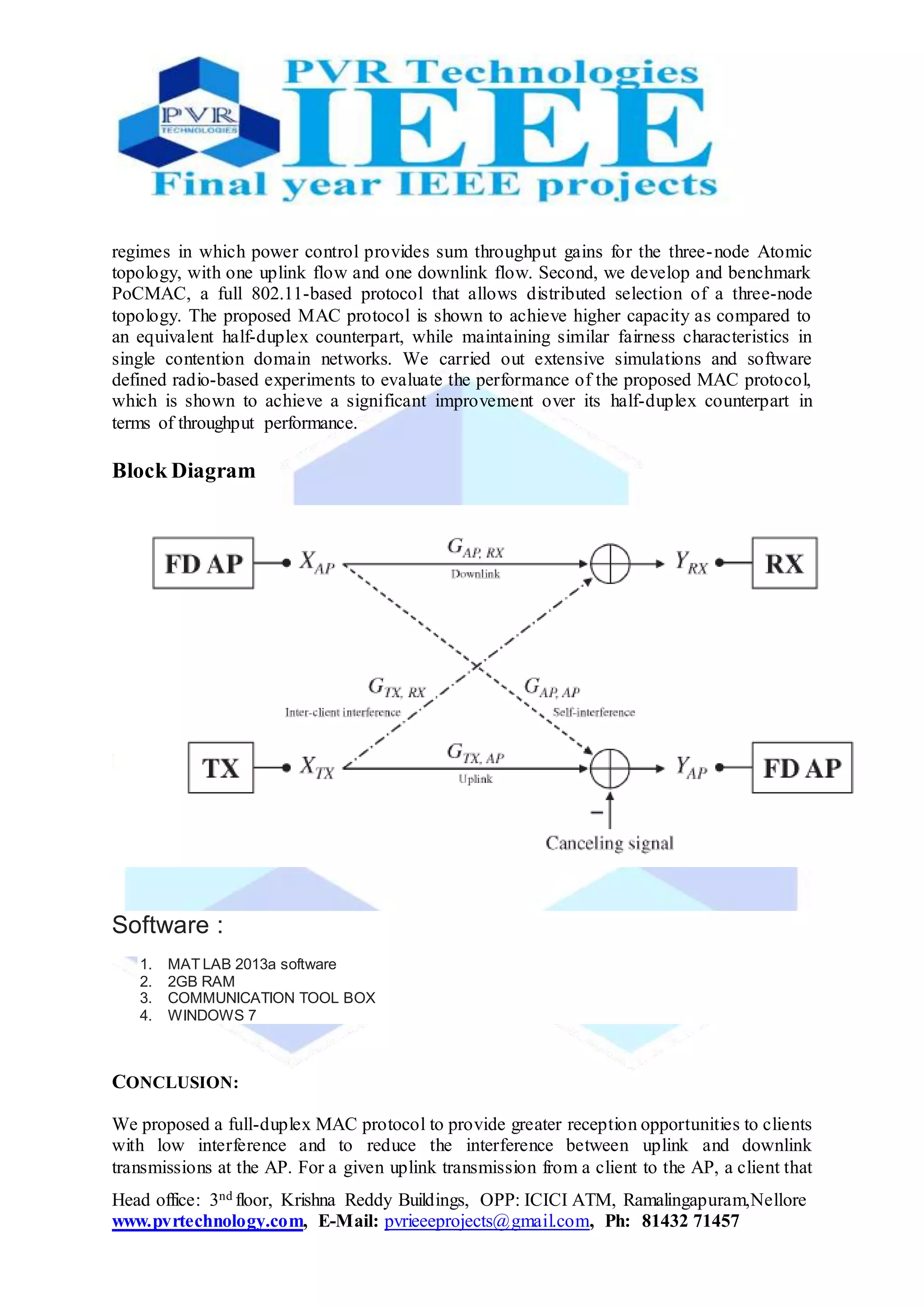
access points can potentially support simultaneous uplink and downlink flows. However, the
atomic three-node topology, which allows simultaneous uplink and downlink, leads to inter-
client interference. In this paper, we propose a random-access medium access control
protocol using distributed power control to manage inter-client interference in wireless
networks with full-duplexcapable access points that serve half-duplex clients. Our key
contributions are two-fold. First, we identify the regimes in which power control provides
sum throughput gains for the three-node Atomictopology, with one uplink flow and one
downlink flow. Second, we develop and benchmark PoCMAC, a full 802.11-based protocol
that allows distributed selection of a three-node topology. The proposed MAC protocol is
shown to achieve higher capacity as compared to an equivalent half-duplex counterpart,
while maintaining similar fairness characteristics in single contention domain networks. We
carried out extensive simulations and software defined radio-based experiments to evaluate
the performance of the proposed MAC protocol, which is shown to achieve a significant
improvement over its half-duplex counterpart in terms of throughput performance.
Index Terms: Full-duplex, power control, MAC protocol, wireless network.
Existing System:
Recent advances in signal processing have demonstrated in-band full-duplex capability at
WiFi ranges. In addition to simultaneous two-way exchange between two nodes, full-duplex
access points can potentially support simultaneous uplink and downlink flows. However, the
atomic three-node topology, which allows simultaneous uplink and downlink, leads to inter-
client interference.
ProposedSystem:
we propose a random-access medium access control protocol using distributed power control
to manage inter-client interference in wireless networks with full-duplexcapable access points
that serve half-duplex clients. Our key contributions are two-fold. First, we identify the
Head office: 3nd floor, Krishna Reddy Buildings, OPP: ICICI ATM, Ramalingapuram,Nellore
www.pvrtechnology.com, E-Mail: pvrieeeprojects@gmail.com, Ph: 81432 71457
regimes in which power control provides sum throughput gains for the three-node Atomic
topology, with one uplink flow and one downlink flow. Second, we develop and benchmark
PoCMAC, a full 802.11-based protocol that allows distributed selection of a three-node
topology. The proposed MAC protocol is shown to achieve higher capacity as compared to
an equivalent half-duplex counterpart, while maintaining similar fairness characteristics in
single contention domain networks. We carried out extensive simulations and software
defined radio-based experiments to evaluate the performance of the proposed MAC protocol,
which is shown to achieve a significant improvement over its half-duplex counterpart in
terms of throughput performance.
Block Diagram
Software :
1. MAT LAB 2013a software
2. 2GB RAM
3. COMMUNICATION TOOL BOX
4. WINDOWS 7
CONCLUSION:
We proposed a full-duplex MAC protocol to provide greater reception opportunities to clients
with low interference and to reduce the interference between uplink and downlink
transmissions at the AP. For a given uplink transmission from a client to the AP, a client that
Head office: 3nd floor, Krishna Reddy Buildings, OPP: ICICI ATM, Ramalingapuram,Nellore
www.pvrtechnology.com, E-Mail: pvrieeeprojects@gmail.com, Ph: 81432 71457
can achieve high SINR in spite of the simultaneous uplink transmission may have a greater
chance of being selected as the downlink client under the proposed RSSB contention
mechanism. To maximize the uplink and downlink SINRs, an optimization problem was
formulated the optimal solution of which determines the transmit power of the AP and the
uplink client. We defined control frames and header structures to implement our protocol,
PoCMAC. The performance of PoCMAC was evaluated under various simulation
configurations with regard to the SINR, throughput, and fairness. In addition, SDR-based
experiments with WARP were performed in a real wireless communication environment. The
simulation and experiment results confirmed the excellentperformance of PoCMAC.

Power controlled medium access control

  • 1.
    Head office: 3ndfloor, Krishna Reddy Buildings, OPP: ICICI ATM, Ramalingapuram,Nellore www.pvrtechnology.com, E-Mail: pvrieeeprojects@gmail.com, Ph: 81432 71457 Power-Controlled Medium Access Control Protocol for Full-Duplex WiFi Networks Abstract Recent advances in signal processing have demonstrated in-band full-duplex capability at WiFi ranges. In addition to simultaneous two-way exchange between two nodes, full-duplex access points can potentially support simultaneous uplink and downlink flows. However, the atomic three-node topology, which allows simultaneous uplink and downlink, leads to inter- client interference. In this paper, we propose a random-access medium access control protocol using distributed power control to manage inter-client interference in wireless networks with full-duplexcapable access points that serve half-duplex clients. Our key contributions are two-fold. First, we identify the regimes in which power control provides sum throughput gains for the three-node Atomictopology, with one uplink flow and one downlink flow. Second, we develop and benchmark PoCMAC, a full 802.11-based protocol that allows distributed selection of a three-node topology. The proposed MAC protocol is shown to achieve higher capacity as compared to an equivalent half-duplex counterpart, while maintaining similar fairness characteristics in single contention domain networks. We carried out extensive simulations and software defined radio-based experiments to evaluate the performance of the proposed MAC protocol, which is shown to achieve a significant improvement over its half-duplex counterpart in terms of throughput performance. Index Terms: Full-duplex, power control, MAC protocol, wireless network. Existing System: Recent advances in signal processing have demonstrated in-band full-duplex capability at WiFi ranges. In addition to simultaneous two-way exchange between two nodes, full-duplex access points can potentially support simultaneous uplink and downlink flows. However, the atomic three-node topology, which allows simultaneous uplink and downlink, leads to inter- client interference. ProposedSystem: we propose a random-access medium access control protocol using distributed power control to manage inter-client interference in wireless networks with full-duplexcapable access points that serve half-duplex clients. Our key contributions are two-fold. First, we identify the
  • 2.
    Head office: 3ndfloor, Krishna Reddy Buildings, OPP: ICICI ATM, Ramalingapuram,Nellore www.pvrtechnology.com, E-Mail: pvrieeeprojects@gmail.com, Ph: 81432 71457 regimes in which power control provides sum throughput gains for the three-node Atomic topology, with one uplink flow and one downlink flow. Second, we develop and benchmark PoCMAC, a full 802.11-based protocol that allows distributed selection of a three-node topology. The proposed MAC protocol is shown to achieve higher capacity as compared to an equivalent half-duplex counterpart, while maintaining similar fairness characteristics in single contention domain networks. We carried out extensive simulations and software defined radio-based experiments to evaluate the performance of the proposed MAC protocol, which is shown to achieve a significant improvement over its half-duplex counterpart in terms of throughput performance. Block Diagram Software : 1. MAT LAB 2013a software 2. 2GB RAM 3. COMMUNICATION TOOL BOX 4. WINDOWS 7 CONCLUSION: We proposed a full-duplex MAC protocol to provide greater reception opportunities to clients with low interference and to reduce the interference between uplink and downlink transmissions at the AP. For a given uplink transmission from a client to the AP, a client that
  • 3.
    Head office: 3ndfloor, Krishna Reddy Buildings, OPP: ICICI ATM, Ramalingapuram,Nellore www.pvrtechnology.com, E-Mail: pvrieeeprojects@gmail.com, Ph: 81432 71457 can achieve high SINR in spite of the simultaneous uplink transmission may have a greater chance of being selected as the downlink client under the proposed RSSB contention mechanism. To maximize the uplink and downlink SINRs, an optimization problem was formulated the optimal solution of which determines the transmit power of the AP and the uplink client. We defined control frames and header structures to implement our protocol, PoCMAC. The performance of PoCMAC was evaluated under various simulation configurations with regard to the SINR, throughput, and fairness. In addition, SDR-based experiments with WARP were performed in a real wireless communication environment. The simulation and experiment results confirmed the excellentperformance of PoCMAC.