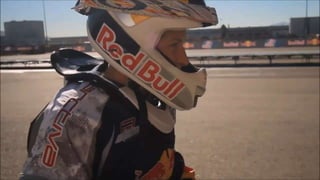
Red Bullis an energy drink sold by Austrian company Red Bull GmbH, created in
1987. Red Bull has the highest market share of any energy drink in the world, with
5.387 billion cans sold in 2013.
Austrian entrepreneur Dietrich Mateschitz was inspired by an existing energy drink
named Krating Daeng, which was first introduced and sold in Thailand by Chaleo
Yoovidhya. He took this idea, modified the ingredients to suit the tastes of Westerners
and, in partnership with Chaleo, founded Red Bull GmbH in 1987 in Chakkapong, Thailand
Energy drinks have been associated with health risks, such as masking the effects of
intoxication when consumed with alcohol, and excessive or repeated consumption can
lead to cardiac and psychiatric conditions.
However, the European Food Safety Authority (EFSA) concluded that an adequate
consumption of Red Bull is safe and that the amount of caffeine in standard Red Bull cans
is unlikely to interact adversely with other typical constituents of energy drinks or with
alcohol.
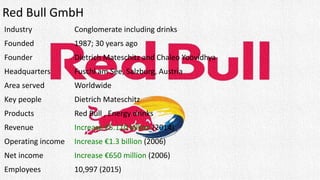
Red Bull GmbH
Industry Conglomerate including drinks
Founded 1987; 30 years ago
Founder Dietrich Mateschitz and Chaleo Yoovidhya
Headquarters Fuschl am See, Salzburg, Austria
Area served Worldwide
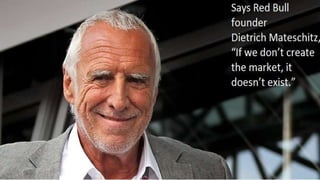
Key people Dietrich Mateschitz
Products Red Bull , Energy drinks
Revenue Increase €5.110 billion (2014)
Operating income Increase €1.3 billion (2006)
Net income Increase €650 million (2006)
Employees 10,997 (2015)
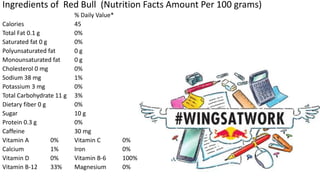
Ingredients of Red Bull (Nutrition Facts Amount Per 100 grams)
% Daily Value*
Calories 45
Total Fat 0.1 g 0%
Saturated fat 0 g 0%
Polyunsaturated fat 0 g
Monounsaturated fat 0 g
Cholesterol 0 mg 0%
Sodium 38 mg 1%
Potassium 3 mg 0%
Total Carbohydrate 11 g 3%
Dietary fiber 0 g 0%
Sugar 10 g
Protein 0.3 g 0%
Caffeine 30 mg
Vitamin A 0% Vitamin C 0%
Calcium 1% Iron 0%
Vitamin D 0% Vitamin B-6 100%
Vitamin B-12 33% Magnesium 0%
The Secret
Mateschitz’s secret to creating a $1.6 billion worldwide stampede for Red Bull lies in a highly
ingenious “buzz-marketing” strategy that herds consumers to exclusive and exciting events tha
high media coverage. Red Bull supports close to 500 world-class extreme sports athletes that
compete in spectacular and often record-breaking events across the globe. Mateschitz explains
“We don’t bring the product to the consumer, we bring consumers to the product.”
The IDEA!
In the summer of 1982 Mateschitz read a story about the top 10 taxpayers in Japan.
He was surprised that a certain Mr. Taisho, who had introduced a high-energy drink to
Japan, made the top of the list.
On the next stop of his sales trip – in Thailand – he learned from a local toothpaste
distributor that energy drinks were a hot item among tired drivers stopping at gas
stations
Besides water, sugar and caffeine (equivalent to that in a cup of coffee), this drink
contains an ingredient named taurine, an amino acid that, according to Japanese
studies, benefits the cardiovascular system
The Bull Fights for Business Survival
The Austrian bureaucracy didn’t allow the drink to be sold without scientific tests.
It took three years and many sales calls to get a license to sell the product.
Meantime, Mateschitz asked his old school friend Johannes Kastner, who ran an advertising agency in
Frankfurt, Germany, to design the can and logo. Kastner worked diligently on a snappy slogan, but
Mateschitz rejected one after the other, each time saying, “Not good enough.” Kastner told Mateschitz to
find someone else to come up with a better slogan, but Mateschitz pleaded, “Sleep on it, and give me
one more tag line.” The next morning Kastner called and said, “Red Bull – gives you wings.” also settling
on a macho logo with two red bulls charging each other
Mateschitz still had to find a bottler to produce his drink. Every bottler he called told him that Red Bull
had no chance of success. Finally, Mateschitz found a sympathetic ear in Roman Rauch, the leading soft-
drink bottler in Austria, and soon the shiny silver cans rolled off the production line.
Within two years, and after many creative promotions, sales began to grow, but so did his losses. While a
million-dollar loss in two years may scare an entrepreneur into closing the business, Mateschitz was
undaunted.
He says, “As long as I can think clearly, I can think of alternatives. All you need is bright eyes and a clear
mind.” After he spent his life savings on the startup, Mateschitz financed everything without outside
capital, and by 1990 Red Bull was in the black.
He soon realized that Austria wasn’t a big enough market, and in 1993 he expanded to neighbouring
Hungary and then focused his energies on conquering the German market.
Once the news of Red Bull’s advancing sales spread in Europe, dozens of copycat competitors came on the
market. Red Bull’s initial move into the German market was highly successful. After three months of
skyrocketing demand, Mateschitz could not get enough aluminum to produce the cans anywhere in
Europe
A competitor named Flying Horse became the market leader. It took Red Bull four years to reclaim the top
spot in the German market.
The expansion to England proved to be even more challenging. The British marketing team was unable to
use the term “energy drink,” since a pharmaceutical company owned that label. That forced Red Bull to
use the term “stimulation” as a tag line to the logo. In two short years, Red Bull’s English operation was
$12 million in the red, with only 2 million cans sold. Mateschitz fired the entire staff, pulled the product
from pubs, and appointed an Austrian marketing director who concentrated on night clubs and the
student market.
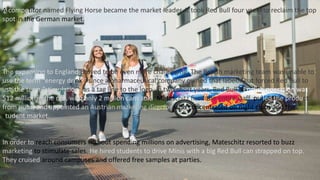
In order to reach consumers without spending millions on advertising, Mateschitz resorted to buzz
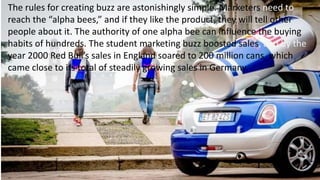
marketing to stimulate sales. He hired students to drive Minis with a big Red Bull can strapped on top.
They cruised around campuses and offered free samples at parties.
The rules for creating buzz are astonishingly simple. Marketers need to
reach the “alpha bees,” and if they like the product, they will tell other
people about it. The authority of one alpha bee can influence the buying
habits of hundreds. The student marketing buzz boosted sales, and by the
year 2000 Red Bull’s sales in England soared to 200 million cans, which
came close to its total of steadily growing sales in Germany.
Mateschitz thrives on resistance. Always eager to push the envelope, he’s hatched spectacular new
marketing ideas that get consumers to flock to events where extreme sports athletes perform stunning
acts that leave audiences gasping for air
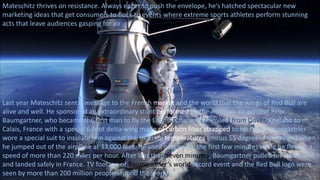
Last year Mateschitz sent a message to the French market and the world that the wings of Red Bull are
alive and well. He sponsored an extraordinary stunt performed by the Austrian air acrobat Felix
Baumgartner, who became the first man to fly the English Channel (22 miles) from Dover, England to
Calais, France with a special 6-foot delta-wing made of carbon fiber strapped to his back. Baumgartner
wore a special suit to insulate him against the freezing temperatures (minus 55 degrees Fahrenheit) when
he jumped out of the airplane at 33,000 feet. He used oxygen for the first few minutes while he flew at a
speed of more than 220 miles per hour. After less than seven minutes, Baumgartner pulled his parachute
and landed safely in France. TV footage of Baumgartner’s world record event and the Red Bull logo were
seen by more than 200 million people around the world.
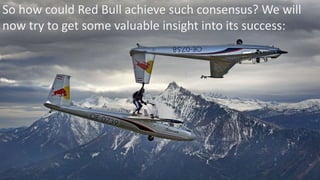
So how could Red Bull achieve such consensus? We will
now try to get some valuable insight into its success:
Phase 1
Initiation:
Initially, the urge to implement change within an organization is
recognized by a group of empowered stakeholders. These stakeholders must guide
the process of change, fully accepting and embodying the culture they wish to
achieve; from top management, the rest of the organization will follow. Dietrich
Mateschitz, founder and CEO of Red Bull, is the personification of this phase as he
is the Red Bull brand.
He recognized the threat of not having a ‘story’ and customer
experience around Red Bull and ensured that his freewheeling spirit disseminated
across the entire organization.
Mateschitz had a specific vision and fully
dedicated the company to it, resulting in Red Bull’s
current success.
Phase 2
Reconstitution:
The second phase consists of demarcation by being
transparent of future plans. After the market-orientation strategy becomes public,
the effort turns to value and norm development, reconnecting with the market,
hiring believers rather than dissenters, and developing a collaborative strategy.
Red Bull is a brand that is constantly changing and
improving. In addition to a high level of professionalism, the company employs
people who are passionate and able to raise the bar of excellence.
`
As a result, the reconstitution stage creates the culture,
understanding, and processes that lead to the
organization’s speedy responsiveness to the
target market.
Phase 3
Institutionalization:
Organizations must now normalize the informal market-
oriented manner into its official culture and organizational behavior, so that it can
implement the market-orientation concept inside out.
Red Bull’s famous tagline “Red Bull gives you wings,” not only
implies its external image of helping customers achieve better performance, but
also formalizes the core ethos of thrill-seeking experiences and adventure into its
own culture.
Phase 4
Maintenance:
The final stage requires continuous market connections and
upkeep of the market-oriented strategy. Red Bull continuously engages in renewing
and reminding the market of their culture.
They are constantly conducting cultural maintenance rituals
that include, employee screening and new hires that share the same spirit, field
visits with the Red Bull cars, and the sponsorship of new sporting events and
athletes.
Red Bull creates continuous customer experiences and the
sponsored activities associated with the brand continue to grow each year.
For example, the Red Bull Stratos (jump back to earth) event in 2012,
really reminded the world that Red Bull does indeed
Give You Wings.
• In the old days, Red Bull was known for its monster hits, like “Felix Baumgartner’s supersonic
freefall from 128k” The Red Bull Stratos space diving project, which took place on Oct. 14,
2012, was viewed live by over 9.5 million users, setting a record for the live stream with the
most concurrent views ever on YouTube.
• At time of writing, that YouTube video has 41.2 million views, and 240,000 engagements,
according to Tubular Labs. So, one might mistakenly think that Red Bull’s current video
marketing strategy is built around creating similar hero content or tent-pole events on
YouTube. But, if you take a close look at the Tubular’s monthly rankings of the most watched
brands across platforms, then you’ll see that Red Bull has ranked #1 in nine of the past 12
months. And in the other three months, February, March, and April 2016, when LEGO ranked
#1, Red Bull ranked #2.
• In other words, Red Bull’s successful video marketing strategy appears to be built on creating
hub content month in and month out that gets a ton of views. Yes, some months dip to as few
as 131 million views and other months jump to as much as 310 million views. But, Red Bull has
generated more than 2.5 billion views – and 50.2 million engagements – in the last 365 days.
That’s the equivalent of making more than 60 space jumps a year – without a parachute!
• That’s what I mean about dramatically changing what everyone thought a successful video
marketing strategy looked like. Red Bull has moved from making occasional “hits” to
producing an ongoing stream of videos that get lots of views – and engagements – day in and
day out.
• According to Tubular Labs, Red Bull has uploaded 4,331 videos to 23 accounts in the last 365
days. On average, these videos get 524,000 views in their first 30 days
The LIFE and WORK
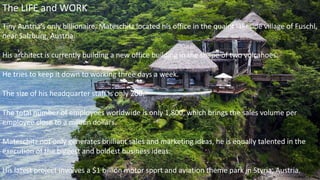
Tiny Austria’s only billionaire, Mateschitz located his office in the quaint lakeside village of Fuschl,
near Salzburg, Austria.
His architect is currently building a new office building in the shape of two volcanoes.
He tries to keep it down to working three days a week.
The size of his headquarter staff is only 200.
The total number of employees worldwide is only 1,800, which brings the sales volume per
employee close to a million dollars.
Mateschitz not only generates brilliant sales and marketing ideas, he is equally talented in the
execution of the biggest and boldest business ideas.
His latest project involves a $1 billion motor sport and aviation theme park in Styria, Austria.
A few years before he launched Red Bull, Mateschitz developed a passion for flying. Once his company
turned substantial profits, he funneled the excess cash into a superb collection of vintage aircraft. In 2000
he created a Red Bull subsidiary, named it Flying Bulls and purchased and restored such planes as two
Corsair fighter-bombers, a twin-engine DC-6 that belonged to former Yugoslav Communist ruler Tito, a T-
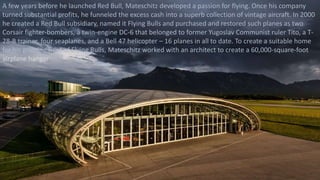
28-B trainer, four seaplanes, and a Bell 47 helicopter – 16 planes in all to date. To create a suitable home
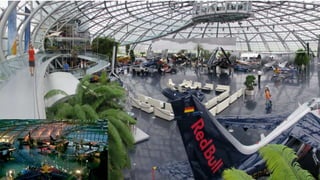
for his growing fleet of Flying Bulls, Mateschitz worked with an architect to create a 60,000-square-foot
airplane hangar
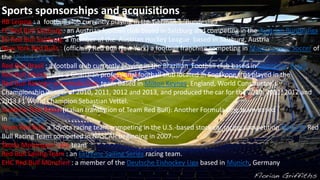
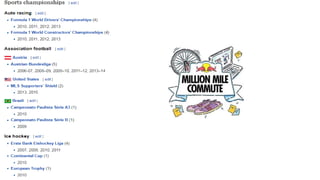
Sports sponsorships and acquisitions
RB Leipzig : a football club currently playing in the German 1. Bundesliga
FC Red Bull Salzburg : an Austrian football club based in Salzburg and competing in the Austrian Bundesliga
EC Red Bull Salzburg: a member of the Austrian Hockey League based in Salzburg, Austria
New York Red Bulls : (officially Red Bull New York) a football franchise competing in Major League Soccer of
the United States
Red Bull Brasil : a football club currently playing in the Brazilian Football club based in Campinas, Brazil
Red Bull Ghana : was a Ghanaian professional football club located in Sogakope that played in the
Red Bull Racing—a Formula One team based in Milton Keynes, England, World Constructor's
Championship winner of 2010, 2011, 2012 and 2013, and produced the car for the 2010, 2011, 2012 and
2013 F1 World Champion Sebastian Vettel.
Scuderia Toro Rosso (Italian translation of Team Red Bull): Another Formula One team based
in Faenza, Italy.
Team Red Bull: a Toyota racing team competing in the U.S.-based stock car racing competition NASCAR Red
Bull Racing Team competed in NASCAR beginning in 2007.
Škoda Motorsport rally team
Red Bull Sailing Team : an Extreme Sailing Series racing team.
EHC Red Bull München : a member of the Deutsche Eishockey Liga based in Munich, Germany
Locations
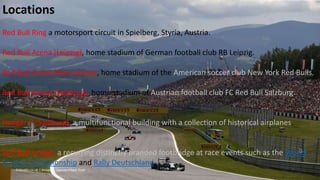
Red Bull Ring a motorsport circuit in Spielberg, Styria, Austria.
Red Bull Arena (Leipzig), home stadium of German football club RB Leipzig.
Red Bull Arena (New Jersey), home stadium of the American soccer club New York Red Bulls.
Red Bull Arena (Salzburg), home stadium of Austrian football club FC Red Bull Salzburg.
Hangar-7 (Salzburg), a multifunctional building with a collection of historical airplanes.
Red Bull bridge, a recurring distinctly branded footbridge at race events such as the World
Enduro Championship and Rally Deutschland.
Redbull
Redbull

Redbull

  • 2.
    Red Bullis anenergy drink sold by Austrian company Red Bull GmbH, created in 1987. Red Bull has the highest market share of any energy drink in the world, with 5.387 billion cans sold in 2013. Austrian entrepreneur Dietrich Mateschitz was inspired by an existing energy drink named Krating Daeng, which was first introduced and sold in Thailand by Chaleo Yoovidhya. He took this idea, modified the ingredients to suit the tastes of Westerners and, in partnership with Chaleo, founded Red Bull GmbH in 1987 in Chakkapong, Thailand Energy drinks have been associated with health risks, such as masking the effects of intoxication when consumed with alcohol, and excessive or repeated consumption can lead to cardiac and psychiatric conditions. However, the European Food Safety Authority (EFSA) concluded that an adequate consumption of Red Bull is safe and that the amount of caffeine in standard Red Bull cans is unlikely to interact adversely with other typical constituents of energy drinks or with alcohol.
  • 3.
    Red Bull GmbH IndustryConglomerate including drinks Founded 1987; 30 years ago Founder Dietrich Mateschitz and Chaleo Yoovidhya Headquarters Fuschl am See, Salzburg, Austria Area served Worldwide Key people Dietrich Mateschitz Products Red Bull , Energy drinks Revenue Increase €5.110 billion (2014) Operating income Increase €1.3 billion (2006) Net income Increase €650 million (2006) Employees 10,997 (2015)
  • 5.
    Ingredients of RedBull (Nutrition Facts Amount Per 100 grams) % Daily Value* Calories 45 Total Fat 0.1 g 0% Saturated fat 0 g 0% Polyunsaturated fat 0 g Monounsaturated fat 0 g Cholesterol 0 mg 0% Sodium 38 mg 1% Potassium 3 mg 0% Total Carbohydrate 11 g 3% Dietary fiber 0 g 0% Sugar 10 g Protein 0.3 g 0% Caffeine 30 mg Vitamin A 0% Vitamin C 0% Calcium 1% Iron 0% Vitamin D 0% Vitamin B-6 100% Vitamin B-12 33% Magnesium 0%
  • 6.
    The Secret Mateschitz’s secretto creating a $1.6 billion worldwide stampede for Red Bull lies in a highly ingenious “buzz-marketing” strategy that herds consumers to exclusive and exciting events tha high media coverage. Red Bull supports close to 500 world-class extreme sports athletes that compete in spectacular and often record-breaking events across the globe. Mateschitz explains “We don’t bring the product to the consumer, we bring consumers to the product.”
  • 7.
    The IDEA! In thesummer of 1982 Mateschitz read a story about the top 10 taxpayers in Japan. He was surprised that a certain Mr. Taisho, who had introduced a high-energy drink to Japan, made the top of the list. On the next stop of his sales trip – in Thailand – he learned from a local toothpaste distributor that energy drinks were a hot item among tired drivers stopping at gas stations Besides water, sugar and caffeine (equivalent to that in a cup of coffee), this drink contains an ingredient named taurine, an amino acid that, according to Japanese studies, benefits the cardiovascular system
  • 8.
    The Bull Fightsfor Business Survival The Austrian bureaucracy didn’t allow the drink to be sold without scientific tests. It took three years and many sales calls to get a license to sell the product. Meantime, Mateschitz asked his old school friend Johannes Kastner, who ran an advertising agency in Frankfurt, Germany, to design the can and logo. Kastner worked diligently on a snappy slogan, but Mateschitz rejected one after the other, each time saying, “Not good enough.” Kastner told Mateschitz to find someone else to come up with a better slogan, but Mateschitz pleaded, “Sleep on it, and give me one more tag line.” The next morning Kastner called and said, “Red Bull – gives you wings.” also settling on a macho logo with two red bulls charging each other
  • 9.
    Mateschitz still hadto find a bottler to produce his drink. Every bottler he called told him that Red Bull had no chance of success. Finally, Mateschitz found a sympathetic ear in Roman Rauch, the leading soft- drink bottler in Austria, and soon the shiny silver cans rolled off the production line. Within two years, and after many creative promotions, sales began to grow, but so did his losses. While a million-dollar loss in two years may scare an entrepreneur into closing the business, Mateschitz was undaunted. He says, “As long as I can think clearly, I can think of alternatives. All you need is bright eyes and a clear mind.” After he spent his life savings on the startup, Mateschitz financed everything without outside capital, and by 1990 Red Bull was in the black. He soon realized that Austria wasn’t a big enough market, and in 1993 he expanded to neighbouring Hungary and then focused his energies on conquering the German market. Once the news of Red Bull’s advancing sales spread in Europe, dozens of copycat competitors came on the market. Red Bull’s initial move into the German market was highly successful. After three months of skyrocketing demand, Mateschitz could not get enough aluminum to produce the cans anywhere in Europe
  • 10.
    A competitor namedFlying Horse became the market leader. It took Red Bull four years to reclaim the top spot in the German market. The expansion to England proved to be even more challenging. The British marketing team was unable to use the term “energy drink,” since a pharmaceutical company owned that label. That forced Red Bull to use the term “stimulation” as a tag line to the logo. In two short years, Red Bull’s English operation was $12 million in the red, with only 2 million cans sold. Mateschitz fired the entire staff, pulled the product from pubs, and appointed an Austrian marketing director who concentrated on night clubs and the student market. In order to reach consumers without spending millions on advertising, Mateschitz resorted to buzz marketing to stimulate sales. He hired students to drive Minis with a big Red Bull can strapped on top. They cruised around campuses and offered free samples at parties.
  • 11.
    The rules forcreating buzz are astonishingly simple. Marketers need to reach the “alpha bees,” and if they like the product, they will tell other people about it. The authority of one alpha bee can influence the buying habits of hundreds. The student marketing buzz boosted sales, and by the year 2000 Red Bull’s sales in England soared to 200 million cans, which came close to its total of steadily growing sales in Germany.
  • 12.
    Mateschitz thrives onresistance. Always eager to push the envelope, he’s hatched spectacular new marketing ideas that get consumers to flock to events where extreme sports athletes perform stunning acts that leave audiences gasping for air Last year Mateschitz sent a message to the French market and the world that the wings of Red Bull are alive and well. He sponsored an extraordinary stunt performed by the Austrian air acrobat Felix Baumgartner, who became the first man to fly the English Channel (22 miles) from Dover, England to Calais, France with a special 6-foot delta-wing made of carbon fiber strapped to his back. Baumgartner wore a special suit to insulate him against the freezing temperatures (minus 55 degrees Fahrenheit) when he jumped out of the airplane at 33,000 feet. He used oxygen for the first few minutes while he flew at a speed of more than 220 miles per hour. After less than seven minutes, Baumgartner pulled his parachute and landed safely in France. TV footage of Baumgartner’s world record event and the Red Bull logo were seen by more than 200 million people around the world.
  • 13.
    So how couldRed Bull achieve such consensus? We will now try to get some valuable insight into its success:
  • 14.
    Phase 1 Initiation: Initially, theurge to implement change within an organization is recognized by a group of empowered stakeholders. These stakeholders must guide the process of change, fully accepting and embodying the culture they wish to achieve; from top management, the rest of the organization will follow. Dietrich Mateschitz, founder and CEO of Red Bull, is the personification of this phase as he is the Red Bull brand. He recognized the threat of not having a ‘story’ and customer experience around Red Bull and ensured that his freewheeling spirit disseminated across the entire organization. Mateschitz had a specific vision and fully dedicated the company to it, resulting in Red Bull’s current success.
  • 15.
    Phase 2 Reconstitution: The secondphase consists of demarcation by being transparent of future plans. After the market-orientation strategy becomes public, the effort turns to value and norm development, reconnecting with the market, hiring believers rather than dissenters, and developing a collaborative strategy. Red Bull is a brand that is constantly changing and improving. In addition to a high level of professionalism, the company employs people who are passionate and able to raise the bar of excellence. ` As a result, the reconstitution stage creates the culture, understanding, and processes that lead to the organization’s speedy responsiveness to the target market.
  • 16.
    Phase 3 Institutionalization: Organizations mustnow normalize the informal market- oriented manner into its official culture and organizational behavior, so that it can implement the market-orientation concept inside out. Red Bull’s famous tagline “Red Bull gives you wings,” not only implies its external image of helping customers achieve better performance, but also formalizes the core ethos of thrill-seeking experiences and adventure into its own culture.
  • 17.
    Phase 4 Maintenance: The finalstage requires continuous market connections and upkeep of the market-oriented strategy. Red Bull continuously engages in renewing and reminding the market of their culture. They are constantly conducting cultural maintenance rituals that include, employee screening and new hires that share the same spirit, field visits with the Red Bull cars, and the sponsorship of new sporting events and athletes. Red Bull creates continuous customer experiences and the sponsored activities associated with the brand continue to grow each year. For example, the Red Bull Stratos (jump back to earth) event in 2012, really reminded the world that Red Bull does indeed Give You Wings.
  • 18.
    • In theold days, Red Bull was known for its monster hits, like “Felix Baumgartner’s supersonic freefall from 128k” The Red Bull Stratos space diving project, which took place on Oct. 14, 2012, was viewed live by over 9.5 million users, setting a record for the live stream with the most concurrent views ever on YouTube. • At time of writing, that YouTube video has 41.2 million views, and 240,000 engagements, according to Tubular Labs. So, one might mistakenly think that Red Bull’s current video marketing strategy is built around creating similar hero content or tent-pole events on YouTube. But, if you take a close look at the Tubular’s monthly rankings of the most watched brands across platforms, then you’ll see that Red Bull has ranked #1 in nine of the past 12 months. And in the other three months, February, March, and April 2016, when LEGO ranked #1, Red Bull ranked #2. • In other words, Red Bull’s successful video marketing strategy appears to be built on creating hub content month in and month out that gets a ton of views. Yes, some months dip to as few as 131 million views and other months jump to as much as 310 million views. But, Red Bull has generated more than 2.5 billion views – and 50.2 million engagements – in the last 365 days. That’s the equivalent of making more than 60 space jumps a year – without a parachute! • That’s what I mean about dramatically changing what everyone thought a successful video marketing strategy looked like. Red Bull has moved from making occasional “hits” to producing an ongoing stream of videos that get lots of views – and engagements – day in and day out. • According to Tubular Labs, Red Bull has uploaded 4,331 videos to 23 accounts in the last 365 days. On average, these videos get 524,000 views in their first 30 days
  • 19.
    The LIFE andWORK Tiny Austria’s only billionaire, Mateschitz located his office in the quaint lakeside village of Fuschl, near Salzburg, Austria. His architect is currently building a new office building in the shape of two volcanoes. He tries to keep it down to working three days a week. The size of his headquarter staff is only 200. The total number of employees worldwide is only 1,800, which brings the sales volume per employee close to a million dollars. Mateschitz not only generates brilliant sales and marketing ideas, he is equally talented in the execution of the biggest and boldest business ideas. His latest project involves a $1 billion motor sport and aviation theme park in Styria, Austria.
  • 20.
    A few yearsbefore he launched Red Bull, Mateschitz developed a passion for flying. Once his company turned substantial profits, he funneled the excess cash into a superb collection of vintage aircraft. In 2000 he created a Red Bull subsidiary, named it Flying Bulls and purchased and restored such planes as two Corsair fighter-bombers, a twin-engine DC-6 that belonged to former Yugoslav Communist ruler Tito, a T- 28-B trainer, four seaplanes, and a Bell 47 helicopter – 16 planes in all to date. To create a suitable home for his growing fleet of Flying Bulls, Mateschitz worked with an architect to create a 60,000-square-foot airplane hangar
  • 22.
    Sports sponsorships andacquisitions RB Leipzig : a football club currently playing in the German 1. Bundesliga FC Red Bull Salzburg : an Austrian football club based in Salzburg and competing in the Austrian Bundesliga EC Red Bull Salzburg: a member of the Austrian Hockey League based in Salzburg, Austria New York Red Bulls : (officially Red Bull New York) a football franchise competing in Major League Soccer of the United States Red Bull Brasil : a football club currently playing in the Brazilian Football club based in Campinas, Brazil Red Bull Ghana : was a Ghanaian professional football club located in Sogakope that played in the Red Bull Racing—a Formula One team based in Milton Keynes, England, World Constructor's Championship winner of 2010, 2011, 2012 and 2013, and produced the car for the 2010, 2011, 2012 and 2013 F1 World Champion Sebastian Vettel. Scuderia Toro Rosso (Italian translation of Team Red Bull): Another Formula One team based in Faenza, Italy. Team Red Bull: a Toyota racing team competing in the U.S.-based stock car racing competition NASCAR Red Bull Racing Team competed in NASCAR beginning in 2007. Škoda Motorsport rally team Red Bull Sailing Team : an Extreme Sailing Series racing team. EHC Red Bull München : a member of the Deutsche Eishockey Liga based in Munich, Germany
  • 23.
    Locations Red Bull Ringa motorsport circuit in Spielberg, Styria, Austria. Red Bull Arena (Leipzig), home stadium of German football club RB Leipzig. Red Bull Arena (New Jersey), home stadium of the American soccer club New York Red Bulls. Red Bull Arena (Salzburg), home stadium of Austrian football club FC Red Bull Salzburg. Hangar-7 (Salzburg), a multifunctional building with a collection of historical airplanes. Red Bull bridge, a recurring distinctly branded footbridge at race events such as the World Enduro Championship and Rally Deutschland.