RED FORT DELHI &
AGRA
HISTORY OF
ARCHITECTURE
JOEDEREK
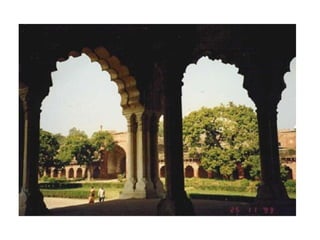
DIWAN I AM
HALL OF PRIVATE
AUDIENCE
COVERED BAZAAR
Mughal Emperor Shahjahan started construction
of the massive fort in 1638 and work was completed in
1648.
The fort contains
•halls of public and private audience,
•domed and arched marble palaces,
•plush private apartments,
•a mosque
•and elaborately designed gardens.
The first job was to build the defences for the
city and, inside, the citadel-fort. Twenty-one
towers and seven main gateways punctuated
the 4 mile long, 27 foot high city wall. The
walls encircling the 124 acre Fort were even
more tremendous, ranging in height from 60
feet on the river side to 75 on the landward
side, and in width from 45 feet at ground
level to 30 feet
INTRODUCTION:
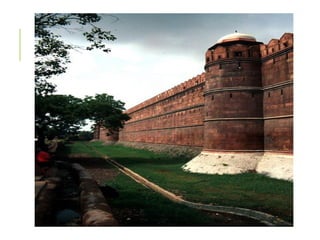
The largest of Old Delhi's monuments is Lal Quila
or Red Fort whose thick red sandstone walls, bulging with
turrets and bastions, have withstood the vagaries of time
and nature.
The Lal Quila rises above a wide dry moat in the
northeast corner of the original city of Shahjahanabad.
Its walls extend from two kilometers and vary in
height from 18 metres on the river side to 33 metres on
the city side.
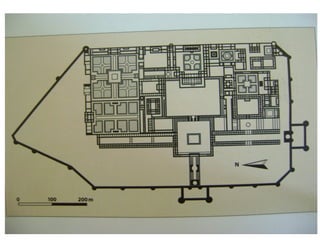
• Agra fort is in the form of an irregular
semicircle, has its back to the river
Yamuna which thus protects its eastern
side.
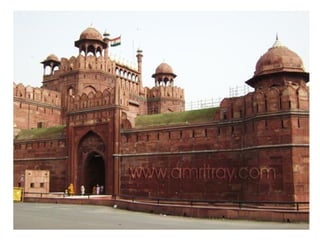
• The western wall is dominated by the
massive main entrance – the so-called
Delhi Gate- and the Hathi Pol. This
gate is approached by a tortuous access
ramp.
• To the south, the Amar Singh gate is
defended by two towers which flank the
entrance
MOTI MASJID
DIWAN I AM

Red Forts

  • 1.
    RED FORT DELHI& AGRA HISTORY OF ARCHITECTURE JOEDEREK
  • 4.
  • 5.
  • 6.
  • 7.
    Mughal Emperor Shahjahanstarted construction of the massive fort in 1638 and work was completed in 1648. The fort contains •halls of public and private audience, •domed and arched marble palaces, •plush private apartments, •a mosque •and elaborately designed gardens.
  • 9.
    The first jobwas to build the defences for the city and, inside, the citadel-fort. Twenty-one towers and seven main gateways punctuated the 4 mile long, 27 foot high city wall. The walls encircling the 124 acre Fort were even more tremendous, ranging in height from 60 feet on the river side to 75 on the landward side, and in width from 45 feet at ground level to 30 feet
  • 11.
    INTRODUCTION: The largest ofOld Delhi's monuments is Lal Quila or Red Fort whose thick red sandstone walls, bulging with turrets and bastions, have withstood the vagaries of time and nature. The Lal Quila rises above a wide dry moat in the northeast corner of the original city of Shahjahanabad. Its walls extend from two kilometers and vary in height from 18 metres on the river side to 33 metres on the city side.
  • 14.
    • Agra fortis in the form of an irregular semicircle, has its back to the river Yamuna which thus protects its eastern side. • The western wall is dominated by the massive main entrance – the so-called Delhi Gate- and the Hathi Pol. This gate is approached by a tortuous access ramp. • To the south, the Amar Singh gate is defended by two towers which flank the entrance
  • 15.
  • 17.