REDDIRT .js
The—of HTML, CSS, & JavaScript
   Future
   Today  
            :)  

     November 3rd, 2011 @ Oklahoma City, OK


                http://reddirtjs.com
#whoami ?

     My name is Nathan. I do
     UX stuff at projekt202.

     But most people know me
     as "the 960 guy" (that's ok).


http://sonspring.com | http://960.gs | http://projekt202.com
Note: You don't have to take notes feverishly.


Download the slides & follow along:
 http://slidesha.re/nathansmith


Or, talk smack about me on Twitter:
             @nathansmith
Today, I want to talk a bit about
 what the future of HTML, CSS,
 and JavaScript will look like.*

* My predictive powers are probably average (at best).
Difficult to see. Always in motion is the future.
In order to determine where
  we're heading, let's reflect
   on where we've been...
Act I
How We Got Here
HTML
http://w3.org/People/Raggett/book4/ch02.html
1989: Tim Berners-Lee created HTML to link research docs.


                   http://w3.org/People/Berners-Lee
"Storage of ASCII text, and display
on [80x24] screens, is in the short
term sufficient, and essential.
Addition of graphics would be an
optional extra with very much less
penetration for the moment."
                 – Tim Berners-Lee


         http://w3.org/History/1989/proposal.html
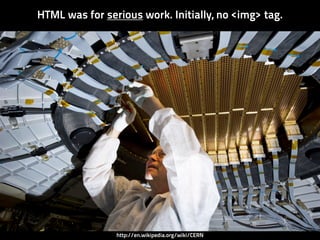
HTML was for serious work. Initially, no <img> tag.


                http://en.wikipedia.org/wiki/CERN
Then everyone
got ahold of it:
But, I digress.
We're getting a little
ahead of ourselves.

      (sorry)
Marc L.
                                                    Andreessen


                                                    Eric J. Bina

http://en.wikipedia.org/wiki/Mosaic_(web_browser)
"Standardizing"  on
browser  innovation.


1993: Marc
Andreessen
proposed the
<IMG> tag.

Mosaic later becomes
Netscape, which then
introduces JS, SSL, etc.
JavaScript
 http://oreilly.com/pub/a/javascript/2001/04/06/js_history.html
Brandon Eich created JS in 10 days.


                          "JS had to 'look like Java'
                          only less so, be Java's
                          dumb kid brother or boy-
                          hostage sidekick. Plus, I
                          had to be done in ten days
                          or something worse than
                          JS would have happened."


         http://en.wikipedia.org/wiki/Brendan_Eich
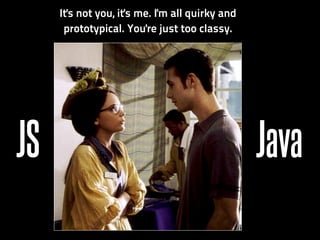
It's not you, it's me. I'm all quirky and
      prototypical. You're just too classy.


JS                                               Java
Object Inheritance #TLDR
With classical inheritance, if
your mother breaks her leg, you
go visit her in the hospital. With
prototypical inheritance, your
leg would also (instantly) break.


      #TLDR = "Too Long, Didn't Read" aka: Sum it up for me :)
1995: JavaScript debuted in Netscape Navigator 2.0.


            http://en.wikipedia.org/wiki/Netscape_Navigator
Brief history of JS = Clear as mud...

The word "JavaScript" was chosen to tap into the
brand name of the Java programming language.

Sun Microsystems (since acquired by Oracle) owned
the trademarks for both Java™ and JavaScript™, and
stewarded the development of Java (not JavaScript).

In 1997, JavaScript (the language) was standardized
by the European Computer Manufacturers
Association, and it was dubbed "ECMAScript."
                                           m  -­  what?
                                          U
     http://en.wikipedia.org/wiki/JavaScript | http://en.wikipedia.org/wiki/ECMAScript
Similar in name: JavaScript is to Java as Hamburger is to Ham.


 Altogether different beasts: Both potentially delicious (or dangerous), but not actually derived from the same animal.
(With apologies to Jeremy Keith and Brad Colbow)


http://coding.smashingmagazine.com/2009/07/29/misunderstanding-markup-xhtml-2-comic-strip
1996: IE 3.0 ships with "JScript" (for copyright purposes).


                       In 1995, MS begins to ship Internet
                       Explorer with Windows 95. For
                       Netscape, it was the beginning of
                       the end. Microsoft also reverse-
                       engineered JavaScript, as "JScript."


                http://en.wikipedia.org/wiki/Internet_Explorer
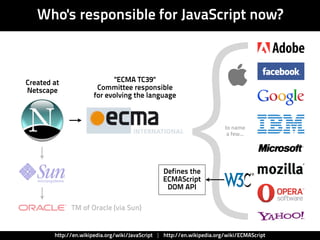
Who's responsible for JavaScript now?


                                                            {
Created at
Netscape
                             "ECMA TC39"
                        Committee responsible
                                                                          
                       for evolving the language


                                                                         to name
                                                                          a few...


                                                 Defines the
                                                 ECMAScript
                                                  DOM API

              TM of Oracle (via Sun)


        http://en.wikipedia.org/wiki/JavaScript | http://en.wikipedia.org/wiki/ECMAScript
JS browser support is pretty good.

JavaScript (ECMAScript 3.0) is supported
fairly consistently in all major browsers.

     This is Wikipedia's compatibility table* for:

     – Trident (IE)
     – Gecko (Firefox)
     – WebKit (Chrome & Safari)
     – Presto (Opera)

* I realize those are rendering engines, not specific JS engines
(which change names more rapidly). It's how Wikipedia lists 'em.


http://en.wikipedia.org/wiki/Comparison_of_layout_engines_(ECMAScript)
JavaScript is that friend in high
N ice  >
           school you secretly had a crush
           on, but was always hanging out
           with that sleazy boyfriend, DOM.
                                           W hat  a  punk


                       http://w3.org/DOM
The Document Object Model (DOM) is what
allows JS to interact with XML/HTML, ala:

window.document.getElementsByTagName('*');

The DOM is stewarded by a different group than governs
JS. Browsers also implement it slightly differently. For
instance, IE historically didn't treat whitespace as text
nodes, even though the official DOM spec says it should.


                       http://w3.org/DOM
2005: Then there was jQuery...
$('p.neat').addClass('ohmy').show('slow');

 JavaScript that reads like CSS code!?

              Heck  yeah!


                 http://jquery.com
But we treated it like CSS...
$(document).ready(function() {
 // Many tutorials put all the code here.
});


      Um,  okay...  What's  the  big  deal?
window.onload

                                               Loosely  translated:

                                             "You'd better lose yourself in
                                             the music, the moment. You
                                             own it, you better never let it
                                             go... You only get one shot, do
                                             not miss your chance to [load]."

                                               (with apologies to Eminem)


http://en.wikipedia.org/wiki/8_Mile_(film)
Beware the danger of abstraction & illiteracy.

  Really, it's not the fault of jQuery, nor of
  any other capable JavaScript libraries:
  Dojo, MooTools, Prototype, Sencha, YUI...

  As is almost always the case with code,
  the problem is actually a human one.
  We've become complacent and forgotten
  (or never learned) how JavaScript works.

            http://ejohn.org/blog/javascript-language-abstractions
CSS
http://w3.org/Style/LieBos2e/history/Overview.html
1994: Marc Andreessen, on styling... "Sorry, you're screwed."


               http://intercom.co.cr/www-archives/1994-q1/0648.html
1994: Håkon Wium Lie proposed CSS.

                           Initially it was called CHSS,
                           ("Cascading HTML Style
                           Sheets"), but was later
                           shortened to simply CSS.

                           1996: The first browser to
                           support CSS was Internet
                           Explorer 3.0, followed
                           closely by Netscape
                           Navigator version 4.0.


        http://people.opera.com/howcome/2006/phd
CHSS had 100 levels of "!important"

       Thankfully, CHSS was never implemented:

h1.font.size = 24px                 12%      /* 12%     importance */

h1.font.size = 16px 100%                     /* 100% importance */

h1.font.size = 12px                 89%      /* 89%     importance */


     CSS has "last-in" wins, with specificity override.

h1     {font-size: 24px;}                  /* Applies globally (weak)   */

h1.x {font-size: 16px;}                    /* More specific             */

h1     {font-size: 12px;}                  /* Beats line 1, not line 2 */


               http://www.w3.org/People/howcome/p/cascade.html
Brief history of the first "Browser War"


           http://en.wikipedia.org/wiki/Browser_wars
1998: "Web Standards" advocacy begins.


                                           The box model
                                           isn't fixed until
                                            October 2006,
                                           release of IE7.


         http://w3.org/Style/LieBos2e/history/Overview.html
We made sites "best viewed in IE6,"
and Netscape lost the browser war.


        http://en.wikipedia.org/wiki/Netscape_Navigator
The "dark side" = developing for 1 browser.


Oh, what... Like you never photoshopped
you vs. yourself with a lightsaber? C'mon!
           http://flickr.com/photos/nathansmith/32757176
In 2001, IE had over 90% market share.


        http://en.wikipedia.org/wiki/File:Browser_Wars.png
2004: Firefox arose from Netscape's ashes.


   Thus began a new Browser War, still in progress.
Since then, IE has been in steady decline.


  http://en.wikipedia.org/wiki/File:Usage_share_of_web_browsers_(Source_Net_Applications).svg
Chrome is gaining, at the expense of Firefox.


  http://en.wikipedia.org/wiki/File:Usage_share_of_alternative_web_browsers_(Source_StatCounter).svg
"My 'pure CSS' demo only works in WebKit"


                                 "Those who cannot
                                 remember the past
                                 are condemned to
                                 repeat it."
                                            – George Santayana


           http://en.wikipedia.org/wiki/George_Santayana
Act II
Where We're Going
http://zeldman.com/2009/07/02/xhtml-wtf
Realistically speaking, XHTML 2.0 would've
been a very tough sell, from a practical
standpoint. It was extremely rigid. A page
simply would not render, if it wasn't perfectly
formed from an XML structure standpoint.


Oh, and it would've done away with <img>.

                                      O h  noes!
There were differing schools of thought on HTML vs. XHTML.


In the field                                     Academic
                                                 "make it valid"
"make it work"
 —>
                                                   pid n
                                                ra      tio
                                                 it era


http://whatwg.org/specs/web-apps/current-work/multipage
Ian Hickson, benevolent HTML5 specification dictator curator.


                   http://en.wikipedia.org/wiki/Ian_Hickson
Technically, "HTML5" is now a misnomer. (But, it's
too late. Marketing already got ahold of it.) HTML is
to be considered an ever-evolving "living standard".

The "WHATWG" — Web Hypertext Application
Technology Working Group — will continue to work
on HTML, and the W3C will "snapshot" feature sets
periodically, and tag them with incremental version
numbers: HTML5 (and presumably, HTML6, etc).

Thus, no more version numbers in DOCTYPE...
HTML5 "killed" XHTML. Good riddance, says I.


 <!DOCTYPE html>         <—  Much  easier  to  remember!


 <!DOCTYPE html PUBLIC "-//W3C//DTD XHTML 1.0
 Transitional//EN" "http://www.w3.org/TR/xhtml1/
 DTD/xhtml1-transitional.dtd">


As it turns out, "<!DOCTYPE html>" = minimum number of
characters to trigger "standards" mode in older IE versions.
You don't have to type extra junk anymore.

<script>
  alert('This is some inline JS.');
</script>


<script type="text/javascript" charset="utf-8">
/* <![CDATA[ */
  alert('Are you kidding me?');
/* ]]> */
</script>
Have you ever used a non-CSS stylesheet?

  (No?  Me  neither,  so  why  "type"  it?)

<link rel="stylesheet" href="/path/file.css">


<link rel="stylesheet" href="/path/file.css"
  type="text/css" media="all" />


Note: Media queries best defined via @media in a single
stylesheet anyway, to avoid unnecessary HTTP requests.
I know what you XHTML purists are thinking:

You can't do that! What about the validator?

Relax. It's valid. HTML5 is no longer a sub-
set of SGML like all versions of HTML before
it. Nor is it a spin on XML, like XHTML 1.x
was. HTML is just HTML now. This is how
browsers always treated (X)HTML anyway.
                      (phew!)
               http://en.wikipedia.org/wiki/HTML
What about JS? (Not stewarded by W3C)


     HTML5                             CSS3


             http://w3.org/html/logo
https://github.com/voodootikigod/logo.js
Branding, FTW! So, what's next?


1. Get cool logo(s). [X]

2. Convince others.            [X]

3. Profit!                     [X]
Apple likes HTML5.


    http://apple.com/html5
Google likes HTML5.


     http://html5rocks.com
Mozilla likes HTML5.


 https://developer.mozilla.org/en/HTML/HTML5
Opera likes HTML5.


http://opera.com/docs/specs/presto25/html5
Microsoft likes HTML5.


  http://msdn.microsoft.com/en-us/ie/aa740476
HTML5 <canvas> is gaining traction.


             http://playbiolab.com
As of IE9, all browsers support <canvas>.


      http://ie.microsoft.com/testdrive/performance/asteroidbelt/default.html
2011: IE9 supports SVG (proposed in 1999).


                                                           Examples of
                                                           Dojo.js charts


                            To be fair, IE9 renders SVG very
                            fast, via hardware acceleration.
                            Konqueror (WebKit predecessor), was the first
                            browser to have built-in SVG support, in 2004.

          http://user.sitepen.com/~dwalsh/dojo-charting.html
SVG is like construction paper. Layers retain
distinct shapes. SVG files can live without JS.


                                                  And, each layer
                                                  can respond to
                                                  mouse events!


             http://flickr.com/photos/124330160/2127121118
Canvas is like a whiteboard drawing, one layer.
Note: Canvas only works in the browser via JS.


              http://flickr.com/photos/azuriblue/3350954960
Quick CSS tip to fix IE9's SVG rendering:


 svg {
   overflow: hidden;
 }
IE9, without the CSS fix for SVG:


         http://host.sonspring.com/raph
IE9, with the CSS fix for SVG:


        http://host.sonspring.com/raph
SVG in: Chrome, Firefox, Opera, & Safari.


              http://host.sonspring.com/raph
I won't cover <svg> or <canvas> in
    detail during this talk, but two helpful
    JavaScript libraries are worth noting...
Raphaël (SVG) – Dmitry Baranovskiy   Processing JS (Canvas) – John Resig


         http://raphaeljs.com                http://processingjs.org
More  Semantic  Richness!


New tags
in HTML5
   http://html5doctor.com/element-index
<header role="banner">
                              Mixes  well  with  ARIA
<nav role="navigation">


<div role="main">                   <aside>


 <article>                           <figure>


                                      <img />
  <section>


                                      <figcaption>
   <hgroup>


   <p>                               <details>
   etc...
                                      <summary>

  <section>
                                      <p>

   <dialog>                           etc...


<footer role="contentinfo">
WebGL is going to be HUGE
          (eventually)  

The dawn of 3D browser graphics.
aka: Can I play Farmville in IMAX!?


         http://en.wikipedia.org/wiki/WebGL
https://github.com/mrdoob/three.js
Metaprogramming


        Haml => HTML
Sass/Compass => CSS
CoffeeScript =>   JS
          Note: Yes, I'm sure there are many, many
          more examples in the wild. But my time
          is finite, and this is what I'm familiar with.


http://haml-lang.com | http://sass-lang.com | http://compass-style.org | http://coffeescript.org
Personal note: After giving 'em a try, I am
becoming more a fan of meta languages
that treat whitespace as significant.

Usual  disclaimers  apply:

"It depends." Your mileage may vary. No purchase
necessary. Machine-wash only. Enter at own risk.
Batteries not included. Void where prohibited, etc.
Example of Sass (with Compass).


@import compass/css3 // CSS3 helpers, etc.


// I write this Sass code:
.foobar
 +background-image(linear-gradient(#fff, #ccc))
 +border-top-right-radius(4px)
 +box-shadow(rgba(#000, 0.5) 0 2px 5px 0)
 &:hover
   text-decoration: underline
Example of Sass (with Compass).

/* This CSS is generated... */

.foobar {
    background-image: -webkit-gradient(linear, 50% 0%, 50% 100%, color-stop(0%, #ffffff), color-stop(100%, #cccccc));
    background-image: -webkit-linear-gradient(#ffffff, #cccccc);
    background-image: -moz-linear-gradient(#ffffff, #cccccc);
    background-image: -o-linear-gradient(#ffffff, #cccccc);
    background-image: -ms-linear-gradient(#ffffff, #cccccc);
    background-image: linear-gradient(#ffffff, #cccccc);
    -moz-border-radius-topright: 4px;

                                                              BLOAT?  Not  really.  You'd
    -webkit-border-top-right-radius: 4px;
    -o-border-top-right-radius: 4px;
    -ms-border-top-right-radius: 4px;
    -khtml-border-top-right-radius: 4px;
    border-top-right-radius: 4px;
                                                              have  to  type  all  this  to  make  it  
    -moz-box-shadow: rgba(0, 0, 0, 0.5) 0 2px 5px 0;
    -webkit-box-shadow: rgba(0, 0, 0, 0.5) 0 2px 5px 0;
    -o-box-shadow: rgba(0, 0, 0, 0.5) 0 2px 5px 0;
                                                              work  cross-­browser  anyway.
    box-shadow: rgba(0, 0, 0, 0.5) 0 2px 5px 0;
}


.foobar:hover {
    text-decoration: underline;
}
Note: Don't indent unnecessarily with Sass.


// This looks innocent enough:
table.table-class
  tbody
   tr
     td
        a.link-class
          color: orange
Note: Don't indent unnecessarily with Sass.


/* But it generates this... */
table.table-class tbody tr td a.link-class {
    color: orange;
}


/* When you probably just meant... */
.table-class .link-class {
    color: orange;
}
Note: Don't steal another presenter's topic.


      I could go on. But
       I won't. (Sorry Jina)

         Note: Jina Bolton is presenting on Sass later today. Don't miss it!
Haml rocks, if you're in a Ruby project.


                 To me, Haml means
                 never typing this again...

                 </div></div></div>
Haml can generate nicely formatted HTML.
I'm not an über-Ruby guy. Get your feet wet:


                 http://get-serve.com
Okay, so abstraction for HTML and CSS is fine.
It saves keystrokes, and those languages are
pretty #yawn anyway, right? I mean, they're
declarative, so of course we should automate
writing them. But this is a JS conference,
right? Do not touch my JavaScript. I repeat...
get.your(coffee) {
  return 'off my lawn';
}
Not everyone's a fan. Dustin Diaz, quoting Douglas Crockford:
http://blog.meloncard.com/post/12175941935/how-one-missing-var-ruined-our-launch
http://nodejs.org
Can you spot the bug?
var joe = 1,                      var joe = 1
          sue = 2,                          sue = 2,
          bob = 3;                          bob = 3;
Bugs like this can be laborious to find, which is why I write...
Nuthin' wrong with being overly clear.
                  var joe = 1;
                  var sue = 2;
                  var bob = 3;
Minifiers like Uglify JS can handle removing repeated var
keywords. Put that burden on automation, not yourself.

        https://github.com/mishoo/UglifyJS | http://marijnhaverbeke.nl/uglifyjs
I just tell JSLint: "Hey JSLint... Shut up."


 Actually, JSLint.com is a great tool for checking for JavaScript
errors. But validation is a means to an end, not the goal itself.

If you want to ensure JSLint compliance, there's CoffeeScript...

                            http://jslint.com
Recursion -> CoffeeScript is written in CoffeeScript.


        https://plus.google.com/116264189418994838408/posts/CSXeyftovTJ
CoffeeScript -to- JavaScript...
# CoffeeScript:            LOL  -­  That's  all?
$('#foobar').click ->
 # Do stuff.


// JavaScript:
$('#foobar').click(function() {
 // Do stuff.
});
CoffeeScript = Syntactic Sugar...
# CoffeeScript:                     Oh,  I  see.
is_between = 3 < my_value < 12


// JavaScript:
var is_between;
is_between = (3 < my_value && my_value < 12);
One last example... (Sorry Brandon)
# CoffeeScript:                                                              That's  hawt.
happy = true unless raining


// JavaScript:
var happy;
if (!raining) {
    happy = true;
}


         Note: Brandon Satrom is presenting on CoffeeScript later today. Don't miss it!
BRAVE NEW WORLD
HTML, CSS, JS, & Flash:

Government can
reach its citizens
directly (1:1), via
social media...
Ours is an era of technological marvels.
(Free) fonts used in this presentation.

         Lady Ice REDDIRT.js              logo
         http://j.mp/font_lady-ice


         SteelFish
         http://j.mp/font_steelfish


         Hand  of  Sean
         http://j.mp/font_hand-of-sean

         Titillium Text
         http://j.mp/font_titillium-text


         Anonymous Pro
         http://j.mp/font_anonymous-pro

              (Listed in order of appearance)
Code "reddirtjs" = 50% off Cody Lindley's book. (I tech-edited)


                     http://javascriptenlightenment.com
Shameless plug: I'll be speaking on Sass & Drupal next year.


       http://denver2012.drupal.org/program/sessions/using-sass-compass-drupal-theming
Questions? I may (not) know the answer.


 Enjoy Red Dirt JS! Get the slides:
 http://slidesha.re/nathansmith


   Feel free to say hi on Twitter:
          @nathansmith

Red Dirt JS

  • 1.
    REDDIRT .js The—of HTML,CSS, & JavaScript Future Today   :)   November 3rd, 2011 @ Oklahoma City, OK http://reddirtjs.com
  • 2.
    #whoami ? My name is Nathan. I do UX stuff at projekt202. But most people know me as "the 960 guy" (that's ok). http://sonspring.com | http://960.gs | http://projekt202.com
  • 3.
    Note: You don'thave to take notes feverishly. Download the slides & follow along: http://slidesha.re/nathansmith Or, talk smack about me on Twitter: @nathansmith
  • 4.
    Today, I wantto talk a bit about what the future of HTML, CSS, and JavaScript will look like.* * My predictive powers are probably average (at best).
  • 5.
    Difficult to see.Always in motion is the future.
  • 6.
    In order todetermine where we're heading, let's reflect on where we've been...
  • 7.
    Act I How WeGot Here
  • 8.
  • 9.
    1989: Tim Berners-Leecreated HTML to link research docs. http://w3.org/People/Berners-Lee
  • 10.
    "Storage of ASCIItext, and display on [80x24] screens, is in the short term sufficient, and essential. Addition of graphics would be an optional extra with very much less penetration for the moment." – Tim Berners-Lee http://w3.org/History/1989/proposal.html
  • 11.
    HTML was forserious work. Initially, no <img> tag. http://en.wikipedia.org/wiki/CERN
  • 12.
  • 14.
    But, I digress. We'regetting a little ahead of ourselves. (sorry)
  • 15.
    Marc L. Andreessen Eric J. Bina http://en.wikipedia.org/wiki/Mosaic_(web_browser)
  • 16.
    "Standardizing"  on browser  innovation. 1993:Marc Andreessen proposed the <IMG> tag. Mosaic later becomes Netscape, which then introduces JS, SSL, etc.
  • 18.
  • 19.
    Brandon Eich createdJS in 10 days. "JS had to 'look like Java' only less so, be Java's dumb kid brother or boy- hostage sidekick. Plus, I had to be done in ten days or something worse than JS would have happened." http://en.wikipedia.org/wiki/Brendan_Eich
  • 20.
    It's not you,it's me. I'm all quirky and prototypical. You're just too classy. JS Java
  • 21.
    Object Inheritance #TLDR Withclassical inheritance, if your mother breaks her leg, you go visit her in the hospital. With prototypical inheritance, your leg would also (instantly) break. #TLDR = "Too Long, Didn't Read" aka: Sum it up for me :)
  • 22.
    1995: JavaScript debutedin Netscape Navigator 2.0. http://en.wikipedia.org/wiki/Netscape_Navigator
  • 23.
    Brief history ofJS = Clear as mud... The word "JavaScript" was chosen to tap into the brand name of the Java programming language. Sun Microsystems (since acquired by Oracle) owned the trademarks for both Java™ and JavaScript™, and stewarded the development of Java (not JavaScript). In 1997, JavaScript (the language) was standardized by the European Computer Manufacturers Association, and it was dubbed "ECMAScript." m  -­  what? U http://en.wikipedia.org/wiki/JavaScript | http://en.wikipedia.org/wiki/ECMAScript
  • 24.
    Similar in name:JavaScript is to Java as Hamburger is to Ham. Altogether different beasts: Both potentially delicious (or dangerous), but not actually derived from the same animal.
  • 25.
    (With apologies toJeremy Keith and Brad Colbow) http://coding.smashingmagazine.com/2009/07/29/misunderstanding-markup-xhtml-2-comic-strip
  • 26.
    1996: IE 3.0ships with "JScript" (for copyright purposes). In 1995, MS begins to ship Internet Explorer with Windows 95. For Netscape, it was the beginning of the end. Microsoft also reverse- engineered JavaScript, as "JScript." http://en.wikipedia.org/wiki/Internet_Explorer
  • 27.
    Who's responsible forJavaScript now? { Created at Netscape "ECMA TC39" Committee responsible  for evolving the language to name a few... Defines the ECMAScript DOM API TM of Oracle (via Sun) http://en.wikipedia.org/wiki/JavaScript | http://en.wikipedia.org/wiki/ECMAScript
  • 28.
    JS browser supportis pretty good. JavaScript (ECMAScript 3.0) is supported fairly consistently in all major browsers. This is Wikipedia's compatibility table* for: – Trident (IE) – Gecko (Firefox) – WebKit (Chrome & Safari) – Presto (Opera) * I realize those are rendering engines, not specific JS engines (which change names more rapidly). It's how Wikipedia lists 'em. http://en.wikipedia.org/wiki/Comparison_of_layout_engines_(ECMAScript)
  • 29.
    JavaScript is thatfriend in high N ice  > school you secretly had a crush on, but was always hanging out with that sleazy boyfriend, DOM. W hat  a  punk http://w3.org/DOM
  • 30.
    The Document ObjectModel (DOM) is what allows JS to interact with XML/HTML, ala: window.document.getElementsByTagName('*'); The DOM is stewarded by a different group than governs JS. Browsers also implement it slightly differently. For instance, IE historically didn't treat whitespace as text nodes, even though the official DOM spec says it should. http://w3.org/DOM
  • 31.
    2005: Then therewas jQuery... $('p.neat').addClass('ohmy').show('slow'); JavaScript that reads like CSS code!? Heck  yeah! http://jquery.com
  • 32.
    But we treatedit like CSS... $(document).ready(function() { // Many tutorials put all the code here. }); Um,  okay...  What's  the  big  deal?
  • 33.
    window.onload Loosely  translated: "You'd better lose yourself in the music, the moment. You own it, you better never let it go... You only get one shot, do not miss your chance to [load]." (with apologies to Eminem) http://en.wikipedia.org/wiki/8_Mile_(film)
  • 34.
    Beware the dangerof abstraction & illiteracy. Really, it's not the fault of jQuery, nor of any other capable JavaScript libraries: Dojo, MooTools, Prototype, Sencha, YUI... As is almost always the case with code, the problem is actually a human one. We've become complacent and forgotten (or never learned) how JavaScript works. http://ejohn.org/blog/javascript-language-abstractions
  • 35.
  • 36.
    1994: Marc Andreessen,on styling... "Sorry, you're screwed." http://intercom.co.cr/www-archives/1994-q1/0648.html
  • 37.
    1994: Håkon WiumLie proposed CSS. Initially it was called CHSS, ("Cascading HTML Style Sheets"), but was later shortened to simply CSS. 1996: The first browser to support CSS was Internet Explorer 3.0, followed closely by Netscape Navigator version 4.0. http://people.opera.com/howcome/2006/phd
  • 38.
    CHSS had 100levels of "!important" Thankfully, CHSS was never implemented: h1.font.size = 24px 12% /* 12% importance */ h1.font.size = 16px 100% /* 100% importance */ h1.font.size = 12px 89% /* 89% importance */ CSS has "last-in" wins, with specificity override. h1 {font-size: 24px;} /* Applies globally (weak) */ h1.x {font-size: 16px;} /* More specific */ h1 {font-size: 12px;} /* Beats line 1, not line 2 */ http://www.w3.org/People/howcome/p/cascade.html
  • 39.
    Brief history ofthe first "Browser War" http://en.wikipedia.org/wiki/Browser_wars
  • 40.
    1998: "Web Standards"advocacy begins. The box model isn't fixed until October 2006, release of IE7. http://w3.org/Style/LieBos2e/history/Overview.html
  • 41.
    We made sites"best viewed in IE6," and Netscape lost the browser war. http://en.wikipedia.org/wiki/Netscape_Navigator
  • 42.
    The "dark side"= developing for 1 browser. Oh, what... Like you never photoshopped you vs. yourself with a lightsaber? C'mon! http://flickr.com/photos/nathansmith/32757176
  • 43.
    In 2001, IEhad over 90% market share. http://en.wikipedia.org/wiki/File:Browser_Wars.png
  • 44.
    2004: Firefox arosefrom Netscape's ashes. Thus began a new Browser War, still in progress.
  • 45.
    Since then, IEhas been in steady decline. http://en.wikipedia.org/wiki/File:Usage_share_of_web_browsers_(Source_Net_Applications).svg
  • 46.
    Chrome is gaining,at the expense of Firefox. http://en.wikipedia.org/wiki/File:Usage_share_of_alternative_web_browsers_(Source_StatCounter).svg
  • 47.
    "My 'pure CSS'demo only works in WebKit" "Those who cannot remember the past are condemned to repeat it." – George Santayana http://en.wikipedia.org/wiki/George_Santayana
  • 48.
  • 49.
  • 50.
    Realistically speaking, XHTML2.0 would've been a very tough sell, from a practical standpoint. It was extremely rigid. A page simply would not render, if it wasn't perfectly formed from an XML structure standpoint. Oh, and it would've done away with <img>. O h  noes!
  • 51.
    There were differingschools of thought on HTML vs. XHTML. In the field Academic "make it valid" "make it work"
  • 52.
     —> pid n ra tio it era http://whatwg.org/specs/web-apps/current-work/multipage
  • 53.
    Ian Hickson, benevolentHTML5 specification dictator curator. http://en.wikipedia.org/wiki/Ian_Hickson
  • 54.
    Technically, "HTML5" isnow a misnomer. (But, it's too late. Marketing already got ahold of it.) HTML is to be considered an ever-evolving "living standard". The "WHATWG" — Web Hypertext Application Technology Working Group — will continue to work on HTML, and the W3C will "snapshot" feature sets periodically, and tag them with incremental version numbers: HTML5 (and presumably, HTML6, etc). Thus, no more version numbers in DOCTYPE...
  • 55.
    HTML5 "killed" XHTML.Good riddance, says I. <!DOCTYPE html> <—  Much  easier  to  remember! <!DOCTYPE html PUBLIC "-//W3C//DTD XHTML 1.0 Transitional//EN" "http://www.w3.org/TR/xhtml1/ DTD/xhtml1-transitional.dtd"> As it turns out, "<!DOCTYPE html>" = minimum number of characters to trigger "standards" mode in older IE versions.
  • 56.
    You don't haveto type extra junk anymore. <script> alert('This is some inline JS.'); </script> <script type="text/javascript" charset="utf-8"> /* <![CDATA[ */ alert('Are you kidding me?'); /* ]]> */ </script>
  • 57.
    Have you everused a non-CSS stylesheet? (No?  Me  neither,  so  why  "type"  it?) <link rel="stylesheet" href="/path/file.css"> <link rel="stylesheet" href="/path/file.css" type="text/css" media="all" /> Note: Media queries best defined via @media in a single stylesheet anyway, to avoid unnecessary HTTP requests.
  • 58.
    I know whatyou XHTML purists are thinking: You can't do that! What about the validator? Relax. It's valid. HTML5 is no longer a sub- set of SGML like all versions of HTML before it. Nor is it a spin on XML, like XHTML 1.x was. HTML is just HTML now. This is how browsers always treated (X)HTML anyway. (phew!) http://en.wikipedia.org/wiki/HTML
  • 59.
    What about JS?(Not stewarded by W3C) HTML5 CSS3 http://w3.org/html/logo
  • 61.
  • 62.
    Branding, FTW! So,what's next? 1. Get cool logo(s). [X] 2. Convince others. [X] 3. Profit! [X]
  • 63.
    Apple likes HTML5. http://apple.com/html5
  • 64.
    Google likes HTML5. http://html5rocks.com
  • 65.
    Mozilla likes HTML5. https://developer.mozilla.org/en/HTML/HTML5
  • 66.
  • 67.
    Microsoft likes HTML5. http://msdn.microsoft.com/en-us/ie/aa740476
  • 68.
    HTML5 <canvas> isgaining traction. http://playbiolab.com
  • 69.
    As of IE9,all browsers support <canvas>. http://ie.microsoft.com/testdrive/performance/asteroidbelt/default.html
  • 70.
    2011: IE9 supportsSVG (proposed in 1999). Examples of Dojo.js charts To be fair, IE9 renders SVG very fast, via hardware acceleration. Konqueror (WebKit predecessor), was the first browser to have built-in SVG support, in 2004. http://user.sitepen.com/~dwalsh/dojo-charting.html
  • 71.
    SVG is likeconstruction paper. Layers retain distinct shapes. SVG files can live without JS. And, each layer can respond to mouse events! http://flickr.com/photos/124330160/2127121118
  • 72.
    Canvas is likea whiteboard drawing, one layer. Note: Canvas only works in the browser via JS. http://flickr.com/photos/azuriblue/3350954960
  • 73.
    Quick CSS tipto fix IE9's SVG rendering: svg { overflow: hidden; }
  • 74.
    IE9, without theCSS fix for SVG: http://host.sonspring.com/raph
  • 75.
    IE9, with theCSS fix for SVG: http://host.sonspring.com/raph
  • 76.
    SVG in: Chrome,Firefox, Opera, & Safari. http://host.sonspring.com/raph
  • 77.
    I won't cover<svg> or <canvas> in detail during this talk, but two helpful JavaScript libraries are worth noting... Raphaël (SVG) – Dmitry Baranovskiy Processing JS (Canvas) – John Resig http://raphaeljs.com http://processingjs.org
  • 78.
    More  Semantic  Richness! Newtags in HTML5 http://html5doctor.com/element-index
  • 79.
    <header role="banner"> Mixes  well  with  ARIA <nav role="navigation"> <div role="main"> <aside> <article> <figure> <img /> <section> <figcaption> <hgroup> <p> <details> etc... <summary> <section> <p> <dialog> etc... <footer role="contentinfo">
  • 80.
    WebGL is goingto be HUGE (eventually)   The dawn of 3D browser graphics. aka: Can I play Farmville in IMAX!? http://en.wikipedia.org/wiki/WebGL
  • 81.
  • 82.
  • 83.
    Metaprogramming Haml => HTML Sass/Compass => CSS CoffeeScript => JS Note: Yes, I'm sure there are many, many more examples in the wild. But my time is finite, and this is what I'm familiar with. http://haml-lang.com | http://sass-lang.com | http://compass-style.org | http://coffeescript.org
  • 84.
    Personal note: Aftergiving 'em a try, I am becoming more a fan of meta languages that treat whitespace as significant. Usual  disclaimers  apply: "It depends." Your mileage may vary. No purchase necessary. Machine-wash only. Enter at own risk. Batteries not included. Void where prohibited, etc.
  • 85.
    Example of Sass(with Compass). @import compass/css3 // CSS3 helpers, etc. // I write this Sass code: .foobar +background-image(linear-gradient(#fff, #ccc)) +border-top-right-radius(4px) +box-shadow(rgba(#000, 0.5) 0 2px 5px 0) &:hover text-decoration: underline
  • 86.
    Example of Sass(with Compass). /* This CSS is generated... */ .foobar { background-image: -webkit-gradient(linear, 50% 0%, 50% 100%, color-stop(0%, #ffffff), color-stop(100%, #cccccc)); background-image: -webkit-linear-gradient(#ffffff, #cccccc); background-image: -moz-linear-gradient(#ffffff, #cccccc); background-image: -o-linear-gradient(#ffffff, #cccccc); background-image: -ms-linear-gradient(#ffffff, #cccccc); background-image: linear-gradient(#ffffff, #cccccc); -moz-border-radius-topright: 4px; BLOAT?  Not  really.  You'd -webkit-border-top-right-radius: 4px; -o-border-top-right-radius: 4px; -ms-border-top-right-radius: 4px; -khtml-border-top-right-radius: 4px; border-top-right-radius: 4px; have  to  type  all  this  to  make  it   -moz-box-shadow: rgba(0, 0, 0, 0.5) 0 2px 5px 0; -webkit-box-shadow: rgba(0, 0, 0, 0.5) 0 2px 5px 0; -o-box-shadow: rgba(0, 0, 0, 0.5) 0 2px 5px 0; work  cross-­browser  anyway. box-shadow: rgba(0, 0, 0, 0.5) 0 2px 5px 0; } .foobar:hover { text-decoration: underline; }
  • 87.
    Note: Don't indentunnecessarily with Sass. // This looks innocent enough: table.table-class tbody tr td a.link-class color: orange
  • 88.
    Note: Don't indentunnecessarily with Sass. /* But it generates this... */ table.table-class tbody tr td a.link-class { color: orange; } /* When you probably just meant... */ .table-class .link-class { color: orange; }
  • 89.
    Note: Don't stealanother presenter's topic. I could go on. But I won't. (Sorry Jina) Note: Jina Bolton is presenting on Sass later today. Don't miss it!
  • 90.
    Haml rocks, ifyou're in a Ruby project. To me, Haml means never typing this again... </div></div></div>
  • 91.
    Haml can generatenicely formatted HTML.
  • 92.
    I'm not anüber-Ruby guy. Get your feet wet: http://get-serve.com
  • 93.
    Okay, so abstractionfor HTML and CSS is fine. It saves keystrokes, and those languages are pretty #yawn anyway, right? I mean, they're declarative, so of course we should automate writing them. But this is a JS conference, right? Do not touch my JavaScript. I repeat...
  • 94.
    get.your(coffee) { return 'off my lawn'; }
  • 95.
    Not everyone's afan. Dustin Diaz, quoting Douglas Crockford:
  • 96.
  • 97.
  • 98.
    Can you spotthe bug? var joe = 1, var joe = 1 sue = 2, sue = 2, bob = 3; bob = 3; Bugs like this can be laborious to find, which is why I write...
  • 99.
    Nuthin' wrong withbeing overly clear. var joe = 1; var sue = 2; var bob = 3; Minifiers like Uglify JS can handle removing repeated var keywords. Put that burden on automation, not yourself. https://github.com/mishoo/UglifyJS | http://marijnhaverbeke.nl/uglifyjs
  • 100.
    I just tellJSLint: "Hey JSLint... Shut up." Actually, JSLint.com is a great tool for checking for JavaScript errors. But validation is a means to an end, not the goal itself. If you want to ensure JSLint compliance, there's CoffeeScript... http://jslint.com
  • 101.
    Recursion -> CoffeeScriptis written in CoffeeScript. https://plus.google.com/116264189418994838408/posts/CSXeyftovTJ
  • 102.
    CoffeeScript -to- JavaScript... #CoffeeScript: LOL  -­  That's  all? $('#foobar').click -> # Do stuff. // JavaScript: $('#foobar').click(function() { // Do stuff. });
  • 103.
    CoffeeScript = SyntacticSugar... # CoffeeScript: Oh,  I  see. is_between = 3 < my_value < 12 // JavaScript: var is_between; is_between = (3 < my_value && my_value < 12);
  • 104.
    One last example...(Sorry Brandon) # CoffeeScript: That's  hawt. happy = true unless raining // JavaScript: var happy; if (!raining) { happy = true; } Note: Brandon Satrom is presenting on CoffeeScript later today. Don't miss it!
  • 105.
    BRAVE NEW WORLD HTML,CSS, JS, & Flash: Government can reach its citizens directly (1:1), via social media...
  • 106.
    Ours is anera of technological marvels.
  • 107.
    (Free) fonts usedin this presentation. Lady Ice REDDIRT.js logo http://j.mp/font_lady-ice SteelFish http://j.mp/font_steelfish Hand  of  Sean http://j.mp/font_hand-of-sean Titillium Text http://j.mp/font_titillium-text Anonymous Pro http://j.mp/font_anonymous-pro (Listed in order of appearance)
  • 108.
    Code "reddirtjs" =50% off Cody Lindley's book. (I tech-edited) http://javascriptenlightenment.com
  • 109.
    Shameless plug: I'llbe speaking on Sass & Drupal next year. http://denver2012.drupal.org/program/sessions/using-sass-compass-drupal-theming
  • 110.
    Questions? I may(not) know the answer. Enjoy Red Dirt JS! Get the slides: http://slidesha.re/nathansmith Feel free to say hi on Twitter: @nathansmith