JavaScript Today
Muhammed Albarmavi
Agenda
JavaScript?
Version ES 1,2,3,4 @.@,5.1 ,5, 6 (ES2015)
,..
Community
Wired parts
Modern JavaScript
1995-1999
In 1995, Netscape Communications recruited Brendan Eich with
the goal of embedding the Scheme programming language into its
Netscape Navigator. Before he could get started, Netscape
Communications collaborated with Sun Microsystems to include
Sun's more static programming language, Java, in Netscape
Navigator so as to compete with Microsoft for user adoption of
Web technologies and platforms. Netscape Communications then
decided that the scripting language they wanted to create would
complement Java and should have a similar syntax, which
excluded adopting other languages such as Perl, Python, TCL, or
Scheme. To defend the idea of JavaScript against competing
proposals, the company needed a prototype. Eich wrote one in 10
days, in May 1995.
Although it was developed under the name Mocha, the language
was officially called LiveScript when it first shipped in beta
releases of Netscape Navigator 2.0 in September 1995, but it
was renamed JavaScript when it was deployed in the Netscape
Navigator 2.0 beta 3 in December ,The final choice of name
caused confusion, giving the impression that the language was a
spin-off of the Java programming language, and the choice has
been characterized as a marketing ploy by Netscape to give
JavaScript the cachet of what was then the hot new Web
programming language.
Standardization
November 1996, Netscape submitted JavaScript to ECMA International to
carve out a standard specification, which other browser vendors could
then implement based on the work done at Netscape. This led to the
official release of the language specification ECMAScript published in
the first edition of the ECMA-262 standard in June 1997, with
JavaScript being the most well known of the
implementations. ActionScript and JScript were other well-known
implementations of ECMAScript.
The release of ECMAScript 2 in June 1998 continued the standards
process cycle, conforming some modifications to the ISO/IEC 16262
international standard. ECMAScript 3 was released in December 1999.
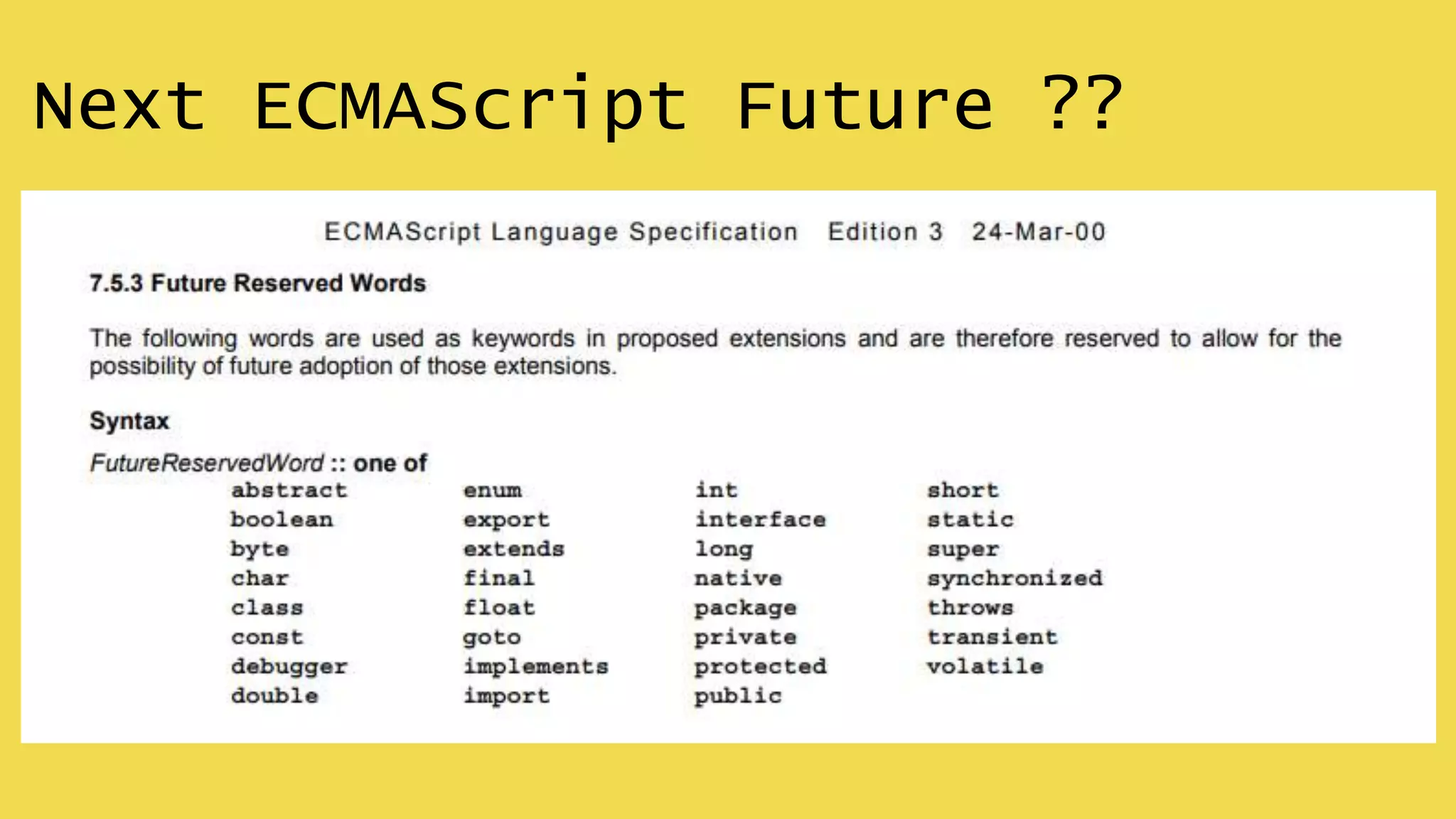
Next ECMAScript Future ??
2000-2005
Standardization
ECMAScript 4 work led by Waldemar Horwat (then at Netscape, now at Google) started in
2000. Microsoft initially participated and implemented some proposals in their JScript .NET language.
Over time it was clear that Microsoft had no intention of cooperating or implementing proper
JavaScript in Internet Explorer, even though they had no competing proposal and they had a partial
(and diverged at this point) implementation on the .NET server side. So by 2003, the original
ECMAScript 4 work was mothballed.
The next major event was in 2005, with two major happenings in JavaScript's history. First, Brendan
Eich and Mozilla rejoined Ecma International as a not-for-profit member and work started
on ECMAScript for XML (E4X), the ECMA-357 standard, which came from ex-Microsoft employees at BEA
Systems (originally acquired as Crossgain). This led to working jointly with Macromedia (later
acquired by Adobe Systems), who were implementing E4X in ActionScript 3 (ActionScript 3 was a fork of
original ECMAScript 4).
So, along with Macromedia, work restarted on ECMAScript 4 with the goal of standardizing what was in
ActionScript 3. To this end, Adobe Systems released the ActionScript Virtual Machine 2, code
named Tamarin, as an open source project. But Tamarin and ActionScript 3 were too different from web
JavaScript to converge, as was realized by the parties in 2007 and 2008.
Alas, there was still turmoil between the various players; Douglas Crockford—then at Yahoo!—joined
forces with Microsoft in 2007 to oppose ECMAScript 4, which led to the ECMAScript 3.1 effort. The
development of ECMAScript 4 was never completed, but that work influenced subsequent versions.
Community - AJAX
While all of this was happening, the open source and developer communities
set to work to revolutionize what could be done with JavaScript. This
community effort was sparked in 2005 when Jesse James Garrett released a
white paper in which he coined the term Ajax, and described a set of
technologies, of which JavaScript was the backbone, used to create web
applications where data can be loaded in the background, avoiding the need
for full page reloads and leading to more dynamic applications.
2006-2009
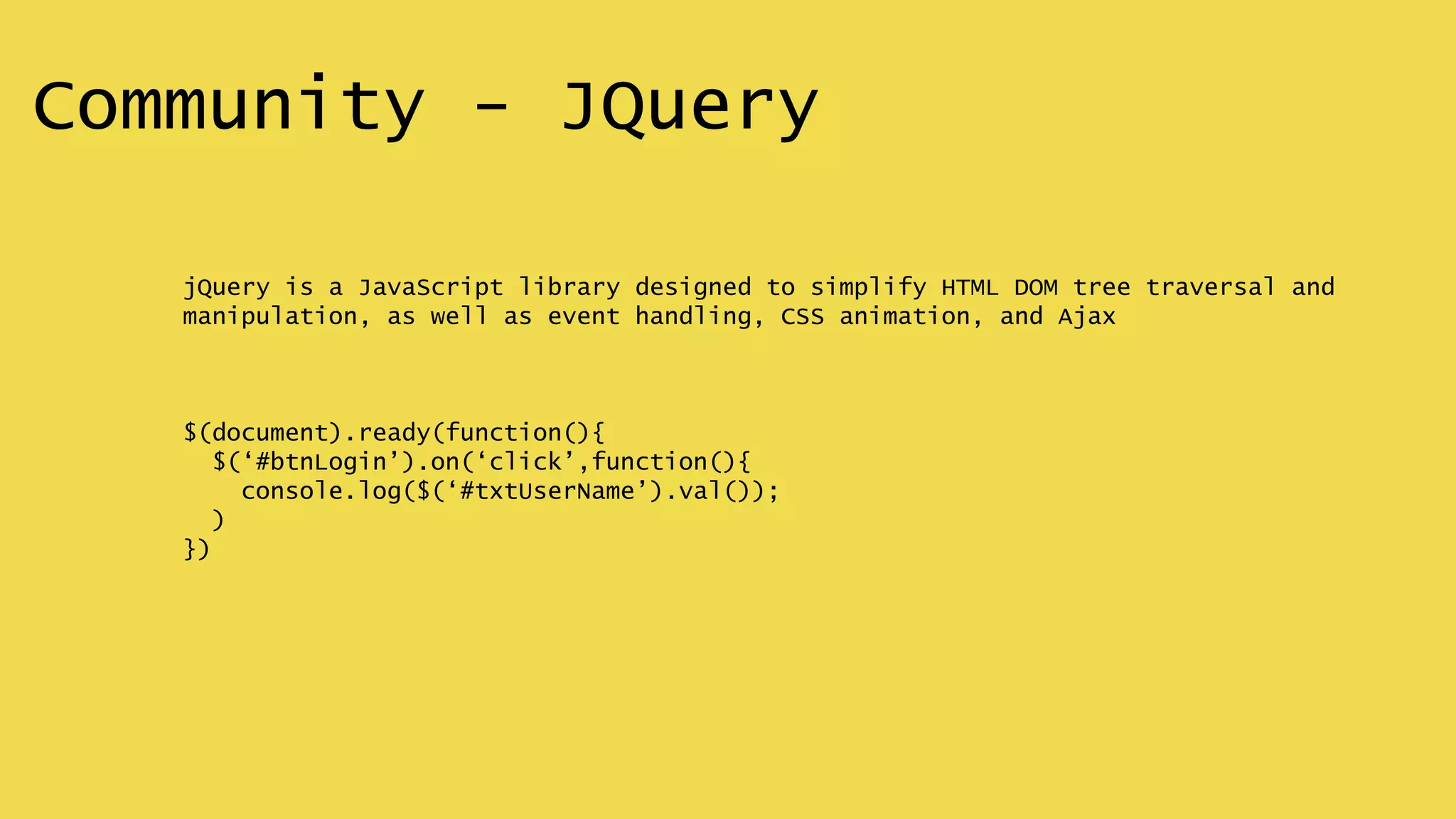
Community - JQuery
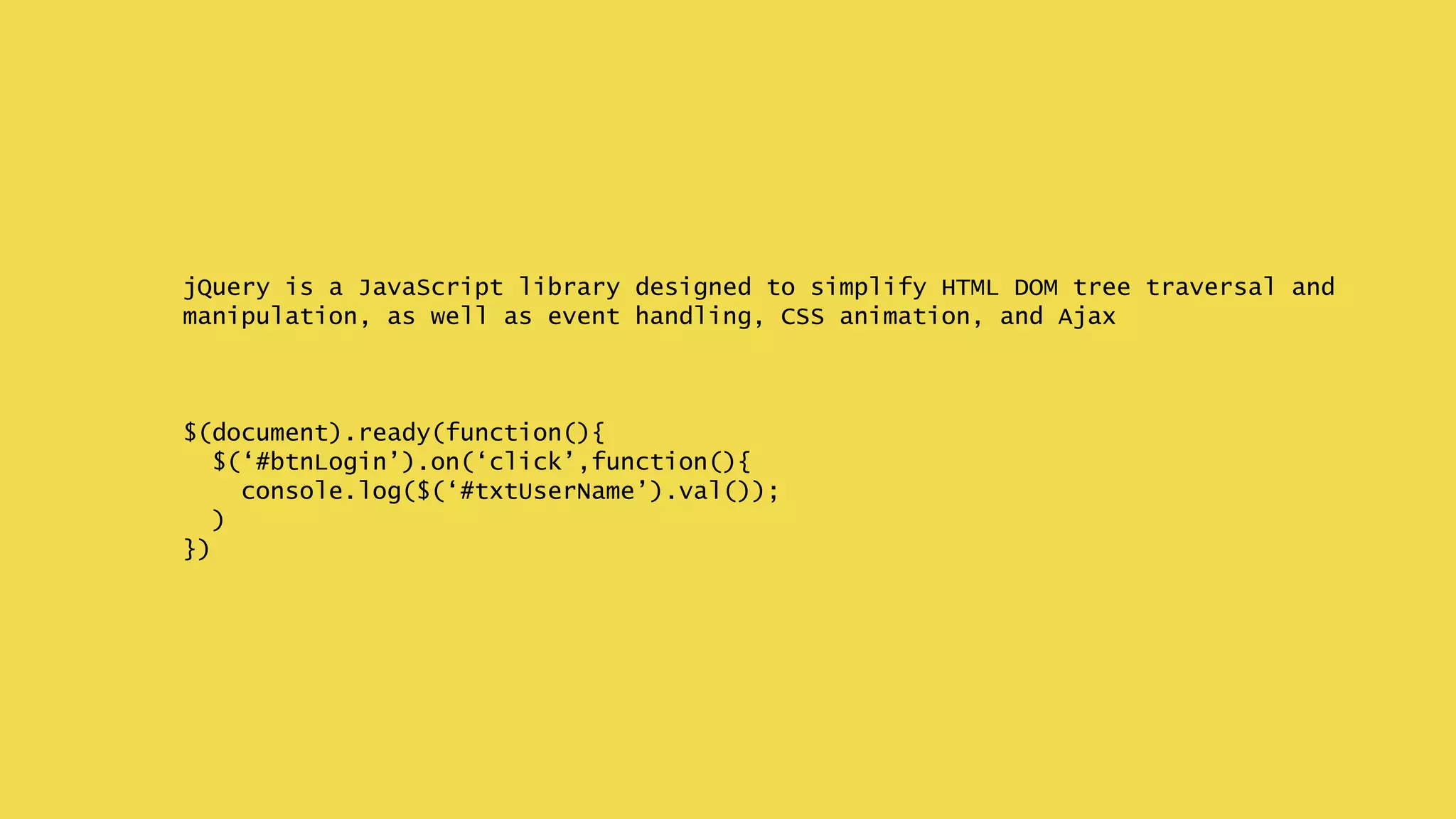
jQuery is a JavaScript library designed to simplify HTML DOM tree traversal and
manipulation, as well as event handling, CSS animation, and Ajax
$(document).ready(function(){
$(‘#btnLogin’).on(‘click’,function(){
console.log($(‘#txtUserName’).val());
)
})
JavaScript Library Author vs JavaScript Developer
jQuery is a JavaScript library designed to simplify HTML DOM tree traversal and
manipulation, as well as event handling, CSS animation, and Ajax
$(document).ready(function(){
$(‘#btnLogin’).on(‘click’,function(){
console.log($(‘#txtUserName’).val());
)
})
Until 2009
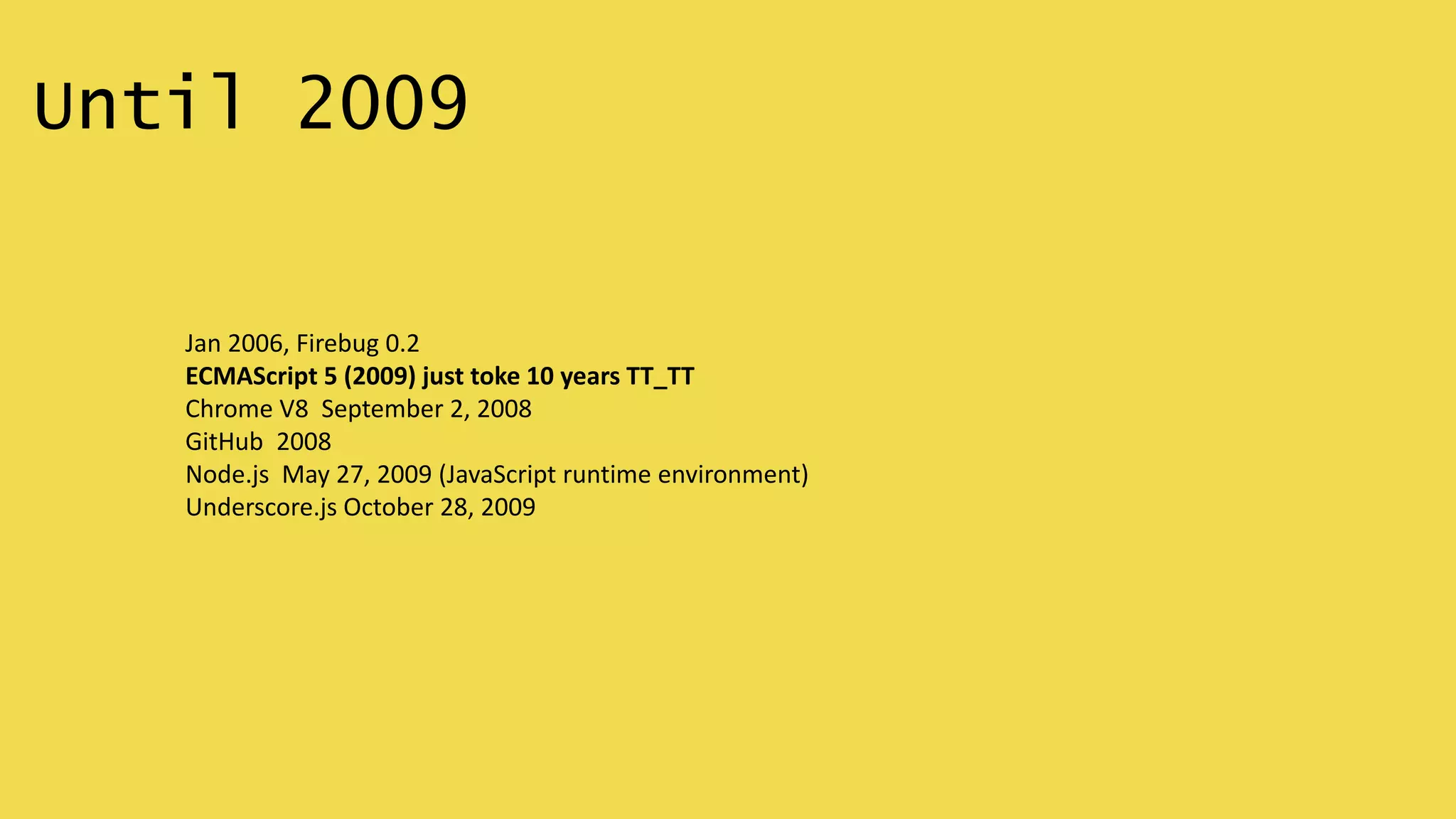
Jan 2006, Firebug 0.2
ECMAScript 5 (2009) just toke 10 years TT_TT
Chrome V8 September 2, 2008
GitHub 2008
Node.js May 27, 2009 (JavaScript runtime environment)
Underscore.js October 28, 2009
2010-2015
2010 until 2015
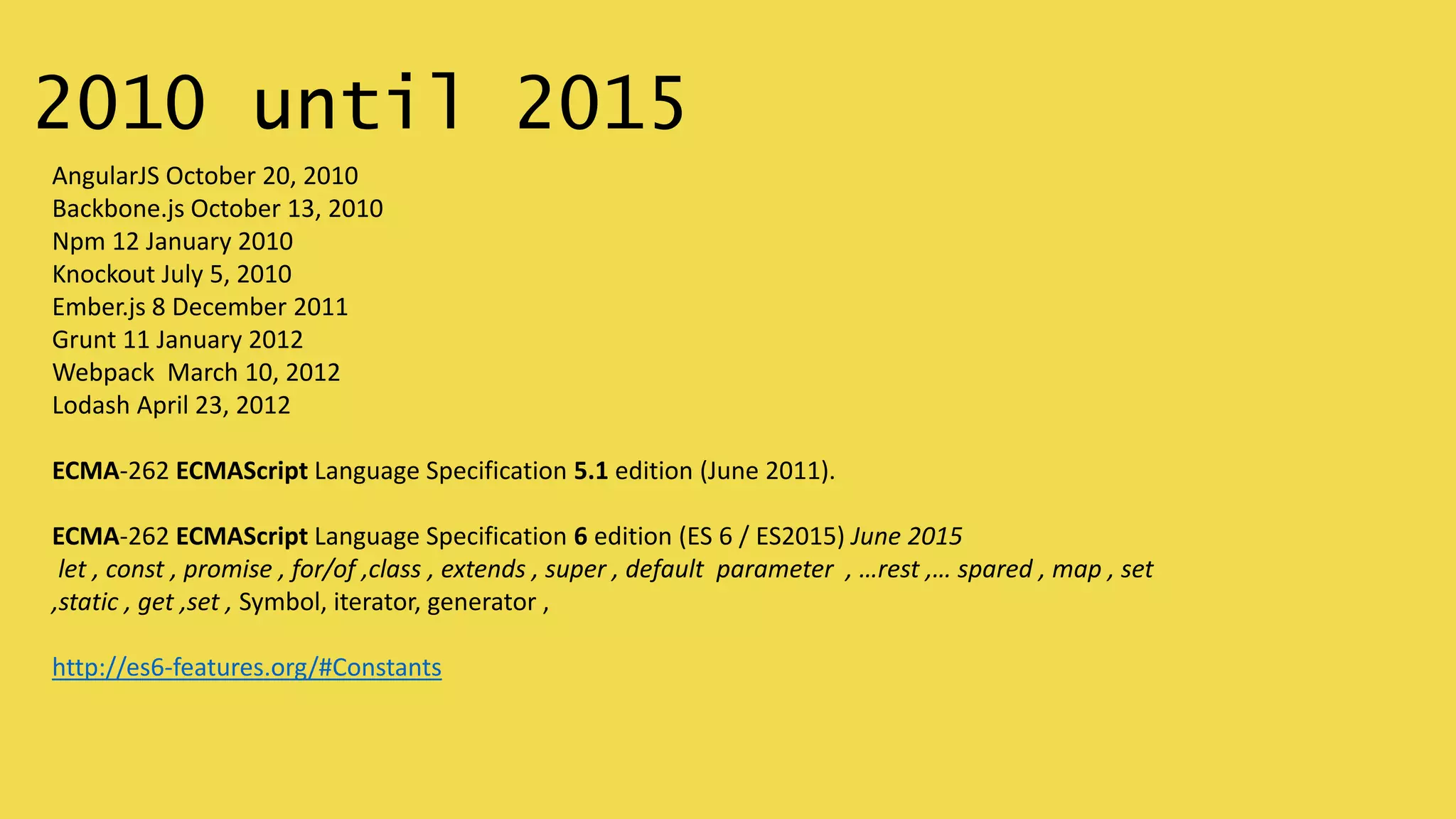
AngularJS October 20, 2010
Backbone.js October 13, 2010
Npm 12 January 2010
Knockout July 5, 2010
Ember.js 8 December 2011
Grunt 11 January 2012
Webpack March 10, 2012
Lodash April 23, 2012
ECMA-262 ECMAScript Language Specification 5.1 edition (June 2011).
ECMA-262 ECMAScript Language Specification 6 edition (ES 6 / ES2015) June 2015
let , const , promise , for/of ,class , extends , super , default parameter , …rest ,… spared , map , set
,static , get ,set , Symbol, iterator, generator ,
http://es6-features.org/#Constants
Weird Parts
Weird Parts
Don’t use == it is evil use ===
Weird Parts
• setInterval
• clearInterval
• fetch
• this
• document
• document.getElementById
• document.querySelector
• alert
• localStorage
• confirm…
Weird Parts
Weird Parts
1 == ‘1’
1 == true
1 === ‘1’
NaN == NaN
{} == {}
{} === {}
1 + ‘1’
1 – ‘1’
‘5’ – ‘1’
0 == []
"0" == []
Weird Parts
1 == ‘1’ => true
1 == true => true
1 === ‘1’ => false
NaN == NaN => false
{} == {} => false
{} === {} => false
1 + ‘1’ => ’11’
1 – ‘1’ => 0
‘5’ – ‘1’ => 4
0 == [] => true
"0" == [] => false
Solution :
https://www.ecma-international.org/ecma-262/5.1/#sec-11.9.3
Weird Parts
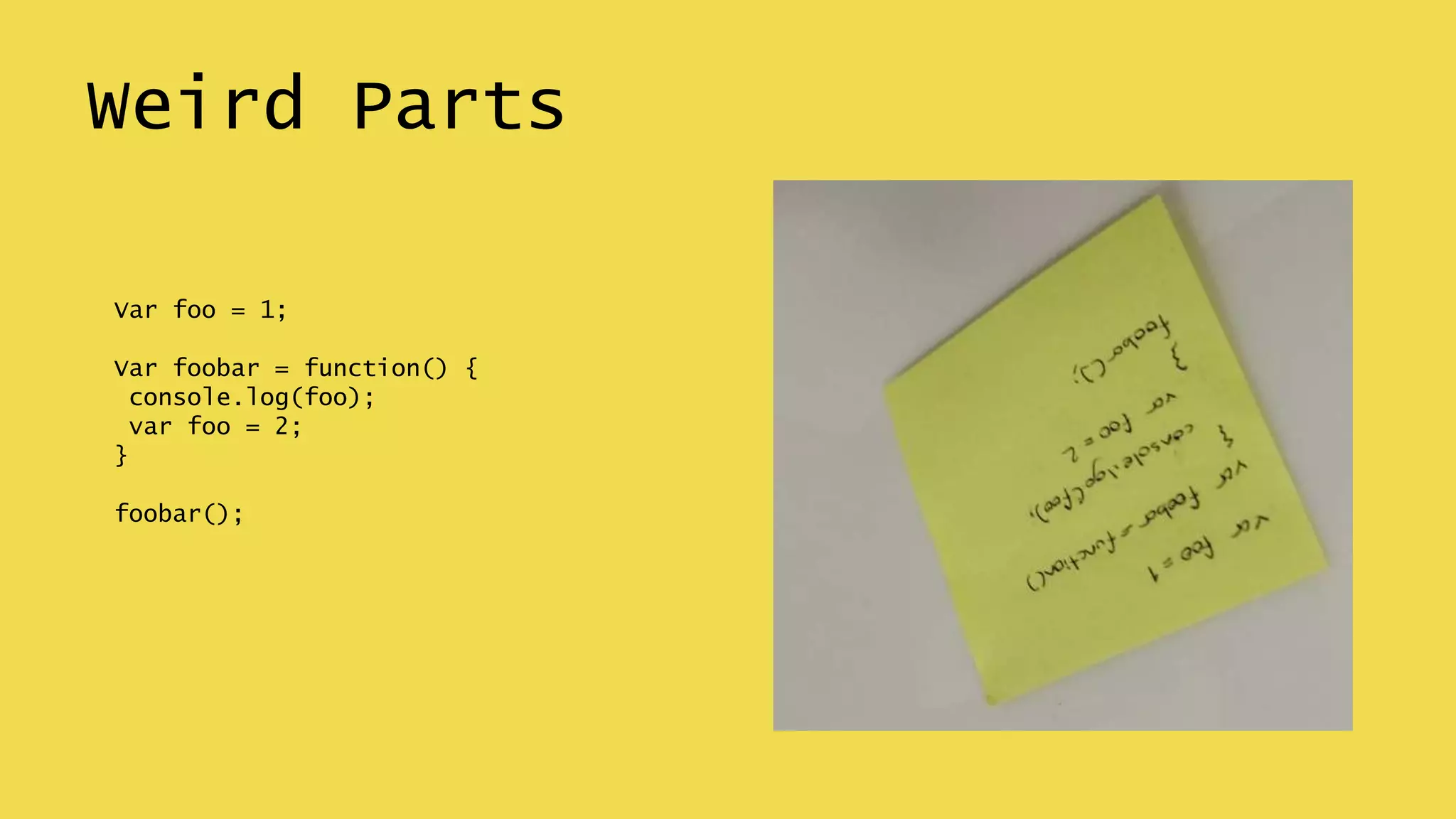
Var foo = 1;
Var foobar = function() {
console.log(foo);
var foo = 2;
}
foobar();
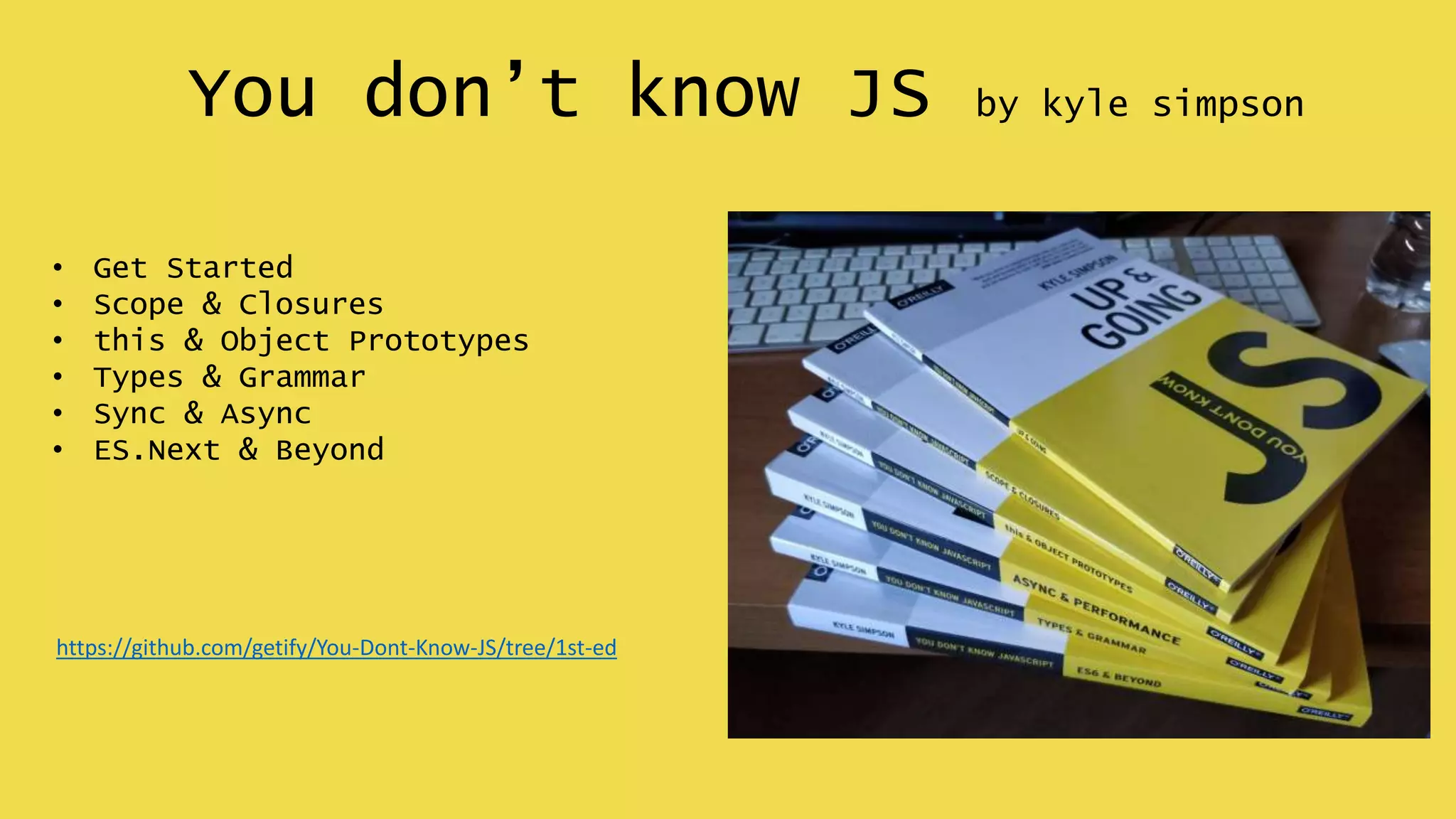
You don’t know JS by kyle simpson
• Get Started
• Scope & Closures
• this & Object Prototypes
• Types & Grammar
• Sync & Async
• ES.Next & Beyond
https://github.com/getify/You-Dont-Know-JS/tree/1st-ed
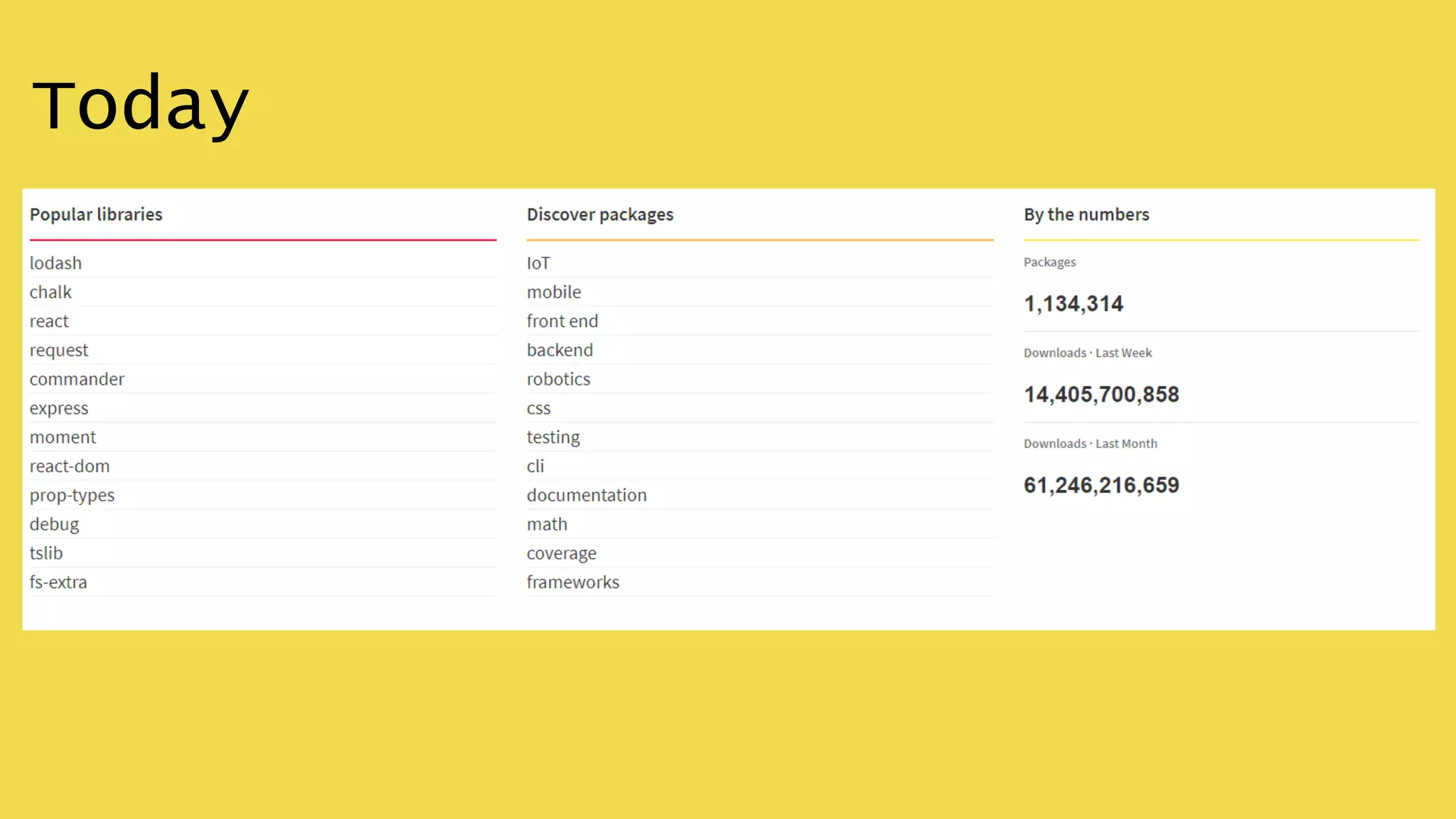
Today
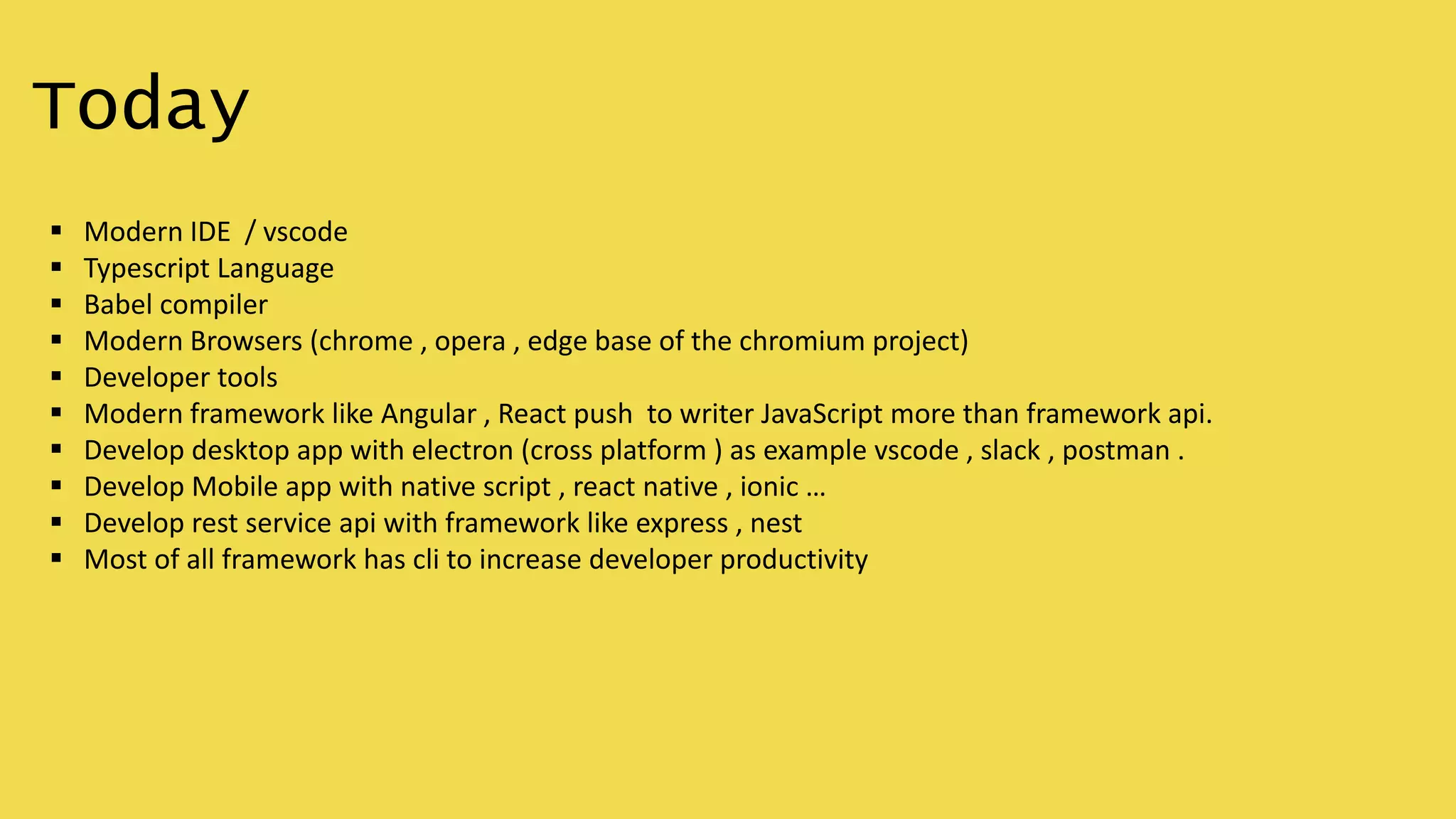
Today
Today
 Modern IDE / vscode
 Typescript Language
 Babel compiler
 Modern Browsers (chrome , opera , edge base of the chromium project)
 Developer tools
 Modern framework like Angular , React push to writer JavaScript more than framework api.
 Develop desktop app with electron (cross platform ) as example vscode , slack , postman .
 Develop Mobile app with native script , react native , ionic …
 Develop rest service api with framework like express , nest
 Most of all framework has cli to increase developer productivity

Javascript Today

  • 1.
  • 2.
    Agenda JavaScript? Version ES 1,2,3,4@.@,5.1 ,5, 6 (ES2015) ,.. Community Wired parts Modern JavaScript
  • 3.
  • 4.
    In 1995, NetscapeCommunications recruited Brendan Eich with the goal of embedding the Scheme programming language into its Netscape Navigator. Before he could get started, Netscape Communications collaborated with Sun Microsystems to include Sun's more static programming language, Java, in Netscape Navigator so as to compete with Microsoft for user adoption of Web technologies and platforms. Netscape Communications then decided that the scripting language they wanted to create would complement Java and should have a similar syntax, which excluded adopting other languages such as Perl, Python, TCL, or Scheme. To defend the idea of JavaScript against competing proposals, the company needed a prototype. Eich wrote one in 10 days, in May 1995.
  • 5.
    Although it wasdeveloped under the name Mocha, the language was officially called LiveScript when it first shipped in beta releases of Netscape Navigator 2.0 in September 1995, but it was renamed JavaScript when it was deployed in the Netscape Navigator 2.0 beta 3 in December ,The final choice of name caused confusion, giving the impression that the language was a spin-off of the Java programming language, and the choice has been characterized as a marketing ploy by Netscape to give JavaScript the cachet of what was then the hot new Web programming language.
  • 6.
    Standardization November 1996, Netscapesubmitted JavaScript to ECMA International to carve out a standard specification, which other browser vendors could then implement based on the work done at Netscape. This led to the official release of the language specification ECMAScript published in the first edition of the ECMA-262 standard in June 1997, with JavaScript being the most well known of the implementations. ActionScript and JScript were other well-known implementations of ECMAScript. The release of ECMAScript 2 in June 1998 continued the standards process cycle, conforming some modifications to the ISO/IEC 16262 international standard. ECMAScript 3 was released in December 1999.
  • 7.
  • 8.
  • 9.
    Standardization ECMAScript 4 workled by Waldemar Horwat (then at Netscape, now at Google) started in 2000. Microsoft initially participated and implemented some proposals in their JScript .NET language. Over time it was clear that Microsoft had no intention of cooperating or implementing proper JavaScript in Internet Explorer, even though they had no competing proposal and they had a partial (and diverged at this point) implementation on the .NET server side. So by 2003, the original ECMAScript 4 work was mothballed. The next major event was in 2005, with two major happenings in JavaScript's history. First, Brendan Eich and Mozilla rejoined Ecma International as a not-for-profit member and work started on ECMAScript for XML (E4X), the ECMA-357 standard, which came from ex-Microsoft employees at BEA Systems (originally acquired as Crossgain). This led to working jointly with Macromedia (later acquired by Adobe Systems), who were implementing E4X in ActionScript 3 (ActionScript 3 was a fork of original ECMAScript 4). So, along with Macromedia, work restarted on ECMAScript 4 with the goal of standardizing what was in ActionScript 3. To this end, Adobe Systems released the ActionScript Virtual Machine 2, code named Tamarin, as an open source project. But Tamarin and ActionScript 3 were too different from web JavaScript to converge, as was realized by the parties in 2007 and 2008. Alas, there was still turmoil between the various players; Douglas Crockford—then at Yahoo!—joined forces with Microsoft in 2007 to oppose ECMAScript 4, which led to the ECMAScript 3.1 effort. The development of ECMAScript 4 was never completed, but that work influenced subsequent versions.
  • 10.
    Community - AJAX Whileall of this was happening, the open source and developer communities set to work to revolutionize what could be done with JavaScript. This community effort was sparked in 2005 when Jesse James Garrett released a white paper in which he coined the term Ajax, and described a set of technologies, of which JavaScript was the backbone, used to create web applications where data can be loaded in the background, avoiding the need for full page reloads and leading to more dynamic applications.
  • 11.
  • 12.
    Community - JQuery jQueryis a JavaScript library designed to simplify HTML DOM tree traversal and manipulation, as well as event handling, CSS animation, and Ajax $(document).ready(function(){ $(‘#btnLogin’).on(‘click’,function(){ console.log($(‘#txtUserName’).val()); ) })
  • 13.
    JavaScript Library Authorvs JavaScript Developer
  • 14.
    jQuery is aJavaScript library designed to simplify HTML DOM tree traversal and manipulation, as well as event handling, CSS animation, and Ajax $(document).ready(function(){ $(‘#btnLogin’).on(‘click’,function(){ console.log($(‘#txtUserName’).val()); ) })
  • 15.
    Until 2009 Jan 2006,Firebug 0.2 ECMAScript 5 (2009) just toke 10 years TT_TT Chrome V8 September 2, 2008 GitHub 2008 Node.js May 27, 2009 (JavaScript runtime environment) Underscore.js October 28, 2009
  • 16.
  • 17.
    2010 until 2015 AngularJSOctober 20, 2010 Backbone.js October 13, 2010 Npm 12 January 2010 Knockout July 5, 2010 Ember.js 8 December 2011 Grunt 11 January 2012 Webpack March 10, 2012 Lodash April 23, 2012 ECMA-262 ECMAScript Language Specification 5.1 edition (June 2011). ECMA-262 ECMAScript Language Specification 6 edition (ES 6 / ES2015) June 2015 let , const , promise , for/of ,class , extends , super , default parameter , …rest ,… spared , map , set ,static , get ,set , Symbol, iterator, generator , http://es6-features.org/#Constants
  • 18.
  • 19.
    Weird Parts Don’t use== it is evil use ===
  • 20.
    Weird Parts • setInterval •clearInterval • fetch • this • document • document.getElementById • document.querySelector • alert • localStorage • confirm…
  • 21.
  • 22.
    Weird Parts 1 ==‘1’ 1 == true 1 === ‘1’ NaN == NaN {} == {} {} === {} 1 + ‘1’ 1 – ‘1’ ‘5’ – ‘1’ 0 == [] "0" == []
  • 23.
    Weird Parts 1 ==‘1’ => true 1 == true => true 1 === ‘1’ => false NaN == NaN => false {} == {} => false {} === {} => false 1 + ‘1’ => ’11’ 1 – ‘1’ => 0 ‘5’ – ‘1’ => 4 0 == [] => true "0" == [] => false Solution : https://www.ecma-international.org/ecma-262/5.1/#sec-11.9.3
  • 24.
    Weird Parts Var foo= 1; Var foobar = function() { console.log(foo); var foo = 2; } foobar();
  • 25.
    You don’t knowJS by kyle simpson • Get Started • Scope & Closures • this & Object Prototypes • Types & Grammar • Sync & Async • ES.Next & Beyond https://github.com/getify/You-Dont-Know-JS/tree/1st-ed
  • 26.
  • 27.
  • 28.
    Today  Modern IDE/ vscode  Typescript Language  Babel compiler  Modern Browsers (chrome , opera , edge base of the chromium project)  Developer tools  Modern framework like Angular , React push to writer JavaScript more than framework api.  Develop desktop app with electron (cross platform ) as example vscode , slack , postman .  Develop Mobile app with native script , react native , ionic …  Develop rest service api with framework like express , nest  Most of all framework has cli to increase developer productivity