RECYCLING
PARTICIPATION
AMONG RENTERS
IN MULTI-FAMILY
DWELLINGS
Working with the City of
Pittsburgh to improve
participation and outcomes
Simone Vecchio, Diane Flagg, Maria Didomenico, Caesar de Chicchis
PROJECT BACKGROUND
 39.3% of Pittsburgh’s 305,000 residents live in multi-unit
housing.
 Recycling has been mandated by the City of Pittsburgh
since 2004
 Section 619.13 requires landlords to inform the tenant of
city rules for storage, disposal, and recycling of refuse
 Buildings with 5 units or less receive free curbside recycling
pick-up from the City of Pittsburgh (bi-monthly, single
stream)
 Buildings with 6 or more units are responsible for
contracting with a private hauler to comply with the city’s
recycling mandate
CHALLENGES FOR THE CITY’S
RECYCLING PROGRAM
 The office has a limited staff of three people
responsible for enforcement and promotion of the
recycling program
 It is difficult to ensure that building managers are
offering recycling services to their tenants.
 It is difficult to determine who is in violation of the
mandate: the landlord or the tenant.
DESIGN OF STUDY
 Goal: Identify specific challenges and obstacles that prevent
renters and landlords from fully participating in mandated
recycling and propose recommendations for increasing recycling
compliance.
 Methods:
 Review of scholarly and practitioner literature
 Take examples from other similarly-situated cities
 Review how area universities can play a role in this issue
 Conduct a survey of residents and landlords and evaluate the
resulting qualitative and quantitative data
BARRIERS TO PARTICIPATION
 High turnover of tenants/Large student population
 Limited storage space
 Lack of cooperation by building owners
 Lack of communication between tenants and
management
 Lack of information of recycling practices
 High contamination rates
BEST PRACTICES FROM CITY AND
UNIVERSITY RESEARCH
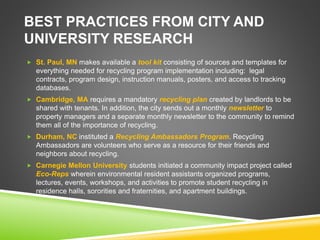
 St. Paul, MN makes available a tool kit consisting of sources and templates for
everything needed for recycling program implementation including: legal
contracts, program design, instruction manuals, posters, and access to tracking
databases.
 Cambridge, MA requires a mandatory recycling plan created by landlords to be
shared with tenants. In addition, the city sends out a monthly newsletter to
property managers and a separate monthly newsletter to the community to remind
them all of the importance of recycling.
 Durham, NC instituted a Recycling Ambassadors Program. Recycling
Ambassadors are volunteers who serve as a resource for their friends and
neighbors about recycling.
 Carnegie Mellon University students initiated a community impact project called
Eco-Reps wherein environmental resident assistants organized programs,
lectures, events, workshops, and activities to promote student recycling in
residence halls, sororities and fraternities, and apartment buildings.
SURVEY RESEARCH: RESIDENTS
 55 = total surveys
 41 = Pittsburgh residents
 28 = renters
 10 = dormitory
 3 = owner-occupied
 Geography
 Age
 Tenure
 Building type
 Duration
 Awareness of program
 Level of participation
 Motivating factors
 Problems
QUANTIFYING PARTICIPATION
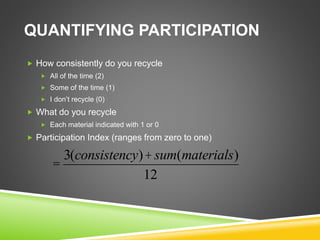
 How consistently do you recycle
 All of the time (2)
 Some of the time (1)
 I don’t recycle (0)
 What do you recycle
 Each material indicated with 1 or 0
 Participation Index (ranges from zero to one)
=
3(consistency)+sum(materials)
12
MATERIALS: PERCENT OF
RESPONDENTS RECYCLING
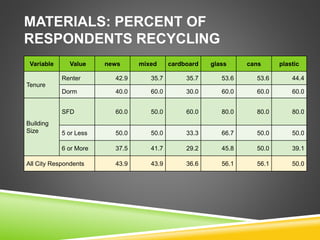
Variable Value news mixed cardboard glass cans plastic
Tenure
Renter 42.9 35.7 35.7 53.6 53.6 44.4
Dorm 40.0 60.0 30.0 60.0 60.0 60.0
Building
Size
SFD 60.0 50.0 60.0 80.0 80.0 80.0
5 or Less 50.0 50.0 33.3 66.7 50.0 50.0
6 or More 37.5 41.7 29.2 45.8 50.0 39.1
All City Respondents 43.9 43.9 36.6 56.1 56.1 50.0
VARIATION IN PARTICIPATION SCORE
ACROSS TWO HOUSING VARIABLES
Building Type
SFD* 5 or Less 6 or More
Housing
Tenure
OWN 1.00 1.00
RENT 0.64 0.53 0.36 0.48
DORM 0.51 0.51
0.71 0.53 0.43
City-wide mean = 0.51
MULTIVARIATE ANALYSIS
IV coefficient P>|t|
months at residence -0.0002 0.902
5 units or less -0.106 0.58
more than 5 units -0.273 0.087
rent -0.393 0.294
dorm -0.247 0.537
constant 1.033 0.007
observations 40
Prob > F 0.217
R-squared 0.180
Adj. R-squared 0.060
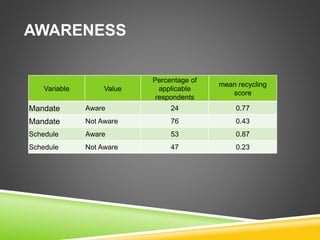
AWARENESS
Variable Value
Percentage of
applicable
respondents
mean recycling
score
Mandate Aware 24 0.77
Mandate Not Aware 76 0.43
Schedule Aware 53 0.87
Schedule Not Aware 47 0.23
BUILDING MANAGER SURVEY
 Administered at a monthly meeting of the Western Pennsylvania
Real Estate Investors Association
 36 total surveys, 24 were of managers of properties within City of
Pittsburgh
 19 of 24 surveys were from managers of buildings with 5 units or
less
 Survey gathered data on geography, building type, knowledge of
mandate, fines/warnings, and what steps the managers take to
facilitate recycling among tenants.
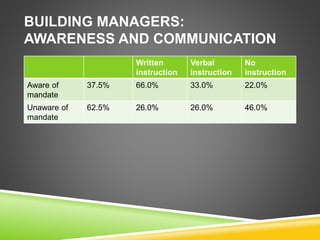
BUILDING MANAGERS:
AWARENESS AND COMMUNICATION
Written
instruction
Verbal
instruction
No
instruction
Aware of
mandate
37.5% 66.0% 33.0% 22.0%
Unaware of
mandate
62.5% 26.0% 26.0% 46.0%
RECOMMENDATIONS:
 Enhanced Recycling Website
 Improving the Website
 Automate the process that informs residents of their collection schedule.
 Include information about recycling batteries and electronic waste.
 Provide links to non profit groups that accept reusable furniture and appliances.
 Marketing the Website
 Several universities have expressed interest in including a link to recycling
information on the web pages they maintain for off-campus housing resources.
 The Western Pennsylvania Real Estate Investors Association and other
organizations geared toward property managers could provide a link on their website
or in their newsletters to help inform landlords of the City’s recycling procedures.
RECOMMENDATIONS
 Collection of Data and Assessing MFD performance levels
 City and State law currently requires building managers in conjunction with
haulers to report recycling tonnages on a quarterly or annual basis, although it
is unclear to what extent this information is available.
 Tonnage data could form the basis of a performance evaluation system that
would classify buildings as having high, medium, or low levels of compliance.
 A performance evaluation system would help to allocate resources to problem
areas.
RECOMMENDATIONS:
 Landlord/Tenant Action Plan
 A tool kit similar to those being used in St. Paul, MN could facilitate landlord
tenant communication on recycling.
 A system of random inspections, such as that administered in Cambridge, MA
could increase compliance among managers. Having these enforcement
measures covered in the media could amplify their efficacy.
 The City should work with the County and Municipalities to establish uniform
recycling regulations for MFDs. This could help increase compliance among
landlords who own properties in multiple jurisdictions.
RECOMMENDATIONS
 Recycling Ambassador
 Evaluate current recycling programs and provide feedback to better enhance
their effectiveness and convenience for residents and encourage
management and resident participation.
 Act as a consultant to landlords/property managers to develop recycling in
their buildings, to advise landlords on providing educational materials, and to
provide recycling information in lease agreements and newsletters when
available.
 Evaluate participation and collection in large complexes to provide feedback
on contamination issues and progress.

recycling presentation ppt final

  • 1.
    RECYCLING PARTICIPATION AMONG RENTERS IN MULTI-FAMILY DWELLINGS Workingwith the City of Pittsburgh to improve participation and outcomes Simone Vecchio, Diane Flagg, Maria Didomenico, Caesar de Chicchis
  • 2.
    PROJECT BACKGROUND  39.3%of Pittsburgh’s 305,000 residents live in multi-unit housing.  Recycling has been mandated by the City of Pittsburgh since 2004  Section 619.13 requires landlords to inform the tenant of city rules for storage, disposal, and recycling of refuse  Buildings with 5 units or less receive free curbside recycling pick-up from the City of Pittsburgh (bi-monthly, single stream)  Buildings with 6 or more units are responsible for contracting with a private hauler to comply with the city’s recycling mandate
  • 3.
    CHALLENGES FOR THECITY’S RECYCLING PROGRAM  The office has a limited staff of three people responsible for enforcement and promotion of the recycling program  It is difficult to ensure that building managers are offering recycling services to their tenants.  It is difficult to determine who is in violation of the mandate: the landlord or the tenant.
  • 4.
    DESIGN OF STUDY Goal: Identify specific challenges and obstacles that prevent renters and landlords from fully participating in mandated recycling and propose recommendations for increasing recycling compliance.  Methods:  Review of scholarly and practitioner literature  Take examples from other similarly-situated cities  Review how area universities can play a role in this issue  Conduct a survey of residents and landlords and evaluate the resulting qualitative and quantitative data
  • 5.
    BARRIERS TO PARTICIPATION High turnover of tenants/Large student population  Limited storage space  Lack of cooperation by building owners  Lack of communication between tenants and management  Lack of information of recycling practices  High contamination rates
  • 6.
    BEST PRACTICES FROMCITY AND UNIVERSITY RESEARCH  St. Paul, MN makes available a tool kit consisting of sources and templates for everything needed for recycling program implementation including: legal contracts, program design, instruction manuals, posters, and access to tracking databases.  Cambridge, MA requires a mandatory recycling plan created by landlords to be shared with tenants. In addition, the city sends out a monthly newsletter to property managers and a separate monthly newsletter to the community to remind them all of the importance of recycling.  Durham, NC instituted a Recycling Ambassadors Program. Recycling Ambassadors are volunteers who serve as a resource for their friends and neighbors about recycling.  Carnegie Mellon University students initiated a community impact project called Eco-Reps wherein environmental resident assistants organized programs, lectures, events, workshops, and activities to promote student recycling in residence halls, sororities and fraternities, and apartment buildings.
  • 7.
    SURVEY RESEARCH: RESIDENTS 55 = total surveys  41 = Pittsburgh residents  28 = renters  10 = dormitory  3 = owner-occupied  Geography  Age  Tenure  Building type  Duration  Awareness of program  Level of participation  Motivating factors  Problems
  • 8.
    QUANTIFYING PARTICIPATION  Howconsistently do you recycle  All of the time (2)  Some of the time (1)  I don’t recycle (0)  What do you recycle  Each material indicated with 1 or 0  Participation Index (ranges from zero to one) = 3(consistency)+sum(materials) 12
  • 9.
    MATERIALS: PERCENT OF RESPONDENTSRECYCLING Variable Value news mixed cardboard glass cans plastic Tenure Renter 42.9 35.7 35.7 53.6 53.6 44.4 Dorm 40.0 60.0 30.0 60.0 60.0 60.0 Building Size SFD 60.0 50.0 60.0 80.0 80.0 80.0 5 or Less 50.0 50.0 33.3 66.7 50.0 50.0 6 or More 37.5 41.7 29.2 45.8 50.0 39.1 All City Respondents 43.9 43.9 36.6 56.1 56.1 50.0
  • 10.
    VARIATION IN PARTICIPATIONSCORE ACROSS TWO HOUSING VARIABLES Building Type SFD* 5 or Less 6 or More Housing Tenure OWN 1.00 1.00 RENT 0.64 0.53 0.36 0.48 DORM 0.51 0.51 0.71 0.53 0.43 City-wide mean = 0.51
  • 11.
    MULTIVARIATE ANALYSIS IV coefficientP>|t| months at residence -0.0002 0.902 5 units or less -0.106 0.58 more than 5 units -0.273 0.087 rent -0.393 0.294 dorm -0.247 0.537 constant 1.033 0.007 observations 40 Prob > F 0.217 R-squared 0.180 Adj. R-squared 0.060
  • 12.
    AWARENESS Variable Value Percentage of applicable respondents meanrecycling score Mandate Aware 24 0.77 Mandate Not Aware 76 0.43 Schedule Aware 53 0.87 Schedule Not Aware 47 0.23
  • 13.
    BUILDING MANAGER SURVEY Administered at a monthly meeting of the Western Pennsylvania Real Estate Investors Association  36 total surveys, 24 were of managers of properties within City of Pittsburgh  19 of 24 surveys were from managers of buildings with 5 units or less  Survey gathered data on geography, building type, knowledge of mandate, fines/warnings, and what steps the managers take to facilitate recycling among tenants.
  • 14.
    BUILDING MANAGERS: AWARENESS ANDCOMMUNICATION Written instruction Verbal instruction No instruction Aware of mandate 37.5% 66.0% 33.0% 22.0% Unaware of mandate 62.5% 26.0% 26.0% 46.0%
  • 15.
    RECOMMENDATIONS:  Enhanced RecyclingWebsite  Improving the Website  Automate the process that informs residents of their collection schedule.  Include information about recycling batteries and electronic waste.  Provide links to non profit groups that accept reusable furniture and appliances.  Marketing the Website  Several universities have expressed interest in including a link to recycling information on the web pages they maintain for off-campus housing resources.  The Western Pennsylvania Real Estate Investors Association and other organizations geared toward property managers could provide a link on their website or in their newsletters to help inform landlords of the City’s recycling procedures.
  • 16.
    RECOMMENDATIONS  Collection ofData and Assessing MFD performance levels  City and State law currently requires building managers in conjunction with haulers to report recycling tonnages on a quarterly or annual basis, although it is unclear to what extent this information is available.  Tonnage data could form the basis of a performance evaluation system that would classify buildings as having high, medium, or low levels of compliance.  A performance evaluation system would help to allocate resources to problem areas.
  • 17.
    RECOMMENDATIONS:  Landlord/Tenant ActionPlan  A tool kit similar to those being used in St. Paul, MN could facilitate landlord tenant communication on recycling.  A system of random inspections, such as that administered in Cambridge, MA could increase compliance among managers. Having these enforcement measures covered in the media could amplify their efficacy.  The City should work with the County and Municipalities to establish uniform recycling regulations for MFDs. This could help increase compliance among landlords who own properties in multiple jurisdictions.
  • 18.
    RECOMMENDATIONS  Recycling Ambassador Evaluate current recycling programs and provide feedback to better enhance their effectiveness and convenience for residents and encourage management and resident participation.  Act as a consultant to landlords/property managers to develop recycling in their buildings, to advise landlords on providing educational materials, and to provide recycling information in lease agreements and newsletters when available.  Evaluate participation and collection in large complexes to provide feedback on contamination issues and progress.

Editor's Notes

  • #7 the non-profit recycling hauler, Eureka Recycling contracted by the city of St. Paul. available to assist apartment buildings in nearby cities with designing a model program to establish recycling collection. available to assist apartment buildings in nearby cities with designing a model program to establish recycling collection.
  • #11 This table compares recycling participation across two variables. The two respondents who owned their own home had perfect recycling scores. Participation drops markedly for those that rent or live in a dormitory. Again, participation also decreases as we move from single family dwellings to larger apartment buildings, suggesting that the most severe problem is among residents who do not have their recycling collected by the city. The interior of the table represents the cross section of both variables, and illustrates that renters in buildings with 6 or more units exhibits the lowest levels of participation
  • #16 Automated process: create and application that would allow residents to input their address and have their recycling information generated automatically
  • #17 Further research is needed on participation rates and recycling behavior among renters in the city
  • #18 The toolkit can include posters, commitment pledges.
  • #19 to coordinate and address the needs and challenges of recycling in MFDs