Searching and Sorting
 Linear search Is the process to find whether a number is present in an array.
If it's present, then at what location it occurs.
 It is also known as a sequential search.
 It is straightforward and compare each element with the element to search
until we find it or the list ends.
 Best case: When element is found at first position in array
No. of comparisons=1
 Worst case; When element is found at last position in array
No. of comparisons=n(no. of elements )
 Average case: When element is found in middle of array
No. of comparisons=n/2(no. of elements/2 )
Linear Search
Linear Search
• Check every element in the list, until the
target is found
• For example, our target is 38:
i 0 1 2 3 4 5
a[i] 25 14 9 38 77 45
If item to search=38 ,then it tells found at
location 4
If item to search=55 ,then it tells Item Not found
Program to perform Linear Search
void linearsearch(int array[],item,n)
{
for (i = 0; i < n; i++)
{
if (array[i] == item) /* If required element is found */
{
printf(“Found at location %d”, i+1);
flag=1
break;
}
}
if (flag==0)
printf(“Item not found”);
}
Explanation
• Assume array of size n and item to search
• Assume initially flag=0
• First, we have to traverse the array elements using
a for loop.
• In each iteration of for loop, compare the search element
with the current array element,
– If array[i]==item, then it displays found at the position
of the corresponding array element and sets flag=1.
– If the element does not match, then move to the next
element.
• If flag==0 that means there is no match found in the given
array , then it displays not found
Binary Search
• Binary Search is a searching approach for finding an
element in a sorted array.
• Binary search follows the divide and conquer
approach in which the array is divided into two
halves, and the item is compared with the middle
element of an array.
• If the match is found then, the location of the middle
element is returned.
• Otherwise, we search into either of the halves
depending upon the result produced through the
match.
Binary Search
int BinarySearch(int key, int arr[], int n)
{
int low, high, mid;
low = 0;
high = n – 1;
while ( low <= high) {
mid = (low + high) / 2;
if ( key== arr[mid])
return mid; /*found match,return position where it is found*/
else if (key > arr[mid])
low = mid + 1; //search on right half by updating low
else
high = mid – 1; //search on left half by updating high
}
return –1; /*No match ,so return -1*/
}
Binary Search Explanation
• Assume key is element to search in array arr of size n
• Set two variables low=0 and high=n-1 pointing to start and
end of array
• Find the middle position of array ,mid=(low+high)/2
• Compare the middle element of the array with the key to
search.
– If the key ==arr[mid], then process is terminated and display found at
middle location.
– If the key is not found at middle element, choose which half will be
used as the next search space.
• If the key > arr[mid], then the right side is used for next search.
• If the key < arr[mid], then the left side is used for next search.
• This process is continued until the key is found or the complete
array is exhausted.
Example
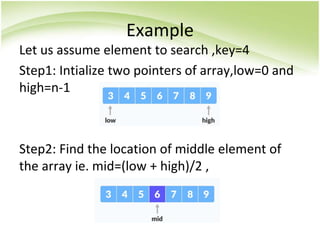
Let us assume element to search ,key=4
Step1: Intialize two pointers of array,low=0 and
high=n-1
Step2: Find the location of middle element of
the array ie. mid=(low + high)/2 ,
Example
Step3: As key <arr[mid] so it has to search on
left of array.So it update,low=0 and high=mid-1
Step4:Now new middle position=(low+high)/2=1
Step5: Then,it compares key with middle
element .As key==arr[mid],so it displays found
at middle location 1
Sorting – Example
11
• Original list:
– 10, 30, 20, 80, 70, 10, 60, 40, 70
• Sorted in non-decreasing order:
– 10, 10, 20, 30, 40, 60, 70, 70, 80
• Sorted in non-increasing order:
– 80, 70, 70, 60, 40, 30, 20, 10, 10
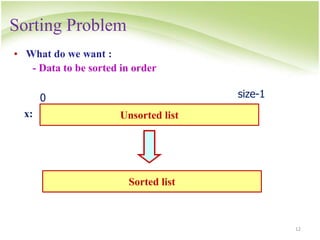
Sorting Problem
12
Unsorted list
• What do we want :
- Data to be sorted in order
x:
0 size-1
Sorted list
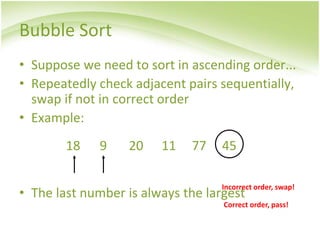
• Suppose we need to sort in ascending order...
• Repeatedly check adjacent pairs sequentially,
swap if not in correct order
• Example:
• The last number is always the largest
Bubble Sort
9 20 11
18 45
77
Incorrect order, swap!
Correct order, pass!
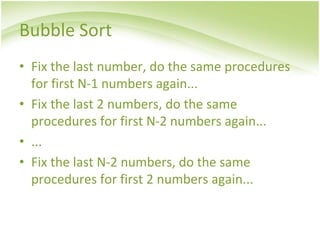
Bubble Sort
• Fix the last number, do the same procedures
for first N-1 numbers again...
• Fix the last 2 numbers, do the same
procedures for first N-2 numbers again...
• ...
• Fix the last N-2 numbers, do the same
procedures for first 2 numbers again...
Bubble Sort
for i -> 1 to n-1
for j -> 1 to n-i
if a[j]>a[j+1], swap them
• How to swap?
Bubble Sort
19
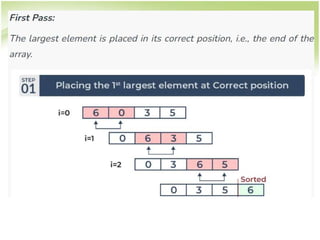
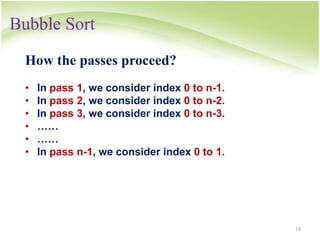
How the passes proceed?
• In pass 1, we consider index 0 to n-1.
• In pass 2, we consider index 0 to n-2.
• In pass 3, we consider index 0 to n-3.
• ……
• ……
• In pass n-1, we consider index 0 to 1.
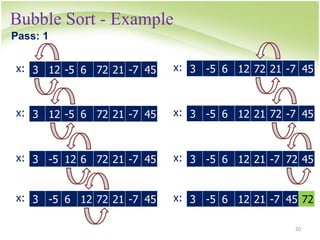
Bubble Sort - Example
20
3 12 -5 6 72 21 -7 45
x:
Pass: 1
3 12 -5 6 72 21 -7 45
x:
3 -5 12 6 72 21 -7 45
x:
3 -5 6 12 72 21 -7 45
x:
3 -5 6 12 72 21 -7 45
x:
3 -5 6 12 21 72 -7 45
x:
3 -5 6 12 21 -7 72 45
x:
3 -5 6 12 21 -7 45 72
x:
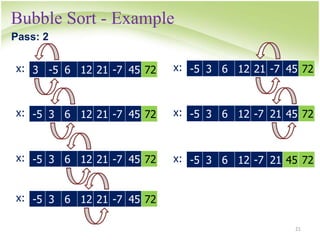
Bubble Sort - Example
21
3 -5 6 12 21 -7 45 72
x:
Pass: 2
-5 3 6 12 21 -7 45 72
x:
-5 3 6 12 21 -7 45 72
x:
-5 3 6 12 21 -7 45 72
x:
-5 3 6 12 21 -7 45 72
x:
-5 3 6 12 -7 21 45 72
x:
-5 3 6 12 -7 21 45 72
x:
Bubble Sort
void bubbleSort (int a[ ] , int size)
{
int i, j, temp;
for ( i = 0; i < size; i++ ) /* controls passes through the list */
{
for ( j = 0; j < size - 1; j++ ) /* performs adjacent comparisons */
{
if ( a[ j ] > a[ j+1 ] ) /* determines if a swap should occur */
{
temp = a[ j ]; /* swap is performed */
a[ j ] = a[ j + 1 ];
a[ j+1 ] = temp;
}
}
}
}
Insertion Sort
23
General situation :
0 size-1
i
remainder, unsorted
smallest elements, sorted
0 size-1
i
x:
i
j
Compare and
Shift till x[i] is
larger.
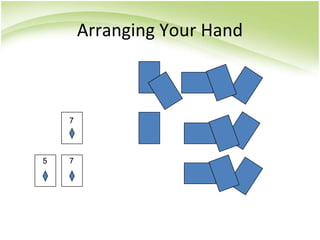
Arranging Your Hand
7
5 7
Insertion Sort
25
void insertionSort (int list[], int size)
{
int i,j,item;
for (i=1; i<size; i++)
{
item = list[i] ;
/* Move elements of list[0..i-1], that are greater than
item, to one position ahead of their current position */
for (j=i-1; (j>=0)&& (list[j] > item); j--)
list[j+1] = list[j];
list[j+1] = item ;
}
}
26
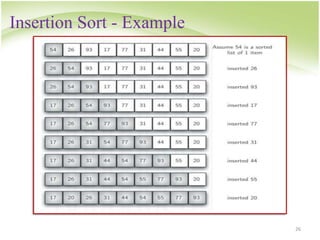
Insertion Sort - Example
Insertion Sort
void insertionSort(int numbers[], int array_size)
{
int i, j, index;
for (i=1; i < array_size; i++) {
index = numbers[i];
j = i;
while ((j > 0) && (numbers[j-1] > index)) {
numbers[j] = numbers[j-1];
j = j - 1;
}
numbers[j] = index;
}
}
Selection Sort
28
General situation :
remainder, unsorted
smallest elements, sorted
0 size-1
k
x:
Steps :
• Find smallest element, mval, in x[k…size-1]
• Swap smallest element with x[k], then increase k.
0 k size-1
mval
swap
x:
Selection Sort
29
/* Yield location of smallest element in
x[k .. size-1];*/
int findMinLloc (int x[ ], int k, int size)
{
int j, pos; /* x[pos] is the smallest
element found so far */
pos = k;
for (j=k+1; j<size; j++)
if (x[j] < x[pos])
pos = j;
return pos;
}
Selection Sort
30
/* The main sorting function */
/* Sort x[0..size-1] in non-decreasing order */
int selectionSort (int x[], int size)
{ int k, m;
for (k=0; k<size-1; k++)
{
m = findMinLoc(x, k, size);
temp = a[k];
a[k] = a[m];
a[m] = temp;
}
}
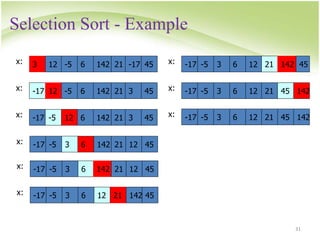
Selection Sort - Example
31
-17 12 -5 6 142 21 3 45
x:
3 12 -5 6 142 21 -17 45
x:
-17 -5 12 6 142 21 3 45
x:
-17 -5 3 6 142 21 12 45
x:
-17 -5 3 6 142 21 12 45
x:
-17 -5 3 6 12 21 142 45
x:
-17 -5 3 6 12 21 45 142
x:
-17 -5 3 6 21 142 45
x: 12
-17 -5 3 6 12 21 45 142
x:
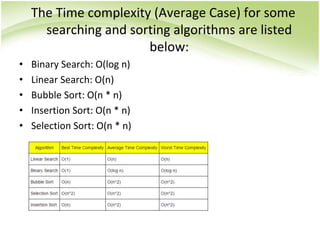
The Time complexity (Average Case) for some
searching and sorting algorithms are listed
below:
• Binary Search: O(log n)
• Linear Search: O(n)
• Bubble Sort: O(n * n)
• Insertion Sort: O(n * n)
• Selection Sort: O(n * n)

search_sort.ppt

  • 1.
  • 2.
     Linear searchIs the process to find whether a number is present in an array. If it's present, then at what location it occurs.  It is also known as a sequential search.  It is straightforward and compare each element with the element to search until we find it or the list ends.  Best case: When element is found at first position in array No. of comparisons=1  Worst case; When element is found at last position in array No. of comparisons=n(no. of elements )  Average case: When element is found in middle of array No. of comparisons=n/2(no. of elements/2 ) Linear Search
  • 3.
    Linear Search • Checkevery element in the list, until the target is found • For example, our target is 38: i 0 1 2 3 4 5 a[i] 25 14 9 38 77 45 If item to search=38 ,then it tells found at location 4 If item to search=55 ,then it tells Item Not found
  • 4.
    Program to performLinear Search void linearsearch(int array[],item,n) { for (i = 0; i < n; i++) { if (array[i] == item) /* If required element is found */ { printf(“Found at location %d”, i+1); flag=1 break; } } if (flag==0) printf(“Item not found”); }
  • 5.
    Explanation • Assume arrayof size n and item to search • Assume initially flag=0 • First, we have to traverse the array elements using a for loop. • In each iteration of for loop, compare the search element with the current array element, – If array[i]==item, then it displays found at the position of the corresponding array element and sets flag=1. – If the element does not match, then move to the next element. • If flag==0 that means there is no match found in the given array , then it displays not found
  • 6.
    Binary Search • BinarySearch is a searching approach for finding an element in a sorted array. • Binary search follows the divide and conquer approach in which the array is divided into two halves, and the item is compared with the middle element of an array. • If the match is found then, the location of the middle element is returned. • Otherwise, we search into either of the halves depending upon the result produced through the match.
  • 7.
    Binary Search int BinarySearch(intkey, int arr[], int n) { int low, high, mid; low = 0; high = n – 1; while ( low <= high) { mid = (low + high) / 2; if ( key== arr[mid]) return mid; /*found match,return position where it is found*/ else if (key > arr[mid]) low = mid + 1; //search on right half by updating low else high = mid – 1; //search on left half by updating high } return –1; /*No match ,so return -1*/ }
  • 8.
    Binary Search Explanation •Assume key is element to search in array arr of size n • Set two variables low=0 and high=n-1 pointing to start and end of array • Find the middle position of array ,mid=(low+high)/2 • Compare the middle element of the array with the key to search. – If the key ==arr[mid], then process is terminated and display found at middle location. – If the key is not found at middle element, choose which half will be used as the next search space. • If the key > arr[mid], then the right side is used for next search. • If the key < arr[mid], then the left side is used for next search. • This process is continued until the key is found or the complete array is exhausted.
  • 9.
    Example Let us assumeelement to search ,key=4 Step1: Intialize two pointers of array,low=0 and high=n-1 Step2: Find the location of middle element of the array ie. mid=(low + high)/2 ,
  • 10.
    Example Step3: As key<arr[mid] so it has to search on left of array.So it update,low=0 and high=mid-1 Step4:Now new middle position=(low+high)/2=1 Step5: Then,it compares key with middle element .As key==arr[mid],so it displays found at middle location 1
  • 11.
    Sorting – Example 11 •Original list: – 10, 30, 20, 80, 70, 10, 60, 40, 70 • Sorted in non-decreasing order: – 10, 10, 20, 30, 40, 60, 70, 70, 80 • Sorted in non-increasing order: – 80, 70, 70, 60, 40, 30, 20, 10, 10
  • 12.
    Sorting Problem 12 Unsorted list •What do we want : - Data to be sorted in order x: 0 size-1 Sorted list
  • 13.
    • Suppose weneed to sort in ascending order... • Repeatedly check adjacent pairs sequentially, swap if not in correct order • Example: • The last number is always the largest Bubble Sort 9 20 11 18 45 77 Incorrect order, swap! Correct order, pass!
  • 14.
    Bubble Sort • Fixthe last number, do the same procedures for first N-1 numbers again... • Fix the last 2 numbers, do the same procedures for first N-2 numbers again... • ... • Fix the last N-2 numbers, do the same procedures for first 2 numbers again...
  • 15.
    Bubble Sort for i-> 1 to n-1 for j -> 1 to n-i if a[j]>a[j+1], swap them • How to swap?
  • 19.
    Bubble Sort 19 How thepasses proceed? • In pass 1, we consider index 0 to n-1. • In pass 2, we consider index 0 to n-2. • In pass 3, we consider index 0 to n-3. • …… • …… • In pass n-1, we consider index 0 to 1.
  • 20.
    Bubble Sort -Example 20 3 12 -5 6 72 21 -7 45 x: Pass: 1 3 12 -5 6 72 21 -7 45 x: 3 -5 12 6 72 21 -7 45 x: 3 -5 6 12 72 21 -7 45 x: 3 -5 6 12 72 21 -7 45 x: 3 -5 6 12 21 72 -7 45 x: 3 -5 6 12 21 -7 72 45 x: 3 -5 6 12 21 -7 45 72 x:
  • 21.
    Bubble Sort -Example 21 3 -5 6 12 21 -7 45 72 x: Pass: 2 -5 3 6 12 21 -7 45 72 x: -5 3 6 12 21 -7 45 72 x: -5 3 6 12 21 -7 45 72 x: -5 3 6 12 21 -7 45 72 x: -5 3 6 12 -7 21 45 72 x: -5 3 6 12 -7 21 45 72 x:
  • 22.
    Bubble Sort void bubbleSort(int a[ ] , int size) { int i, j, temp; for ( i = 0; i < size; i++ ) /* controls passes through the list */ { for ( j = 0; j < size - 1; j++ ) /* performs adjacent comparisons */ { if ( a[ j ] > a[ j+1 ] ) /* determines if a swap should occur */ { temp = a[ j ]; /* swap is performed */ a[ j ] = a[ j + 1 ]; a[ j+1 ] = temp; } } } }
  • 23.
    Insertion Sort 23 General situation: 0 size-1 i remainder, unsorted smallest elements, sorted 0 size-1 i x: i j Compare and Shift till x[i] is larger.
  • 24.
  • 25.
    Insertion Sort 25 void insertionSort(int list[], int size) { int i,j,item; for (i=1; i<size; i++) { item = list[i] ; /* Move elements of list[0..i-1], that are greater than item, to one position ahead of their current position */ for (j=i-1; (j>=0)&& (list[j] > item); j--) list[j+1] = list[j]; list[j+1] = item ; } }
  • 26.
  • 27.
    Insertion Sort void insertionSort(intnumbers[], int array_size) { int i, j, index; for (i=1; i < array_size; i++) { index = numbers[i]; j = i; while ((j > 0) && (numbers[j-1] > index)) { numbers[j] = numbers[j-1]; j = j - 1; } numbers[j] = index; } }
  • 28.
    Selection Sort 28 General situation: remainder, unsorted smallest elements, sorted 0 size-1 k x: Steps : • Find smallest element, mval, in x[k…size-1] • Swap smallest element with x[k], then increase k. 0 k size-1 mval swap x:
  • 29.
    Selection Sort 29 /* Yieldlocation of smallest element in x[k .. size-1];*/ int findMinLloc (int x[ ], int k, int size) { int j, pos; /* x[pos] is the smallest element found so far */ pos = k; for (j=k+1; j<size; j++) if (x[j] < x[pos]) pos = j; return pos; }
  • 30.
    Selection Sort 30 /* Themain sorting function */ /* Sort x[0..size-1] in non-decreasing order */ int selectionSort (int x[], int size) { int k, m; for (k=0; k<size-1; k++) { m = findMinLoc(x, k, size); temp = a[k]; a[k] = a[m]; a[m] = temp; } }
  • 31.
    Selection Sort -Example 31 -17 12 -5 6 142 21 3 45 x: 3 12 -5 6 142 21 -17 45 x: -17 -5 12 6 142 21 3 45 x: -17 -5 3 6 142 21 12 45 x: -17 -5 3 6 142 21 12 45 x: -17 -5 3 6 12 21 142 45 x: -17 -5 3 6 12 21 45 142 x: -17 -5 3 6 21 142 45 x: 12 -17 -5 3 6 12 21 45 142 x:
  • 32.
    The Time complexity(Average Case) for some searching and sorting algorithms are listed below: • Binary Search: O(log n) • Linear Search: O(n) • Bubble Sort: O(n * n) • Insertion Sort: O(n * n) • Selection Sort: O(n * n)