RECURRENCE AFTER HELLER’S
MYOTOMY
DR PRAVIN JOHN
Dr JOHN AC THANAKUMAR
ANURAG HOSPITAL, COIMBATORE.
1
Images from Achalasia by PM Fisichella, et al, Brian Katz-SAGES, Internet
Surgical treatment for achalasia fails in 10-20% of patients
2
ABBREVIATIONS USED:
LES -Lower Esophageal Sphincter
PD -Endoscopic Pneumatic Dilatation
EGJ -Esophageal Gastric Junction
LHM -Laparoscopic Heller’s Myotomy
POEM -Per Oral Endoscopic Myotomy
GERD -Gastro Esophageal Reflux Disease
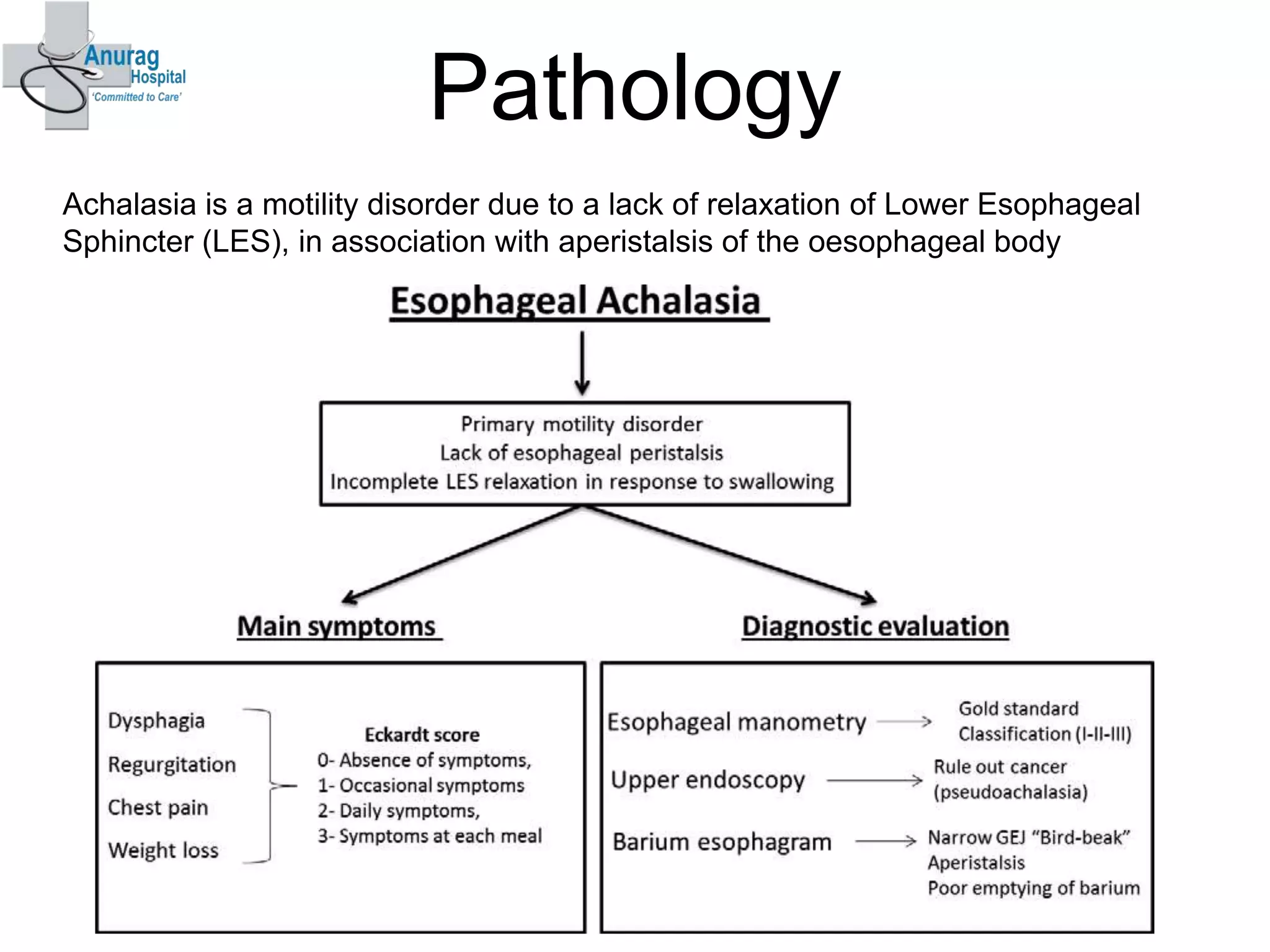
Pathology
Achalasia is a motility disorder due to a lack of relaxation of Lower Esophageal
Sphincter (LES), in association with aperistalsis of the oesophageal body
3
AIM OF PRIMARY TREATMENT
Aim is to relieve the dysphagia by reducing LES pressure by
• medical
• physical or
• surgical methods
4
Primary Achalasia
PRIMARY TREATMENT OF ACHALASIA
Medical Measures -
• Calcium channel blockers or nitroglycerine
• Endoscopic botulinum toxin by injection
Mechanical Measures -
• Endoscopic Pneumatic Dilatation (PD)
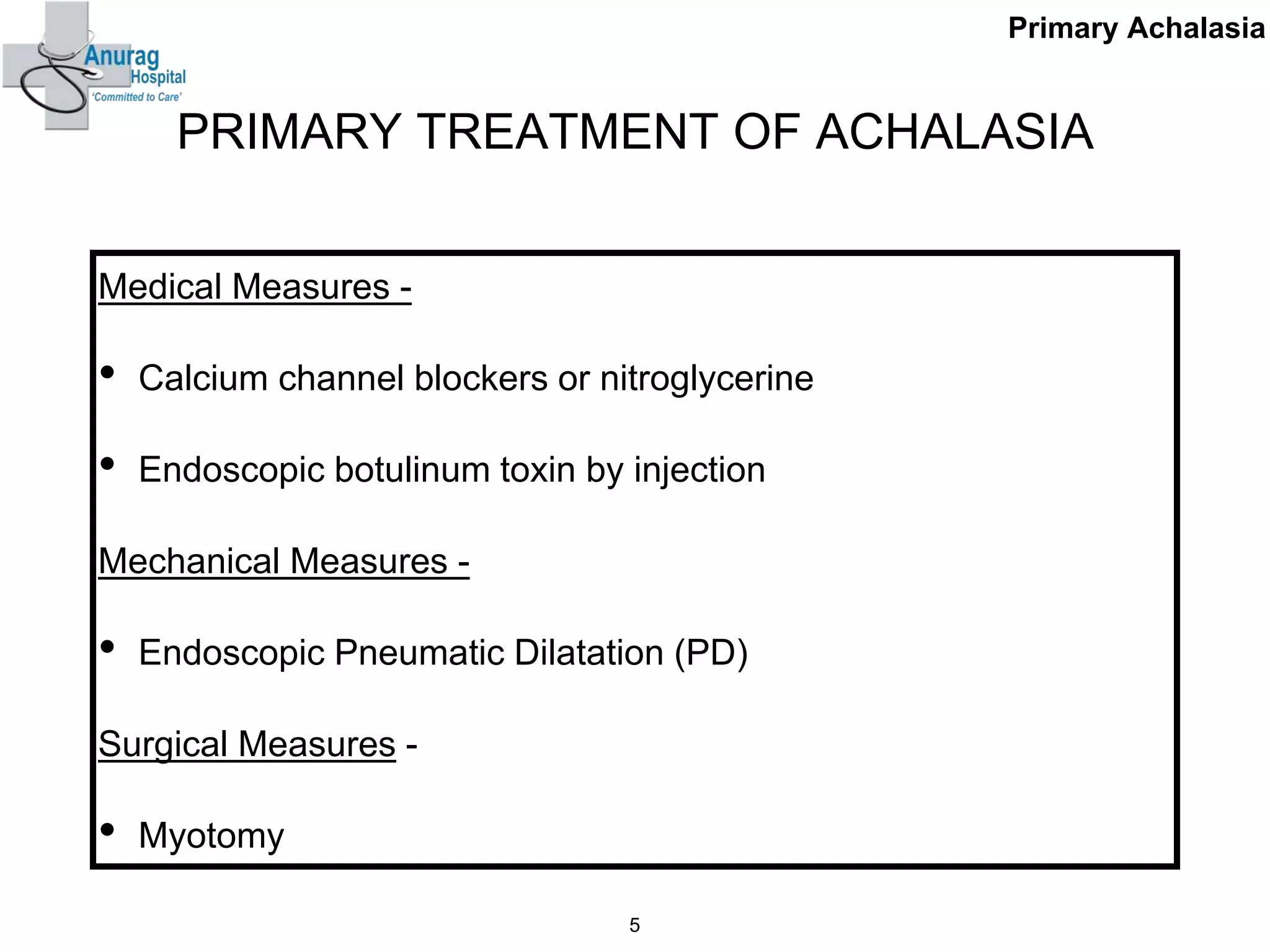
Surgical Measures -
• Myotomy
5
Primary Achalasia
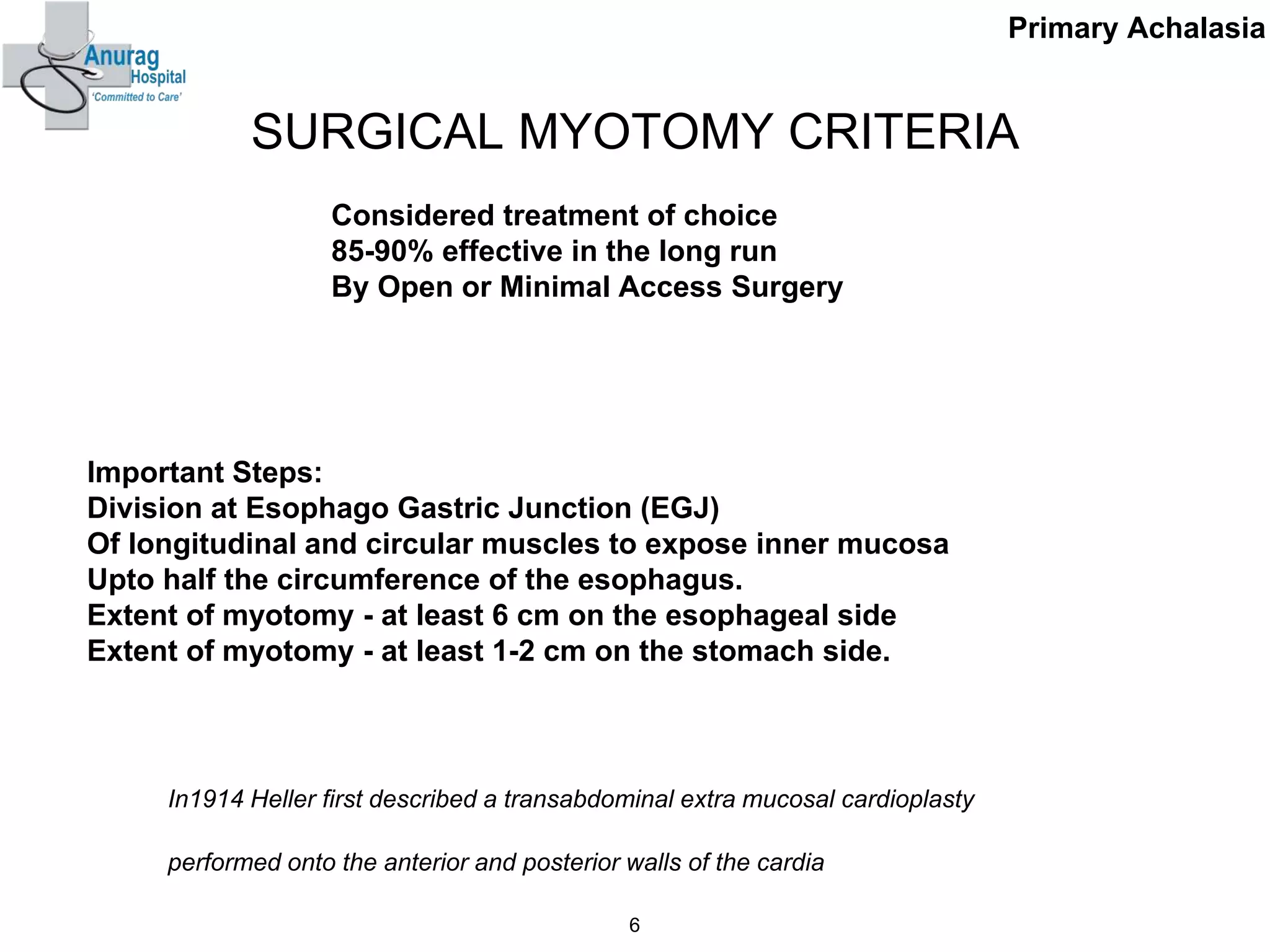
SURGICAL MYOTOMY CRITERIA
Considered treatment of choice
85-90% effective in the long run
By Open or Minimal Access Surgery
Important Steps:
Division at Esophago Gastric Junction (EGJ)
Of longitudinal and circular muscles to expose inner mucosa
Upto half the circumference of the esophagus.
Extent of myotomy - at least 6 cm on the esophageal side
Extent of myotomy - at least 1-2 cm on the stomach side.
6
Primary Achalasia
In1914 Heller first described a transabdominal extra mucosal cardioplasty
performed onto the anterior and posterior walls of the cardia
TYPES OF SURGICAL MYOTOMY
Laparoscopic Heller’s Myotomy (LHM)
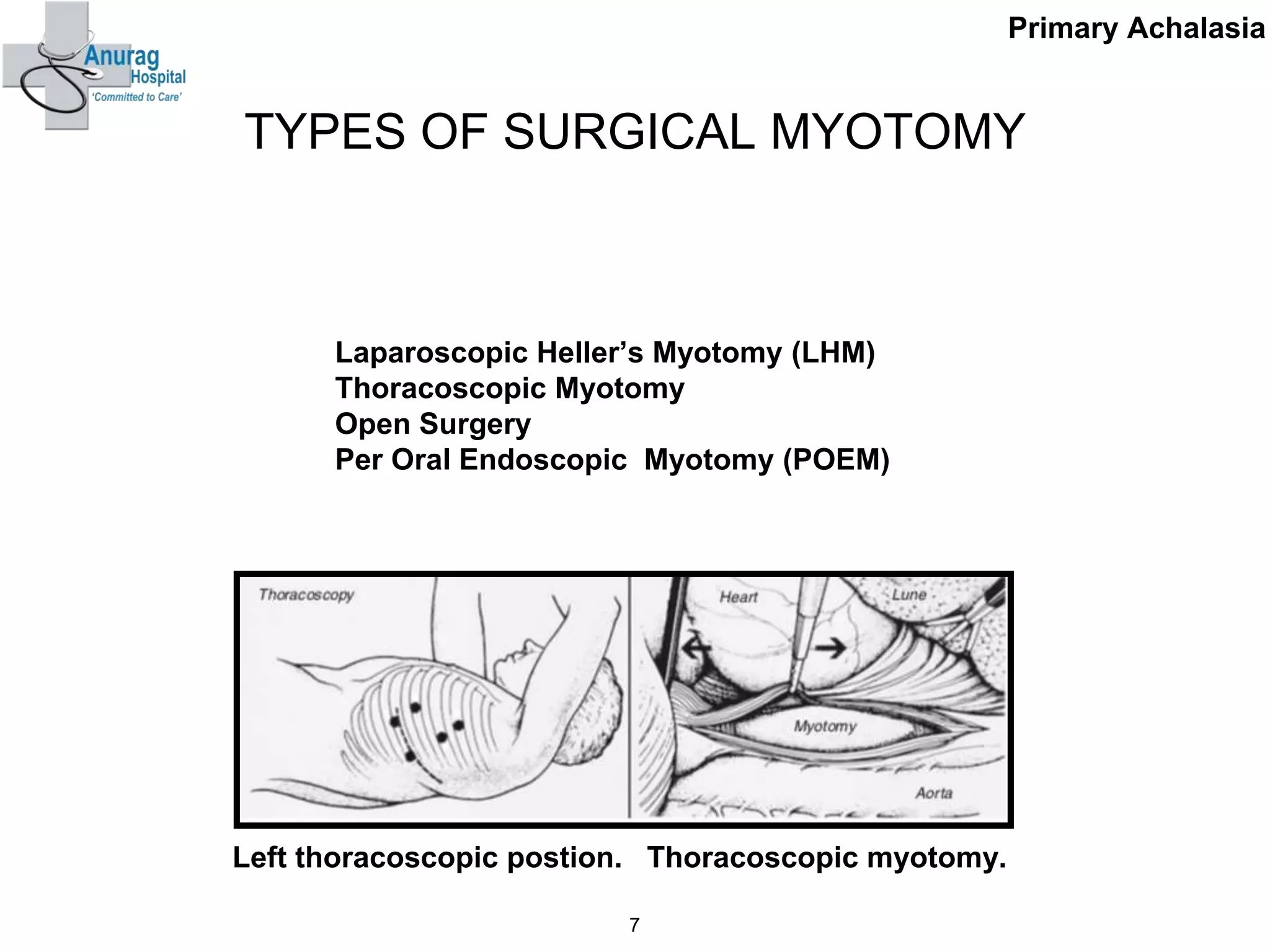
Thoracoscopic Myotomy
Open Surgery
Per Oral Endoscopic Myotomy (POEM)
7
Primary Achalasia
Left thoracoscopic postion. Thoracoscopic myotomy.
RECURRENCE AFTER MYOTOMY
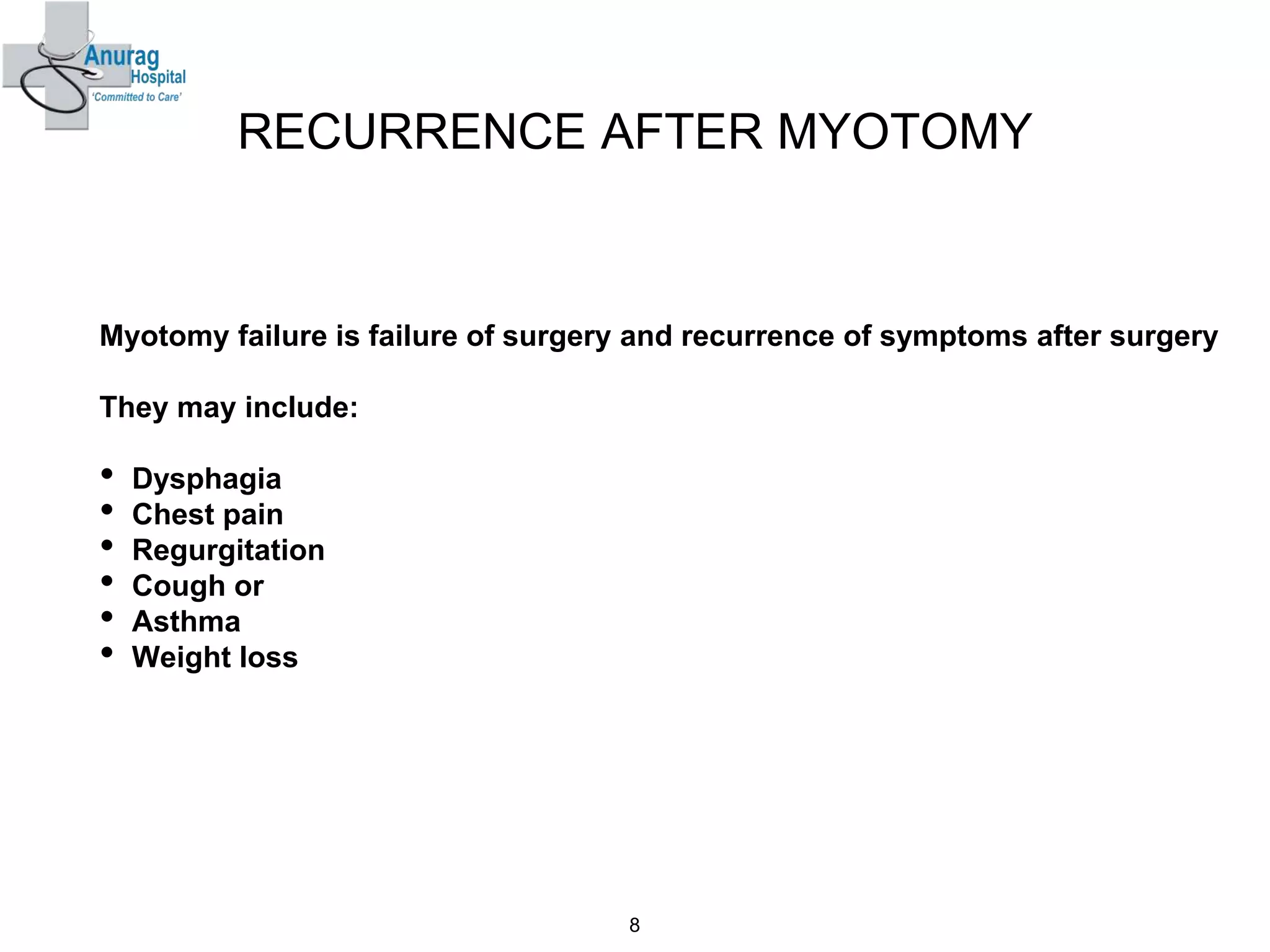
Myotomy failure is failure of surgery and recurrence of symptoms after surgery
They may include:
• Dysphagia
• Chest pain
• Regurgitation
• Cough or
• Asthma
• Weight loss
8
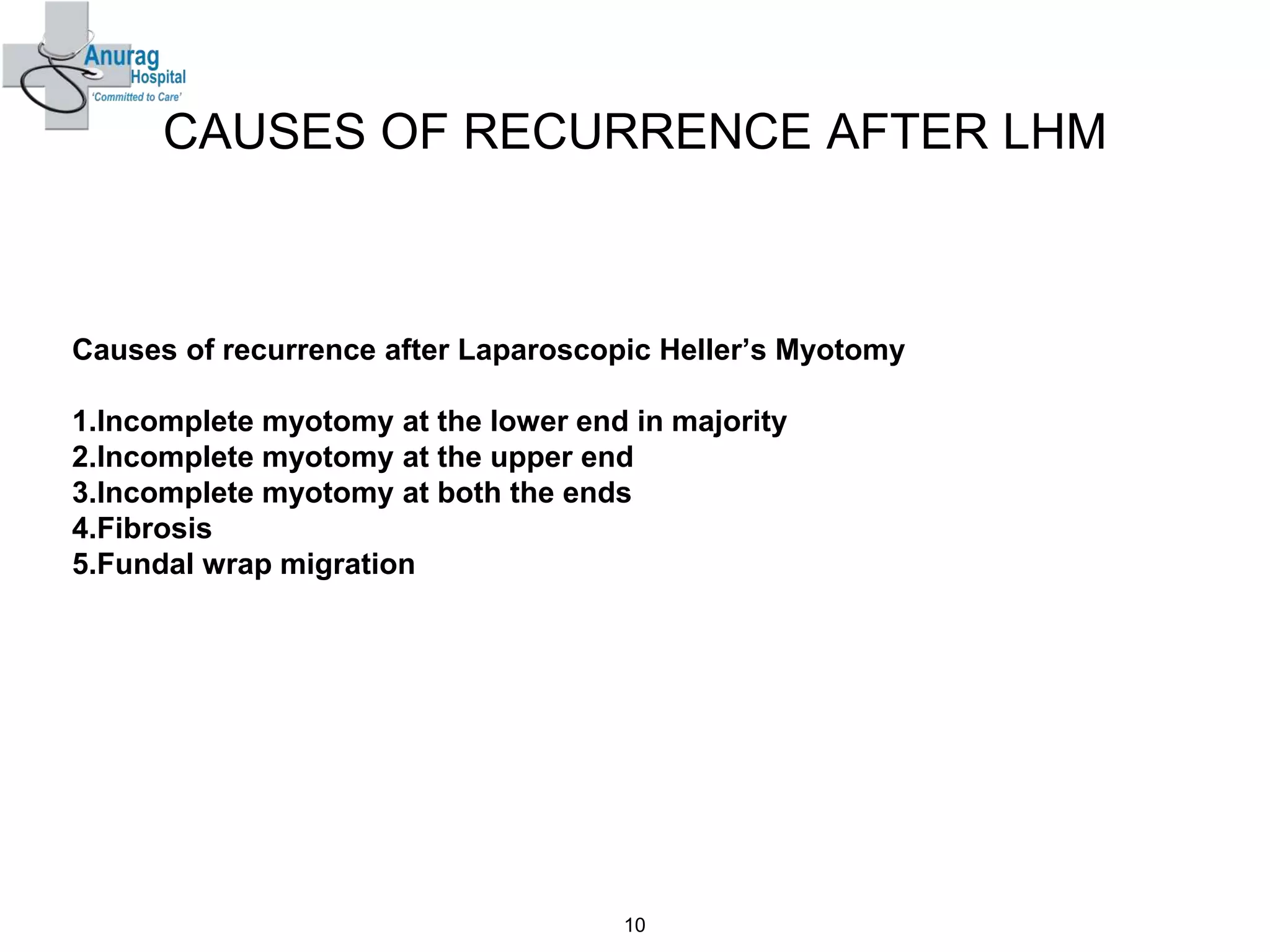
CAUSES OF FAILURE IN PD
Causes of failure in Pneumatic Dilatation:
1.Incomplete myotomy at the lower end
2.Incomplete myotomy at the upper end
3.Incomplete myotomy at both the ends
4.Fibrosis
9
CAUSES OF RECURRENCE AFTER LHM
Causes of recurrence after Laparoscopic Heller’s Myotomy
1.Incomplete myotomy at the lower end in majority
2.Incomplete myotomy at the upper end
3.Incomplete myotomy at both the ends
4.Fibrosis
5.Fundal wrap migration
10
PER ORAL ENDOSCOPIC MYOTOMY (POEM)
Complications include
Mucosal perforation
Subcutaneous emphysema
Mediastinal emphysema
Pneumothorax
Pneumoperitoneum
Gastro esophageal relux (GERD)
Success rate in 98.4%
11
FUNDOPLICATION
DOR fundoplication which is anterior
Helps as antireflux procedure
Seals micro perforations if any
Covers mucosa and protects from adhesions to left lobe liver, viscera
Repeat surgery when indicated requires careful, tedious dissection
TOUPET fundoplication which is posterior
Effective to protect against GERD
Unfortunately requires the entire mobilisation of lower end of esophagus
Exposed to anterior, the mucosa forms adhesions to liver & viscera
Repeat surgery takes time and care.
12
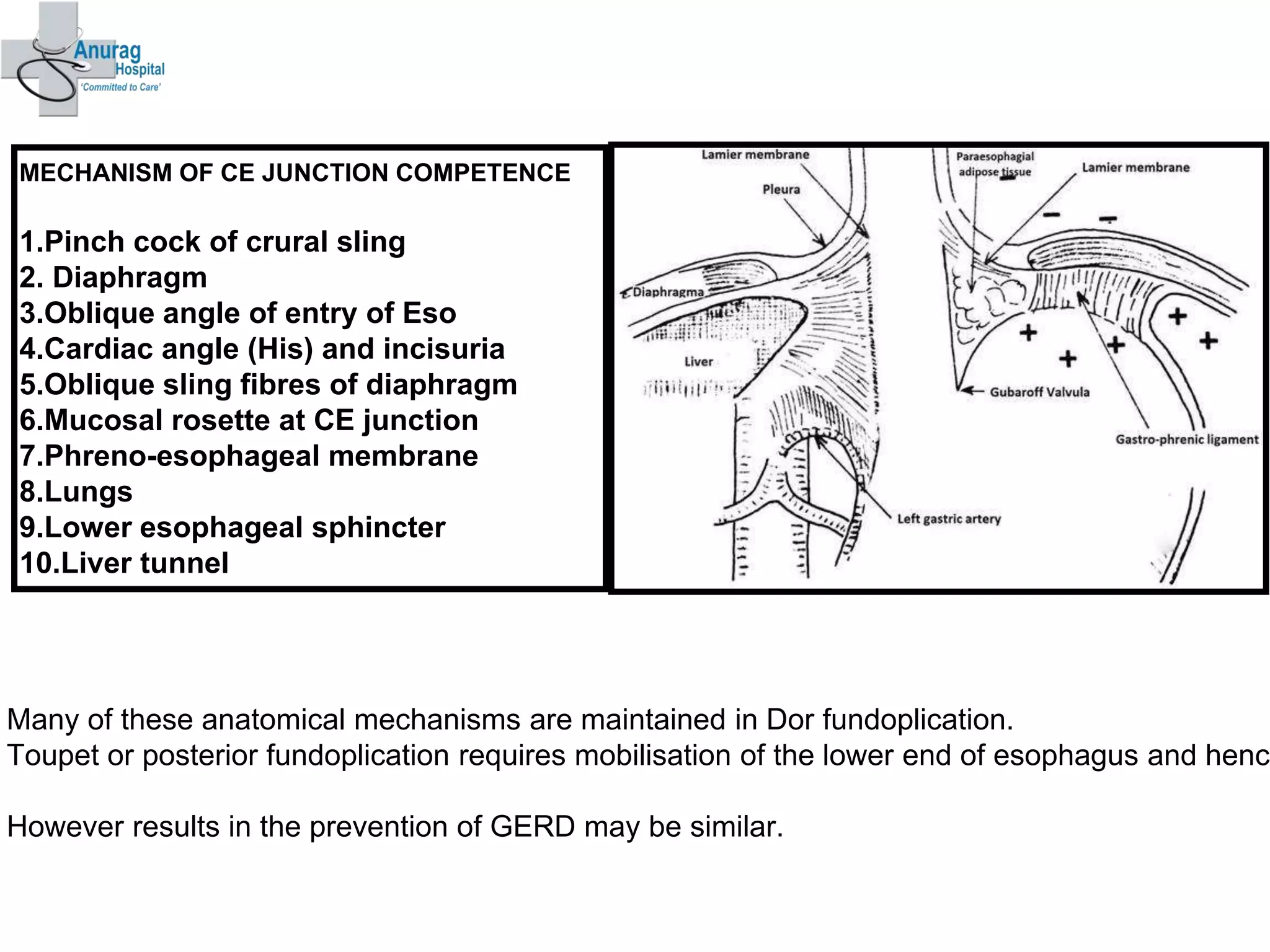
MECHANISM OF CE JUNCTION COMPETENCE
1.Pinch cock of crural sling
2. Diaphragm
3.Oblique angle of entry of Eso
4.Cardiac angle (His) and incisuria
5.Oblique sling fibres of diaphragm
6.Mucosal rosette at CE junction
7.Phreno-esophageal membrane
8.Lungs
9.Lower esophageal sphincter
10.Liver tunnel
Many of these anatomical mechanisms are maintained in Dor fundoplication.
Toupet or posterior fundoplication requires mobilisation of the lower end of esophagus and hence
However results in the prevention of GERD may be similar.
POST MYOTOMY DYSPHAGIA
Post Myotomy Dysphagia in Achalasia
• Suspect incomplete myotomy mainly lower end
• Cause not due to myotomy- may be a tight fundoplication
• Tight peptic stricture due to GERD - Prevent by PPI
• Neoplasms of esophagus - Especially squamous type, years later
14
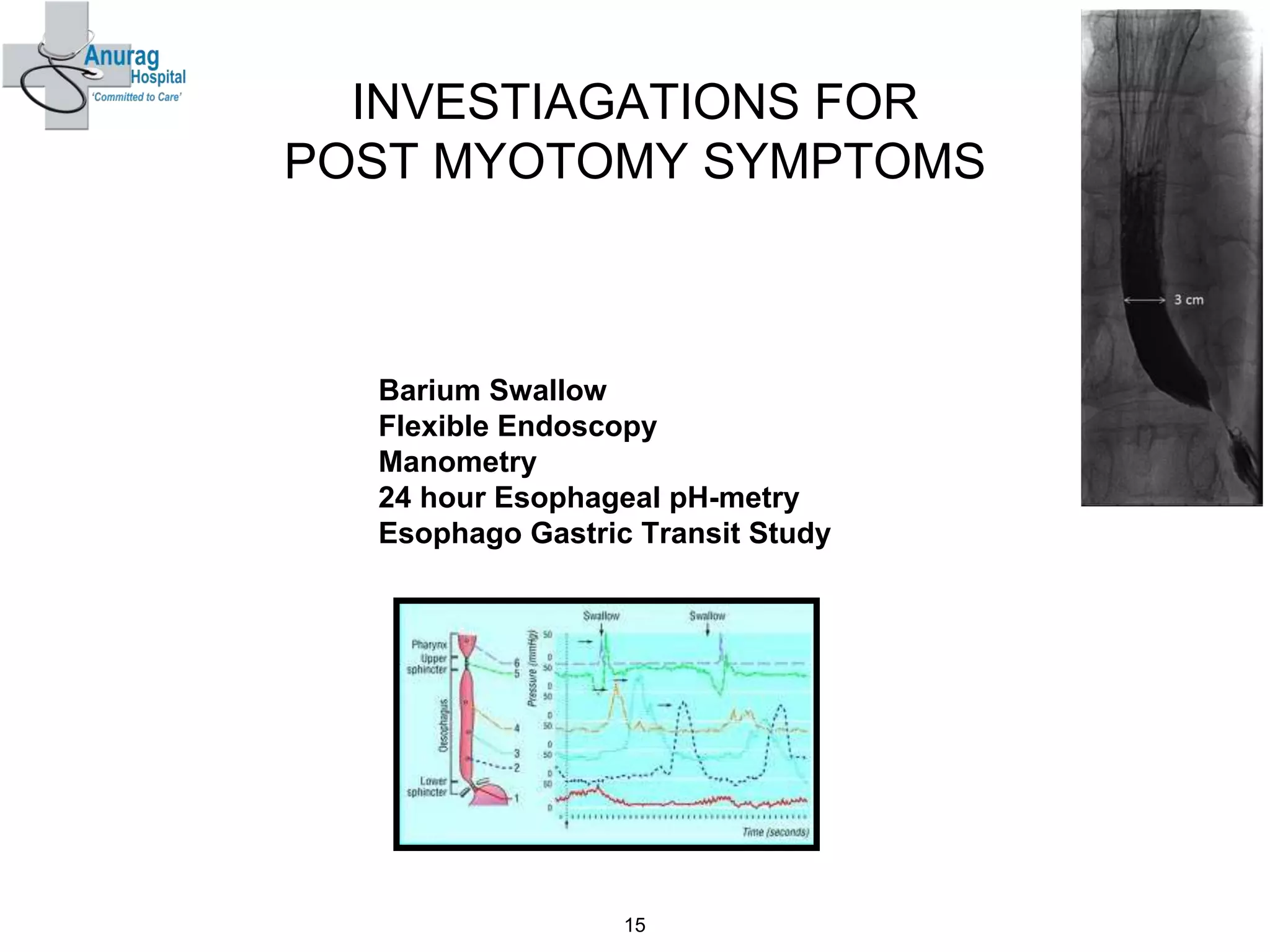
INVESTIAGATIONS FOR
POST MYOTOMY SYMPTOMS
Barium Swallow
Flexible Endoscopy
Manometry
24 hour Esophageal pH-metry
Esophago Gastric Transit Study
15
POST LHM TREATMENT CHOICES
Following Heller’s Myotomy, choices of treatment include
1.Pneumatic Dilatation
2.Re Laparoscopic Heller’s Myotomy
3.Per Oral Endoscopic Myotomy
4.Botulinum Toxin Injection
5.Esophagectomy - MIS or Open
6.Esophago- Gastrostomy
16
POST LHM TREATMENT CHOICES
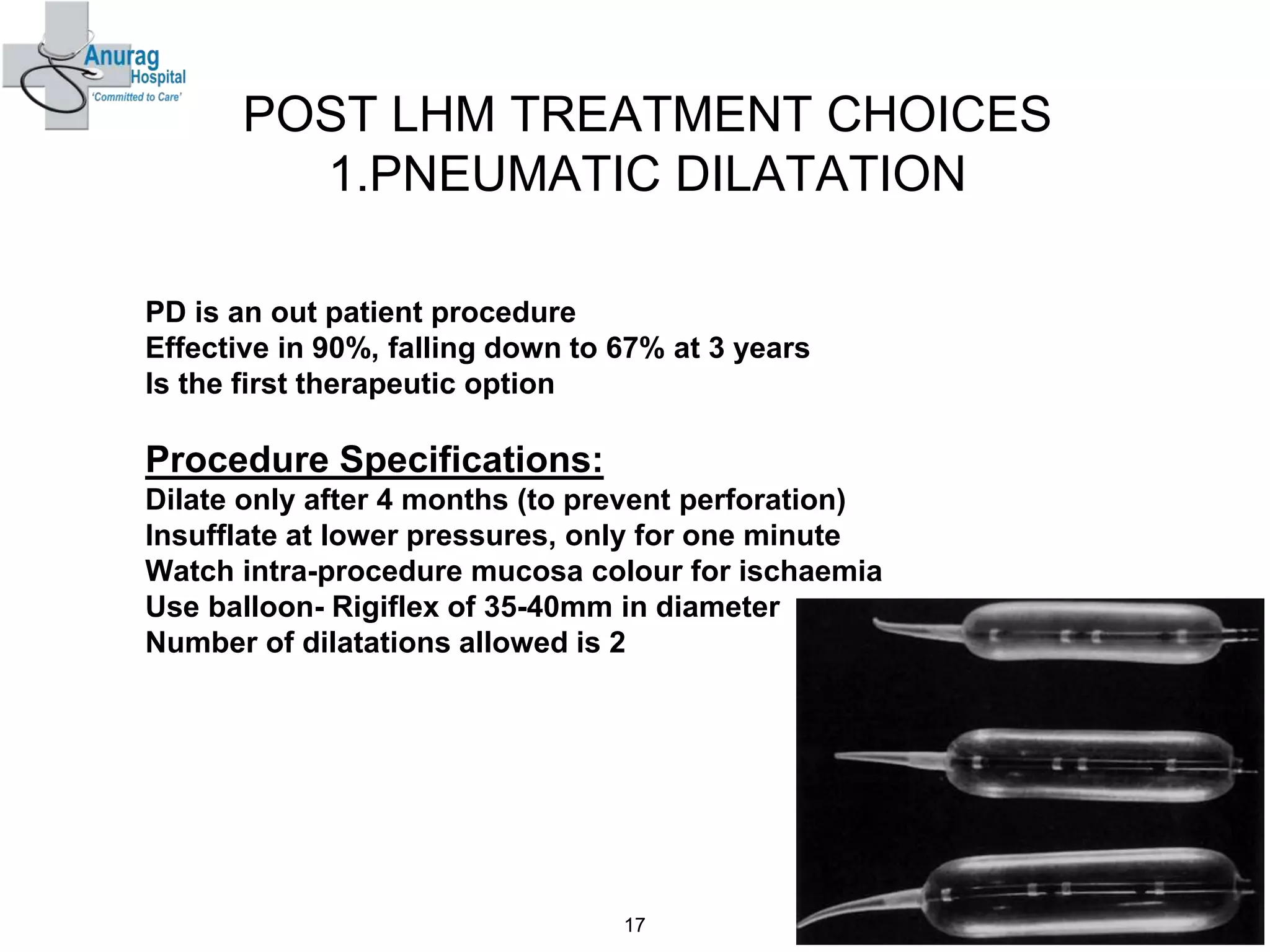
1.PNEUMATIC DILATATION
PD is an out patient procedure
Effective in 90%, falling down to 67% at 3 years
Is the first therapeutic option
Procedure Specifications:
Dilate only after 4 months (to prevent perforation)
Insufflate at lower pressures, only for one minute
Watch intra-procedure mucosa colour for ischaemia
Use balloon- Rigiflex of 35-40mm in diameter
Number of dilatations allowed is 2
17
POST LHM TREATMENT CHOICES
2.RELAPAROSCOPIC MYOTOMY
Redo laparoscopy and Myotomy
Safe and effective in 86 %
Indicated after PD or Xray Stage I and II with relapse
18
19
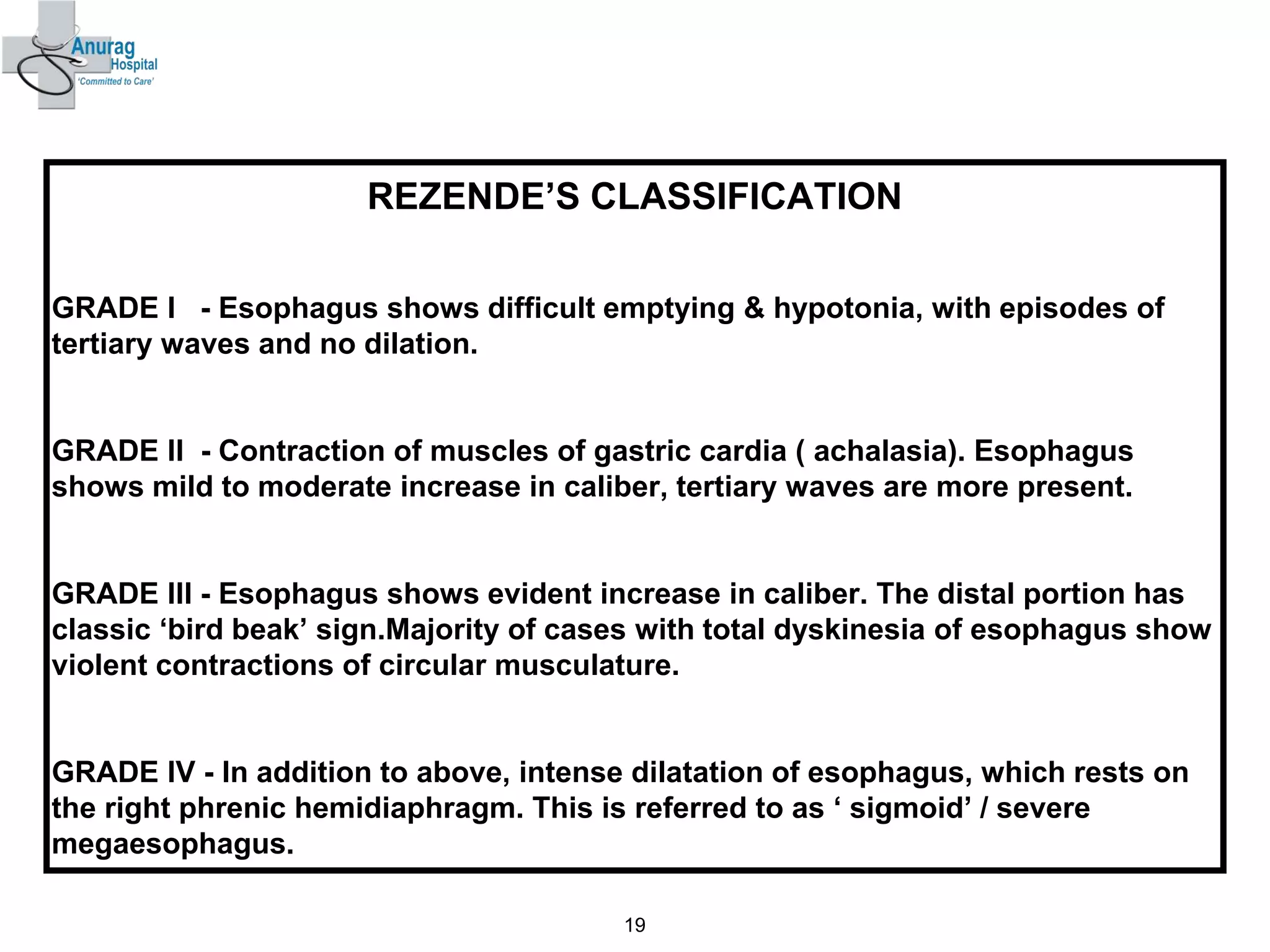
REZENDE’S CLASSIFICATION
GRADE I - Esophagus shows difficult emptying & hypotonia, with episodes of
tertiary waves and no dilation.
GRADE II - Contraction of muscles of gastric cardia ( achalasia). Esophagus
shows mild to moderate increase in caliber, tertiary waves are more present.
GRADE III - Esophagus shows evident increase in caliber. The distal portion has
classic ‘bird beak’ sign.Majority of cases with total dyskinesia of esophagus show
violent contractions of circular musculature.
GRADE IV - In addition to above, intense dilatation of esophagus, which rests on
the right phrenic hemidiaphragm. This is referred to as ‘ sigmoid’ / severe
megaesophagus.
20
Rezende’s Classification:
Group 1 - Esophageal hypotonia and gastric bubble
Group II - Moderately dilated esophagus and tertiary waves
Group III- Esophageal dilatation & ‘’bird beak sign on cardia
Group IV- Akinesia and dolicomegaesophagus with ‘bird beak’ sign
Radiological findings in Rezende’s classification
Abud et al, Radiol Bras. 2016
POST LHM TREATMENT CHOICES
2.RELAPAROSCOPIC MYOTOMY
Procedure Details
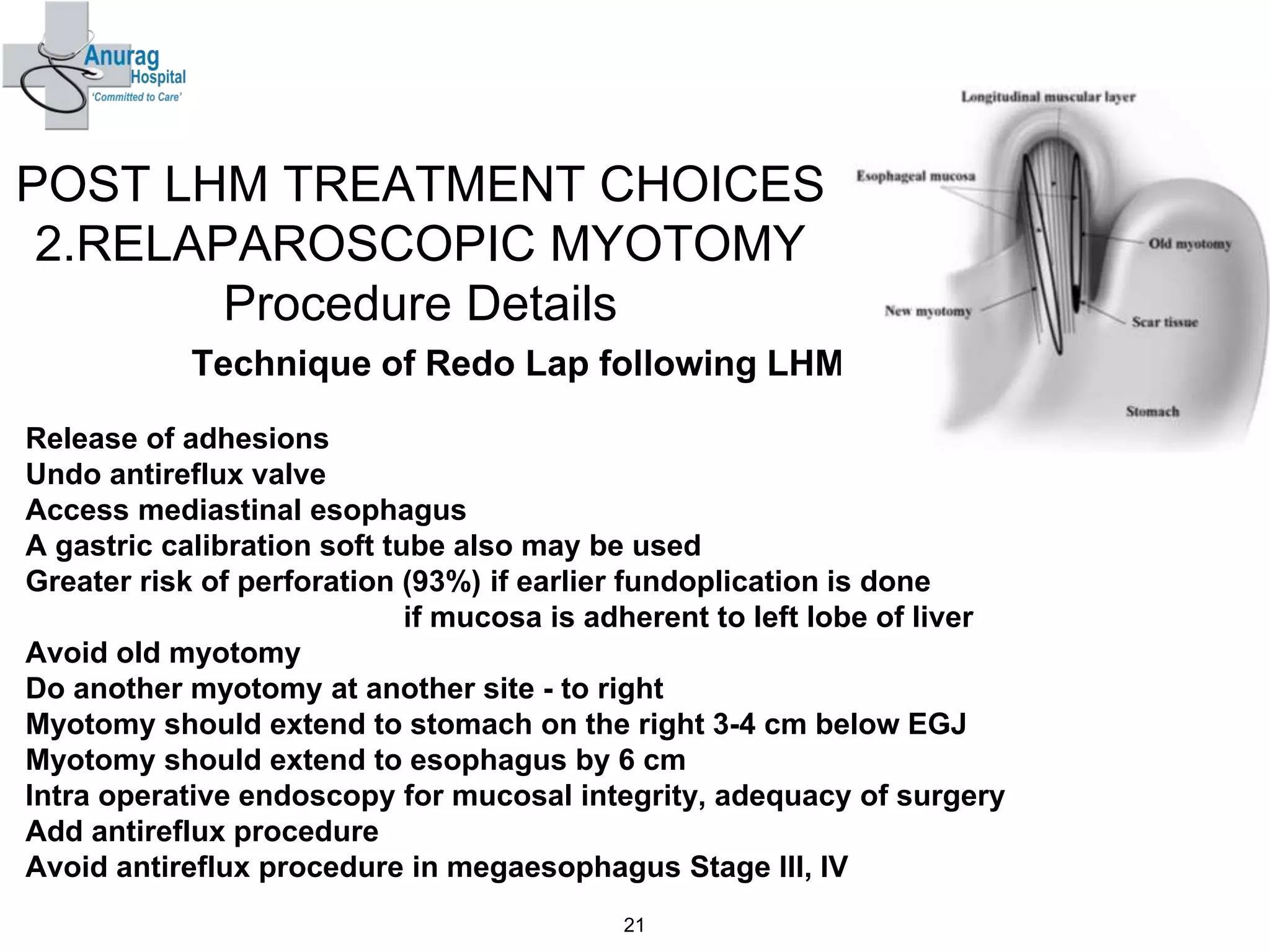
Technique of Redo Lap following LHM
Release of adhesions
Undo antireflux valve
Access mediastinal esophagus
A gastric calibration soft tube also may be used
Greater risk of perforation (93%) if earlier fundoplication is done
if mucosa is adherent to left lobe of liver
Avoid old myotomy
Do another myotomy at another site - to right
Myotomy should extend to stomach on the right 3-4 cm below EGJ
Myotomy should extend to esophagus by 6 cm
Intra operative endoscopy for mucosal integrity, adequacy of surgery
Add antireflux procedure
Avoid antireflux procedure in megaesophagus Stage III, IV
21
POST LHM TREATMENT CHOICES
3.PER ORAL ENDOSCOPIC MYOTOMY
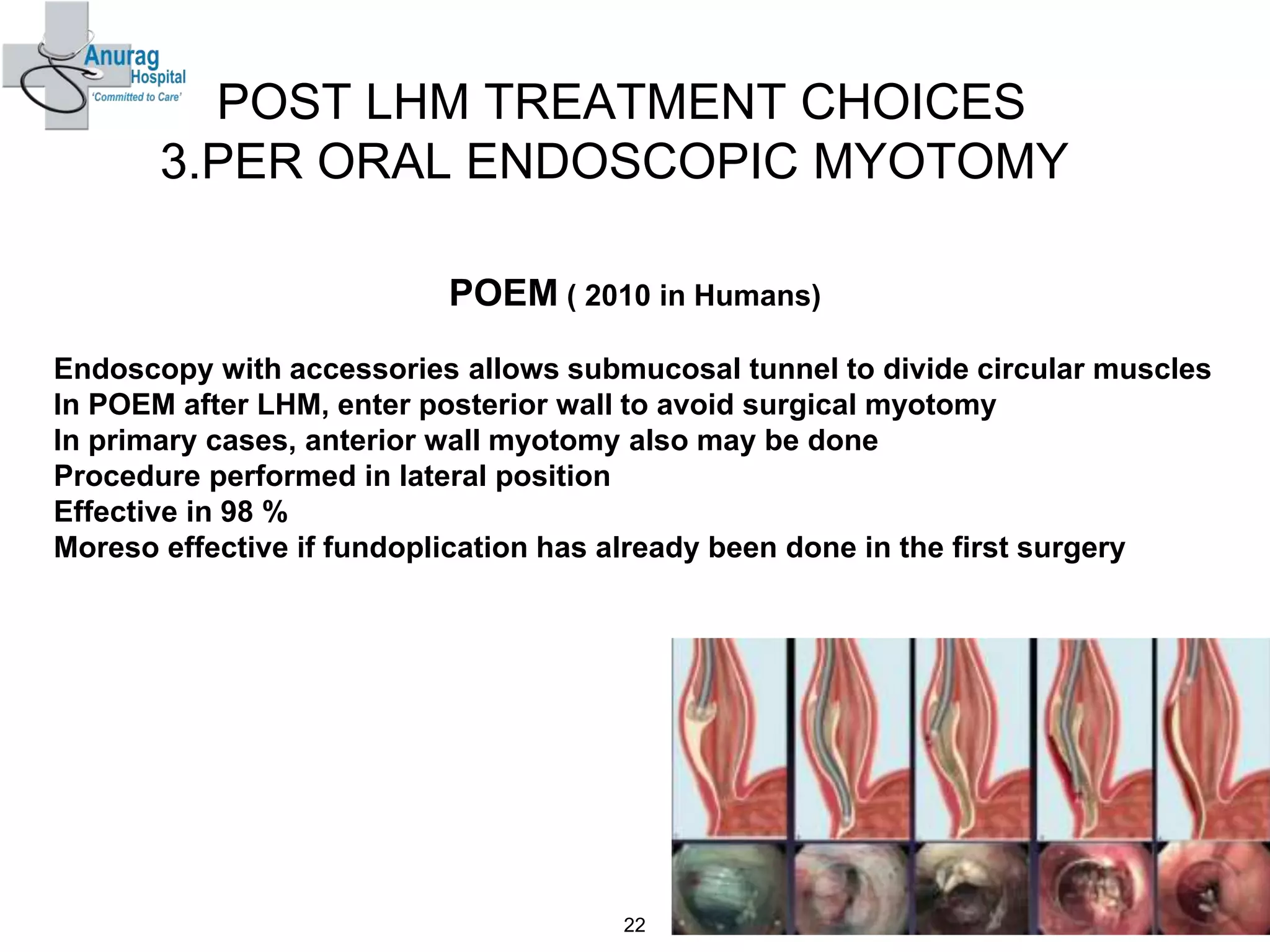
POEM ( 2010 in Humans)
Endoscopy with accessories allows submucosal tunnel to divide circular muscles
In POEM after LHM, enter posterior wall to avoid surgical myotomy
In primary cases, anterior wall myotomy also may be done
Procedure performed in lateral position
Effective in 98 %
Moreso effective if fundoplication has already been done in the first surgery
22
POST LHM TREATMENT CHOICES
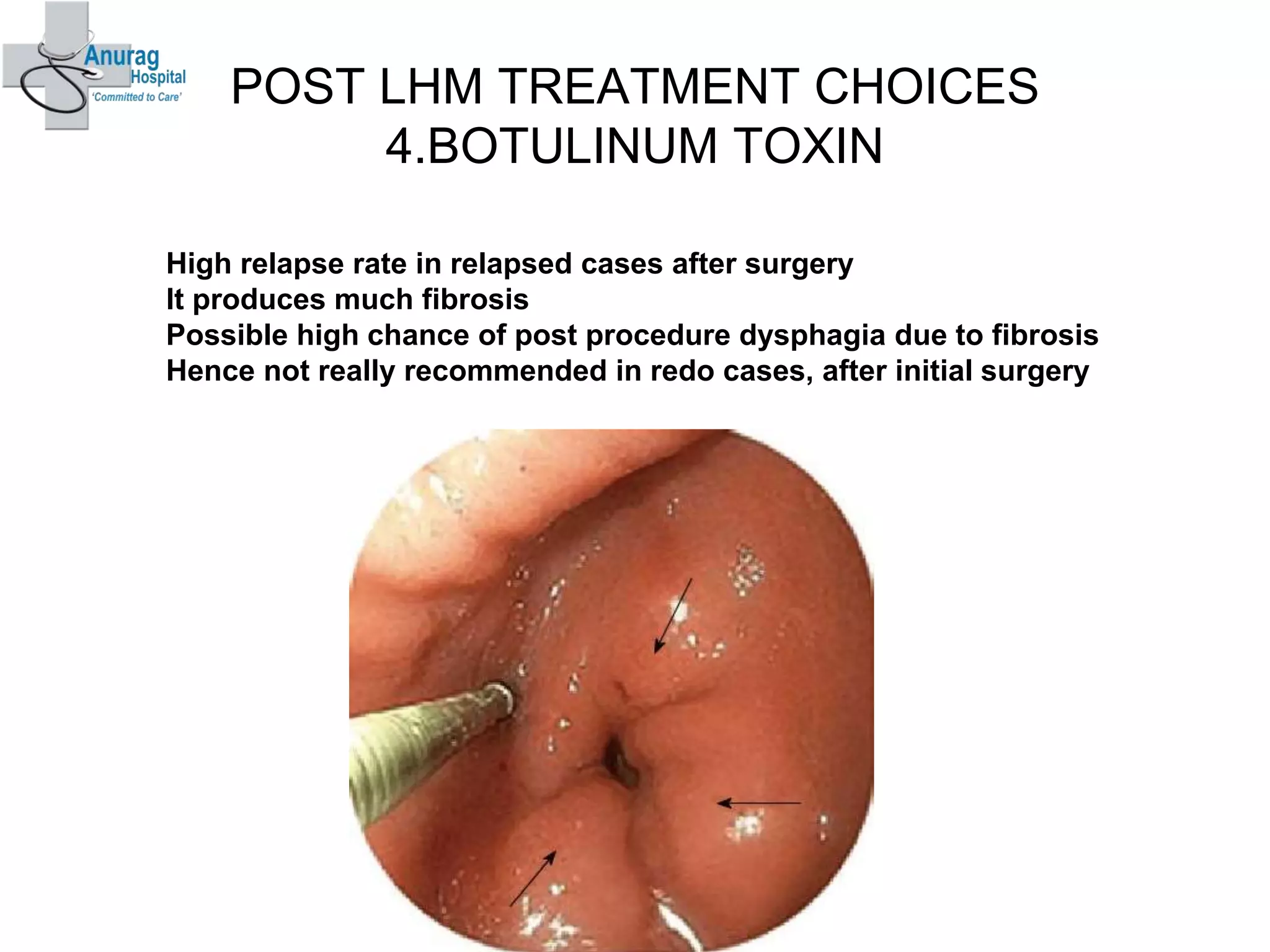
4.BOTULINUM TOXIN
High relapse rate in relapsed cases after surgery
It produces much fibrosis
Possible high chance of post procedure dysphagia due to fibrosis
Hence not really recommended in redo cases, after initial surgery
23
POST LHM TREATMENT CHOICES
5.ESOPHAGECTOMY
Esophagel replacement and gastro pasty can eliminate fully dysphagia
Particularly useful in megaesophagus ( > 6cm)
Routes Thoracoscopic or Open ( Transhiatal or Trans thoracic)
Main drawback are high morbidity ( 35%) and mortality (5%)
Hence only to be considered-in radiological Stage IV megaesophagus and
-in megaesophagus where less invasion has failed
24
POST LHM TREATMENT CHOICES
6.Lap ESOPHAGO-GASTROSTOMY
End stage Achalasia
- Failed botulinum toxin injection
- Failed LHM
- Dysphagia
- Losing weight
- Mega esophagus
Options viable are either total esophagectomy or
Lap Esophago- Gastrostomy
25
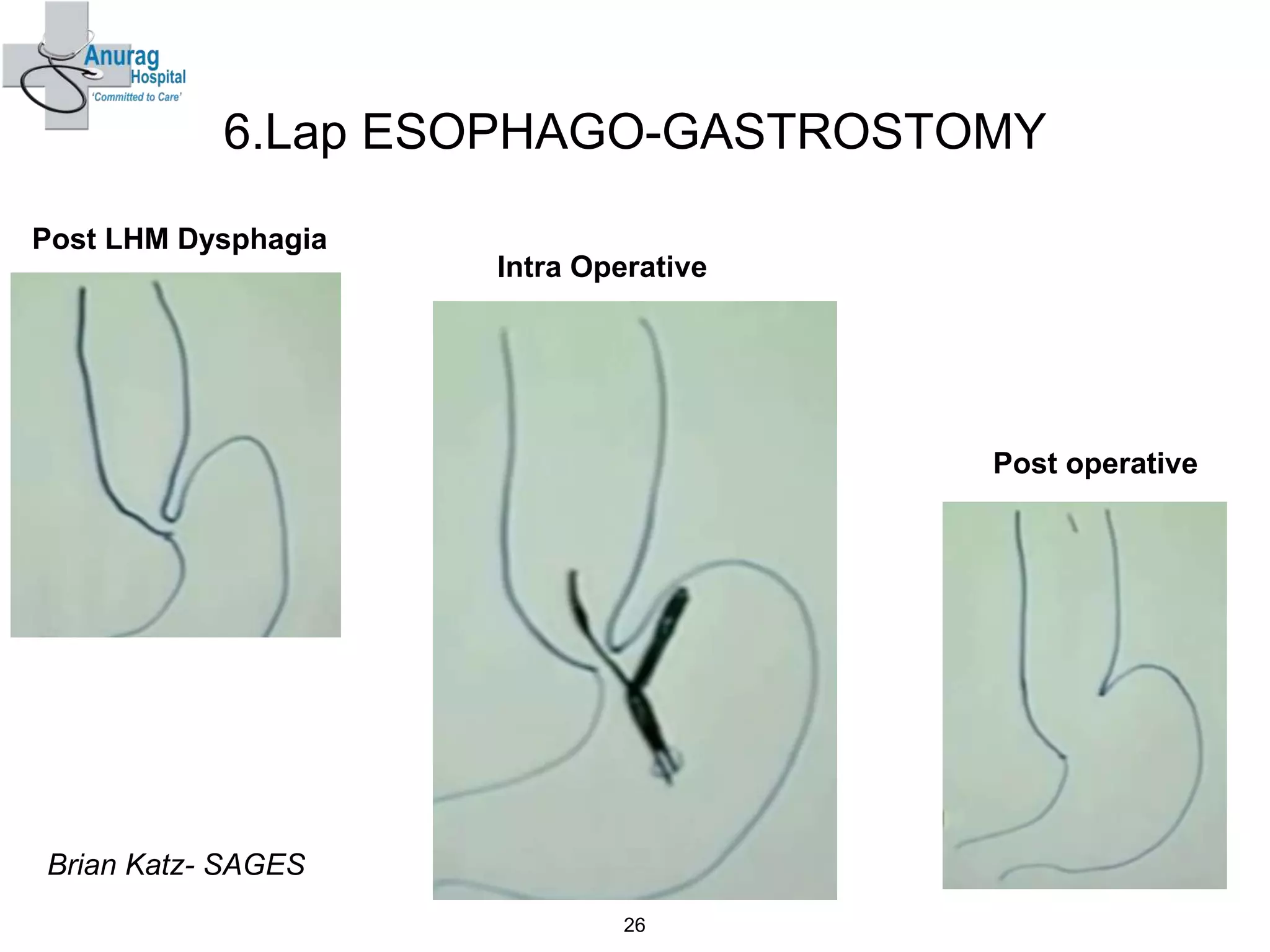
6.Lap ESOPHAGO-GASTROSTOMY
26
Post LHM Dysphagia
Intra Operative
Post operative
Brian Katz- SAGES
POST LHM TREATMENT CHOICES
6.Lap ESOPHAGO-GASTROSTOMY
Procedure
Brian Katz- SAGES
Laparoscopic adhesiolysis with 5 ports
Upper gastrotomy
Insertion of endo GIA stapler
One blade in esophageal lumen
Another blade in fundal lumen
Watch and confirm by an endoscope from above
Esophago-gastrostomy achieved with the stapler
Close the fundal defect with stapler/ suturing
Post op Barium study
PPI for reflux symptoms to control GERD
27
28
THE END

Recurrence of Symptoms after Heller's myotomy- ACHALASIA

  • 1.
    RECURRENCE AFTER HELLER’S MYOTOMY DRPRAVIN JOHN Dr JOHN AC THANAKUMAR ANURAG HOSPITAL, COIMBATORE. 1 Images from Achalasia by PM Fisichella, et al, Brian Katz-SAGES, Internet
  • 2.
    Surgical treatment forachalasia fails in 10-20% of patients 2 ABBREVIATIONS USED: LES -Lower Esophageal Sphincter PD -Endoscopic Pneumatic Dilatation EGJ -Esophageal Gastric Junction LHM -Laparoscopic Heller’s Myotomy POEM -Per Oral Endoscopic Myotomy GERD -Gastro Esophageal Reflux Disease
  • 3.
    Pathology Achalasia is amotility disorder due to a lack of relaxation of Lower Esophageal Sphincter (LES), in association with aperistalsis of the oesophageal body 3
  • 4.
    AIM OF PRIMARYTREATMENT Aim is to relieve the dysphagia by reducing LES pressure by • medical • physical or • surgical methods 4 Primary Achalasia
  • 5.
    PRIMARY TREATMENT OFACHALASIA Medical Measures - • Calcium channel blockers or nitroglycerine • Endoscopic botulinum toxin by injection Mechanical Measures - • Endoscopic Pneumatic Dilatation (PD) Surgical Measures - • Myotomy 5 Primary Achalasia
  • 6.
    SURGICAL MYOTOMY CRITERIA Consideredtreatment of choice 85-90% effective in the long run By Open or Minimal Access Surgery Important Steps: Division at Esophago Gastric Junction (EGJ) Of longitudinal and circular muscles to expose inner mucosa Upto half the circumference of the esophagus. Extent of myotomy - at least 6 cm on the esophageal side Extent of myotomy - at least 1-2 cm on the stomach side. 6 Primary Achalasia In1914 Heller first described a transabdominal extra mucosal cardioplasty performed onto the anterior and posterior walls of the cardia
  • 7.
    TYPES OF SURGICALMYOTOMY Laparoscopic Heller’s Myotomy (LHM) Thoracoscopic Myotomy Open Surgery Per Oral Endoscopic Myotomy (POEM) 7 Primary Achalasia Left thoracoscopic postion. Thoracoscopic myotomy.
  • 8.
    RECURRENCE AFTER MYOTOMY Myotomyfailure is failure of surgery and recurrence of symptoms after surgery They may include: • Dysphagia • Chest pain • Regurgitation • Cough or • Asthma • Weight loss 8
  • 9.
    CAUSES OF FAILUREIN PD Causes of failure in Pneumatic Dilatation: 1.Incomplete myotomy at the lower end 2.Incomplete myotomy at the upper end 3.Incomplete myotomy at both the ends 4.Fibrosis 9
  • 10.
    CAUSES OF RECURRENCEAFTER LHM Causes of recurrence after Laparoscopic Heller’s Myotomy 1.Incomplete myotomy at the lower end in majority 2.Incomplete myotomy at the upper end 3.Incomplete myotomy at both the ends 4.Fibrosis 5.Fundal wrap migration 10
  • 11.
    PER ORAL ENDOSCOPICMYOTOMY (POEM) Complications include Mucosal perforation Subcutaneous emphysema Mediastinal emphysema Pneumothorax Pneumoperitoneum Gastro esophageal relux (GERD) Success rate in 98.4% 11
  • 12.
    FUNDOPLICATION DOR fundoplication whichis anterior Helps as antireflux procedure Seals micro perforations if any Covers mucosa and protects from adhesions to left lobe liver, viscera Repeat surgery when indicated requires careful, tedious dissection TOUPET fundoplication which is posterior Effective to protect against GERD Unfortunately requires the entire mobilisation of lower end of esophagus Exposed to anterior, the mucosa forms adhesions to liver & viscera Repeat surgery takes time and care. 12
  • 13.
    MECHANISM OF CEJUNCTION COMPETENCE 1.Pinch cock of crural sling 2. Diaphragm 3.Oblique angle of entry of Eso 4.Cardiac angle (His) and incisuria 5.Oblique sling fibres of diaphragm 6.Mucosal rosette at CE junction 7.Phreno-esophageal membrane 8.Lungs 9.Lower esophageal sphincter 10.Liver tunnel Many of these anatomical mechanisms are maintained in Dor fundoplication. Toupet or posterior fundoplication requires mobilisation of the lower end of esophagus and hence However results in the prevention of GERD may be similar.
  • 14.
    POST MYOTOMY DYSPHAGIA PostMyotomy Dysphagia in Achalasia • Suspect incomplete myotomy mainly lower end • Cause not due to myotomy- may be a tight fundoplication • Tight peptic stricture due to GERD - Prevent by PPI • Neoplasms of esophagus - Especially squamous type, years later 14
  • 15.
    INVESTIAGATIONS FOR POST MYOTOMYSYMPTOMS Barium Swallow Flexible Endoscopy Manometry 24 hour Esophageal pH-metry Esophago Gastric Transit Study 15
  • 16.
    POST LHM TREATMENTCHOICES Following Heller’s Myotomy, choices of treatment include 1.Pneumatic Dilatation 2.Re Laparoscopic Heller’s Myotomy 3.Per Oral Endoscopic Myotomy 4.Botulinum Toxin Injection 5.Esophagectomy - MIS or Open 6.Esophago- Gastrostomy 16
  • 17.
    POST LHM TREATMENTCHOICES 1.PNEUMATIC DILATATION PD is an out patient procedure Effective in 90%, falling down to 67% at 3 years Is the first therapeutic option Procedure Specifications: Dilate only after 4 months (to prevent perforation) Insufflate at lower pressures, only for one minute Watch intra-procedure mucosa colour for ischaemia Use balloon- Rigiflex of 35-40mm in diameter Number of dilatations allowed is 2 17
  • 18.
    POST LHM TREATMENTCHOICES 2.RELAPAROSCOPIC MYOTOMY Redo laparoscopy and Myotomy Safe and effective in 86 % Indicated after PD or Xray Stage I and II with relapse 18
  • 19.
    19 REZENDE’S CLASSIFICATION GRADE I- Esophagus shows difficult emptying & hypotonia, with episodes of tertiary waves and no dilation. GRADE II - Contraction of muscles of gastric cardia ( achalasia). Esophagus shows mild to moderate increase in caliber, tertiary waves are more present. GRADE III - Esophagus shows evident increase in caliber. The distal portion has classic ‘bird beak’ sign.Majority of cases with total dyskinesia of esophagus show violent contractions of circular musculature. GRADE IV - In addition to above, intense dilatation of esophagus, which rests on the right phrenic hemidiaphragm. This is referred to as ‘ sigmoid’ / severe megaesophagus.
  • 20.
    20 Rezende’s Classification: Group 1- Esophageal hypotonia and gastric bubble Group II - Moderately dilated esophagus and tertiary waves Group III- Esophageal dilatation & ‘’bird beak sign on cardia Group IV- Akinesia and dolicomegaesophagus with ‘bird beak’ sign Radiological findings in Rezende’s classification Abud et al, Radiol Bras. 2016
  • 21.
    POST LHM TREATMENTCHOICES 2.RELAPAROSCOPIC MYOTOMY Procedure Details Technique of Redo Lap following LHM Release of adhesions Undo antireflux valve Access mediastinal esophagus A gastric calibration soft tube also may be used Greater risk of perforation (93%) if earlier fundoplication is done if mucosa is adherent to left lobe of liver Avoid old myotomy Do another myotomy at another site - to right Myotomy should extend to stomach on the right 3-4 cm below EGJ Myotomy should extend to esophagus by 6 cm Intra operative endoscopy for mucosal integrity, adequacy of surgery Add antireflux procedure Avoid antireflux procedure in megaesophagus Stage III, IV 21
  • 22.
    POST LHM TREATMENTCHOICES 3.PER ORAL ENDOSCOPIC MYOTOMY POEM ( 2010 in Humans) Endoscopy with accessories allows submucosal tunnel to divide circular muscles In POEM after LHM, enter posterior wall to avoid surgical myotomy In primary cases, anterior wall myotomy also may be done Procedure performed in lateral position Effective in 98 % Moreso effective if fundoplication has already been done in the first surgery 22
  • 23.
    POST LHM TREATMENTCHOICES 4.BOTULINUM TOXIN High relapse rate in relapsed cases after surgery It produces much fibrosis Possible high chance of post procedure dysphagia due to fibrosis Hence not really recommended in redo cases, after initial surgery 23
  • 24.
    POST LHM TREATMENTCHOICES 5.ESOPHAGECTOMY Esophagel replacement and gastro pasty can eliminate fully dysphagia Particularly useful in megaesophagus ( > 6cm) Routes Thoracoscopic or Open ( Transhiatal or Trans thoracic) Main drawback are high morbidity ( 35%) and mortality (5%) Hence only to be considered-in radiological Stage IV megaesophagus and -in megaesophagus where less invasion has failed 24
  • 25.
    POST LHM TREATMENTCHOICES 6.Lap ESOPHAGO-GASTROSTOMY End stage Achalasia - Failed botulinum toxin injection - Failed LHM - Dysphagia - Losing weight - Mega esophagus Options viable are either total esophagectomy or Lap Esophago- Gastrostomy 25
  • 26.
    6.Lap ESOPHAGO-GASTROSTOMY 26 Post LHMDysphagia Intra Operative Post operative Brian Katz- SAGES
  • 27.
    POST LHM TREATMENTCHOICES 6.Lap ESOPHAGO-GASTROSTOMY Procedure Brian Katz- SAGES Laparoscopic adhesiolysis with 5 ports Upper gastrotomy Insertion of endo GIA stapler One blade in esophageal lumen Another blade in fundal lumen Watch and confirm by an endoscope from above Esophago-gastrostomy achieved with the stapler Close the fundal defect with stapler/ suturing Post op Barium study PPI for reflux symptoms to control GERD 27
  • 28.