ANURAG HOSPITAL, COIMBATORE. WWW.ANURAG-HOSPITAL.COM
TIPS ON TESTS BEFORE ANTIREFLUX SURGERY
Dr PRAVIN HECTOR JOHN
MS, FIAGES, FALS, FIBC
&
Dr JOHN AC THANAKUMAR
MBBS, MS, MNAMS, FRCS (Ed), FRCS (G), Dip MIS (Strasbourg), FICS, FALS.
GENERAL COMMENTS
• POOR DIAGNOSIS POOR OUTCOME
• SUCCESS OF REOPERATIONS IS LESS
• SPASTIC DISTURBANCES CAN PRODUCE HEART BURNS
OTHER CAUSES OF DEFECTIVE LES AND
ESOPHAGITIS
RED FLAGS
• APART FROM GERD, XEROSTOMIA, HYPO-MOTILITY OF ESOPAHGUS
• DELAYED GASTRIC EMPTYING
• DUODENO GASTRIC REFLUX
SO BEFORE SURGERY, CONSIDER
1) THOROUGH HISTORY & COUNSELLING
2) pH MONITORING
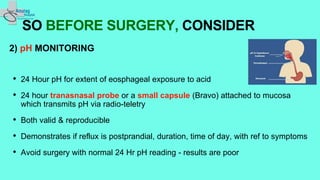
• 24 Hour pH for extent of eosphageal exposure to acid
• 24 hour tranasnasal probe or a small capsule (Bravo) attached to mucosa
which transmits pH via radio-teletry
• Both valid & reproducible
• Demonstrates if reflux is postprandial, duration, time of day, with ref to symptoms
• Avoid surgery with normal 24 Hr pH reading - results are poor
SO BEFORE SURGERY, CONSIDER
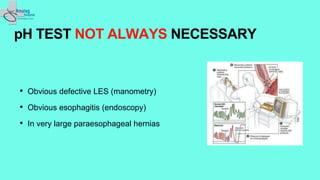
Cautions before pH monitoring
• PPI off for a week
• Histamine H2Blockers off for 2 days
• Beware of cheats who don’t comply
when the pH result is normal
SO BEFORE SURGERY, CONSIDER
Withholding PPI
• Good test when symptoms recur
• If no response, use caution
pH TEST NOT ALWAYS NECESSARY
• Obvious defective LES (manometry)
• Obvious esophagitis (endoscopy)
• In very large paraesophageal hernias
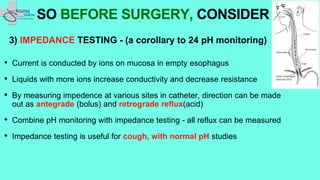
3) IMPEDANCE TESTING - (a corollary to 24 pH monitoring)
• Current is conducted by ions on mucosa in empty esophagus
• Liquids with more ions increase conductivity and decrease resistance
• By measuring impedence at various sites in catheter, direction can be made
out as antegrade (bolus) and retrograde reflux(acid)
• Combine pH monitoring with impedance testing - all reflux can be measured
• Impedance testing is useful for cough, with normal pH studies
SO BEFORE SURGERY, CONSIDER
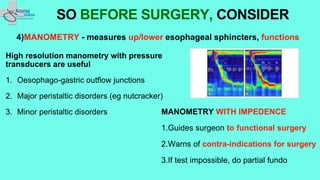
4)MANOMETRY - measures up/lower esophageal sphincters, functions
High resolution manometry with pressure
transducers are useful
1. Oesophago-gastric outflow junctions
2. Major peristaltic disorders (eg nutcracker)
3. Minor peristaltic disorders
SO BEFORE SURGERY, CONSIDER
MANOMETRY WITH IMPEDENCE
1.Guides surgeon to functional surgery
2.Warns of contra-indications for surgery
3.If test impossible, do partial fundo
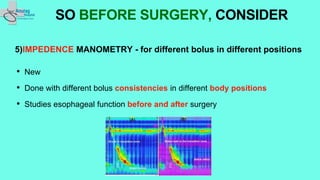
5)IMPEDENCE MANOMETRY - for different bolus in different positions
• New
• Done with different bolus consistencies in different body positions
• Studies esophageal function before and after surgery
SO BEFORE SURGERY, CONSIDER
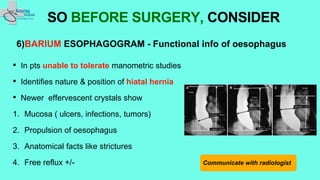
6)BARIUM ESOPHAGOGRAM - Functional info of oesophagus
• In pts unable to tolerate manometric studies
• Identifies nature & position of hiatal hernia
• Newer effervescent crystals show
1. Mucosa ( ulcers, infections, tumors)
2. Propulsion of oesophagus
3. Anatomical facts like strictures
4. Free reflux +/-
SO BEFORE SURGERY, CONSIDER
Communicate with radiologist
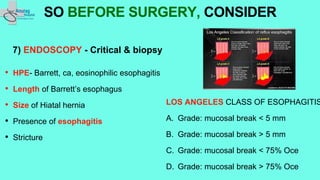
7) ENDOSCOPY - Critical & biopsy
• HPE- Barrett, ca, eosinophilic esophagitis
• Length of Barrett’s esophagus
• Size of Hiatal hernia
• Presence of esophagitis
• Stricture
SO BEFORE SURGERY, CONSIDER
LOS ANGELES CLASS OF ESOPHAGITIS
A. Grade: mucosal break < 5 mm
B. Grade: mucosal break > 5 mm
C. Grade: mucosal break < 75% Oce
D. Grade: mucosal break > 75% Oce
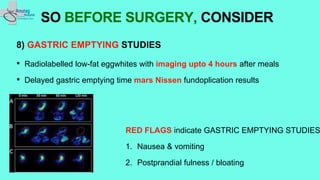
8) GASTRIC EMPTYING STUDIES
• Radiolabelled low-fat eggwhites with imaging upto 4 hours after meals
• Delayed gastric emptying time mars Nissen fundoplication results
SO BEFORE SURGERY, CONSIDER
RED FLAGS indicate GASTRIC EMPTYING STUDIES
1. Nausea & vomiting
2. Postprandial fulness / bloating
In summary -1
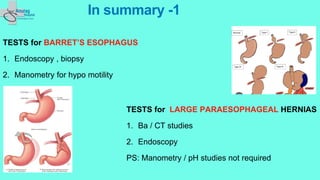
TESTS for BARRET’S ESOPHAGUS
1. Endoscopy , biopsy
2. Manometry for hypo motility
TESTS for LARGE PARAESOPHAGEAL HERNIAS
1. Ba / CT studies
2. Endoscopy
PS: Manometry / pH studies not required
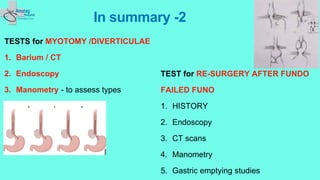
TESTS for MYOTOMY /DIVERTICULAE
1. Barium / CT
2. Endoscopy
3. Manometry - to assess types
In summary -2
TEST for RE-SURGERY AFTER FUNDO
FAILED FUNO
1. HISTORY
2. Endoscopy
3. CT scans
4. Manometry
5. Gastric emptying studies
Thank you
www.anurag-hospital.com

Testing before GERD / FUNDOPLICATION SURGERY

  • 1.
    ANURAG HOSPITAL, COIMBATORE.WWW.ANURAG-HOSPITAL.COM TIPS ON TESTS BEFORE ANTIREFLUX SURGERY Dr PRAVIN HECTOR JOHN MS, FIAGES, FALS, FIBC & Dr JOHN AC THANAKUMAR MBBS, MS, MNAMS, FRCS (Ed), FRCS (G), Dip MIS (Strasbourg), FICS, FALS.
  • 2.
    GENERAL COMMENTS • POORDIAGNOSIS POOR OUTCOME • SUCCESS OF REOPERATIONS IS LESS • SPASTIC DISTURBANCES CAN PRODUCE HEART BURNS
  • 3.
    OTHER CAUSES OFDEFECTIVE LES AND ESOPHAGITIS RED FLAGS • APART FROM GERD, XEROSTOMIA, HYPO-MOTILITY OF ESOPAHGUS • DELAYED GASTRIC EMPTYING • DUODENO GASTRIC REFLUX
  • 4.
    SO BEFORE SURGERY,CONSIDER 1) THOROUGH HISTORY & COUNSELLING
  • 5.
    2) pH MONITORING •24 Hour pH for extent of eosphageal exposure to acid • 24 hour tranasnasal probe or a small capsule (Bravo) attached to mucosa which transmits pH via radio-teletry • Both valid & reproducible • Demonstrates if reflux is postprandial, duration, time of day, with ref to symptoms • Avoid surgery with normal 24 Hr pH reading - results are poor SO BEFORE SURGERY, CONSIDER
  • 6.
    Cautions before pHmonitoring • PPI off for a week • Histamine H2Blockers off for 2 days • Beware of cheats who don’t comply when the pH result is normal SO BEFORE SURGERY, CONSIDER Withholding PPI • Good test when symptoms recur • If no response, use caution
  • 7.
    pH TEST NOTALWAYS NECESSARY • Obvious defective LES (manometry) • Obvious esophagitis (endoscopy) • In very large paraesophageal hernias
  • 8.
    3) IMPEDANCE TESTING- (a corollary to 24 pH monitoring) • Current is conducted by ions on mucosa in empty esophagus • Liquids with more ions increase conductivity and decrease resistance • By measuring impedence at various sites in catheter, direction can be made out as antegrade (bolus) and retrograde reflux(acid) • Combine pH monitoring with impedance testing - all reflux can be measured • Impedance testing is useful for cough, with normal pH studies SO BEFORE SURGERY, CONSIDER
  • 9.
    4)MANOMETRY - measuresup/lower esophageal sphincters, functions High resolution manometry with pressure transducers are useful 1. Oesophago-gastric outflow junctions 2. Major peristaltic disorders (eg nutcracker) 3. Minor peristaltic disorders SO BEFORE SURGERY, CONSIDER MANOMETRY WITH IMPEDENCE 1.Guides surgeon to functional surgery 2.Warns of contra-indications for surgery 3.If test impossible, do partial fundo
  • 10.
    5)IMPEDENCE MANOMETRY -for different bolus in different positions • New • Done with different bolus consistencies in different body positions • Studies esophageal function before and after surgery SO BEFORE SURGERY, CONSIDER
  • 11.
    6)BARIUM ESOPHAGOGRAM -Functional info of oesophagus • In pts unable to tolerate manometric studies • Identifies nature & position of hiatal hernia • Newer effervescent crystals show 1. Mucosa ( ulcers, infections, tumors) 2. Propulsion of oesophagus 3. Anatomical facts like strictures 4. Free reflux +/- SO BEFORE SURGERY, CONSIDER Communicate with radiologist
  • 12.
    7) ENDOSCOPY -Critical & biopsy • HPE- Barrett, ca, eosinophilic esophagitis • Length of Barrett’s esophagus • Size of Hiatal hernia • Presence of esophagitis • Stricture SO BEFORE SURGERY, CONSIDER LOS ANGELES CLASS OF ESOPHAGITIS A. Grade: mucosal break < 5 mm B. Grade: mucosal break > 5 mm C. Grade: mucosal break < 75% Oce D. Grade: mucosal break > 75% Oce
  • 13.
    8) GASTRIC EMPTYINGSTUDIES • Radiolabelled low-fat eggwhites with imaging upto 4 hours after meals • Delayed gastric emptying time mars Nissen fundoplication results SO BEFORE SURGERY, CONSIDER RED FLAGS indicate GASTRIC EMPTYING STUDIES 1. Nausea & vomiting 2. Postprandial fulness / bloating
  • 14.
    In summary -1 TESTSfor BARRET’S ESOPHAGUS 1. Endoscopy , biopsy 2. Manometry for hypo motility TESTS for LARGE PARAESOPHAGEAL HERNIAS 1. Ba / CT studies 2. Endoscopy PS: Manometry / pH studies not required
  • 15.
    TESTS for MYOTOMY/DIVERTICULAE 1. Barium / CT 2. Endoscopy 3. Manometry - to assess types In summary -2 TEST for RE-SURGERY AFTER FUNDO FAILED FUNO 1. HISTORY 2. Endoscopy 3. CT scans 4. Manometry 5. Gastric emptying studies
  • 16.