Austerity drive for rectal cancer :
can we do with less ?
Dr Bala Vellayappan MBBS, FRANZCR, MCI
Consultant, Radiation Oncology, NCIS, NUH
Asst. Prof, YYL SoM
Dept Research Director
Disclosures
• None
• I am a believer in the use of RT for rectal cancers
Frequently asked questions at lower GI
tumour board…
1. Is that 5 mm lung nodule metastatic disease?
2. Is it above or below the peritoneal reflection?
3. Is it stage 2 or 3? i.e are the LN involved?
Introduction
• In Singapore, most
common cancer overall.
1/3 present with stage III
disease. Patel SG Curr Gastroenterol Rep 2018
How is rectal cancer different from colon
cancer?
Rectal cancer Colon cancer
Patterns of local recurrence High : Rich lymphatics, and
drainage to pelvic side walls
Low : Local recurrence/anastomotic
recurrence not common
Patterns of distant recurrence Drainage along superior rectal
vessel IVC>> Lung mets more
common
*Extra-peritoneal
Drainage via portal vein >> Liver
mets more common.
More peritoneal dissemination
Surgical approach Narrow pelvis limits surgical
accessibility
Surgery is considerably easier
Benefit of RT Proven No strong evidence (ref INT 0130)
Response to chemotherapy = =
Workup for rectal cancer
• H + P
• Full colonoscopy and biopsy (5% synchronous)
• Baseline labs and CEA
• T staging : Clinical exam and MRI
• N staging : MRI (+- contrast), CT or PET/CT
• M staging : CT TAP or PET/CT
MRI protocol
• 3T better than 1.5 T
• Useful in assessing meso-rectal invasion and EMVI
• NUH protocol : Ax T2, Sag T2, Cor T2, Ax DWI, Ax T1, Ax Lava Flex, Ax
Lava pre
• Point of controversy: Is contrast useful ?
Spot the seagull
Traditional approach : Surgery alone  high
local recurrences
Stage group Local failure rates
T1-T2 N0 LF <10%
T3N0, T1N1 LF 15– 35% Rationale for pelvic
radiotherapy!T3-T4 or N1/2 LF 45 – 65%
Local failure is debilitating and morbid. Limited ability to
salvage.
We must do everything we can to reduce local recurrences.
Where are we now?
1.
2.
3a.
4.
3b.
Variations in the delivery of RT
1. Pre-op vs post-op
2. Short-course vs long-course
3. Addition of oxaliplatin
4. 3D VS Intensity-modulated Radiation therapy (IMRT)
Variations in the delivery of RT
1. Pre-op vs post-op
2. Short-course vs long-course
3. Addition of oxaliplatin
4. 3D VS IMRT
Pre-op(neoadjuvant) vs post-op (adjuvant)
Pre-OP Post-OP
Symptom relief Slow Quick
Appropriate patient selection for
RT
10-20% overtreatment (T2, N0) Pathologically staged = accurate
Bowel toxicity Less Bowel flops into pelvis
Wound complications More Less
Anastomotic complications Less More
Sphincter salvage Possible …
Tumor Hypoxia Less More
Patient compliance Better Potentially worse
German Rectal Cancer Study: Preop vs postop
823
Patients
, EUS
staged
cT3/4,N0/+
Adenoca
TME surgery
postop CRT
55.8Gy
Preop CRT
50.4Gy TME
surgery
• No difference in OS (76% vs. 74%. p=0.8)
• Increased local control (6% vs. 13%. P=0.06)
• Decreased G3/4 acute toxicity (27% vs.
40%. P=0.001)
• 8% patients had complete pathological
response
• Improved sphincter preservation with pre-
op
Sauer NEJM 2004
R
A
N
D
O
M
I
Z
E
Variations in the delivery of RT
1. Pre-op vs post-op
2. Short-course vs long-course
3. Addition of oxaliplatin
4. 3D VS IMRT
Pre-op : Short (25Gy in 1 week) or long (50Gy over 5
weeks ?
Author Inclusion N Intervention Comparison Outcome Comments
Bukjo 2004 T3 – T4 314 25 Gy / 5 # 50.4Gy/28# + 5FU No difference in
sphincter preservation
rate
More acute toxicity in
CRT group (18% vs. 3%)
No difference in DFS
(58% vs. 56%), local
recurrence (9% vs. 14%),
and late toxicity (10% vs.
7%)
Ngan 2012 T3, Nx 326 25Gy /5# 50.4Gy/28# +
capecitabine
No diff in local
recurrence (7.5 v 5.7%)
No diff in OS (74 vs 70%)
Subgroup :
More
recurrence in
distal cancer
with short
course (12 %
vs 3%)
SHORT COURSE = LONG COURSE
Low rectal cancers, CRM threatened
LONG > SHORT
Risk-stratified approach
Variations in the delivery of RT
1. Pre-op vs post-op
2. Short-course vs long-course
3. Addition of oxaliplatin
4. 3D VS IMRT
Does addition of concurrent oxaliplatin
improve outcome?
STAR-01 ACCORD-12 NSABP-R04 CAO/ARO-04 PETACC-6
N 720 596 1608 1265 1094
RT dose 50.4 45 - 50 50.4 – 55.8 50.4 45 - 50
G3+ GI
toxicity
7 v 24% 11 v 25% 7 v 15% 8 v 12% 6 v 18%
yPCR 16% 13 v 19% 19 v 21% 13 v 17% 11.5 v 13%
Spincter
salvage
78% 75% 62% 88% 65 – 69%
Gerard JCO 2010; Aschele JCO 2011; Rodel Lancet
Oncol 2012; Roh JCO, 2014; Schmoll, PASCO, 2013
Variations in the delivery of RT
1. Pre-op vs post-op
2. Short-course vs long-course
3. Addition of oxaliplatin
4. 3D VS IMRT
Do newer RT techniques improve outcome?
• IMRT in rectal cancer
• Ability to conform radiation dose to primary rectal
tumour and regional lymphatics
• At the same time spares critical normal tissues such
as
• Bladder
• Small bowel
• Femoral heads
• Potential for radiation dose escalation
3D RT
3DCRT vs IMRT dosimetric comparison
IMRT decreases dose to bladder, small bowel and femoral heads
3DCRT IMRT
3
D
C
R
T
I
M
R
T
Journal of Cancer 2017, p 3114
• Prospective single-arm Phase II design
• IMRT 55Gy/25# with concurrent capecitabine
• TME surgery 8 weeks post RT
• Primary outcome : pCR
• Secondary outcome : downstaging rate
• n = 20
• 35% pCR, 65% downstaging. Spincter preservation 85%. 5% G3
toxicity (proctitis). 2 year OS 90%
Evolution of rectal cancer treatment
APR
Anterior
resection TME surgery
NIH
Consensus
statement :
adjuvant RT
+ chemo for
all T3, N+
Neoadjuvant
therapy
Long course Short course
Individualised
therapy
TNT
Distant
recurrence
Local
recurrence
~30%
1920s 1960s 1980-90s 1990s 2000s 2010s Present
<5%
Can we do with less local therapy ?
Can we do with less surgery (or no surgery)?
• Potential scenario :
• 1) Avoid surgery in patients who achieve a complete clinical response
to pre-op therapy? i.e. watch and wait policy
Rationale :
• surgical complications ~30%
• permanent or temp stoma
• impaired bowel/bladder/sexual function
In the footsteps of ANAL cancer paradigm
• Anal Cancer : APR surgery (before 1970s)Preop chemoRT
(1970s)Definitive chemoRT (present)
• Distal rectal cancer : APR (present)  Preop chemoRT
(present)definitive chemoRT (future)
Response is a surrogate for better biology
Response
Tumour Regression
Grade (TRG)
Outcome
TRG 4 i.e pCR NO local recurrence.
86% 5y DFS
TRG 2-3 4% local recurrence,
75% 5y DFS
TRG 0-1 6% local recurrence,
63% 5y DFS
Rodel JCO 2005
Brazilian data
Inclusion
• 361 patients
• 99 with clinical CR (27%)
Treatment
• Median followup 60 m
Results
• 5% local recurrence - mostly surgical salvage
• mean interval to recurrence 52m
• 0% pelvic recurrence, 8% distant mets
• 5 ys OS 93%
Habr-Gama J Gastrointest Surg 2006
NOM : selection bias for better biology?
• MSKCC retrospective review comparing patients in cCR and pCR
• Are we doing patients with “better biology” a dis-service by omitting
surgery?
• Median followup 19 m
• 26% had local recurrence (19 of 73) all surgically salvaged
Smith ASCO GI 015
Challenges with NOM
• Surgery still the only means of reliably detecting a pCR
• Clinical response may not always correlate with pathological response
• Clinical evaluation can be limited to distinuguish fibrosis from residual
disease
• Biopsy post chemoRT can be difficult to interpret
• Committed patients for very close surveillance and early salvage in
order not to compromise outcome  increased healthcare cost at
the expense of ?better QoL
Can we do with less RT (or no RT?)
• 1) In patients with negative margins after TME? (post-op RT)
• 2) In patients with good response to systemic therapy?
N=1350
Operable
Rectal
cancer
TME surgery
Preoperative 25Gy/5#
TME surgery
Montefiore. Lancet Oncol
2009
Post operative chemoRT
45G/25# only if CRM <1mm. If
CRM clear, no adjuvant
therapy)
R
A
N
D
O
M
I
Z
E
Primary
outcome :
Local
recurrence
Even with good clean surgery,
you can’t boot RT
Can we boot RT with effective
chemotherapy?
PROSPECT trial
Do we need more chemo?
APR
Anterior
resection TME surgery
NIH
Consensus
statement :
adjuvant RT
+ chemo for
all T3, N+
Neoadjuvant
therapy
Long course Short course
Individualised
therapy
TNT
Distant
recurrence
Local
recurrence
~30%
1920s 1960s 1980-90s 1990s 2000s 2010s Present
<5%
Conclusion
Even at specialty cancer centers, a sizeable
minority of patients with rectal cancer
treated with curative-intent neoadjuvant
chemoradiotherapy do not complete
postoperative chemotherapy. Strategies to
facilitate the ability to complete this third
and final component of curative intent
treatment are necessary.
Adjuvant chemo completion rates are still suboptimal
1) There is a still a problem of poor completion rates of adjuvant
chemotherapy
2) Still 35% rates of DM – micrometastatic disease should be addressed
earlier
3) LRR <5% are already close to optimal with current (C)RT regimens. We
should not be trying too hard to tweak this further.
4) Adding more chemo or dose to chemoRT is unlikely to improve DFS/OS
and only adds more toxicity.
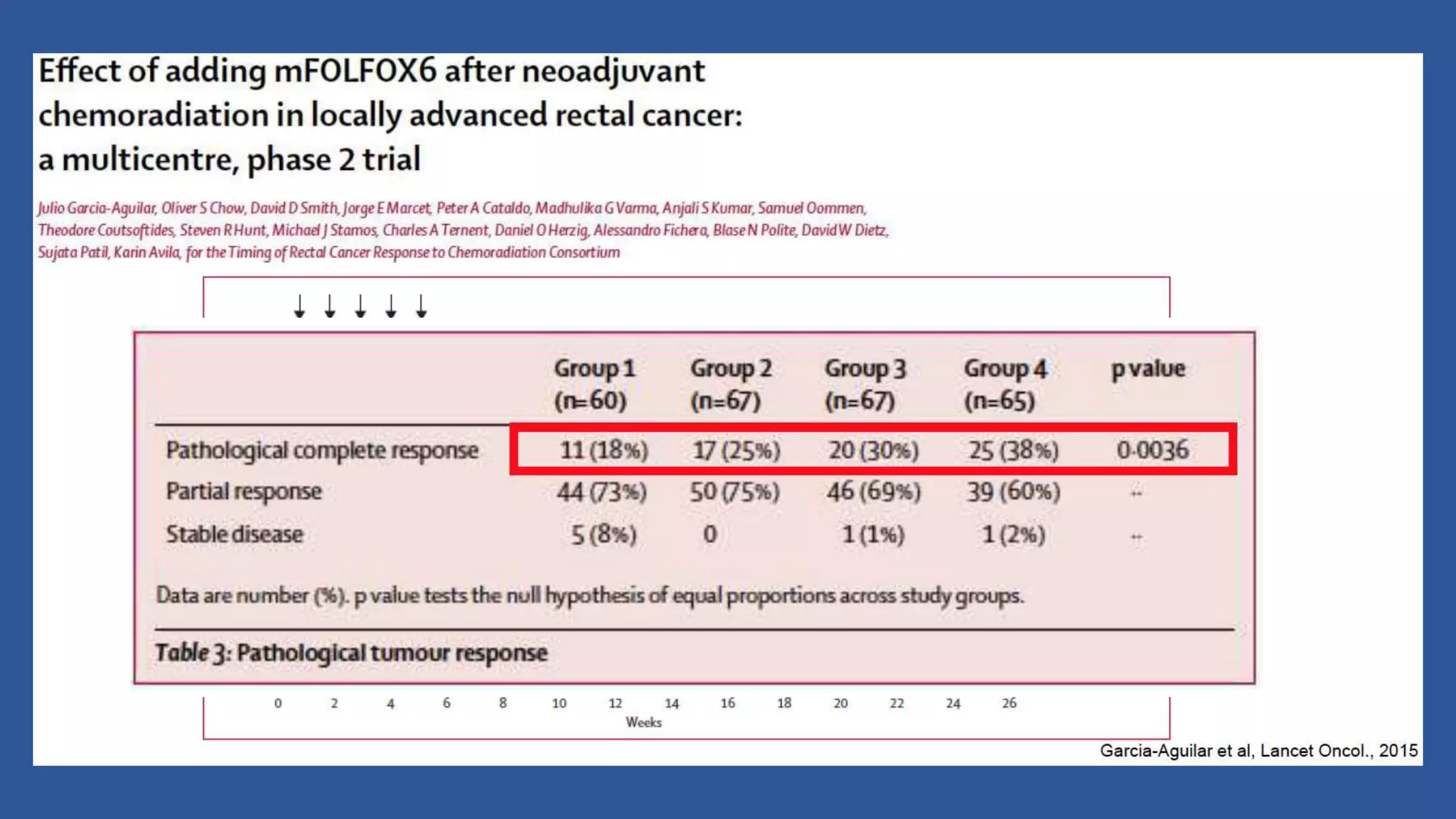
Total neoadjuvant therapy (TNT)
: Rationale
TNT
Polish II Phase 3 RCT
Polish II : results
Bukjo Ann Onc 2016
Pre-op SCRT + Chemo – RAPIDO Trial
TNT : Pre-op SCRT + Chemo
Compliance to pre-op chemo is good – 80-100%
Higher rates of pCR may allow omission of surgery
Superiority over current standard still unproven
Case study : EA
• 69, Lady, PS 0
• Ano-rectal mass. Extending 8cm into rectum.
• No vaginal involvement
• Biopsy : adenocarcinoma
IMRT with concurrent capecitabine
45 Gy
50Gy
Conclusion
• Pre-op chemoRT remains the standard of care for stage 2 – 3 rectal cancer
• Reduces local recurrence
• Allows for sphincter preservation
• In terms of local recurrence, we have reached a point where we can consider de-
intensification for selected patient (less surgery or less RT)
• Trimodality treatment still needed for high-risk patients.
• Can biomarkers or functional imaging help in patient selection?
• Distant mets continues to pose a problem – more effective systemic
therapy/biologics or TNT may reduce the rate of DM, and perhaps improve OS
Thank you for your attention!
Bala_vellayappan@nuhs.edu.sg

Rectal cancer

  • 1.
    Austerity drive forrectal cancer : can we do with less ? Dr Bala Vellayappan MBBS, FRANZCR, MCI Consultant, Radiation Oncology, NCIS, NUH Asst. Prof, YYL SoM Dept Research Director
  • 2.
    Disclosures • None • Iam a believer in the use of RT for rectal cancers
  • 3.
    Frequently asked questionsat lower GI tumour board… 1. Is that 5 mm lung nodule metastatic disease? 2. Is it above or below the peritoneal reflection? 3. Is it stage 2 or 3? i.e are the LN involved?
  • 4.
    Introduction • In Singapore,most common cancer overall. 1/3 present with stage III disease. Patel SG Curr Gastroenterol Rep 2018
  • 5.
    How is rectalcancer different from colon cancer? Rectal cancer Colon cancer Patterns of local recurrence High : Rich lymphatics, and drainage to pelvic side walls Low : Local recurrence/anastomotic recurrence not common Patterns of distant recurrence Drainage along superior rectal vessel IVC>> Lung mets more common *Extra-peritoneal Drainage via portal vein >> Liver mets more common. More peritoneal dissemination Surgical approach Narrow pelvis limits surgical accessibility Surgery is considerably easier Benefit of RT Proven No strong evidence (ref INT 0130) Response to chemotherapy = =
  • 6.
    Workup for rectalcancer • H + P • Full colonoscopy and biopsy (5% synchronous) • Baseline labs and CEA • T staging : Clinical exam and MRI • N staging : MRI (+- contrast), CT or PET/CT • M staging : CT TAP or PET/CT
  • 7.
    MRI protocol • 3Tbetter than 1.5 T • Useful in assessing meso-rectal invasion and EMVI • NUH protocol : Ax T2, Sag T2, Cor T2, Ax DWI, Ax T1, Ax Lava Flex, Ax Lava pre • Point of controversy: Is contrast useful ?
  • 8.
  • 9.
    Traditional approach :Surgery alone  high local recurrences Stage group Local failure rates T1-T2 N0 LF <10% T3N0, T1N1 LF 15– 35% Rationale for pelvic radiotherapy!T3-T4 or N1/2 LF 45 – 65% Local failure is debilitating and morbid. Limited ability to salvage. We must do everything we can to reduce local recurrences.
  • 10.
    Where are wenow? 1. 2. 3a. 4. 3b.
  • 11.
    Variations in thedelivery of RT 1. Pre-op vs post-op 2. Short-course vs long-course 3. Addition of oxaliplatin 4. 3D VS Intensity-modulated Radiation therapy (IMRT)
  • 12.
    Variations in thedelivery of RT 1. Pre-op vs post-op 2. Short-course vs long-course 3. Addition of oxaliplatin 4. 3D VS IMRT
  • 13.
    Pre-op(neoadjuvant) vs post-op(adjuvant) Pre-OP Post-OP Symptom relief Slow Quick Appropriate patient selection for RT 10-20% overtreatment (T2, N0) Pathologically staged = accurate Bowel toxicity Less Bowel flops into pelvis Wound complications More Less Anastomotic complications Less More Sphincter salvage Possible … Tumor Hypoxia Less More Patient compliance Better Potentially worse
  • 14.
    German Rectal CancerStudy: Preop vs postop 823 Patients , EUS staged cT3/4,N0/+ Adenoca TME surgery postop CRT 55.8Gy Preop CRT 50.4Gy TME surgery • No difference in OS (76% vs. 74%. p=0.8) • Increased local control (6% vs. 13%. P=0.06) • Decreased G3/4 acute toxicity (27% vs. 40%. P=0.001) • 8% patients had complete pathological response • Improved sphincter preservation with pre- op Sauer NEJM 2004 R A N D O M I Z E
  • 15.
    Variations in thedelivery of RT 1. Pre-op vs post-op 2. Short-course vs long-course 3. Addition of oxaliplatin 4. 3D VS IMRT
  • 16.
    Pre-op : Short(25Gy in 1 week) or long (50Gy over 5 weeks ? Author Inclusion N Intervention Comparison Outcome Comments Bukjo 2004 T3 – T4 314 25 Gy / 5 # 50.4Gy/28# + 5FU No difference in sphincter preservation rate More acute toxicity in CRT group (18% vs. 3%) No difference in DFS (58% vs. 56%), local recurrence (9% vs. 14%), and late toxicity (10% vs. 7%) Ngan 2012 T3, Nx 326 25Gy /5# 50.4Gy/28# + capecitabine No diff in local recurrence (7.5 v 5.7%) No diff in OS (74 vs 70%) Subgroup : More recurrence in distal cancer with short course (12 % vs 3%) SHORT COURSE = LONG COURSE Low rectal cancers, CRM threatened LONG > SHORT
  • 17.
  • 18.
    Variations in thedelivery of RT 1. Pre-op vs post-op 2. Short-course vs long-course 3. Addition of oxaliplatin 4. 3D VS IMRT
  • 19.
    Does addition ofconcurrent oxaliplatin improve outcome? STAR-01 ACCORD-12 NSABP-R04 CAO/ARO-04 PETACC-6 N 720 596 1608 1265 1094 RT dose 50.4 45 - 50 50.4 – 55.8 50.4 45 - 50 G3+ GI toxicity 7 v 24% 11 v 25% 7 v 15% 8 v 12% 6 v 18% yPCR 16% 13 v 19% 19 v 21% 13 v 17% 11.5 v 13% Spincter salvage 78% 75% 62% 88% 65 – 69% Gerard JCO 2010; Aschele JCO 2011; Rodel Lancet Oncol 2012; Roh JCO, 2014; Schmoll, PASCO, 2013
  • 20.
    Variations in thedelivery of RT 1. Pre-op vs post-op 2. Short-course vs long-course 3. Addition of oxaliplatin 4. 3D VS IMRT
  • 21.
    Do newer RTtechniques improve outcome? • IMRT in rectal cancer • Ability to conform radiation dose to primary rectal tumour and regional lymphatics • At the same time spares critical normal tissues such as • Bladder • Small bowel • Femoral heads • Potential for radiation dose escalation 3D RT
  • 22.
    3DCRT vs IMRTdosimetric comparison IMRT decreases dose to bladder, small bowel and femoral heads 3DCRT IMRT 3 D C R T I M R T
  • 23.
    Journal of Cancer2017, p 3114 • Prospective single-arm Phase II design • IMRT 55Gy/25# with concurrent capecitabine • TME surgery 8 weeks post RT • Primary outcome : pCR • Secondary outcome : downstaging rate • n = 20 • 35% pCR, 65% downstaging. Spincter preservation 85%. 5% G3 toxicity (proctitis). 2 year OS 90%
  • 24.
    Evolution of rectalcancer treatment APR Anterior resection TME surgery NIH Consensus statement : adjuvant RT + chemo for all T3, N+ Neoadjuvant therapy Long course Short course Individualised therapy TNT Distant recurrence Local recurrence ~30% 1920s 1960s 1980-90s 1990s 2000s 2010s Present <5%
  • 25.
    Can we dowith less local therapy ?
  • 26.
    Can we dowith less surgery (or no surgery)? • Potential scenario : • 1) Avoid surgery in patients who achieve a complete clinical response to pre-op therapy? i.e. watch and wait policy Rationale : • surgical complications ~30% • permanent or temp stoma • impaired bowel/bladder/sexual function
  • 27.
    In the footstepsof ANAL cancer paradigm • Anal Cancer : APR surgery (before 1970s)Preop chemoRT (1970s)Definitive chemoRT (present) • Distal rectal cancer : APR (present)  Preop chemoRT (present)definitive chemoRT (future)
  • 28.
    Response is asurrogate for better biology Response Tumour Regression Grade (TRG) Outcome TRG 4 i.e pCR NO local recurrence. 86% 5y DFS TRG 2-3 4% local recurrence, 75% 5y DFS TRG 0-1 6% local recurrence, 63% 5y DFS Rodel JCO 2005
  • 29.
    Brazilian data Inclusion • 361patients • 99 with clinical CR (27%) Treatment • Median followup 60 m Results • 5% local recurrence - mostly surgical salvage • mean interval to recurrence 52m • 0% pelvic recurrence, 8% distant mets • 5 ys OS 93% Habr-Gama J Gastrointest Surg 2006
  • 30.
    NOM : selectionbias for better biology? • MSKCC retrospective review comparing patients in cCR and pCR • Are we doing patients with “better biology” a dis-service by omitting surgery?
  • 31.
    • Median followup19 m • 26% had local recurrence (19 of 73) all surgically salvaged Smith ASCO GI 015
  • 32.
    Challenges with NOM •Surgery still the only means of reliably detecting a pCR • Clinical response may not always correlate with pathological response • Clinical evaluation can be limited to distinuguish fibrosis from residual disease • Biopsy post chemoRT can be difficult to interpret • Committed patients for very close surveillance and early salvage in order not to compromise outcome  increased healthcare cost at the expense of ?better QoL
  • 33.
    Can we dowith less RT (or no RT?) • 1) In patients with negative margins after TME? (post-op RT) • 2) In patients with good response to systemic therapy?
  • 34.
    N=1350 Operable Rectal cancer TME surgery Preoperative 25Gy/5# TMEsurgery Montefiore. Lancet Oncol 2009 Post operative chemoRT 45G/25# only if CRM <1mm. If CRM clear, no adjuvant therapy) R A N D O M I Z E Primary outcome : Local recurrence
  • 35.
    Even with goodclean surgery, you can’t boot RT
  • 36.
    Can we bootRT with effective chemotherapy?
  • 37.
  • 38.
    Do we needmore chemo? APR Anterior resection TME surgery NIH Consensus statement : adjuvant RT + chemo for all T3, N+ Neoadjuvant therapy Long course Short course Individualised therapy TNT Distant recurrence Local recurrence ~30% 1920s 1960s 1980-90s 1990s 2000s 2010s Present <5%
  • 39.
    Conclusion Even at specialtycancer centers, a sizeable minority of patients with rectal cancer treated with curative-intent neoadjuvant chemoradiotherapy do not complete postoperative chemotherapy. Strategies to facilitate the ability to complete this third and final component of curative intent treatment are necessary. Adjuvant chemo completion rates are still suboptimal
  • 40.
    1) There isa still a problem of poor completion rates of adjuvant chemotherapy 2) Still 35% rates of DM – micrometastatic disease should be addressed earlier 3) LRR <5% are already close to optimal with current (C)RT regimens. We should not be trying too hard to tweak this further. 4) Adding more chemo or dose to chemoRT is unlikely to improve DFS/OS and only adds more toxicity. Total neoadjuvant therapy (TNT) : Rationale
  • 41.
  • 43.
  • 44.
    Polish II :results Bukjo Ann Onc 2016
  • 45.
    Pre-op SCRT +Chemo – RAPIDO Trial
  • 46.
    TNT : Pre-opSCRT + Chemo Compliance to pre-op chemo is good – 80-100% Higher rates of pCR may allow omission of surgery Superiority over current standard still unproven
  • 47.
    Case study :EA • 69, Lady, PS 0 • Ano-rectal mass. Extending 8cm into rectum. • No vaginal involvement • Biopsy : adenocarcinoma
  • 48.
    IMRT with concurrentcapecitabine 45 Gy 50Gy
  • 50.
    Conclusion • Pre-op chemoRTremains the standard of care for stage 2 – 3 rectal cancer • Reduces local recurrence • Allows for sphincter preservation • In terms of local recurrence, we have reached a point where we can consider de- intensification for selected patient (less surgery or less RT) • Trimodality treatment still needed for high-risk patients. • Can biomarkers or functional imaging help in patient selection? • Distant mets continues to pose a problem – more effective systemic therapy/biologics or TNT may reduce the rate of DM, and perhaps improve OS
  • 51.
    Thank you foryour attention! Bala_vellayappan@nuhs.edu.sg

Editor's Notes

  • #14 Sterile surgical bed
  • #41  Can we further improve outcomes by addressing micrometastaticsystemic disease as well as the primary tumor with upfront chemotherapy rather than adjuvant chemotherapy?