NEOADJUVANT THERAPY FOR
COLORECTAL CARCINOMA
Dr. Ankita Singh
Senior Resident
Unit 1
Department of Surgical Disciplines
AIIMS Delhi
INTRODUCTION TO COLORECTAL CA
(CRC)
• Colorectal cancer (CRC) - third most common cancer
diagnosed in both sexes & second leading cause of
cancer deaths in the Western World.
• 1.5L cases and 52,300 deaths in United States (2019).
Rebecca L, Siegel MPH , Kimberly D, Miller MPH , Ahmedin Jemal DVM. Cancer statistics,
2019. https://doi.org/10.3322/caac.21551
INTRODUCTION TO COLORECTAL CA
(CRC)
• Overall incidence as well as mortality has decreased
• Rising incidence <50 years, estimated incidence for
colon & rectal cancers will increase by 90% & 124.25
respectively for pts 20-34yrs by 2030.
• 60% are age >65 years
• Men > women
• Racial disparities- non-Hispanic blacks (NHB) have
higher incidence 20% and higher mortality 40% vs
non Hispanic Whites.
• Lowest rates in Africa & South Central Asia..Jemal A, Murray T, Samuels A, et al. Cancer statistics, 2003. CA Cancer J Clin. 2003;53:5.
Siegel, RL, Miller, KD, Fedewa, SA, et al. Colorectal Cancer Statistics, 2017. CA Cancer J Clin.
2017;67:177-193.
INTRODUCTION TO COLORECTAL CA
(CRC)
• Several risk factors implicated in
tumorigenesis including genetics, age, obesity,
smoking, and diet.
• Genetic susceptibility (Lynch, FAP)
• Sporadic > Hereditary (20% of ca colon are
familial)
• Heterogeneous disease- variable molecular
defects
.Jemal A, Murray T, Samuels A, et al. Cancer statistics, 2003. CA Cancer J Clin. 2003;53:5.
Siegel, RL, Miller, KD, Fedewa, SA, et al. Colorectal Cancer Statistics, 2017. CA Cancer J Clin.
2017;67:177-193
INTRODUCTION TO COLORECTAL CA
(CRC)
• 40% in the proximal colon & 60% are in the distal
colon and rectum.
• Cancers of the rectum and rectosigmoid junction-
30% of all CRC
• Overall survival is higher with rectal cancer (67%)
than colon cancer (64%)
• Women are more likely to have proximal lesions
(46%) when compared to men (37%), and this
disparity increases with advancing age.
.Jemal A, Murray T, Samuels A, et al. Cancer statistics, 2003. CA Cancer J Clin. 2003;53:5.
Siegel, RL, Miller, KD, Fedewa, SA, et al. Colorectal Cancer Statistics, 2017. CA Cancer J Clin.
2017;67:177-193
INTRODUCTION TO COLORECTAL CA
(CRC)
• At younger ages (<50yr), both men (41%) and
women (36%) are more likely to be diagnosed with
rectal than colon cancer
• Substantial absolute increase in the risk of rectal
cancer in patients born after 1970.
• More than 90% of colorectal cancers are
Adenocarcinoma. Adenocarcinoma of the rectum-
30%.
• Left sided colon & rectal cancers- usually
symptomatic
• Diagnosis – clinical suspicion followed by HPE
• Management according to stage
1.Jemal A, Murray T, Samuels A, et al. Cancer statistics, 2003. CA Cancer J Clin. 2003;53:5.
2. Siegel, RL, Miller, KD, Fedewa, SA, et al. Colorectal Cancer Statistics, 2017. CA Cancer J Clin.
2017;67:177-193
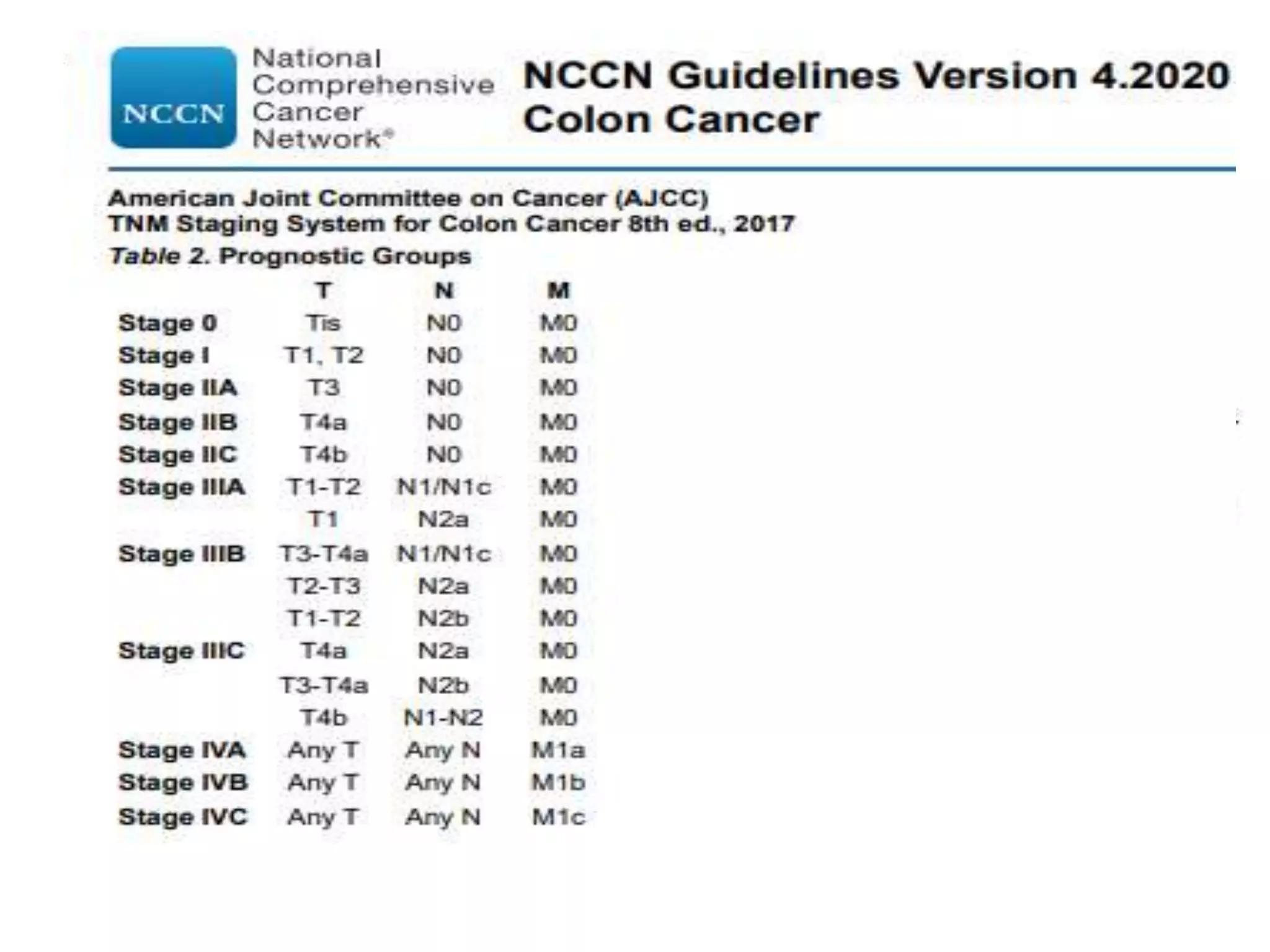
CRC STAGING
• 8th edition AJCC TNM classification & staging
Surgery is the cornerstone in management colorectal
malignancy
However
Surgery alone with intention to cure, in patients of colorectal
CA without evidence of gross disease postoperatively may
still develop local recurrence or distant metastasis
Up to 45% of patients who undergo TME
with tumor-free radial and distal margins may develop local
failure.
LOCAL RECURRENCE FOLLOWING
SURGERY ALONE
David B, ChessinJose G, Guillem. Surgical Issues in Rectal Cancer: A 2004 Update. Clinical Colorectal Cancer, vol.4, 2004; 233-40
LOCAL RECURRENCE FOLLOWING
SURGERY ALONE
T1-2, N0, M0 <10%
T3, N0, M0 15-35%
T1,N1,M0 15-35%
T3-4, N1-2, M0 45-65%
REASON FOR LOCAL RECURRENCE
• Micrometastatic disease
• Close proximity of rectum to adjacent organs
Anteriorly: Genitourinary tract (5-17%)
Posteriorly: Sacrum and presacral fascia & sacral root
sheaths(22-49%)
Laterally: Muscles (piriformis, levator), soft tissue of the
pelvic sidewall, lymph nodes, major iliac vessels, sacral
nerve plexus & lateral bony pelvis (21%)
• Technical difficulties in obtaining wide surgical
margins at resection
• Absence of serosa covering rectum
Could incidence of local recurrence be
reduced?
COMBINED MODALITY THERAPY
+/- Neoadjuvant therapy
+
Surgery
(TME + APR/ end to end OR colonic pouch
reconstruction)
+/-
Adjuvant therapy
*Based on preoperative staging and high risk features.
CURRENT TREATMENT
RECOMMENDATION
ADVANTAGES OF NEOADJUVANT
THERAPY (NAT)
• Tumour downsizing (upto 80%)
# Pathological complete response (15-30%)
# Shrinkage of tumour facilitates R0 resection
# Sphincter preservation
• Higher CT dose with RT
• Radiating tissues with higher oxygen
• Decreased incidence of radiation enteritis
• Better compliance
• For complete responders, adjuvant short course less
toxic regimen is commonly considered.
INDICATIONS OF NEOADJUVANT (NAT)
THERAPY IN CRC
RECTUM:
cT3-T4/anyN,
cT1-T2/N1-N2,
some bulky T2lesions near
anal verge
Locally unresectable,
COLON:
cT4b,
Bulky nodal disease
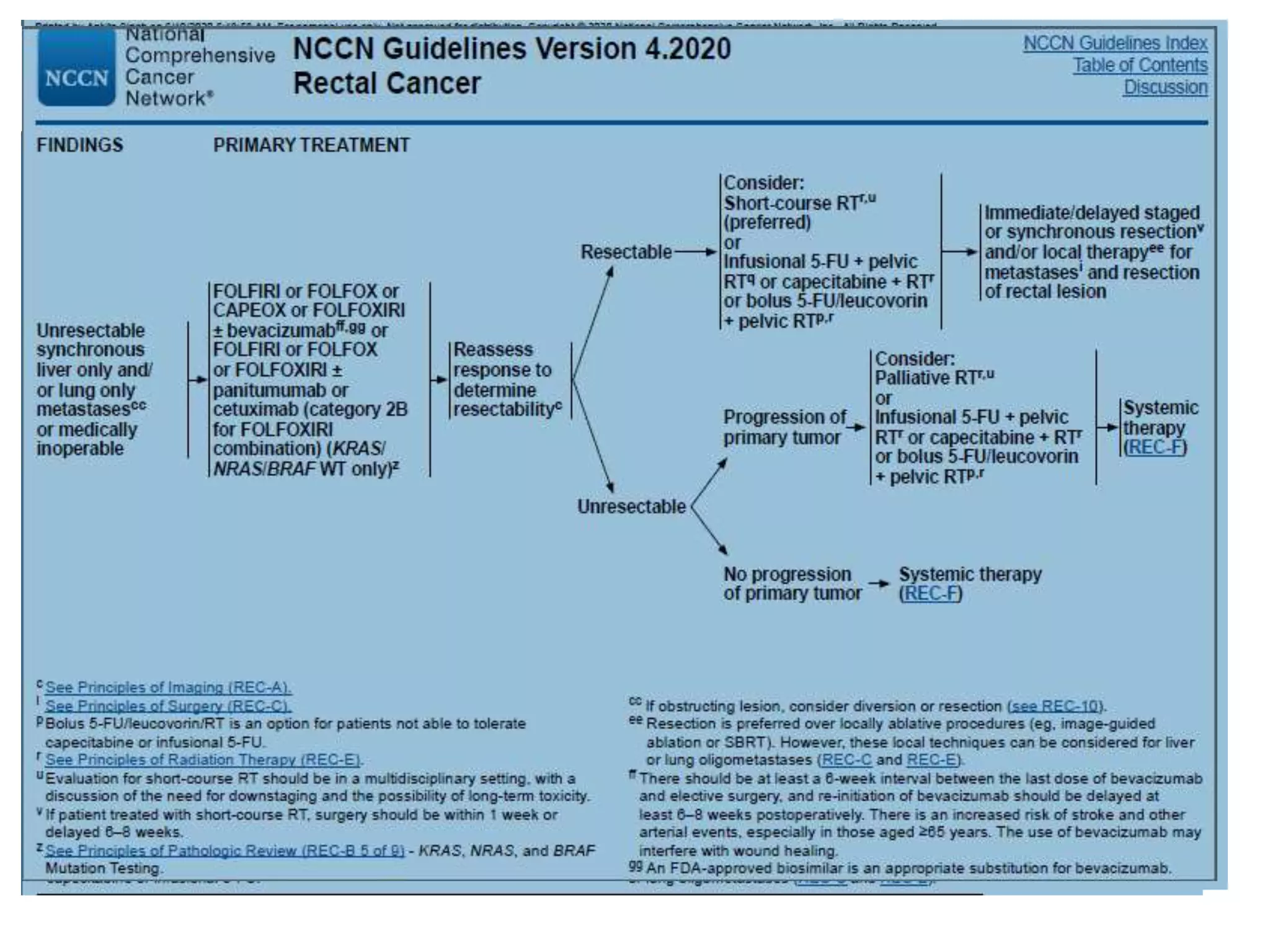
*Resactable/unresectable
synchronous liver only &/
lung only mets.
Medically inoperable
Monson JRT, Weiser MR, Buie WD, et al. Standards Practice Task Force of the American Society of Colon and Rectal Surgeons. Practice
parameters for the management of rectal cancer (revised) Dis Colon Rectum. 2013;56:535–50.
National Comprehensive Cancer Network. NCCN Clinical Practice Guidelines in Oncology - Rectal Cancer & colon cancer (Ver 4.2020) 2020.
www.uptodate.com (September 2015) Br J Cancer 2000; 82:1131
Evidence into benefit of Neoadjuvant therapy in
CRC?
Studies:
preRT vs surgery alone
preRT vs preCRT
preCRT vs postCT
preCRT vs postCRT
preCT vs surgery alone
Studied comparison of rate of local recurrence post surgery in colorectal ca groups
with/out preRT.
Conclusion-
• Statistically significant decrease of local recurrence rate in preRT
• Swedish trial is first & only to show overall survival benefit of preRT in stage III
Study- Addition of chemotherapy to preoperativeRT & use of postoperative
chemotherapy in treatment of carcinoma rectum.
conclusion-
• No overall survival benefit
• No clear survival benefit of post CT with preCRT.
• Statistically significant decrease in local recurrence with addition of CT to preRT.
Study- compared preop short course RT(5 days of 5 Gy) versus conventional radiotherapy
(28 fractions of 1.8 Gy for a total of 50.4 Gy) to ascertain whether there was a difference in
sphincter preservation.
Conclusion-
• No impact on sphincter preservation
• No difference in survival, local control or late complications (anorectal/sexual)
GENERAL RECTAL CA TRIAL - CAO/ARO/AIO-94
N Engl J Med. 2004 Oct 21;351(17):1731-40.
Study- stage II/III RCT: preCRT vs postCRT
Conclusion-
• Local recurrence rate (6%vs13%) p=0.006
• No difference in overall survival
• 39% predetermined candidates for APR, underwent sphincter preservation. (p=0.004)
• Also decreased acute and long term treatment related toxicity with preCRT.
Patrick M. Boland1, Marwan Fakih2 .The emerging role of neoadjuvant chemotherapy for rectal cancer. Vol 5, no. 5,Oct 2014.
• .
Patrick M. Boland1, Marwan Fakih2 .The emerging role of neoadjuvant chemotherapy for rectal cancer. Vol 5, no. 5,Oct 2014.
• .
CONCLUSION OF TRIAL:
• Short course RT with or without delay compared with Long course RT with delayed
Surgery has a similar outcome.
• Long-course RT with delay is similar to both short-course RT regimens, but
prolongs the t/t time substantially.
• Delaying surgery after short-course RT gives similar oncological results compared
with shortcourse radiotherapy with immediate surgery.
• Short-course RT with delay had less postoperative complications.
• Short-course RT with delay to surgery is useful alternative to conventional short-
course RT
What have we learnt??
EVIDENCE BASED APPROACH
• Eligibility for NAT: primary tumour stage & extrarectal
tumour burdon
• Recommendations for staging of local invasion and
locoregional pathologic lymph nodes include both
endorectal ultrasound and pelvic MRI.
• To assess distant disease: chest, abdomen, and pelvis
computed tomography scan.
• No current evidence supports positron emission
tomography as a superior study.
EVIDENCE BASED APPROACH
• Eligibility for neoadjuvant therapy, different
approaches are available that vary by
institutional practice patterns.
• The three evidence-based approaches
currently accepted include:
1) long-course chemoradiotherapy,
2) induction chemotherapy followed by long-
course chemoradiotherapy, and
3) short-course radiotherapy.
Long-course chemoradiotherapy
• Total 45-50Gy of IMRT over 25-28 daily fractions +
concomitant fluoropyrimidine-based chemotherapy.
• Infusional 5-FU + capecitabine or bolus 5-FU + leucovorin.
• The choice of sensitizing chemotherapy driven by patient
fitness & experience of the partnering medical oncologist.
• Timing of surgery following long-course chemoradiotherapy
continues to be widely debated. Consensus exists 8-12
weeks.
• Recent observational studies and GRECCAR6 multi-
institutional randomized control trial demonstrated: waiting
>8 weeks contributes to lower rates of sphincter preservation,
higher postoperative morbidity, and lower success achieving
TME.
• Current practice guidelines remain unreconciled, this
evidence currently supports surgery after 5-12weeks.
Short-course radiotherapy
• Widely practiced in Northern Europe, much less commonly
used in US.
• Higher dose per fraction with 5 Gy/day for 5 days.
• Followed by surgery 1 to 2 weeks after.
• Aims to sterilize the mesorectal fat prior to surgery in manner
that is better tolerated, more convenient for patients, and
lower cost.
• A landmark Australian/New Zealand head-to-head trial
compared traditional long-course CRT and short-course RT
demonstrated non-inferiority in oncologic outcomes between
the two approaches.
Short-course radiotherapy
• T4 tumors and those threatening the anal sphincter are not
eligible due to the lack of downsizing observed with
immediate surgery.
• The short-course RT’s role in current American rectal cancer
care practice remains controversial, but the approach may
offer clinically relevant advantages for a well-selected subset
of rectal cancer patients.
Induction chemotherapy with long-
course chemoradiotherapy
• RT based NAT reduced local recurrence rates, no protection
against systemic spread leading up to surgery.
• Induction CT regimens vary, typically include combination
chemotherapy: 5-FU(or capecitabine), oxaliplatin, and
leucovorin given for 3-6 cycles prior to initiation of traditional
long-course RT.
• The GCR-3 Spanish randomized clinical trial supports that
induction CT provides at least similar oncologic outcomes as
postoperative CT and receiving definitive chemotherapy
before surgery – increasingly referred to as “total neoadjuvant
therapy” – reduced toxicity and improved completion rates.
• Since 2015, the National Comprehensive Cancer Network
(NCCN) includes induction chemotherapy as an equivalent
approach to the prior two discussed above.
Evaluation & treatment algorithm
Ira L. Leeds, Sandy H, Fang. Neoadjuvant Therapy for Rectal Cancer. Dis Colon Rectum
2018 ; 61(8): 883–6.
Where do we stand now?
With this evidence as of now neoadjuvant therapy
Has become the standard of care for
Operable T3/T4/N+ rectal cancers
NCCN (version 4.2020) guidelines-
Phase II
FOxTROT Trial
The overarching aim of CRC management is
surgical removal of the tumour and all draining lymph
node basins, in an intact mesenteric package, in order
to achieve an R0 resection, with negative resection
margins, with the aim of reducing local recurrence
rates.
Facilitated by NAT
How does it work?
Is there no downside?
NAT AGENTS: CT
• Act to limit tumour cell division by arresting mitosis in several
ways.
• 5-FU: pyramidine antagonist, prevents replication by getting
incorporated as fluropyremidine (false). Acts as radiosensitiser
by preventing DNA repair of RT induced DNA damage.
• Leucovorin/folinic acid: augmens effects of fluoropyrimidines.
• Oxaliplatin: platinum based alkylating agent, acts via the
formation of DNA-platinum adducts blocking cell replication.
• Capicitabine: pyramidine antagonist
• Novel agents: Irinotecan (topoisomerase I inh), Bevacizumab
(VEGFR blocker), Cetuximab & panitumab(EGFR blocker),
RT
• Causes DNA damage by photons/charged
particles.(direct effect or indirect inonization by free
radicals)
• Oxygen acts as radiosensitiser.
• neoadjuvant radiotherapy can cause excessive tissue
oedema, leading to a loss of surgical planes, thereby
posing an increased surgical challenge, especially in
the narrow male pelvis.
• GI side effects- Anorectal dysfunction
• Urinary dysfunction, Pelvic #, & LARS
Complications of RT
Where are we headed?
TRIALS ON THE GO!!
CAN SURGERY BE COMPLETELY AVOIDED??
 PROSPECT TRIAL(NCT01515787)
• Phase II/III trial from the alliance for clinical trials in oncology, “the
alliance”,
• Study- Examining the efficacy preCRT (6 cycles of FOLFOX with the
selective use of chemoradiation) in patients with non-bulky stage
II/III rectal cancer.
• Patients are being randomized to pre-operative FOLFOX versus pre-
operative chemoradiation, with post-operative treatment left to the
discretion of the individual investigator.
• In the chemotherapy only arm, the use of chemoradiation will be
limited to the pre-operative setting in those having less than a 20%
reduction in their rectal tumor and the post-operative setting for
those patients with positive circumferential margins.
• MRI will be utilized to guide therapy, with a primary end-point of
DFS
 BACCHUS trial(NCT01650428)
• Is a phase II trial
• Study- evaluating the efficacy and toxicity of 6 cycles of FOLFOX +
bevacizumab vs 6 cycles of FOLFOXIRI (5-FU, leucovorin, oxaliplatin,
irinotecan) + bevacizumab held in the final cycle for both
• Chemoradiation will only be selectively utilized and the primary
outcome is pCR rate.
(NCT01211210)
• There is also an ongoing 3-arm, randomized phase II trial in China
evaluating 4 cycles of pre-operative FOLFOX versus FOLFOX
followed by FOLFOX-based chemoradiation versus chemoradiation
with 5-FU alone.
• The primary end-point is 3-year DFS.
FUTURE
“watch-and-wait” approach
Firstly advocated by Dr. Habr-Gama & colleagues (Sao Paolo) 2004
• In patients with clinical complete response (cCR)
Wait and watch in rectal cancer
• 35 participating institutes, 11 countries
• 802 patients
• 679 cases with reason for inclusion: Ccr
• Year of decision for W & W: <2005-2016
INDUCTION TREATMENT
IMAGING STRATERGY
Wait and watch in rectal cancer
database
CONCLUDE:
• Risk of cancer related death in W& W cohort seems
small
• Data is heterogenous
• Aim is to expand the prospective chort
• Establish an expert group on W & W
Gerard Feeney, Rishabh Sehgal, Margaret Sheehan, Aisling Hogan, Mark Regan, Myles Joyce, and Michael Kerin. Wor Journ Gastrol. 2019 Sep 7;
25(33): 4850–4869.
In a nutshell
• NAT remains a critical component of locally
advanced and metastatic CRC care.
• Bridge to improve surgical outcome.
• Assessment of one’s institutional environment
and a multidisciplinary, shared-decision
making approach are necessary to determine
the best option for each patient.
Thank you!
Follow up

Neoadjuvant therapy in colorectal carcinoma

  • 1.
    NEOADJUVANT THERAPY FOR COLORECTALCARCINOMA Dr. Ankita Singh Senior Resident Unit 1 Department of Surgical Disciplines AIIMS Delhi
  • 2.
    INTRODUCTION TO COLORECTALCA (CRC) • Colorectal cancer (CRC) - third most common cancer diagnosed in both sexes & second leading cause of cancer deaths in the Western World. • 1.5L cases and 52,300 deaths in United States (2019). Rebecca L, Siegel MPH , Kimberly D, Miller MPH , Ahmedin Jemal DVM. Cancer statistics, 2019. https://doi.org/10.3322/caac.21551
  • 3.
    INTRODUCTION TO COLORECTALCA (CRC) • Overall incidence as well as mortality has decreased • Rising incidence <50 years, estimated incidence for colon & rectal cancers will increase by 90% & 124.25 respectively for pts 20-34yrs by 2030. • 60% are age >65 years • Men > women • Racial disparities- non-Hispanic blacks (NHB) have higher incidence 20% and higher mortality 40% vs non Hispanic Whites. • Lowest rates in Africa & South Central Asia..Jemal A, Murray T, Samuels A, et al. Cancer statistics, 2003. CA Cancer J Clin. 2003;53:5. Siegel, RL, Miller, KD, Fedewa, SA, et al. Colorectal Cancer Statistics, 2017. CA Cancer J Clin. 2017;67:177-193.
  • 4.
    INTRODUCTION TO COLORECTALCA (CRC) • Several risk factors implicated in tumorigenesis including genetics, age, obesity, smoking, and diet. • Genetic susceptibility (Lynch, FAP) • Sporadic > Hereditary (20% of ca colon are familial) • Heterogeneous disease- variable molecular defects .Jemal A, Murray T, Samuels A, et al. Cancer statistics, 2003. CA Cancer J Clin. 2003;53:5. Siegel, RL, Miller, KD, Fedewa, SA, et al. Colorectal Cancer Statistics, 2017. CA Cancer J Clin. 2017;67:177-193
  • 5.
    INTRODUCTION TO COLORECTALCA (CRC) • 40% in the proximal colon & 60% are in the distal colon and rectum. • Cancers of the rectum and rectosigmoid junction- 30% of all CRC • Overall survival is higher with rectal cancer (67%) than colon cancer (64%) • Women are more likely to have proximal lesions (46%) when compared to men (37%), and this disparity increases with advancing age. .Jemal A, Murray T, Samuels A, et al. Cancer statistics, 2003. CA Cancer J Clin. 2003;53:5. Siegel, RL, Miller, KD, Fedewa, SA, et al. Colorectal Cancer Statistics, 2017. CA Cancer J Clin. 2017;67:177-193
  • 6.
    INTRODUCTION TO COLORECTALCA (CRC) • At younger ages (<50yr), both men (41%) and women (36%) are more likely to be diagnosed with rectal than colon cancer • Substantial absolute increase in the risk of rectal cancer in patients born after 1970. • More than 90% of colorectal cancers are Adenocarcinoma. Adenocarcinoma of the rectum- 30%. • Left sided colon & rectal cancers- usually symptomatic • Diagnosis – clinical suspicion followed by HPE • Management according to stage 1.Jemal A, Murray T, Samuels A, et al. Cancer statistics, 2003. CA Cancer J Clin. 2003;53:5. 2. Siegel, RL, Miller, KD, Fedewa, SA, et al. Colorectal Cancer Statistics, 2017. CA Cancer J Clin. 2017;67:177-193
  • 7.
    CRC STAGING • 8thedition AJCC TNM classification & staging
  • 8.
    Surgery is thecornerstone in management colorectal malignancy However Surgery alone with intention to cure, in patients of colorectal CA without evidence of gross disease postoperatively may still develop local recurrence or distant metastasis Up to 45% of patients who undergo TME with tumor-free radial and distal margins may develop local failure.
  • 9.
    LOCAL RECURRENCE FOLLOWING SURGERYALONE David B, ChessinJose G, Guillem. Surgical Issues in Rectal Cancer: A 2004 Update. Clinical Colorectal Cancer, vol.4, 2004; 233-40
  • 10.
    LOCAL RECURRENCE FOLLOWING SURGERYALONE T1-2, N0, M0 <10% T3, N0, M0 15-35% T1,N1,M0 15-35% T3-4, N1-2, M0 45-65%
  • 11.
    REASON FOR LOCALRECURRENCE • Micrometastatic disease • Close proximity of rectum to adjacent organs Anteriorly: Genitourinary tract (5-17%) Posteriorly: Sacrum and presacral fascia & sacral root sheaths(22-49%) Laterally: Muscles (piriformis, levator), soft tissue of the pelvic sidewall, lymph nodes, major iliac vessels, sacral nerve plexus & lateral bony pelvis (21%) • Technical difficulties in obtaining wide surgical margins at resection • Absence of serosa covering rectum
  • 12.
    Could incidence oflocal recurrence be reduced?
  • 13.
    COMBINED MODALITY THERAPY +/-Neoadjuvant therapy + Surgery (TME + APR/ end to end OR colonic pouch reconstruction) +/- Adjuvant therapy *Based on preoperative staging and high risk features.
  • 14.
  • 15.
    ADVANTAGES OF NEOADJUVANT THERAPY(NAT) • Tumour downsizing (upto 80%) # Pathological complete response (15-30%) # Shrinkage of tumour facilitates R0 resection # Sphincter preservation • Higher CT dose with RT • Radiating tissues with higher oxygen • Decreased incidence of radiation enteritis • Better compliance • For complete responders, adjuvant short course less toxic regimen is commonly considered.
  • 16.
    INDICATIONS OF NEOADJUVANT(NAT) THERAPY IN CRC RECTUM: cT3-T4/anyN, cT1-T2/N1-N2, some bulky T2lesions near anal verge Locally unresectable, COLON: cT4b, Bulky nodal disease *Resactable/unresectable synchronous liver only &/ lung only mets. Medically inoperable Monson JRT, Weiser MR, Buie WD, et al. Standards Practice Task Force of the American Society of Colon and Rectal Surgeons. Practice parameters for the management of rectal cancer (revised) Dis Colon Rectum. 2013;56:535–50. National Comprehensive Cancer Network. NCCN Clinical Practice Guidelines in Oncology - Rectal Cancer & colon cancer (Ver 4.2020) 2020. www.uptodate.com (September 2015) Br J Cancer 2000; 82:1131
  • 17.
    Evidence into benefitof Neoadjuvant therapy in CRC? Studies: preRT vs surgery alone preRT vs preCRT preCRT vs postCT preCRT vs postCRT preCT vs surgery alone
  • 18.
    Studied comparison ofrate of local recurrence post surgery in colorectal ca groups with/out preRT. Conclusion- • Statistically significant decrease of local recurrence rate in preRT • Swedish trial is first & only to show overall survival benefit of preRT in stage III
  • 19.
    Study- Addition ofchemotherapy to preoperativeRT & use of postoperative chemotherapy in treatment of carcinoma rectum. conclusion- • No overall survival benefit • No clear survival benefit of post CT with preCRT. • Statistically significant decrease in local recurrence with addition of CT to preRT.
  • 20.
    Study- compared preopshort course RT(5 days of 5 Gy) versus conventional radiotherapy (28 fractions of 1.8 Gy for a total of 50.4 Gy) to ascertain whether there was a difference in sphincter preservation. Conclusion- • No impact on sphincter preservation • No difference in survival, local control or late complications (anorectal/sexual)
  • 21.
    GENERAL RECTAL CATRIAL - CAO/ARO/AIO-94 N Engl J Med. 2004 Oct 21;351(17):1731-40. Study- stage II/III RCT: preCRT vs postCRT Conclusion- • Local recurrence rate (6%vs13%) p=0.006 • No difference in overall survival • 39% predetermined candidates for APR, underwent sphincter preservation. (p=0.004) • Also decreased acute and long term treatment related toxicity with preCRT.
  • 22.
    Patrick M. Boland1,Marwan Fakih2 .The emerging role of neoadjuvant chemotherapy for rectal cancer. Vol 5, no. 5,Oct 2014. • .
  • 23.
    Patrick M. Boland1,Marwan Fakih2 .The emerging role of neoadjuvant chemotherapy for rectal cancer. Vol 5, no. 5,Oct 2014. • .
  • 25.
    CONCLUSION OF TRIAL: •Short course RT with or without delay compared with Long course RT with delayed Surgery has a similar outcome. • Long-course RT with delay is similar to both short-course RT regimens, but prolongs the t/t time substantially. • Delaying surgery after short-course RT gives similar oncological results compared with shortcourse radiotherapy with immediate surgery. • Short-course RT with delay had less postoperative complications. • Short-course RT with delay to surgery is useful alternative to conventional short- course RT
  • 26.
    What have welearnt??
  • 27.
    EVIDENCE BASED APPROACH •Eligibility for NAT: primary tumour stage & extrarectal tumour burdon • Recommendations for staging of local invasion and locoregional pathologic lymph nodes include both endorectal ultrasound and pelvic MRI. • To assess distant disease: chest, abdomen, and pelvis computed tomography scan. • No current evidence supports positron emission tomography as a superior study.
  • 28.
    EVIDENCE BASED APPROACH •Eligibility for neoadjuvant therapy, different approaches are available that vary by institutional practice patterns. • The three evidence-based approaches currently accepted include: 1) long-course chemoradiotherapy, 2) induction chemotherapy followed by long- course chemoradiotherapy, and 3) short-course radiotherapy.
  • 29.
    Long-course chemoradiotherapy • Total45-50Gy of IMRT over 25-28 daily fractions + concomitant fluoropyrimidine-based chemotherapy. • Infusional 5-FU + capecitabine or bolus 5-FU + leucovorin. • The choice of sensitizing chemotherapy driven by patient fitness & experience of the partnering medical oncologist. • Timing of surgery following long-course chemoradiotherapy continues to be widely debated. Consensus exists 8-12 weeks. • Recent observational studies and GRECCAR6 multi- institutional randomized control trial demonstrated: waiting >8 weeks contributes to lower rates of sphincter preservation, higher postoperative morbidity, and lower success achieving TME. • Current practice guidelines remain unreconciled, this evidence currently supports surgery after 5-12weeks.
  • 30.
    Short-course radiotherapy • Widelypracticed in Northern Europe, much less commonly used in US. • Higher dose per fraction with 5 Gy/day for 5 days. • Followed by surgery 1 to 2 weeks after. • Aims to sterilize the mesorectal fat prior to surgery in manner that is better tolerated, more convenient for patients, and lower cost. • A landmark Australian/New Zealand head-to-head trial compared traditional long-course CRT and short-course RT demonstrated non-inferiority in oncologic outcomes between the two approaches.
  • 31.
    Short-course radiotherapy • T4tumors and those threatening the anal sphincter are not eligible due to the lack of downsizing observed with immediate surgery. • The short-course RT’s role in current American rectal cancer care practice remains controversial, but the approach may offer clinically relevant advantages for a well-selected subset of rectal cancer patients.
  • 32.
    Induction chemotherapy withlong- course chemoradiotherapy • RT based NAT reduced local recurrence rates, no protection against systemic spread leading up to surgery. • Induction CT regimens vary, typically include combination chemotherapy: 5-FU(or capecitabine), oxaliplatin, and leucovorin given for 3-6 cycles prior to initiation of traditional long-course RT. • The GCR-3 Spanish randomized clinical trial supports that induction CT provides at least similar oncologic outcomes as postoperative CT and receiving definitive chemotherapy before surgery – increasingly referred to as “total neoadjuvant therapy” – reduced toxicity and improved completion rates. • Since 2015, the National Comprehensive Cancer Network (NCCN) includes induction chemotherapy as an equivalent approach to the prior two discussed above.
  • 33.
    Evaluation & treatmentalgorithm Ira L. Leeds, Sandy H, Fang. Neoadjuvant Therapy for Rectal Cancer. Dis Colon Rectum 2018 ; 61(8): 883–6.
  • 34.
    Where do westand now?
  • 35.
    With this evidenceas of now neoadjuvant therapy Has become the standard of care for Operable T3/T4/N+ rectal cancers NCCN (version 4.2020) guidelines-
  • 36.
  • 37.
    The overarching aimof CRC management is surgical removal of the tumour and all draining lymph node basins, in an intact mesenteric package, in order to achieve an R0 resection, with negative resection margins, with the aim of reducing local recurrence rates. Facilitated by NAT How does it work? Is there no downside?
  • 38.
    NAT AGENTS: CT •Act to limit tumour cell division by arresting mitosis in several ways. • 5-FU: pyramidine antagonist, prevents replication by getting incorporated as fluropyremidine (false). Acts as radiosensitiser by preventing DNA repair of RT induced DNA damage. • Leucovorin/folinic acid: augmens effects of fluoropyrimidines. • Oxaliplatin: platinum based alkylating agent, acts via the formation of DNA-platinum adducts blocking cell replication. • Capicitabine: pyramidine antagonist • Novel agents: Irinotecan (topoisomerase I inh), Bevacizumab (VEGFR blocker), Cetuximab & panitumab(EGFR blocker),
  • 39.
    RT • Causes DNAdamage by photons/charged particles.(direct effect or indirect inonization by free radicals) • Oxygen acts as radiosensitiser. • neoadjuvant radiotherapy can cause excessive tissue oedema, leading to a loss of surgical planes, thereby posing an increased surgical challenge, especially in the narrow male pelvis. • GI side effects- Anorectal dysfunction • Urinary dysfunction, Pelvic #, & LARS
  • 40.
  • 41.
    Where are weheaded? TRIALS ON THE GO!! CAN SURGERY BE COMPLETELY AVOIDED??
  • 42.
     PROSPECT TRIAL(NCT01515787) •Phase II/III trial from the alliance for clinical trials in oncology, “the alliance”, • Study- Examining the efficacy preCRT (6 cycles of FOLFOX with the selective use of chemoradiation) in patients with non-bulky stage II/III rectal cancer. • Patients are being randomized to pre-operative FOLFOX versus pre- operative chemoradiation, with post-operative treatment left to the discretion of the individual investigator. • In the chemotherapy only arm, the use of chemoradiation will be limited to the pre-operative setting in those having less than a 20% reduction in their rectal tumor and the post-operative setting for those patients with positive circumferential margins. • MRI will be utilized to guide therapy, with a primary end-point of DFS
  • 43.
     BACCHUS trial(NCT01650428) •Is a phase II trial • Study- evaluating the efficacy and toxicity of 6 cycles of FOLFOX + bevacizumab vs 6 cycles of FOLFOXIRI (5-FU, leucovorin, oxaliplatin, irinotecan) + bevacizumab held in the final cycle for both • Chemoradiation will only be selectively utilized and the primary outcome is pCR rate. (NCT01211210) • There is also an ongoing 3-arm, randomized phase II trial in China evaluating 4 cycles of pre-operative FOLFOX versus FOLFOX followed by FOLFOX-based chemoradiation versus chemoradiation with 5-FU alone. • The primary end-point is 3-year DFS.
  • 44.
    FUTURE “watch-and-wait” approach Firstly advocatedby Dr. Habr-Gama & colleagues (Sao Paolo) 2004 • In patients with clinical complete response (cCR)
  • 46.
    Wait and watchin rectal cancer • 35 participating institutes, 11 countries • 802 patients • 679 cases with reason for inclusion: Ccr • Year of decision for W & W: <2005-2016
  • 47.
  • 50.
    Wait and watchin rectal cancer database CONCLUDE: • Risk of cancer related death in W& W cohort seems small • Data is heterogenous • Aim is to expand the prospective chort • Establish an expert group on W & W
  • 51.
    Gerard Feeney, RishabhSehgal, Margaret Sheehan, Aisling Hogan, Mark Regan, Myles Joyce, and Michael Kerin. Wor Journ Gastrol. 2019 Sep 7; 25(33): 4850–4869.
  • 52.
    In a nutshell •NAT remains a critical component of locally advanced and metastatic CRC care. • Bridge to improve surgical outcome. • Assessment of one’s institutional environment and a multidisciplinary, shared-decision making approach are necessary to determine the best option for each patient.
  • 53.
  • 54.

Editor's Notes

  • #29 These modalities are typically viewed as complementary with case-specific factors often dictating preference for one over the other. In the invasive lesions most suited to neoadjuvant therapy, endorectal ultrasound has been criticized as an inadequate evaluation due to the technical proficiency required to identify pathologic mesorectal lymph nodes and its limited radiologic view.3 European practice and United States-based Commission on Cancer rectal cancer accreditation standards reflect this view, and pelvic MRI will likely become the preferred modality in the future.5–7 Importantly, standard pelvic MRI is not adequate for rectal cancer staging due to volume-quality relationships and specific rectal protocols required.7,8
  • #31 Radiosensitiser ct- prevent DNA reair of radio damged cells. Traditionally, the shortest acceptable interval between chemoradiotherapy and surgery has been 8 weeks to allow time for downstaging and tumor cell death. However, anecdotal evidence suggested that radiation-associated fibrosis led to technically more difficult operations in a time-dependent fashion.
  • #34 to obtain early systemic control and potentially avoid postoperative chemotherapy-related toxicity.