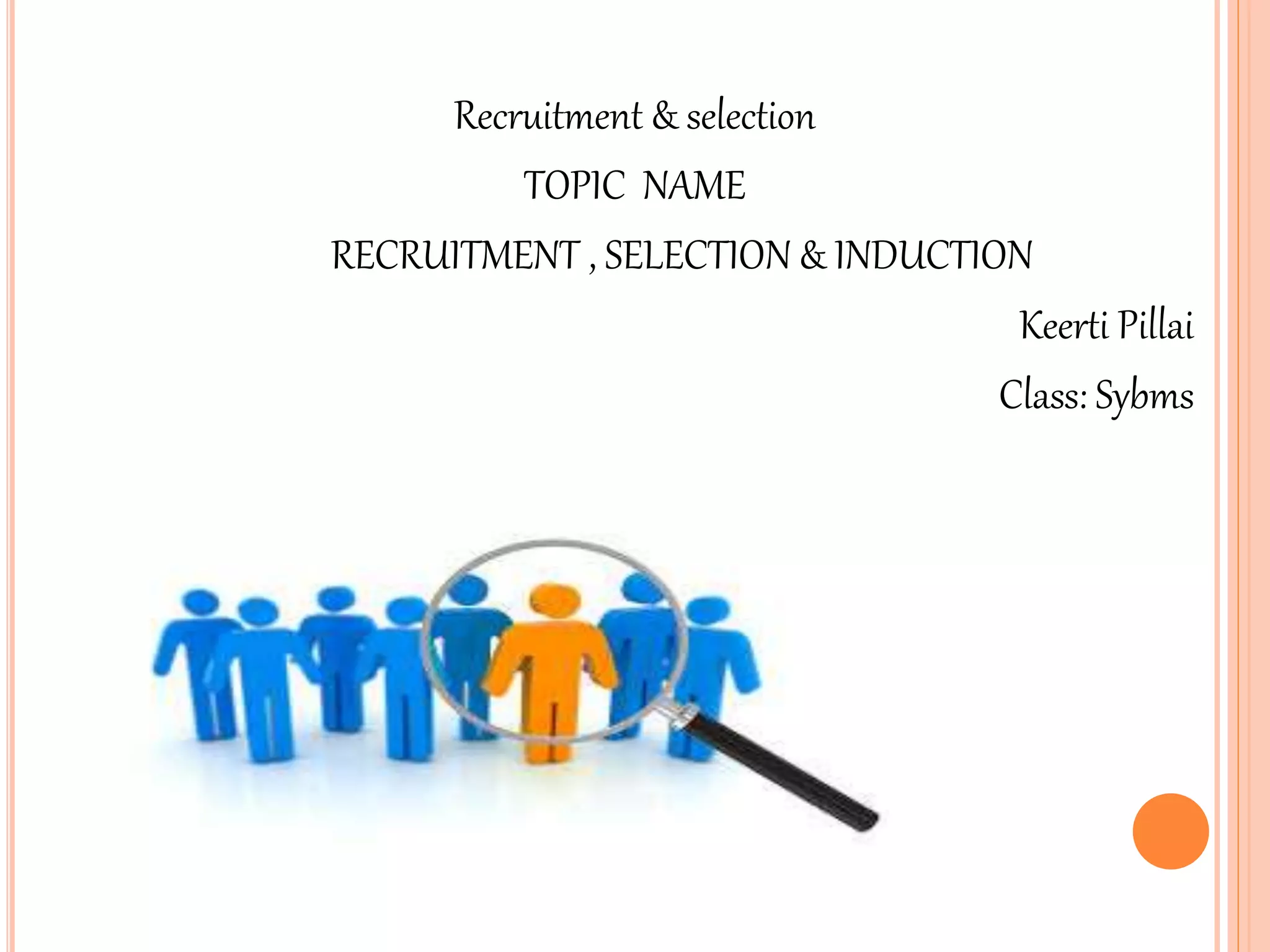
Recruitment & selection
TOPIC NAME
RECRUITMENT , SELECTION & INDUCTION
Keerti Pillai
Class: Sybms
CONTENTS
Meaning&definition of recruitment
Nature of recruitment
Sources/Methods of managerial recruitment
Adv/Disadvantages of internal&external sources of recruitment
Meaning&definition of selection
Benefits/Significance of scientific selection
Process of selection and steps involved
Types of selection tests
Advantages of employment tests in the selection process
Types of interviews
Importance/role of interviews in selection procedure
MEANING OF RECRUITMENT
Recruitment is the process of searching and obtaining
applications from interested candidates so as to have
pool of job seekers from whom most suitable persons can
be selected for appointment
Definition of recruitment
Recruitment is the process of searching for prospective
employees and stimulating them to apply for jobs in the
organization
Edwin Flippo
NATURE OF RECRUITMENT
Process of searching
Connecting link between job providers and job seekers
Encourages interested candidates to apply
Positive and persuasive functions
Purpose is to attract many candidates for available
jobs
Prior to selection
Complex process
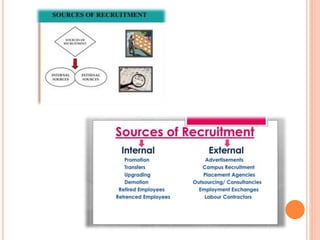
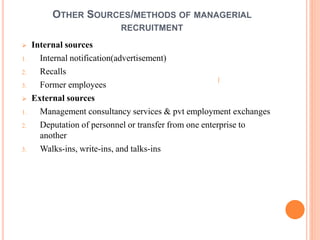
OTHER SOURCES/METHODS OF MANAGERIAL
RECRUITMENT
 Internal sources
1. Internal notification(advertisement)
2. Recalls
3. Former employees
 External sources
1. Management consultancy services & pvt employment exchanges
2. Deputation of personnel or transfer from one enterprise to
another
3. Walks-ins, write-ins, and talks-ins
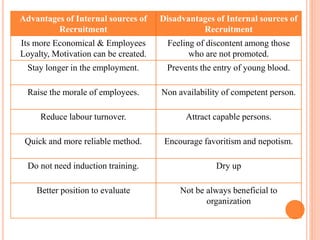
Advantages of Internal sources of
Recruitment
Disadvantages of Internal sources of
Recruitment
Its more Economical & Employees
Loyalty, Motivation can be created.
Feeling of discontent among those
who are not promoted.
Stay longer in the employment. Prevents the entry of young blood.
Raise the morale of employees. Non availability of competent person.
Reduce labour turnover. Attract capable persons.
Quick and more reliable method. Encourage favoritism and nepotism.
Do not need induction training. Dry up
Better position to evaluate Not be always beneficial to
organization
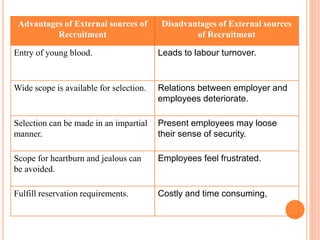
Advantages of External sources of
Recruitment
Disadvantages of External sources
of Recruitment
Entry of young blood. Leads to labour turnover.
Wide scope is available for selection. Relations between employer and
employees deteriorate.
Selection can be made in an impartial
manner.
Present employees may loose
their sense of security.
Scope for heartburn and jealous can
be avoided.
Employees feel frustrated.
Fulfill reservation requirements. Costly and time consuming,
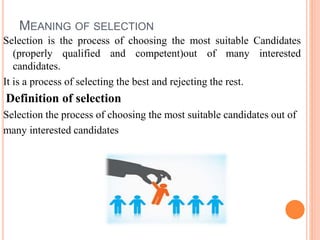
MEANING OF SELECTION
Selection is the process of choosing the most suitable Candidates
(properly qualified and competent)out of many interested
candidates.
It is a process of selecting the best and rejecting the rest.
Definition of selection
Selection the process of choosing the most suitable candidates out of
many interested candidates
BENEFITS/SIGNIFICANCE OF SCIENTIFIC
SELECTION
I. Benefits of scientific selection to
employer/management.
II. Benefits of scientific selection to employees.
A) BENEFITS OF SCIENTIFIC SELECTION TO
EMPLOYER/MANAGEMENT
1. The objective of right man for the right job is achieved.
2. Stability to labour force as labour turnover is minimized.
3. Expenditure on frequent selection of candidates is avoided.
4. Scientific selection raises organizational efficiency and creates good
image.
5. Unsuitable candidates are kept away from the organization.
6. Training provided to properly selected candidates gives promising
results.
7. Positive impact on work performance and employee cost.
B) BENEFITS OF SCIENTIFIC SELECTION TO EMPOYEES
1. Job satisfaction and raising of morale of employees.
2. Self development through promotions, training, etc. is possible.
3. Avoids frustration on the part of employees.
4. Higher salary due to promotions and career development.
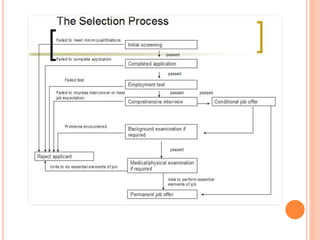
PROCESS OF SELECTION
1. Job analysis
2. Advertisement
3. Collection of application/application blanks
4. Scrutiny of application
5. Trade/written tests
6. Psychological tests
7. Personal interviews
8. Reference check
9. Medical examination
10. Final selection for appointment
TYPES OF SELECTION TESTS(PSYCHOLOGICAL
TESTS)
 Intelligence tests
 Aptitude test
 Analytical test
 Synthetic test
 Trade test
 Personality test
ADVANTAGES OF EMPLOYMENT TEST IN THE SELECTION
PROCESS
 Objective comparison
 Incompetent
 Suitable
 Right man to the right job
 Achievements
 Compatibility
 Mental qualities
 Overall ability
 Application of knowledge
 accuracy
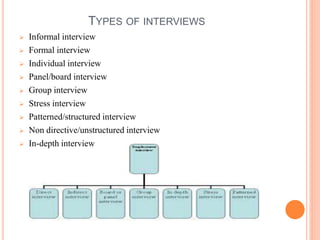
TYPES OF INTERVIEWS
 Informal interview
 Formal interview
 Individual interview
 Panel/board interview
 Group interview
 Stress interview
 Patterned/structured interview
 Non directive/unstructured interview
 In-depth interview
IMPORTANCE/ROLE OF INTERVIEW IN SELECTION
PROCEDURE
 Full view of candidate
 Accurate judgement of candidate
 Base of final selection
 Facilitates two-way communication
 Provides additional information to candidates
 Facilitates the use of collective wisdom of experts/interviews
 Miscellaneous benefits
INDUCTION/ORIENTATION
Introduction of induction
When a newly selected and appointed person joins an
organization, he is stranger to the organization and the
person working therein.
He may experience lot of difficulties/inconvenience.
MEANING OF INDUCTION
 Next to selection and placement is induction in which a newly
selected employee is given brief introduction about the organization
in which he is going to work for a long period. This is called
induction or induction training. It is a technique or process by which
a newly appointed employee is rehabilitated into the changed
surrounding and introduced properly to the practices and policies of
the organization where he has to work for a long period
DEFINITION OF INDUCTION
 Induction may be defined as “planned introduction
of employees to their jobs, their co-workers and the
organization”
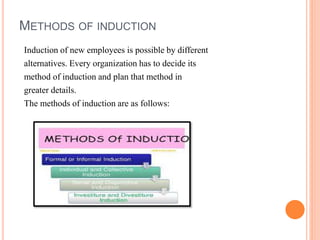
METHODS OF INDUCTION
Induction of new employees is possible by different
alternatives. Every organization has to decide its
method of induction and plan that method in
greater details.
The methods of induction are as follows:
PROCESS OF INDUCTION
 Induction process or procedure is normally a brief which is
completed within a couple of days. Every organization has to
complete it in an orderly manner.
 Normal process are noted below:-
1. Given warm welcome and formal introduction to a manager.
2. Should meet and welcome the new employee to the organization.
3. The administrative formalities should be completed.
4. Departmental orientation should be conducted.
5. Information on various matters is given in verbal form.
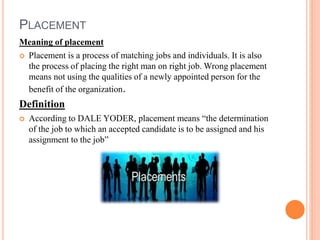
PLACEMENT
Meaning of placement
 Placement is a process of matching jobs and individuals. It is also
the process of placing the right man on right job. Wrong placement
means not using the qualities of a newly appointed person for the
benefit of the organization.
Definition
 According to DALE YODER, placement means “the determination
of the job to which an accepted candidate is to be assigned and his
assignment to the job”
IMPORTANCE OF PLACEMENT
 Placement is important as it offers the following benefits:-
1. Proper placement removes anxiety of newly appointed employee
and enable him to concentrate his attention on the job assigned.
This raises his efficiency and morale. He also gets job
satisfaction due to proper placement.
2. Reduces absentism and turnover among new employees.
3. Develops cordial relation and team spirit.
4. Newly appointed worker becomes loyal and committed to the
organization.
5. Proper placement is beneficial to the organization and also to
concerned employee.
CONCLUSION:
1. The employees of any organization are its life blood, without doubt.
With the dawn of this realization upon the present day business
organizations, there appears to be a major shift towards human
resource management.
2. In fact, the employees of today are encouraged to participate in the
major decisions and thus play a vital role in the management of the
firm.
3. Hence it is of crucial importance that employees with the most
suitable qualifications be selected. This is where the processes
of recruitment and selection come in. It is difficult to separate one
from the other.
4. Grueling procedure through which the candidate goes through is
in itself, an indicator of the significance of these processes in the
efficient functioning of the organization.
Recruitment selection and induction

Recruitment selection and induction

  • 1.
    Recruitment & selection TOPICNAME RECRUITMENT , SELECTION & INDUCTION Keerti Pillai Class: Sybms
  • 2.
    CONTENTS Meaning&definition of recruitment Natureof recruitment Sources/Methods of managerial recruitment Adv/Disadvantages of internal&external sources of recruitment Meaning&definition of selection Benefits/Significance of scientific selection Process of selection and steps involved Types of selection tests Advantages of employment tests in the selection process Types of interviews Importance/role of interviews in selection procedure
  • 3.
    MEANING OF RECRUITMENT Recruitmentis the process of searching and obtaining applications from interested candidates so as to have pool of job seekers from whom most suitable persons can be selected for appointment Definition of recruitment Recruitment is the process of searching for prospective employees and stimulating them to apply for jobs in the organization Edwin Flippo
  • 4.
    NATURE OF RECRUITMENT Processof searching Connecting link between job providers and job seekers Encourages interested candidates to apply Positive and persuasive functions Purpose is to attract many candidates for available jobs Prior to selection Complex process
  • 6.
    OTHER SOURCES/METHODS OFMANAGERIAL RECRUITMENT  Internal sources 1. Internal notification(advertisement) 2. Recalls 3. Former employees  External sources 1. Management consultancy services & pvt employment exchanges 2. Deputation of personnel or transfer from one enterprise to another 3. Walks-ins, write-ins, and talks-ins
  • 7.
    Advantages of Internalsources of Recruitment Disadvantages of Internal sources of Recruitment Its more Economical & Employees Loyalty, Motivation can be created. Feeling of discontent among those who are not promoted. Stay longer in the employment. Prevents the entry of young blood. Raise the morale of employees. Non availability of competent person. Reduce labour turnover. Attract capable persons. Quick and more reliable method. Encourage favoritism and nepotism. Do not need induction training. Dry up Better position to evaluate Not be always beneficial to organization
  • 8.
    Advantages of Externalsources of Recruitment Disadvantages of External sources of Recruitment Entry of young blood. Leads to labour turnover. Wide scope is available for selection. Relations between employer and employees deteriorate. Selection can be made in an impartial manner. Present employees may loose their sense of security. Scope for heartburn and jealous can be avoided. Employees feel frustrated. Fulfill reservation requirements. Costly and time consuming,
  • 10.
    MEANING OF SELECTION Selectionis the process of choosing the most suitable Candidates (properly qualified and competent)out of many interested candidates. It is a process of selecting the best and rejecting the rest. Definition of selection Selection the process of choosing the most suitable candidates out of many interested candidates
  • 11.
    BENEFITS/SIGNIFICANCE OF SCIENTIFIC SELECTION I.Benefits of scientific selection to employer/management. II. Benefits of scientific selection to employees.
  • 12.
    A) BENEFITS OFSCIENTIFIC SELECTION TO EMPLOYER/MANAGEMENT 1. The objective of right man for the right job is achieved. 2. Stability to labour force as labour turnover is minimized. 3. Expenditure on frequent selection of candidates is avoided. 4. Scientific selection raises organizational efficiency and creates good image. 5. Unsuitable candidates are kept away from the organization. 6. Training provided to properly selected candidates gives promising results. 7. Positive impact on work performance and employee cost.
  • 13.
    B) BENEFITS OFSCIENTIFIC SELECTION TO EMPOYEES 1. Job satisfaction and raising of morale of employees. 2. Self development through promotions, training, etc. is possible. 3. Avoids frustration on the part of employees. 4. Higher salary due to promotions and career development.
  • 14.
    PROCESS OF SELECTION 1.Job analysis 2. Advertisement 3. Collection of application/application blanks 4. Scrutiny of application 5. Trade/written tests 6. Psychological tests 7. Personal interviews 8. Reference check 9. Medical examination 10. Final selection for appointment
  • 16.
    TYPES OF SELECTIONTESTS(PSYCHOLOGICAL TESTS)  Intelligence tests  Aptitude test  Analytical test  Synthetic test  Trade test  Personality test
  • 17.
    ADVANTAGES OF EMPLOYMENTTEST IN THE SELECTION PROCESS  Objective comparison  Incompetent  Suitable  Right man to the right job  Achievements  Compatibility  Mental qualities  Overall ability  Application of knowledge  accuracy
  • 18.
    TYPES OF INTERVIEWS Informal interview  Formal interview  Individual interview  Panel/board interview  Group interview  Stress interview  Patterned/structured interview  Non directive/unstructured interview  In-depth interview
  • 19.
    IMPORTANCE/ROLE OF INTERVIEWIN SELECTION PROCEDURE  Full view of candidate  Accurate judgement of candidate  Base of final selection  Facilitates two-way communication  Provides additional information to candidates  Facilitates the use of collective wisdom of experts/interviews  Miscellaneous benefits
  • 20.
    INDUCTION/ORIENTATION Introduction of induction Whena newly selected and appointed person joins an organization, he is stranger to the organization and the person working therein. He may experience lot of difficulties/inconvenience.
  • 21.
    MEANING OF INDUCTION Next to selection and placement is induction in which a newly selected employee is given brief introduction about the organization in which he is going to work for a long period. This is called induction or induction training. It is a technique or process by which a newly appointed employee is rehabilitated into the changed surrounding and introduced properly to the practices and policies of the organization where he has to work for a long period
  • 22.
    DEFINITION OF INDUCTION Induction may be defined as “planned introduction of employees to their jobs, their co-workers and the organization”
  • 23.
    METHODS OF INDUCTION Inductionof new employees is possible by different alternatives. Every organization has to decide its method of induction and plan that method in greater details. The methods of induction are as follows:
  • 24.
    PROCESS OF INDUCTION Induction process or procedure is normally a brief which is completed within a couple of days. Every organization has to complete it in an orderly manner.  Normal process are noted below:- 1. Given warm welcome and formal introduction to a manager. 2. Should meet and welcome the new employee to the organization. 3. The administrative formalities should be completed. 4. Departmental orientation should be conducted. 5. Information on various matters is given in verbal form.
  • 25.
    PLACEMENT Meaning of placement Placement is a process of matching jobs and individuals. It is also the process of placing the right man on right job. Wrong placement means not using the qualities of a newly appointed person for the benefit of the organization. Definition  According to DALE YODER, placement means “the determination of the job to which an accepted candidate is to be assigned and his assignment to the job”
  • 26.
    IMPORTANCE OF PLACEMENT Placement is important as it offers the following benefits:- 1. Proper placement removes anxiety of newly appointed employee and enable him to concentrate his attention on the job assigned. This raises his efficiency and morale. He also gets job satisfaction due to proper placement. 2. Reduces absentism and turnover among new employees. 3. Develops cordial relation and team spirit. 4. Newly appointed worker becomes loyal and committed to the organization. 5. Proper placement is beneficial to the organization and also to concerned employee.
  • 27.
    CONCLUSION: 1. The employeesof any organization are its life blood, without doubt. With the dawn of this realization upon the present day business organizations, there appears to be a major shift towards human resource management. 2. In fact, the employees of today are encouraged to participate in the major decisions and thus play a vital role in the management of the firm. 3. Hence it is of crucial importance that employees with the most suitable qualifications be selected. This is where the processes of recruitment and selection come in. It is difficult to separate one from the other. 4. Grueling procedure through which the candidate goes through is in itself, an indicator of the significance of these processes in the efficient functioning of the organization.