
Matching the right person for the right job


                      @PHONERSIS
                      CONSULTING

                        Delivered By
                        Leke Oshiyemi
                        Head, Human Resources
                        Verod Capital Management Limited
                        March 03, 2012
My Contact Details:
leke_oshiyemi@yahoo.com
www.linkedin.com/in/lekeoshiyemi
www.facebook.com/lekeoshiyemi
www.twitter.com/lekeoshiyemi
(Mobile)+2348033071649
   To demystify the Recruitment Process
   Enlighten on How to Get a Job in 2011.
   Determining what your exact hiring needs are
   Demonstrate how to Initiate a recruitment action
    (All from the perspective of Employer & Employee)
 Understand the importance of recruitment to
 the organization
 Identifythe outcomes of the Selection Decision
 to the organization
 Detailthe main biases that can occur during
 the selection process
 Implement   an effective Recruitment Process
•   Understand the function of the
    interview and types of interview
    questions that can be employed

•   Discuss applications of psychometric
    testing within the recruitment process

•   Effectively measure the recruitment
    process
 Interviewing those candidates that you
 believe can perform the work of the
 position
 Selectingthe “best qualified” candidate
 for each and every position you advertise
 Retaining   the employees once you have
 them
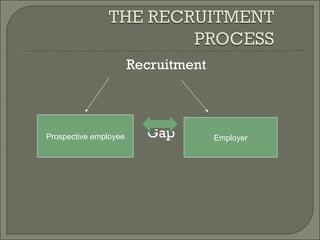
Recruitment


Prospective employee     Gap         Employer
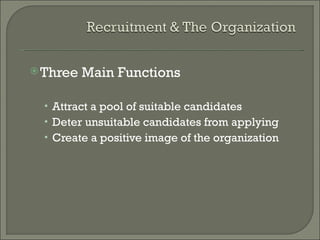
 Three   Main Functions

  • Attract a pool of suitable candidates
  • Deter unsuitable candidates from applying
  • Create a positive image of the organization
The right person for the right job
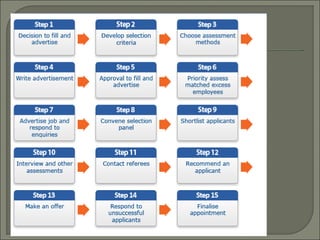
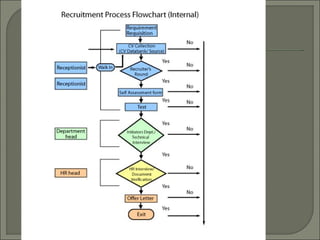
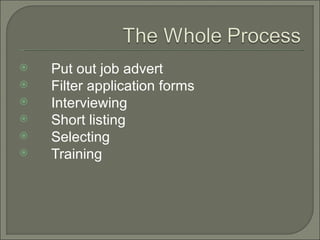
   Put out job advert
   Filter application forms
   Interviewing
   Short listing
   Selecting
   Training
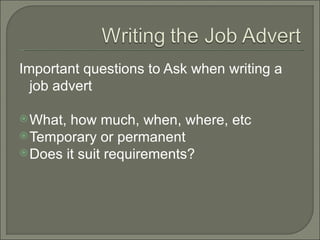
Important questions to Ask when writing a
  job advert

 What, how much, when, where, etc
 Temporary or permanent
 Does it suit requirements?
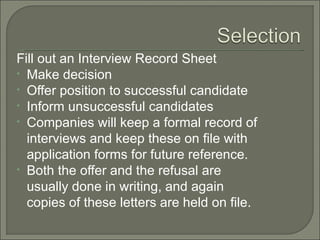
Fill out an Interview Record Sheet
• Make decision
• Offer position to successful candidate
• Inform unsuccessful candidates
• Companies will keep a formal record of
  interviews and keep these on file with
  application forms for future reference.
• Both the offer and the refusal are
  usually done in writing, and again
  copies of these letters are held on file.
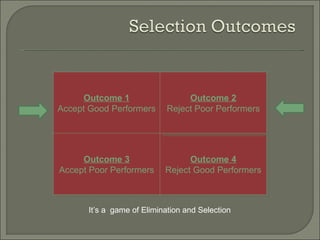
Outcome 1                   Outcome 2
Accept Good Performers      Reject Poor Performers


     Outcome 3                   Outcome 4
Accept Poor Performers     Reject Good Performers


      It’s a game of Elimination and Selection
 Determining   what your exact hiring
  needs are
 Initiating a recruitment action
 Issuing a vacancy announcement
  for the position
 Marketing the position to get high
  quality applicants
Interviews
 The  most widely-used hiring tool among
  practitioners
 Yet are widely criticized by researchers
  • unreliable
  • susceptible to bias
  • poor validity
Lack of structure/standardization
 Reduces reliability
 Opportunity for disparate treatment
 Questions often aren’t job related
Opportunity for bias
 Positive or negative
 Unintended or intentional
  • Physical attractiveness; similarity
  • What you ask, how you interpret, non-verbal
   cues, self-fulfilling prophecy
Interview behavior may not reflect KSAs
...Knowledge, Skills and Abilities...
  For Leke: Its Attitude, Skills, Knowledge...ASK


      Nervousness
      Coaching
      Faking
 Behavior   Description interviewing
  • How have you handled situations before?
 Situational   interviewing
  • How would you respond to hypothetical job
   situation?
 Case   interviews
  • Can you demonstrate reasoning skills in logic
   puzzle questions?
KSAs...Knowledge, Skills and Abilities...a list of special qualifications and
personal attributes that you need to have for a particular job. These are the
unique requirements that the hiring agency wants to find in the person selected
to fill a particular job.

A primary purpose of KSAs is to measure those qualities that will set one
candidate apart from the others.

How well an applicant can show that he or she matches the position’s
defined KSAs determines whether that person will be seriously considered
for the job.

Knowledge A body of information applied directly to the performance of a
function.

Skill statements refer to the proficient manual, verbal or mental manipulation of
data or things.

Ability statements refer to the power to perform an observable activity at the
present time. This means that abilities have been evidenced through activities or
behaviors that are similar to those required on the job, e.g., ability to plan and
organize work.
Best Practice for Interviewing
   Be prepared
   Assess the candidate objectively
   Convince the applicant to accept a position
   Market the company
   Focus on KSAs for which interviews are best suited
   Pre-planned, standardized questions
   Focus on behavior, not traits
   Standardized rating system
“Recruitment; to the Employer: IS A BID TO FILL A NEED
Recruitment; to the Employee: IS A BID TO FILL A NEED
  To fill these NEEDs, both Employee and Employer must
                be STRATEGIC”- Leke Oshiyemi
Leke Oshiyemi
HR-Expert| Recruiter | Seminar/Conference Speaker: on
  Human Resources Management and Social Media/LinkedIn.
 leke_oshiyemi@yahoo.com
 www.linkedin.com/in/lekeoshiyemi
 www.facebook.com/lekeoshiyemi
 www.twitter.com/lekeoshiyemi
 (Mobile)+2348033071649

Recruitment process slides leke oshiyemi march 2012

  • 1.
    Matching the rightperson for the right job @PHONERSIS CONSULTING Delivered By Leke Oshiyemi Head, Human Resources Verod Capital Management Limited March 03, 2012
  • 2.
  • 3.
     To demystify the Recruitment Process  Enlighten on How to Get a Job in 2011.  Determining what your exact hiring needs are  Demonstrate how to Initiate a recruitment action (All from the perspective of Employer & Employee)
  • 4.
     Understand theimportance of recruitment to the organization  Identifythe outcomes of the Selection Decision to the organization  Detailthe main biases that can occur during the selection process  Implement an effective Recruitment Process
  • 5.
    • Understand the function of the interview and types of interview questions that can be employed • Discuss applications of psychometric testing within the recruitment process • Effectively measure the recruitment process
  • 6.
     Interviewing thosecandidates that you believe can perform the work of the position  Selectingthe “best qualified” candidate for each and every position you advertise  Retaining the employees once you have them
  • 7.
  • 10.
     Three Main Functions • Attract a pool of suitable candidates • Deter unsuitable candidates from applying • Create a positive image of the organization
  • 11.
    The right personfor the right job
  • 12.
     Put out job advert  Filter application forms  Interviewing  Short listing  Selecting  Training
  • 13.
    Important questions toAsk when writing a job advert  What, how much, when, where, etc  Temporary or permanent  Does it suit requirements?
  • 14.
    Fill out anInterview Record Sheet • Make decision • Offer position to successful candidate • Inform unsuccessful candidates • Companies will keep a formal record of interviews and keep these on file with application forms for future reference. • Both the offer and the refusal are usually done in writing, and again copies of these letters are held on file.
  • 15.
    Outcome 1 Outcome 2 Accept Good Performers Reject Poor Performers Outcome 3 Outcome 4 Accept Poor Performers Reject Good Performers It’s a game of Elimination and Selection
  • 16.
     Determining what your exact hiring needs are  Initiating a recruitment action  Issuing a vacancy announcement for the position  Marketing the position to get high quality applicants
  • 17.
  • 18.
     The most widely-used hiring tool among practitioners  Yet are widely criticized by researchers • unreliable • susceptible to bias • poor validity
  • 19.
    Lack of structure/standardization Reduces reliability  Opportunity for disparate treatment  Questions often aren’t job related
  • 20.
    Opportunity for bias Positive or negative  Unintended or intentional • Physical attractiveness; similarity • What you ask, how you interpret, non-verbal cues, self-fulfilling prophecy
  • 21.
    Interview behavior maynot reflect KSAs ...Knowledge, Skills and Abilities... For Leke: Its Attitude, Skills, Knowledge...ASK  Nervousness  Coaching  Faking
  • 22.
     Behavior Description interviewing • How have you handled situations before?  Situational interviewing • How would you respond to hypothetical job situation?  Case interviews • Can you demonstrate reasoning skills in logic puzzle questions?
  • 23.
    KSAs...Knowledge, Skills andAbilities...a list of special qualifications and personal attributes that you need to have for a particular job. These are the unique requirements that the hiring agency wants to find in the person selected to fill a particular job. A primary purpose of KSAs is to measure those qualities that will set one candidate apart from the others. How well an applicant can show that he or she matches the position’s defined KSAs determines whether that person will be seriously considered for the job. Knowledge A body of information applied directly to the performance of a function. Skill statements refer to the proficient manual, verbal or mental manipulation of data or things. Ability statements refer to the power to perform an observable activity at the present time. This means that abilities have been evidenced through activities or behaviors that are similar to those required on the job, e.g., ability to plan and organize work.
  • 24.
    Best Practice forInterviewing  Be prepared  Assess the candidate objectively  Convince the applicant to accept a position  Market the company  Focus on KSAs for which interviews are best suited  Pre-planned, standardized questions  Focus on behavior, not traits  Standardized rating system
  • 25.
    “Recruitment; to theEmployer: IS A BID TO FILL A NEED Recruitment; to the Employee: IS A BID TO FILL A NEED To fill these NEEDs, both Employee and Employer must be STRATEGIC”- Leke Oshiyemi
  • 26.
    Leke Oshiyemi HR-Expert| Recruiter| Seminar/Conference Speaker: on Human Resources Management and Social Media/LinkedIn.  leke_oshiyemi@yahoo.com  www.linkedin.com/in/lekeoshiyemi  www.facebook.com/lekeoshiyemi  www.twitter.com/lekeoshiyemi  (Mobile)+2348033071649

Editor's Notes

  • #13 A company looks for a successful candidate at every stage of this process
  • #14 Job advertisements form an important part of the recruitment process. By proceeding in this, your company are able to communicate job vacancies to selected audience, an audience who have the qualities to fill the vacancy. There are many factors your company need to consider when advertising a job, it is important to specify:   What type of job is vacant . Your company may achieve this by including the job title i.e. … or/and a brief description of the job and what it entails. Pay and conditions. The type of job the candidate is applying for determines the rate of pay. If the job is low grade, the rate of pay will be lower than that of a high-grade job. Where the will the job be advertised? In the actual store, job centre, newspaper? When? The advert needs to be advertised in the appropriate media well in advance of the closing date for applicants. Presentation of advert.