CAMELIA BUCATARIU
INTERNATIONAL POLICY DEVELOPMENT CONSULTANT
RURAL INFRASTRUCTURE & AGRO-INDUSTRIES DIVISION (AGS), FAO
RECOVERY AND REDISTRIBUTION OF
SAFE AND NUTRITIOUS FOOD FOR HUMAN CONSUMPTION
`
NO MORE FOOD TO WASTE - GLOBAL ACTION TO STOP FOOD LOSS AND FOOD WASTE
THE HAGUE, THE NETHERLANDS, 16 - 19 JUNE 2015
 GLOBAL SETTING
 FOOD AND NUTRITION SECURITY
 SUSTAINABLE NATURAL RESOURCES UTILIZATION
 ZERO HUNGER CHALLENGE
 COMMITTEE OF WORLD FOOD SECURITY
 SUSTAINABLE DEVELOPMENT GOALS, POST – 2015
 RECOVERY AND REDISTRIBUTION OF SAFE AND NUTRITIOUS FOOD
FOR HUMAN CONSUMPTION
 TERMINOLOGY
 FIGURES AND FACTS
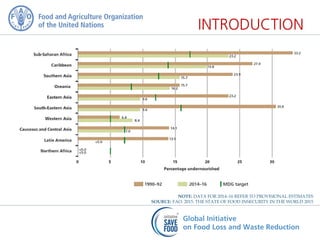
NOTE: DATA FOR 2014–16 REFER TO PROVISIONAL ESTIMATES
SOURCE: FAO. 2015. THE STATE OF FOOD INSECURITY IN THE WORLD 2015
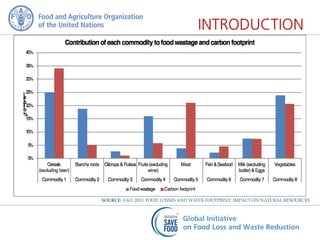
SOURCE: FAO. 2013. FOOD LOSSES AND WASTE FOOTPRINT: IMPACT ON NATURAL RESOURCES
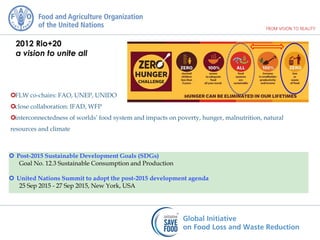
2012 Rio+20
a vision to unite all
FLW co-chairs: FAO, UNEP, UNIDO
close collaboration: IFAD, WFP
interconnectedness of worlds’ food system and impacts on poverty, hunger, malnutrition, natural
resources and climate
 Post-2015 Sustainable Development Goals (SDGs)
Goal No. 12.3 Sustainable Consumption and Production
 United Nations Summit to adopt the post-2015 development agenda
25 Sep 2015 - 27 Sep 2015, New York, USA
FLW CAUSES
 consequences of how food systems function → technical, cultural, economic → require an integrated &
interrelated perspective → feasible and sustainable solutions → prioritize actions
 macro-level → meso-level → micro-level
FLW SYSTEMIC RECOMMENDATIONS
 States and international organizations: integrate system perspective in food security and nutrition
 Reduction of FLW → improve agricultural and food systems efficiency and sustainability → improved
food security and nutrition
 Four parallel and inclusive supportive tracks:
1. Improve data collection and knowledge sharing on FLW
2. Develop effective strategies to reduce FLW, at the appropriate levels
3. Take effective steps to reduce FLW
4. Improve coordination of policies and strategies in order to reduce FLW
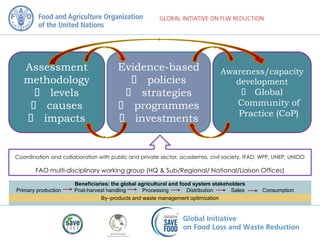
Assessment
methodology
 levels
 causes
 impacts
Evidence-based
 policies
 strategies
 programmes
 investments
Awareness/capacity
development
 Global
Community of
Practice (CoP)
Coordination and collaboration with public and private sector, academia, civil society, IFAD, WFP, UNEP, UNIDO
FAO multi-disciplinary working group (HQ & Sub/Regional/ National/Liaison Offices)
Beneficiaries: the global agricultural and food system stakeholders
Primary production Post-harvest handling Processing Distribution Sales Consumption
By–products and waste management optimization
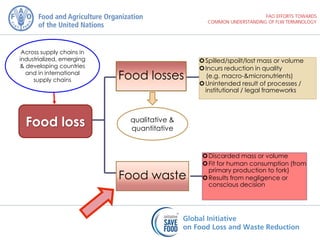
qualitative &
quantitative
Food loss
Food losses
Food waste
Spilled/spoilt/lost mass or volume
Incurs reduction in quality
(e.g. macro-&micronutrients)
Unintended result of processes /
institutional / legal frameworks
Discarded mass or volume
Fit for human consumption (from
primary production to fork)
Results from negligence or
conscious decision
Across supply chains in
industrialized, emerging
& developing countries
and in international
supply chains
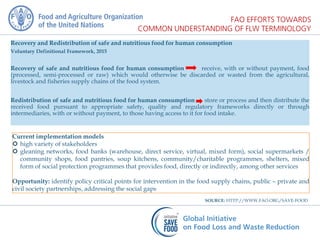
Recovery and Redistribution of safe and nutritious food for human consumption
Voluntary Definitional Framework, 2015
Recovery of safe and nutritious food for human consumption receive, with or without payment, food
(processed, semi-processed or raw) which would otherwise be discarded or wasted from the agricultural,
livestock and fisheries supply chains of the food system.
Redistribution of safe and nutritious food for human consumption store or process and then distribute the
received food pursuant to appropriate safety, quality and regulatory frameworks directly or through
intermediaries, with or without payment, to those having access to it for food intake.
Current implementation models
 high variety of stakeholders
 gleaning networks, food banks (warehouse, direct service, virtual, mixed form), social supermarkets /
community shops, food pantries, soup kitchens, community/charitable programmes, shelters, mixed
form of social protection programmes that provides food, directly or indirectly, among other services
Opportunity: identify policy critical points for intervention in the food supply chains, public – private and
civil society partnerships, addressing the social gaps
SOURCE: HTTP://WWW.FAO.ORG/SAVE-FOOD
Paper (forthcoming) on Recovery and redistribution of safe and nutrition food for human consumption and food waste
prevention and reduction. FAO. 2015. Knowledge and Information for Sustainable Food Systems
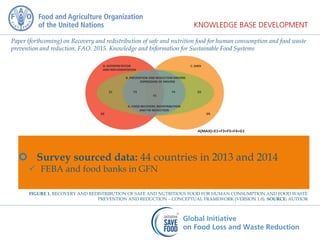
FIGURE 1. RECOVERY AND REDISTRIBUTION OF SAFE AND NUTRITIOUS FOOD FOR HUMAN CONSUMPTION AND FOOD WASTE
PREVENTION AND REDUCTION – CONCEPTUAL FRAMEWORK (VERSION 1.0). SOURCE: AUTHOR
 Survey sourced data: 44 countries in 2013 and 2014
 FEBA and food banks in GFN
Paper (forthcoming) on Recovery and redistribution of safe and nutrition food for human consumption and
food waste prevention and reduction. FAO. 2015. Knowledge and Information for Sustainable Food Systems
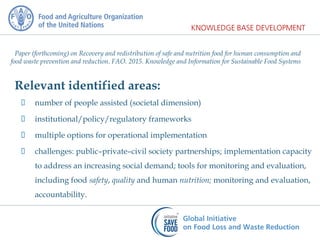
Relevant identified areas:
 number of people assisted (societal dimension)
 institutional/policy/regulatory frameworks
 multiple options for operational implementation
 challenges: public–private–civil society partnerships; implementation capacity
to address an increasing social demand; tools for monitoring and evaluation,
including food safety, quality and human nutrition; monitoring and evaluation,
accountability.
JOIN SAVE FOOD

Recovery and redistribution

  • 1.
    CAMELIA BUCATARIU INTERNATIONAL POLICYDEVELOPMENT CONSULTANT RURAL INFRASTRUCTURE & AGRO-INDUSTRIES DIVISION (AGS), FAO RECOVERY AND REDISTRIBUTION OF SAFE AND NUTRITIOUS FOOD FOR HUMAN CONSUMPTION ` NO MORE FOOD TO WASTE - GLOBAL ACTION TO STOP FOOD LOSS AND FOOD WASTE THE HAGUE, THE NETHERLANDS, 16 - 19 JUNE 2015
  • 2.
     GLOBAL SETTING FOOD AND NUTRITION SECURITY  SUSTAINABLE NATURAL RESOURCES UTILIZATION  ZERO HUNGER CHALLENGE  COMMITTEE OF WORLD FOOD SECURITY  SUSTAINABLE DEVELOPMENT GOALS, POST – 2015  RECOVERY AND REDISTRIBUTION OF SAFE AND NUTRITIOUS FOOD FOR HUMAN CONSUMPTION  TERMINOLOGY  FIGURES AND FACTS
  • 3.
    NOTE: DATA FOR2014–16 REFER TO PROVISIONAL ESTIMATES SOURCE: FAO. 2015. THE STATE OF FOOD INSECURITY IN THE WORLD 2015
  • 4.
    SOURCE: FAO. 2013.FOOD LOSSES AND WASTE FOOTPRINT: IMPACT ON NATURAL RESOURCES
  • 5.
    2012 Rio+20 a visionto unite all FLW co-chairs: FAO, UNEP, UNIDO close collaboration: IFAD, WFP interconnectedness of worlds’ food system and impacts on poverty, hunger, malnutrition, natural resources and climate  Post-2015 Sustainable Development Goals (SDGs) Goal No. 12.3 Sustainable Consumption and Production  United Nations Summit to adopt the post-2015 development agenda 25 Sep 2015 - 27 Sep 2015, New York, USA
  • 6.
    FLW CAUSES  consequencesof how food systems function → technical, cultural, economic → require an integrated & interrelated perspective → feasible and sustainable solutions → prioritize actions  macro-level → meso-level → micro-level FLW SYSTEMIC RECOMMENDATIONS  States and international organizations: integrate system perspective in food security and nutrition  Reduction of FLW → improve agricultural and food systems efficiency and sustainability → improved food security and nutrition  Four parallel and inclusive supportive tracks: 1. Improve data collection and knowledge sharing on FLW 2. Develop effective strategies to reduce FLW, at the appropriate levels 3. Take effective steps to reduce FLW 4. Improve coordination of policies and strategies in order to reduce FLW
  • 7.
    Assessment methodology  levels  causes impacts Evidence-based  policies  strategies  programmes  investments Awareness/capacity development  Global Community of Practice (CoP) Coordination and collaboration with public and private sector, academia, civil society, IFAD, WFP, UNEP, UNIDO FAO multi-disciplinary working group (HQ & Sub/Regional/ National/Liaison Offices) Beneficiaries: the global agricultural and food system stakeholders Primary production Post-harvest handling Processing Distribution Sales Consumption By–products and waste management optimization
  • 8.
    qualitative & quantitative Food loss Foodlosses Food waste Spilled/spoilt/lost mass or volume Incurs reduction in quality (e.g. macro-&micronutrients) Unintended result of processes / institutional / legal frameworks Discarded mass or volume Fit for human consumption (from primary production to fork) Results from negligence or conscious decision Across supply chains in industrialized, emerging & developing countries and in international supply chains
  • 9.
    Recovery and Redistributionof safe and nutritious food for human consumption Voluntary Definitional Framework, 2015 Recovery of safe and nutritious food for human consumption receive, with or without payment, food (processed, semi-processed or raw) which would otherwise be discarded or wasted from the agricultural, livestock and fisheries supply chains of the food system. Redistribution of safe and nutritious food for human consumption store or process and then distribute the received food pursuant to appropriate safety, quality and regulatory frameworks directly or through intermediaries, with or without payment, to those having access to it for food intake. Current implementation models  high variety of stakeholders  gleaning networks, food banks (warehouse, direct service, virtual, mixed form), social supermarkets / community shops, food pantries, soup kitchens, community/charitable programmes, shelters, mixed form of social protection programmes that provides food, directly or indirectly, among other services Opportunity: identify policy critical points for intervention in the food supply chains, public – private and civil society partnerships, addressing the social gaps SOURCE: HTTP://WWW.FAO.ORG/SAVE-FOOD
  • 10.
    Paper (forthcoming) onRecovery and redistribution of safe and nutrition food for human consumption and food waste prevention and reduction. FAO. 2015. Knowledge and Information for Sustainable Food Systems FIGURE 1. RECOVERY AND REDISTRIBUTION OF SAFE AND NUTRITIOUS FOOD FOR HUMAN CONSUMPTION AND FOOD WASTE PREVENTION AND REDUCTION – CONCEPTUAL FRAMEWORK (VERSION 1.0). SOURCE: AUTHOR  Survey sourced data: 44 countries in 2013 and 2014  FEBA and food banks in GFN
  • 11.
    Paper (forthcoming) onRecovery and redistribution of safe and nutrition food for human consumption and food waste prevention and reduction. FAO. 2015. Knowledge and Information for Sustainable Food Systems Relevant identified areas:  number of people assisted (societal dimension)  institutional/policy/regulatory frameworks  multiple options for operational implementation  challenges: public–private–civil society partnerships; implementation capacity to address an increasing social demand; tools for monitoring and evaluation, including food safety, quality and human nutrition; monitoring and evaluation, accountability.
  • 12.