


Recommender Systems
By: Yousef Fadila
Slides by Xavier Amatriain - MLSS ‘14
Research/Engineering Director @ Netflix
Approaches and applications on Netflix
Index
1. What is a Recommender System and why it is important
2. Approaches to Recommendation
a. Collaborative Filtering
1. Association Rules
b. Content-based Recommendations
c. Hybrid Approaches
3. A practical example: Netflix
What is a Recommender
System and why it is important?
Information overload
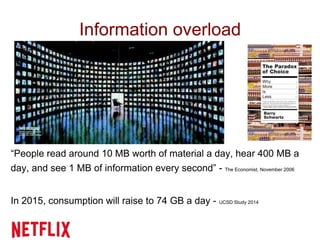
“People read around 10 MB worth of material a day, hear 400 MB a
day, and see 1 MB of information every second” - The Economist, November 2006
In 2015, consumption will raise to 74 GB a day - UCSD Study 2014
The Age of Search has come to an
end
• ... long live the Age of Recommendation!
• Chris Anderson in “The Long Tail”
• “We are leaving the age of search and entering the age of
recommendation”
• CNN Money, “The race to create a 'smart' Google”:
• “The Web, they say, is leaving the era of search and
entering one of discovery. What's the difference? Search is
what you do when you're looking for something. Discovery
is when something wonderful that you didn't know existed,
or didn't know how to ask for, finds you.”
The value of recommendations
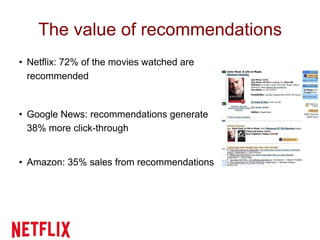
• Netflix: 72% of the movies watched are
recommended
• Google News: recommendations generate
38% more click-through
• Amazon: 35% sales from recommendations
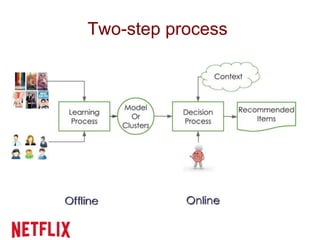
Two-step process
Examples of Different Approaches
to Recommendation
● Collaborative Filtering: Recommend items based only on the
users past behavior
○ User-based: Find similar users to me and recommend what
they liked
○ Item-based: Find similar items to those that I have
previously liked
● Content-based: Recommend based on item features
● Social recommendations (trust-based)
● Hybrid: Combine two or more approaches together
Collaborative Filtering
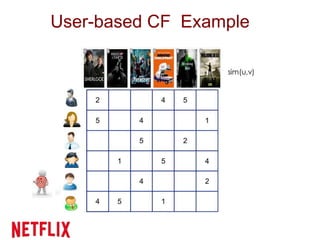
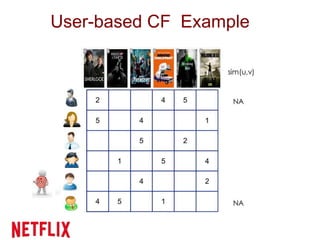
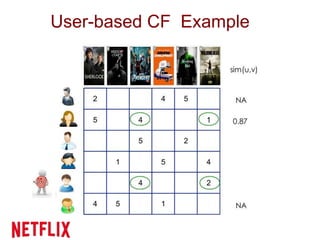
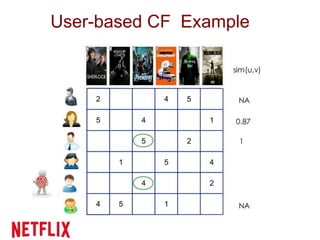
User-based Collaborative Filtering
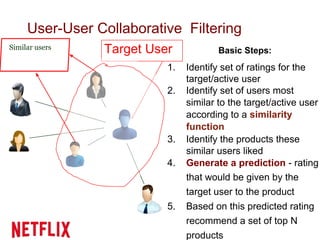
User-User Collaborative Filtering
Target UserSimilar users
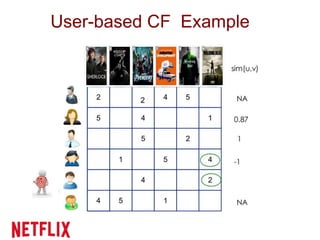
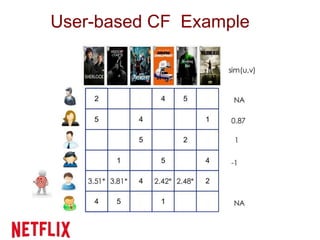
Basic Steps:
1. Identify set of ratings for the
target/active user
2. Identify set of users most
similar to the target/active user
according to a similarity
function
3. Identify the products these
similar users liked
4. Generate a prediction - rating
that would be given by the
target user to the product
5. Based on this predicted rating
recommend a set of top N
products
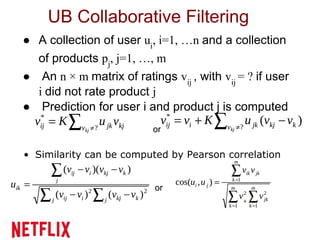
UB Collaborative Filtering
as
● A collection of user ui
, i=1, …n and a collection
of products pj
, j=1, …, m
● An n × m matrix of ratings vij
, with vij
= ? if user
i did not rate product j
● Prediction for user i and product j is computed
or
• Similarity can be computed by Pearson correlation
or
User-based CF Example
Collaborative Filtering
● Pros:
○ Simple and general model where users and products are symbols
without any internal structure or characteristics
○ Produces good-enough results in most cases
● Cons:
○ Cold Start: There needs to be enough other users already in the
system to find a match. New items need to get enough ratings.
○ Popularity Bias: Hard to recommend items to someone with
unique tastes as it tends to recommend popular items
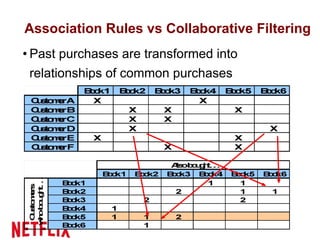
Association Rules vs Collaborative Filtering
• Past purchases are transformed into
relationships of common purchases
Content-based Recommenders
What is content?
● What is the content of an item?
● It can be explicit attributes or characteristics of the
item. For example for a film:
○ Genre: Action / adventure
○ Feature: Bruce Willis
○ Year: 1995
● It can also be textual content (title, description, table
of content, etc.)
Content-Based Recommendations
● Recommendations based on information on the content of
items rather than on other users’ opinions/interactions
● In content-based recommendations, the system tries to
recommend items similar to those a given user has liked in
the past
● A pure content-based recommender system makes
recommendations for a user based solely on the profile built up
by analyzing the content of items which that user has rated in
the past.
Content-based Methods
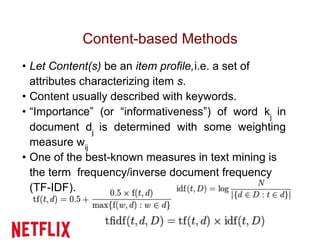
• Let Content(s) be an item profile,i.e. a set of
attributes characterizing item s.
• Content usually described with keywords.
• “Importance” (or “informativeness”) of word kj
in
document dj
is determined with some weighting
measure wij
• One of the best-known measures in text mining is
the term frequency/inverse document frequency
(TF-IDF).
Advantages of CB Approach
● No need for data on other users.
○ No cold-start or sparsity problems.
● Able to recommend to users with unique tastes.
● Able to recommend new and unpopular items
○ No first-rater problem.
● Can provide explanations of recommended items by listing
content-features that caused an item to be recommended.
Disadvantages of CB Approach
● Requires content that can be encoded as meaningful features.
● Some kind of items are not amenable to easy feature extraction
methods (e.g. movies, music)
● Users’ tastes must be represented as a learnable function of
these content features.
● Hard to exploit quality judgements of other users.
Hybrid Approaches
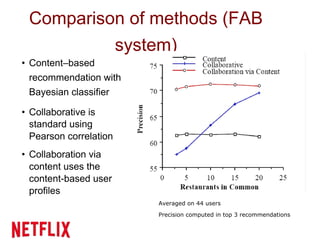
Comparison of methods (FAB
system)
• Content–based
recommendation with
Bayesian classifier
• Collaborative is
standard using
Pearson correlation
• Collaboration via
content uses the
content-based user
profiles
Averaged on 44 users
Precision computed in top 3 recommendations
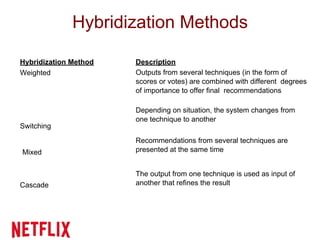
Hybridization Methods
Hybridization Method
Weighted
Switching
Mixed
Cascade
Description
Outputs from several techniques (in the form of
scores or votes) are combined with different degrees
of importance to offer final recommendations
Depending on situation, the system changes from
one technique to another
Recommendations from several techniques are
presented at the same time
The output from one technique is used as input of
another that refines the result
Anatomy of
Netflix
Personalization
Everything is a Recommendation
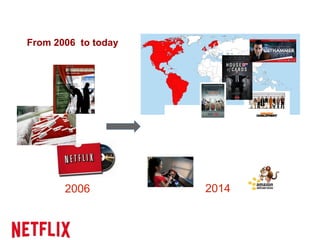
From 2006 to today
2006 2014
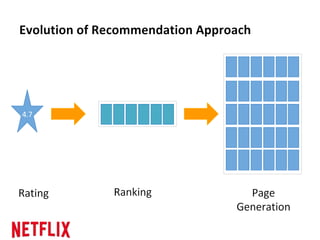
…
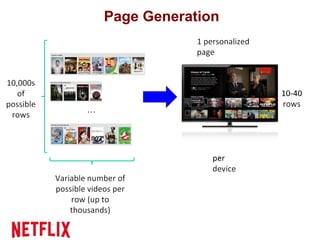
Page Generation
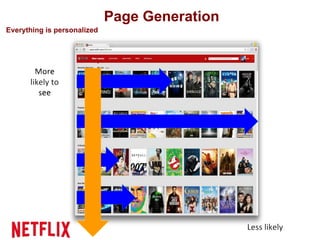
Page Generation
Everything is personalized
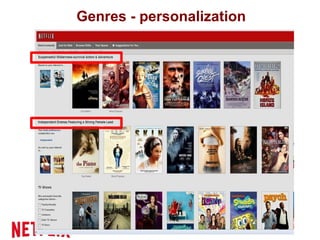
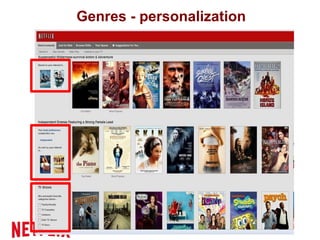
Genres - personalization
Personalized Genre Rows
● Personalized genre rows focus on user interest
○ Also provide context and “evidence”
● How are they generated?
○ Implicit: based on user’s recent plays, ratings, & other
interactions
○ Explicit taste preferences
○ Hybrid:combine the above
● Also take into account:
○ Freshness - has this been shown before?
○ Diversity– avoid repeating tags and genres.
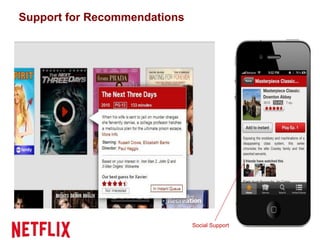
Support for Recommendations
Social Support
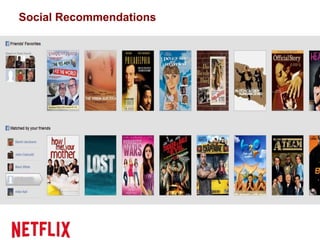
Social Recommendations
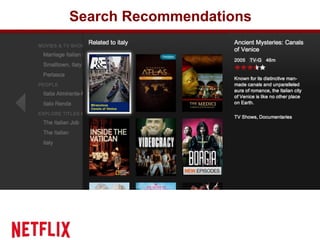
Search Recommendations
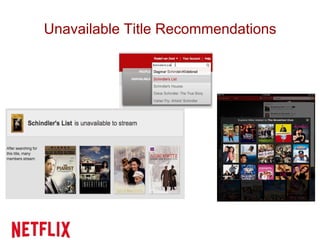
Unavailable Title Recommendations
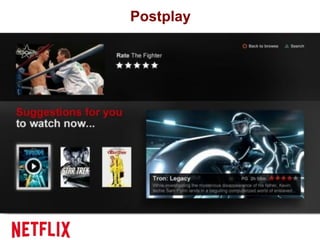
Postplay
Data
&
Models
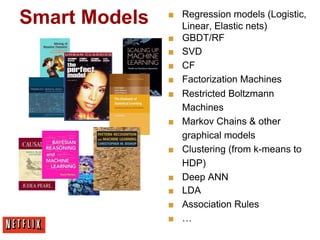
Smart Models ■ Regression models (Logistic,
Linear, Elastic nets)
■ GBDT/RF
■ SVD
■ CF
■ Factorization Machines
■ Restricted Boltzmann
Machines
■ Markov Chains & other
graphical models
■ Clustering (from k-means to
HDP)
■ Deep ANN
■ LDA
■ Association Rules
■ …
Metadata
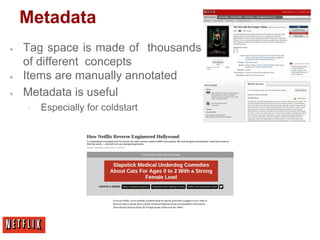
● Tag space is made of thousands
of different concepts
● Items are manually annotated
● Metadata is useful
○ Especially for coldstart
Social
● Can your “friends” interests help us better predict
yours?
● The answer is similar to the Metadata case:
○ If we know enough about you, social information
becomes less useful
○ But, it is very interesting for coldstarting
● And… social support for recommendations has
been shown to matter
Conclusions
● Recommender Systems (RS) is an important
application of User Mining
● RS are fairly new but already grounded on well-
proven technology
○ Collaborative Filtering
○ Machine Learning
○ Text Mining and Content Analysis
○ ...
● RS have the potential to become as important as
Search is now
Thank You!
Questions?

Recommandation systems -

  • 1.
    Recommender Systems By: YousefFadila Slides by Xavier Amatriain - MLSS ‘14 Research/Engineering Director @ Netflix Approaches and applications on Netflix
  • 2.
    Index 1. What isa Recommender System and why it is important 2. Approaches to Recommendation a. Collaborative Filtering 1. Association Rules b. Content-based Recommendations c. Hybrid Approaches 3. A practical example: Netflix
  • 3.
    What is aRecommender System and why it is important?
  • 4.
    Information overload “People readaround 10 MB worth of material a day, hear 400 MB a day, and see 1 MB of information every second” - The Economist, November 2006 In 2015, consumption will raise to 74 GB a day - UCSD Study 2014
  • 5.
    The Age ofSearch has come to an end • ... long live the Age of Recommendation! • Chris Anderson in “The Long Tail” • “We are leaving the age of search and entering the age of recommendation” • CNN Money, “The race to create a 'smart' Google”: • “The Web, they say, is leaving the era of search and entering one of discovery. What's the difference? Search is what you do when you're looking for something. Discovery is when something wonderful that you didn't know existed, or didn't know how to ask for, finds you.”
  • 6.
    The value ofrecommendations • Netflix: 72% of the movies watched are recommended • Google News: recommendations generate 38% more click-through • Amazon: 35% sales from recommendations
  • 7.
  • 8.
    Examples of DifferentApproaches to Recommendation ● Collaborative Filtering: Recommend items based only on the users past behavior ○ User-based: Find similar users to me and recommend what they liked ○ Item-based: Find similar items to those that I have previously liked ● Content-based: Recommend based on item features ● Social recommendations (trust-based) ● Hybrid: Combine two or more approaches together
  • 9.
  • 10.
    User-User Collaborative Filtering TargetUserSimilar users Basic Steps: 1. Identify set of ratings for the target/active user 2. Identify set of users most similar to the target/active user according to a similarity function 3. Identify the products these similar users liked 4. Generate a prediction - rating that would be given by the target user to the product 5. Based on this predicted rating recommend a set of top N products
  • 11.
    UB Collaborative Filtering as ●A collection of user ui , i=1, …n and a collection of products pj , j=1, …, m ● An n × m matrix of ratings vij , with vij = ? if user i did not rate product j ● Prediction for user i and product j is computed or • Similarity can be computed by Pearson correlation or
  • 12.
  • 13.
  • 14.
  • 15.
  • 16.
  • 17.
  • 18.
    Collaborative Filtering ● Pros: ○Simple and general model where users and products are symbols without any internal structure or characteristics ○ Produces good-enough results in most cases ● Cons: ○ Cold Start: There needs to be enough other users already in the system to find a match. New items need to get enough ratings. ○ Popularity Bias: Hard to recommend items to someone with unique tastes as it tends to recommend popular items
  • 19.
    Association Rules vsCollaborative Filtering • Past purchases are transformed into relationships of common purchases
  • 20.
  • 21.
    What is content? ●What is the content of an item? ● It can be explicit attributes or characteristics of the item. For example for a film: ○ Genre: Action / adventure ○ Feature: Bruce Willis ○ Year: 1995 ● It can also be textual content (title, description, table of content, etc.)
  • 22.
    Content-Based Recommendations ● Recommendationsbased on information on the content of items rather than on other users’ opinions/interactions ● In content-based recommendations, the system tries to recommend items similar to those a given user has liked in the past ● A pure content-based recommender system makes recommendations for a user based solely on the profile built up by analyzing the content of items which that user has rated in the past.
  • 23.
    Content-based Methods • LetContent(s) be an item profile,i.e. a set of attributes characterizing item s. • Content usually described with keywords. • “Importance” (or “informativeness”) of word kj in document dj is determined with some weighting measure wij • One of the best-known measures in text mining is the term frequency/inverse document frequency (TF-IDF).
  • 24.
    Advantages of CBApproach ● No need for data on other users. ○ No cold-start or sparsity problems. ● Able to recommend to users with unique tastes. ● Able to recommend new and unpopular items ○ No first-rater problem. ● Can provide explanations of recommended items by listing content-features that caused an item to be recommended.
  • 25.
    Disadvantages of CBApproach ● Requires content that can be encoded as meaningful features. ● Some kind of items are not amenable to easy feature extraction methods (e.g. movies, music) ● Users’ tastes must be represented as a learnable function of these content features. ● Hard to exploit quality judgements of other users.
  • 26.
  • 27.
    Comparison of methods(FAB system) • Content–based recommendation with Bayesian classifier • Collaborative is standard using Pearson correlation • Collaboration via content uses the content-based user profiles Averaged on 44 users Precision computed in top 3 recommendations
  • 28.
    Hybridization Methods Hybridization Method Weighted Switching Mixed Cascade Description Outputsfrom several techniques (in the form of scores or votes) are combined with different degrees of importance to offer final recommendations Depending on situation, the system changes from one technique to another Recommendations from several techniques are presented at the same time The output from one technique is used as input of another that refines the result
  • 29.
  • 31.
    From 2006 totoday 2006 2014
  • 33.
  • 34.
  • 35.
  • 36.
  • 37.
    Personalized Genre Rows ●Personalized genre rows focus on user interest ○ Also provide context and “evidence” ● How are they generated? ○ Implicit: based on user’s recent plays, ratings, & other interactions ○ Explicit taste preferences ○ Hybrid:combine the above ● Also take into account: ○ Freshness - has this been shown before? ○ Diversity– avoid repeating tags and genres.
  • 38.
  • 39.
  • 40.
  • 41.
  • 42.
  • 43.
  • 44.
    Smart Models ■Regression models (Logistic, Linear, Elastic nets) ■ GBDT/RF ■ SVD ■ CF ■ Factorization Machines ■ Restricted Boltzmann Machines ■ Markov Chains & other graphical models ■ Clustering (from k-means to HDP) ■ Deep ANN ■ LDA ■ Association Rules ■ …
  • 45.
    Metadata ● Tag spaceis made of thousands of different concepts ● Items are manually annotated ● Metadata is useful ○ Especially for coldstart
  • 46.
    Social ● Can your“friends” interests help us better predict yours? ● The answer is similar to the Metadata case: ○ If we know enough about you, social information becomes less useful ○ But, it is very interesting for coldstarting ● And… social support for recommendations has been shown to matter
  • 47.
    Conclusions ● Recommender Systems(RS) is an important application of User Mining ● RS are fairly new but already grounded on well- proven technology ○ Collaborative Filtering ○ Machine Learning ○ Text Mining and Content Analysis ○ ... ● RS have the potential to become as important as Search is now
  • 48.