Recommendations of NCL
National Commission on Labour
Introduction
• The first National Labour Commission was established on 24th
December, 1966 under the Chairmanship of Dr. Gajendragadkar. The
objective was to study and review the living conditions of labour and
the labour legislations since 1947.
• The Second National Labour Commission was brought into existence
after a long gap of 33 years based on the recommendation of Indian
labour Conference held in September, 1992. It consisted of ten
members. In view of economic liberalisation of labour
laws. Government of India set up 2nd National commission of
Labour under chairmanship of Mr. Ravindra Varma
(a) to suggest measures about rationalisation of labour laws
(b) to suggest “umbrella” legislation for ensuring a minimum level of protection
to the workers in the organised sector.
Contd..
• While developing the framework for its recommendation, the Commission
took into account, the emerging economic environment involving rapid
technological change, globalisation of economy, liberalisation of trade and
industry, need for bringing existing laws in tune with future labour market
needs and demands. Study groups were formed for detailed study and
review of various laws, umbrella legislation for unorganised sector
workers, globalisation and its impact, social security, women and child
labour, skill development training and workers education.
• The commission believes the level of wages depend on economic
efficiency of an undertaking.” The commission further adds “workers have
to be interested in productivity as the management is.”
Recommendations of Second Labour Commission are:
• The Commission recommended new labour laws on
– labour management relation,
– wages,
– occupational safety and health,
– small enterprise,
– hours of work,
– leave and other working condition of work place,
– child labour and unorganized sector etc.
• The Commission suggested that there is no need for any wage board for
fixing wage rates for workers in any industry. It opined that each state or
union territory should have the authority to fix minimum rates of wage not
less than national level. It also recommended linking of child labour with
education by enactment of Child Labour (Prevention and Education) Act.
Contd..
• The Commission recommended that there should be a policy framework in the
unorganized sector that ensures the generation and protection of jobs, access to
jobs, protection against the exploitation of poverty and lack of organization,
protection against arbitrary or whimsical dismissal and denial of minimum
wages. It also suggested that a system of welfare should include access to
compensation for injuries suffered while engaged in work, provident fund,
medical care, pension benefit, maternity benefits, child care shelter and old age
support.
• Compulsory adjudication of disputes should be used only as a last resort.
• Both organizationally and financially, trade unions need to be strengthened.
• Workers’ education should be intensified for building up internal union
leaderships and making workers more knowledgeable and conscious about their
rights and obligations.
• Popularized should be the idea of one plant or one industry.
• Government should encourage the parties to settle their industrial disputes by
negotiation and bipartite consultation.
Contd..
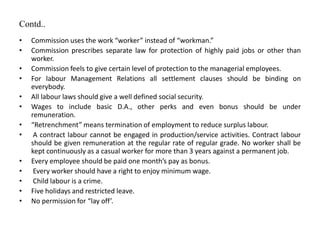
• Commission uses the work “worker” instead of “workman.”
• Commission prescribes separate law for protection of highly paid jobs or other than
worker.
• Commission feels to give certain level of protection to the managerial employees.
• For labour Management Relations all settlement clauses should be binding on
everybody.
• All labour laws should give a well defined social security.
• Wages to include basic D.A., other perks and even bonus should be under
remuneration.
• “Retrenchment” means termination of employment to reduce surplus labour.
• A contract labour cannot be engaged in production/service activities. Contract labour
should be given remuneration at the regular rate of regular grade. No worker shall be
kept continuously as a casual worker for more than 3 years against a permanent job.
• Every employee should be paid one month’s pay as bonus.
• Every worker should have a right to enjoy minimum wage.
• Child labour is a crime.
• Five holidays and restricted leave.
• No permission for “lay off’.

Recommendations of NCL.pptx

  • 1.
  • 2.
    National Commission onLabour Introduction • The first National Labour Commission was established on 24th December, 1966 under the Chairmanship of Dr. Gajendragadkar. The objective was to study and review the living conditions of labour and the labour legislations since 1947. • The Second National Labour Commission was brought into existence after a long gap of 33 years based on the recommendation of Indian labour Conference held in September, 1992. It consisted of ten members. In view of economic liberalisation of labour laws. Government of India set up 2nd National commission of Labour under chairmanship of Mr. Ravindra Varma (a) to suggest measures about rationalisation of labour laws (b) to suggest “umbrella” legislation for ensuring a minimum level of protection to the workers in the organised sector.
  • 3.
    Contd.. • While developingthe framework for its recommendation, the Commission took into account, the emerging economic environment involving rapid technological change, globalisation of economy, liberalisation of trade and industry, need for bringing existing laws in tune with future labour market needs and demands. Study groups were formed for detailed study and review of various laws, umbrella legislation for unorganised sector workers, globalisation and its impact, social security, women and child labour, skill development training and workers education. • The commission believes the level of wages depend on economic efficiency of an undertaking.” The commission further adds “workers have to be interested in productivity as the management is.”
  • 4.
    Recommendations of SecondLabour Commission are: • The Commission recommended new labour laws on – labour management relation, – wages, – occupational safety and health, – small enterprise, – hours of work, – leave and other working condition of work place, – child labour and unorganized sector etc. • The Commission suggested that there is no need for any wage board for fixing wage rates for workers in any industry. It opined that each state or union territory should have the authority to fix minimum rates of wage not less than national level. It also recommended linking of child labour with education by enactment of Child Labour (Prevention and Education) Act.
  • 5.
    Contd.. • The Commissionrecommended that there should be a policy framework in the unorganized sector that ensures the generation and protection of jobs, access to jobs, protection against the exploitation of poverty and lack of organization, protection against arbitrary or whimsical dismissal and denial of minimum wages. It also suggested that a system of welfare should include access to compensation for injuries suffered while engaged in work, provident fund, medical care, pension benefit, maternity benefits, child care shelter and old age support. • Compulsory adjudication of disputes should be used only as a last resort. • Both organizationally and financially, trade unions need to be strengthened. • Workers’ education should be intensified for building up internal union leaderships and making workers more knowledgeable and conscious about their rights and obligations. • Popularized should be the idea of one plant or one industry. • Government should encourage the parties to settle their industrial disputes by negotiation and bipartite consultation.
  • 6.
    Contd.. • Commission usesthe work “worker” instead of “workman.” • Commission prescribes separate law for protection of highly paid jobs or other than worker. • Commission feels to give certain level of protection to the managerial employees. • For labour Management Relations all settlement clauses should be binding on everybody. • All labour laws should give a well defined social security. • Wages to include basic D.A., other perks and even bonus should be under remuneration. • “Retrenchment” means termination of employment to reduce surplus labour. • A contract labour cannot be engaged in production/service activities. Contract labour should be given remuneration at the regular rate of regular grade. No worker shall be kept continuously as a casual worker for more than 3 years against a permanent job. • Every employee should be paid one month’s pay as bonus. • Every worker should have a right to enjoy minimum wage. • Child labour is a crime. • Five holidays and restricted leave. • No permission for “lay off’.