Filtering and
Recommender
Systems
Content-based
and
Collaborative
Some of the slides based
On Mooney’s Slides
Personalization
• Recommenders are instances of
personalization software.
• Personalization concerns adapting to the
individual needs, interests, and preferences of
each user.
• Includes:
– Recommending
– Filtering
– Predicting (e.g. form or calendar appt. completion)
• From a business perspective, it is viewed as
part of Customer Relationship Management
(CRM).
Feedback &
Prediction/Recommendation
• Traditional IR has a single user—probably
working in single-shot modes
– Relevance feedback…
• WEB search engines have:
– Working continually
• User profiling
– Profile is a “model” of the user
• (and also Relevance feedback)
– Many users
• Collaborative filtering
– Propagate user preferences to other
users…
You know this one
Recommender Systems in Use
• Systems for recommending items (e.g. books,
movies, CD’s, web pages, newsgroup
messages) to users based on examples of
their preferences.
• Many on-line stores provide
recommendations (e.g. Amazon, CDNow).
• Recommenders have been shown to
substantially increase sales at on-line stores.
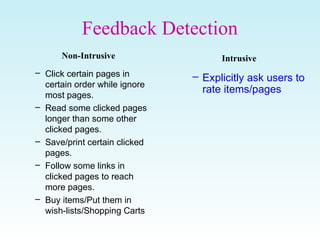
Feedback Detection
– Click certain pages in
certain order while ignore
most pages.
– Read some clicked pages
longer than some other
clicked pages.
– Save/print certain clicked
pages.
– Follow some links in
clicked pages to reach
more pages.
– Buy items/Put them in
wish-lists/Shopping Carts
– Explicitly ask users to
rate items/pages
Non-Intrusive Intrusive
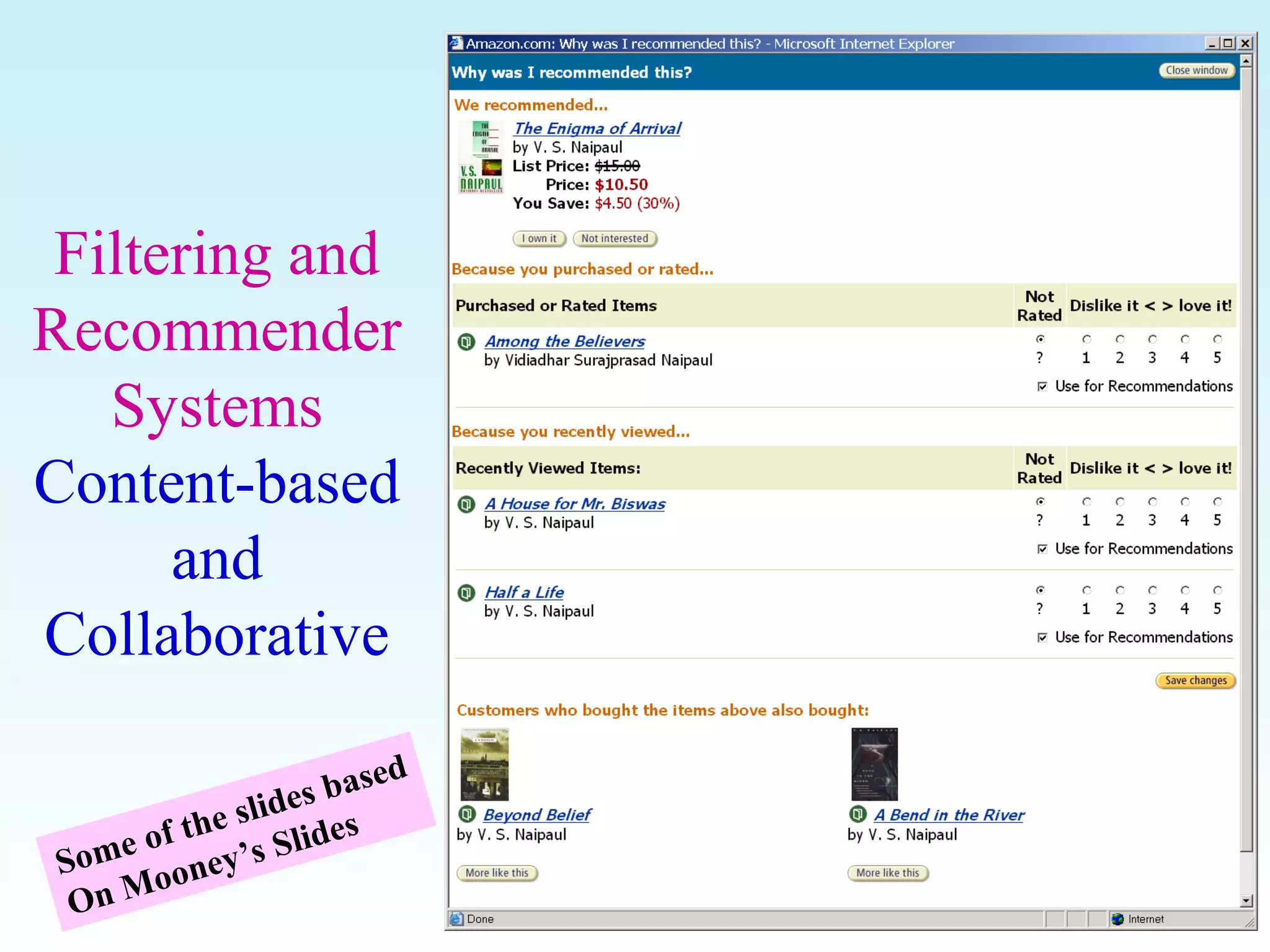
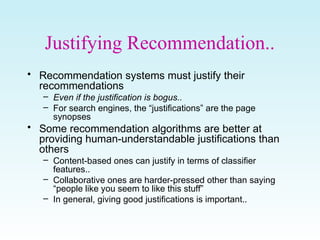
Justifying Recommendation..
• Recommendation systems must justify their
recommendations
– Even if the justification is bogus..
– For search engines, the “justifications” are the page
synopses
• Some recommendation algorithms are better at
providing human-understandable justifications than
others
– Content-based ones can justify in terms of classifier
features..
– Collaborative ones are harder-pressed other than saying
“people like you seem to like this stuff”
– In general, giving good justifications is important..
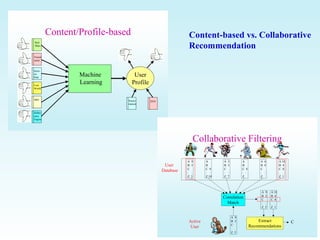
Content/Profile-based
Red
Mars
Juras-
sic
Park
Lost
World
2001
Found
ation
Differ-
ence
Engine
Machine
Learning
User
Profile
Neuro-
mancer
2010
Collaborative Filtering
A 9
B 3
C
: :
Z 5
A
B
C 9
: :
Z 10
A 5
B 3
C
: :
Z 7
A
B
C 8
: :
Z
A 6
B 4
C
: :
Z
A 10
B 4
C 8
. .
Z 1
User
Database
Active
User
Correlation
Match
A 9
B 3
C
. .
Z 5
A 9
B 3
C
: :
Z 5
A 10
B 4
C 8
. .
Z 1
Extract
Recommendations
C
Content-based vs. Collaborative
Recommendation
Collaborative Filtering
A 9
B 3
C
: :
Z 5
A
B
C 9
: :
Z 10
A 5
B 3
C
: :
Z 7
A
B
C 8
: :
Z
A 6
B 4
C
: :
Z
A 10
B 4
C 8
. .
Z 1
User
Database
Active
User
Correlation
Match
A 9
B 3
C
. .
Z 5
A 9
B 3
C
: :
Z 5
A 10
B 4
C 8
. .
Z 1
Extract
Recommendations
C
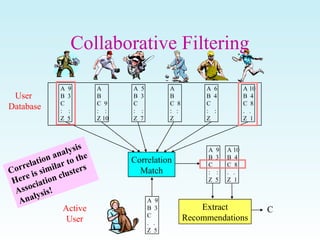
Correlation analysis
Here is similar to the
Association clusters
Analysis!
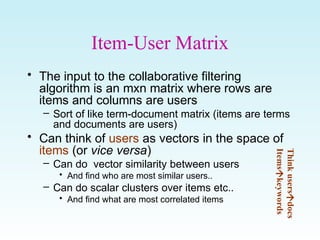
Item-User Matrix
• The input to the collaborative filtering
algorithm is an mxn matrix where rows are
items and columns are users
– Sort of like term-document matrix (items are terms
and documents are users)
• Can think of users as vectors in the space of
items (or vice versa)
– Can do vector similarity between users
• And find who are most similar users..
– Can do scalar clusters over items etc..
• And find what are most correlated items
Thinkusers

docs
Items

keywords
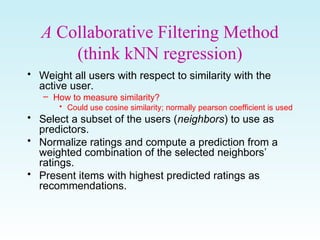
A Collaborative Filtering Method
(think kNN regression)
• Weight all users with respect to similarity with the
active user.
– How to measure similarity?
• Could use cosine similarity; normally pearson coefficient is used
• Select a subset of the users (neighbors) to use as
predictors.
• Normalize ratings and compute a prediction from a
weighted combination of the selected neighbors’
ratings.
• Present items with highest predicted ratings as
recommendations.
3/27
Homework 2 Solns posted
Midterm on Thursday in class
Covers everything covered by the first two
homeworks
Qns??
Today
Complete Filtering
Discuss Das/Datar paper
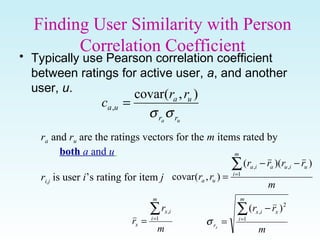
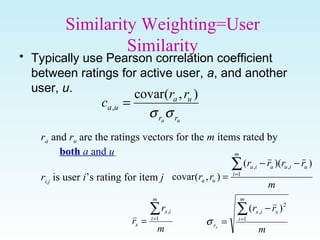
Finding User Similarity with Person
Correlation Coefficient
• Typically use Pearson correlation coefficient
between ratings for active user, a, and another
user, u.
ua rr
ua
ua
rr
c
σσ
),(covar
, =
ra and ru are the ratings vectors for the m items rated by
both a and u
ri,j is user i’s rating for item j
m
rrrr
rr
m
i
uiuaia
ua
∑=
−−
= 1
,, ))((
),(covar
m
rr
m
i
xix
rx
∑=
−
= 1
2
, )(
σ
m
r
r
m
i
ix
x
∑=
= 1
,
Neighbor Selection
• For a given active user, a, select correlated
users to serve as source of predictions.
• Standard approach is to use the most similar
k users, u, based on similarity weights, wa,u
• Alternate approach is to include all users
whose similarity weight is above a given
threshold.
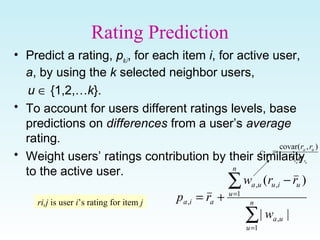
Rating Prediction
• Predict a rating, pa,i, for each item i, for active user,
a, by using the k selected neighbor users,
u ∈ {1,2,…k}.
• To account for users different ratings levels, base
predictions on differences from a user’s average
rating.
• Weight users’ ratings contribution by their similarity
to the active user.
∑
∑
=
=
−
+= n
u
ua
n
u
uiuua
aia
w
rrw
rp
1
,
1
,,
,
||
)(
ri,j is user i’s rating for item j
ua rr
ua
ua
rr
c
σσ
),(covar
, =
Similarity Weighting=User
Similarity
• Typically use Pearson correlation coefficient
between ratings for active user, a, and another
user, u.
ua rr
ua
ua
rr
c
σσ
),(covar
, =
ra and ru are the ratings vectors for the m items rated by
both a and u
ri,j is user i’s rating for item j
m
rrrr
rr
m
i
uiuaia
ua
∑=
−−
= 1
,, ))((
),(covar
m
rr
m
i
xix
rx
∑=
−
= 1
2
, )(
σ
m
r
r
m
i
ix
x
∑=
= 1
,
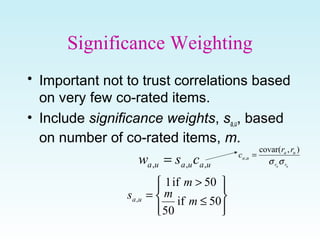
Significance Weighting
• Important not to trust correlations based
on very few co-rated items.
• Include significance weights, sa,u, based
on number of co-rated items, m.
uauaua csw ,,, =








≤
>
=
50if
50
50if1
, m
m
m
s ua
ua rr
ua
ua
rr
c
σσ
),(covar
, =
Problems with Collaborative Filtering
• Cold Start: There needs to be enough other users
already in the system to find a match.
• Sparsity: If there are many items to be recommended,
even if there are many users, the user/ratings matrix is
sparse, and it is hard to find users that have rated the
same items.
• First Rater: Cannot recommend an item that has not
been previously rated.
– New items
– Esoteric items
• Popularity Bias: Cannot recommend items to
someone with unique tastes.
– Tends to recommend popular items.
• WHAT DO YOU MEAN YOU DON’T CARE FOR BRITNEY
SPEARS YOU DUNDERHEAD? #$%$%$&^
Content-Based Recommending
• Recommendations are based on
information on the content of items
rather than on other users’ opinions.
• Uses machine learning algorithms to
induce a profile of the users
preferences from examples based on a
featural description of content.
• Lots of systems
Adapting Naïve Bayes idea for Book
Recommendation
• Vector of Bags model
– E.g. Books have several
different fields that are all
text
• Authors, description, …
• A word appearing in one
field is different from the
same word appearing in
another
– Want to keep each bag
different—vector of m Bags;
Conditional probabilities for
each word w.r.t each class
and bag
• Can give a profile of a
user in terms of words
that are most predictive
of what they like
– Odds Ratio
P(rel|example)/P(~rel|
example)
An example is positive if the
odds ratio is > 1
– Strengh of a keyword
• Log[P(w|rel)/P(w|~rel)]
– We can summarize a
user’s profile in terms of
the words that have
strength above some
threshold.
∏∏= =
=
S
m
dm
i
mi smcjaP
BookP
cjP
BookcjP
1
||
1
),|(
)(
)(
)|(
Advantages of Content-Based
Approach
• No need for data on other users.
– No cold-start or sparsity problems.
• Able to recommend to users with unique tastes.
• Able to recommend new and unpopular items
– No first-rater problem.
• Can provide explanations of recommended items
by listing content-features that caused an item to
be recommended.
• Well-known technology The entire field of
Classification Learning is at (y)our disposal!
Disadvantages of Content-Based
Method
• Requires content that can be encoded as
meaningful features.
• Users’ tastes must be represented as a
learnable function of these content features.
• Unable to exploit quality judgments of other
users.
– Unless these are somehow included in the content
features.
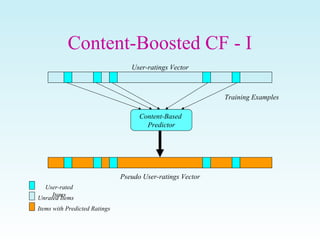
Content-Boosted CF - I
Content-Based
Predictor
Training Examples
Pseudo User-ratings Vector
Items with Predicted Ratings
User-ratings Vector
User-rated
Items
Unrated Items
Content-Boosted CF - II
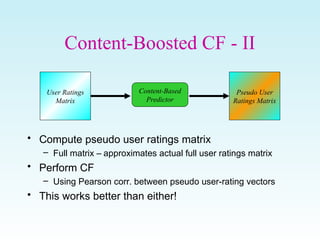
• Compute pseudo user ratings matrix
– Full matrix – approximates actual full user ratings matrix
• Perform CF
– Using Pearson corr. between pseudo user-rating vectors
• This works better than either!
User Ratings
Matrix
Pseudo User
Ratings Matrix
Content-Based
Predictor
Why can’t the pseudo ratings be
used to help content-based filtering?
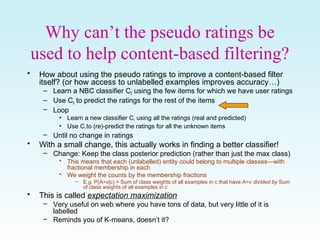
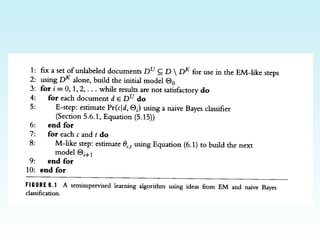
• How about using the pseudo ratings to improve a content-based filter
itself? (or how access to unlabelled examples improves accuracy…)
– Learn a NBC classifier C0 using the few items for which we have user ratings
– Use C0 to predict the ratings for the rest of the items
– Loop
• Learn a new classifier C1 using all the ratings (real and predicted)
• Use C1 to (re)-predict the ratings for all the unknown items
– Until no change in ratings
• With a small change, this actually works in finding a better classifier!
– Change: Keep the class posterior prediction (rather than just the max class)
• This means that each (unlabelled) entity could belong to multiple classes—with
fractional membership in each
• We weight the counts by the membership fractions
– E.g. P(A=v|c) = Sum of class weights of all examples in c that have A=v divided by Sum
of class weights of all examples in c
• This is called expectation maximization
– Very useful on web where you have tons of data, but very little of it is
labelled
– Reminds you of K-means, doesn’t it?
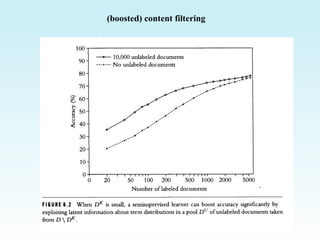
(boosted) content filtering
Co-training
• Suppose each instance has two parts:
x = [x1, x2]
x1, x2 conditionally independent given f(x)
• Suppose each half can be used to classify instance
∃f1, f2 such that f1(x1) = f2(x2) = f(x)
• Suppose f1, f2 are learnable
f1 ∈ H1, f2 ∈ H2, ∃ learning algorithms A1, A2
Unlabeled Instances
[x1, x2]
Labeled Instances
<[x1, x2], f1(x1)>A1 f2
Hypothesis
~
A2
Small labeled data needed
You train me—I train you…
Observations
• Can apply A1 to generate as much training
data as one wants
– If x1 is conditionally independent of x2 / f(x),
– then the error in the labels produced by A1
– will look like random noise to A2 !!!
• Thus no limit to quality of the hypothesis
A2 can make
Discussion of the Google News
Collaborative Filtering Paper

Filtering content bbased crs

  • 1.
  • 2.
    Personalization • Recommenders areinstances of personalization software. • Personalization concerns adapting to the individual needs, interests, and preferences of each user. • Includes: – Recommending – Filtering – Predicting (e.g. form or calendar appt. completion) • From a business perspective, it is viewed as part of Customer Relationship Management (CRM).
  • 3.
    Feedback & Prediction/Recommendation • TraditionalIR has a single user—probably working in single-shot modes – Relevance feedback… • WEB search engines have: – Working continually • User profiling – Profile is a “model” of the user • (and also Relevance feedback) – Many users • Collaborative filtering – Propagate user preferences to other users… You know this one
  • 4.
    Recommender Systems inUse • Systems for recommending items (e.g. books, movies, CD’s, web pages, newsgroup messages) to users based on examples of their preferences. • Many on-line stores provide recommendations (e.g. Amazon, CDNow). • Recommenders have been shown to substantially increase sales at on-line stores.
  • 5.
    Feedback Detection – Clickcertain pages in certain order while ignore most pages. – Read some clicked pages longer than some other clicked pages. – Save/print certain clicked pages. – Follow some links in clicked pages to reach more pages. – Buy items/Put them in wish-lists/Shopping Carts – Explicitly ask users to rate items/pages Non-Intrusive Intrusive
  • 6.
    Justifying Recommendation.. • Recommendationsystems must justify their recommendations – Even if the justification is bogus.. – For search engines, the “justifications” are the page synopses • Some recommendation algorithms are better at providing human-understandable justifications than others – Content-based ones can justify in terms of classifier features.. – Collaborative ones are harder-pressed other than saying “people like you seem to like this stuff” – In general, giving good justifications is important..
  • 7.
    Content/Profile-based Red Mars Juras- sic Park Lost World 2001 Found ation Differ- ence Engine Machine Learning User Profile Neuro- mancer 2010 Collaborative Filtering A 9 B3 C : : Z 5 A B C 9 : : Z 10 A 5 B 3 C : : Z 7 A B C 8 : : Z A 6 B 4 C : : Z A 10 B 4 C 8 . . Z 1 User Database Active User Correlation Match A 9 B 3 C . . Z 5 A 9 B 3 C : : Z 5 A 10 B 4 C 8 . . Z 1 Extract Recommendations C Content-based vs. Collaborative Recommendation
  • 8.
    Collaborative Filtering A 9 B3 C : : Z 5 A B C 9 : : Z 10 A 5 B 3 C : : Z 7 A B C 8 : : Z A 6 B 4 C : : Z A 10 B 4 C 8 . . Z 1 User Database Active User Correlation Match A 9 B 3 C . . Z 5 A 9 B 3 C : : Z 5 A 10 B 4 C 8 . . Z 1 Extract Recommendations C Correlation analysis Here is similar to the Association clusters Analysis!
  • 9.
    Item-User Matrix • Theinput to the collaborative filtering algorithm is an mxn matrix where rows are items and columns are users – Sort of like term-document matrix (items are terms and documents are users) • Can think of users as vectors in the space of items (or vice versa) – Can do vector similarity between users • And find who are most similar users.. – Can do scalar clusters over items etc.. • And find what are most correlated items Thinkusers  docs Items  keywords
  • 10.
    A Collaborative FilteringMethod (think kNN regression) • Weight all users with respect to similarity with the active user. – How to measure similarity? • Could use cosine similarity; normally pearson coefficient is used • Select a subset of the users (neighbors) to use as predictors. • Normalize ratings and compute a prediction from a weighted combination of the selected neighbors’ ratings. • Present items with highest predicted ratings as recommendations.
  • 11.
    3/27 Homework 2 Solnsposted Midterm on Thursday in class Covers everything covered by the first two homeworks Qns?? Today Complete Filtering Discuss Das/Datar paper
  • 12.
    Finding User Similaritywith Person Correlation Coefficient • Typically use Pearson correlation coefficient between ratings for active user, a, and another user, u. ua rr ua ua rr c σσ ),(covar , = ra and ru are the ratings vectors for the m items rated by both a and u ri,j is user i’s rating for item j m rrrr rr m i uiuaia ua ∑= −− = 1 ,, ))(( ),(covar m rr m i xix rx ∑= − = 1 2 , )( σ m r r m i ix x ∑= = 1 ,
  • 13.
    Neighbor Selection • Fora given active user, a, select correlated users to serve as source of predictions. • Standard approach is to use the most similar k users, u, based on similarity weights, wa,u • Alternate approach is to include all users whose similarity weight is above a given threshold.
  • 14.
    Rating Prediction • Predicta rating, pa,i, for each item i, for active user, a, by using the k selected neighbor users, u ∈ {1,2,…k}. • To account for users different ratings levels, base predictions on differences from a user’s average rating. • Weight users’ ratings contribution by their similarity to the active user. ∑ ∑ = = − += n u ua n u uiuua aia w rrw rp 1 , 1 ,, , || )( ri,j is user i’s rating for item j ua rr ua ua rr c σσ ),(covar , =
  • 15.
    Similarity Weighting=User Similarity • Typicallyuse Pearson correlation coefficient between ratings for active user, a, and another user, u. ua rr ua ua rr c σσ ),(covar , = ra and ru are the ratings vectors for the m items rated by both a and u ri,j is user i’s rating for item j m rrrr rr m i uiuaia ua ∑= −− = 1 ,, ))(( ),(covar m rr m i xix rx ∑= − = 1 2 , )( σ m r r m i ix x ∑= = 1 ,
  • 16.
    Significance Weighting • Importantnot to trust correlations based on very few co-rated items. • Include significance weights, sa,u, based on number of co-rated items, m. uauaua csw ,,, =         ≤ > = 50if 50 50if1 , m m m s ua ua rr ua ua rr c σσ ),(covar , =
  • 17.
    Problems with CollaborativeFiltering • Cold Start: There needs to be enough other users already in the system to find a match. • Sparsity: If there are many items to be recommended, even if there are many users, the user/ratings matrix is sparse, and it is hard to find users that have rated the same items. • First Rater: Cannot recommend an item that has not been previously rated. – New items – Esoteric items • Popularity Bias: Cannot recommend items to someone with unique tastes. – Tends to recommend popular items. • WHAT DO YOU MEAN YOU DON’T CARE FOR BRITNEY SPEARS YOU DUNDERHEAD? #$%$%$&^
  • 18.
    Content-Based Recommending • Recommendationsare based on information on the content of items rather than on other users’ opinions. • Uses machine learning algorithms to induce a profile of the users preferences from examples based on a featural description of content. • Lots of systems
  • 19.
    Adapting Naïve Bayesidea for Book Recommendation • Vector of Bags model – E.g. Books have several different fields that are all text • Authors, description, … • A word appearing in one field is different from the same word appearing in another – Want to keep each bag different—vector of m Bags; Conditional probabilities for each word w.r.t each class and bag • Can give a profile of a user in terms of words that are most predictive of what they like – Odds Ratio P(rel|example)/P(~rel| example) An example is positive if the odds ratio is > 1 – Strengh of a keyword • Log[P(w|rel)/P(w|~rel)] – We can summarize a user’s profile in terms of the words that have strength above some threshold. ∏∏= = = S m dm i mi smcjaP BookP cjP BookcjP 1 || 1 ),|( )( )( )|(
  • 20.
    Advantages of Content-Based Approach •No need for data on other users. – No cold-start or sparsity problems. • Able to recommend to users with unique tastes. • Able to recommend new and unpopular items – No first-rater problem. • Can provide explanations of recommended items by listing content-features that caused an item to be recommended. • Well-known technology The entire field of Classification Learning is at (y)our disposal!
  • 21.
    Disadvantages of Content-Based Method •Requires content that can be encoded as meaningful features. • Users’ tastes must be represented as a learnable function of these content features. • Unable to exploit quality judgments of other users. – Unless these are somehow included in the content features.
  • 22.
    Content-Boosted CF -I Content-Based Predictor Training Examples Pseudo User-ratings Vector Items with Predicted Ratings User-ratings Vector User-rated Items Unrated Items
  • 23.
    Content-Boosted CF -II • Compute pseudo user ratings matrix – Full matrix – approximates actual full user ratings matrix • Perform CF – Using Pearson corr. between pseudo user-rating vectors • This works better than either! User Ratings Matrix Pseudo User Ratings Matrix Content-Based Predictor
  • 24.
    Why can’t thepseudo ratings be used to help content-based filtering? • How about using the pseudo ratings to improve a content-based filter itself? (or how access to unlabelled examples improves accuracy…) – Learn a NBC classifier C0 using the few items for which we have user ratings – Use C0 to predict the ratings for the rest of the items – Loop • Learn a new classifier C1 using all the ratings (real and predicted) • Use C1 to (re)-predict the ratings for all the unknown items – Until no change in ratings • With a small change, this actually works in finding a better classifier! – Change: Keep the class posterior prediction (rather than just the max class) • This means that each (unlabelled) entity could belong to multiple classes—with fractional membership in each • We weight the counts by the membership fractions – E.g. P(A=v|c) = Sum of class weights of all examples in c that have A=v divided by Sum of class weights of all examples in c • This is called expectation maximization – Very useful on web where you have tons of data, but very little of it is labelled – Reminds you of K-means, doesn’t it?
  • 26.
  • 27.
    Co-training • Suppose eachinstance has two parts: x = [x1, x2] x1, x2 conditionally independent given f(x) • Suppose each half can be used to classify instance ∃f1, f2 such that f1(x1) = f2(x2) = f(x) • Suppose f1, f2 are learnable f1 ∈ H1, f2 ∈ H2, ∃ learning algorithms A1, A2 Unlabeled Instances [x1, x2] Labeled Instances <[x1, x2], f1(x1)>A1 f2 Hypothesis ~ A2 Small labeled data needed You train me—I train you…
  • 28.
    Observations • Can applyA1 to generate as much training data as one wants – If x1 is conditionally independent of x2 / f(x), – then the error in the labels produced by A1 – will look like random noise to A2 !!! • Thus no limit to quality of the hypothesis A2 can make
  • 30.
    Discussion of theGoogle News Collaborative Filtering Paper