INTRODUCTION
A recommender system (RS) helps users that
have no sufficient competence or time to evaluate the,
potentially overwhelming, number of alternatives
offered by a web site.
In their simplest form, RSs recommend to their users
personalized and ranked lists of items
COLLABORATIVE FILTERING
One approach to the design of recommender systems
that has wide use is collaborative filtering. Collaborative
filtering is based on the assumption that people who
agreed in the past will agree in the future, and that they
will like similar kinds of items as they liked in the past.
The system generates recommendations using only
information about rating profiles for different users or
items. By locating peer users/items with a rating history
similar to the current user or item, they generate
recommendations using this neighborhood.
Collaborative filtering methods are classified as memory-
based and model-based. A well-known example of
memory-based approaches is the user-based algorithm,
while that of model-based approaches is Matrix
Factorization.
Methodology of collaborative filtering
Collaborative filtering systems have many forms, but many common systems can be reduced to two
steps:
1. Look for users who share the same rating patterns with the active user
2. Use the ratings from those like-minded users found in step 1 to calculate a prediction for the active
user
This falls under the category of user-based collaborative filtering. A specific application of this is the user-
based Nearest Neighbor algorithm.
Alternatively, item-based collaborative filtering, proceeds in an item-centric manner:
1. Build an item-item matrix determining relationships between pairs of items
2. Infer the tastes of the current user by examining the matrix and matching that user's data
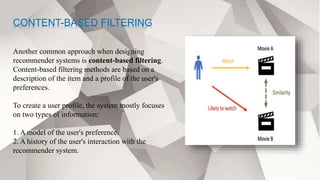
CONTENT-BASED FILTERING
Another common approach when designing
recommender systems is content-based filtering.
Content-based filtering methods are based on a
description of the item and a profile of the user's
preferences.
To create a user profile, the system mostly focuses
on two types of information:
1. A model of the user's preference.
2. A history of the user's interaction with the
recommender system.
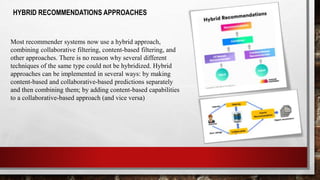
HYBRID RECOMMENDATIONS APPROACHES
Most recommender systems now use a hybrid approach,
combining collaborative filtering, content-based filtering, and
other approaches. There is no reason why several different
techniques of the same type could not be hybridized. Hybrid
approaches can be implemented in several ways: by making
content-based and collaborative-based predictions separately
and then combining them; by adding content-based capabilities
to a collaborative-based approach (and vice versa)
big data analysis.pptx

big data analysis.pptx

  • 2.
    INTRODUCTION A recommender system(RS) helps users that have no sufficient competence or time to evaluate the, potentially overwhelming, number of alternatives offered by a web site. In their simplest form, RSs recommend to their users personalized and ranked lists of items
  • 4.
    COLLABORATIVE FILTERING One approachto the design of recommender systems that has wide use is collaborative filtering. Collaborative filtering is based on the assumption that people who agreed in the past will agree in the future, and that they will like similar kinds of items as they liked in the past. The system generates recommendations using only information about rating profiles for different users or items. By locating peer users/items with a rating history similar to the current user or item, they generate recommendations using this neighborhood. Collaborative filtering methods are classified as memory- based and model-based. A well-known example of memory-based approaches is the user-based algorithm, while that of model-based approaches is Matrix Factorization.
  • 5.
    Methodology of collaborativefiltering Collaborative filtering systems have many forms, but many common systems can be reduced to two steps: 1. Look for users who share the same rating patterns with the active user 2. Use the ratings from those like-minded users found in step 1 to calculate a prediction for the active user This falls under the category of user-based collaborative filtering. A specific application of this is the user- based Nearest Neighbor algorithm. Alternatively, item-based collaborative filtering, proceeds in an item-centric manner: 1. Build an item-item matrix determining relationships between pairs of items 2. Infer the tastes of the current user by examining the matrix and matching that user's data
  • 6.
    CONTENT-BASED FILTERING Another commonapproach when designing recommender systems is content-based filtering. Content-based filtering methods are based on a description of the item and a profile of the user's preferences. To create a user profile, the system mostly focuses on two types of information: 1. A model of the user's preference. 2. A history of the user's interaction with the recommender system.
  • 7.
    HYBRID RECOMMENDATIONS APPROACHES Mostrecommender systems now use a hybrid approach, combining collaborative filtering, content-based filtering, and other approaches. There is no reason why several different techniques of the same type could not be hybridized. Hybrid approaches can be implemented in several ways: by making content-based and collaborative-based predictions separately and then combining them; by adding content-based capabilities to a collaborative-based approach (and vice versa)