RECIST GUIDELINES
Dr. D. Ramu
• Assessment of the change in tumour burden is an important feature of the
clinical evaluation of cancer therapeutics.
• Both tumour shrinkage (objective response) and time to the development
of disease progression are important endpoints in cancer clinical trials
• 1981 the World Health Organisation (WHO) first published tumour
response criteria
• Over all assessment of tumour burden by summing the products of bidimensional
lesion measurements
• Determined response to therapy by evaluation of change from baseline while on
treatment.
•
• International Working Party was formed in the mid 1990s to
standardise and simplify response criteria. New criteria, known as
RECIST (Response Evaluation Criteria in Solid Tumours), were pub-
lished in 2000
• Clinicians with expertise in early drug development from academic
research organisations, government and industry, together with imag-
ing specialists and statisticians
• Because the fundamental approach to assessment remains grounded
in the anatomical, rather than functional, assessment of disease, have
elected to name this version RECIST 1.1, rather than 2.0.
• Working Group and particularly those involved in imaging research,
did not believe that there is at present sufficient standardisation and
widespread availability to recommend adoption of these alternative
assessment methods
• standard approach to solid tumour measurement and definitions for
objective assessment of change in tumour size for use in adult and
paediatric cancer clinical trials
• Not intended that these RECIST guidelines play a role in that decision
making, except if determined appropriate by the treating oncologist
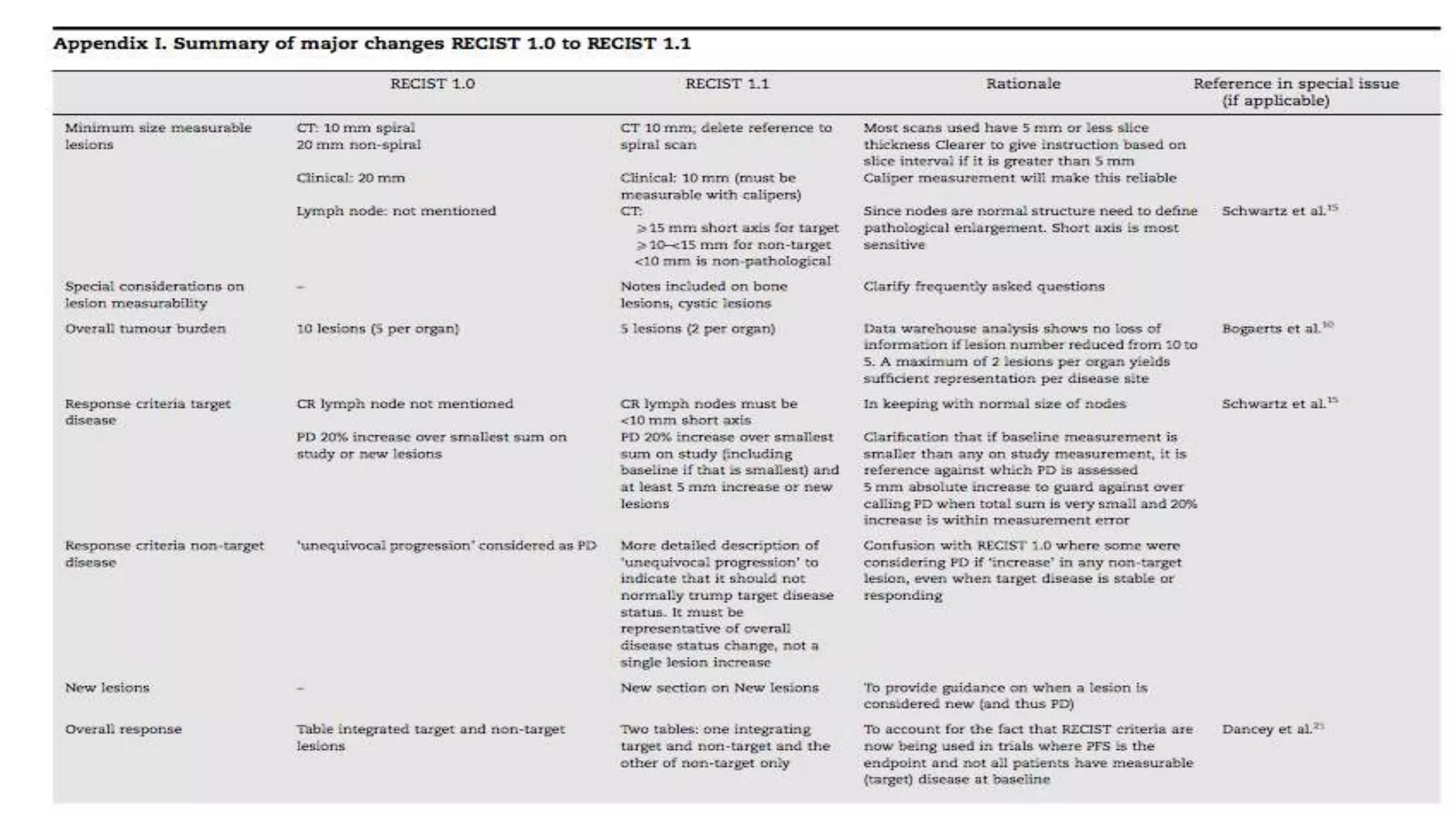
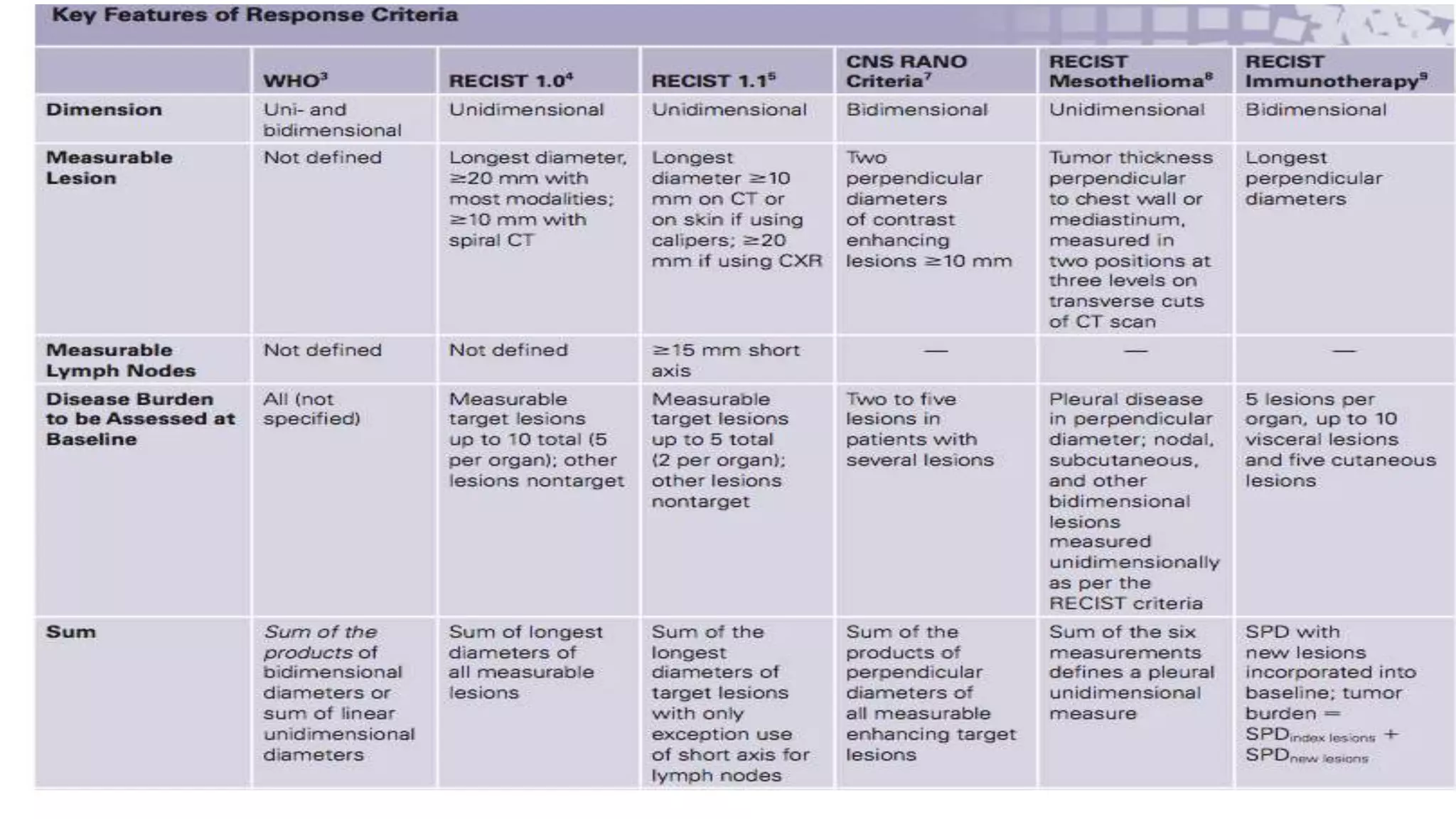
• Measurable
• Tumour lesions: Must be accurately measured in at least one dimension
(longest diameter in the plane of measurement is to be recorded) with
a minimum size of:
• 10 mm by CT scan (CT scan slice thickness no greater than 5 mm; see Appendix II
on imaging guidance).
• 10 mm caliper measurement by clinical exam (lesions which cannot be accurately
measured with calipers should be recorded as non-measurable).
• 20 mm by chest X-ray.
• Malignant lymph nodes: To be considered pathologically en- larged and
measurable, a lymph node must be P15 mm in short axis when assessed by CT
scan
• Non-measurable
• Small lesions (longest diameter <10 mm or pathological lymph nodes with
P10 to <15 mm short axis)
• Truly non-measurable lesions. Lesions considered truly non-measurable
include: leptomeningeal dis- ease, ascites, pleural or pericardial effusion,
inflammatory breast disease, lymphangitic involvement of skin or lung,
abdominal masses/abdominal organomegaly identified by physical exam that
is not measurable by reproducible imaging techniques.
• Special considerations regarding lesion measurability for Bone
lesions, cystic lesions, and lesions previously treated with local
therapy require particular comment
• Same method of assessment and the same technique should be used
to characterise each identified and reported lesion at baseline and
during follow-up
• Ultrasound
• Endoscopy, laparoscopy
• Tumour markers
• Cytology, histology
Tumour response evaluation
• Baseline documentation of ‘target’ and ‘non-target’ lesions
• Evaluation of target lesions
• Complete Response (CR): Disappearance of all target lesions. Any pathological
lymph nodes (whether target or non-target) must have reduction in short axis
to <10 mm.
• Partial Response (PR): At least a 30% decrease in the sum of diameters of
target lesions, taking as reference the baseline sum diameters.
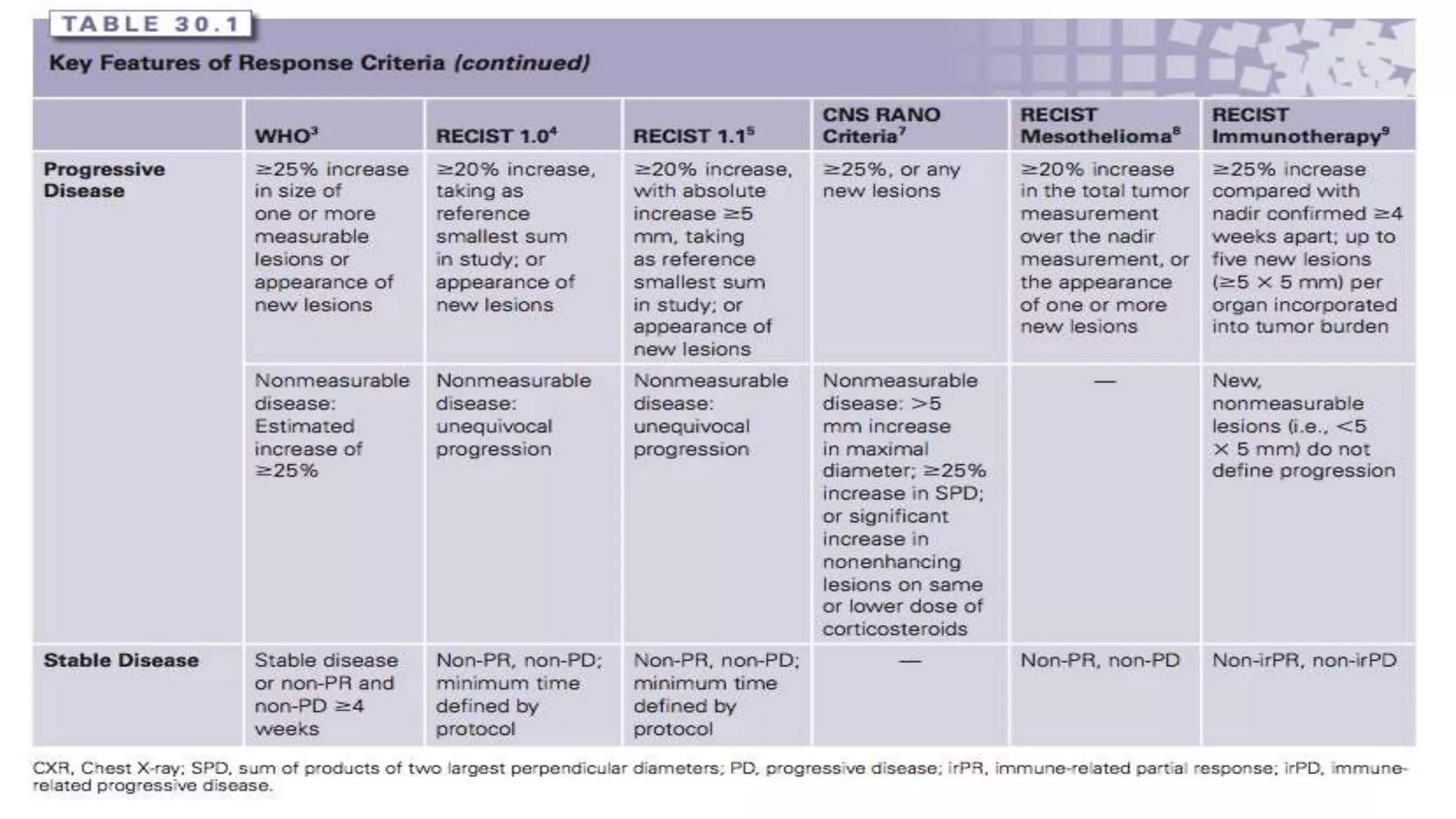
• Progressive Disease (PD): At least a 20% increase in the sum of diameters of
target lesions, taking as reference the smallest sum on study (this includes the
baseline sum if that is the smallest on study). In addition to the relative
increase of 20%, the sum must also dem- onstrate an absolute increase of at
least 5 mm. (Note: the appearance of one or more new lesions is also
considered progression).
• Stable Disease (SD): Neither sufficient shrinkage to qualify for PR nor
sufficient increase to qualify for PD, taking as reference the smallest sum
diameters while on study.
• Evaluation of non-target lesions
• Complete Response (CR): Disappearance of all non-target le- sions and
normalisation of tumour marker level. All lymph nodes must be non-
pathological in size (<10 mm short axis).
• Non-CR/Non-PD: Persistence of one or more non-target le- sion(s) and/or
maintenance of tumour marker level above the normal limits.
• Progressive Disease (PD): Unequivocal progression (see com- ments below) of
existing non-target lesions. (Note: the appearance of one or more new lesions
is also considered progression).
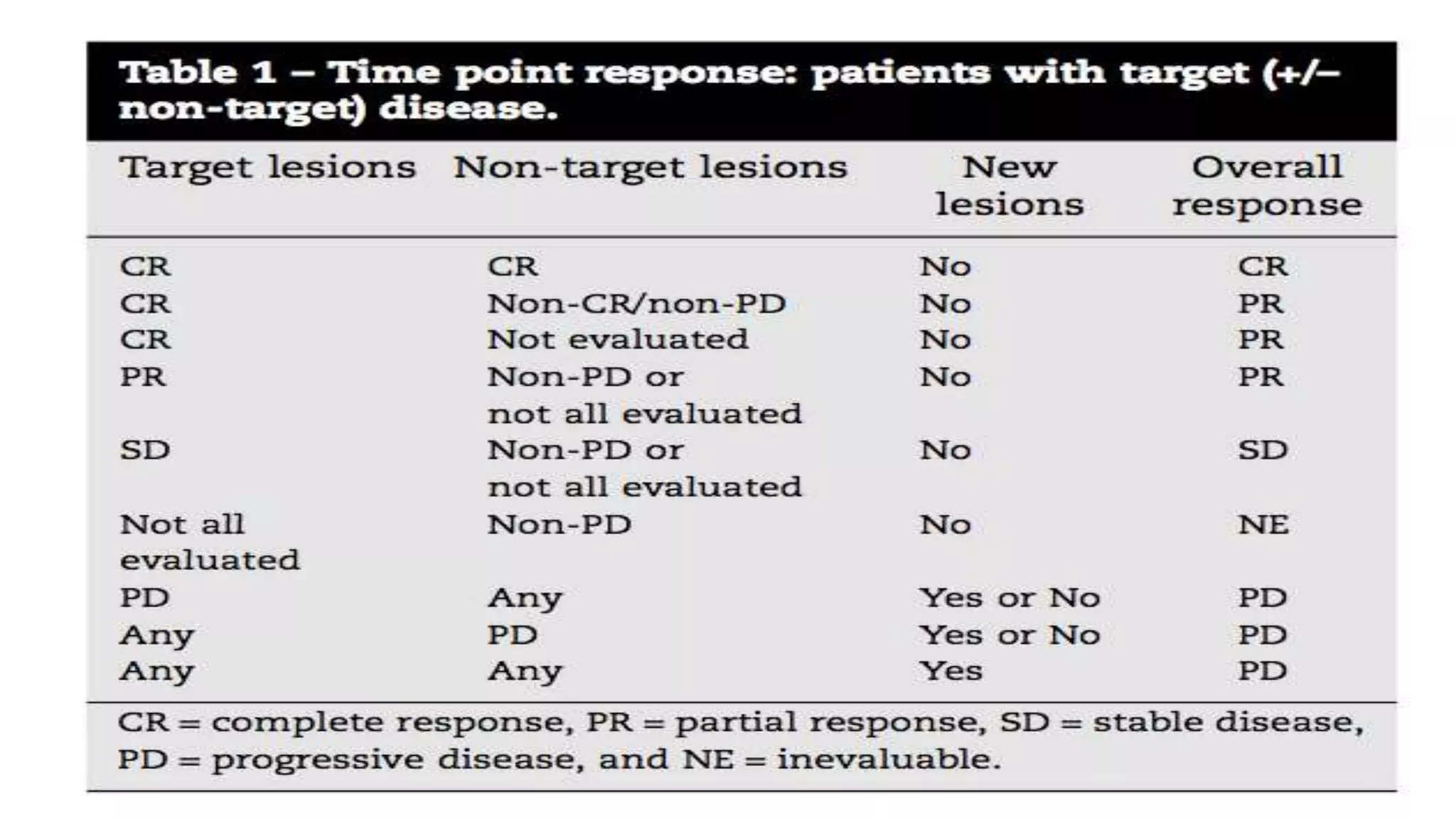
Evaluation of best overall response
• Best response recorded from the start of the study treatment until
the end of treatment taking into account any requirement for
confirmation
• For equivocal findings of progression (e.g. very small and uncertain
new lesions; cystic changes or necrosis in existing lesions), treatment
may continue until the next scheduled assessment
• Frequency of tumour re-evaluation while on treatment should be
protocol specific
• Phase II studies where the beneficial effect of therapy is not known,
follow-up every 6–8 weeks (timed to coincide with the end of a cycle)
is reasonable
• Non-randomised trials where response is the primary end- point,
confirmation of PR and CR
• Randomised trials (phase II or III) or studies where stable disease or
progression are the primary endpoints
• Duration of overall response
• Time measurement criteria are first met for CR/PR (whichever is first
recorded) until the first date that recurrent or progressive dis- ease is
objectively documented
• Duration of stable disease
• Start of the treatment (in randomised trials, from date of randomisation) until
the crite- ria for progression are met
Recist
Recist
Recist
Recist
Recist
Recist

Recist

  • 1.
  • 2.
    • Assessment ofthe change in tumour burden is an important feature of the clinical evaluation of cancer therapeutics. • Both tumour shrinkage (objective response) and time to the development of disease progression are important endpoints in cancer clinical trials • 1981 the World Health Organisation (WHO) first published tumour response criteria • Over all assessment of tumour burden by summing the products of bidimensional lesion measurements • Determined response to therapy by evaluation of change from baseline while on treatment. •
  • 3.
    • International WorkingParty was formed in the mid 1990s to standardise and simplify response criteria. New criteria, known as RECIST (Response Evaluation Criteria in Solid Tumours), were pub- lished in 2000 • Clinicians with expertise in early drug development from academic research organisations, government and industry, together with imag- ing specialists and statisticians • Because the fundamental approach to assessment remains grounded in the anatomical, rather than functional, assessment of disease, have elected to name this version RECIST 1.1, rather than 2.0.
  • 4.
    • Working Groupand particularly those involved in imaging research, did not believe that there is at present sufficient standardisation and widespread availability to recommend adoption of these alternative assessment methods • standard approach to solid tumour measurement and definitions for objective assessment of change in tumour size for use in adult and paediatric cancer clinical trials • Not intended that these RECIST guidelines play a role in that decision making, except if determined appropriate by the treating oncologist
  • 5.
    • Measurable • Tumourlesions: Must be accurately measured in at least one dimension (longest diameter in the plane of measurement is to be recorded) with a minimum size of: • 10 mm by CT scan (CT scan slice thickness no greater than 5 mm; see Appendix II on imaging guidance). • 10 mm caliper measurement by clinical exam (lesions which cannot be accurately measured with calipers should be recorded as non-measurable). • 20 mm by chest X-ray. • Malignant lymph nodes: To be considered pathologically en- larged and measurable, a lymph node must be P15 mm in short axis when assessed by CT scan
  • 6.
    • Non-measurable • Smalllesions (longest diameter <10 mm or pathological lymph nodes with P10 to <15 mm short axis) • Truly non-measurable lesions. Lesions considered truly non-measurable include: leptomeningeal dis- ease, ascites, pleural or pericardial effusion, inflammatory breast disease, lymphangitic involvement of skin or lung, abdominal masses/abdominal organomegaly identified by physical exam that is not measurable by reproducible imaging techniques. • Special considerations regarding lesion measurability for Bone lesions, cystic lesions, and lesions previously treated with local therapy require particular comment
  • 7.
    • Same methodof assessment and the same technique should be used to characterise each identified and reported lesion at baseline and during follow-up • Ultrasound • Endoscopy, laparoscopy • Tumour markers • Cytology, histology
  • 8.
    Tumour response evaluation •Baseline documentation of ‘target’ and ‘non-target’ lesions • Evaluation of target lesions • Complete Response (CR): Disappearance of all target lesions. Any pathological lymph nodes (whether target or non-target) must have reduction in short axis to <10 mm. • Partial Response (PR): At least a 30% decrease in the sum of diameters of target lesions, taking as reference the baseline sum diameters. • Progressive Disease (PD): At least a 20% increase in the sum of diameters of target lesions, taking as reference the smallest sum on study (this includes the baseline sum if that is the smallest on study). In addition to the relative increase of 20%, the sum must also dem- onstrate an absolute increase of at least 5 mm. (Note: the appearance of one or more new lesions is also considered progression). • Stable Disease (SD): Neither sufficient shrinkage to qualify for PR nor sufficient increase to qualify for PD, taking as reference the smallest sum diameters while on study.
  • 9.
    • Evaluation ofnon-target lesions • Complete Response (CR): Disappearance of all non-target le- sions and normalisation of tumour marker level. All lymph nodes must be non- pathological in size (<10 mm short axis). • Non-CR/Non-PD: Persistence of one or more non-target le- sion(s) and/or maintenance of tumour marker level above the normal limits. • Progressive Disease (PD): Unequivocal progression (see com- ments below) of existing non-target lesions. (Note: the appearance of one or more new lesions is also considered progression).
  • 10.
    Evaluation of bestoverall response • Best response recorded from the start of the study treatment until the end of treatment taking into account any requirement for confirmation • For equivocal findings of progression (e.g. very small and uncertain new lesions; cystic changes or necrosis in existing lesions), treatment may continue until the next scheduled assessment • Frequency of tumour re-evaluation while on treatment should be protocol specific • Phase II studies where the beneficial effect of therapy is not known, follow-up every 6–8 weeks (timed to coincide with the end of a cycle) is reasonable
  • 12.
    • Non-randomised trialswhere response is the primary end- point, confirmation of PR and CR • Randomised trials (phase II or III) or studies where stable disease or progression are the primary endpoints • Duration of overall response • Time measurement criteria are first met for CR/PR (whichever is first recorded) until the first date that recurrent or progressive dis- ease is objectively documented • Duration of stable disease • Start of the treatment (in randomised trials, from date of randomisation) until the crite- ria for progression are met