HPV
Dr D. Ramu
• Non-enveloped double-stranded circular DNA viruses with a genome
of approximately 8000 kilo base pair
• Viral family Papillomaviridae
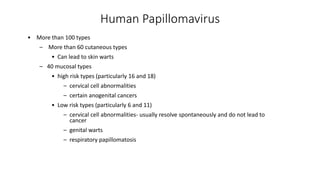
Human Papillomavirus
• More than 100 types
– More than 60 cutaneous types
• Can lead to skin warts
– 40 mucosal types
• high risk types (particularly 16 and 18)
– cervical cell abnormalities
– certain anogenital cancers
• Low risk types (particularly 6 and 11)
– cervical cell abnormalities- usually resolve spontaneously and do not lead to
cancer
– genital warts
– respiratory papillomatosis
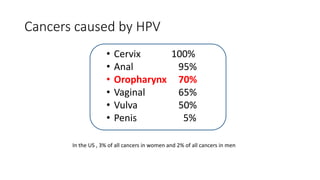
Cancers caused by HPV
• Cervix 100%
• Anal 95%
• Oropharynx 70%
• Vaginal 65%
• Vulva 50%
• Penis 5%
In the US , 3% of all cancers in women and 2% of all cancers in men
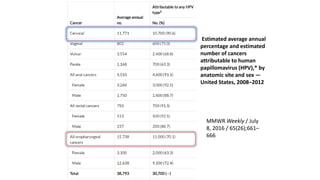
Estimated average annual
percentage and estimated
number of cancers
attributable to human
papillomavirus (HPV),* by
anatomic site and sex —
United States, 2008–2012
MMWR Weekly / July
8, 2016 / 65(26);661–
666
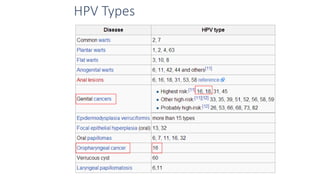
HPV Types
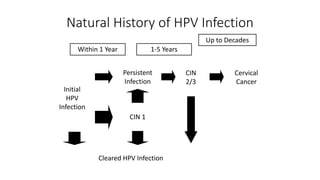
Natural History of HPV Infection
Within 1 Year 1-5 Years
Up to Decades
Initial
HPV
Infection
Persistent
Infection
CIN
2/3
Cervical
Cancer
CIN 1
Cleared HPV Infection
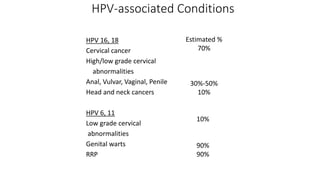
HPV-associated Conditions
HPV 16, 18
Cervical cancer
High/low grade cervical
abnormalities
Anal, Vulvar, Vaginal, Penile
Head and neck cancers
HPV 6, 11
Low grade cervical
abnormalities
Genital warts
RRP
Estimated %
70%
30%-50%
10%
10%
90%
90%
• Specific tropism for keratinocytes, full productive cycle only in
squamous cells
• Hpv genome devided into two regions– early region and late region
10
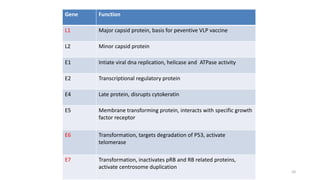
Gene Function
L1 Major capsid protein, basis for peventive VLP vaccine
L2 Minor capsid protein
E1 Intiate viral dna replication, helicase and ATPase activity
E2 Transcriptional regulatory protein
E4 Late protein, disrupts cytokeratin
E5 Membrane transforming protein, interacts with specific growth
factor receptor
E6 Transformation, targets degradation of P53, activate
telomerase
E7 Transformation, inactivates pRB and RB related proteins,
activate centrosome duplication
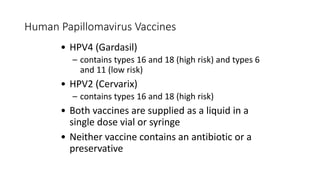
Human Papillomavirus Vaccines
• HPV4 (Gardasil)
– contains types 16 and 18 (high risk) and types 6
and 11 (low risk)
• HPV2 (Cervarix)
– contains types 16 and 18 (high risk)
• Both vaccines are supplied as a liquid in a
single dose vial or syringe
• Neither vaccine contains an antibiotic or a
preservative
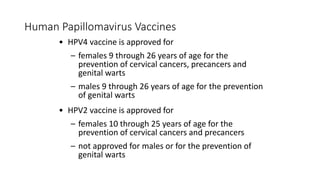
Human Papillomavirus Vaccines
• HPV4 vaccine is approved for
– females 9 through 26 years of age for the
prevention of cervical cancers, precancers and
genital warts
– males 9 through 26 years of age for the prevention
of genital warts
• HPV2 vaccine is approved for
– females 10 through 25 years of age for the
prevention of cervical cancers and precancers
– not approved for males or for the prevention of
genital warts
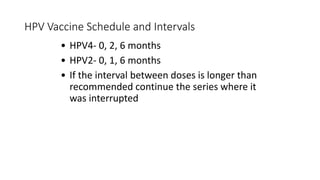
HPV Vaccine Schedule and Intervals
• HPV4- 0, 2, 6 months
• HPV2- 0, 1, 6 months
• If the interval between doses is longer than
recommended continue the series where it
was interrupted
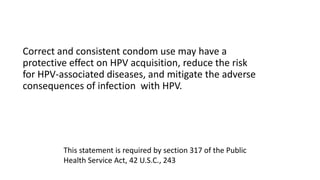
Correct and consistent condom use may have a
protective effect on HPV acquisition, reduce the risk
for HPV-associated diseases, and mitigate the adverse
consequences of infection with HPV.
This statement is required by section 317 of the Public
Health Service Act, 42 U.S.C., 243
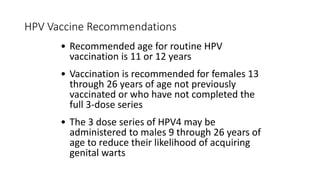
HPV Vaccine Recommendations
• Recommended age for routine HPV
vaccination is 11 or 12 years
• Vaccination is recommended for females 13
through 26 years of age not previously
vaccinated or who have not completed the
full 3-dose series
• The 3 dose series of HPV4 may be
administered to males 9 through 26 years of
age to reduce their likelihood of acquiring
genital warts
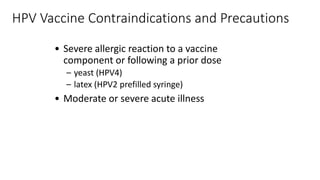
HPV Vaccine Contraindications and Precautions
• Severe allergic reaction to a vaccine
component or following a prior dose
– yeast (HPV4)
– latex (HPV2 prefilled syringe)
• Moderate or severe acute illness
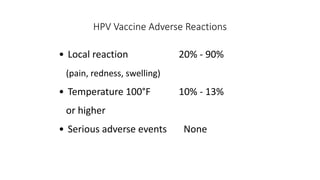
HPV Vaccine Adverse Reactions
• Local reaction 20% - 90%
(pain, redness, swelling)
• Temperature 100°F 10% - 13%
or higher
• Serious adverse events None
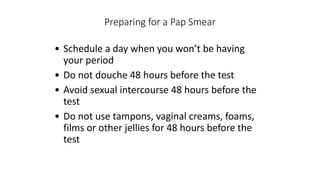
Preparing for a Pap Smear
• Schedule a day when you won’t be having
your period
• Do not douche 48 hours before the test
• Avoid sexual intercourse 48 hours before the
test
• Do not use tampons, vaginal creams, foams,
films or other jellies for 48 hours before the
test
20
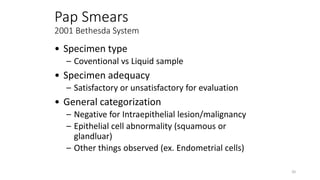
Pap Smears
2001 Bethesda System
• Specimen type
– Coventional vs Liquid sample
• Specimen adequacy
– Satisfactory or unsatisfactory for evaluation
• General categorization
– Negative for Intraepithelial lesion/malignancy
– Epithelial cell abnormality (squamous or
glandluar)
– Other things observed (ex. Endometrial cells)
21
Pap Smears
2001 Bethesda System
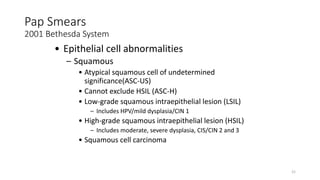
• Epithelial cell abnormalities
– Squamous
• Atypical squamous cell of undetermined
significance(ASC-US)
• Cannot exclude HSIL (ASC-H)
• Low-grade squamous intraepithelial lesion (LSIL)
– Includes HPV/mild dysplasia/CIN 1
• High-grade squamous intraepithelial lesion (HSIL)
– Includes moderate, severe dysplasia, CIS/CIN 2 and 3
• Squamous cell carcinoma
22
Pap Smears
2001 Bethesda System
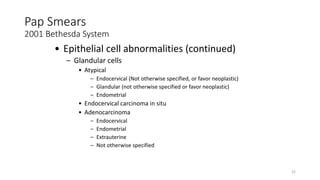
• Epithelial cell abnormalities (continued)
– Glandular cells
• Atypical
– Endocervical (Not otherwise specified, or favor neoplastic)
– Glandular (not otherwise specified or favor neoplastic)
– Endometrial
• Endocervical carcinoma in situ
• Adenocarcinoma
– Endocervical
– Endometrial
– Extrauterine
– Not otherwise specified
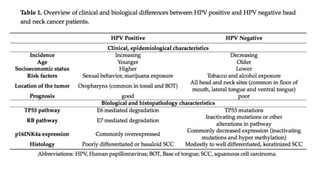
HPV Positive Head and Neck Cancers
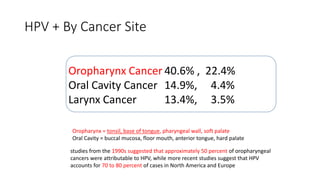
HPV + By Cancer Site
Oropharynx Cancer 40.6% , 22.4%
Oral Cavity Cancer 14.9%, 4.4%
Larynx Cancer 13.4%, 3.5%
Oropharynx = tonsil, base of tongue, pharyngeal wall, soft palate
Oral Cavity = buccal mucosa, floor mouth, anterior tongue, hard palate
studies from the 1990s suggested that approximately 50 percent of oropharyngeal
cancers were attributable to HPV, while more recent studies suggest that HPV
accounts for 70 to 80 percent of cases in North America and Europe
Long-term prognosis and risk factors among
patients with HPV-associated
oropharyngeal squamous cell carcinoma
Cancer
Volume 119, Issue 19, pages 3462–3471, 1 October 2013
patients with human papillomavirus
(HPV)-associated oropharyngeal
squamous cell carcinoma (HPV-OSCC)
HPV-OSCC who received treatment at the
Johns Hopkins Hospital between 1997
and 2008 and who had tissue available
for HPV testing
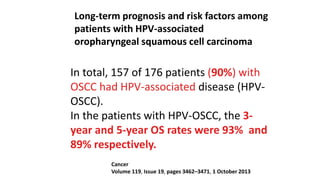
Long-term prognosis and risk factors among
patients with HPV-associated
oropharyngeal squamous cell carcinoma
Cancer
Volume 119, Issue 19, pages 3462–3471, 1 October 2013
In total, 157 of 176 patients (90%) with
OSCC had HPV-associated disease (HPV-
OSCC).
In the patients with HPV-OSCC, the 3-
year and 5-year OS rates were 93% and
89% respectively.
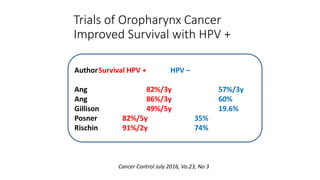
Trials of Oropharynx Cancer
Improved Survival with HPV +
AuthorSurvival HPV + HPV –
Ang 82%/3y 57%/3y
Ang 86%/3y 60%
Gillison 49%/5y 19.6%
Posner 82%/5y 35%
Rischin 91%/2y 74%
Cancer Control July 2016, Vo.23, No 3
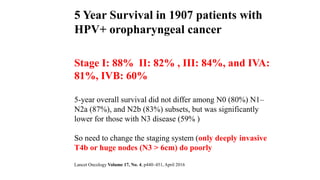
5 Year Survival in 1907 patients with
HPV+ oropharyngeal cancer
Stage I: 88% II: 82% , III: 84%, and IVA:
81%, IVB: 60%
5-year overall survival did not differ among N0 (80%) N1–
N2a (87%), and N2b (83%) subsets, but was significantly
lower for those with N3 disease (59% )
So need to change the staging system (only deeply invasive
T4b or huge nodes (N3 > 6cm) do poorly
Lancet Oncology Volume 17, No. 4, p440–451, April 2016
Hpv
Hpv

Hpv

  • 1.
  • 2.
    • Non-enveloped double-strandedcircular DNA viruses with a genome of approximately 8000 kilo base pair • Viral family Papillomaviridae
  • 3.
    Human Papillomavirus • Morethan 100 types – More than 60 cutaneous types • Can lead to skin warts – 40 mucosal types • high risk types (particularly 16 and 18) – cervical cell abnormalities – certain anogenital cancers • Low risk types (particularly 6 and 11) – cervical cell abnormalities- usually resolve spontaneously and do not lead to cancer – genital warts – respiratory papillomatosis
  • 4.
    Cancers caused byHPV • Cervix 100% • Anal 95% • Oropharynx 70% • Vaginal 65% • Vulva 50% • Penis 5% In the US , 3% of all cancers in women and 2% of all cancers in men
  • 5.
    Estimated average annual percentageand estimated number of cancers attributable to human papillomavirus (HPV),* by anatomic site and sex — United States, 2008–2012 MMWR Weekly / July 8, 2016 / 65(26);661– 666
  • 6.
  • 7.
    Natural History ofHPV Infection Within 1 Year 1-5 Years Up to Decades Initial HPV Infection Persistent Infection CIN 2/3 Cervical Cancer CIN 1 Cleared HPV Infection
  • 8.
    HPV-associated Conditions HPV 16,18 Cervical cancer High/low grade cervical abnormalities Anal, Vulvar, Vaginal, Penile Head and neck cancers HPV 6, 11 Low grade cervical abnormalities Genital warts RRP Estimated % 70% 30%-50% 10% 10% 90% 90%
  • 9.
    • Specific tropismfor keratinocytes, full productive cycle only in squamous cells • Hpv genome devided into two regions– early region and late region
  • 10.
    10 Gene Function L1 Majorcapsid protein, basis for peventive VLP vaccine L2 Minor capsid protein E1 Intiate viral dna replication, helicase and ATPase activity E2 Transcriptional regulatory protein E4 Late protein, disrupts cytokeratin E5 Membrane transforming protein, interacts with specific growth factor receptor E6 Transformation, targets degradation of P53, activate telomerase E7 Transformation, inactivates pRB and RB related proteins, activate centrosome duplication
  • 11.
    Human Papillomavirus Vaccines •HPV4 (Gardasil) – contains types 16 and 18 (high risk) and types 6 and 11 (low risk) • HPV2 (Cervarix) – contains types 16 and 18 (high risk) • Both vaccines are supplied as a liquid in a single dose vial or syringe • Neither vaccine contains an antibiotic or a preservative
  • 12.
    Human Papillomavirus Vaccines •HPV4 vaccine is approved for – females 9 through 26 years of age for the prevention of cervical cancers, precancers and genital warts – males 9 through 26 years of age for the prevention of genital warts • HPV2 vaccine is approved for – females 10 through 25 years of age for the prevention of cervical cancers and precancers – not approved for males or for the prevention of genital warts
  • 13.
    HPV Vaccine Scheduleand Intervals • HPV4- 0, 2, 6 months • HPV2- 0, 1, 6 months • If the interval between doses is longer than recommended continue the series where it was interrupted
  • 14.
    Correct and consistentcondom use may have a protective effect on HPV acquisition, reduce the risk for HPV-associated diseases, and mitigate the adverse consequences of infection with HPV. This statement is required by section 317 of the Public Health Service Act, 42 U.S.C., 243
  • 15.
    HPV Vaccine Recommendations •Recommended age for routine HPV vaccination is 11 or 12 years • Vaccination is recommended for females 13 through 26 years of age not previously vaccinated or who have not completed the full 3-dose series • The 3 dose series of HPV4 may be administered to males 9 through 26 years of age to reduce their likelihood of acquiring genital warts
  • 16.
    HPV Vaccine Contraindicationsand Precautions • Severe allergic reaction to a vaccine component or following a prior dose – yeast (HPV4) – latex (HPV2 prefilled syringe) • Moderate or severe acute illness
  • 17.
    HPV Vaccine AdverseReactions • Local reaction 20% - 90% (pain, redness, swelling) • Temperature 100°F 10% - 13% or higher • Serious adverse events None
  • 19.
    Preparing for aPap Smear • Schedule a day when you won’t be having your period • Do not douche 48 hours before the test • Avoid sexual intercourse 48 hours before the test • Do not use tampons, vaginal creams, foams, films or other jellies for 48 hours before the test
  • 20.
    20 Pap Smears 2001 BethesdaSystem • Specimen type – Coventional vs Liquid sample • Specimen adequacy – Satisfactory or unsatisfactory for evaluation • General categorization – Negative for Intraepithelial lesion/malignancy – Epithelial cell abnormality (squamous or glandluar) – Other things observed (ex. Endometrial cells)
  • 21.
    21 Pap Smears 2001 BethesdaSystem • Epithelial cell abnormalities – Squamous • Atypical squamous cell of undetermined significance(ASC-US) • Cannot exclude HSIL (ASC-H) • Low-grade squamous intraepithelial lesion (LSIL) – Includes HPV/mild dysplasia/CIN 1 • High-grade squamous intraepithelial lesion (HSIL) – Includes moderate, severe dysplasia, CIS/CIN 2 and 3 • Squamous cell carcinoma
  • 22.
    22 Pap Smears 2001 BethesdaSystem • Epithelial cell abnormalities (continued) – Glandular cells • Atypical – Endocervical (Not otherwise specified, or favor neoplastic) – Glandular (not otherwise specified or favor neoplastic) – Endometrial • Endocervical carcinoma in situ • Adenocarcinoma – Endocervical – Endometrial – Extrauterine – Not otherwise specified
  • 24.
    HPV Positive Headand Neck Cancers
  • 26.
    HPV + ByCancer Site Oropharynx Cancer 40.6% , 22.4% Oral Cavity Cancer 14.9%, 4.4% Larynx Cancer 13.4%, 3.5% Oropharynx = tonsil, base of tongue, pharyngeal wall, soft palate Oral Cavity = buccal mucosa, floor mouth, anterior tongue, hard palate studies from the 1990s suggested that approximately 50 percent of oropharyngeal cancers were attributable to HPV, while more recent studies suggest that HPV accounts for 70 to 80 percent of cases in North America and Europe
  • 27.
    Long-term prognosis andrisk factors among patients with HPV-associated oropharyngeal squamous cell carcinoma Cancer Volume 119, Issue 19, pages 3462–3471, 1 October 2013 patients with human papillomavirus (HPV)-associated oropharyngeal squamous cell carcinoma (HPV-OSCC) HPV-OSCC who received treatment at the Johns Hopkins Hospital between 1997 and 2008 and who had tissue available for HPV testing
  • 28.
    Long-term prognosis andrisk factors among patients with HPV-associated oropharyngeal squamous cell carcinoma Cancer Volume 119, Issue 19, pages 3462–3471, 1 October 2013 In total, 157 of 176 patients (90%) with OSCC had HPV-associated disease (HPV- OSCC). In the patients with HPV-OSCC, the 3- year and 5-year OS rates were 93% and 89% respectively.
  • 29.
    Trials of OropharynxCancer Improved Survival with HPV + AuthorSurvival HPV + HPV – Ang 82%/3y 57%/3y Ang 86%/3y 60% Gillison 49%/5y 19.6% Posner 82%/5y 35% Rischin 91%/2y 74% Cancer Control July 2016, Vo.23, No 3
  • 30.
    5 Year Survivalin 1907 patients with HPV+ oropharyngeal cancer Stage I: 88% II: 82% , III: 84%, and IVA: 81%, IVB: 60% 5-year overall survival did not differ among N0 (80%) N1– N2a (87%), and N2b (83%) subsets, but was significantly lower for those with N3 disease (59% ) So need to change the staging system (only deeply invasive T4b or huge nodes (N3 > 6cm) do poorly Lancet Oncology Volume 17, No. 4, p440–451, April 2016

Editor's Notes

  • #20 The best time to schedule your test is 8 to 12 days from the start of your last menstrual cycle.
  • #21 In results reported according to the Bethesda 2001 system, the specimen is first reported as to whether it was satisfactory for evaluation; if the specimen was not satisfactory for evaluation, then a new specimen must be gathered. Usually the test would be repeated within the next 2 to 3 months. A smear interpreted to be “negative for intraepithelial lesion” (the reported “normal” and desired result) could still have other findings, for example Trichomonas, yeast, various bacterial concerns, cellular changes consistent with Herpes infection, and cell changes resulting from injury, radiation or inflammation. Epithelial cell abnormalities may either be of squamous cells (the outermost layer of cells) or glandular cells.
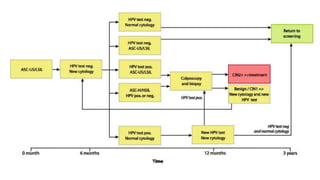
  • #22 Squamous cells are the cells that cover the majority of the cervix. The potential for malignancy (cancer) increases down this list, squamous cell carcinoma being an invasive cancer. In the case of ASC or ASC-US results, it’s recommended that an HPV test be done on this or an additional sample to determine if the atypical result is related to HPV infection.
  • #23 Glandular cells cover the lining of the uterine opening and canal. “Carcinoma in situ” or “Adenocarcinoma in situ” refers to a malignancy that is not yet invasive, that is to say, has not moved into the flesh beyond the surface of the cervix. These abnormalities are much less common than squamous cell abnormalities on a pap smear. Pap smears also may occasionally report other malignancies without necessarily being able to note the originating site of the malignancy. Most diagnoses of a malignancy require conslutation with pathologists and/or specialists. The majority of abnormalities reported on Pap smears are NOT cancer, and are either reversible or treatable and do not progress on to become a malignancy; it is important in the event of an abnormality to get follow-up Pap smears and (as necessary) other testing to monitor the situation and determine if treatment is necessary.