





Welcome
Recent Trends In
Primary Market
What is Primary Market?
The first opportunity that investors have to
buy a newly issued security. After the first
purchases, subsequent trading is in the
secondary market.
Recent trends in Primary Market……
Raising of Capital
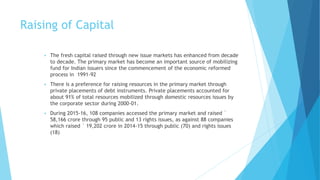
 The fresh capital raised through new issue markets has enhanced from decade
to decade. The primary market has become an important source of mobilizing
fund for Indian issuers since the commencement of the economic reformed
process in 1991-92
 There is a preference for raising resources in the primary market through
private placements of debt instruments. Private placements accounted for
about 91% of total resources mobilized through domestic resources issues by
the corporate sector during 2000-01.
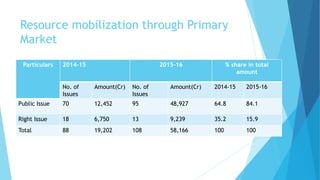
 During 2015-16, 108 companies accessed the primary market and raised `
58,166 crore through 95 public and 13 rights issues, as against 88 companies
which raised ` 19,202 crore in 2014-15 through public (70) and rights issues
(18)
Resource mobilization through Primary
Market
Particulars 2014-15 2015-16 % share in total
amount
No. of
Issues
Amount(Cr) No. of
Issues
Amount(Cr) 2014-15 2015-16
Public Issue 70 12,452 95 48,927 64.8 84.1
Right Issue 18 6,750 13 9,239 35.2 15.9
Total 88 19,202 108 58,166 100 100
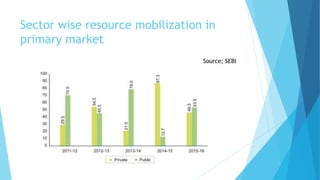
Sector wise resource mobilization in
primary market
Source; SEBI
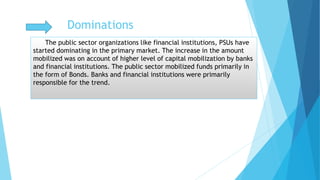
The public sector organizations like financial institutions, PSUs have
started dominating in the primary market. The increase in the amount
mobilized was on account of higher level of capital mobilization by banks
and financial institutions. The public sector mobilized funds primarily in
the form of Bonds. Banks and financial institutions were primarily
responsible for the trend.
Dominations
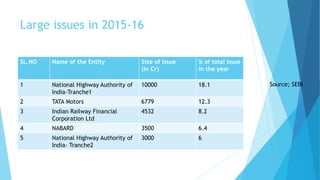
Large issues in 2015-16
SL.NO Name of the Entity Size of Issue
(In Cr)
% of total Issue
in the year
1 National Highway Authority of
India-Tranche1
10000 18.1
2 TATA Motors 6779 12.3
3 Indian Railway Financial
Corporation Ltd
4532 8.2
4 NABARD 3500 6.4
5 National Highway Authority of
India- Tranche2
3000 6
Source; SEBI
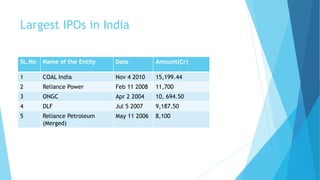
Largest IPOs in India
SL.No Name of the Entity Date Amount(Cr)
1 COAL India Nov 4 2010 15,199.44
2 Reliance Power Feb 11 2008 11,700
3 ONGC Apr 2 2004 10, 694.50
4 DLF Jul 5 2007 9,187.50
5 Reliance Petroleum
(Merged)
May 11 2006 8,100
Factors which have accelerated the
growth of Primary Market Investment
 Industrial Growth
The industrial growth and exhausting production capacities in the industry has
necessitated further expansion of industrial capacities. It induced the companies to
mobilize resources for further investment in future.
 Buoyancy of the secondary market
Buoyancy of the secondary market led all-round rise in prices of shares. This
factor induced the investors put higher amount of their savings in investment in the
primary market`
 Fiscal incentives
The fiscal incentives given to investors in schemes of mutual funds and reduction
in capital gain tax attracted investors in the primary market
 Tightening of norms
On-going process of improving the quality of issues and tightening of norms
relating to merchant bankers and credit rate agencies probably created more
confidence among investors.
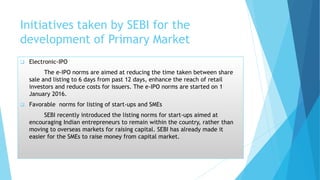
Initiatives taken by SEBI for the
development of Primary Market
 Electronic-IPO
The e-IPO norms are aimed at reducing the time taken between share
sale and listing to 6 days from past 12 days, enhance the reach of retail
investors and reduce costs for issuers. The e-IPO norms are started on 1
January 2016.
 Favorable norms for listing of start-ups and SMEs
SEBI recently introduced the listing norms for start-ups aimed at
encouraging Indian entrepreneurs to remain within the country, rather than
moving to overseas markets for raising capital. SEBI has already made it
easier for the SMEs to raise money from capital market.
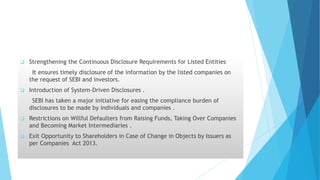
 Strengthening the Continuous Disclosure Requirements for Listed Entities
It ensures timely disclosure of the information by the listed companies on
the request of SEBI and investors.
 Introduction of System-Driven Disclosures .
SEBI has taken a major initiative for easing the compliance burden of
disclosures to be made by individuals and companies .
 Restrictions on Willful Defaulters from Raising Funds, Taking Over Companies
and Becoming Market Intermediaries .
 Exit Opportunity to Shareholders in Case of Change in Objects by Issuers as
per Companies Act 2013.
Recent trends in primary market

Recent trends in primary market

  • 1.
  • 2.
  • 3.
    What is PrimaryMarket? The first opportunity that investors have to buy a newly issued security. After the first purchases, subsequent trading is in the secondary market.
  • 4.
    Recent trends inPrimary Market……
  • 5.
    Raising of Capital The fresh capital raised through new issue markets has enhanced from decade to decade. The primary market has become an important source of mobilizing fund for Indian issuers since the commencement of the economic reformed process in 1991-92  There is a preference for raising resources in the primary market through private placements of debt instruments. Private placements accounted for about 91% of total resources mobilized through domestic resources issues by the corporate sector during 2000-01.  During 2015-16, 108 companies accessed the primary market and raised ` 58,166 crore through 95 public and 13 rights issues, as against 88 companies which raised ` 19,202 crore in 2014-15 through public (70) and rights issues (18)
  • 6.
    Resource mobilization throughPrimary Market Particulars 2014-15 2015-16 % share in total amount No. of Issues Amount(Cr) No. of Issues Amount(Cr) 2014-15 2015-16 Public Issue 70 12,452 95 48,927 64.8 84.1 Right Issue 18 6,750 13 9,239 35.2 15.9 Total 88 19,202 108 58,166 100 100
  • 7.
    Sector wise resourcemobilization in primary market Source; SEBI
  • 8.
    The public sectororganizations like financial institutions, PSUs have started dominating in the primary market. The increase in the amount mobilized was on account of higher level of capital mobilization by banks and financial institutions. The public sector mobilized funds primarily in the form of Bonds. Banks and financial institutions were primarily responsible for the trend. Dominations
  • 9.
    Large issues in2015-16 SL.NO Name of the Entity Size of Issue (In Cr) % of total Issue in the year 1 National Highway Authority of India-Tranche1 10000 18.1 2 TATA Motors 6779 12.3 3 Indian Railway Financial Corporation Ltd 4532 8.2 4 NABARD 3500 6.4 5 National Highway Authority of India- Tranche2 3000 6 Source; SEBI
  • 10.
    Largest IPOs inIndia SL.No Name of the Entity Date Amount(Cr) 1 COAL India Nov 4 2010 15,199.44 2 Reliance Power Feb 11 2008 11,700 3 ONGC Apr 2 2004 10, 694.50 4 DLF Jul 5 2007 9,187.50 5 Reliance Petroleum (Merged) May 11 2006 8,100
  • 11.
    Factors which haveaccelerated the growth of Primary Market Investment  Industrial Growth The industrial growth and exhausting production capacities in the industry has necessitated further expansion of industrial capacities. It induced the companies to mobilize resources for further investment in future.  Buoyancy of the secondary market Buoyancy of the secondary market led all-round rise in prices of shares. This factor induced the investors put higher amount of their savings in investment in the primary market`  Fiscal incentives The fiscal incentives given to investors in schemes of mutual funds and reduction in capital gain tax attracted investors in the primary market  Tightening of norms On-going process of improving the quality of issues and tightening of norms relating to merchant bankers and credit rate agencies probably created more confidence among investors.
  • 12.
    Initiatives taken bySEBI for the development of Primary Market  Electronic-IPO The e-IPO norms are aimed at reducing the time taken between share sale and listing to 6 days from past 12 days, enhance the reach of retail investors and reduce costs for issuers. The e-IPO norms are started on 1 January 2016.  Favorable norms for listing of start-ups and SMEs SEBI recently introduced the listing norms for start-ups aimed at encouraging Indian entrepreneurs to remain within the country, rather than moving to overseas markets for raising capital. SEBI has already made it easier for the SMEs to raise money from capital market.
  • 13.
     Strengthening theContinuous Disclosure Requirements for Listed Entities It ensures timely disclosure of the information by the listed companies on the request of SEBI and investors.  Introduction of System-Driven Disclosures . SEBI has taken a major initiative for easing the compliance burden of disclosures to be made by individuals and companies .  Restrictions on Willful Defaulters from Raising Funds, Taking Over Companies and Becoming Market Intermediaries .  Exit Opportunity to Shareholders in Case of Change in Objects by Issuers as per Companies Act 2013.