PRIMARY MARKET- Meaning
Primary market is a place where the companies issue the
shares to the public at a pre determined or negotiated
price for the very first time for raising capital. These
markets enables the investors to purchase securities
directly from the issuer.
• Primary markets are facilitated by underwriting group
consisting of investment banks that set a beginning
price range for a given security and oversee its sale to
investors.
• Once the initial sale is complete, further trading is
conducted on the secondary market, where the bulk of
exchange trading occurs each day.
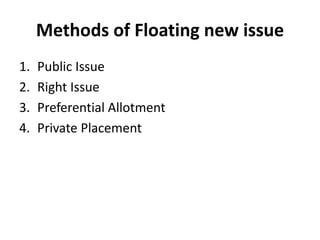
Methods of Floating new issue
1. Public Issue
2. Right Issue
3. Preferential Allotment
4. Private Placement
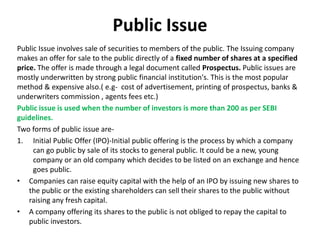
Public Issue
Public Issue involves sale of securities to members of the public. The Issuing company
makes an offer for sale to the public directly of a fixed number of shares at a specified
price. The offer is made through a legal document called Prospectus. Public issues are
mostly underwritten by strong public financial institution's. This is the most popular
method & expensive also.( e.g- cost of advertisement, printing of prospectus, banks &
underwriters commission , agents fees etc.)
Public issue is used when the number of investors is more than 200 as per SEBI
guidelines.
Two forms of public issue are-
1. Initial Public Offer (IPO)-Initial public offering is the process by which a company
can go public by sale of its stocks to general public. It could be a new, young
company or an old company which decides to be listed on an exchange and hence
goes public.
• Companies can raise equity capital with the help of an IPO by issuing new shares to
the public or the existing shareholders can sell their shares to the public without
raising any fresh capital.
• A company offering its shares to the public is not obliged to repay the capital to
public investors.
Contd..
2. Follow on Public Offer (FPO) or Further Public
Offerings- FPO (Follow on Public Offer) is a process by
which a company, which is already listed on an
exchange, issues new shares to the investors or the
existing shareholders, usually the promoters. FPO is
used by companies to diversify their equity base.
The two main types of FPOs are
a) dilutive—meaning new shares are added.
b) non-dilutive—meaning existing private shares are
sold publicly.
Basis IPO FPO
Meaning
IPO refers to an offer of
securities made to the public
for subscription by the
company for the first time
FPO refers to an offer of securities for
subscription to the public by a
publicly-traded enterprise
Issuer Unlisted company Listed company
Raising Capital
Through the first time from
public
Through a subsequent public
contribution
Risk High Comparatively low
Objective
The main objective is raising
capital through public
investment
The main objective is subsequent
public investment
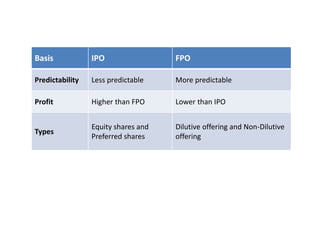
Basis IPO FPO
Predictability Less predictable More predictable
Profit Higher than FPO Lower than IPO
Types
Equity shares and
Preferred shares
Dilutive offering and Non-Dilutive
offering
Right Issue
The right issue involves selling of new securities to the existing shareholders in
proportion of their current holdings. As per section 81 of The Companies Act,
1956, when a company issues additional equity capital it has to be offered first to
the existing shareholders on pro-rata basis (Proportionate allocation). However,
the shareholders may forfeit (give up) this special right by passing a special
resolution & thereby enable the company to issue additional capital to the public
through a public issue. This method is in expensive method.
• Shares are issued at discount.
• Right issue is used to lower Debt equity ratio.
• 1 share= 1 right , if you have 1000 shares then you have 1000 rights.
• Biggest right Issue -Reliance raised 53125 crores through right issue @14%
discount from the closing price in April 2020. Shareholders can subscribe to
one equity share for every 15 equity shares held by eligible shareholders as on
date.
• Right issue dilutes equity stake and may affect the shareholders value and no
of share holder increases.
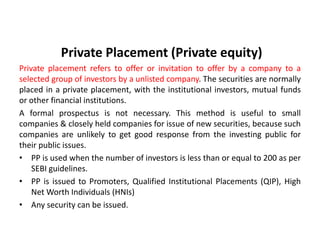
Private Placement (Private equity)
Private placement refers to offer or invitation to offer by a company to a
selected group of investors by a unlisted company. The securities are normally
placed in a private placement, with the institutional investors, mutual funds
or other financial institutions.
A formal prospectus is not necessary. This method is useful to small
companies & closely held companies for issue of new securities, because such
companies are unlikely to get good response from the investing public for
their public issues.
• PP is used when the number of investors is less than or equal to 200 as per
SEBI guidelines.
• PP is issued to Promoters, Qualified Institutional Placements (QIP), High
Net Worth Individuals (HNIs)
• Any security can be issued.
Contd..
• Article of Association must authorise it.
• Section 42 of the companies Act 2013
• Private placement offer letter is sent to the
investors inviting them to subscribe for
shares.
• Payment is made by cheque or DD or any
other mode except cash.
• Application money is kept in a separate
account of SCB.
Preferential Allotment
• A preferential issue is an issue of shares or of convertible securities by
listed companies to a select group of persons by a listed company under
Section 81 of the Companies Act, 1956 which is neither a rights issue nor a
public issue. This is a faster way for a company to raise equity capital.
• The issuer company has to comply with the Companies Act and the
requirements contained in Chapter pertaining to preferential allotment in
SEBI (DIP) guidelines which inter-alia include pricing, disclosures in notice
etc.
• Only Equity and preference shares can be issued.
• No authorization in Articles of association is required
• Section 62(1) (C)of The Companies Act 2013
• No offer document is issued to the investors
• No separate account is required to keep the money.
Issues of Private Companies
• Private Companies
As per Companies Act 1956, Pvt Companies cannot issue IPO, can only
issue right issue, Bonus shares, private placements, preferential
allotments
• Private Banks
As per RBI guidelines, Private banks must take its approval before
raising capital through IPO, preferential issues or private placement.
However, for Bonus shares & right issues there is no need for any such
approval.
• Private Insurance Companies
As per IRDA, Insurers must have complete 10 years in the business
only then they can raise capital through IPO.
Functions of NIM(New Issue Market)
The three functions to perform are-
1. Origination
2. Underwriting
3. Distribution
1. Origination-
Origination is the preliminary work in connection with the floatation of a new issue by
the company. It deals with the feasibility of the project, technical, economic &
financial , as also making all arrangements for the actual floatation of the issue.
Decisions have to be taken on the following issues-
• Time of Floating of the issue
• Type of issue
• Price of the issue
In the primary market, the price of the security is determined by the issuer not
by the market(either at par or premium).
The origination function in NIM is now being carried out by merchant bankers.
Now separate institutions are registered with SEBI as Merchant Bankers*. (e.g
Bajaj Capital Ltd., Bank of Maharastra, Canara Bank, Central Bank of India, SIDBI,
SBI Capital Markets Ltd etc.)
(For more details of the list of banker please visit -www.sebi.gov.in)
*A merchant bank is a financial institution providing capital to companies in the
form of share ownership instead of loans. A merchant bank also provides
advisory on corporate matters to the firms in which they invest. In the United
Kingdom, the historical term "merchant bank" refers to an investment bank.
2. Underwriting-
Underwriting is an activity of providing a guarantee to
the issuer to ensure successful marketing of the issue.
An underwriter is an individual or institutions which
gives an undertaking to the stock issuing company to
purchase specified no. of shares of the company in the
event of shortfall to the new issue.
The Stock issuing company can thus ensure full
subscription to the new issue through underwriter's,
even if there is no proper response to the new issue
from investors. For e.g. LIC UTI IDBI IFCI, GIC,
commercial banks & also by brokers.
3. Distribution-
Distribution function is carried out by the
brokers, sub – brokers & agents.
New issues have to be publicized by different
mass media like newspaper, magazines, TV,
radio, internet, mass mailing etc. It has become
a general practice to distribute prospectus,
application form & other literature regarding
new issues among the investing public.
Disadvantages of Primary Market
• There may be limited information for an investor to access
before investment in an IPO since unlisted companies do not
fall under the purview of regulatory and disclosure
requirements of the Securities and Exchange Board of India.
• Each stock is exposed to varying degrees of risk, but there is
no historical trading data in a primary market for analysing
IPO shares because the company is offering its shares to the
public for the first time through an initial public offering.
• In some cases, it may not be favourable for small investors. If
a share is oversubscribed, small investors may not receive
share allocation
Advantages of Primary Market
• Companies can raise capital at relatively low cost, and the securities so
issued in the primary market provide high liquidity as the same can be
sold in the secondary market almost immediately.
• The primary market is an important source for mobilisation of savings in
an economy. Funds are mobilised from commoners for investing in other
channels. It leads to monetary resources being put into investment
options.
• Chances of price manipulation in the primary market are considerably less
when compared to the secondary market. Such manipulation usually
occurs by deflating or inflating a security price, thereby deliberately
interfering with fair and free operations of the market.
Contd.
• The primary market acts as a potential avenue
for diversification to cut down on risk. It
enables an investor to allocate his/her
investment across different categories
involving multiple financial instruments and
industries.
• It is not subject to any market fluctuations.
The prices of stocks are determined before an
initial public offering, and investors know the
actual amount they will have to invest.
Parties involved in the new issue
1. Managers to Issue-
Lead managers are appointed by the company to manage the public issue
programmes. Their main duties are –
a) Drafting of prospectus
b) Preparing the budget of expenses related to the issue
c) Suggesting appropriate timings of issue
d) Assisting in marketing the public issue
e) Advising in the appointment of registrar to the issue, underwriter, broker,
banker’s to issue adverting agents etc.
f) Directing the various agencies involved in the public issue Company Ltd.
g) Like SBI Capital Ltd. Bank of Baroda, ICICI Securities& Finance Company
Ltd etc. (merchant banks, foreign banks, subsidiary of commercial banks
financial institutions etc.)
2. Registrar to issue- Main function of registrar is in connection to
public issue are-
a) Collection of application from investors
b) Keeping record of applications & money received from investors
c) Assisting stock issuing company in determining the basis of allotment of
securities in consultation with the stock exchange.
d) Finalising the list of persons entitled to allotment of securities.
e) Processing & despatching allotment letters, refund orders, certificates
etc.
3. Underwriters-
Underwriters are divided into two categories
a) Financial Institutions & Banks
b) Brokers & approved investment companies
Some of the underwriters are merchant bankers, member of stock exchange
EXIM, SBI etc.
4. Bankers to Issue- ( in connection with public issue)
a) Acceptance of application & application money
b) Acceptance of allotment of call money
c) Refund of application money
d) Payment of dividend or interest warrants.
5. Advertising Agents
After comparing the effectiveness & cost of each programme with the other,
a suitable advertising agency is selected in consultation with lead manager to
issue
6. Financial Institutions
Financial Institutions generally underwrite the issue & lend term loans to the
companies. Hence , normally they go through the draft of prospectus, study
the proposed programme for public issue & approve them. IDBI, IFCI, ICICI,
LIC, GIC, & UTI are some of the example.

Primary market by Vibhor Goyal

  • 1.
    PRIMARY MARKET- Meaning Primarymarket is a place where the companies issue the shares to the public at a pre determined or negotiated price for the very first time for raising capital. These markets enables the investors to purchase securities directly from the issuer. • Primary markets are facilitated by underwriting group consisting of investment banks that set a beginning price range for a given security and oversee its sale to investors. • Once the initial sale is complete, further trading is conducted on the secondary market, where the bulk of exchange trading occurs each day.
  • 2.
    Methods of Floatingnew issue 1. Public Issue 2. Right Issue 3. Preferential Allotment 4. Private Placement
  • 3.
    Public Issue Public Issueinvolves sale of securities to members of the public. The Issuing company makes an offer for sale to the public directly of a fixed number of shares at a specified price. The offer is made through a legal document called Prospectus. Public issues are mostly underwritten by strong public financial institution's. This is the most popular method & expensive also.( e.g- cost of advertisement, printing of prospectus, banks & underwriters commission , agents fees etc.) Public issue is used when the number of investors is more than 200 as per SEBI guidelines. Two forms of public issue are- 1. Initial Public Offer (IPO)-Initial public offering is the process by which a company can go public by sale of its stocks to general public. It could be a new, young company or an old company which decides to be listed on an exchange and hence goes public. • Companies can raise equity capital with the help of an IPO by issuing new shares to the public or the existing shareholders can sell their shares to the public without raising any fresh capital. • A company offering its shares to the public is not obliged to repay the capital to public investors.
  • 4.
    Contd.. 2. Follow onPublic Offer (FPO) or Further Public Offerings- FPO (Follow on Public Offer) is a process by which a company, which is already listed on an exchange, issues new shares to the investors or the existing shareholders, usually the promoters. FPO is used by companies to diversify their equity base. The two main types of FPOs are a) dilutive—meaning new shares are added. b) non-dilutive—meaning existing private shares are sold publicly.
  • 5.
    Basis IPO FPO Meaning IPOrefers to an offer of securities made to the public for subscription by the company for the first time FPO refers to an offer of securities for subscription to the public by a publicly-traded enterprise Issuer Unlisted company Listed company Raising Capital Through the first time from public Through a subsequent public contribution Risk High Comparatively low Objective The main objective is raising capital through public investment The main objective is subsequent public investment
  • 6.
    Basis IPO FPO PredictabilityLess predictable More predictable Profit Higher than FPO Lower than IPO Types Equity shares and Preferred shares Dilutive offering and Non-Dilutive offering
  • 7.
    Right Issue The rightissue involves selling of new securities to the existing shareholders in proportion of their current holdings. As per section 81 of The Companies Act, 1956, when a company issues additional equity capital it has to be offered first to the existing shareholders on pro-rata basis (Proportionate allocation). However, the shareholders may forfeit (give up) this special right by passing a special resolution & thereby enable the company to issue additional capital to the public through a public issue. This method is in expensive method. • Shares are issued at discount. • Right issue is used to lower Debt equity ratio. • 1 share= 1 right , if you have 1000 shares then you have 1000 rights. • Biggest right Issue -Reliance raised 53125 crores through right issue @14% discount from the closing price in April 2020. Shareholders can subscribe to one equity share for every 15 equity shares held by eligible shareholders as on date. • Right issue dilutes equity stake and may affect the shareholders value and no of share holder increases.
  • 8.
    Private Placement (Privateequity) Private placement refers to offer or invitation to offer by a company to a selected group of investors by a unlisted company. The securities are normally placed in a private placement, with the institutional investors, mutual funds or other financial institutions. A formal prospectus is not necessary. This method is useful to small companies & closely held companies for issue of new securities, because such companies are unlikely to get good response from the investing public for their public issues. • PP is used when the number of investors is less than or equal to 200 as per SEBI guidelines. • PP is issued to Promoters, Qualified Institutional Placements (QIP), High Net Worth Individuals (HNIs) • Any security can be issued.
  • 9.
    Contd.. • Article ofAssociation must authorise it. • Section 42 of the companies Act 2013 • Private placement offer letter is sent to the investors inviting them to subscribe for shares. • Payment is made by cheque or DD or any other mode except cash. • Application money is kept in a separate account of SCB.
  • 10.
    Preferential Allotment • Apreferential issue is an issue of shares or of convertible securities by listed companies to a select group of persons by a listed company under Section 81 of the Companies Act, 1956 which is neither a rights issue nor a public issue. This is a faster way for a company to raise equity capital. • The issuer company has to comply with the Companies Act and the requirements contained in Chapter pertaining to preferential allotment in SEBI (DIP) guidelines which inter-alia include pricing, disclosures in notice etc. • Only Equity and preference shares can be issued. • No authorization in Articles of association is required • Section 62(1) (C)of The Companies Act 2013 • No offer document is issued to the investors • No separate account is required to keep the money.
  • 11.
    Issues of PrivateCompanies • Private Companies As per Companies Act 1956, Pvt Companies cannot issue IPO, can only issue right issue, Bonus shares, private placements, preferential allotments • Private Banks As per RBI guidelines, Private banks must take its approval before raising capital through IPO, preferential issues or private placement. However, for Bonus shares & right issues there is no need for any such approval. • Private Insurance Companies As per IRDA, Insurers must have complete 10 years in the business only then they can raise capital through IPO.
  • 12.
    Functions of NIM(NewIssue Market) The three functions to perform are- 1. Origination 2. Underwriting 3. Distribution
  • 13.
    1. Origination- Origination isthe preliminary work in connection with the floatation of a new issue by the company. It deals with the feasibility of the project, technical, economic & financial , as also making all arrangements for the actual floatation of the issue. Decisions have to be taken on the following issues- • Time of Floating of the issue • Type of issue • Price of the issue In the primary market, the price of the security is determined by the issuer not by the market(either at par or premium). The origination function in NIM is now being carried out by merchant bankers. Now separate institutions are registered with SEBI as Merchant Bankers*. (e.g Bajaj Capital Ltd., Bank of Maharastra, Canara Bank, Central Bank of India, SIDBI, SBI Capital Markets Ltd etc.) (For more details of the list of banker please visit -www.sebi.gov.in) *A merchant bank is a financial institution providing capital to companies in the form of share ownership instead of loans. A merchant bank also provides advisory on corporate matters to the firms in which they invest. In the United Kingdom, the historical term "merchant bank" refers to an investment bank.
  • 14.
    2. Underwriting- Underwriting isan activity of providing a guarantee to the issuer to ensure successful marketing of the issue. An underwriter is an individual or institutions which gives an undertaking to the stock issuing company to purchase specified no. of shares of the company in the event of shortfall to the new issue. The Stock issuing company can thus ensure full subscription to the new issue through underwriter's, even if there is no proper response to the new issue from investors. For e.g. LIC UTI IDBI IFCI, GIC, commercial banks & also by brokers.
  • 15.
    3. Distribution- Distribution functionis carried out by the brokers, sub – brokers & agents. New issues have to be publicized by different mass media like newspaper, magazines, TV, radio, internet, mass mailing etc. It has become a general practice to distribute prospectus, application form & other literature regarding new issues among the investing public.
  • 16.
    Disadvantages of PrimaryMarket • There may be limited information for an investor to access before investment in an IPO since unlisted companies do not fall under the purview of regulatory and disclosure requirements of the Securities and Exchange Board of India. • Each stock is exposed to varying degrees of risk, but there is no historical trading data in a primary market for analysing IPO shares because the company is offering its shares to the public for the first time through an initial public offering. • In some cases, it may not be favourable for small investors. If a share is oversubscribed, small investors may not receive share allocation
  • 17.
    Advantages of PrimaryMarket • Companies can raise capital at relatively low cost, and the securities so issued in the primary market provide high liquidity as the same can be sold in the secondary market almost immediately. • The primary market is an important source for mobilisation of savings in an economy. Funds are mobilised from commoners for investing in other channels. It leads to monetary resources being put into investment options. • Chances of price manipulation in the primary market are considerably less when compared to the secondary market. Such manipulation usually occurs by deflating or inflating a security price, thereby deliberately interfering with fair and free operations of the market.
  • 18.
    Contd. • The primarymarket acts as a potential avenue for diversification to cut down on risk. It enables an investor to allocate his/her investment across different categories involving multiple financial instruments and industries. • It is not subject to any market fluctuations. The prices of stocks are determined before an initial public offering, and investors know the actual amount they will have to invest.
  • 19.
    Parties involved inthe new issue 1. Managers to Issue- Lead managers are appointed by the company to manage the public issue programmes. Their main duties are – a) Drafting of prospectus b) Preparing the budget of expenses related to the issue c) Suggesting appropriate timings of issue d) Assisting in marketing the public issue e) Advising in the appointment of registrar to the issue, underwriter, broker, banker’s to issue adverting agents etc. f) Directing the various agencies involved in the public issue Company Ltd. g) Like SBI Capital Ltd. Bank of Baroda, ICICI Securities& Finance Company Ltd etc. (merchant banks, foreign banks, subsidiary of commercial banks financial institutions etc.)
  • 20.
    2. Registrar toissue- Main function of registrar is in connection to public issue are- a) Collection of application from investors b) Keeping record of applications & money received from investors c) Assisting stock issuing company in determining the basis of allotment of securities in consultation with the stock exchange. d) Finalising the list of persons entitled to allotment of securities. e) Processing & despatching allotment letters, refund orders, certificates etc. 3. Underwriters- Underwriters are divided into two categories a) Financial Institutions & Banks b) Brokers & approved investment companies Some of the underwriters are merchant bankers, member of stock exchange EXIM, SBI etc.
  • 21.
    4. Bankers toIssue- ( in connection with public issue) a) Acceptance of application & application money b) Acceptance of allotment of call money c) Refund of application money d) Payment of dividend or interest warrants. 5. Advertising Agents After comparing the effectiveness & cost of each programme with the other, a suitable advertising agency is selected in consultation with lead manager to issue 6. Financial Institutions Financial Institutions generally underwrite the issue & lend term loans to the companies. Hence , normally they go through the draft of prospectus, study the proposed programme for public issue & approve them. IDBI, IFCI, ICICI, LIC, GIC, & UTI are some of the example.