2017 OECD ECONOMIC
SURVEY OF SWEDEN
Growing more equal
Stockholm, 8 February 2017
@OECD
@OECDeconomy
http://www.oecd.org/eco/surveys/economic-survey-sweden.htm
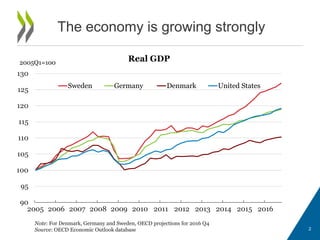
The economy is growing strongly
2
Note: For Denmark, Germany and Sweden, OECD projections for 2016 Q4
Source: OECD Economic Outlook database
90
95
100
105
110
115
120
125
130
2005 2006 2007 2008 2009 2010 2011 2012 2013 2014 2015 2016
Real GDP
Sweden Germany Denmark United States
2005Q1=100
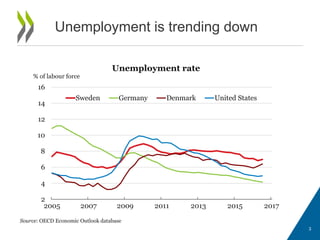
Unemployment is trending down
3
Source: OECD Economic Outlook database
2005 2007 2009 2011 2013 2015 2017
2
4
6
8
10
12
14
16
% of labour force
Unemployment rate
Sweden Germany Denmark United States
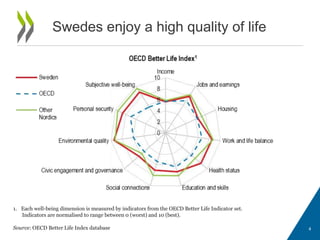
Swedes enjoy a high quality of life
4
1. Each well-being dimension is measured by indicators from the OECD Better Life Indicator set.
Indicators are normalised to range between 0 (worst) and 10 (best).
Source: OECD Better Life Index database
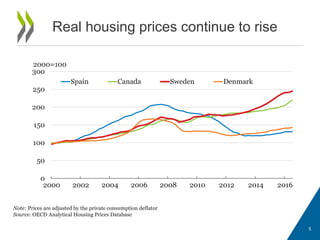
Real housing prices continue to rise
5
Note: Prices are adjusted by the private consumption deflator
Source: OECD Analytical Housing Prices Database
0
50
100
150
200
250
300
2000 2002 2004 2006 2008 2010 2012 2014 2016
2000=100
Spain Canada Sweden Denmark
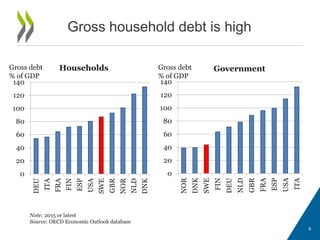
Gross household debt is high
6
0
20
40
60
80
100
120
140
DEU
ITA
FRA
FIN
ESP
USA
SWE
GBR
NOR
NLD
DNK
0
20
40
60
80
100
120
140
NOR
DNK
SWE
FIN
DEU
NLD
GBR
FRA
ESP
USA
ITA
Note: 2015 or latest
Source: OECD Economic Outlook database
Households GovernmentGross debt
% of GDP
Gross debt
% of GDP
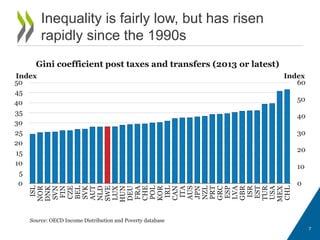
Inequality is fairly low, but has risen
rapidly since the 1990s
7
Source: OECD Income Distribution and Poverty database
0
10
20
30
40
50
60
0
5
10
15
20
25
30
35
40
45
50
ISL
NOR
DNK
SVN
FIN
CZE
BEL
SVK
AUT
NLD
SWE
LUX
HUN
DEU
FRA
CHE
POL
KOR
IRL
CAN
ITA
AUS
JPN
NZL
PRT
GRC
ESP
LVA
GBR
ISR
EST
TUR
USA
MEX
CHL
IndexIndex
Gini coefficient post taxes and transfers (2013 or latest)
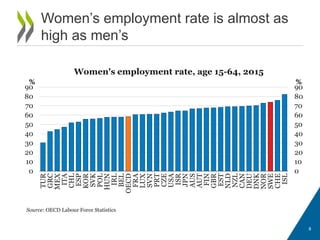
Women’s employment rate is almost as
high as men’s
8
Source: OECD Labour Force Statistics
0
10
20
30
40
50
60
70
80
90
0
10
20
30
40
50
60
70
80
90
TUR
GRC
MEX
ITA
CHL
ESP
KOR
SVK
POL
HUN
IRL
BEL
OECD
FRA
LUX
SVN
PRT
CZE
USA
ISR
JPN
AUS
AUT
FIN
GBR
EST
NLD
NZL
CAN
DEU
DNK
NOR
SWE
CHE
ISL
%%
Women's employment rate, age 15-64, 2015
9
Key recommendations – Macroeconomic policies
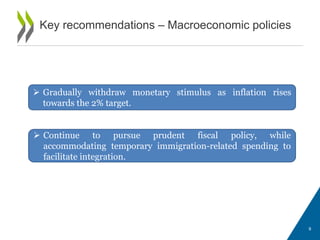
 Gradually withdraw monetary stimulus as inflation rises
towards the 2% target.
 Continue to pursue prudent fiscal policy, while
accommodating temporary immigration-related spending to
facilitate integration.
10
Key recommendations
– Housing and household debt
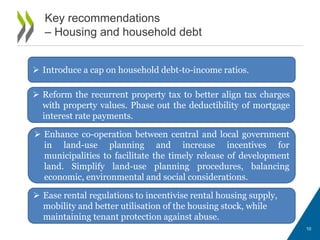
 Introduce a cap on household debt-to-income ratios.
 Reform the recurrent property tax to better align tax charges
with property values. Phase out the deductibility of mortgage
interest rate payments.
 Enhance co-operation between central and local government
in land-use planning and increase incentives for
municipalities to facilitate the timely release of development
land. Simplify land-use planning procedures, balancing
economic, environmental and social considerations.
 Ease rental regulations to incentivise rental housing supply,
mobility and better utilisation of the housing stock, while
maintaining tenant protection against abuse.
INCOME, WEALTH AND
EQUAL OPPORTUNITIES
11
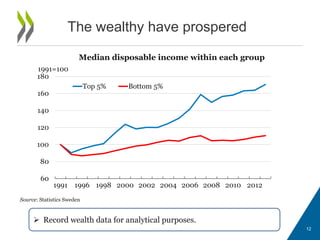
The wealthy have prospered
12
 Record wealth data for analytical purposes.
Median disposable income within each group
Source: Statistics Sweden
60
80
100
120
140
160
180
1991 1996 1998 2000 2002 2004 2006 2008 2010 2012
1991=100
Top 5% Bottom 5%
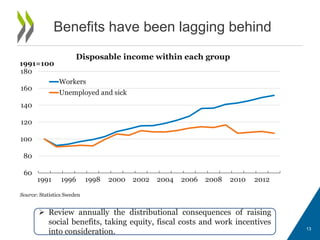
Benefits have been lagging behind
13
 Review annually the distributional consequences of raising
social benefits, taking equity, fiscal costs and work incentives
into consideration.
60
80
100
120
140
160
180
1991 1996 1998 2000 2002 2004 2006 2008 2010 2012
1991=100
Workers
Unemployed and sick
Source: Statistics Sweden
Disposable income within each group
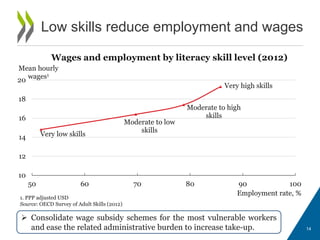
Low skills reduce employment and wages
14
 Consolidate wage subsidy schemes for the most vulnerable workers
and ease the related administrative burden to increase take-up.
Very low skills
Moderate to low
skills
Moderate to high
skills
Very high skills
10
12
14
16
18
20
50 60 70 80 90 100
Mean hourly
wages1
Employment rate, %
1. PPP adjusted USD
Source: OECD Survey of Adult Skills (2012)
Wages and employment by literacy skill level (2012)
0.000
0.002
0.004
0.006
0.008
0.010
0.012
0.014
50 90 130 170 210 250 290 330 370 410
Share of
graduates
PIAAC score points
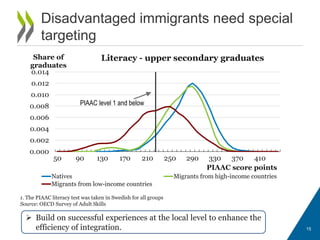
Literacy - upper secondary graduates
Natives Migrants from high-income countries
Migrants from low-income countries
PIAAC level 1 and below
Disadvantaged immigrants need special
targeting
15
 Build on successful experiences at the local level to enhance the
efficiency of integration.
1. The PIAAC literacy test was taken in Swedish for all groups
Source: OECD Survey of Adult Skills
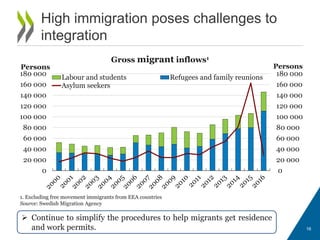
High immigration poses challenges to
integration
16
 Continue to simplify the procedures to help migrants get residence
and work permits.
0
20 000
40 000
60 000
80 000
100 000
120 000
140 000
160 000
180 000
0
20 000
40 000
60 000
80 000
100 000
120 000
140 000
160 000
180 000
PersonsPersons
Labour and students Refugees and family reunions
Asylum seekers
1. Excluding free movement immigrants from EEA countries
Source: Swedish Migration Agency
Gross migrant inflows1
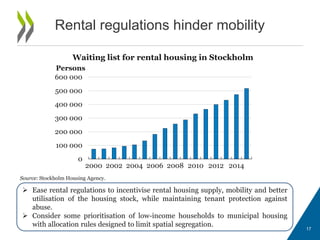
Rental regulations hinder mobility
17
 Ease rental regulations to incentivise rental housing supply, mobility and better
utilisation of the housing stock, while maintaining tenant protection against
abuse.
 Consider some prioritisation of low-income households to municipal housing
with allocation rules designed to limit spatial segregation.
Source: Stockholm Housing Agency.
0
100 000
200 000
300 000
400 000
500 000
600 000
2000 2002 2004 2006 2008 2010 2012 2014
Persons
Waiting list for rental housing in Stockholm
18
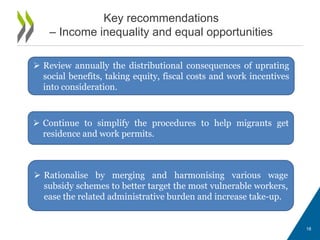
Key recommendations
– Income inequality and equal opportunities
 Review annually the distributional consequences of uprating
social benefits, taking equity, fiscal costs and work incentives
into consideration.
 Continue to simplify the procedures to help migrants get
residence and work permits.
 Rationalise by merging and harmonising various wage
subsidy schemes to better target the most vulnerable workers,
ease the related administrative burden and increase take-up.
FIGHTING GENDER
INEQUALITY
19
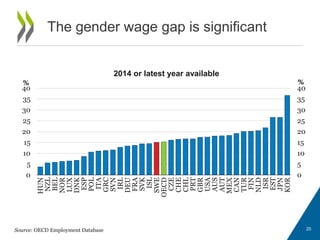
The gender wage gap is significant
20Source: OECD Employment Database
2014 or latest year available
0
5
10
15
20
25
30
35
40
0
5
10
15
20
25
30
35
40
HUN
NZL
BEL
NOR
LUX
DNK
ESP
POL
ITA
GRC
SVN
IRL
DEU
FRA
SVK
ISL
SWE
OECD
CZE
CHE
CHL
PRT
GBR
USA
AUS
AUT
MEX
CAN
TUR
FIN
NLD
ISR
EST
JPN
KOR
%%
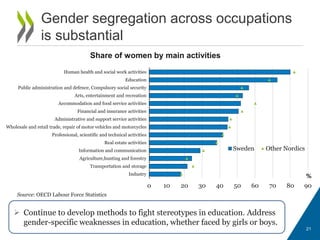
Gender segregation across occupations
is substantial
21
Source: OECD Labour Force Statistics
 Continue to develop methods to fight stereotypes in education. Address
gender-specific weaknesses in education, whether faced by girls or boys.
Share of women by main activities
0 10 20 30 40 50 60 70 80 90
Human health and social work activities
Education
Public administration and defence, Compulsory social security
Arts, entertainment and recreation
Accommodation and food service activities
Financial and insurance activities
Administrative and support service activities
Wholesale and retail trade, repair of motor vehicles and motorcycles
Professional, scientific and technical activities
Real estate activities
Information and communication
Agriculture,hunting and forestry
Transportation and storage
Industry
%
Sweden Other Nordics
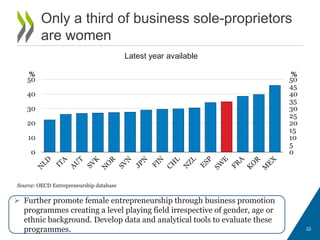
Only a third of business sole-proprietors
are women
22
Source: OECD Entrepreneurship database
 Further promote female entrepreneurship through business promotion
programmes creating a level playing field irrespective of gender, age or
ethnic background. Develop data and analytical tools to evaluate these
programmes.
Latest year available
0
5
10
15
20
25
30
35
40
45
50
0
10
20
30
40
50
%%
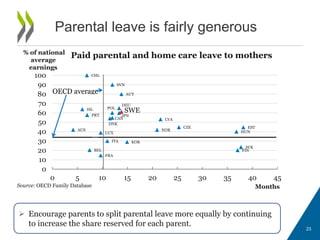
Parental leave is fairly generous
23
Source: OECD Family Database
 Encourage parents to split parental leave more equally by continuing
to increase the share reserved for each parent.
AUS
AUT
BEL
CAN
CHL
CZE
DNK
EST
FIN
FRA
DEU
HUN
ISL
ITA
JPN
KOR
LVA
LUX
NOR
POL
PRT
SVK
SVN
SWE
0
10
20
30
40
50
60
70
80
90
100
0 5 10 15 20 25 30 35 40 45
OECD average
Months
% of national
average
earnings
Paid parental and home care leave to mothers
20
30
40
50
60
70
80
90
20
30
40
50
60
70
80
90
ISL
ISR
CHE
NZL
EST
PRT
CAN
NOR
LUX
GBR
AUS
HUN
SWE
DEU
CZE
AUT
USA
DNK
OECD
IRL
NLD
FIN
SVK
SVN
ESP
POL
ITA
FRA
BEL
GRC
MEX
TUR
%% Native born Foreign born
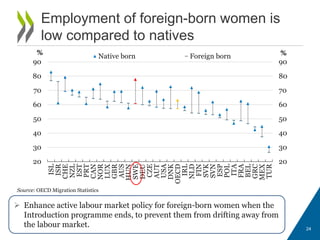
Employment of foreign-born women is
low compared to natives
24
Source: OECD Migration Statistics
 Enhance active labour market policy for foreign-born women when the
Introduction programme ends, to prevent them from drifting away from
the labour market.
25
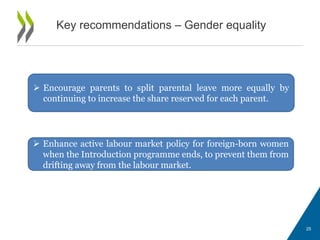
Key recommendations – Gender equality
 Encourage parents to split parental leave more equally by
continuing to increase the share reserved for each parent.
 Enhance active labour market policy for foreign-born women
when the Introduction programme ends, to prevent them from
drifting away from the labour market.
26
For more information
http://www.oecd.org/eco/surveys/economic-survey-sweden.htm
OECD
OECD Economics
Disclaimers:
The statistical data for Israel are supplied by and under the responsibility of the relevant Israeli authorities. The use of such data by the OECD is without
prejudice to the status of the Golan Heights, East Jerusalem and Israeli settlements in the West Bank under the terms of international law.
This document and any map included herein are without prejudice to the status of or sovereignty over any territory, to the delimitation of international frontiers
and boundaries and to the name of any territory, city or area.

OECD "Sweden 2017-oecd-economic-survey-growing-more-equal"

  • 1.
    2017 OECD ECONOMIC SURVEYOF SWEDEN Growing more equal Stockholm, 8 February 2017 @OECD @OECDeconomy http://www.oecd.org/eco/surveys/economic-survey-sweden.htm
  • 2.
    The economy isgrowing strongly 2 Note: For Denmark, Germany and Sweden, OECD projections for 2016 Q4 Source: OECD Economic Outlook database 90 95 100 105 110 115 120 125 130 2005 2006 2007 2008 2009 2010 2011 2012 2013 2014 2015 2016 Real GDP Sweden Germany Denmark United States 2005Q1=100
  • 3.
    Unemployment is trendingdown 3 Source: OECD Economic Outlook database 2005 2007 2009 2011 2013 2015 2017 2 4 6 8 10 12 14 16 % of labour force Unemployment rate Sweden Germany Denmark United States
  • 4.
    Swedes enjoy ahigh quality of life 4 1. Each well-being dimension is measured by indicators from the OECD Better Life Indicator set. Indicators are normalised to range between 0 (worst) and 10 (best). Source: OECD Better Life Index database
  • 5.
    Real housing pricescontinue to rise 5 Note: Prices are adjusted by the private consumption deflator Source: OECD Analytical Housing Prices Database 0 50 100 150 200 250 300 2000 2002 2004 2006 2008 2010 2012 2014 2016 2000=100 Spain Canada Sweden Denmark
  • 6.
    Gross household debtis high 6 0 20 40 60 80 100 120 140 DEU ITA FRA FIN ESP USA SWE GBR NOR NLD DNK 0 20 40 60 80 100 120 140 NOR DNK SWE FIN DEU NLD GBR FRA ESP USA ITA Note: 2015 or latest Source: OECD Economic Outlook database Households GovernmentGross debt % of GDP Gross debt % of GDP
  • 7.
    Inequality is fairlylow, but has risen rapidly since the 1990s 7 Source: OECD Income Distribution and Poverty database 0 10 20 30 40 50 60 0 5 10 15 20 25 30 35 40 45 50 ISL NOR DNK SVN FIN CZE BEL SVK AUT NLD SWE LUX HUN DEU FRA CHE POL KOR IRL CAN ITA AUS JPN NZL PRT GRC ESP LVA GBR ISR EST TUR USA MEX CHL IndexIndex Gini coefficient post taxes and transfers (2013 or latest)
  • 8.
    Women’s employment rateis almost as high as men’s 8 Source: OECD Labour Force Statistics 0 10 20 30 40 50 60 70 80 90 0 10 20 30 40 50 60 70 80 90 TUR GRC MEX ITA CHL ESP KOR SVK POL HUN IRL BEL OECD FRA LUX SVN PRT CZE USA ISR JPN AUS AUT FIN GBR EST NLD NZL CAN DEU DNK NOR SWE CHE ISL %% Women's employment rate, age 15-64, 2015
  • 9.
    9 Key recommendations –Macroeconomic policies  Gradually withdraw monetary stimulus as inflation rises towards the 2% target.  Continue to pursue prudent fiscal policy, while accommodating temporary immigration-related spending to facilitate integration.
  • 10.
    10 Key recommendations – Housingand household debt  Introduce a cap on household debt-to-income ratios.  Reform the recurrent property tax to better align tax charges with property values. Phase out the deductibility of mortgage interest rate payments.  Enhance co-operation between central and local government in land-use planning and increase incentives for municipalities to facilitate the timely release of development land. Simplify land-use planning procedures, balancing economic, environmental and social considerations.  Ease rental regulations to incentivise rental housing supply, mobility and better utilisation of the housing stock, while maintaining tenant protection against abuse.
  • 11.
    INCOME, WEALTH AND EQUALOPPORTUNITIES 11
  • 12.
    The wealthy haveprospered 12  Record wealth data for analytical purposes. Median disposable income within each group Source: Statistics Sweden 60 80 100 120 140 160 180 1991 1996 1998 2000 2002 2004 2006 2008 2010 2012 1991=100 Top 5% Bottom 5%
  • 13.
    Benefits have beenlagging behind 13  Review annually the distributional consequences of raising social benefits, taking equity, fiscal costs and work incentives into consideration. 60 80 100 120 140 160 180 1991 1996 1998 2000 2002 2004 2006 2008 2010 2012 1991=100 Workers Unemployed and sick Source: Statistics Sweden Disposable income within each group
  • 14.
    Low skills reduceemployment and wages 14  Consolidate wage subsidy schemes for the most vulnerable workers and ease the related administrative burden to increase take-up. Very low skills Moderate to low skills Moderate to high skills Very high skills 10 12 14 16 18 20 50 60 70 80 90 100 Mean hourly wages1 Employment rate, % 1. PPP adjusted USD Source: OECD Survey of Adult Skills (2012) Wages and employment by literacy skill level (2012)
  • 15.
    0.000 0.002 0.004 0.006 0.008 0.010 0.012 0.014 50 90 130170 210 250 290 330 370 410 Share of graduates PIAAC score points Literacy - upper secondary graduates Natives Migrants from high-income countries Migrants from low-income countries PIAAC level 1 and below Disadvantaged immigrants need special targeting 15  Build on successful experiences at the local level to enhance the efficiency of integration. 1. The PIAAC literacy test was taken in Swedish for all groups Source: OECD Survey of Adult Skills
  • 16.
    High immigration poseschallenges to integration 16  Continue to simplify the procedures to help migrants get residence and work permits. 0 20 000 40 000 60 000 80 000 100 000 120 000 140 000 160 000 180 000 0 20 000 40 000 60 000 80 000 100 000 120 000 140 000 160 000 180 000 PersonsPersons Labour and students Refugees and family reunions Asylum seekers 1. Excluding free movement immigrants from EEA countries Source: Swedish Migration Agency Gross migrant inflows1
  • 17.
    Rental regulations hindermobility 17  Ease rental regulations to incentivise rental housing supply, mobility and better utilisation of the housing stock, while maintaining tenant protection against abuse.  Consider some prioritisation of low-income households to municipal housing with allocation rules designed to limit spatial segregation. Source: Stockholm Housing Agency. 0 100 000 200 000 300 000 400 000 500 000 600 000 2000 2002 2004 2006 2008 2010 2012 2014 Persons Waiting list for rental housing in Stockholm
  • 18.
    18 Key recommendations – Incomeinequality and equal opportunities  Review annually the distributional consequences of uprating social benefits, taking equity, fiscal costs and work incentives into consideration.  Continue to simplify the procedures to help migrants get residence and work permits.  Rationalise by merging and harmonising various wage subsidy schemes to better target the most vulnerable workers, ease the related administrative burden and increase take-up.
  • 19.
  • 20.
    The gender wagegap is significant 20Source: OECD Employment Database 2014 or latest year available 0 5 10 15 20 25 30 35 40 0 5 10 15 20 25 30 35 40 HUN NZL BEL NOR LUX DNK ESP POL ITA GRC SVN IRL DEU FRA SVK ISL SWE OECD CZE CHE CHL PRT GBR USA AUS AUT MEX CAN TUR FIN NLD ISR EST JPN KOR %%
  • 21.
    Gender segregation acrossoccupations is substantial 21 Source: OECD Labour Force Statistics  Continue to develop methods to fight stereotypes in education. Address gender-specific weaknesses in education, whether faced by girls or boys. Share of women by main activities 0 10 20 30 40 50 60 70 80 90 Human health and social work activities Education Public administration and defence, Compulsory social security Arts, entertainment and recreation Accommodation and food service activities Financial and insurance activities Administrative and support service activities Wholesale and retail trade, repair of motor vehicles and motorcycles Professional, scientific and technical activities Real estate activities Information and communication Agriculture,hunting and forestry Transportation and storage Industry % Sweden Other Nordics
  • 22.
    Only a thirdof business sole-proprietors are women 22 Source: OECD Entrepreneurship database  Further promote female entrepreneurship through business promotion programmes creating a level playing field irrespective of gender, age or ethnic background. Develop data and analytical tools to evaluate these programmes. Latest year available 0 5 10 15 20 25 30 35 40 45 50 0 10 20 30 40 50 %%
  • 23.
    Parental leave isfairly generous 23 Source: OECD Family Database  Encourage parents to split parental leave more equally by continuing to increase the share reserved for each parent. AUS AUT BEL CAN CHL CZE DNK EST FIN FRA DEU HUN ISL ITA JPN KOR LVA LUX NOR POL PRT SVK SVN SWE 0 10 20 30 40 50 60 70 80 90 100 0 5 10 15 20 25 30 35 40 45 OECD average Months % of national average earnings Paid parental and home care leave to mothers
  • 24.
    20 30 40 50 60 70 80 90 20 30 40 50 60 70 80 90 ISL ISR CHE NZL EST PRT CAN NOR LUX GBR AUS HUN SWE DEU CZE AUT USA DNK OECD IRL NLD FIN SVK SVN ESP POL ITA FRA BEL GRC MEX TUR %% Native bornForeign born Employment of foreign-born women is low compared to natives 24 Source: OECD Migration Statistics  Enhance active labour market policy for foreign-born women when the Introduction programme ends, to prevent them from drifting away from the labour market.
  • 25.
    25 Key recommendations –Gender equality  Encourage parents to split parental leave more equally by continuing to increase the share reserved for each parent.  Enhance active labour market policy for foreign-born women when the Introduction programme ends, to prevent them from drifting away from the labour market.
  • 26.
    26 For more information http://www.oecd.org/eco/surveys/economic-survey-sweden.htm OECD OECDEconomics Disclaimers: The statistical data for Israel are supplied by and under the responsibility of the relevant Israeli authorities. The use of such data by the OECD is without prejudice to the status of the Golan Heights, East Jerusalem and Israeli settlements in the West Bank under the terms of international law. This document and any map included herein are without prejudice to the status of or sovereignty over any territory, to the delimitation of international frontiers and boundaries and to the name of any territory, city or area.