1
By
SN Panigrahi
2
SN Panigrahi is a Versatile Practitioner, Strategist, Energetic Coach, Learning Enabler.
He is an International-Corporate Trainer, Mentor & Author – PMP Trainer
He has diverse experience and expertise in Project Management, Contract
Management, Supply Chain Management, Procurement, Strategic
Sourcing, Global Sourcing, Logistics, Exports & Imports, Indirect Taxes –
GST etc.
He had done more than 150 Workshops on above
Published more than 500 Articles; More than 60 YouTube
Presentations & More than 70 SlideSharesHe is an Engineer + MBA +PGD ISO 9000 / TQM with around 29 Yrs of
Experience
He is a certified PMP® from PMI (USA) and become PMI India
Champion
Also a Certified Lean Six Sigma Green Belt from Exemplar Global
Trained in COD for 31/2 Yrs. on Strategy & Leadership
GST Certified – MSME – Tech. Dev. Centre (Govt of India Organization)
ZED Consultant – Certified by QCI – MSME (Govt of India Organization)
Member Board of Studies, IIMM
Co-Chairman, Indirect Tax Committee, FTAPCCI
Empanelled Faculty in NI MSME
He has shared his domain expertise in various forums as a speaker & presented a number of papers in various national and
international public forums and received a number of awards for his writings and contribution to business thoughts.
SN Panigrahi
9652571117
snpanigrahi1963@gmail.com
Hyderabad
SN Panigrahi 3
SN Panigrahi 4
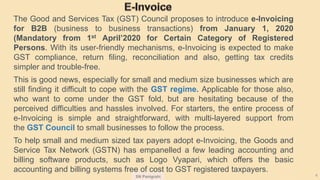
The Good and Services Tax (GST) Council proposes to introduce e-Invoicing
for B2B (business to business transactions) from January 1, 2020
(Mandatory from 1st April’2020 for Certain Category of Registered
Persons. With its user-friendly mechanisms, e-Invoicing is expected to make
GST compliance, return filing, reconciliation and also, getting tax credits
simpler and trouble-free.
This is good news, especially for small and medium size businesses which are
still finding it difficult to cope with the GST regime. Applicable for those also,
who want to come under the GST fold, but are hesitating because of the
perceived difficulties and hassles involved. For starters, the entire process of
e-Invoicing is simple and straightforward, with multi-layered support from
the GST Council to small businesses to follow the process.
To help small and medium sized tax payers adopt e-Invoicing, the Goods and
Service Tax Network (GSTN) has empanelled a few leading accounting and
billing software products, such as Logo Vyapari, which offers the basic
accounting and billing systems free of cost to GST registered taxpayers.
SN Panigrahi 5
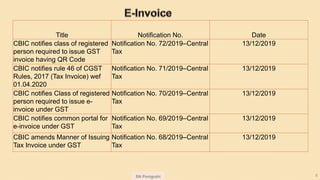
Title Notification No. Date
CBIC notifies class of registered
person required to issue GST
invoice having QR Code
Notification No. 72/2019–Central
Tax
13/12/2019
CBIC notifies rule 46 of CGST
Rules, 2017 (Tax Invoice) wef
01.04.2020
Notification No. 71/2019–Central
Tax
13/12/2019
CBIC notifies Class of registered
person required to issue e-
invoice under GST
Notification No. 70/2019–Central
Tax
13/12/2019
CBIC notifies common portal for
e-invoice under GST
Notification No. 69/2019–Central
Tax
13/12/2019
CBIC amends Manner of Issuing
Tax Invoice under GST
Notification No. 68/2019–Central
Tax
13/12/2019
6
The Gist of the Notifications is as under:
1.A new sub-rule has been inserted to mandate issuance of electronic invoices by registered persons having an aggregate annual turnover in
excess of INR100 crores. The requirement is for supplies made to a Registered Person only ie B2B Transactions only
2.The aforementioned electronic invoice should mandatorily contain the following:
•Particulars as contained in Form GST INV-01 after obtaining Invoice Reference Number (IRN)
•The tax invoice shall also contain Quick Response (QR) code
3.Further, where registered persons have a turnover in excess of INR 500 crore and make a supply to an unregistered person (B2C
supplies), invoices shall contain the QR code
4.The changes shall come into effect from 1 April 2020
Notification nos. 68/2019-Central Tax, 70/2019-Central Tax, 71/2019-Central tax and 72/2019-Central Tax dated 13 December 2019]
It may be noted that for the purpose of e-invoice, Ten Invoice Registration Portal (IRP) have been notified. The same shall be effective from 1
January 2020.
[Notification no 69/2019-Central Tax dated 13 December 2019]
Our comments
During the last few months, there were several news articles on this subject. Vide the above notifications, the Government has shown its intent to
implement e-invoicing from the coming financial year. Also, ten IRPs have been notified from 1 Jan 2020 itself, which means the industry can initiate
e-invoicing from 1 Jan 2020.
The industry should now gear up and use the voluntary three-month e-invoice generation
period effective 1 January 2020 and identify challenges/suggestions which can be represented before the Government.
SN Panigrahi 7
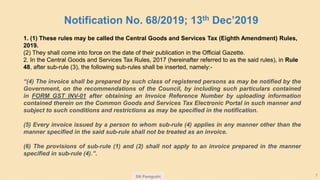
1. (1) These rules may be called the Central Goods and Services Tax (Eighth Amendment) Rules,
2019.
(2) They shall come into force on the date of their publication in the Official Gazette.
2. In the Central Goods and Services Tax Rules, 2017 (hereinafter referred to as the said rules), in Rule
48, after sub-rule (3), the following sub-rules shall be inserted, namely:-
“(4) The invoice shall be prepared by such class of registered persons as may be notified by the
Government, on the recommendations of the Council, by including such particulars contained
in FORM GST INV-01 after obtaining an Invoice Reference Number by uploading information
contained therein on the Common Goods and Services Tax Electronic Portal in such manner and
subject to such conditions and restrictions as may be specified in the notification.
(5) Every invoice issued by a person to whom sub-rule (4) applies in any manner other than the
manner specified in the said sub-rule shall not be treated as an invoice.
(6) The provisions of sub-rule (1) and (2) shall not apply to an invoice prepared in the manner
specified in sub-rule (4).”.
Notification No. 68/2019; 13th Dec’2019
SN Panigrahi 8
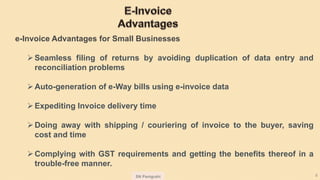
e-Invoice Advantages for Small Businesses
Seamless filing of returns by avoiding duplication of data entry and
reconciliation problems
Auto-generation of e-Way bills using e-invoice data
Expediting Invoice delivery time
Doing away with shipping / couriering of invoice to the buyer, saving
cost and time
Complying with GST requirements and getting the benefits thereof in a
trouble-free manner.
SN Panigrahi 9
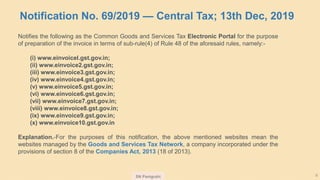
Notification No. 69/2019 — Central Tax; 13th Dec, 2019
Notifies the following as the Common Goods and Services Tax Electronic Portal for the purpose
of preparation of the invoice in terms of sub-rule(4) of Rule 48 of the aforesaid rules, namely:-
(i) www.einvoicel.gst.gov.in;
(ii) www.einvoice2.gst.gov.in;
(iii) www.einvoice3.gst.gov.in;
(iv) www.einvoice4.gst.gov.in;
(v) www.einvoice5.gst.gov.in;
(vi) www.einvoice6.gst.gov.in;
(vii) www.einvoice7.gst.gov.in;
(viii) www.einvoice8.gst.gov.in;
(ix) www.einvoice9.gst.gov.in;
(x) www.einvoice10.gst.gov.in
Explanation.-For the purposes of this notification, the above mentioned websites mean the
websites managed by the Goods and Services Tax Network, a company incorporated under the
provisions of section 8 of the Companies Act, 2013 (18 of 2013).
SN Panigrahi 10
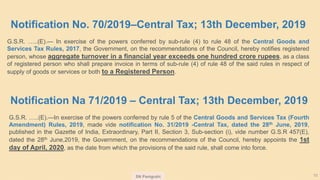
Notification No. 70/2019–Central Tax; 13th December, 2019
G.S.R. …..(E).— In exercise of the powers conferred by sub-rule (4) to rule 48 of the Central Goods and
Services Tax Rules, 2017, the Government, on the recommendations of the Council, hereby notifies registered
person, whose aggregate turnover in a financial year exceeds one hundred crore rupees, as a class
of registered person who shall prepare invoice in terms of sub-rule (4) of rule 48 of the said rules in respect of
supply of goods or services or both to a Registered Person.
Notification Na 71/2019 – Central Tax; 13th December, 2019
G.S.R. …..(E).—In exercise of the powers conferred by rule 5 of the Central Goods and Services Tax (Fourth
Amendment) Rules, 2019, made vide notification No. 31/2019 -Central Tax, dated the 28th June, 2019,
published in the Gazette of India, Extraordinary, Part II, Section 3, Sub-section (i), vide number G.S.R 457(E),
dated the 28th June,2019, the Government, on the recommendations of the Council, hereby appoints the 1st
day of April, 2020, as the date from which the provisions of the said rule, shall come into force.
SN Panigrahi 11
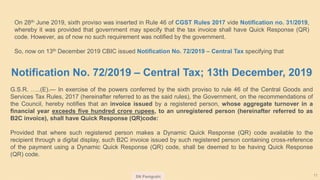
Notification No. 72/2019 – Central Tax; 13th December, 2019
G.S.R. …..(E).— In exercise of the powers conferred by the sixth proviso to rule 46 of the Central Goods and
Services Tax Rules, 2017 (hereinafter referred to as the said rules), the Government, on the recommendations of
the Council, hereby notifies that an invoice issued by a registered person, whose aggregate turnover in a
financial year exceeds five hundred crore rupees, to an unregistered person (hereinafter referred to as
B2C invoice), shall have Quick Response (QR)code:
Provided that where such registered person makes a Dynamic Quick Response (QR) code available to the
recipient through a digital display, such B2C invoice issued by such registered person containing cross-reference
of the payment using a Dynamic Quick Response (QR) code, shall be deemed to be having Quick Response
(QR) code.
On 28th June 2019, sixth proviso was inserted in Rule 46 of CGST Rules 2017 vide Notification no. 31/2019,
whereby it was provided that government may specify that the tax invoice shall have Quick Response (QR)
code. However, as of now no such requirement was notified by the government.
So, now on 13th December 2019 CBIC issued Notification No. 72/2019 – Central Tax specifying that
SN Panigrahi 12
Hassle-free, Simplified Processes
•The e-Invoice need not be generated on the government’s tax portal. Tax payers have to continue using
their own accounting system. The only criterion is the invoice should be generated in a particular
template in JSON format. The GST invoice in a standard template and a unique invoice reference
number (IRN), based on the enterprise’s GST registration number, will be generated through a GST
Network created exclusively for e-Invoicing.
•The government nominated registrar, the Invoice Registration Portal (IRP) of GST, will issue the e-
Invoice after receiving and verifying invoice requests sent by the business.
•This request can sent through SMS, mobile app, web, offline tool, an application program
interface (API) or specified online tools.
•The capacity of IRP system is designed to manage the predicted loads of simultaneous uploads based
on data reported in GSTR-1 for the last two years.
•At a later stage, multiple invoice registrars will be employed so that the load for invoice registration can
be distributed.
SN Panigrahi 13
•While requesting for an e-Invoice, the supplier has also to report other important documents to the
registrar, which include supplier’s invoice and credit notes, recipient’s debit note, and any other legal
document relevant to the transaction.
•The e-Invoice, digitally signed by the registrar, will also have a QR code, which will contain important
details, such as GSTIN (GST Identification Number) of both seller and buyer, invoice date and number,
line item number, HSN (Harmonized System of Nomenclature) of the items in the invoice as per their
values, among others.
•The e-Invoice signed by the IRP can also be used by GST / E-Way bill system.
•After the e-Invoice is generated by the registrar, it is sent back to the supplier and a copy is also sent to
the buyer in whose name the invoice is made.
•In the GST portal, the supplier’s tax invoice will be updated and also reflected in the newly proposed
return formats proposed.
SN Panigrahi 14
•The e-Invoice form will have provision for both mandatory and optional items. The request will
be accepted in the GST system only if the mandatory items are filled. The optional items are to
be used by businesses to suit their individual requirements.
•The e-Invoice generated can also be cancelled but supplier within 24 hours after it is issued.
However, the supplier can cancel it manually on the GST portal before filing returns.
•This new e-Invoice schema also caters to export invoices. Based on most common standards,
the schema will help buyer’s system to read the e-Invoice without any issue.
Changes / Requirements the Tax Payer has to Ensure
 The tax payer’s accounting system should support e-invoice requirements.
 After IRN number is issued, it should be imported into the system. The system should be
able to capture IRN corresponding to the tax invoice.
 The dispatch / packaging slip should display the IRN Number.
 IRN should be captured against the e-Way Bill in the system.
SN Panigrahi 15
SN Panigrahi 16
The government has introduced an important change around the e-way bill generation with an
aim to crack down on GST non-filers and evaders.
With effect from December 1st, 2019, the blocking and unblocking of the e-way bill generation
facility has been implemented on the e-way bill portal.
E-way bill generation has been barred for taxpayers who haven’t filed their returns for the
previous two consecutive months.
As many as 3.5 lakh GST payers may see their e-way bill facility get blocked from today.
GST Network, the entity that provides the IT backbone for the Goods and Services Tax (GST),
has activated the blocking-unblocking facility for the e-way bill generation from today. The
government, in order to increase compliance under GST and minimise tax frauds, has come up
with a new rule to block the facility to generate e-way bill for taxpayers who have not filed their
GSTR-3B returns for two consecutive months.
Blocking of E way Bill w.e.f. 01-12-2019
SN Panigrahi 17
1. As per Rule 138E, non furnishing of CMP-08 for 2 consecutive quarters shall result in blocking of
E way bill for Composition Dealers. CMP-08 for April to June 2019 was required to be filed till 31-
08-2019 (N/N 35/2019-CT dated 29-7-2019) and CMP-08 for July to Sep 2019 is required to be filed
till 22nd October 2019[ N/N 50/2019 dtd 24-10-19]. For subsequent quarters due date for CMP-08 is
18th of month suceeding quarter. Hence blocking shall be from 19th.
2. Non furnishing of GSTR 3B for 2 consecutive months for normal taxpayers shall result in blocking
of e way bill for normal dealers. GSTR 3B is required to be filed till 20th of next month. Hence blocking
shall be from 21st. No filing of GSTR-1 shall not result in blocking of e way bill.
3. Effective Date: Blocking of E way bill has been made effective from 01-12-2019 on portal. Earlier
blocking was proposed w.e.f. 21-06-19 but extended to 21-8-19 by N/N 25/2019-CT and further
extended to 21-11-2019 by N/N 36/2019. Cautionary messages during November were conveyed while
generating E way bill, however blocking has been put into operation only w.e.f. 01-12-2019.
4. State of J&K: Due to poor Internet connectivity in state of J&K, number of people have not
able to file GSTR 3B. Now effective from 01-12-2019, e way bill for goods consigned to/from J&K
have been blocked.
5. Transporters registered with GSTIN shall also be blocked if they fail to file GSTR-3B for 2
consecutive months. Consignors and consignees transporting through such transporters can generate E
way bill. However, Transporters only enrolled for e way bill and not registered shall not be affected
Blocking of E way Bill w.e.f. 01-12-2019
SN Panigrahi 18
6. If blocking is done for consignor then consignee also cannot generate E way bill for inward supplies. Similarly
if consignee is blocked, then consignor also can’t generate e way bill for goods to be dispatched to consignee.
Transporter also can not generate e way bill for blocked consignor and consignee
7. Unblocking of E way Bill can be done by:
a) Filing GSTR 3B/CMP-08 and reducing default to lesser than 2 consecutive periods. E way bill shall
be unblocked automatically next day. If status is still not updated, then log in e way bill portal and click on
option Search > Update Block status. Enter GSTIN followed by captcha. Then click on Update Unblock status
from GST Common Portal
b) Unblocking can also be done by jurisdictional officer online on GST portal upon considering manual
representation from taxpayer [FAQ 2 and 9]. At present this functionality is not available with jurisdictional
officers also.
c) Online application for unblocking in EWB-05 can also be filed where representing sufficient cause for non
filing of GSTR 3B. Jurisdictional Commissioner may by reasoned order in EWB-06 unblock the E way bill.
Rejection of request shall not be made without providing opportunity of being heard. Facility of online application
is not available for the time being.
8. Blocking of e way bill shall result in assessee falling into clutches of section 129 entailing penalty and tax.
9. Blocking of E way bill implies blocking of delivery of goods. In such case, tax should also not be collected
from the taxpayer because the supply of the goods has been hampered.
10. While suppliers of goods have been penalized the services providers shall not be affected by non filing of
returns which appears to be discriminatory for suppliers of goods. Further suppliers of goods might resort
to splitting of bills to obviate the rigours of Rule 138E.
Blocking of E way Bill w.e.f. 01-12-2019
SN Panigrahi 19
SN Panigrahi 20
In the 31st GST Council meeting, recommendation was made for new GST Returns to facilitate tax
payer. In order to effect such change, a transition plan has been introduced by CBIC. Under the new
scheme, Form GST ANX – 1 shall replace Form GSTR-1 and Form GST RET -01shall replace Form
GSTR-3B.
2. The dealer shall be able to upload invoices using FORM GST ANX-1 offline tool. The details in respect
of inward supplies can be viewed and downloaded in Form GST ANX-2 (offline tool). The dealer can
import the purchase register in the offline tool and match it with the downloaded inward supply in order to
arrive at the differences.
21
GST
Returns
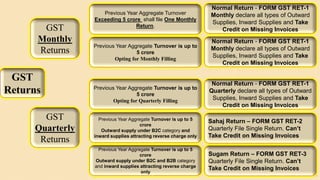
GST
Monthly
Returns
GST
Quarterly
Returns
Previous Year Aggregate Turnover
Exceeding 5 crore shall file One Monthly
Return.
Previous Year Aggregate Turnover is up to
5 crore
Opting for Monthly Filling
Previous Year Aggregate Turnover is up to 5
crore
Outward supply under B2C category and
inward supplies attracting reverse charge only
Previous Year Aggregate Turnover is up to 5
crore
Outward supply under B2C and B2B category
and inward supplies attracting reverse charge
only
Previous Year Aggregate Turnover is up to
5 crore
Opting for Quarterly Filling
Normal Return - FORM GST RET-1
Monthly declare all types of Outward
Supplies, Inward Supplies and Take
Credit on Missing Invoices
Normal Return - FORM GST RET-1
Monthly declare all types of Outward
Supplies, Inward Supplies and Take
Credit on Missing Invoices
Normal Return - FORM GST RET-1
Quarterly declare all types of Outward
Supplies, Inward Supplies and Take
Credit on Missing Invoices
Sahaj Return – FORM GST RET-2
Quarterly File Single Return. Can’t
Take Credit on Missing Invoices
Sugam Return – FORM GST RET-3
Quarterly File Single Return. Can’t
Take Credit on Missing Invoices
SN Panigrahi 22
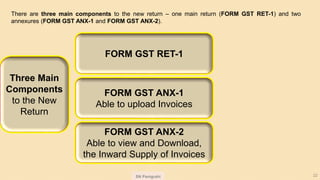
There are three main components to the new return – one main return (FORM GST RET-1) and two
annexures (FORM GST ANX-1 and FORM GST ANX-2).
Three Main
Components
to the New
Return
FORM GST RET-1
FORM GST ANX-2
Able to view and Download,
the Inward Supply of Invoices
FORM GST ANX-1
Able to upload Invoices
SN Panigrahi 23
SN Panigrahi 24
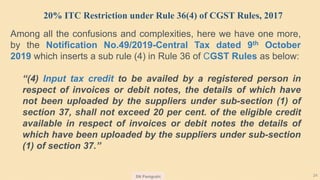
20% ITC Restriction under Rule 36(4) of CGST Rules, 2017
Among all the confusions and complexities, here we have one more,
by the Notification No.49/2019-Central Tax dated 9th October
2019 which inserts a sub rule (4) in Rule 36 of CGST Rules as below:
“(4) Input tax credit to be availed by a registered person in
respect of invoices or debit notes, the details of which have
not been uploaded by the suppliers under sub-section (1) of
section 37, shall not exceed 20 per cent. of the eligible credit
available in respect of invoices or debit notes the details of
which have been uploaded by the suppliers under sub-section
(1) of section 37.”
SN Panigrahi 25
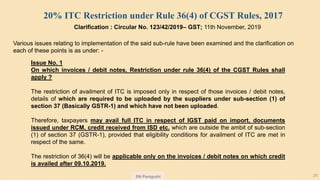
Clarification : Circular No. 123/42/2019– GST; 11th November, 2019
20% ITC Restriction under Rule 36(4) of CGST Rules, 2017
Various issues relating to implementation of the said sub-rule have been examined and the clarification on
each of these points is as under: -
Issue No. 1
On which invoices / debit notes, Restriction under rule 36(4) of the CGST Rules shall
apply ?
The restriction of availment of ITC is imposed only in respect of those invoices / debit notes,
details of which are required to be uploaded by the suppliers under sub-section (1) of
section 37 (Basically GSTR-1) and which have not been uploaded.
Therefore, taxpayers may avail full ITC in respect of IGST paid on import, documents
issued under RCM, credit received from ISD etc. which are outside the ambit of sub-section
(1) of section 37 (GSTR-1), provided that eligibility conditions for availment of ITC are met in
respect of the same.
The restriction of 36(4) will be applicable only on the invoices / debit notes on which credit
is availed after 09.10.2019.
SN Panigrahi 26
Issue No. 2
Whether the said restriction is to be calculated supplier wise or on consolidated
basis?
The restriction imposed is not supplier wise, It is on consolidated basis; total eligible ITC
from all suppliers against all supplies whose details have been uploaded by the suppliers in
GSTR-1.
Further, the calculation would be based on only those invoices which are otherwise eligible
for ITC.
Accordingly, those invoices on which ITC is not available under any of the provision
[say under section 17 (5)] would not be considered for calculating 20% of the eligible
credit available
Clarification : Circular No. 123/42/2019– GST; 11th November, 2019
20% ITC Restriction under Rule 36(4) of CGST Rules, 2017
SN Panigrahi 27
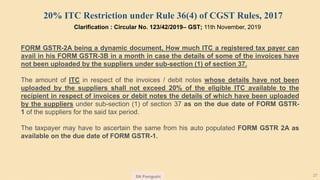
Clarification : Circular No. 123/42/2019– GST; 11th November, 2019
20% ITC Restriction under Rule 36(4) of CGST Rules, 2017
FORM GSTR-2A being a dynamic document, How much ITC a registered tax payer can
avail in his FORM GSTR-3B in a month in case the details of some of the invoices have
not been uploaded by the suppliers under sub-section (1) of section 37.
The amount of ITC in respect of the invoices / debit notes whose details have not been
uploaded by the suppliers shall not exceed 20% of the eligible ITC available to the
recipient in respect of invoices or debit notes the details of which have been uploaded
by the suppliers under sub-section (1) of section 37 as on the due date of FORM GSTR-
1 of the suppliers for the said tax period.
The taxpayer may have to ascertain the same from his auto populated FORM GSTR 2A as
available on the due date of FORM GSTR-1.
28
Clarification : Circular No. 123/42/2019– GST; 11th November, 2019
20% ITC Restriction under Rule 36(4) of CGST Rules, 2017
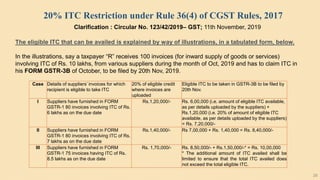
The eligible ITC that can be availed is explained by way of illustrations, in a tabulated form, below.
In the illustrations, say a taxpayer “R” receives 100 invoices (for inward supply of goods or services)
involving ITC of Rs. 10 lakhs, from various suppliers during the month of Oct, 2019 and has to claim ITC in
his FORM GSTR-3B of October, to be filed by 20th Nov, 2019.
Case Details of suppliers’ invoices for which
recipient is eligible to take ITC
20% of eligible credit
where invoices are
uploaded
Eligible ITC to be taken in GSTR-3B to be filed by
20th Nov.
I Suppliers have furnished in FORM
GSTR-1 80 invoices involving ITC of Rs.
6 lakhs as on the due date
Rs.1,20,000/- Rs. 6,00,000 (i.e. amount of eligible ITC available,
as per details uploaded by the suppliers) +
Rs.1,20,000 (i.e. 20% of amount of eligible ITC
available, as per details uploaded by the suppliers)
= Rs. 7,20,000/-
II Suppliers have furnished in FORM
GSTR-1 80 invoices involving ITC of Rs.
7 lakhs as on the due date
Rs.1,40,000/- Rs 7,00,000 + Rs. 1,40,000 = Rs. 8,40,000/-
III Suppliers have furnished in FORM
GSTR-1 75 invoices having ITC of Rs.
8.5 lakhs as on the due date
Rs. 1,70,000/- Rs. 8,50,000/- + Rs.1,50,000/-* = Rs. 10,00,000
* The additional amount of ITC availed shall be
limited to ensure that the total ITC availed does
not exceed the total eligible ITC.
SN Panigrahi 29
Clarification : Circular No. 123/42/2019– GST; 11th November, 2019
20% ITC Restriction under Rule 36(4) of CGST Rules, 2017
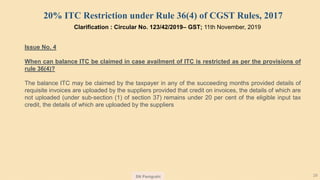
Issue No. 4
When can balance ITC be claimed in case availment of ITC is restricted as per the provisions of
rule 36(4)?
The balance ITC may be claimed by the taxpayer in any of the succeeding months provided details of
requisite invoices are uploaded by the suppliers provided that credit on invoices, the details of which are
not uploaded (under sub-section (1) of section 37) remains under 20 per cent of the eligible input tax
credit, the details of which are uploaded by the suppliers
30
SN Panigrahi
31
Contact Details:
SN Panigrahi
9652571117
snpanigrahi1963@gmail.com 32

#Recent Changes in GST# By SN Panigrahi

  • 1.
  • 2.
    2 SN Panigrahi isa Versatile Practitioner, Strategist, Energetic Coach, Learning Enabler. He is an International-Corporate Trainer, Mentor & Author – PMP Trainer He has diverse experience and expertise in Project Management, Contract Management, Supply Chain Management, Procurement, Strategic Sourcing, Global Sourcing, Logistics, Exports & Imports, Indirect Taxes – GST etc. He had done more than 150 Workshops on above Published more than 500 Articles; More than 60 YouTube Presentations & More than 70 SlideSharesHe is an Engineer + MBA +PGD ISO 9000 / TQM with around 29 Yrs of Experience He is a certified PMP® from PMI (USA) and become PMI India Champion Also a Certified Lean Six Sigma Green Belt from Exemplar Global Trained in COD for 31/2 Yrs. on Strategy & Leadership GST Certified – MSME – Tech. Dev. Centre (Govt of India Organization) ZED Consultant – Certified by QCI – MSME (Govt of India Organization) Member Board of Studies, IIMM Co-Chairman, Indirect Tax Committee, FTAPCCI Empanelled Faculty in NI MSME He has shared his domain expertise in various forums as a speaker & presented a number of papers in various national and international public forums and received a number of awards for his writings and contribution to business thoughts. SN Panigrahi 9652571117 snpanigrahi1963@gmail.com Hyderabad
  • 3.
  • 4.
    SN Panigrahi 4 TheGood and Services Tax (GST) Council proposes to introduce e-Invoicing for B2B (business to business transactions) from January 1, 2020 (Mandatory from 1st April’2020 for Certain Category of Registered Persons. With its user-friendly mechanisms, e-Invoicing is expected to make GST compliance, return filing, reconciliation and also, getting tax credits simpler and trouble-free. This is good news, especially for small and medium size businesses which are still finding it difficult to cope with the GST regime. Applicable for those also, who want to come under the GST fold, but are hesitating because of the perceived difficulties and hassles involved. For starters, the entire process of e-Invoicing is simple and straightforward, with multi-layered support from the GST Council to small businesses to follow the process. To help small and medium sized tax payers adopt e-Invoicing, the Goods and Service Tax Network (GSTN) has empanelled a few leading accounting and billing software products, such as Logo Vyapari, which offers the basic accounting and billing systems free of cost to GST registered taxpayers.
  • 5.
    SN Panigrahi 5 TitleNotification No. Date CBIC notifies class of registered person required to issue GST invoice having QR Code Notification No. 72/2019–Central Tax 13/12/2019 CBIC notifies rule 46 of CGST Rules, 2017 (Tax Invoice) wef 01.04.2020 Notification No. 71/2019–Central Tax 13/12/2019 CBIC notifies Class of registered person required to issue e- invoice under GST Notification No. 70/2019–Central Tax 13/12/2019 CBIC notifies common portal for e-invoice under GST Notification No. 69/2019–Central Tax 13/12/2019 CBIC amends Manner of Issuing Tax Invoice under GST Notification No. 68/2019–Central Tax 13/12/2019
  • 6.
    6 The Gist ofthe Notifications is as under: 1.A new sub-rule has been inserted to mandate issuance of electronic invoices by registered persons having an aggregate annual turnover in excess of INR100 crores. The requirement is for supplies made to a Registered Person only ie B2B Transactions only 2.The aforementioned electronic invoice should mandatorily contain the following: •Particulars as contained in Form GST INV-01 after obtaining Invoice Reference Number (IRN) •The tax invoice shall also contain Quick Response (QR) code 3.Further, where registered persons have a turnover in excess of INR 500 crore and make a supply to an unregistered person (B2C supplies), invoices shall contain the QR code 4.The changes shall come into effect from 1 April 2020 Notification nos. 68/2019-Central Tax, 70/2019-Central Tax, 71/2019-Central tax and 72/2019-Central Tax dated 13 December 2019] It may be noted that for the purpose of e-invoice, Ten Invoice Registration Portal (IRP) have been notified. The same shall be effective from 1 January 2020. [Notification no 69/2019-Central Tax dated 13 December 2019] Our comments During the last few months, there were several news articles on this subject. Vide the above notifications, the Government has shown its intent to implement e-invoicing from the coming financial year. Also, ten IRPs have been notified from 1 Jan 2020 itself, which means the industry can initiate e-invoicing from 1 Jan 2020. The industry should now gear up and use the voluntary three-month e-invoice generation period effective 1 January 2020 and identify challenges/suggestions which can be represented before the Government.
  • 7.
    SN Panigrahi 7 1.(1) These rules may be called the Central Goods and Services Tax (Eighth Amendment) Rules, 2019. (2) They shall come into force on the date of their publication in the Official Gazette. 2. In the Central Goods and Services Tax Rules, 2017 (hereinafter referred to as the said rules), in Rule 48, after sub-rule (3), the following sub-rules shall be inserted, namely:- “(4) The invoice shall be prepared by such class of registered persons as may be notified by the Government, on the recommendations of the Council, by including such particulars contained in FORM GST INV-01 after obtaining an Invoice Reference Number by uploading information contained therein on the Common Goods and Services Tax Electronic Portal in such manner and subject to such conditions and restrictions as may be specified in the notification. (5) Every invoice issued by a person to whom sub-rule (4) applies in any manner other than the manner specified in the said sub-rule shall not be treated as an invoice. (6) The provisions of sub-rule (1) and (2) shall not apply to an invoice prepared in the manner specified in sub-rule (4).”. Notification No. 68/2019; 13th Dec’2019
  • 8.
    SN Panigrahi 8 e-InvoiceAdvantages for Small Businesses Seamless filing of returns by avoiding duplication of data entry and reconciliation problems Auto-generation of e-Way bills using e-invoice data Expediting Invoice delivery time Doing away with shipping / couriering of invoice to the buyer, saving cost and time Complying with GST requirements and getting the benefits thereof in a trouble-free manner.
  • 9.
    SN Panigrahi 9 NotificationNo. 69/2019 — Central Tax; 13th Dec, 2019 Notifies the following as the Common Goods and Services Tax Electronic Portal for the purpose of preparation of the invoice in terms of sub-rule(4) of Rule 48 of the aforesaid rules, namely:- (i) www.einvoicel.gst.gov.in; (ii) www.einvoice2.gst.gov.in; (iii) www.einvoice3.gst.gov.in; (iv) www.einvoice4.gst.gov.in; (v) www.einvoice5.gst.gov.in; (vi) www.einvoice6.gst.gov.in; (vii) www.einvoice7.gst.gov.in; (viii) www.einvoice8.gst.gov.in; (ix) www.einvoice9.gst.gov.in; (x) www.einvoice10.gst.gov.in Explanation.-For the purposes of this notification, the above mentioned websites mean the websites managed by the Goods and Services Tax Network, a company incorporated under the provisions of section 8 of the Companies Act, 2013 (18 of 2013).
  • 10.
    SN Panigrahi 10 NotificationNo. 70/2019–Central Tax; 13th December, 2019 G.S.R. …..(E).— In exercise of the powers conferred by sub-rule (4) to rule 48 of the Central Goods and Services Tax Rules, 2017, the Government, on the recommendations of the Council, hereby notifies registered person, whose aggregate turnover in a financial year exceeds one hundred crore rupees, as a class of registered person who shall prepare invoice in terms of sub-rule (4) of rule 48 of the said rules in respect of supply of goods or services or both to a Registered Person. Notification Na 71/2019 – Central Tax; 13th December, 2019 G.S.R. …..(E).—In exercise of the powers conferred by rule 5 of the Central Goods and Services Tax (Fourth Amendment) Rules, 2019, made vide notification No. 31/2019 -Central Tax, dated the 28th June, 2019, published in the Gazette of India, Extraordinary, Part II, Section 3, Sub-section (i), vide number G.S.R 457(E), dated the 28th June,2019, the Government, on the recommendations of the Council, hereby appoints the 1st day of April, 2020, as the date from which the provisions of the said rule, shall come into force.
  • 11.
    SN Panigrahi 11 NotificationNo. 72/2019 – Central Tax; 13th December, 2019 G.S.R. …..(E).— In exercise of the powers conferred by the sixth proviso to rule 46 of the Central Goods and Services Tax Rules, 2017 (hereinafter referred to as the said rules), the Government, on the recommendations of the Council, hereby notifies that an invoice issued by a registered person, whose aggregate turnover in a financial year exceeds five hundred crore rupees, to an unregistered person (hereinafter referred to as B2C invoice), shall have Quick Response (QR)code: Provided that where such registered person makes a Dynamic Quick Response (QR) code available to the recipient through a digital display, such B2C invoice issued by such registered person containing cross-reference of the payment using a Dynamic Quick Response (QR) code, shall be deemed to be having Quick Response (QR) code. On 28th June 2019, sixth proviso was inserted in Rule 46 of CGST Rules 2017 vide Notification no. 31/2019, whereby it was provided that government may specify that the tax invoice shall have Quick Response (QR) code. However, as of now no such requirement was notified by the government. So, now on 13th December 2019 CBIC issued Notification No. 72/2019 – Central Tax specifying that
  • 12.
    SN Panigrahi 12 Hassle-free,Simplified Processes •The e-Invoice need not be generated on the government’s tax portal. Tax payers have to continue using their own accounting system. The only criterion is the invoice should be generated in a particular template in JSON format. The GST invoice in a standard template and a unique invoice reference number (IRN), based on the enterprise’s GST registration number, will be generated through a GST Network created exclusively for e-Invoicing. •The government nominated registrar, the Invoice Registration Portal (IRP) of GST, will issue the e- Invoice after receiving and verifying invoice requests sent by the business. •This request can sent through SMS, mobile app, web, offline tool, an application program interface (API) or specified online tools. •The capacity of IRP system is designed to manage the predicted loads of simultaneous uploads based on data reported in GSTR-1 for the last two years. •At a later stage, multiple invoice registrars will be employed so that the load for invoice registration can be distributed.
  • 13.
    SN Panigrahi 13 •Whilerequesting for an e-Invoice, the supplier has also to report other important documents to the registrar, which include supplier’s invoice and credit notes, recipient’s debit note, and any other legal document relevant to the transaction. •The e-Invoice, digitally signed by the registrar, will also have a QR code, which will contain important details, such as GSTIN (GST Identification Number) of both seller and buyer, invoice date and number, line item number, HSN (Harmonized System of Nomenclature) of the items in the invoice as per their values, among others. •The e-Invoice signed by the IRP can also be used by GST / E-Way bill system. •After the e-Invoice is generated by the registrar, it is sent back to the supplier and a copy is also sent to the buyer in whose name the invoice is made. •In the GST portal, the supplier’s tax invoice will be updated and also reflected in the newly proposed return formats proposed.
  • 14.
    SN Panigrahi 14 •Thee-Invoice form will have provision for both mandatory and optional items. The request will be accepted in the GST system only if the mandatory items are filled. The optional items are to be used by businesses to suit their individual requirements. •The e-Invoice generated can also be cancelled but supplier within 24 hours after it is issued. However, the supplier can cancel it manually on the GST portal before filing returns. •This new e-Invoice schema also caters to export invoices. Based on most common standards, the schema will help buyer’s system to read the e-Invoice without any issue. Changes / Requirements the Tax Payer has to Ensure  The tax payer’s accounting system should support e-invoice requirements.  After IRN number is issued, it should be imported into the system. The system should be able to capture IRN corresponding to the tax invoice.  The dispatch / packaging slip should display the IRN Number.  IRN should be captured against the e-Way Bill in the system.
  • 15.
  • 16.
    SN Panigrahi 16 Thegovernment has introduced an important change around the e-way bill generation with an aim to crack down on GST non-filers and evaders. With effect from December 1st, 2019, the blocking and unblocking of the e-way bill generation facility has been implemented on the e-way bill portal. E-way bill generation has been barred for taxpayers who haven’t filed their returns for the previous two consecutive months. As many as 3.5 lakh GST payers may see their e-way bill facility get blocked from today. GST Network, the entity that provides the IT backbone for the Goods and Services Tax (GST), has activated the blocking-unblocking facility for the e-way bill generation from today. The government, in order to increase compliance under GST and minimise tax frauds, has come up with a new rule to block the facility to generate e-way bill for taxpayers who have not filed their GSTR-3B returns for two consecutive months. Blocking of E way Bill w.e.f. 01-12-2019
  • 17.
    SN Panigrahi 17 1.As per Rule 138E, non furnishing of CMP-08 for 2 consecutive quarters shall result in blocking of E way bill for Composition Dealers. CMP-08 for April to June 2019 was required to be filed till 31- 08-2019 (N/N 35/2019-CT dated 29-7-2019) and CMP-08 for July to Sep 2019 is required to be filed till 22nd October 2019[ N/N 50/2019 dtd 24-10-19]. For subsequent quarters due date for CMP-08 is 18th of month suceeding quarter. Hence blocking shall be from 19th. 2. Non furnishing of GSTR 3B for 2 consecutive months for normal taxpayers shall result in blocking of e way bill for normal dealers. GSTR 3B is required to be filed till 20th of next month. Hence blocking shall be from 21st. No filing of GSTR-1 shall not result in blocking of e way bill. 3. Effective Date: Blocking of E way bill has been made effective from 01-12-2019 on portal. Earlier blocking was proposed w.e.f. 21-06-19 but extended to 21-8-19 by N/N 25/2019-CT and further extended to 21-11-2019 by N/N 36/2019. Cautionary messages during November were conveyed while generating E way bill, however blocking has been put into operation only w.e.f. 01-12-2019. 4. State of J&K: Due to poor Internet connectivity in state of J&K, number of people have not able to file GSTR 3B. Now effective from 01-12-2019, e way bill for goods consigned to/from J&K have been blocked. 5. Transporters registered with GSTIN shall also be blocked if they fail to file GSTR-3B for 2 consecutive months. Consignors and consignees transporting through such transporters can generate E way bill. However, Transporters only enrolled for e way bill and not registered shall not be affected Blocking of E way Bill w.e.f. 01-12-2019
  • 18.
    SN Panigrahi 18 6.If blocking is done for consignor then consignee also cannot generate E way bill for inward supplies. Similarly if consignee is blocked, then consignor also can’t generate e way bill for goods to be dispatched to consignee. Transporter also can not generate e way bill for blocked consignor and consignee 7. Unblocking of E way Bill can be done by: a) Filing GSTR 3B/CMP-08 and reducing default to lesser than 2 consecutive periods. E way bill shall be unblocked automatically next day. If status is still not updated, then log in e way bill portal and click on option Search > Update Block status. Enter GSTIN followed by captcha. Then click on Update Unblock status from GST Common Portal b) Unblocking can also be done by jurisdictional officer online on GST portal upon considering manual representation from taxpayer [FAQ 2 and 9]. At present this functionality is not available with jurisdictional officers also. c) Online application for unblocking in EWB-05 can also be filed where representing sufficient cause for non filing of GSTR 3B. Jurisdictional Commissioner may by reasoned order in EWB-06 unblock the E way bill. Rejection of request shall not be made without providing opportunity of being heard. Facility of online application is not available for the time being. 8. Blocking of e way bill shall result in assessee falling into clutches of section 129 entailing penalty and tax. 9. Blocking of E way bill implies blocking of delivery of goods. In such case, tax should also not be collected from the taxpayer because the supply of the goods has been hampered. 10. While suppliers of goods have been penalized the services providers shall not be affected by non filing of returns which appears to be discriminatory for suppliers of goods. Further suppliers of goods might resort to splitting of bills to obviate the rigours of Rule 138E. Blocking of E way Bill w.e.f. 01-12-2019
  • 19.
  • 20.
    SN Panigrahi 20 Inthe 31st GST Council meeting, recommendation was made for new GST Returns to facilitate tax payer. In order to effect such change, a transition plan has been introduced by CBIC. Under the new scheme, Form GST ANX – 1 shall replace Form GSTR-1 and Form GST RET -01shall replace Form GSTR-3B. 2. The dealer shall be able to upload invoices using FORM GST ANX-1 offline tool. The details in respect of inward supplies can be viewed and downloaded in Form GST ANX-2 (offline tool). The dealer can import the purchase register in the offline tool and match it with the downloaded inward supply in order to arrive at the differences.
  • 21.
    21 GST Returns GST Monthly Returns GST Quarterly Returns Previous Year AggregateTurnover Exceeding 5 crore shall file One Monthly Return. Previous Year Aggregate Turnover is up to 5 crore Opting for Monthly Filling Previous Year Aggregate Turnover is up to 5 crore Outward supply under B2C category and inward supplies attracting reverse charge only Previous Year Aggregate Turnover is up to 5 crore Outward supply under B2C and B2B category and inward supplies attracting reverse charge only Previous Year Aggregate Turnover is up to 5 crore Opting for Quarterly Filling Normal Return - FORM GST RET-1 Monthly declare all types of Outward Supplies, Inward Supplies and Take Credit on Missing Invoices Normal Return - FORM GST RET-1 Monthly declare all types of Outward Supplies, Inward Supplies and Take Credit on Missing Invoices Normal Return - FORM GST RET-1 Quarterly declare all types of Outward Supplies, Inward Supplies and Take Credit on Missing Invoices Sahaj Return – FORM GST RET-2 Quarterly File Single Return. Can’t Take Credit on Missing Invoices Sugam Return – FORM GST RET-3 Quarterly File Single Return. Can’t Take Credit on Missing Invoices
  • 22.
    SN Panigrahi 22 Thereare three main components to the new return – one main return (FORM GST RET-1) and two annexures (FORM GST ANX-1 and FORM GST ANX-2). Three Main Components to the New Return FORM GST RET-1 FORM GST ANX-2 Able to view and Download, the Inward Supply of Invoices FORM GST ANX-1 Able to upload Invoices
  • 23.
  • 24.
    SN Panigrahi 24 20%ITC Restriction under Rule 36(4) of CGST Rules, 2017 Among all the confusions and complexities, here we have one more, by the Notification No.49/2019-Central Tax dated 9th October 2019 which inserts a sub rule (4) in Rule 36 of CGST Rules as below: “(4) Input tax credit to be availed by a registered person in respect of invoices or debit notes, the details of which have not been uploaded by the suppliers under sub-section (1) of section 37, shall not exceed 20 per cent. of the eligible credit available in respect of invoices or debit notes the details of which have been uploaded by the suppliers under sub-section (1) of section 37.”
  • 25.
    SN Panigrahi 25 Clarification: Circular No. 123/42/2019– GST; 11th November, 2019 20% ITC Restriction under Rule 36(4) of CGST Rules, 2017 Various issues relating to implementation of the said sub-rule have been examined and the clarification on each of these points is as under: - Issue No. 1 On which invoices / debit notes, Restriction under rule 36(4) of the CGST Rules shall apply ? The restriction of availment of ITC is imposed only in respect of those invoices / debit notes, details of which are required to be uploaded by the suppliers under sub-section (1) of section 37 (Basically GSTR-1) and which have not been uploaded. Therefore, taxpayers may avail full ITC in respect of IGST paid on import, documents issued under RCM, credit received from ISD etc. which are outside the ambit of sub-section (1) of section 37 (GSTR-1), provided that eligibility conditions for availment of ITC are met in respect of the same. The restriction of 36(4) will be applicable only on the invoices / debit notes on which credit is availed after 09.10.2019.
  • 26.
    SN Panigrahi 26 IssueNo. 2 Whether the said restriction is to be calculated supplier wise or on consolidated basis? The restriction imposed is not supplier wise, It is on consolidated basis; total eligible ITC from all suppliers against all supplies whose details have been uploaded by the suppliers in GSTR-1. Further, the calculation would be based on only those invoices which are otherwise eligible for ITC. Accordingly, those invoices on which ITC is not available under any of the provision [say under section 17 (5)] would not be considered for calculating 20% of the eligible credit available Clarification : Circular No. 123/42/2019– GST; 11th November, 2019 20% ITC Restriction under Rule 36(4) of CGST Rules, 2017
  • 27.
    SN Panigrahi 27 Clarification: Circular No. 123/42/2019– GST; 11th November, 2019 20% ITC Restriction under Rule 36(4) of CGST Rules, 2017 FORM GSTR-2A being a dynamic document, How much ITC a registered tax payer can avail in his FORM GSTR-3B in a month in case the details of some of the invoices have not been uploaded by the suppliers under sub-section (1) of section 37. The amount of ITC in respect of the invoices / debit notes whose details have not been uploaded by the suppliers shall not exceed 20% of the eligible ITC available to the recipient in respect of invoices or debit notes the details of which have been uploaded by the suppliers under sub-section (1) of section 37 as on the due date of FORM GSTR- 1 of the suppliers for the said tax period. The taxpayer may have to ascertain the same from his auto populated FORM GSTR 2A as available on the due date of FORM GSTR-1.
  • 28.
    28 Clarification : CircularNo. 123/42/2019– GST; 11th November, 2019 20% ITC Restriction under Rule 36(4) of CGST Rules, 2017 The eligible ITC that can be availed is explained by way of illustrations, in a tabulated form, below. In the illustrations, say a taxpayer “R” receives 100 invoices (for inward supply of goods or services) involving ITC of Rs. 10 lakhs, from various suppliers during the month of Oct, 2019 and has to claim ITC in his FORM GSTR-3B of October, to be filed by 20th Nov, 2019. Case Details of suppliers’ invoices for which recipient is eligible to take ITC 20% of eligible credit where invoices are uploaded Eligible ITC to be taken in GSTR-3B to be filed by 20th Nov. I Suppliers have furnished in FORM GSTR-1 80 invoices involving ITC of Rs. 6 lakhs as on the due date Rs.1,20,000/- Rs. 6,00,000 (i.e. amount of eligible ITC available, as per details uploaded by the suppliers) + Rs.1,20,000 (i.e. 20% of amount of eligible ITC available, as per details uploaded by the suppliers) = Rs. 7,20,000/- II Suppliers have furnished in FORM GSTR-1 80 invoices involving ITC of Rs. 7 lakhs as on the due date Rs.1,40,000/- Rs 7,00,000 + Rs. 1,40,000 = Rs. 8,40,000/- III Suppliers have furnished in FORM GSTR-1 75 invoices having ITC of Rs. 8.5 lakhs as on the due date Rs. 1,70,000/- Rs. 8,50,000/- + Rs.1,50,000/-* = Rs. 10,00,000 * The additional amount of ITC availed shall be limited to ensure that the total ITC availed does not exceed the total eligible ITC.
  • 29.
    SN Panigrahi 29 Clarification: Circular No. 123/42/2019– GST; 11th November, 2019 20% ITC Restriction under Rule 36(4) of CGST Rules, 2017 Issue No. 4 When can balance ITC be claimed in case availment of ITC is restricted as per the provisions of rule 36(4)? The balance ITC may be claimed by the taxpayer in any of the succeeding months provided details of requisite invoices are uploaded by the suppliers provided that credit on invoices, the details of which are not uploaded (under sub-section (1) of section 37) remains under 20 per cent of the eligible input tax credit, the details of which are uploaded by the suppliers
  • 30.
  • 31.
  • 32.