www.symtrax.com
Ebook
E-invoicing
under GST:
Applicability, Updates,
Mandates, and Process
1
Table of
content
Overview .....................................................................................................................................2
1. E-invoicing under GST regulations.....................................................................................4
2. E-invoicing processes and technical specifications .........................................................6
3. Invoice Reference Number and QR code..........................................................................8
4. E-invoicing with E-way bill..................................................................................................11
5. E-invoicing Schema of mandatory parameters...............................................................14
6. Why is E-invoicing being implemented?..........................................................................18
7. E-invoicing Software............................................................................................................20
About The author.....................................................................................................................22
2
Overview
3
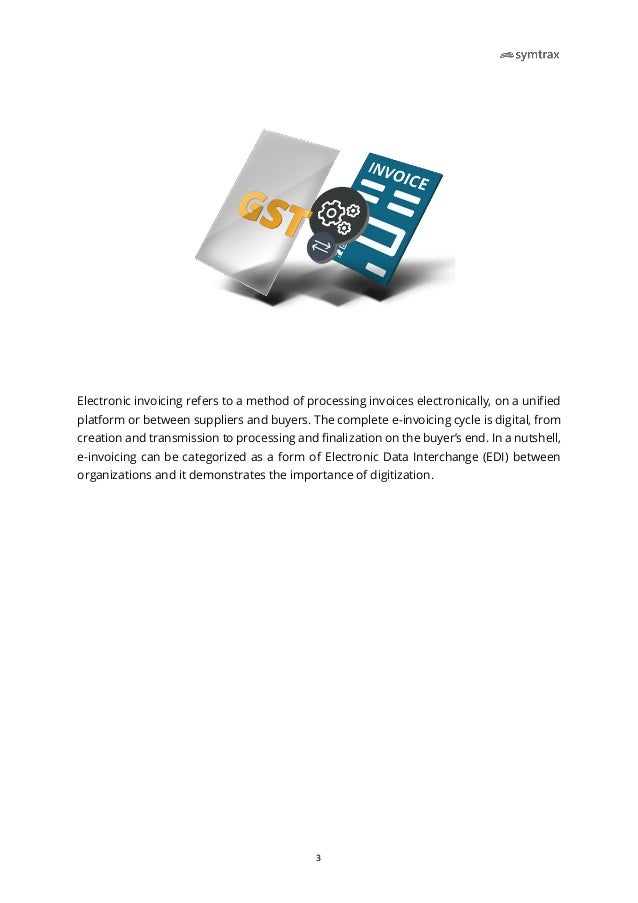
Electronic invoicing refers to a method of processing invoices electronically, on a unified
platform or between suppliers and buyers. The complete e-invoicing cycle is digital, from
creation and transmission to processing and finalization on the buyer’s end. In a nutshell,
e-invoicing can be categorized as a form of Electronic Data Interchange (EDI) between
organizations and it demonstrates the importance of digitization.
4
1.
E-invoicing
under
GST regulations
5
It is important to note that e-invoicing under GST does not generate invoices for the
supplier. Instead it is a platform for supplier-generated invoices to be registered on a
common unified government portal (Invoice Registration Portal). Therefore, taxpayers
can continue to use their existing Accounting/ERP systems to create invoices and report
them to the IRP to be uniquely identified with an Invoice Reference Number (IRN) hash
and QR code.
E-invoicing under GST is only implemented for invoices pertaining to B2B transactions
across the country, with a few exceptions.
These exceptions are:
• SEZ (Special Economic Zone units)
• Financial institutions
• Insurance companies
• Banking sectors (including non-banking financial companies)
• Goods transport agencies (GTAs) providing services solely for the
transportation of goods by road
• Passenger transportation services,
• Multiplexes
E-invoicing is applicable for:
• Supplies to registered taxpayers (involved in a B2B transaction)
• Supplies to special economic zone units (with or without payment),
• Export supplies (with or without payment),
• Deemed exports
Documents that are applicable for e-invoicing include invoices, debit notes, and credit
notes.
6
2.
E-invoicing
processes
and
technical
specifications
7
The e-invoicing process contains the following stages. These need to be followed for
successful registration.
Pre-requisites:
• The Invoice Registration Portal (IRP) is accessible via an API. This is possible
through a government-approved direct API integration or integration via a GST
Suvidha Provider (GSP).
• Your internal invoicing system needs to be configured in accordance with
government compliance protocols to be able to successfully communicate
with the IRP.
Process:
1. The invoice/CN/DN will be generated by your company as per your invoicing
guidelines. IRP only reads electronic documents in a standard JSON format.
This must be defined per GSTN guidelines along with a pre-defined set of
mandatory values known as the schema (information provided below).
Essential details, such as supplier and buyer GSTIN, invoice number, supply
type, document type, item list, amount etc., need to be defined in a JSON
format before being sent to the IRP using the integrated API.
2. The IRP verifies the details provided in the JSON. Upon successful validation
and duplication checks, it then produces a response JSON to thesupplier which
contains the IRN and a digitally signed and encoded QR code for the invoice.
Simultaneously, the IRP also updates this information on the GST portal for
filing of returns and in the E-way bill portal (if applicable for that transaction).
After registering an invoice on the IRP, you can continue using your company branding
and customize your documents for further processing. As long as the invoice holds the
IRN and QR code, it is valid and legally binding.. Let’s look at how the two can work
together as a unified automation solution.
8
3.
Invoice
Reference Number
and
QR code
9
The IRN is a unique 64-digit hash generated by the IRP for each registered document. This
hash is generated using a computer algorithm (RSA256) from a combination of the
supplier’s GSTIN, financial year of the invoice, document type, and document number.
After an IRN has been generated for an invoice, it will be available to the taxpayer for
reference on the portal for 24 hours.
After generation, an IRN cannot be modified, deleted, or changed. If, however, the invoice
for which an IRN has been generated contains incorrect information, you can cancel the
IRN for that invoice. After cancellation, the same invoice with the same document number
cannot be submitted again to the IRP for IRN generation.
Therefore, in case of cancellation, a new document with corrected information and
updated document number has to be uploaded to the IRP to generate a new IRN.
QR Code details
A digitally-signed QR code comes in the JSON output from the IRP. The information
contained in the QR code includes the following parameters:
• GSTIN of the supplier
• GSTIN of the recipient/buyer
• Invoice number as given by the supplier
• Date of the generation of invoice
• Invoice value (taxable value on the amount)
• Number of line items
• HSN Code of the main item (the item having the highest amount)
• Unique IRN hash
• Date of IRN generation
• Digital signature
10
Why and how is this QR code useful?
- It makes it very easy to verify an invoice, which can be done simply by scanning
the QR code (specially with an application that is available offline). As a result, tax
officials can easily ascertain the authenticity of an invoice and validate it.
- Data is machine verifiable, removing the need for manual checks. This is notably
helpful for bulk machine verification, which saves time and ensures that the data
is secure, reliable, and accurate.
It is important to note here that the details of the QR code cannot be changed or
tampered with. Upon doing so, the invoice will be deemed invalid, resulting in
unsuccessful verification. The QR codemust be printed on the invoice issued to the buyer:
this cannot be done on a separate document.
11
4.
E-invoicing
with
E-way bill
12
Before the introduction of e-invoicing, the government had introduced a document called
the e-way bill, which is mandatory for the physical transportation and/or shipment of
good. Now that the invoicing process has been digitized, e-way bills cannot be generated
separately. Henceforth, e-invoicing and e-way bill will be an integrated process that can
only be done through the e-invoicing system.
Let’s see what e-way bills are and how do they integrate with the e-invoicing process.
What is an E-way bill?
E-way bill is an electronic bill, required by law, to be generated for the transportation and
shipment of goods worth ₹50,000 and more. With the introduction of e-way bills, the idea
was to help facilitate supply chain activities and prevent drawbacks that occur due to
incorrect transport information, delays in delivery, illegal transportation, etc., that can
hamper legitimate tax collection.
An E-way bill (EWB) is generated from the NIC E-way bill portal and is supposed to be
carried by the transporter along with the consignment. Having an e-way bill process
keeps consignments from having to make unnecessary stops and has helped reduce
documentation requirements. Therefore, it’s impact on the logistics industry has been
tremendous.
We have a detailed blog on the impact and importance of E-way bill. You can read it here
for more information.
E-way bill consists of two parts in which the data needs to be filled in order to successfully
generate it:
• Part A details needs to be filled out but the supplier or the buyer which includes
information such as consignor and consignee GSTIN, place of delivery, invoice
and/or document number, type of supply, HSN code, item list, goods value, etc.
• Part B details are filled out by the parties involved (buyer or supplier) or the
transporter responsible for the transportation of the goods. This section contains
details such as transporter details, vehicle type, vehicle number, mode of
transportation, distance between dispatch and shipping, etc.
The integration of E-way bill with E-invoicing
To ease the e-way bill process and to take the digitization curve ahead, GSTN introduced
a common platform for the generation of e-invoicing with e-way bills. So, for
organizations to whom both e-invoicing and e-way bill generation is applicable, can
essentially get both documents through a single process.
13
How this works is that the data for generation of IRN and EWB number will be sent
together to the IRP as the only input document. If the details of Part B section i.e., the
transporter details have been provided together with the e-invoicing details in the JSON
input, the IRP will return both the IRN and the EWB number. The IRP communicates with
the e-way bill portal in real-time by auto-populating the Part A details with the provision
of Part B details in order to successfully carry out both the processes.
14
5.
E-invoicing Schema
of mandatory
parameters
15
Type Parameters Description
user_gstin GSTIN of API User
Transaction
Details
supply_type
"Type of Supply: B2B Business to Business,
SEZWP - With SEZ payment, SEZWOP - SEZ
without payment, EXPWP - Export With
Payment, EXPWOP - Export without payment,
DEXP - Deemed Export"
Document
Details
document_type
"Document Type: INV-INVOICE, CRN-CREDIT
NOTE, DBN-DEBIT NOTE"
document_number Document Number
document_date Document Date
Seller Details
Gstin GSTIN
legal_name Legal Name
address1 Building / Flat no, Road / Street
Location Location
Pincode Pincode
state_code State Name
Buyer Details
Gstin GSTIN of Buyer, PRO Exporting ow"
legal_name Legal Name
place_of_supply
State code of place of supply. If POS lies outside
the country, a code-the-Shall BE 96."
address1
"Address 1 of-the Buyer. (Building / Flat no.,
Road / Street etc.)"
Location Location
Dispatch
Details
company_name
"Name of the company From where the Goods
are dispatched"
address1
"Address 1 From Which entity of-the Goods are
dispatched. (Building / Flat no.Road / Street
etc.)"
Location Location
Pincode Pincode
state_code State code
Shipping
Details
legal_name Legal Name
address1
"Address1 of-the-the entity to whom supplies
are shipped to. (Building / Flat no., Road / Street
etc.)"
Location
"Place (City, Town, Village) entity to whom-the
supplies are shipped to."
Pincode Pincode
state_code "State Code to which supplies are shipped to."
Reference
Details
invoice_period_start_date Invoice Period Start Date
invoice_period_end_date Invoice Period End Date
Preceding
document
details
reference_of_original_invoic
e
"Reference of original invoice, ow ANY."
preceding_invoice_date Preceding Invoice Date
Value Details
total_assessable_value Total Assessable value of items for
total_invoice_value Final Invoice value
Item List item_serial_number Serial No. of Item
16
is_service
Specify the-WHETHER or not supply the service.
Specify Y for Service
hsn_code HSN Code
unit_price Unit Price-Rate
total_amount Gross Amount (Unit Price * Quantity)
assessable_value Taxable Value (Total Amount -Discount)
gst_rate
The GST rate, as represented Percentage That
applied to-the invoiced item. The Will IGST-only
rate.
total_item_value
Total Item Value = Assessable Amount *
[1+(CGST Rate + SGST Rate + Cess Rate + State
Cess Rate)] + Cess NonAdvol Amount
Batch Details Name Batch name
E-way Bill
Details
supplyType Supply whether it is outward/inward.
subSupplyType Sub types of Supply
subSypplyDesc
Sub Supply Description if selected “Others” in
subSupplyType
docType Document Type
docNo Document No
docDate Document Date
fromGstin GSTIN of the Consignor
fromPincode Pincode of consignor
fromStateCode State of consignor
actFromStateCode State of Supply
toGstin GSTIN of consignee
toPincode Pincode of the consignee
toStateCode State of Supply
actToStateCode State of Supply
cgstValue CGST Amount
sgstValue SGST Amount
igstValue IGST Amount
transporterId Transporter Id
transDistance Distance of transportation
transactionType Type of transaction
transDocNo Transporter Doc No
transDocDate Transporter Doc Date
transMode Mode of transportation
VehicleType Type of Vehcile
vehicleNo Vehicle No.
totInvValue Total Invoice Value
transporterName Transporter Name
productName Name of the Product
productDesc Description of the Product
hsnCode HSN Code of the Product
quantity Quantity of Product in Numbers
qtyUnit Unit of the Product, like Liter,Kg etc
cgstRate CGST Rate
sgstRate SGST Rate
igstRate IGST Rate
cessRate CESS Rate
cessNonadvol Cess Non-Advolerum
17
taxableAmount Taxable Amount
18
6.
Why
is E-invoicing being
implemented?
19
E-invoicing implementation signifies the bridging of digitization and standard business
processes. This will benefit not just taxpayers but the government as well.
The advantages of an e-invoicing system:
- A unified platform: E-invoicing will serve as the only platform for the reporting of
all B2B invoices thereby making it the only means of authorization.
- Curbing tax evasion: All information will be populated on the GST portal before
a transaction occurs, making it difficult to manipulate invoice data. Furthermore,
with duplication checks the generation of fake invoices is avoided. As a result, false
income tax claims cannot be made by a registered taxpayer.
- Common document standard: A consistent format for all invoices across the
country improves readability and usability.
- Multi-platform operability: Integration with the e-way bill system makes e-
invoicing and e-way bill creation a seamless process. In addition, auto-populating
information on the GST portal allows registered recipients to view and edit. This is
especially beneficial when the persons involved file GSTR-1.
- Paperless invoice registration process: Complete electronic processing of
documents makes it necessary for companies to adapt to a part of digitization.
- Reduction in data mismatch and errors: Having to report to a single platform
increases transparency and reduces the need for generation of multiple
documents.
- Less processing cost: With electronic generation, submission, and processing of
legal documents, the expenses with respect to printing, signing, and even scanning
is reduced.
20
7.
E-invoicing Software
21
The ideal e-invoicing solution or software will integrate seamlessly with your existing
document management process. This will reduce the strain of any major changes that
you might have to make to your infrastructure. With the right solution, your entire
invoicing system can be digitized to deliver business-ready documents in the best format
for your company.
Proper format support and customization options let you work with all types of
documents without the need for time-consuming conversions. Gain flexibility while
ensuring that your processes are error-free and secure.
To learn more about what you would need in an e-invoicing software, read our blog here.
The advantages of an e-invoicing solution:
- Recognized listing which allows direct API access to the IRP.
- Track and monitor invoices in real-time from a user-friendly interface. You can
view the input and output documents, along with the final PDF with IRN and QR
code. Easily perform actions such as cancelling an e-invoice and re-submitting it
to the IRP.
- Validation checks ensure that all compliance guidelines and parameters are being
met before submitting the document to the IRP.
- Automate the entire process and eliminate the need for manual intervention. This
reduces data entry errors and the hassle of re-processing afterwards.
Symtrax e-invoicing solutions offers a wide range of optimization strategies that can
help transitioning towards e-invoicing become a seamless process.
Contact our experts
to schedule a free demo
22
About
The author
Priyanshu Anand – Technical Writer
Priyanshu Anand works as a Technical Writer for Symtrax and writes engaging content to
express and convey precise information to readers.

En ebook-e-invoicing-under-gst-applicability-updates-mandates-and process

  • 1.
  • 2.
    1 Table of content Overview .....................................................................................................................................2 1.E-invoicing under GST regulations.....................................................................................4 2. E-invoicing processes and technical specifications .........................................................6 3. Invoice Reference Number and QR code..........................................................................8 4. E-invoicing with E-way bill..................................................................................................11 5. E-invoicing Schema of mandatory parameters...............................................................14 6. Why is E-invoicing being implemented?..........................................................................18 7. E-invoicing Software............................................................................................................20 About The author.....................................................................................................................22
  • 3.
  • 4.
    3 Electronic invoicing refersto a method of processing invoices electronically, on a unified platform or between suppliers and buyers. The complete e-invoicing cycle is digital, from creation and transmission to processing and finalization on the buyer’s end. In a nutshell, e-invoicing can be categorized as a form of Electronic Data Interchange (EDI) between organizations and it demonstrates the importance of digitization.
  • 5.
  • 6.
    5 It is importantto note that e-invoicing under GST does not generate invoices for the supplier. Instead it is a platform for supplier-generated invoices to be registered on a common unified government portal (Invoice Registration Portal). Therefore, taxpayers can continue to use their existing Accounting/ERP systems to create invoices and report them to the IRP to be uniquely identified with an Invoice Reference Number (IRN) hash and QR code. E-invoicing under GST is only implemented for invoices pertaining to B2B transactions across the country, with a few exceptions. These exceptions are: • SEZ (Special Economic Zone units) • Financial institutions • Insurance companies • Banking sectors (including non-banking financial companies) • Goods transport agencies (GTAs) providing services solely for the transportation of goods by road • Passenger transportation services, • Multiplexes E-invoicing is applicable for: • Supplies to registered taxpayers (involved in a B2B transaction) • Supplies to special economic zone units (with or without payment), • Export supplies (with or without payment), • Deemed exports Documents that are applicable for e-invoicing include invoices, debit notes, and credit notes.
  • 7.
  • 8.
    7 The e-invoicing processcontains the following stages. These need to be followed for successful registration. Pre-requisites: • The Invoice Registration Portal (IRP) is accessible via an API. This is possible through a government-approved direct API integration or integration via a GST Suvidha Provider (GSP). • Your internal invoicing system needs to be configured in accordance with government compliance protocols to be able to successfully communicate with the IRP. Process: 1. The invoice/CN/DN will be generated by your company as per your invoicing guidelines. IRP only reads electronic documents in a standard JSON format. This must be defined per GSTN guidelines along with a pre-defined set of mandatory values known as the schema (information provided below). Essential details, such as supplier and buyer GSTIN, invoice number, supply type, document type, item list, amount etc., need to be defined in a JSON format before being sent to the IRP using the integrated API. 2. The IRP verifies the details provided in the JSON. Upon successful validation and duplication checks, it then produces a response JSON to thesupplier which contains the IRN and a digitally signed and encoded QR code for the invoice. Simultaneously, the IRP also updates this information on the GST portal for filing of returns and in the E-way bill portal (if applicable for that transaction). After registering an invoice on the IRP, you can continue using your company branding and customize your documents for further processing. As long as the invoice holds the IRN and QR code, it is valid and legally binding.. Let’s look at how the two can work together as a unified automation solution.
  • 9.
  • 10.
    9 The IRN isa unique 64-digit hash generated by the IRP for each registered document. This hash is generated using a computer algorithm (RSA256) from a combination of the supplier’s GSTIN, financial year of the invoice, document type, and document number. After an IRN has been generated for an invoice, it will be available to the taxpayer for reference on the portal for 24 hours. After generation, an IRN cannot be modified, deleted, or changed. If, however, the invoice for which an IRN has been generated contains incorrect information, you can cancel the IRN for that invoice. After cancellation, the same invoice with the same document number cannot be submitted again to the IRP for IRN generation. Therefore, in case of cancellation, a new document with corrected information and updated document number has to be uploaded to the IRP to generate a new IRN. QR Code details A digitally-signed QR code comes in the JSON output from the IRP. The information contained in the QR code includes the following parameters: • GSTIN of the supplier • GSTIN of the recipient/buyer • Invoice number as given by the supplier • Date of the generation of invoice • Invoice value (taxable value on the amount) • Number of line items • HSN Code of the main item (the item having the highest amount) • Unique IRN hash • Date of IRN generation • Digital signature
  • 11.
    10 Why and howis this QR code useful? - It makes it very easy to verify an invoice, which can be done simply by scanning the QR code (specially with an application that is available offline). As a result, tax officials can easily ascertain the authenticity of an invoice and validate it. - Data is machine verifiable, removing the need for manual checks. This is notably helpful for bulk machine verification, which saves time and ensures that the data is secure, reliable, and accurate. It is important to note here that the details of the QR code cannot be changed or tampered with. Upon doing so, the invoice will be deemed invalid, resulting in unsuccessful verification. The QR codemust be printed on the invoice issued to the buyer: this cannot be done on a separate document.
  • 12.
  • 13.
    12 Before the introductionof e-invoicing, the government had introduced a document called the e-way bill, which is mandatory for the physical transportation and/or shipment of good. Now that the invoicing process has been digitized, e-way bills cannot be generated separately. Henceforth, e-invoicing and e-way bill will be an integrated process that can only be done through the e-invoicing system. Let’s see what e-way bills are and how do they integrate with the e-invoicing process. What is an E-way bill? E-way bill is an electronic bill, required by law, to be generated for the transportation and shipment of goods worth ₹50,000 and more. With the introduction of e-way bills, the idea was to help facilitate supply chain activities and prevent drawbacks that occur due to incorrect transport information, delays in delivery, illegal transportation, etc., that can hamper legitimate tax collection. An E-way bill (EWB) is generated from the NIC E-way bill portal and is supposed to be carried by the transporter along with the consignment. Having an e-way bill process keeps consignments from having to make unnecessary stops and has helped reduce documentation requirements. Therefore, it’s impact on the logistics industry has been tremendous. We have a detailed blog on the impact and importance of E-way bill. You can read it here for more information. E-way bill consists of two parts in which the data needs to be filled in order to successfully generate it: • Part A details needs to be filled out but the supplier or the buyer which includes information such as consignor and consignee GSTIN, place of delivery, invoice and/or document number, type of supply, HSN code, item list, goods value, etc. • Part B details are filled out by the parties involved (buyer or supplier) or the transporter responsible for the transportation of the goods. This section contains details such as transporter details, vehicle type, vehicle number, mode of transportation, distance between dispatch and shipping, etc. The integration of E-way bill with E-invoicing To ease the e-way bill process and to take the digitization curve ahead, GSTN introduced a common platform for the generation of e-invoicing with e-way bills. So, for organizations to whom both e-invoicing and e-way bill generation is applicable, can essentially get both documents through a single process.
  • 14.
    13 How this worksis that the data for generation of IRN and EWB number will be sent together to the IRP as the only input document. If the details of Part B section i.e., the transporter details have been provided together with the e-invoicing details in the JSON input, the IRP will return both the IRN and the EWB number. The IRP communicates with the e-way bill portal in real-time by auto-populating the Part A details with the provision of Part B details in order to successfully carry out both the processes.
  • 15.
  • 16.
    15 Type Parameters Description user_gstinGSTIN of API User Transaction Details supply_type "Type of Supply: B2B Business to Business, SEZWP - With SEZ payment, SEZWOP - SEZ without payment, EXPWP - Export With Payment, EXPWOP - Export without payment, DEXP - Deemed Export" Document Details document_type "Document Type: INV-INVOICE, CRN-CREDIT NOTE, DBN-DEBIT NOTE" document_number Document Number document_date Document Date Seller Details Gstin GSTIN legal_name Legal Name address1 Building / Flat no, Road / Street Location Location Pincode Pincode state_code State Name Buyer Details Gstin GSTIN of Buyer, PRO Exporting ow" legal_name Legal Name place_of_supply State code of place of supply. If POS lies outside the country, a code-the-Shall BE 96." address1 "Address 1 of-the Buyer. (Building / Flat no., Road / Street etc.)" Location Location Dispatch Details company_name "Name of the company From where the Goods are dispatched" address1 "Address 1 From Which entity of-the Goods are dispatched. (Building / Flat no.Road / Street etc.)" Location Location Pincode Pincode state_code State code Shipping Details legal_name Legal Name address1 "Address1 of-the-the entity to whom supplies are shipped to. (Building / Flat no., Road / Street etc.)" Location "Place (City, Town, Village) entity to whom-the supplies are shipped to." Pincode Pincode state_code "State Code to which supplies are shipped to." Reference Details invoice_period_start_date Invoice Period Start Date invoice_period_end_date Invoice Period End Date Preceding document details reference_of_original_invoic e "Reference of original invoice, ow ANY." preceding_invoice_date Preceding Invoice Date Value Details total_assessable_value Total Assessable value of items for total_invoice_value Final Invoice value Item List item_serial_number Serial No. of Item
  • 17.
    16 is_service Specify the-WHETHER ornot supply the service. Specify Y for Service hsn_code HSN Code unit_price Unit Price-Rate total_amount Gross Amount (Unit Price * Quantity) assessable_value Taxable Value (Total Amount -Discount) gst_rate The GST rate, as represented Percentage That applied to-the invoiced item. The Will IGST-only rate. total_item_value Total Item Value = Assessable Amount * [1+(CGST Rate + SGST Rate + Cess Rate + State Cess Rate)] + Cess NonAdvol Amount Batch Details Name Batch name E-way Bill Details supplyType Supply whether it is outward/inward. subSupplyType Sub types of Supply subSypplyDesc Sub Supply Description if selected “Others” in subSupplyType docType Document Type docNo Document No docDate Document Date fromGstin GSTIN of the Consignor fromPincode Pincode of consignor fromStateCode State of consignor actFromStateCode State of Supply toGstin GSTIN of consignee toPincode Pincode of the consignee toStateCode State of Supply actToStateCode State of Supply cgstValue CGST Amount sgstValue SGST Amount igstValue IGST Amount transporterId Transporter Id transDistance Distance of transportation transactionType Type of transaction transDocNo Transporter Doc No transDocDate Transporter Doc Date transMode Mode of transportation VehicleType Type of Vehcile vehicleNo Vehicle No. totInvValue Total Invoice Value transporterName Transporter Name productName Name of the Product productDesc Description of the Product hsnCode HSN Code of the Product quantity Quantity of Product in Numbers qtyUnit Unit of the Product, like Liter,Kg etc cgstRate CGST Rate sgstRate SGST Rate igstRate IGST Rate cessRate CESS Rate cessNonadvol Cess Non-Advolerum
  • 18.
  • 19.
  • 20.
    19 E-invoicing implementation signifiesthe bridging of digitization and standard business processes. This will benefit not just taxpayers but the government as well. The advantages of an e-invoicing system: - A unified platform: E-invoicing will serve as the only platform for the reporting of all B2B invoices thereby making it the only means of authorization. - Curbing tax evasion: All information will be populated on the GST portal before a transaction occurs, making it difficult to manipulate invoice data. Furthermore, with duplication checks the generation of fake invoices is avoided. As a result, false income tax claims cannot be made by a registered taxpayer. - Common document standard: A consistent format for all invoices across the country improves readability and usability. - Multi-platform operability: Integration with the e-way bill system makes e- invoicing and e-way bill creation a seamless process. In addition, auto-populating information on the GST portal allows registered recipients to view and edit. This is especially beneficial when the persons involved file GSTR-1. - Paperless invoice registration process: Complete electronic processing of documents makes it necessary for companies to adapt to a part of digitization. - Reduction in data mismatch and errors: Having to report to a single platform increases transparency and reduces the need for generation of multiple documents. - Less processing cost: With electronic generation, submission, and processing of legal documents, the expenses with respect to printing, signing, and even scanning is reduced.
  • 21.
  • 22.
    21 The ideal e-invoicingsolution or software will integrate seamlessly with your existing document management process. This will reduce the strain of any major changes that you might have to make to your infrastructure. With the right solution, your entire invoicing system can be digitized to deliver business-ready documents in the best format for your company. Proper format support and customization options let you work with all types of documents without the need for time-consuming conversions. Gain flexibility while ensuring that your processes are error-free and secure. To learn more about what you would need in an e-invoicing software, read our blog here. The advantages of an e-invoicing solution: - Recognized listing which allows direct API access to the IRP. - Track and monitor invoices in real-time from a user-friendly interface. You can view the input and output documents, along with the final PDF with IRN and QR code. Easily perform actions such as cancelling an e-invoice and re-submitting it to the IRP. - Validation checks ensure that all compliance guidelines and parameters are being met before submitting the document to the IRP. - Automate the entire process and eliminate the need for manual intervention. This reduces data entry errors and the hassle of re-processing afterwards. Symtrax e-invoicing solutions offers a wide range of optimization strategies that can help transitioning towards e-invoicing become a seamless process. Contact our experts to schedule a free demo
  • 23.
    22 About The author Priyanshu Anand– Technical Writer Priyanshu Anand works as a Technical Writer for Symtrax and writes engaging content to express and convey precise information to readers.