
!
Session 5:!
Interview Confidently!
!
presented by Robin Frank
Social Media
!
I work with
companies large and
small to help them
build and tune-up
an engaging online
presence.
!
I’m known as a
dynamic speaker
and speak regularly
at national
conferences,
companies, and
events.
Personal Branding!
!
I help individuals in
many fields create
powerful personal
brands.!
!
My personal branding
strategy is featured in
the recent book
“Digital Marketing”
written by Larry Weber
and endorsed by Reid
Hoffman (Chairman,
Founder/LinkedIn) and
John Donahoe (CEO/
eBay).
Reboot Camp!
!
Innovative program to
help Moms confidently
re-enter the workforce
after a break.!
!
Six inspiring and
pragmatic sessions
cover topics from
networking and
interview skills to social
media and personal
branding, plus two
hours of one-on-one
coaching.
Mom!
!
Twin 8 Yr old boys!
!
Live in Mill Valley
Yours Truly
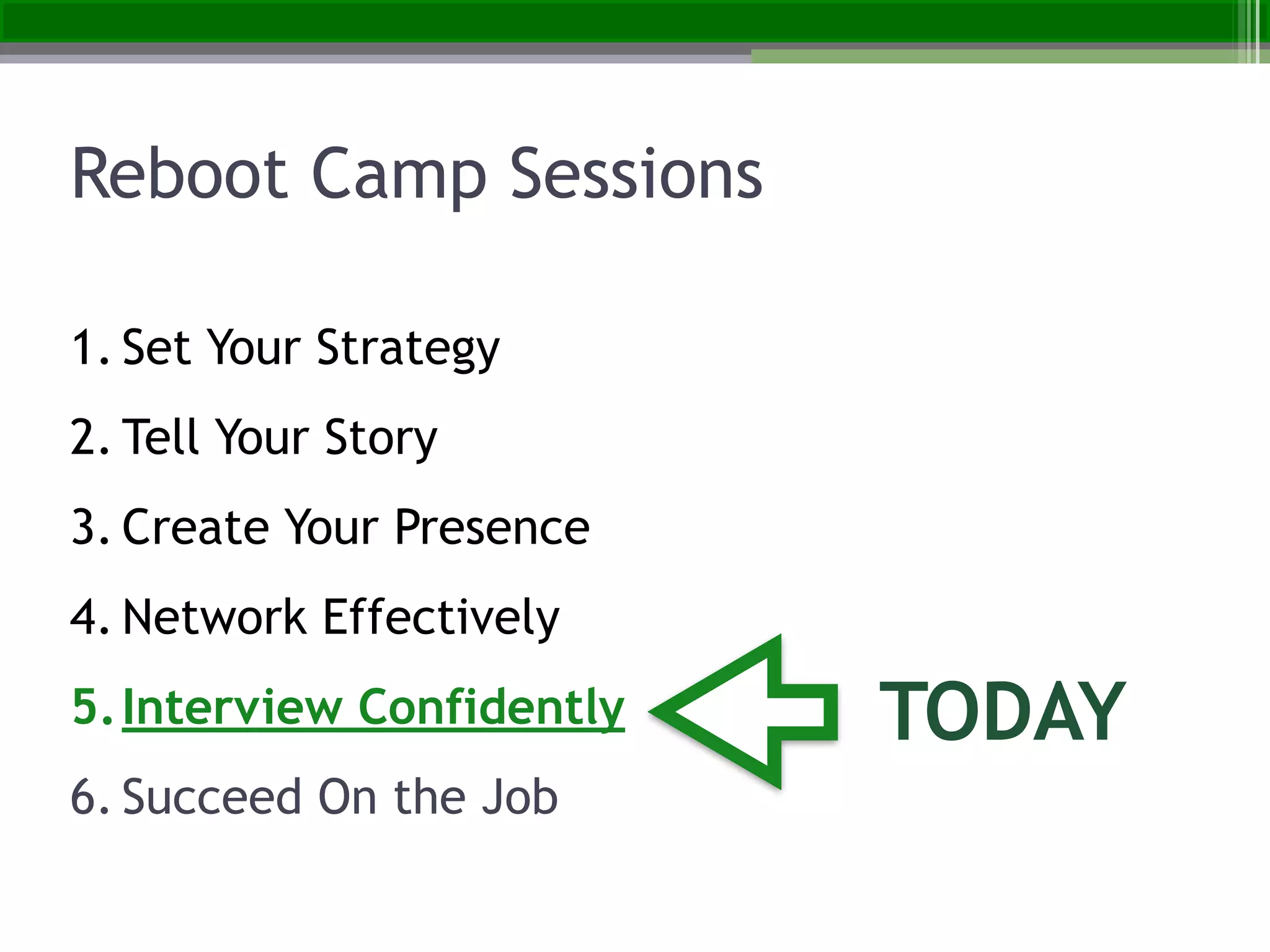
1. Set Your Strategy
2. Tell Your Story
3. Create Your Presence
4. Network Effectively
5.Interview Confidently
6. Succeed On the Job
Reboot Camp Sessions
TODAY
• This presentation will be available to you online - which means you are free to
listen without taking notes
• We have 15 minutes for questions at the end
• You also have 2 hours of one-on-one to use however you like
Today’s Session
Let’s Dive In!
5
Top 5 Keys to Acing the Interview
1. Own your time off
with confidence
2. Brush up on
interviewing tips
3. Take time to
prepare
4. Look and act
confident
5. Professional
social media use/
references
6
7
Own Your Gap Time with Strength
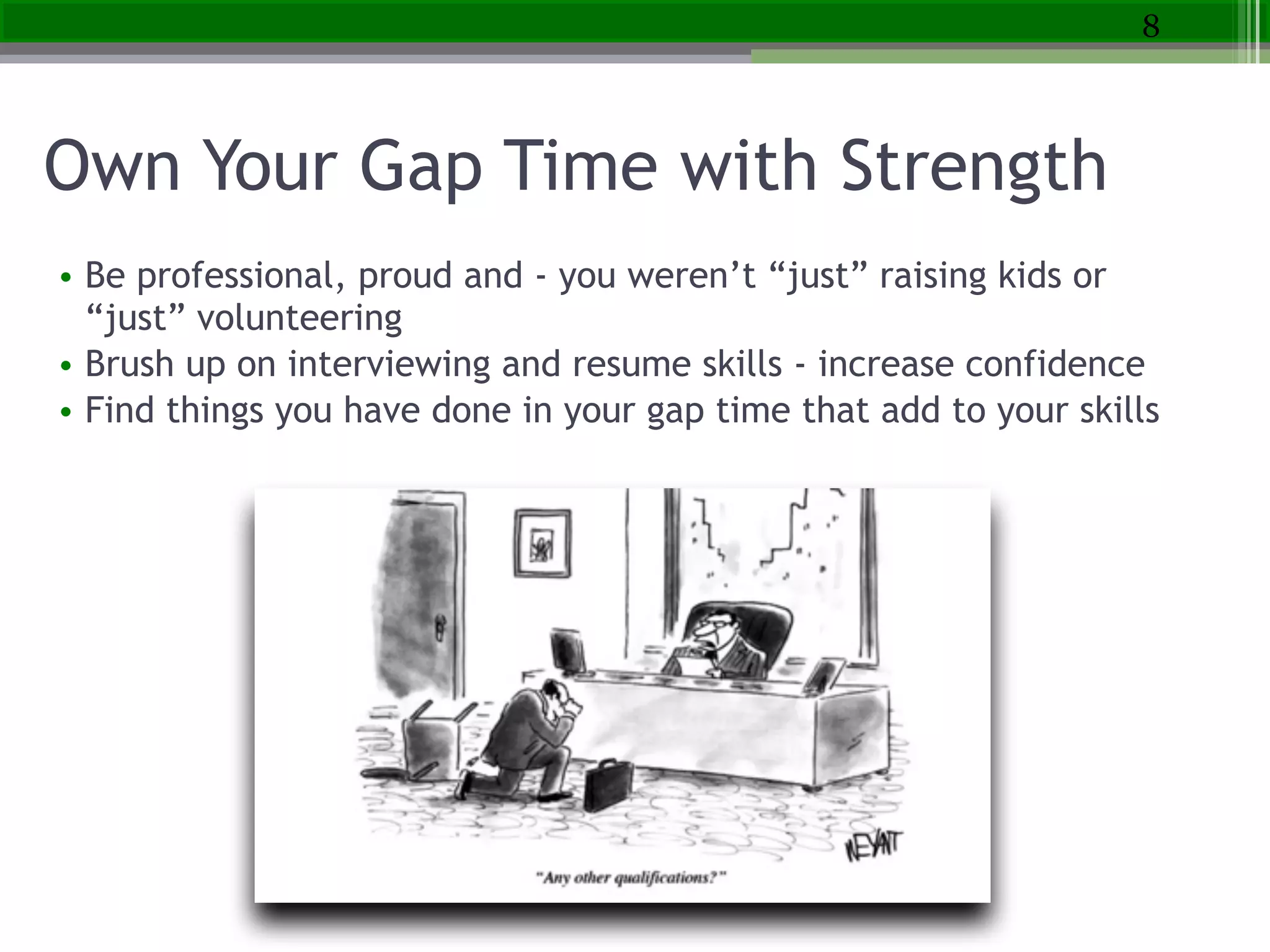
• Be professional, proud and - you weren’t “just” raising kids or
“just” volunteering
• Brush up on interviewing and resume skills - increase confidence
• Find things you have done in your gap time that add to your skills
8
Rewrite Negative Self Talk
• Three replacement statements
• “If you change the way you look at things, the things
you look at change.” - Wayne Dyer
• Focus on positive experiences - Hardwiring Happiness
9
Talking About the Gap
• It is OK to have a gap
• What matters is how you explain it in your
resume, cover letter and interview
10
Talking About the Gap
• Talk about your time off - what did you oversee
or coordinate - make it useful in some way
• “I have been a stay at home mom for the past
X years. During that time, I have been
volunteering at a local food bank where I’ve
overseen and coordinated several food drives
• It was during that time I realized my passion
for….
• I’ve been taking courses in …….”
• Be concise - don’t give too much detail
11
Moms Make Desirable Employees
• Experience, maturity and
perspective
• Resourceful and solutions
oriented
• Excellent time
management skills
• Adept people managers -
with finely honed
communication skills
• Eager to get back to
work
12
Be Positive and Enthusiastic
• “Thats why I am excited
to work for your company”
!
• The most crucial message
to deliver is how you are
ready to return to work
!
• Your enthusiasm can be
one of the aspects that
sets you aside from
everyone else
13
Communicate Your Childcare Game
Plan
• Some employers have concerns that childcare could cause absences
• Reassure your prospective employer that you have childcare
worked out, including a backup plan
14
Interviewing - Brush Up on Tips for
Success
15
Inside the Head of Your Interviewer
1. Have you got the
skills, expertise and
experience to perform
the job?
2. Are you enthusiastic
and interested in the
job and the company?
3. Will you fit into the
team, culture and
company?
16
Map Your Skills and Experience to the Job
17
• Look at the skills and
experience required for
the job
• Map your skills and
experience to those
required
• Prepare concrete
examples of your skills
in action and have
these memorized so
you can draw on them
during the interview
Draw on These to Answer Intimidating,
Open-Ended Questions
• Always go back to key skills, expertise and experience
when answering scary (and sometimes silly) questions
about yourself
• What are your greatest strengths / weaknesses?
• What can you do for us that other candidates can’t
• Why do you think you are right for this job?
• What do you think the main challenges will be?
18
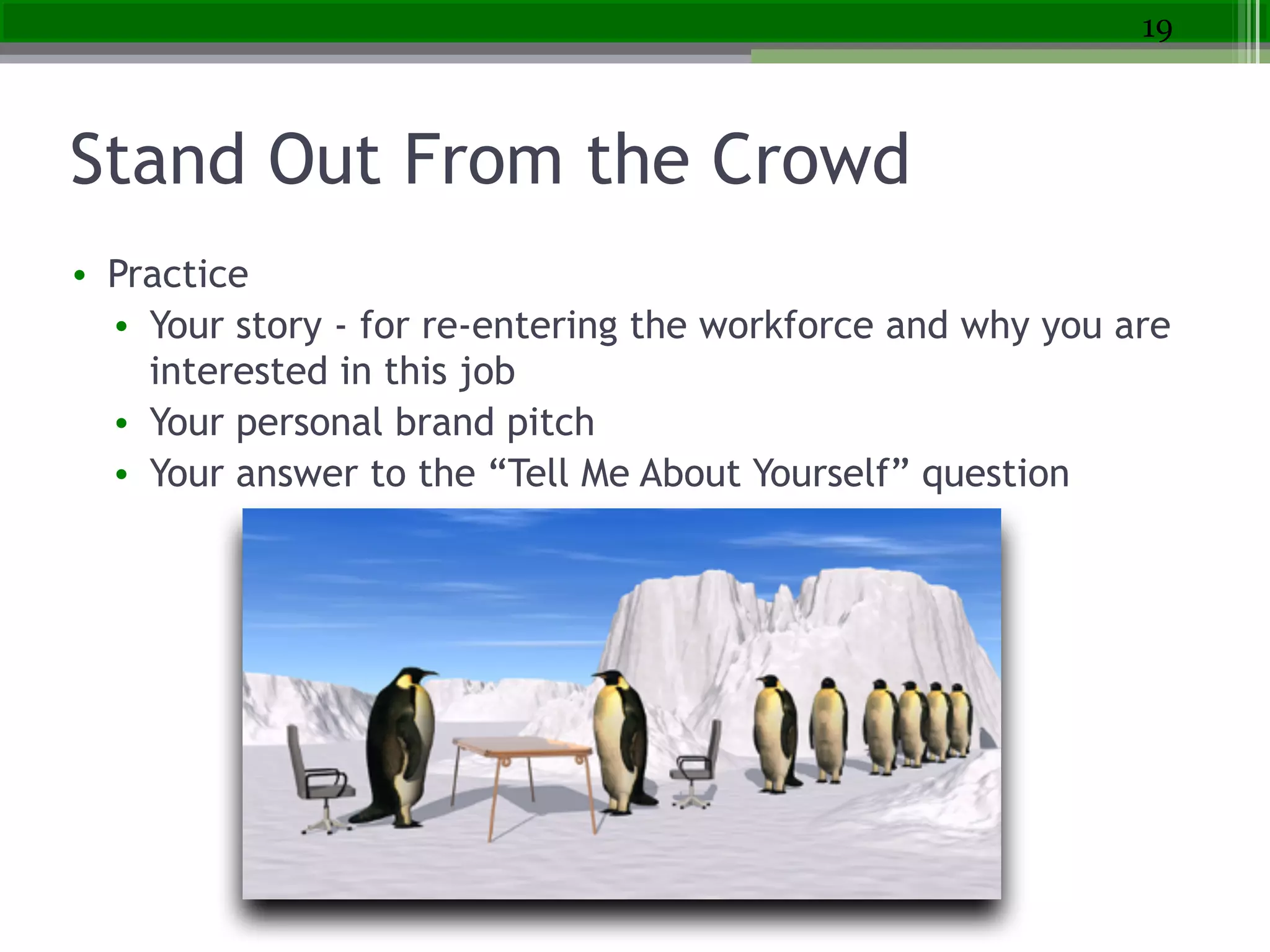
Stand Out From the Crowd
• Practice
• Your story - for re-entering the workforce and why you are
interested in this job
• Your personal brand pitch
• Your answer to the “Tell Me About Yourself” question
19
Backup Your Enthusiasm with
Research
20
• Of course you want the
interviewer to know you can’t
wait to join the company…
BUT…
• Nothing conveys this better
than a demonstrated
understanding of the
company, its strategy,
current performance,
structure, market position
and products
Your Bonus Homework
• Google
• Read the company's "FAQ" or "About
Us" section
• You will be reading the same
things as other candidates
• Also check out
• 10-K filing for strengths and
weaknesses which will inform
what value you can bring
• Annual Report - company
direction/goals so you can align
your answers
• Press Releases - company image
• Competitors - demonstrate you
know them
21
Prepare Questions for the
Interviewer
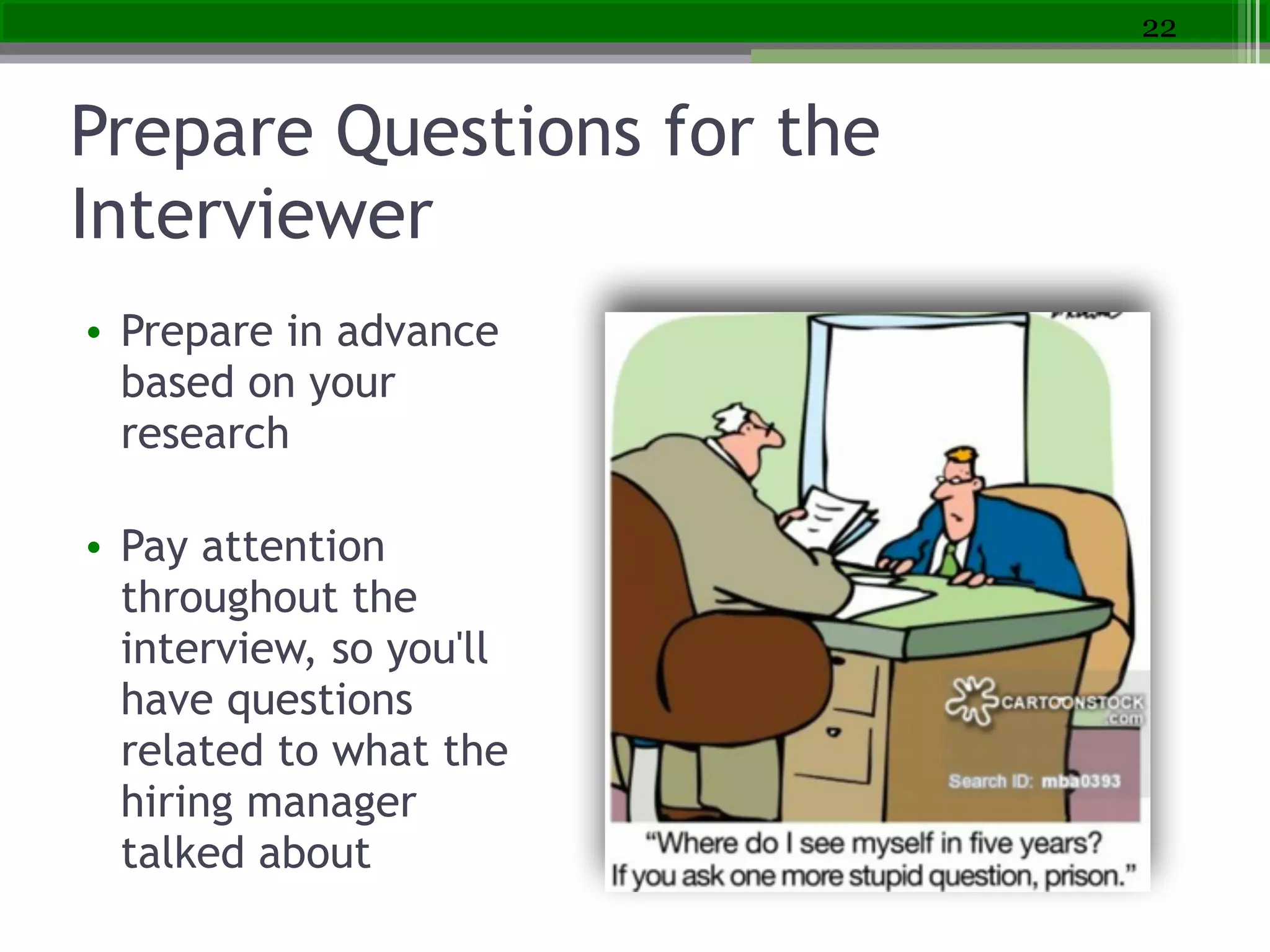
• Prepare in advance
based on your
research
!
• Pay attention
throughout the
interview, so you'll
have questions
related to what the
hiring manager
talked about
22
10 Thoughtful Questions to Ask
1. What’s the most important goal the person in this
role needs to accomplish in order to be successful?
2. What are the immediate priorities?
3. How will this skill be used on the job?
4. How will performance be measured?
5. Can you walk me through the organization chart?
6. What is the manager’s vision for the department
and this role?
7. What is your/the manager’s leadership style?
8. How are decisions made at the company? What’s
the appetite for change? What’s are the politics/
the intensity/the sophistication of the
infrastructure?
9. How do you plan to deal with x?
10.What are some things your competitors are doing
right that you need to copy?
23
2 Minute Exercises to Calm You
• You think you are calm
but then your body
gets nervous
• Palms over eyes
• Relaxes and relieves
eye strain
• Longer exhales
• Relaxes and calms
the sympathetic
nervous system (fight
& flight)
24
7 Seconds to Make a First
Impression
• The moment that stranger sees you, his or her brain makes a thousand
computations - Are you trustworthy, competent, likeable, confident?
• These computations are made at lightning speed — making major decisions
about one another in the first seven seconds of meeting
• The human brain is hardwired in this way as a prehistoric survival
mechanism – you can understand how to make those decisions work in your
favor
25
Nonverbal Cues are Influential
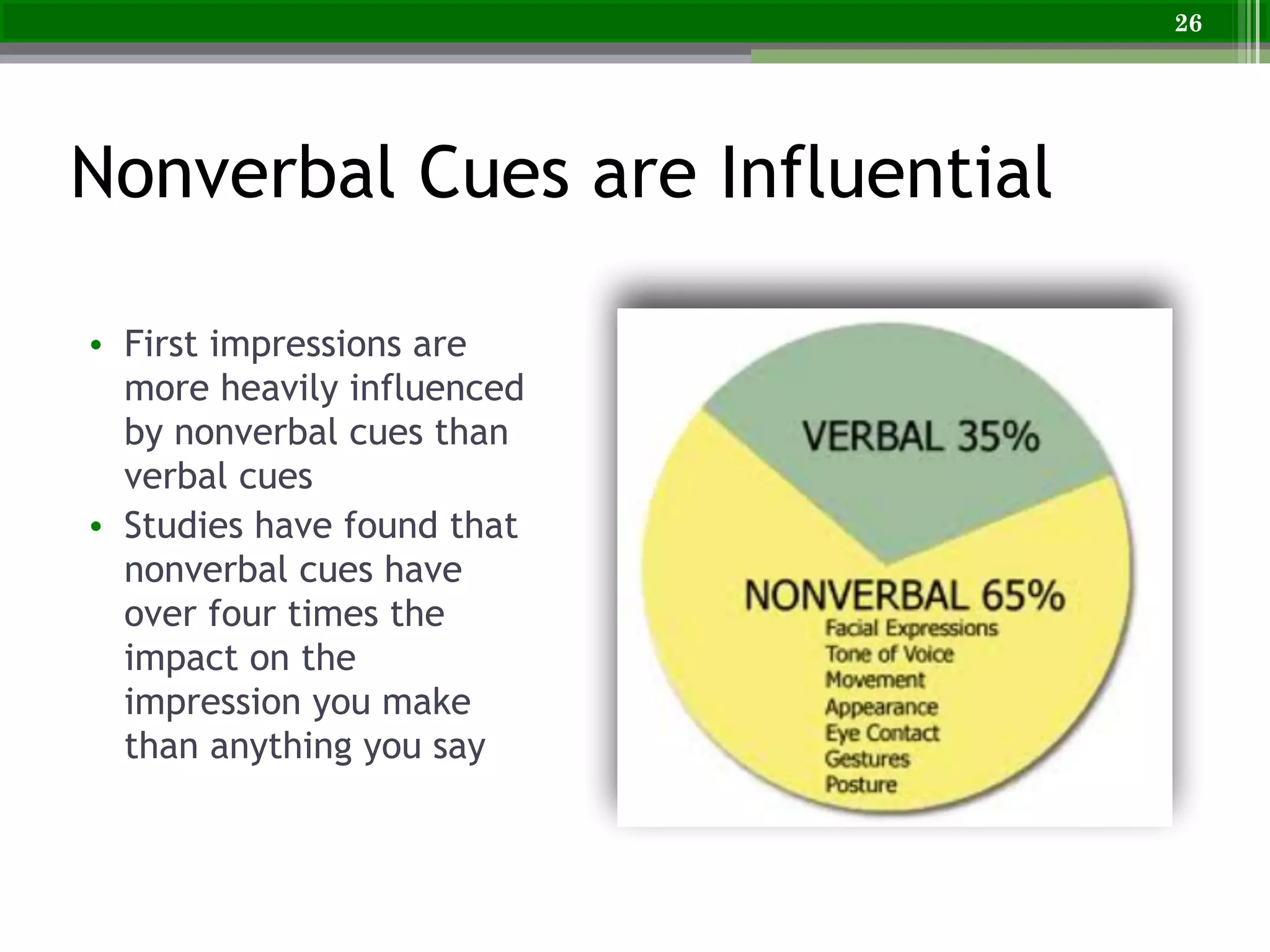
• First impressions are
more heavily influenced
by nonverbal cues than
verbal cues
• Studies have found that
nonverbal cues have
over four times the
impact on the
impression you make
than anything you say
26
Wear the Right Outfit
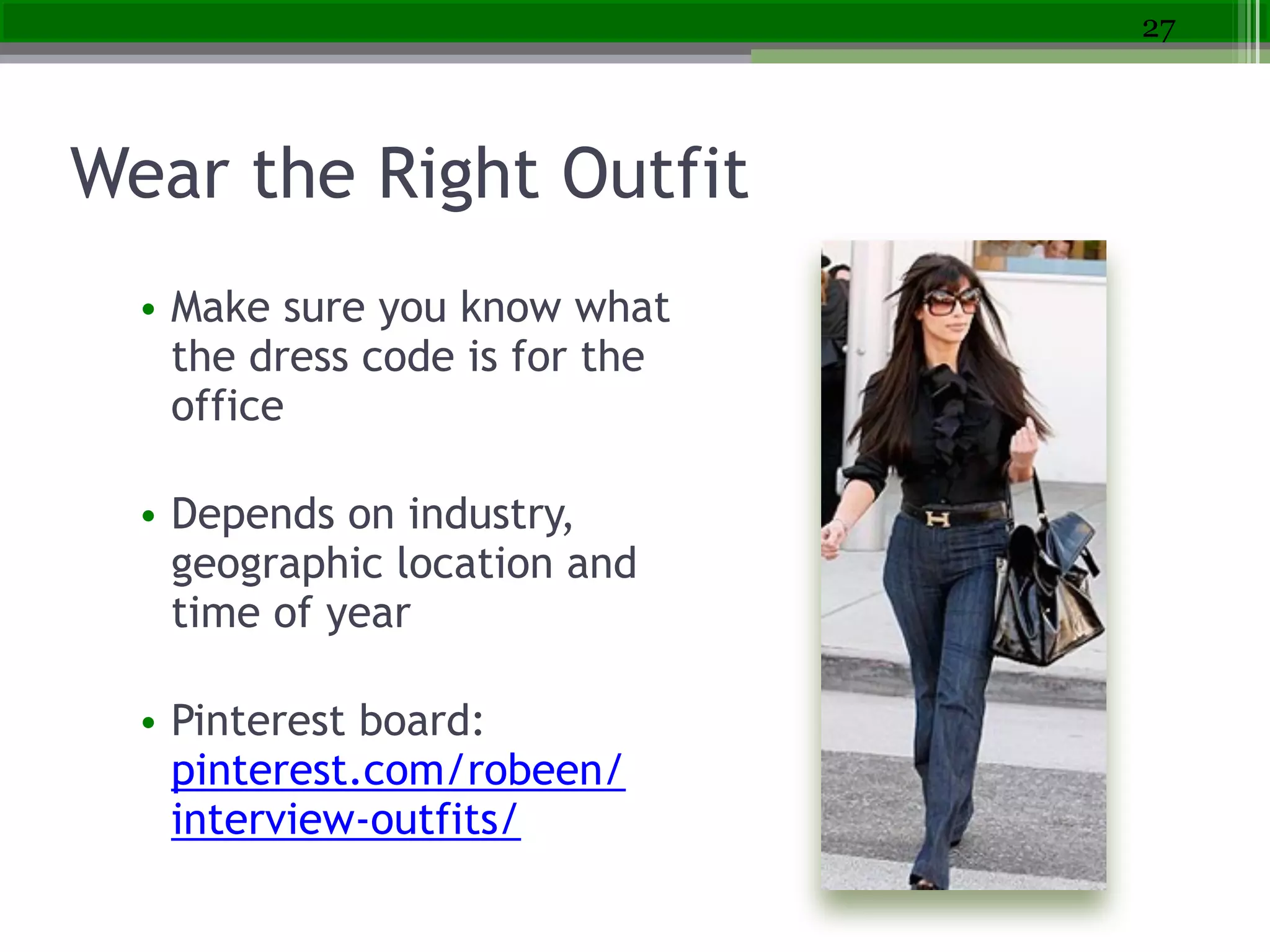
• Make sure you know what
the dress code is for the
office
!
• Depends on industry,
geographic location and
time of year
!
• Pinterest board:
pinterest.com/robeen/
interview-outfits/
27
Use Positive Body Language
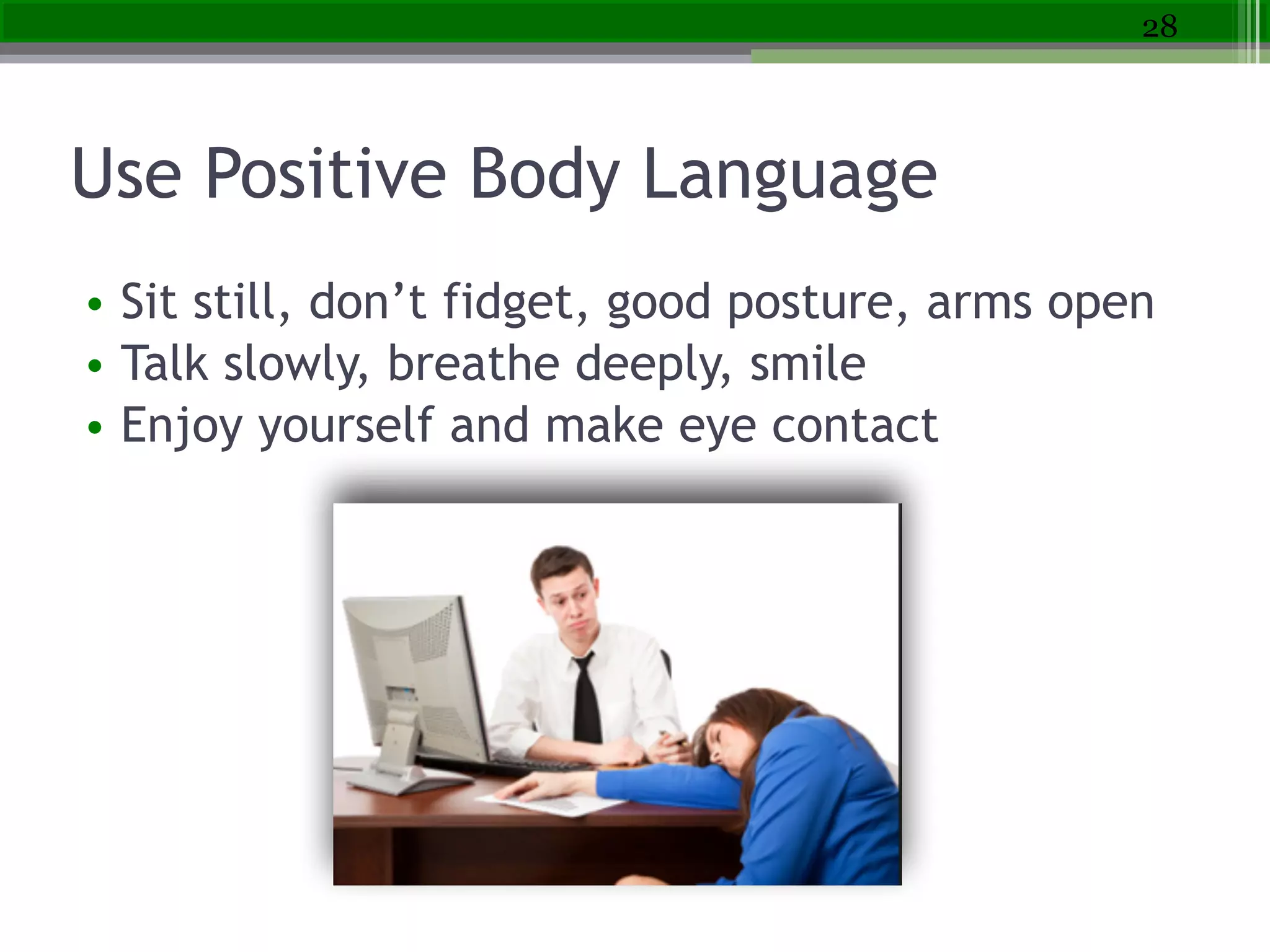
• Sit still, don’t fidget, good posture, arms open
• Talk slowly, breathe deeply, smile
• Enjoy yourself and make eye contact
28
Power Posing - Amy Cuddy
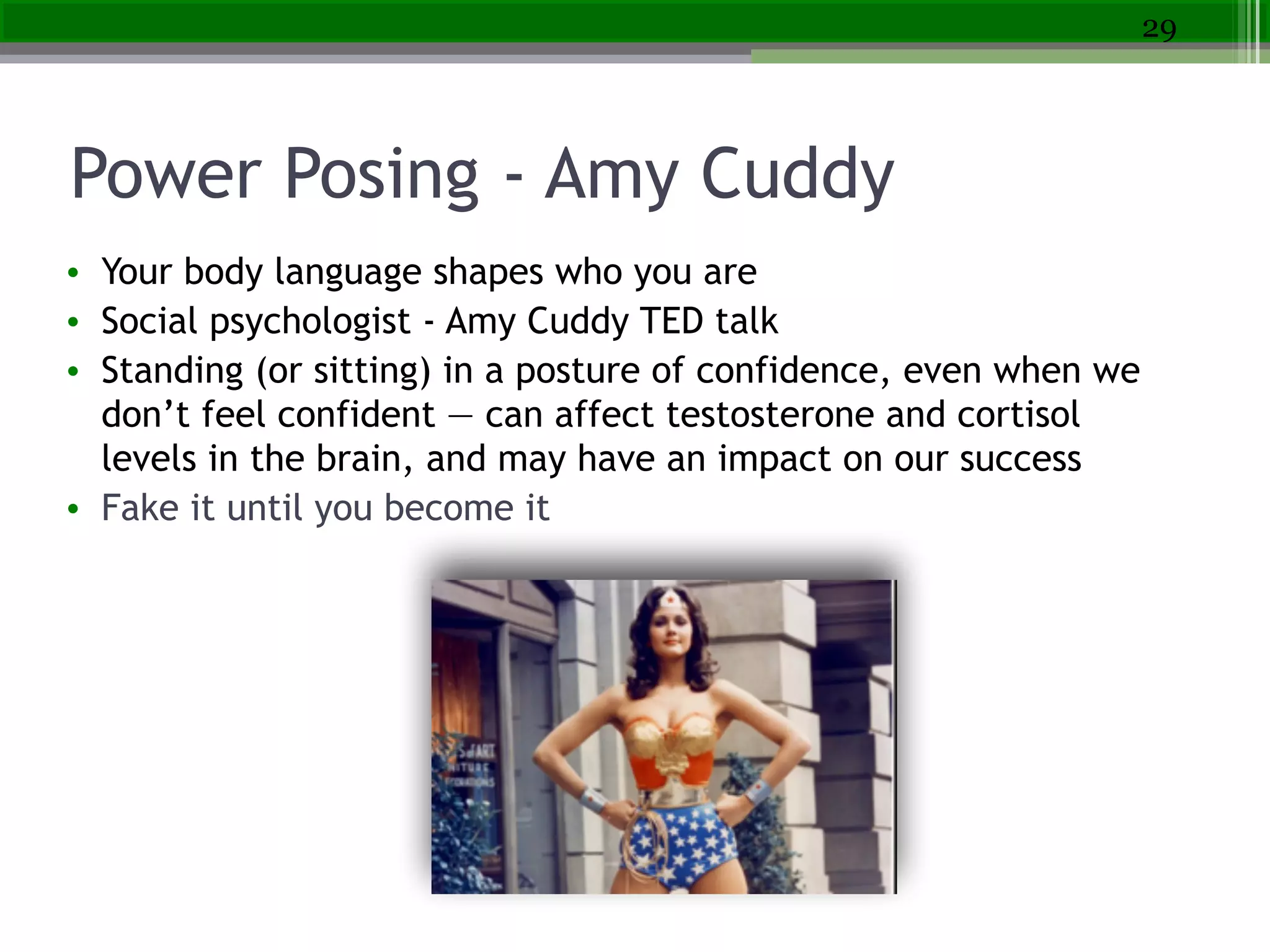
• Your body language shapes who you are
• Social psychologist - Amy Cuddy TED talk
• Standing (or sitting) in a posture of confidence, even when we
don’t feel confident — can affect testosterone and cortisol
levels in the brain, and may have an impact on our success
• Fake it until you become it
29
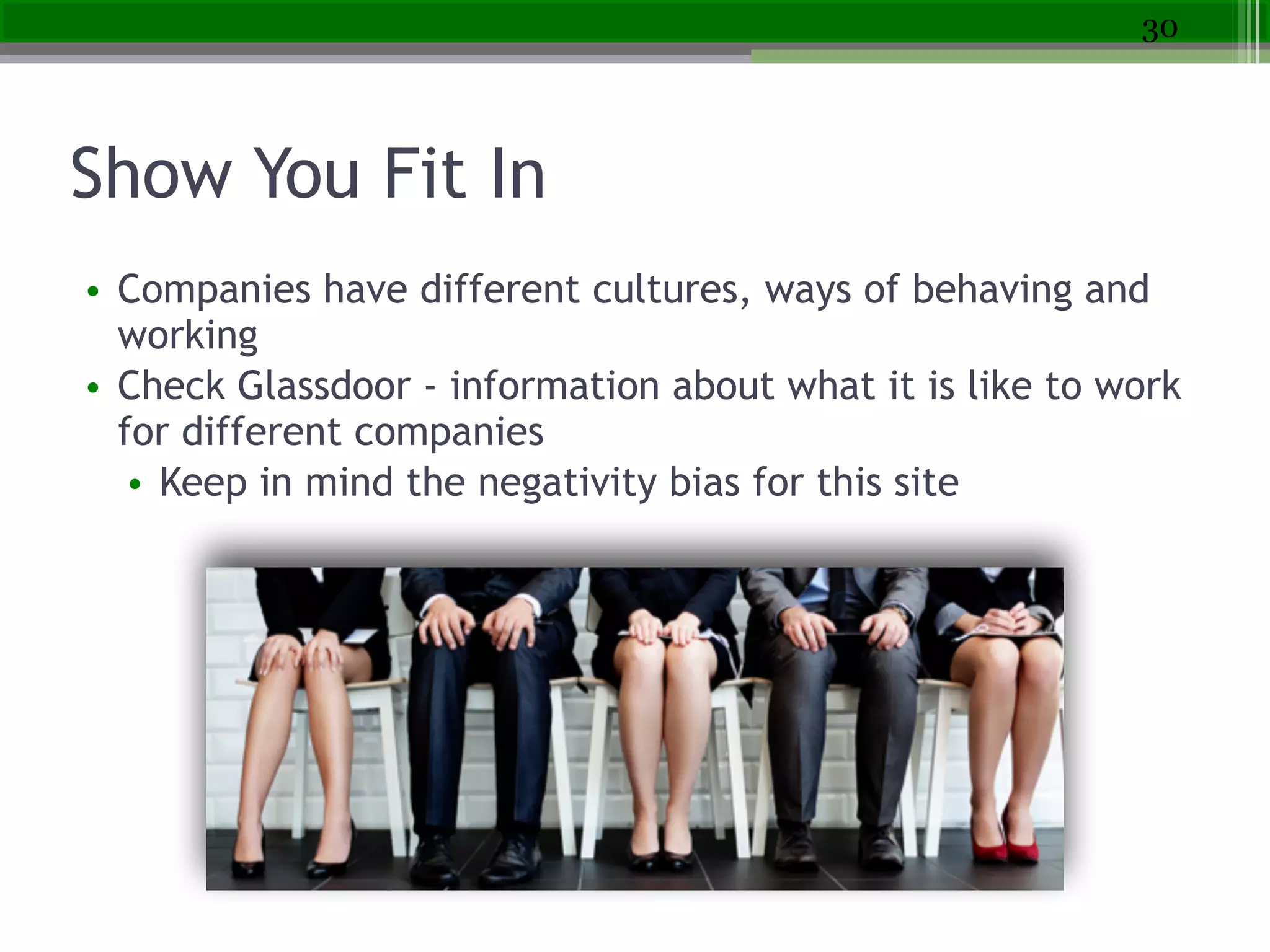
Show You Fit In
• Companies have different cultures, ways of behaving and
working
• Check Glassdoor - information about what it is like to work
for different companies
• Keep in mind the negativity bias for this site
30
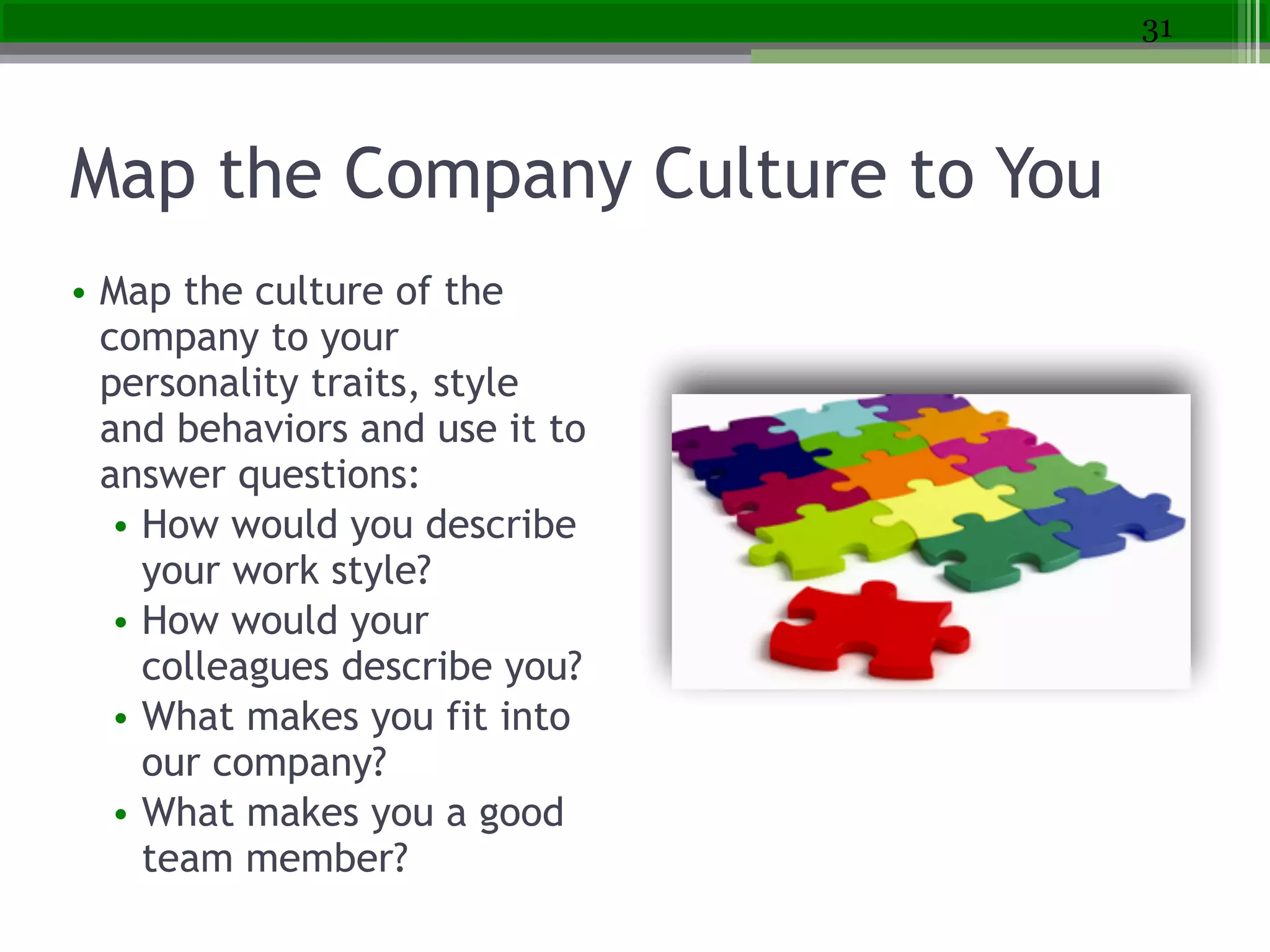
Map the Company Culture to You
• Map the culture of the
company to your
personality traits, style
and behaviors and use it to
answer questions:
• How would you describe
your work style?
• How would your
colleagues describe you?
• What makes you fit into
our company?
• What makes you a good
team member?
31
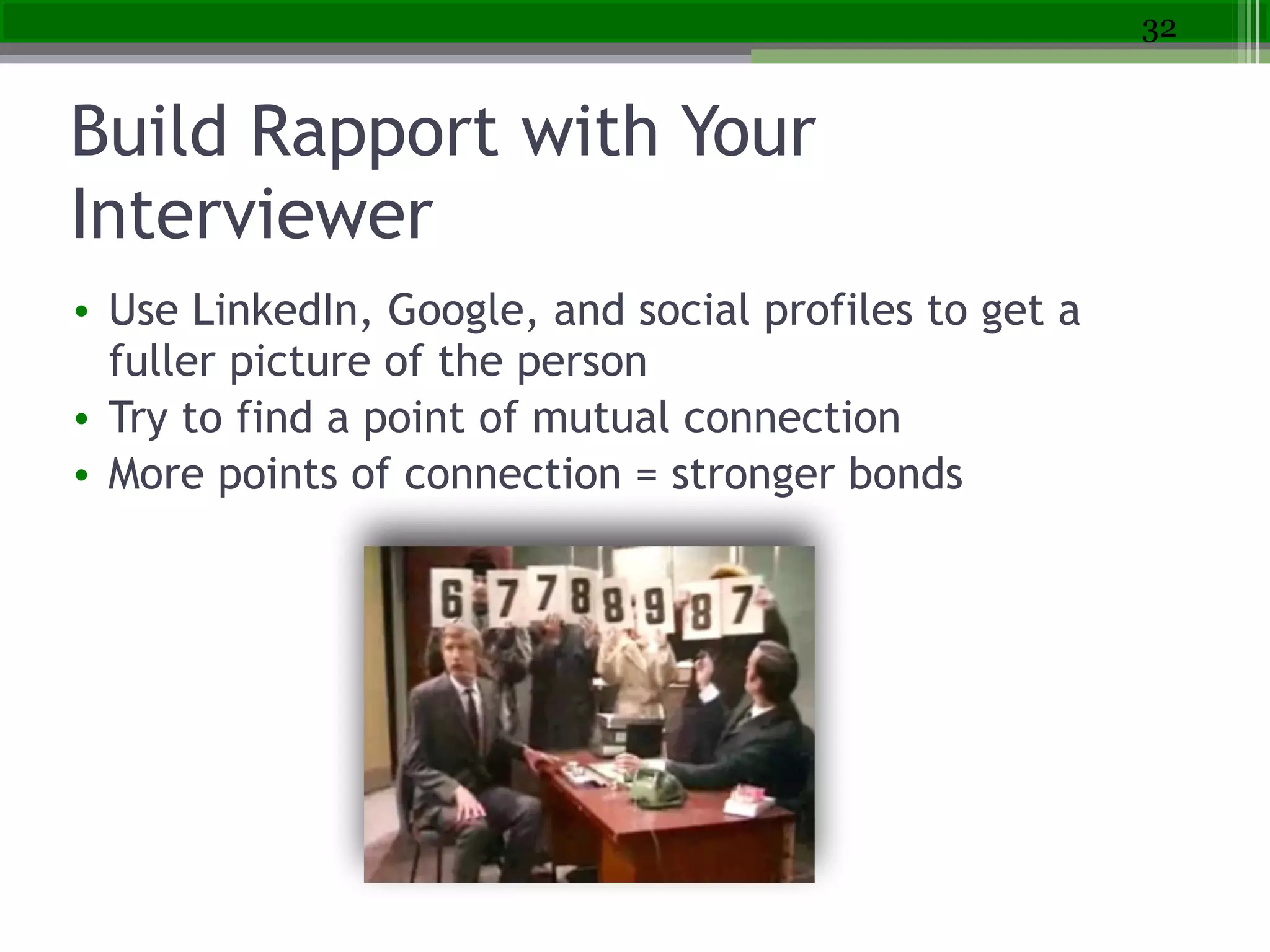
Build Rapport with Your
Interviewer
• Use LinkedIn, Google, and social profiles to get a
fuller picture of the person
• Try to find a point of mutual connection
• More points of connection = stronger bonds
32
Give the Right Answer to the Weakness
Question
• Don’t give a cop-out answer
• Be honest and give a real answer - something you’ve struggle
with in a particular situation
• Avoid deal breakers
• Talk about your proactive attempts to overcome
33
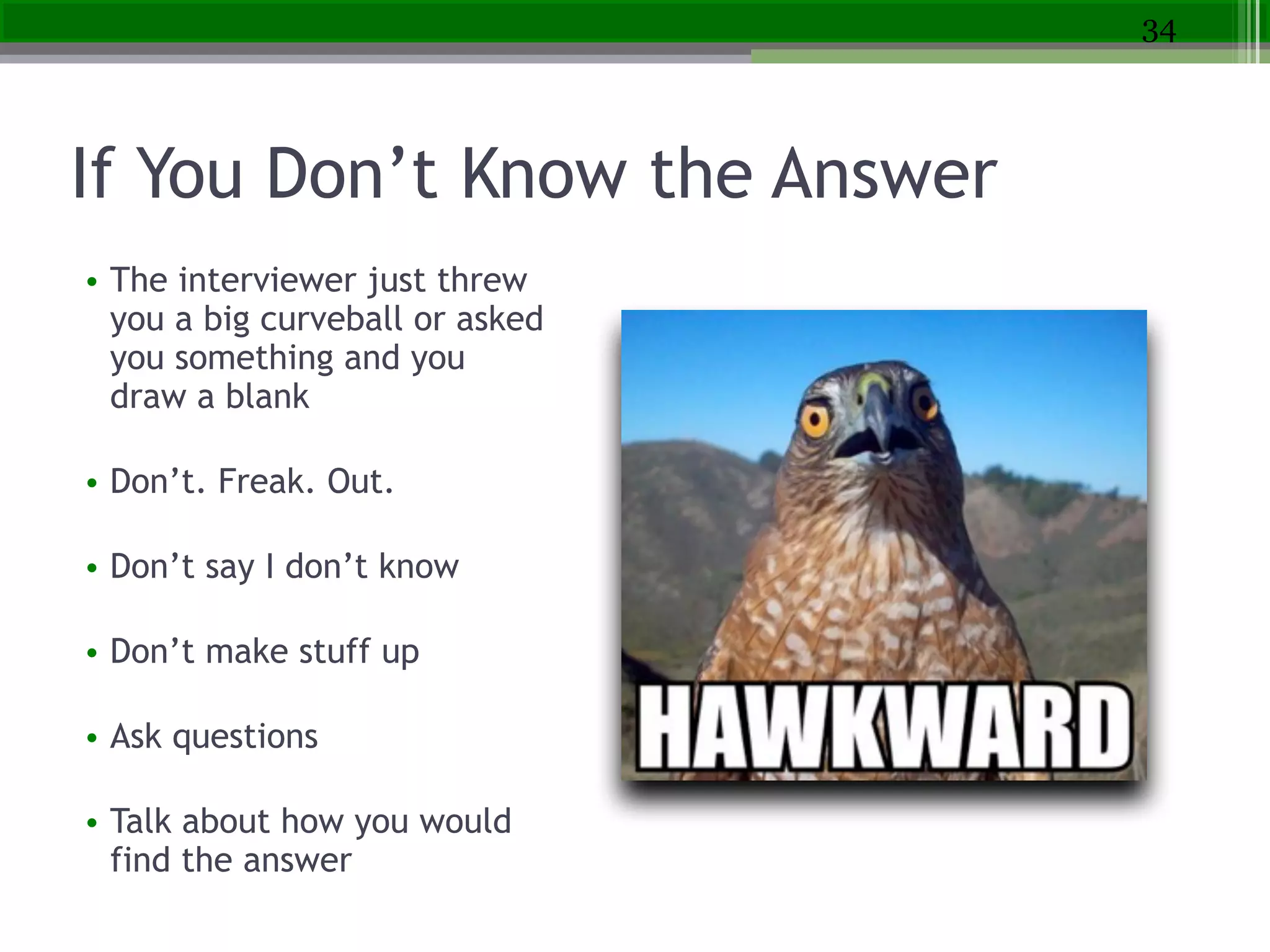
If You Don’t Know the Answer
• The interviewer just threw
you a big curveball or asked
you something and you
draw a blank
!
• Don’t. Freak. Out.
!
• Don’t say I don’t know
!
• Don’t make stuff up
!
• Ask questions
!
• Talk about how you would
find the answer
34
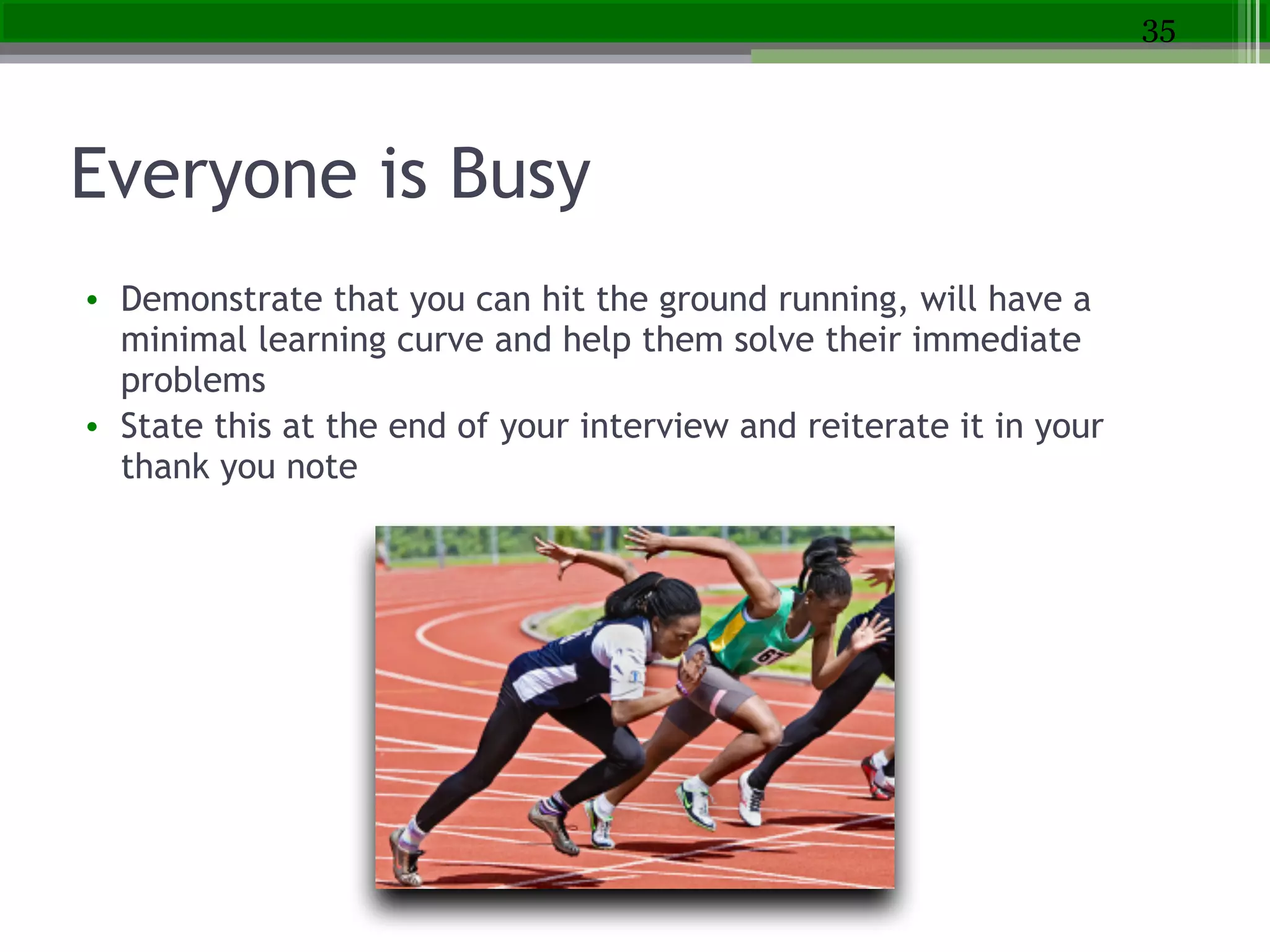
Everyone is Busy
• Demonstrate that you can hit the ground running, will have a
minimal learning curve and help them solve their immediate
problems
• State this at the end of your interview and reiterate it in your
thank you note
35
Have a Game Plan of What it Will
Take to Be Successful On The Job
• Be proactive - based on the job description and requirements,
think through what it will take to be successful in the job
• Create a list of items and put these items into a one-page
“Game Plan” document with a brief explanation of each item
• Example - Pharma Sales Rep
• Products: Learn everything there is to know about the
products I’ll be representing
• Terminology: Learn all the appropriate medical
terminology that customers will use during our discussions.
Obtain recommendations from my manager on the best
ways to gain this knowledge - reading articles, attending
seminars, memorizing terminology and definitions, etc.
• Sales territory: Learn my sales territory as well as history
36
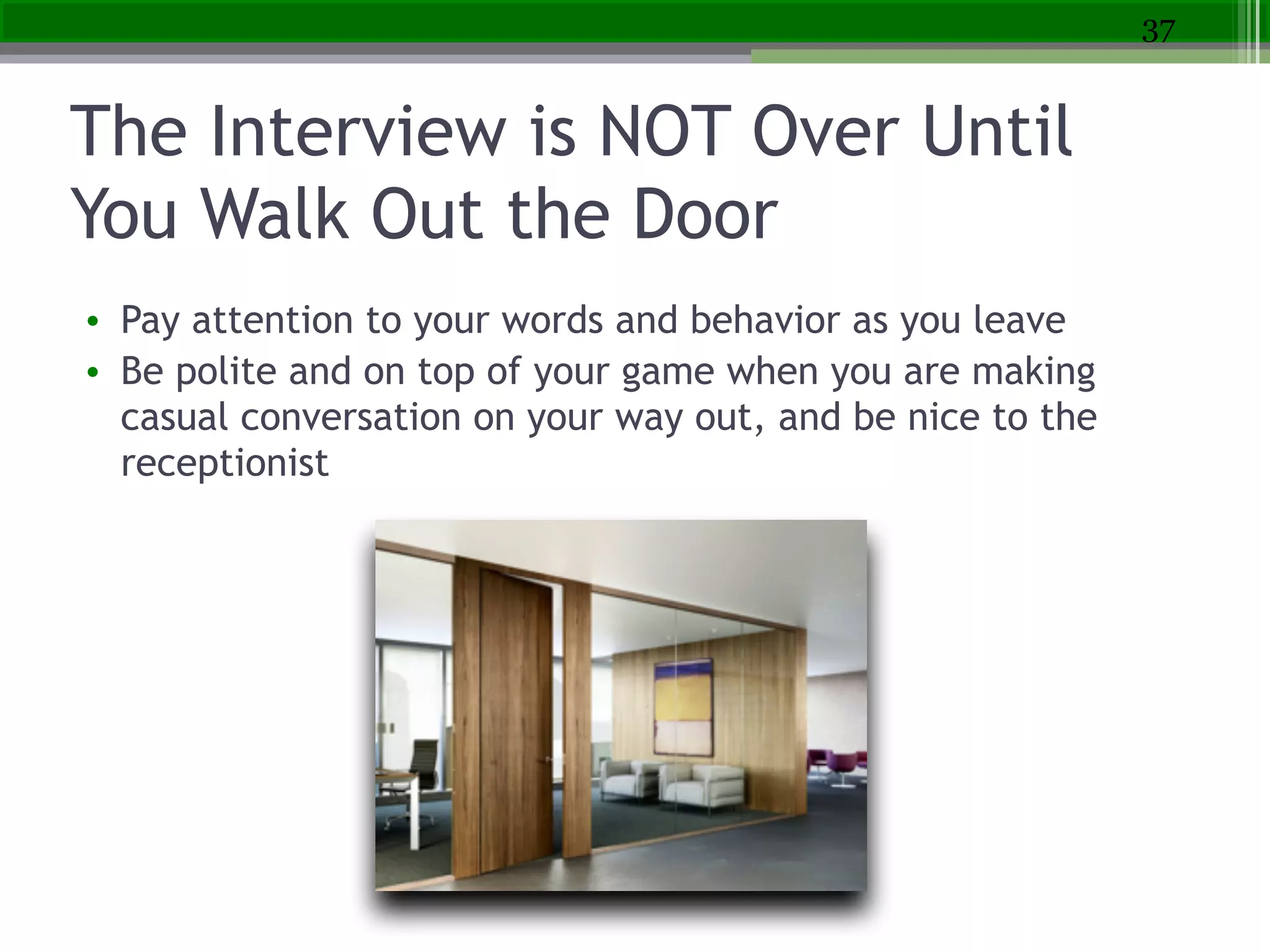
The Interview is NOT Over Until
You Walk Out the Door
• Pay attention to your words and behavior as you leave
• Be polite and on top of your game when you are making
casual conversation on your way out, and be nice to the
receptionist
37
Ask About Next Steps Before You
Leave
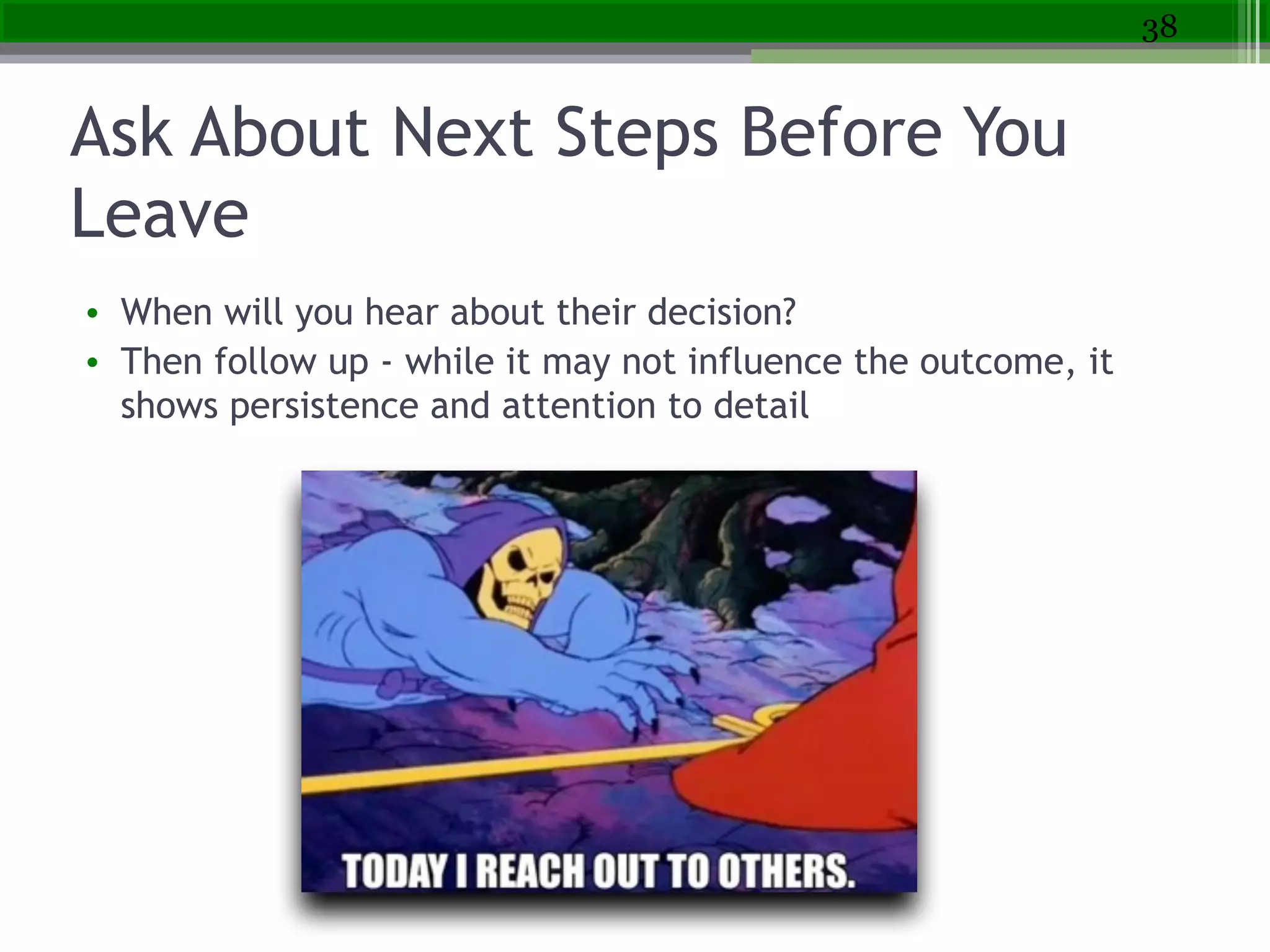
• When will you hear about their decision?
• Then follow up - while it may not influence the outcome, it
shows persistence and attention to detail
38
Your Personal Brand is a Big Deal
39
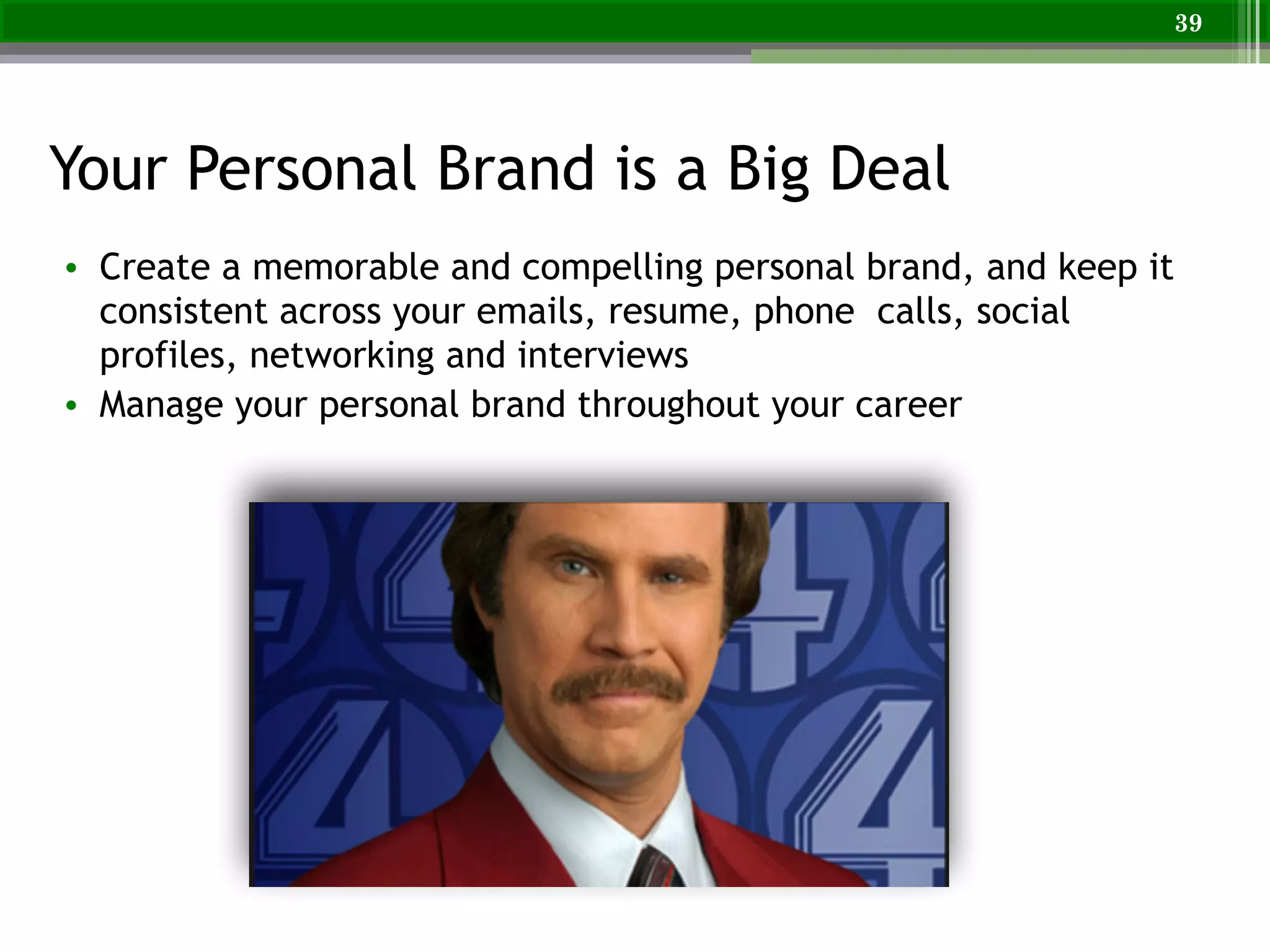
• Create a memorable and compelling personal brand, and keep it
consistent across your emails, resume, phone calls, social
profiles, networking and interviews
• Manage your personal brand throughout your career
Have Recommendations Ready
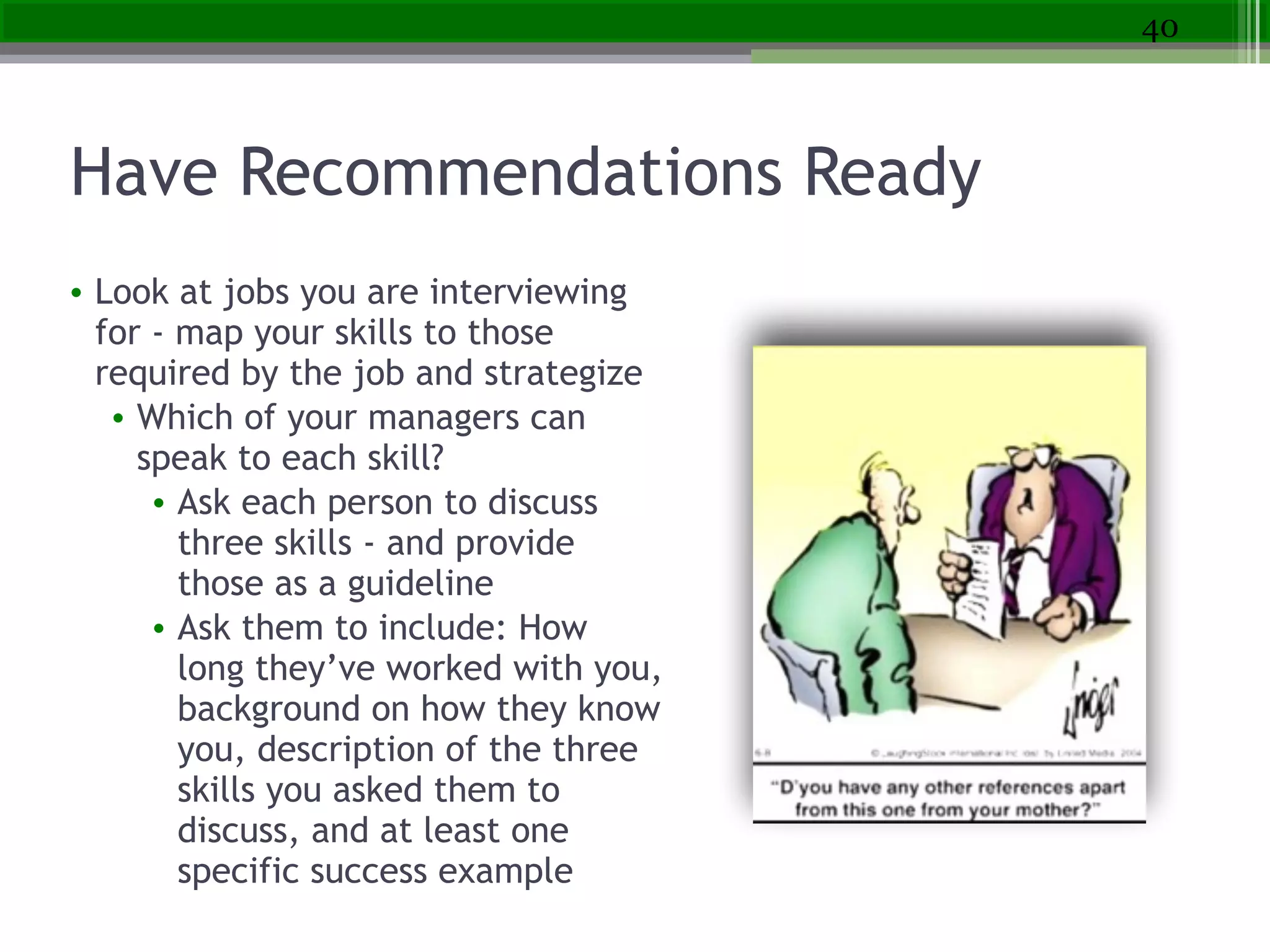
• Look at jobs you are interviewing
for - map your skills to those
required by the job and strategize
• Which of your managers can
speak to each skill?
• Ask each person to discuss
three skills - and provide
those as a guideline
• Ask them to include: How
long they’ve worked with you,
background on how they know
you, description of the three
skills you asked them to
discuss, and at least one
specific success example
40
The Intersection of Social Media
and Your Job Search
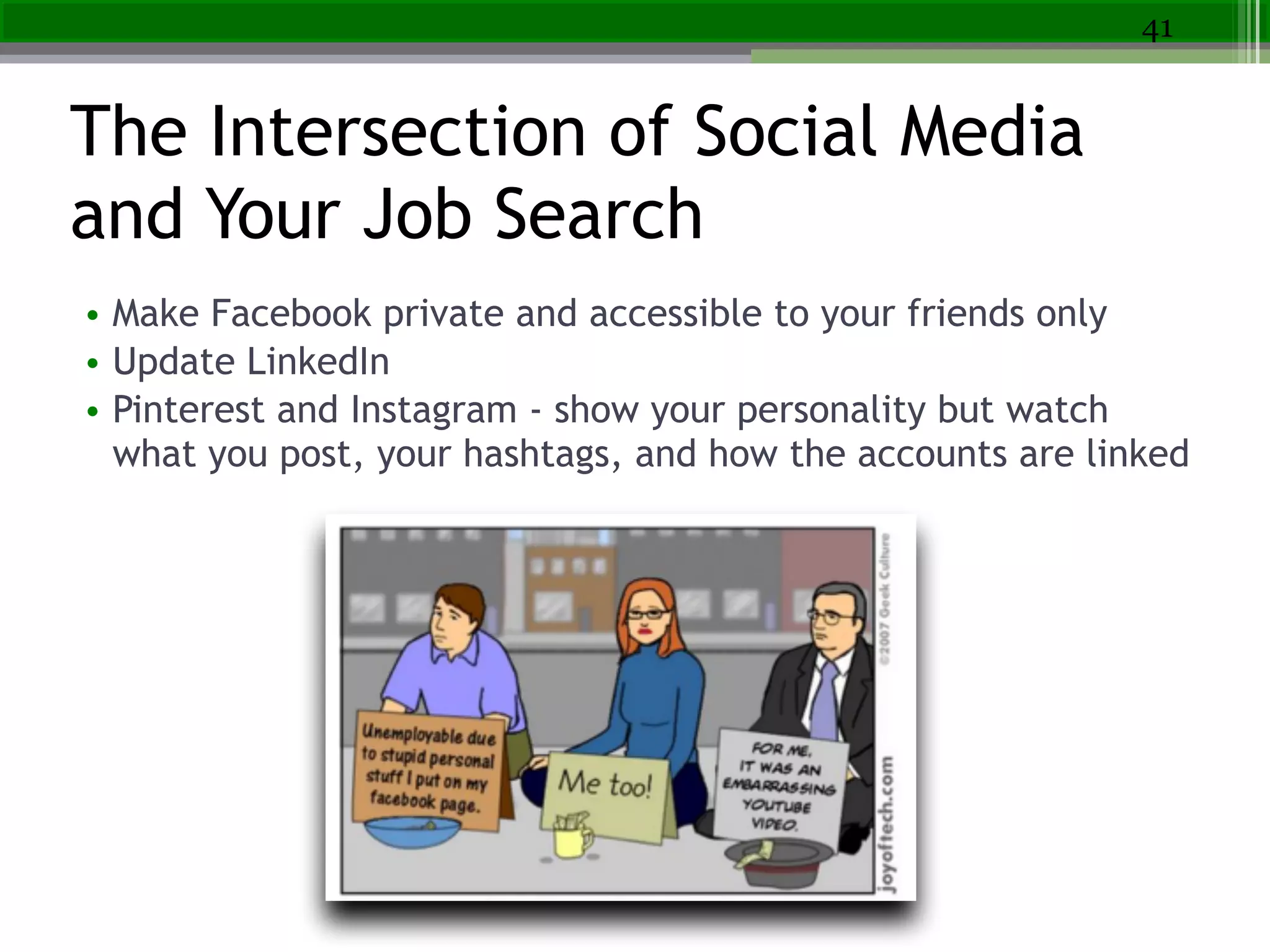
• Make Facebook private and accessible to your friends only
• Update LinkedIn
• Pinterest and Instagram - show your personality but watch
what you post, your hashtags, and how the accounts are linked
41
Engage Social Media to Show Your
Interest
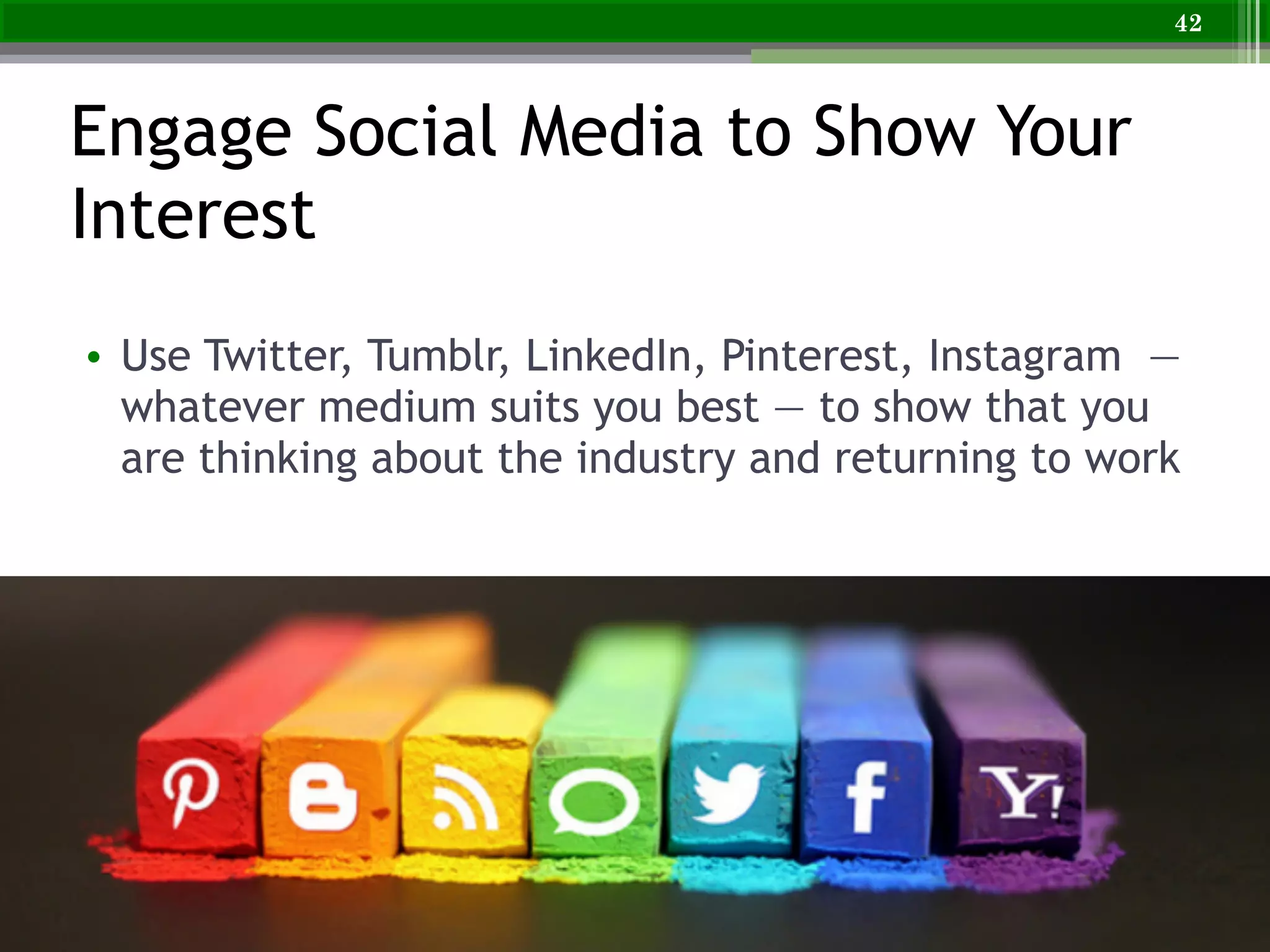
• Use Twitter, Tumblr, LinkedIn, Pinterest, Instagram —
whatever medium suits you best — to show that you
are thinking about the industry and returning to work
42
You Are Going Back to Work
Because You Want to Work
• Do not talk about your problems - You need the
job to pay off your student loans, etc.
• The hiring manager does not want to hear about
your 99 problems
• You will be hired based on your qualifications,
potential for success, and your fit with the
culture - everything else will be secondary to
those factors.
43
Thank You!
44
robeenf@gmail.com
linkedin.com/in/robinfrank!
robeenf.com
GoRebootCamp.com
slideshare.net/robeen
pinterest.com/robeen

Reboot Camp Session 5: Interview Successfully

  • 1.
  • 2.
    Social Media ! I workwith companies large and small to help them build and tune-up an engaging online presence. ! I’m known as a dynamic speaker and speak regularly at national conferences, companies, and events. Personal Branding! ! I help individuals in many fields create powerful personal brands.! ! My personal branding strategy is featured in the recent book “Digital Marketing” written by Larry Weber and endorsed by Reid Hoffman (Chairman, Founder/LinkedIn) and John Donahoe (CEO/ eBay). Reboot Camp! ! Innovative program to help Moms confidently re-enter the workforce after a break.! ! Six inspiring and pragmatic sessions cover topics from networking and interview skills to social media and personal branding, plus two hours of one-on-one coaching. Mom! ! Twin 8 Yr old boys! ! Live in Mill Valley Yours Truly
  • 3.
    1. Set YourStrategy 2. Tell Your Story 3. Create Your Presence 4. Network Effectively 5.Interview Confidently 6. Succeed On the Job Reboot Camp Sessions TODAY
  • 4.
    • This presentationwill be available to you online - which means you are free to listen without taking notes • We have 15 minutes for questions at the end • You also have 2 hours of one-on-one to use however you like Today’s Session
  • 5.
  • 6.
    Top 5 Keysto Acing the Interview 1. Own your time off with confidence 2. Brush up on interviewing tips 3. Take time to prepare 4. Look and act confident 5. Professional social media use/ references 6
  • 7.
  • 8.
    Own Your GapTime with Strength • Be professional, proud and - you weren’t “just” raising kids or “just” volunteering • Brush up on interviewing and resume skills - increase confidence • Find things you have done in your gap time that add to your skills 8
  • 9.
    Rewrite Negative SelfTalk • Three replacement statements • “If you change the way you look at things, the things you look at change.” - Wayne Dyer • Focus on positive experiences - Hardwiring Happiness 9
  • 10.
    Talking About theGap • It is OK to have a gap • What matters is how you explain it in your resume, cover letter and interview 10
  • 11.
    Talking About theGap • Talk about your time off - what did you oversee or coordinate - make it useful in some way • “I have been a stay at home mom for the past X years. During that time, I have been volunteering at a local food bank where I’ve overseen and coordinated several food drives • It was during that time I realized my passion for…. • I’ve been taking courses in …….” • Be concise - don’t give too much detail 11
  • 12.
    Moms Make DesirableEmployees • Experience, maturity and perspective • Resourceful and solutions oriented • Excellent time management skills • Adept people managers - with finely honed communication skills • Eager to get back to work 12
  • 13.
    Be Positive andEnthusiastic • “Thats why I am excited to work for your company” ! • The most crucial message to deliver is how you are ready to return to work ! • Your enthusiasm can be one of the aspects that sets you aside from everyone else 13
  • 14.
    Communicate Your ChildcareGame Plan • Some employers have concerns that childcare could cause absences • Reassure your prospective employer that you have childcare worked out, including a backup plan 14
  • 15.
    Interviewing - BrushUp on Tips for Success 15
  • 16.
    Inside the Headof Your Interviewer 1. Have you got the skills, expertise and experience to perform the job? 2. Are you enthusiastic and interested in the job and the company? 3. Will you fit into the team, culture and company? 16
  • 17.
    Map Your Skillsand Experience to the Job 17 • Look at the skills and experience required for the job • Map your skills and experience to those required • Prepare concrete examples of your skills in action and have these memorized so you can draw on them during the interview
  • 18.
    Draw on Theseto Answer Intimidating, Open-Ended Questions • Always go back to key skills, expertise and experience when answering scary (and sometimes silly) questions about yourself • What are your greatest strengths / weaknesses? • What can you do for us that other candidates can’t • Why do you think you are right for this job? • What do you think the main challenges will be? 18
  • 19.
    Stand Out Fromthe Crowd • Practice • Your story - for re-entering the workforce and why you are interested in this job • Your personal brand pitch • Your answer to the “Tell Me About Yourself” question 19
  • 20.
    Backup Your Enthusiasmwith Research 20 • Of course you want the interviewer to know you can’t wait to join the company… BUT… • Nothing conveys this better than a demonstrated understanding of the company, its strategy, current performance, structure, market position and products
  • 21.
    Your Bonus Homework •Google • Read the company's "FAQ" or "About Us" section • You will be reading the same things as other candidates • Also check out • 10-K filing for strengths and weaknesses which will inform what value you can bring • Annual Report - company direction/goals so you can align your answers • Press Releases - company image • Competitors - demonstrate you know them 21
  • 22.
    Prepare Questions forthe Interviewer • Prepare in advance based on your research ! • Pay attention throughout the interview, so you'll have questions related to what the hiring manager talked about 22
  • 23.
    10 Thoughtful Questionsto Ask 1. What’s the most important goal the person in this role needs to accomplish in order to be successful? 2. What are the immediate priorities? 3. How will this skill be used on the job? 4. How will performance be measured? 5. Can you walk me through the organization chart? 6. What is the manager’s vision for the department and this role? 7. What is your/the manager’s leadership style? 8. How are decisions made at the company? What’s the appetite for change? What’s are the politics/ the intensity/the sophistication of the infrastructure? 9. How do you plan to deal with x? 10.What are some things your competitors are doing right that you need to copy? 23
  • 24.
    2 Minute Exercisesto Calm You • You think you are calm but then your body gets nervous • Palms over eyes • Relaxes and relieves eye strain • Longer exhales • Relaxes and calms the sympathetic nervous system (fight & flight) 24
  • 25.
    7 Seconds toMake a First Impression • The moment that stranger sees you, his or her brain makes a thousand computations - Are you trustworthy, competent, likeable, confident? • These computations are made at lightning speed — making major decisions about one another in the first seven seconds of meeting • The human brain is hardwired in this way as a prehistoric survival mechanism – you can understand how to make those decisions work in your favor 25
  • 26.
    Nonverbal Cues areInfluential • First impressions are more heavily influenced by nonverbal cues than verbal cues • Studies have found that nonverbal cues have over four times the impact on the impression you make than anything you say 26
  • 27.
    Wear the RightOutfit • Make sure you know what the dress code is for the office ! • Depends on industry, geographic location and time of year ! • Pinterest board: pinterest.com/robeen/ interview-outfits/ 27
  • 28.
    Use Positive BodyLanguage • Sit still, don’t fidget, good posture, arms open • Talk slowly, breathe deeply, smile • Enjoy yourself and make eye contact 28
  • 29.
    Power Posing -Amy Cuddy • Your body language shapes who you are • Social psychologist - Amy Cuddy TED talk • Standing (or sitting) in a posture of confidence, even when we don’t feel confident — can affect testosterone and cortisol levels in the brain, and may have an impact on our success • Fake it until you become it 29
  • 30.
    Show You FitIn • Companies have different cultures, ways of behaving and working • Check Glassdoor - information about what it is like to work for different companies • Keep in mind the negativity bias for this site 30
  • 31.
    Map the CompanyCulture to You • Map the culture of the company to your personality traits, style and behaviors and use it to answer questions: • How would you describe your work style? • How would your colleagues describe you? • What makes you fit into our company? • What makes you a good team member? 31
  • 32.
    Build Rapport withYour Interviewer • Use LinkedIn, Google, and social profiles to get a fuller picture of the person • Try to find a point of mutual connection • More points of connection = stronger bonds 32
  • 33.
    Give the RightAnswer to the Weakness Question • Don’t give a cop-out answer • Be honest and give a real answer - something you’ve struggle with in a particular situation • Avoid deal breakers • Talk about your proactive attempts to overcome 33
  • 34.
    If You Don’tKnow the Answer • The interviewer just threw you a big curveball or asked you something and you draw a blank ! • Don’t. Freak. Out. ! • Don’t say I don’t know ! • Don’t make stuff up ! • Ask questions ! • Talk about how you would find the answer 34
  • 35.
    Everyone is Busy •Demonstrate that you can hit the ground running, will have a minimal learning curve and help them solve their immediate problems • State this at the end of your interview and reiterate it in your thank you note 35
  • 36.
    Have a GamePlan of What it Will Take to Be Successful On The Job • Be proactive - based on the job description and requirements, think through what it will take to be successful in the job • Create a list of items and put these items into a one-page “Game Plan” document with a brief explanation of each item • Example - Pharma Sales Rep • Products: Learn everything there is to know about the products I’ll be representing • Terminology: Learn all the appropriate medical terminology that customers will use during our discussions. Obtain recommendations from my manager on the best ways to gain this knowledge - reading articles, attending seminars, memorizing terminology and definitions, etc. • Sales territory: Learn my sales territory as well as history 36
  • 37.
    The Interview isNOT Over Until You Walk Out the Door • Pay attention to your words and behavior as you leave • Be polite and on top of your game when you are making casual conversation on your way out, and be nice to the receptionist 37
  • 38.
    Ask About NextSteps Before You Leave • When will you hear about their decision? • Then follow up - while it may not influence the outcome, it shows persistence and attention to detail 38
  • 39.
    Your Personal Brandis a Big Deal 39 • Create a memorable and compelling personal brand, and keep it consistent across your emails, resume, phone calls, social profiles, networking and interviews • Manage your personal brand throughout your career
  • 40.
    Have Recommendations Ready •Look at jobs you are interviewing for - map your skills to those required by the job and strategize • Which of your managers can speak to each skill? • Ask each person to discuss three skills - and provide those as a guideline • Ask them to include: How long they’ve worked with you, background on how they know you, description of the three skills you asked them to discuss, and at least one specific success example 40
  • 41.
    The Intersection ofSocial Media and Your Job Search • Make Facebook private and accessible to your friends only • Update LinkedIn • Pinterest and Instagram - show your personality but watch what you post, your hashtags, and how the accounts are linked 41
  • 42.
    Engage Social Mediato Show Your Interest • Use Twitter, Tumblr, LinkedIn, Pinterest, Instagram — whatever medium suits you best — to show that you are thinking about the industry and returning to work 42
  • 43.
    You Are GoingBack to Work Because You Want to Work • Do not talk about your problems - You need the job to pay off your student loans, etc. • The hiring manager does not want to hear about your 99 problems • You will be hired based on your qualifications, potential for success, and your fit with the culture - everything else will be secondary to those factors. 43
  • 44.