Real Life Assessment:

     formative  summative


                      Valerie Bryant


                       Page 1
Link to Google Doc with links, videos,
 files:

https://docs.google.com/open?id=0ByklBfjex97VS3ZtSEZMOUk2OXc


                                                 Page 2
daily informal assessment

– “points keeping” (not for grade)
– self assessment                             http://teach.classdojo.com/#!/launchpad


– peer assessment
http://ncme.org/default/assets/File/pdf/webinars/ncme
  %20formative%20assessment%20materials.pdf


                                                                Page 3
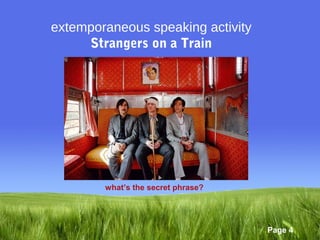
extemporaneous speaking activity
     Strangers on a Train


        what’s the secret phrase?


                                    Page 4
sample formative
assessments to try in class:
•   sharing examples of student work– students watch videos of others’ dialogues
•   sharing comments on work instead of grades to move learners forward
•   using “stoplights” to gauge student understanding (green, red, yellow)
•   activating students as owners of their own learning
•   activating students as instructional resources to one another
•   more listed at URL below…

        •   http://wikiserver.cfsd16.org/users/kimboling/weblog/e03f4/Using_Fo
            rmative_Assessment_in_ForeignLanguage_Classes.html

            compiled from “Bringing Formative Assessment to Life in the Language
            Classroom” by Sally Warner Read and Kristy Placido in The Language
            Educator, August 2012 (Vol. 7, #4, p. 50-53), no e-link


                                                                             Page 5
Vamos a Madrid: formative
assessment
• classroom green screen project used when
  studying about Spain and the places students
  could go
• http://blogs.henrico.k12.va.us/21/2012/01/20/
  vamos-a-madrid/


                                         Page 6
from   Harry Tuttle @ http://eduwithtechn.wordpress.com

•    People enjoy intensity such as the intensity of a ski run, an amusement ride,
     diving into a lake, a round of Jeopardy, or a Soduku puzzle.

•    Students enjoy and benefit from class when we provide them with intensity of
     learning. We can give them short  activities that  are highly focused on
     critical learning. As we move our students from talking about learning to
     using what they are learning, many opportunities exist for intense learning.

•    In my Spanish class, I have my students do many one to two minute speaking
     activities. Each activity focuses on a specific language function such as asking
     for information or persuading. For example, in groups of two, one student
     looks at a picture such as a people in a mall and asks his/her partner
     questions while the partner answers the questions. They do not prepare for
     this activity, they just dive into it. They have to combine their already learned
     vocabulary and grammar from previous lessons to do this activity. After this
     intense activity, they debrief by going over what they could do better next time
     and then practicing to show that they can improve. This formative assessment
     activity provides a intense experience for students.


                                                                           Page 7
Kristy Placido
                        author, presenter and instructional coach
                        http://kplacido.com/


You need to look at your district’s curriculum guide and if you do not
have one, are your students taking a common assessment with
another class that is “learning” more vocab?

Personally, I do have a couple of thematic topical vocab units that
I am forced to cram onto opt to teach my students whenever I am
sharing sections of the same course with another teacher who is
heavily thematic topical. (I am a thematic teacher, however my
themes are things such as “Immigration,” and “Traveling as an
exchange student” and “living during a civil war.” We are talking here
about topics such as “adjectives, home furnishings, animals, and the
dreaded much anticipated amusement park rides unit.”)– Kristy
Placido


                                                                    Page 8
from Kristy Placido
• Learners need a clear understanding of what they are
  learning as well as why and what’s expected of them. This can
  take on many forms in the classroom such as, but not limited
  to: clear learning targets and shared rubrics and expectations
  prior to the learning. Including students in the development of
  the rubric creates even more ownership. Providing students
  experiences using the rubric with sample materials
  (exemplars and non-exemplars) to identify key components
  can lead to a deeper understanding of the learning intentions.
• Feedback for learners can come in many forms. In keeping
  with the rubric idea mentioned above, the feedback can come
  from teachers, peers, or even from a larger/global learning
  community. This feedback needs to be immediate. The
  feedback should help students see the quality of their work
  and potential suggestions for further investigation


                                                        Page 9
Understanding by Design or
                               UbD co-authored the book La hija
Carrie Toth Spanish teacher, Illinois, since 1994. In 2011 she met
 Carol Gaab and Kristy Placido and has since
   del sastre with Carol Gaab.

http://somewheretoshare.wordpress.com/2012/08/19/understanding-by-design    /

   “It seems that a lot of schools are jumping on board the backward
   planning wagon… and to be honest, I am so glad! It is very daunting at
   first when you see the pages and pages of information in the text and
   accompanying workbook but the heart of the whole thing is this…. We
   should have a concrete goal in mind for our students before we teach
   even one lesson in our classroom. “


                                                                     Page 10
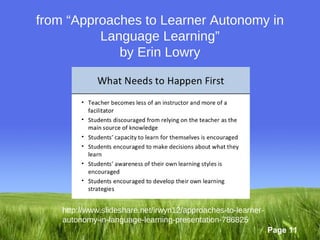
from “Approaches to Learner Autonomy in
          Language Learning”
             by Erin Lowry


    http://www.slideshare.net/irwyn12/approaches-to-learner-
    autonomy-in-language-learning-presentation-786825
                                                               Page 11
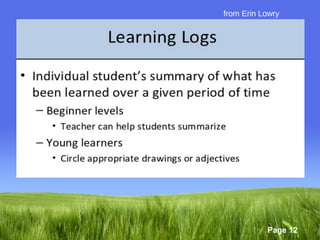
from Erin Lowry


           Page 12
topics for brainstorming PBAs
   •   family and friends
   •   house and home
   •   classes and school
   •   sports and leisure
   •   let’s eat
   •   stores, shopping, clothing
   •   people and places
   •   a day in the life
   •   media and technology
   •   travel and geography
   •   pop culture
   •   future plans
                                    Page 13

Real life assessment Valerie Bryant

  • 1.
    Real Life Assessment: formative  summative Valerie Bryant Page 1
  • 2.
    Link to GoogleDoc with links, videos, files: https://docs.google.com/open?id=0ByklBfjex97VS3ZtSEZMOUk2OXc Page 2
  • 3.
    daily informal assessment –“points keeping” (not for grade) – self assessment http://teach.classdojo.com/#!/launchpad – peer assessment http://ncme.org/default/assets/File/pdf/webinars/ncme %20formative%20assessment%20materials.pdf Page 3
  • 4.
    extemporaneous speaking activity Strangers on a Train what’s the secret phrase? Page 4
  • 5.
    sample formative assessments totry in class: • sharing examples of student work– students watch videos of others’ dialogues • sharing comments on work instead of grades to move learners forward • using “stoplights” to gauge student understanding (green, red, yellow) • activating students as owners of their own learning • activating students as instructional resources to one another • more listed at URL below… • http://wikiserver.cfsd16.org/users/kimboling/weblog/e03f4/Using_Fo rmative_Assessment_in_ForeignLanguage_Classes.html compiled from “Bringing Formative Assessment to Life in the Language Classroom” by Sally Warner Read and Kristy Placido in The Language Educator, August 2012 (Vol. 7, #4, p. 50-53), no e-link Page 5
  • 6.
    Vamos a Madrid:formative assessment • classroom green screen project used when studying about Spain and the places students could go • http://blogs.henrico.k12.va.us/21/2012/01/20/ vamos-a-madrid/ Page 6
  • 7.
    from Harry Tuttle @ http://eduwithtechn.wordpress.com • People enjoy intensity such as the intensity of a ski run, an amusement ride, diving into a lake, a round of Jeopardy, or a Soduku puzzle. • Students enjoy and benefit from class when we provide them with intensity of learning. We can give them short  activities that  are highly focused on critical learning. As we move our students from talking about learning to using what they are learning, many opportunities exist for intense learning. • In my Spanish class, I have my students do many one to two minute speaking activities. Each activity focuses on a specific language function such as asking for information or persuading. For example, in groups of two, one student looks at a picture such as a people in a mall and asks his/her partner questions while the partner answers the questions. They do not prepare for this activity, they just dive into it. They have to combine their already learned vocabulary and grammar from previous lessons to do this activity. After this intense activity, they debrief by going over what they could do better next time and then practicing to show that they can improve. This formative assessment activity provides a intense experience for students. Page 7
  • 8.
    Kristy Placido author, presenter and instructional coach http://kplacido.com/ You need to look at your district’s curriculum guide and if you do not have one, are your students taking a common assessment with another class that is “learning” more vocab? Personally, I do have a couple of thematic topical vocab units that I am forced to cram onto opt to teach my students whenever I am sharing sections of the same course with another teacher who is heavily thematic topical. (I am a thematic teacher, however my themes are things such as “Immigration,” and “Traveling as an exchange student” and “living during a civil war.” We are talking here about topics such as “adjectives, home furnishings, animals, and the dreaded much anticipated amusement park rides unit.”)– Kristy Placido Page 8
  • 9.
    from Kristy Placido •Learners need a clear understanding of what they are learning as well as why and what’s expected of them. This can take on many forms in the classroom such as, but not limited to: clear learning targets and shared rubrics and expectations prior to the learning. Including students in the development of the rubric creates even more ownership. Providing students experiences using the rubric with sample materials (exemplars and non-exemplars) to identify key components can lead to a deeper understanding of the learning intentions. • Feedback for learners can come in many forms. In keeping with the rubric idea mentioned above, the feedback can come from teachers, peers, or even from a larger/global learning community. This feedback needs to be immediate. The feedback should help students see the quality of their work and potential suggestions for further investigation Page 9
  • 10.
    Understanding by Designor UbD co-authored the book La hija Carrie Toth Spanish teacher, Illinois, since 1994. In 2011 she met Carol Gaab and Kristy Placido and has since del sastre with Carol Gaab. http://somewheretoshare.wordpress.com/2012/08/19/understanding-by-design / “It seems that a lot of schools are jumping on board the backward planning wagon… and to be honest, I am so glad! It is very daunting at first when you see the pages and pages of information in the text and accompanying workbook but the heart of the whole thing is this…. We should have a concrete goal in mind for our students before we teach even one lesson in our classroom. “ Page 10
  • 11.
    from “Approaches toLearner Autonomy in Language Learning” by Erin Lowry http://www.slideshare.net/irwyn12/approaches-to-learner- autonomy-in-language-learning-presentation-786825 Page 11
  • 12.
  • 13.
    topics for brainstormingPBAs • family and friends • house and home • classes and school • sports and leisure • let’s eat • stores, shopping, clothing • people and places • a day in the life • media and technology • travel and geography • pop culture • future plans Page 13