Reading with Strategy!
The Strategic way to teach you
Nonfiction reading strategies!
BEFORE READING
★ T i m e
★ P r e p a r i n g
a n d
It’s always best to be pre-pre-prepared!
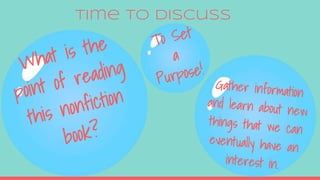
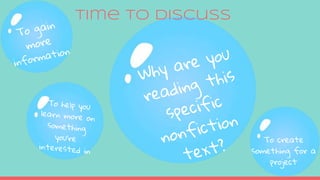
Time to Discuss
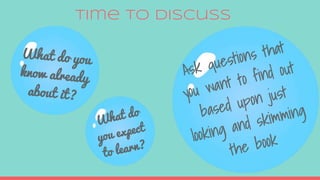
Time to Discuss
Time to Discuss
To create
something for a
project
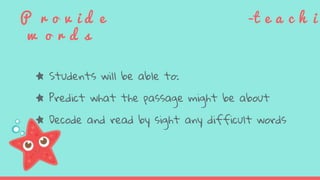
P r o v i d e -t e a c h i
w o r d s
★ Students will be able to:
★ Predict what the passage might be about
★ Decode and read by sight any difficult words
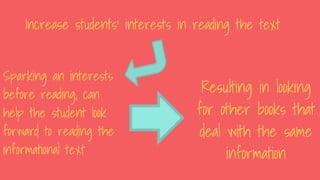
Increase students’ interests in reading the text
Sparking an interests
before reading, can
help the student look
forward to reading the
informational text
Resulting in looking
for other books that
deal with the same
information
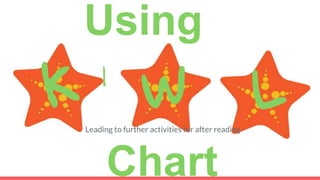
Or they can use the (L)
for What they need to
find out from the
informational text
Then proceed to
write what they
Want to know (W)
Students can write
what they Know
already about the
topic (K)
Using
a
Chart
K W LLeading to further activities for after reading
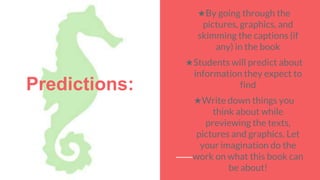
Predictions:
★By going through the
pictures, graphics, and
skimming the captions (if
any) in the book
★Students will predict about
information they expect to
find
★Write down things you
think about while
previewing the texts,
pictures and graphics. Let
your imagination do the
work on what this book can
be about!
D U R I N G
Thinking is key, not
only in your daily life,
but especially in
reading!
Remember to keep your
minds sharp and look for
clues, special information,
and words that you can
use later on!
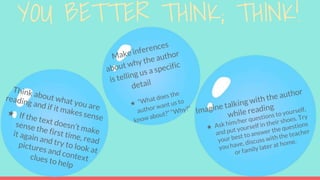
YOU BETTER THINK; THINK!
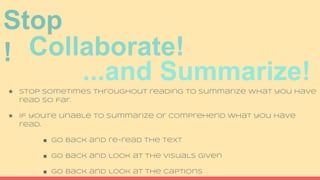
Stop
!
★ Stop sometimes throughout reading to summarize what you have
read so far.
★ If you’re unable to summarize or comprehend what you have
read.
■ Go back and re-read the text
■ Go back and look at the visuals given
■ Go back and look at the captions
Collaborate!
...and Summarize!
S e e k
★ Seek clarification when
there are questions. If your
questions go unanswered
in the text:
★ Go through the text again,
ask a peer, check another
book about the same type
of information. Always ask
your teacher (if needed).
★ Use the inferences you
made as you continue on,
and make them more
concrete when you find
new clues or information
Text to Self:
★ Think about how the
text relates to you
personally
★ Is it a positive connection or
negative? Why?
Text to World
★ Ask yourself if the
information you’re
reading connects to
anything in the real
world
Text to Text
★ Comparing text
you’ve already read
to the information
you read in this book
Evaluate your text
★ Connect Text to text
★ Connect Text to World
★ Connect Text to Self
Connect
your
Connections!
AFTER
READING:
You did it! Your mind now has more information tucked away in a nice file
cabinet for opening whenever you need it!
Now you can go search for another nonfiction book to expand your collection
of files!
Was the image you had in
your mind before we read
the same image after
reading?
★ How did it change? Or get
better?
Compare what you
already knew to
something you read
★ Did it add to your
knowledge or was it the
same of what you already
knew? Do you want to
learn more?
Review your predictions
★ Were they correct?
Were they different?
How?
Think about what you
read and review your
questions in your KWL
★ Were they answered for
you? Do you need more
information? R e v i e w
y o u r
Summarize and Reflect
Summarize the
reading selection
W r i t e
p a r t n e r
e a c h
t h e
a u t h o r
W h y ?
Outline the text
M o s t
d e t a i l s ?
L e a s t
U n n e c e s s
d e t a i l s ?
A f t e r
S u m m a r i z e
s e c t i o n s ,
p a s t ,
D u r i n g
Q u e s t i o n ,
S u m m a r i z e ,
&
B e f o r e
P r e d i c t ,
P r e-t e a c h ,
Reminders of how to
stick with your strategies
Reading involves a lot of thinking caps and attention to be able to fill the file cabinets in our brains.
Cited
Work:
Bursuck, W., & Damer, M. (2011). Teaching reading to
students who are at risk or have disabilities: A multi-
tier approach (2nd ed.). Upper Saddle River, N.J.:
Pearson.
Mandan Public School District - Where the Best Begin.
(n.d.). Retrieved November 19, 2015, from
http://www.mandan.k12.nd.us/lewisclark/teachers/Ga
rland/include/files/documents/Nonfiction before,
during and after.

Reading with Strategy

  • 1.
    Reading with Strategy! TheStrategic way to teach you Nonfiction reading strategies!
  • 2.
    BEFORE READING ★ Ti m e ★ P r e p a r i n g a n d It’s always best to be pre-pre-prepared!
  • 3.
  • 4.
  • 5.
    Time to Discuss Tocreate something for a project
  • 6.
    P r ov i d e -t e a c h i w o r d s ★ Students will be able to: ★ Predict what the passage might be about ★ Decode and read by sight any difficult words
  • 7.
    Increase students’ interestsin reading the text Sparking an interests before reading, can help the student look forward to reading the informational text Resulting in looking for other books that deal with the same information
  • 8.
    Or they canuse the (L) for What they need to find out from the informational text Then proceed to write what they Want to know (W) Students can write what they Know already about the topic (K) Using a Chart K W LLeading to further activities for after reading
  • 9.
    Predictions: ★By going throughthe pictures, graphics, and skimming the captions (if any) in the book ★Students will predict about information they expect to find ★Write down things you think about while previewing the texts, pictures and graphics. Let your imagination do the work on what this book can be about!
  • 10.
    D U RI N G Thinking is key, not only in your daily life, but especially in reading! Remember to keep your minds sharp and look for clues, special information, and words that you can use later on!
  • 11.
  • 12.
    Stop ! ★ Stop sometimesthroughout reading to summarize what you have read so far. ★ If you’re unable to summarize or comprehend what you have read. ■ Go back and re-read the text ■ Go back and look at the visuals given ■ Go back and look at the captions Collaborate! ...and Summarize!
  • 13.
    S e ek ★ Seek clarification when there are questions. If your questions go unanswered in the text: ★ Go through the text again, ask a peer, check another book about the same type of information. Always ask your teacher (if needed). ★ Use the inferences you made as you continue on, and make them more concrete when you find new clues or information
  • 14.
    Text to Self: ★Think about how the text relates to you personally ★ Is it a positive connection or negative? Why? Text to World ★ Ask yourself if the information you’re reading connects to anything in the real world Text to Text ★ Comparing text you’ve already read to the information you read in this book Evaluate your text ★ Connect Text to text ★ Connect Text to World ★ Connect Text to Self Connect your Connections!
  • 15.
    AFTER READING: You did it!Your mind now has more information tucked away in a nice file cabinet for opening whenever you need it! Now you can go search for another nonfiction book to expand your collection of files!
  • 16.
    Was the imageyou had in your mind before we read the same image after reading? ★ How did it change? Or get better? Compare what you already knew to something you read ★ Did it add to your knowledge or was it the same of what you already knew? Do you want to learn more? Review your predictions ★ Were they correct? Were they different? How? Think about what you read and review your questions in your KWL ★ Were they answered for you? Do you need more information? R e v i e w y o u r
  • 17.
    Summarize and Reflect Summarizethe reading selection W r i t e p a r t n e r e a c h t h e a u t h o r W h y ? Outline the text M o s t d e t a i l s ? L e a s t U n n e c e s s d e t a i l s ?
  • 18.
    A f te r S u m m a r i z e s e c t i o n s , p a s t , D u r i n g Q u e s t i o n , S u m m a r i z e , & B e f o r e P r e d i c t , P r e-t e a c h , Reminders of how to stick with your strategies Reading involves a lot of thinking caps and attention to be able to fill the file cabinets in our brains.
  • 19.
    Cited Work: Bursuck, W., &Damer, M. (2011). Teaching reading to students who are at risk or have disabilities: A multi- tier approach (2nd ed.). Upper Saddle River, N.J.: Pearson. Mandan Public School District - Where the Best Begin. (n.d.). Retrieved November 19, 2015, from http://www.mandan.k12.nd.us/lewisclark/teachers/Ga rland/include/files/documents/Nonfiction before, during and after.