STUDY SKILLS Made easy
Chapter 5:Reading
1
Reading
Chapter outline
7.1 ReadingTechniques
7.2 The SQ3R Method
7.3 KeyWords
7.4 How to Read Faster
2
Learning Styles
Chapter outline
2
Learning Styles
Do you like reading? What type of materials do you read mostly?
How often do you read?
In college or university, you have to do a lot of reading for your subjects or
courses. Most of the required reading materials in your studies such as
handouts, books, magazines, journals, etc. are in English.
Most students are put off by the huge volume of reading required as well as
the feeling that they cannot understand what they read. While some are
frustrated at the snail’s pace at which they read.
In this chapter you will be exposed to some reading techniques that will
help you to read effectively.
Introduction
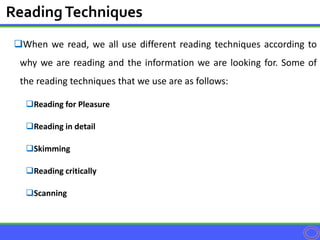
When we read, we all use different reading techniques according to
why we are reading and the information we are looking for. Some of
the reading techniques that we use are as follows:
Reading for Pleasure
Reading in detail
Skimming
Reading critically
Scanning
ReadingTechniques
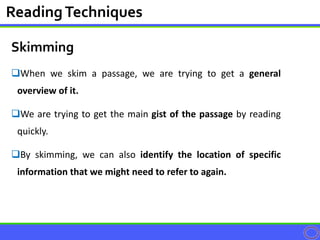
Skimming
When we skim a passage, we are trying to get a general
overview of it.
We are trying to get the main gist of the passage by reading
quickly.
By skimming, we can also identify the location of specific
information that we might need to refer to again.
ReadingTechniques
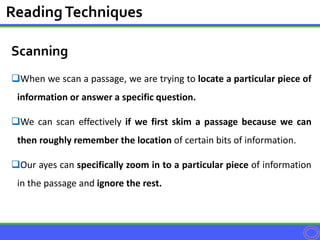
Scanning
When we scan a passage, we are trying to locate a particular piece of
information or answer a specific question.
We can scan effectively if we first skim a passage because we can
then roughly remember the location of certain bits of information.
Our ayes can specifically zoom in to a particular piece of information
in the passage and ignore the rest.
ReadingTechniques
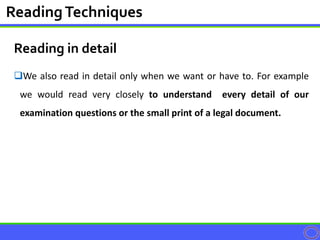
Reading in detail
We also read in detail only when we want or have to. For example
we would read very closely to understand every detail of our
examination questions or the small print of a legal document.
ReadingTechniques
Reading critically
We read something critically because we want to understand
what is written and contribute our opinions or thoughts to it.
This is an important skill because it allows us to evaluate and
make a critical assessment of what we have read.
ReadingTechniques
Reading for Pleasure
This is the most enjoyable for most of us. We read something for
pleasure because we are interested in it. Such as reading a
newspaper. An entertainment magazine, a novel, etc.
There is no pressure as we do not have to worry if we forget what
we have read.
ReadingTechniques
The SQ3R method is a reading technique that gets you actively
involved in your readings. This reading method was developed by
Francis Robinson in 1941.
By using the SQ3R method, you will be able to understand and
remember what you have read. SQ3R basically stands for
survey, questions, read, recall, reviews.
The SQ3R
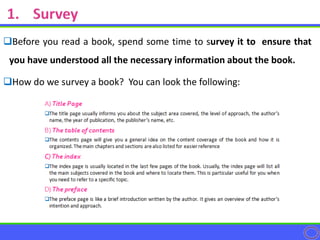
Before you read a book, spend some time to survey it to ensure that
you have understood all the necessary information about the book.
How do we survey a book? You can look the following:
To become actively involved in your reading, you need to read with
a purpose. Be it a whole book, a particular chapter or a section, ask
yourself, “ why am I reading this?” and “ what am I looking for
specifically?”
When you can answer these questions, you are reading with a
purpose.
Once you have a clear purpose of reading, start reading.
You may need to vary the way you read and your reading rate to absorb
different types of information.
Don’t expect to understand everything on the first reading. Reading too
much at once will not help your brain to absorb and digest what you are
reading. As our attention span is short, divide your reading into manageable
sections.
Most students usually forget 80% of what they have read within 24
hours after studying. Most study problems are caused by forgetting
what one has read, not by the difficulties in understanding.
So after you have done your reading, ask yourself, “ what was the
text about?” you may want to read aloud to a friend or quietly to
yourself what you have read.
You may also want to write down what you recall without copying
the text to show that you understand what you have read.
Write the main points down as how you remember them and, if
necessary , check the text for accuracy. If you can recall most of what
you have read , this shows that you have been actively involved in your
reading.
After a few days, check the accuracy of what you have read by reviewing
the material you have studied. This is a form of revision to keep the
information you read fresh in your mind so that it will be stored in your long-
term memory.
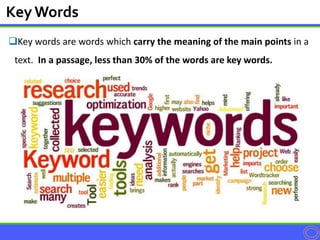
Key words are words which carry the meaning of the main points in a
text. In a passage, less than 30% of the words are key words.
KeyWords
Most key words are nouns, verbs and adjectives, such as “method”,
“read” and “effective”.
If you take note of the key words in a passage, you Should be able to
remember the content of the passage better.
They will form the notes you make for your future reading.
Therefore, if we concentrate on these key words in our notes, we will
be able to Cut down the amount of reading we need to do and study
effectively.
KeyWords
When we read, we need to vary our reading speed according to the
types of reading we do.
There are times we need to read slowly and there are times we need
to read fast.
How to Read Faster
Activity 8
When do we need to read slowly?
If you want to learn to read faster, you need to have a strong desire to
practice and improve yourself, and the willingness to try new ways.
Remember that you do not learn to read fast overnight. It requires
strong dedication and a lot of practice.
The following are some strategies that will help you to read fast.
Reduce Fixations
Avoid Regression
Use a Pointer
AvoidVocalizing
Use the Dictionary only when it is necessary
Read more
How to Read Faster
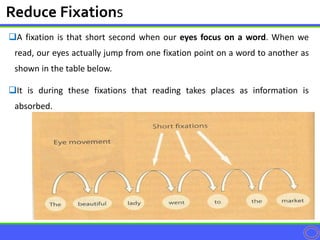
A fixation is that short second when our eyes focus on a word. When we
read, our eyes actually jump from one fixation point on a word to another as
shown in the table below.
It is during these fixations that reading takes places as information is
absorbed.
Reduce Fixations
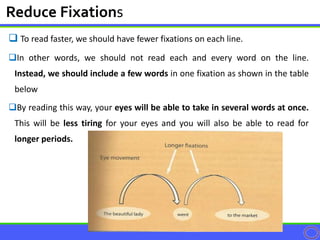
 To read faster, we should have fewer fixations on each line.
In other words, we should not read each and every word on the line.
Instead, we should include a few words in one fixation as shown in the table
below
By reading this way, your eyes will be able to take in several words at once.
This will be less tiring for your eyes and you will also be able to read for
longer periods.
Reduce Fixations
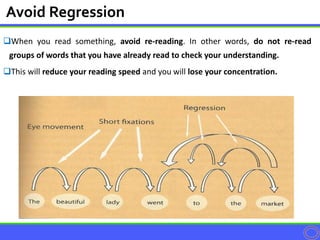
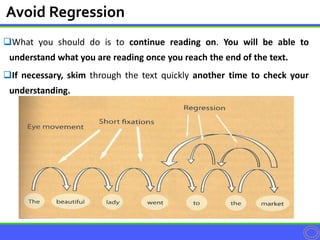
When you read something, avoid re-reading. In other words, do not re-read
groups of words that you have already read to check your understanding.
This will reduce your reading speed and you will lose your concentration.
Avoid Regression
What you should do is to continue reading on. You will be able to
understand what you are reading once you reach the end of the text.
If necessary, skim through the text quickly another time to check your
understanding.
Avoid Regression
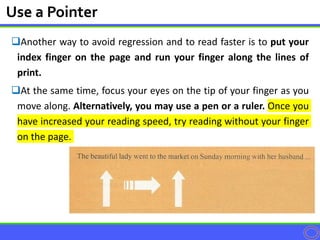
Another way to avoid regression and to read faster is to put your
index finger on the page and run your finger along the lines of
print.
At the same time, focus your eyes on the tip of your finger as you
move along. Alternatively, you may use a pen or a ruler. Once you
have increased your reading speed, try reading without your finger
on the page.
Use a Pointer
Some of us read aloud or move our lips as we read. This is called
vocalisation. Some of us vocalize as we read because we need to be able
to hear ourselves to fully understand what we read.
Vocalizing while reading, however, will slow our reading speed by at
least two or three times.
AvoidVocalizing
As we read, we will encounter some words that we are unfamiliar
with. However, we should not stop and look up the words in the
dictionary. Just continue reading and you will be able to get the main
idea of the text without needing to understand every word in it.
What is more important here is your understanding of what you are
reading. Sometimes, you will be able to guess the meanings of Some
unfamiliar words From the context of the passage.
Use the Dictionary only when it is necessary
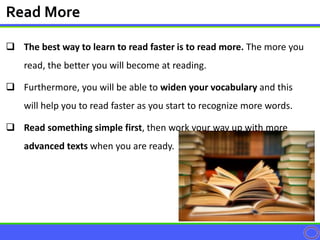
 The best way to learn to read faster is to read more. The more you
read, the better you will become at reading.
 Furthermore, you will be able to widen your vocabulary and this
will help you to read faster as you start to recognize more words.
 Read something simple first, then work your way up with more
advanced texts when you are ready.
Read More
30
Chapter 5: Reading

Chapter 5 Reading.ppt

  • 1.
    STUDY SKILLS Madeeasy Chapter 5:Reading 1 Reading
  • 2.
    Chapter outline 7.1 ReadingTechniques 7.2The SQ3R Method 7.3 KeyWords 7.4 How to Read Faster 2 Learning Styles
  • 3.
  • 4.
    Do you likereading? What type of materials do you read mostly? How often do you read? In college or university, you have to do a lot of reading for your subjects or courses. Most of the required reading materials in your studies such as handouts, books, magazines, journals, etc. are in English. Most students are put off by the huge volume of reading required as well as the feeling that they cannot understand what they read. While some are frustrated at the snail’s pace at which they read. In this chapter you will be exposed to some reading techniques that will help you to read effectively. Introduction
  • 5.
    When we read,we all use different reading techniques according to why we are reading and the information we are looking for. Some of the reading techniques that we use are as follows: Reading for Pleasure Reading in detail Skimming Reading critically Scanning ReadingTechniques
  • 6.
    Skimming When we skima passage, we are trying to get a general overview of it. We are trying to get the main gist of the passage by reading quickly. By skimming, we can also identify the location of specific information that we might need to refer to again. ReadingTechniques
  • 7.
    Scanning When we scana passage, we are trying to locate a particular piece of information or answer a specific question. We can scan effectively if we first skim a passage because we can then roughly remember the location of certain bits of information. Our ayes can specifically zoom in to a particular piece of information in the passage and ignore the rest. ReadingTechniques
  • 8.
    Reading in detail Wealso read in detail only when we want or have to. For example we would read very closely to understand every detail of our examination questions or the small print of a legal document. ReadingTechniques
  • 9.
    Reading critically We readsomething critically because we want to understand what is written and contribute our opinions or thoughts to it. This is an important skill because it allows us to evaluate and make a critical assessment of what we have read. ReadingTechniques
  • 10.
    Reading for Pleasure Thisis the most enjoyable for most of us. We read something for pleasure because we are interested in it. Such as reading a newspaper. An entertainment magazine, a novel, etc. There is no pressure as we do not have to worry if we forget what we have read. ReadingTechniques
  • 11.
    The SQ3R methodis a reading technique that gets you actively involved in your readings. This reading method was developed by Francis Robinson in 1941. By using the SQ3R method, you will be able to understand and remember what you have read. SQ3R basically stands for survey, questions, read, recall, reviews. The SQ3R
  • 12.
    Before you reada book, spend some time to survey it to ensure that you have understood all the necessary information about the book. How do we survey a book? You can look the following:
  • 13.
    To become activelyinvolved in your reading, you need to read with a purpose. Be it a whole book, a particular chapter or a section, ask yourself, “ why am I reading this?” and “ what am I looking for specifically?” When you can answer these questions, you are reading with a purpose.
  • 14.
    Once you havea clear purpose of reading, start reading. You may need to vary the way you read and your reading rate to absorb different types of information. Don’t expect to understand everything on the first reading. Reading too much at once will not help your brain to absorb and digest what you are reading. As our attention span is short, divide your reading into manageable sections.
  • 15.
    Most students usuallyforget 80% of what they have read within 24 hours after studying. Most study problems are caused by forgetting what one has read, not by the difficulties in understanding. So after you have done your reading, ask yourself, “ what was the text about?” you may want to read aloud to a friend or quietly to yourself what you have read.
  • 16.
    You may alsowant to write down what you recall without copying the text to show that you understand what you have read. Write the main points down as how you remember them and, if necessary , check the text for accuracy. If you can recall most of what you have read , this shows that you have been actively involved in your reading.
  • 17.
    After a fewdays, check the accuracy of what you have read by reviewing the material you have studied. This is a form of revision to keep the information you read fresh in your mind so that it will be stored in your long- term memory.
  • 18.
    Key words arewords which carry the meaning of the main points in a text. In a passage, less than 30% of the words are key words. KeyWords
  • 19.
    Most key wordsare nouns, verbs and adjectives, such as “method”, “read” and “effective”. If you take note of the key words in a passage, you Should be able to remember the content of the passage better. They will form the notes you make for your future reading. Therefore, if we concentrate on these key words in our notes, we will be able to Cut down the amount of reading we need to do and study effectively. KeyWords
  • 20.
    When we read,we need to vary our reading speed according to the types of reading we do. There are times we need to read slowly and there are times we need to read fast. How to Read Faster Activity 8 When do we need to read slowly?
  • 21.
    If you wantto learn to read faster, you need to have a strong desire to practice and improve yourself, and the willingness to try new ways. Remember that you do not learn to read fast overnight. It requires strong dedication and a lot of practice. The following are some strategies that will help you to read fast. Reduce Fixations Avoid Regression Use a Pointer AvoidVocalizing Use the Dictionary only when it is necessary Read more How to Read Faster
  • 22.
    A fixation isthat short second when our eyes focus on a word. When we read, our eyes actually jump from one fixation point on a word to another as shown in the table below. It is during these fixations that reading takes places as information is absorbed. Reduce Fixations
  • 23.
     To readfaster, we should have fewer fixations on each line. In other words, we should not read each and every word on the line. Instead, we should include a few words in one fixation as shown in the table below By reading this way, your eyes will be able to take in several words at once. This will be less tiring for your eyes and you will also be able to read for longer periods. Reduce Fixations
  • 24.
    When you readsomething, avoid re-reading. In other words, do not re-read groups of words that you have already read to check your understanding. This will reduce your reading speed and you will lose your concentration. Avoid Regression
  • 25.
    What you shoulddo is to continue reading on. You will be able to understand what you are reading once you reach the end of the text. If necessary, skim through the text quickly another time to check your understanding. Avoid Regression
  • 26.
    Another way toavoid regression and to read faster is to put your index finger on the page and run your finger along the lines of print. At the same time, focus your eyes on the tip of your finger as you move along. Alternatively, you may use a pen or a ruler. Once you have increased your reading speed, try reading without your finger on the page. Use a Pointer
  • 27.
    Some of usread aloud or move our lips as we read. This is called vocalisation. Some of us vocalize as we read because we need to be able to hear ourselves to fully understand what we read. Vocalizing while reading, however, will slow our reading speed by at least two or three times. AvoidVocalizing
  • 28.
    As we read,we will encounter some words that we are unfamiliar with. However, we should not stop and look up the words in the dictionary. Just continue reading and you will be able to get the main idea of the text without needing to understand every word in it. What is more important here is your understanding of what you are reading. Sometimes, you will be able to guess the meanings of Some unfamiliar words From the context of the passage. Use the Dictionary only when it is necessary
  • 29.
     The bestway to learn to read faster is to read more. The more you read, the better you will become at reading.  Furthermore, you will be able to widen your vocabulary and this will help you to read faster as you start to recognize more words.  Read something simple first, then work your way up with more advanced texts when you are ready. Read More
  • 30.