Reading Enrichment Unit
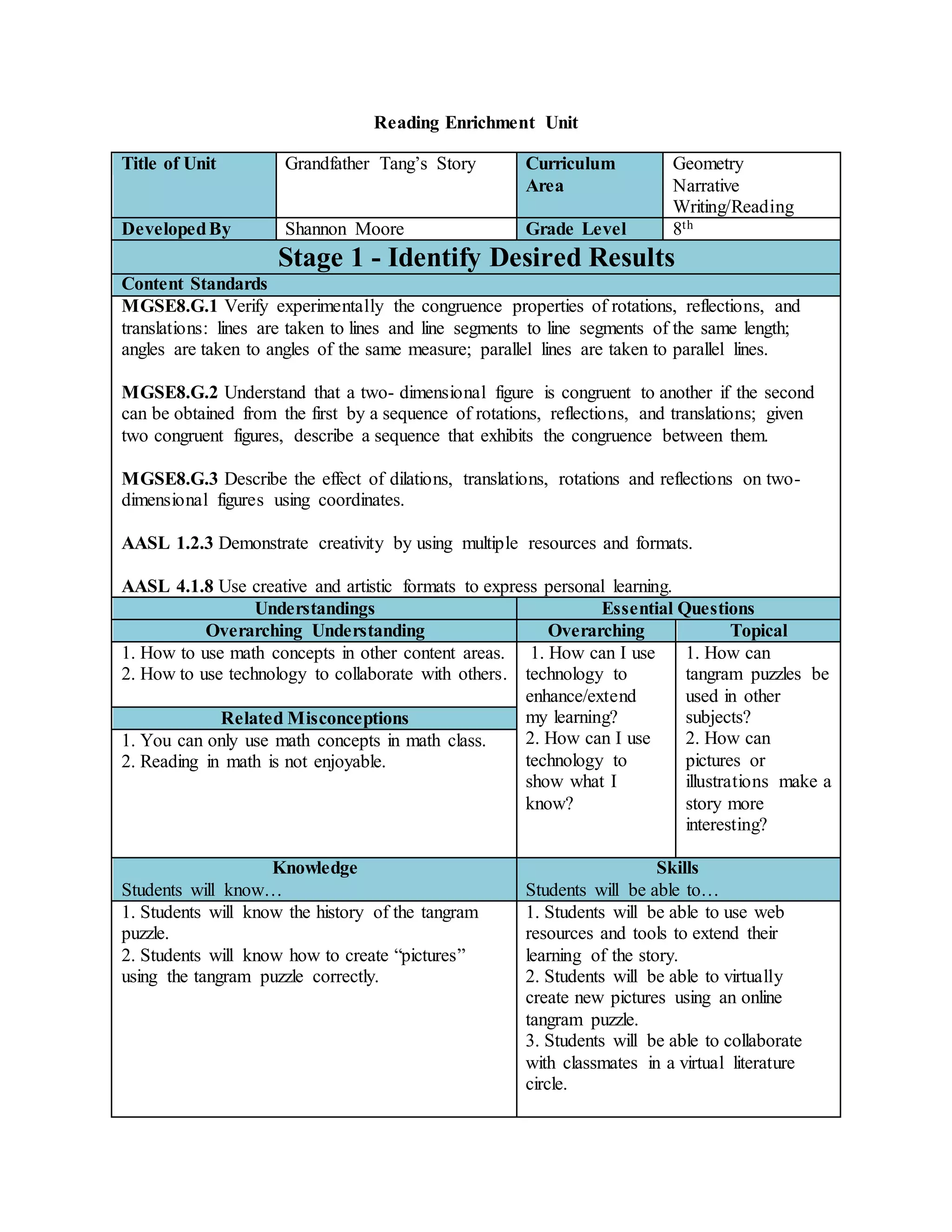
Title of Unit Grandfather Tang’s Story Curriculum
Area
Geometry
Narrative
Writing/Reading
DevelopedBy Shannon Moore Grade Level 8th
Stage 1 - Identify Desired Results
Content Standards
MGSE8.G.1 Verify experimentally the congruence properties of rotations, reflections, and
translations: lines are taken to lines and line segments to line segments of the same length;
angles are taken to angles of the same measure; parallel lines are taken to parallel lines.
MGSE8.G.2 Understand that a two- dimensional figure is congruent to another if the second
can be obtained from the first by a sequence of rotations, reflections, and translations; given
two congruent figures, describe a sequence that exhibits the congruence between them.
MGSE8.G.3 Describe the effect of dilations, translations, rotations and reflections on two-
dimensional figures using coordinates.
AASL 1.2.3 Demonstrate creativity by using multiple resources and formats.
AASL 4.1.8 Use creative and artistic formats to express personal learning.
Understandings Essential Questions
Overarching Understanding Overarching Topical
1. How to use math concepts in other content areas.
2. How to use technology to collaborate with others.
1. How can I use
technology to
enhance/extend
my learning?
2. How can I use
technology to
show what I
know?
1. How can
tangram puzzles be
used in other
subjects?
2. How can
pictures or
illustrations make a
story more
interesting?
Related Misconceptions
1. You can only use math concepts in math class.
2. Reading in math is not enjoyable.
Knowledge
Students will know…
Skills
Students will be able to…
1. Students will know the history of the tangram
puzzle.
2. Students will know how to create “pictures”
using the tangram puzzle correctly.
1. Students will be able to use web
resources and tools to extend their
learning of the story.
2. Students will be able to virtually
create new pictures using an online
tangram puzzle.
3. Students will be able to collaborate
with classmates in a virtual literature
circle.
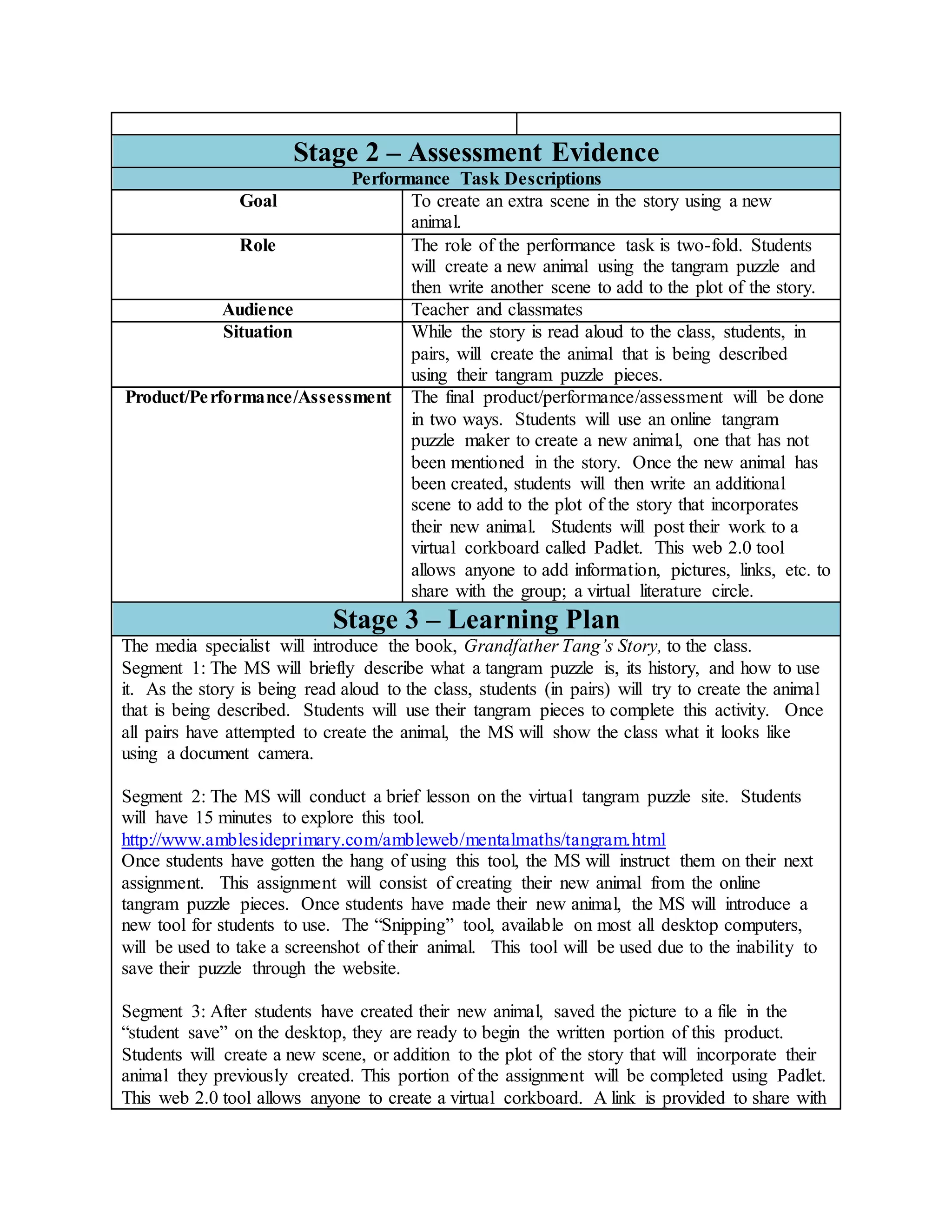
Stage 2 – Assessment Evidence
Performance Task Descriptions
Goal To create an extra scene in the story using a new
animal.
Role The role of the performance task is two-fold. Students
will create a new animal using the tangram puzzle and
then write another scene to add to the plot of the story.
Audience Teacher and classmates
Situation While the story is read aloud to the class, students, in
pairs, will create the animal that is being described
using their tangram puzzle pieces.
Product/Performance/Assessment The final product/performance/assessment will be done
in two ways. Students will use an online tangram
puzzle maker to create a new animal, one that has not
been mentioned in the story. Once the new animal has
been created, students will then write an additional
scene to add to the plot of the story that incorporates
their new animal. Students will post their work to a
virtual corkboard called Padlet. This web 2.0 tool
allows anyone to add information, pictures, links, etc. to
share with the group; a virtual literature circle.
Stage 3 – Learning Plan
The media specialist will introduce the book, Grandfather Tang’s Story, to the class.
Segment 1: The MS will briefly describe what a tangram puzzle is, its history, and how to use
it. As the story is being read aloud to the class, students (in pairs) will try to create the animal
that is being described. Students will use their tangram pieces to complete this activity. Once
all pairs have attempted to create the animal, the MS will show the class what it looks like
using a document camera.
Segment 2: The MS will conduct a brief lesson on the virtual tangram puzzle site. Students
will have 15 minutes to explore this tool.
http://www.amblesideprimary.com/ambleweb/mentalmaths/tangram.html
Once students have gotten the hang of using this tool, the MS will instruct them on their next
assignment. This assignment will consist of creating their new animal from the online
tangram puzzle pieces. Once students have made their new animal, the MS will introduce a
new tool for students to use. The “Snipping” tool, available on most all desktop computers,
will be used to take a screenshot of their animal. This tool will be used due to the inability to
save their puzzle through the website.
Segment 3: After students have created their new animal, saved the picture to a file in the
“student save” on the desktop, they are ready to begin the written portion of this product.
Students will create a new scene, or addition to the plot of the story that will incorporate their
animal they previously created. This portion of the assignment will be completed using Padlet.
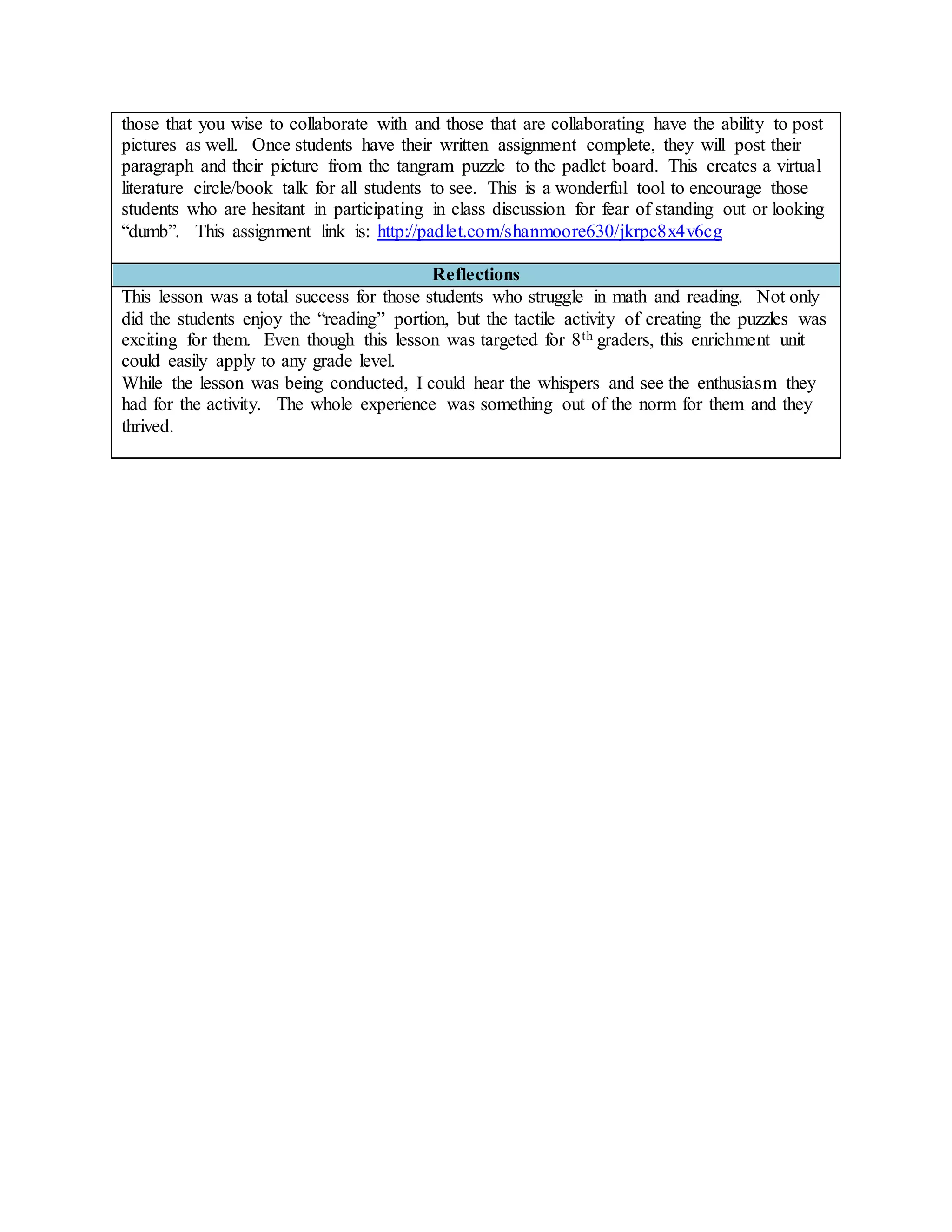
This web 2.0 tool allows anyone to create a virtual corkboard. A link is provided to share with
those that you wise to collaborate with and those that are collaborating have the ability to post
pictures as well. Once students have their written assignment complete, they will post their
paragraph and their picture from the tangram puzzle to the padlet board. This creates a virtual
literature circle/book talk for all students to see. This is a wonderful tool to encourage those
students who are hesitant in participating in class discussion for fear of standing out or looking
“dumb”. This assignment link is: http://padlet.com/shanmoore630/jkrpc8x4v6cg
Reflections
This lesson was a total success for those students who struggle in math and reading. Not only
did the students enjoy the “reading” portion, but the tactile activity of creating the puzzles was
exciting for them. Even though this lesson was targeted for 8th graders, this enrichment unit
could easily apply to any grade level.
While the lesson was being conducted, I could hear the whispers and see the enthusiasm they
had for the activity. The whole experience was something out of the norm for them and they
thrived.

Reading Enrichment Lesson

  • 1.
    Reading Enrichment Unit Titleof Unit Grandfather Tang’s Story Curriculum Area Geometry Narrative Writing/Reading DevelopedBy Shannon Moore Grade Level 8th Stage 1 - Identify Desired Results Content Standards MGSE8.G.1 Verify experimentally the congruence properties of rotations, reflections, and translations: lines are taken to lines and line segments to line segments of the same length; angles are taken to angles of the same measure; parallel lines are taken to parallel lines. MGSE8.G.2 Understand that a two- dimensional figure is congruent to another if the second can be obtained from the first by a sequence of rotations, reflections, and translations; given two congruent figures, describe a sequence that exhibits the congruence between them. MGSE8.G.3 Describe the effect of dilations, translations, rotations and reflections on two- dimensional figures using coordinates. AASL 1.2.3 Demonstrate creativity by using multiple resources and formats. AASL 4.1.8 Use creative and artistic formats to express personal learning. Understandings Essential Questions Overarching Understanding Overarching Topical 1. How to use math concepts in other content areas. 2. How to use technology to collaborate with others. 1. How can I use technology to enhance/extend my learning? 2. How can I use technology to show what I know? 1. How can tangram puzzles be used in other subjects? 2. How can pictures or illustrations make a story more interesting? Related Misconceptions 1. You can only use math concepts in math class. 2. Reading in math is not enjoyable. Knowledge Students will know… Skills Students will be able to… 1. Students will know the history of the tangram puzzle. 2. Students will know how to create “pictures” using the tangram puzzle correctly. 1. Students will be able to use web resources and tools to extend their learning of the story. 2. Students will be able to virtually create new pictures using an online tangram puzzle. 3. Students will be able to collaborate with classmates in a virtual literature circle.
  • 2.
    Stage 2 –Assessment Evidence Performance Task Descriptions Goal To create an extra scene in the story using a new animal. Role The role of the performance task is two-fold. Students will create a new animal using the tangram puzzle and then write another scene to add to the plot of the story. Audience Teacher and classmates Situation While the story is read aloud to the class, students, in pairs, will create the animal that is being described using their tangram puzzle pieces. Product/Performance/Assessment The final product/performance/assessment will be done in two ways. Students will use an online tangram puzzle maker to create a new animal, one that has not been mentioned in the story. Once the new animal has been created, students will then write an additional scene to add to the plot of the story that incorporates their new animal. Students will post their work to a virtual corkboard called Padlet. This web 2.0 tool allows anyone to add information, pictures, links, etc. to share with the group; a virtual literature circle. Stage 3 – Learning Plan The media specialist will introduce the book, Grandfather Tang’s Story, to the class. Segment 1: The MS will briefly describe what a tangram puzzle is, its history, and how to use it. As the story is being read aloud to the class, students (in pairs) will try to create the animal that is being described. Students will use their tangram pieces to complete this activity. Once all pairs have attempted to create the animal, the MS will show the class what it looks like using a document camera. Segment 2: The MS will conduct a brief lesson on the virtual tangram puzzle site. Students will have 15 minutes to explore this tool. http://www.amblesideprimary.com/ambleweb/mentalmaths/tangram.html Once students have gotten the hang of using this tool, the MS will instruct them on their next assignment. This assignment will consist of creating their new animal from the online tangram puzzle pieces. Once students have made their new animal, the MS will introduce a new tool for students to use. The “Snipping” tool, available on most all desktop computers, will be used to take a screenshot of their animal. This tool will be used due to the inability to save their puzzle through the website. Segment 3: After students have created their new animal, saved the picture to a file in the “student save” on the desktop, they are ready to begin the written portion of this product. Students will create a new scene, or addition to the plot of the story that will incorporate their animal they previously created. This portion of the assignment will be completed using Padlet. This web 2.0 tool allows anyone to create a virtual corkboard. A link is provided to share with
  • 3.
    those that youwise to collaborate with and those that are collaborating have the ability to post pictures as well. Once students have their written assignment complete, they will post their paragraph and their picture from the tangram puzzle to the padlet board. This creates a virtual literature circle/book talk for all students to see. This is a wonderful tool to encourage those students who are hesitant in participating in class discussion for fear of standing out or looking “dumb”. This assignment link is: http://padlet.com/shanmoore630/jkrpc8x4v6cg Reflections This lesson was a total success for those students who struggle in math and reading. Not only did the students enjoy the “reading” portion, but the tactile activity of creating the puzzles was exciting for them. Even though this lesson was targeted for 8th graders, this enrichment unit could easily apply to any grade level. While the lesson was being conducted, I could hear the whispers and see the enthusiasm they had for the activity. The whole experience was something out of the norm for them and they thrived.