PATTERNS OF DEVELOPMENT IN WRITING
ACROSS DISCIPLINES
•LESSON OBJECTIVES:
Familiarize yourself with the different writing patterns in
paragraph development;
Identify the transitional words and phrases used in the different
writing patterns;
Write a short paragraph using certain writing pattern; and
Distinguish the uses and the differences of each writing pattern.
•WHAT IS WRITTEN TEXT?
Is a connected discourse is formed from spontaneous
discreteness that predetermined its connectedness.
It only means that text does not have meaning unless they
are connected.
Connectedness can be achieved by applying the techniques
selecting and organizing information by identifying the
relevant and irrelevant ideas.
After learning how to organize, the next thing to learn is
writing patterns so you could develop a paragraph.
LESSON 1: PRELIMINARY ACTIVITY
Read the set of events and rewrite the following details on your
answer sheet to create a coherent story.
1. Finally, the elderly crossed the street safely and Juan was
able to reach school on time.
2. One morning, Juan is in a hurry going to school.
3. Then, he thought of helping an elderly even though he will be
late for school.
4. Suddenly, he saw an old lady, carrying a full of basket,
crossing the street.
PROCESSING QUESTIONS
1. What words are used to signal the correct
sequence of the events?
2. How do you think the ideas were able to relate to
one another?
3. What do we call these words?
4. How do these words help to create a story?
LESSON 1: NARRATION
•WHAT IS NARRATION?
Writing pattern use to tell a story.
Contains the plot which gives direction in making a story.
In developing narration, sequential presentation of events plays an
important role. Signal words help to create unified thought and to
show the transition of events to the next. This leads us to focus on
the use of the action words in the story. It also helps to move the
story and makes the story interesting.
Narrative writing involves chronological ordering.
LESSON 1: NARRATION
•CHRONOLOGICAL ORDERING
Helps to show the reader how the story moves. Most of
the common transitional words are first, next, then, after
and suddenly. Moreover, it is also important to give
specific details in pointing out the direction of the story.
EXAMPLE OF NARRATION
Being a transferee is never easy. At first, I was hesitant to come but my
mother told me that I would find new friends in masayahin senior high school.
I would never forget the day I first entered this school, I felt so shy and
nervous. I did not know anyone for I was a new grade 11 student. When I
entered my first class looking for a chair to sit in, a boy sitting beside the
window sill asked me, “are you new in this school?” And I answered shyly,
“yes.” Then, he offered me the vacant seat beside him. He was jasper, a
former student in that school. We got along with each other well in our class.
We worked on our assignments and school projects, he slept in our house doing
our research work. After a year, we both realized that in many ways we had a
lot of similarities in terms of interests in life. In the end, we became best of
friends.
QUESTIONS:
1. Where and when did the story happen?
2. What transitional devices are used to indicate the
chronological
order of time?
3. What event happened first?
4. What does the paragraph tell?
5. What sequence is presented in the story?
ACTIVITY: COMPLETE ME!
Choose the best word/group of words that will complete the statements.
1. _________ Is a writing pattern that is used to tell a story.
2. A narrative text contains the _________ which gives direction in the
story.
3. _________Are words or phrases that help carry a thought from one
sentence to another, from one idea to another, or from one paragraph to
another.
4. Most of the common transitional words to show _________ of events are
first, next, then, after and suddenly.
5. The _________of events help to show the reader how the story moves.
WRITING ACTIVITY
•Write a short paragraph with 100-150 words, narrate one of the
significant moments in your life that left a great impact in you as a
person. Use transitional devices to make your story coherent.
Rubric
Structure(should have a plot) - 10
Coherence(should have transitional words or devices) - 10 points
Language (grammar and spelling) - 10 points
LESSON 2: PRELIMINARY ACTIVITY
Complete the table by supplying words or phrases that best describe
the given subjects. Use any of your senses to provide appropriate
descriptions.
QUESTIONS
•What do you call the words that are used to provide
a striking effect on the senses of the reader?
•How do these words help create a vivid description
of the given words?
•What kind of paragraph can you develop using the
given details?
LESSON 2: DESCRIPTION
•WHAT IS DESCRIPTION?
Written text involves sensory images to figure out something.
The use of description plays an important role to elucidate the
nature of people, places and things. A series of detailed
observation about the subject can help you create a good
descriptive paragraph. This involves the use of adjectives and
adverbs in the paragraph. (Dayagbil & et al, 2016)
LESSON 2: DESCRIPTION
•WHAT IS SENSORY IMAGE?
The words we used to describe how your subject looks,
sounds, feels, smells or even tastes like.
Concerns how you will arrange the details to provide an
image of the scene, the person or the object you are trying to
describe in your text
LESSON 2: DESCRIPTION
•2 TYPES OF DESCRIPTIONS
OBJECTIVE DESCRIPTION - Writer presents impartial and actual picture of the
subject without biases and excluding personal impression of the subject
Example: Giving your description of an experiment in class.
SUBJECTIVE DESCRIPTION - Writer gives personal impression of what is
observed. This is often used in making fiction stories.
Example: When you are asked to write about a place you visit during summer
vacation, you tend to give your personal judgment of how you experience the
place.
LET’S TRY THIS
Directions: Read the paragraphs below. Tell whether the
description is subjective description or objective.
1. Sampaloc lake is an inactive volcanic maar on the island of
Luzon, the Philippines. It is the largest of the seven lakes of San
Pablo, Laguna. Nearly half of the lake's depth has a shallow
depression at the bottom, indicating its volcanic origin. It is
approximately 104 hectares and 3.5 kilometer boardwalk. The
lake is behind San Pablo city capitol and at the foot of the Doña
Leonila park.
LET’S TRY
2. Malagonlong Bridge is one of the best tourist spots in
Tayabas City. It is where you can bring your friends and loved
ones for picnic and bonding. Most of Tayabasins jog around the
place and do ride bicycles not only to have morning good
exercise but also have fresh air. You can witness the beauty of
nature for it is surrounded with a river.
ACTIVITY: COMPLETE ME!
Choose the best word/group of words that will complete the
statements.
1. ____________ Is a writing pattern of developing paragraph using
detailed observation about the subject.
2. ____________ Are used in writing descriptive paragraph.
3. ____________ Can be in a form of word, phrase or clause.
4. ____________Description presents impartial and actual picture of the
subjects without biases.
5. ____________ Description gives the personal impression of the writer.
WRITING ACTIVITY
•Develop a short composition using description as a pattern of
paragraph development with. Make a vivid picture of your
dream house which you would like to own in the future. Use
at least ten (10) descriptive words.
Rubric
Structure - 10
Coherence - 10 points
Language - 10 points
LESSON 3: PRELIMINARY ACTIVITY
An estimated 50 years old, giant crocodylus porosus is a
saltwater crocodile. It was the largest crocodile caught alive
in buhawan of agusan del sur. According to residents, it is
known to attack people and had eaten animals. The biggest
crocodile was given the name of “lolong” after the name of
ernesto “lolong” goloran, who is one of the veteran hunters
from the palawan crocodile and wildlife reservation center,
who led the hunt. Dr. Adam britton, an australian zoologist
and crocodile expert, measured lolong at 6.17 m (20 ft. 3
in). And in june 2012 lolong was officially certified by the
guinness book of world records as the “world’s largest
crocodile in captivity”.
According to the experts of the national geographic channel,
lolong breaks the record of the previous record-holder with
a measurement of 5.48 m (18 FT 0 in).
PROCESSING QUESTIONS
1. What is being defined in this paragraph?
2. Do the supporting points help you understand
the definition better? Are there facts, reasons,
examples, and details that make it even clearer?
3. What transition words are used between
supporting points?
LESSON 3: DEFINITION
•WHAT IS DEFINITION?
Provide concise but exact meanings of unfamiliar
words and explain special meanings for familiar
words.
They are often used to explain technical words and
concepts.
LESSON 3: DEFINITION
•2 DISTINCT METHOD OF DEFINITION
1. Informal Definition – can either be denotation or
connotation
Denotation - Dictionary meaning of the word.
Example: Rose is a family of prickly shrub with pinnate
leaves and showy flowers.
LESSON 3: DEFINITION
1. Informal Definition – can either be denotation or
connotation
Connotation - Is the secondary meaning of a word and not
necessarily included in the dictionary. Rather it is how a writer
understands a word based on their own personal or consensual
experiences.
Example: A dozen of pink roses is usually given to their beloved
ones. Instead of literally referring to flowers, love and romance are
connoted
LESSON 3: DEFINITION
•2 DISTINCT METHOD OF DEFINITION
2. Formal Definition – Consists of three principal parts: the species
(WORD) n + genus (CLASS) + differentiae (CHARACTERISTIC)
The WORD is the name of the object, process, or concept defined.
This is usually followed by “is” and “are”
The CLASS or general group to which the objects belongs.
Example: Skimming (species) is a reading technique (class) of
allowing the eyes to travel over a page very quickly, stopping
only here and there to gain an idea (differentiae).
LESSON 3: DEFINITION
•Expanded and Extended Definition
Here are common methods used in paragraph development ((Filomena T.
Dayagabil, ethel L. Abao, and remedios C. Bacus, critical reading and
writing for senior high school. Quezon city: lorimar publishing, 2016, 43)
LESSON 3: DEFINITION
•Expanded and Extended Definition
ACTIVITY: TRY TO ANALYZE
Analyze how the writer creates a shared concept and what
different expanded definition methods are used in the
paragraph. Write your answer on a separate sheet of paper.
You may follow the template below:
WRITING ACTIVITY
•Define “Economic Crisis” using the rules you have learned. You may
also choose to use the outline below to help you in writing a good
definition paragraph.
Topic sentence: Economic Crisis is _________________________________.
•First (supporting point#1) + (fact, reason, or detail)
•In addition (supporting point #2) + (fact, reason, example or detail)
•Finally, (supporting point #3 + (fact, reason, example or detail)
•Conclusion: in the end, COVID 19 is_________________________
WRITING ACTIVITY: RUBRIC
Description Highest point Your Score
Clear topic sentence 5 POINTS
Evidences and examples are
specific and accurate
10 POINTS
Mechanics of writing are observed 5 POINTS
TOTAL 20 POINTS
LESSON 4: PRELIMINARY ACTIVITY
Read the passage carefully. Once finished, fill out the table with
the appropriate words that match the headings below:
LESSON 4: PRELIMINARY ACTIVITY
Study the accomplished table. How can you say that the words
and phrases that you have just written all exemplify that of the:
(a) topic sentence
(b) Classification
(c) Examples
d) transition words?
LESSON 4: EXEMPLIFICATION & CLASSIFICATION
• What is Exemplification (or Illustration)?
 The most common and effective pattern to explain an
idea or point.
 In developing this kind of paragraph, the writer develops a general
statement – the topic sentence, with one or more examples to support
it.
 Transitional expressions in writing effective exemplification
paragraphs: for instance, namely, to be specify, to clarify, to
illustrate, for example, in short, as an example.
LESSON 4: EXEMPLIFICATION & CLASSIFICATION
• What is Classification?
 Used when a writer needs to sort out or arrange subjects
to groups or categories based on their common and shared
characteristics.
 Transitional expressions in writing effective classification
paragraphs: classified as, one kind, the last group,
another kind, another, final type, the first category, are
categorized as, the next part
LESSON 4: EXEMPLIFICATION & CLASSIFICATION
Remember!
 You can use both exemplification and
classification in developing a paragraph by
simply identifying categories on a particular
subject and providing examples or illustration to
explain and clarify meaning.
WRITING ACTIVITY:
Choose at least one from the situations below.
Writing task 1: You are the editor-in-chief of your
school’s publication. The school paper adviser requires
you to write a 2-3 paragraph opinion article about the
construction of Kaliwa Dam Project for a special edition
paper. You need to take side and be specific in
explaining your point of view by proving clear examples
and illustrations to support your arguments.
WRITING ACTIVITY:
Choose at least one from the situations below.
Writing task 2: You are one of the business proprietors at your
school’s on-going Business Expo. An interested customer sent
you an e-mail asking about the different types of products you
sell. You need to respond to the e-mail in 2-3 paragraphs
indicating the classification of your products. To encourage your
customer to avail, your message must contain the product’s
category, specific features and prices.
10 POINTS
5 POINTS
5 POINTS
20 POINTS
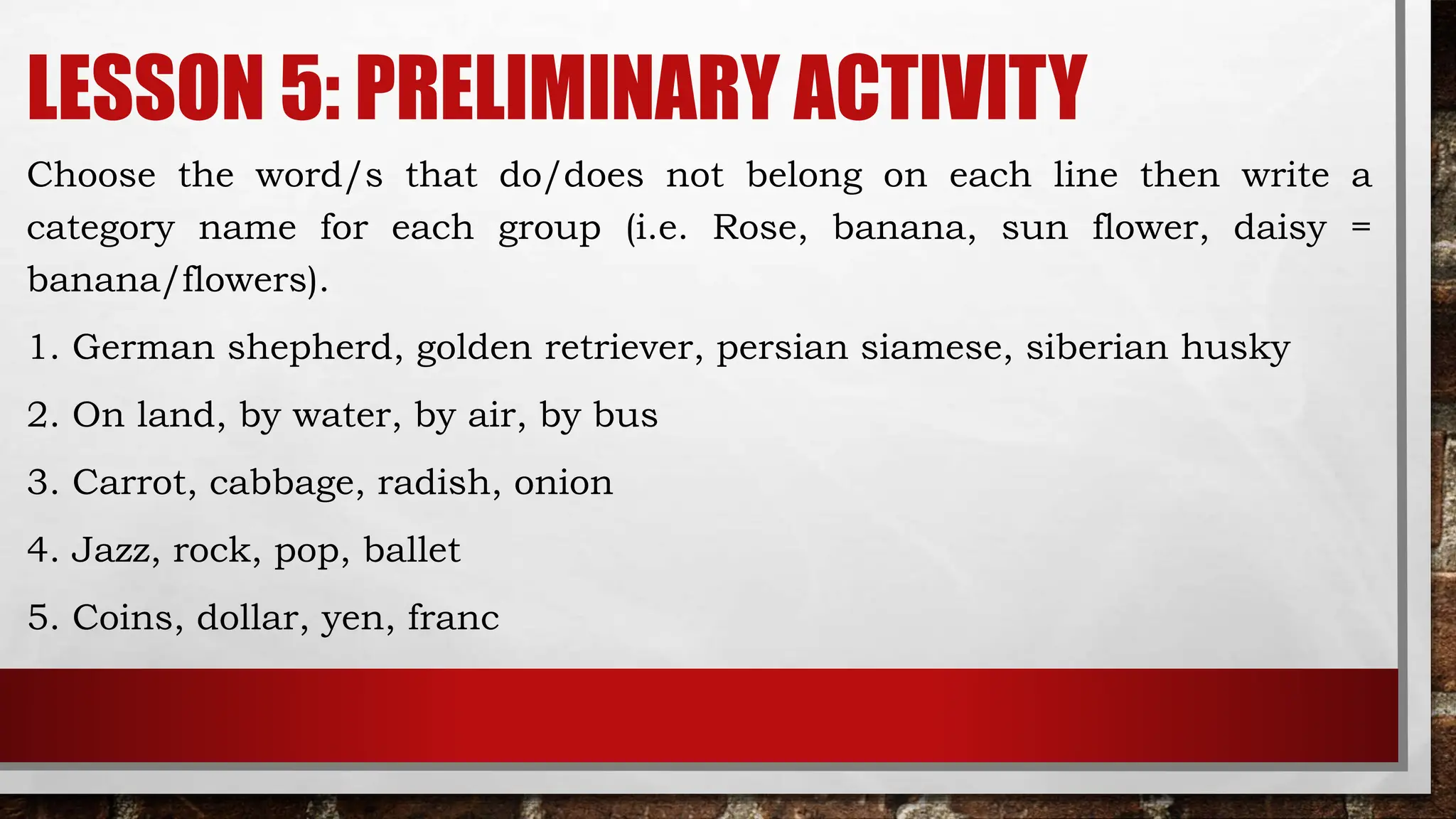
LESSON 5: PRELIMINARY ACTIVITY
Choose the word/s that do/does not belong on each line then write a
category name for each group (i.e. Rose, banana, sun flower, daisy =
banana/flowers).
1. German shepherd, golden retriever, persian siamese, siberian husky
2. On land, by water, by air, by bus
3. Carrot, cabbage, radish, onion
4. Jazz, rock, pop, ballet
5. Coins, dollar, yen, franc
LESSON 5: PRELIMINARY ACTIVITY
Processing Questions:
1. How did you find the activity?
2. How did you point out the word which
does not belong to each group item?
LESSON 5: COMPARISON & CONTRAST
• What is Comparison and Contrast ?
 Comparison in writing discusses elements that are similar
 Contrast in writing discusses elements or ideas that are
different.
 A compare-and-contrast essay, then analyzes two subjects
comparing them, contrasting them, or both. However, its
purpose is not to simply state the obvious but rather to illustrate
subtle differences or unexpected similarities between two
subjects.
LESSON 5: COMPARISON & CONTRAST
Study the given example:
My sisters are as different as Yin and Yang in terms of personality, appearance and
intelligence. Tina, the middle child in the family, prefers staying at home than going out
with her friends. She is slim, petite and has dark skin. As she is not sociable, she finds
friends with the characters from the books she reads most of the time. In addition, she is
very clever in subjects like math and science which made her graduate with highest
honors from senior high school. In contrast, my youngest sister, Joni, is the opposite. She
has an outgoing and friendly personality. There is never a dull moment as she is always
ready with stories to tell. She is tall with a round plump face and fair skin. Being the
youngest in the family, she is often asked to perform during family gatherings since she
sings and dances well. My sisters may be different from each other but they adore one
another.
LESSON 5: COMPARISON & CONTRAST
• 2 Common ways to organize Comparison/Contrast
paragraph or essay.
 Block Method - Used to compare and contrast two subjects
one at a time. You may begin by saying everything you have
to say about the first subject you are discussing then move on
and write everything about your second subject. If you are
writing a short paragraph or essay, you might be able to fit all
of your points about each item.
LESSON 5: COMPARISON & CONTRAST
• 2 Common ways to organize Comparison/Contrast
paragraph or essay.
 Point-by-point - Addressing one subject at a time, you may
use
 Cohesive devices you can use in showing similarities are
likewise, similar to, same with, like, in the same manner. To
show contrast, cue words such as: on the other hand,
however, while, different with, in contrast and the like.
ACTIVITY
Complete the following statements to summarize what you have
learned in this lesson.
1. A compare-and-contrast writing analyzes two subjects by
__________.
2. The purpose of writing a comparison or contrast essay is not to
state what seems so obvious about the things being compared
but __________.
3. The two main organizing strategies for comparison-and-
contrast writing are: __________ and __________.
WRITING ACTIVITY
Create compare-and-contrast paper outline using either point-
by-point or block method by comparing or contrasting junior
high school and senior high school. Be guided by the rubric
below.
10 POINTS
5 POINTS
5 POINTS
20 POINTS
WRITING ACTIVITY
Choose one among the three topics below. Then come up with a
comparison and contrast writing text.
1. Cell phone units and brands
2. Fast food chains and fine dining restaurants
3. Enrolling in college or getting employed after senior high school
10 POINTS
5 POINTS
5 POINTS
20 POINTS
LESSON 6: PRELIMINARY ACTIVITY
Read the passage carefully. Then, complete the diagram that follows.
Discoveries and invention of devices are always welcome until
we, humans, find a way to abuse its benefits and be adversely
affected by it. This was the case when Wilhelm roentgen
discovered x-ray and within five years, the British army was using
a mobile x-ray unit to locate bullets and shrapnel in wounded
soldiers in the Sudan. TV was also invented with positive thoughts
in mind – there would be no national borders, education and
communication would be worldwide, etc. However, we are now
trying to overcome its physiological and psychological adverse
effects on human beings.
LESSON 6: PRELIMINARY ACTIVITY
1. What is the main idea of the text?
2. What states the cause of the idea?
3. What states the results of the idea?
LESSON 6: CAUSE AND EFFECT
•What is Cause and Effect?
 Cause and effect is a text development pattern which
explains why something happens. It also states
what results a particular event produces. It usually
gives a statement emphasizing the cause and
another emphasizing the effect.
LESSON 6: CAUSE AND EFFECT
•The following guide questions can be used for cause-
effect development:
 Why did it happen?
 What caused it?
 What does it cause?
 What are the effects?
 How is it related to something else?
LESSON 6: CAUSE AND EFFECT
•The following guide questions can be used for cause-
effect development:
 Why did it happen?
 What caused it?
 What does it cause?
 What are the effects?
 How is it related to something else?
LESSON 6: CAUSE AND EFFECT
• Signal Words being used in Cause and Effect
writing pattern
 To express cause - as a consequence of, as a result
of, because, because of, now that and since
 To express effect - accordingly, consequently,
hence, so, therefore, and this resulted in to signify
effects.
ACTIVITY 1:
Put a check (✓) if the item is suited for a cause-and-
effect text or a cross (x) if not.
_____1. How to play drums
_____2. Impact to technology in education
_____3. Importance of daily reading habit
_____4. Increased drop-out rate in a school.
_____5. The act of kindness
ACTIVITY 2:
Complete the given statements to sum up your learning for this lesson.
1. Cause and effect is a text development pattern explains ___________
something happens and states ___________results a particular event
produces.
2. ___________Focuses on: why did the topic happen; what caused it;
what does it cause; what are its effects; and, how is it related to
something else.
3. Signal words used in introducing cause include:
_______________________
4. Signal words used in introducing effect include:
_______________________
WRITING ACTIVITY:
Write a 10-sentence paragraph that explains
procrastination among students. Use cause and effect
pattern of development. The rubric below may be used
in this output.
15 POINTS 10 POINTS 5 POINTS
LESSON 7: PRELIMINARY ACTIVITY
Read the essay below. Identify the problem/s and solution/s
cited in the passage.
LESSON 7: PRELIMINARY ACTIVITY
LESSON 7: PROBLEM SOLUTION
•What is a Problem-Solution?
 A problem/solution essay presents a
problem, usually discussing several aspects of
the problem, then concludes by discussing
solutions to the problem.
LESSON 7: PROBLEM SOLUTION
The problem may be addressed in the following ways:
LESSON 7: PROBLEM SOLUTION
Here are some ways to present solutions:
LESSON 7: PROBLEM SOLUTION
The following transitional devices can also help you develop
your text.
WRITING ACTIVITY
Choose a specific problem in your place and try to propose
solutions for it. Write your insights in a short paragraph
following the problem-and-solution pattern of development.
Make use of correct transitional devices in your text. Be guided
by the rubric below.
15 POINTS 10 POINTS 5 POINTS
Problem-solution Problem-solution
Problem-solution
LESSON 8: PRELIMINARY ACTIVITY
Complete the table after reading the paragraph.
Is iPhone 11 worth spending? One of the
company’s recent novelties is the iPhone 11 – a
newer and more advanced version of the most
popular phone in the world. However, the
previous model – iPhone XR – seemed to have
been satisfying people’s needs just fine as well.
So, what is the difference?
LESSON 8: PRELIMINARY ACTIVITY
1. What is the main idea of the text?
2. What issue has been presented in the text?
3. What does the text want us to do?
LESSON 8: PERSUASIVE TEXT
• What is Persuasive Text?
 Can be in the form of an argument, discussion,
exposition, review or even an advertisement
 In developing your own persuasive text, a writer must first
state the issue. This will serve as a background
information about the topic. Then, it should be followed by
a clear, strong and specific argument.
LESSON 8: PERSUASIVE TEXT
• What is Argument?
 An argument is one’s claim or position that can either support or
reject the issue previously stated. Arguments shall be supported with
a well-researched evidences, which will give details on how and why it
supports the argument. Evidences can be factual, logical, statistical or
anecdotal in nature. It can also explain counterarguments not because
the writer wants to prove which claims are wrong or right but to
enlighten the readers about other positions.
 Lastly, a conclusion restating the main argument of the text will be
the end of the text. This will be your final statement to persuade your
readers.
LESSON 8: PERSUASIVE TEXT
•Some guide questions in constructing a persuasive text
include:
1. What is the issue?
2. What is your position or opinion?
3. What is the opposing position/opinion?
4. What are some reasons for your position/opinion?
5. What are some cases or examples that support this?
ACTIVITY 1
ACTIVITY 2
ACTIVITY 3
ACTIVITY 3
ASSESSMENT
READING AND WRITING SKILLS WEEK 1 & 2.pptx

READING AND WRITING SKILLS WEEK 1 & 2.pptx

  • 2.
    PATTERNS OF DEVELOPMENTIN WRITING ACROSS DISCIPLINES •LESSON OBJECTIVES: Familiarize yourself with the different writing patterns in paragraph development; Identify the transitional words and phrases used in the different writing patterns; Write a short paragraph using certain writing pattern; and Distinguish the uses and the differences of each writing pattern.
  • 3.
    •WHAT IS WRITTENTEXT? Is a connected discourse is formed from spontaneous discreteness that predetermined its connectedness. It only means that text does not have meaning unless they are connected. Connectedness can be achieved by applying the techniques selecting and organizing information by identifying the relevant and irrelevant ideas. After learning how to organize, the next thing to learn is writing patterns so you could develop a paragraph.
  • 4.
    LESSON 1: PRELIMINARYACTIVITY Read the set of events and rewrite the following details on your answer sheet to create a coherent story. 1. Finally, the elderly crossed the street safely and Juan was able to reach school on time. 2. One morning, Juan is in a hurry going to school. 3. Then, he thought of helping an elderly even though he will be late for school. 4. Suddenly, he saw an old lady, carrying a full of basket, crossing the street.
  • 5.
    PROCESSING QUESTIONS 1. Whatwords are used to signal the correct sequence of the events? 2. How do you think the ideas were able to relate to one another? 3. What do we call these words? 4. How do these words help to create a story?
  • 6.
    LESSON 1: NARRATION •WHATIS NARRATION? Writing pattern use to tell a story. Contains the plot which gives direction in making a story. In developing narration, sequential presentation of events plays an important role. Signal words help to create unified thought and to show the transition of events to the next. This leads us to focus on the use of the action words in the story. It also helps to move the story and makes the story interesting. Narrative writing involves chronological ordering.
  • 7.
    LESSON 1: NARRATION •CHRONOLOGICALORDERING Helps to show the reader how the story moves. Most of the common transitional words are first, next, then, after and suddenly. Moreover, it is also important to give specific details in pointing out the direction of the story.
  • 8.
    EXAMPLE OF NARRATION Beinga transferee is never easy. At first, I was hesitant to come but my mother told me that I would find new friends in masayahin senior high school. I would never forget the day I first entered this school, I felt so shy and nervous. I did not know anyone for I was a new grade 11 student. When I entered my first class looking for a chair to sit in, a boy sitting beside the window sill asked me, “are you new in this school?” And I answered shyly, “yes.” Then, he offered me the vacant seat beside him. He was jasper, a former student in that school. We got along with each other well in our class. We worked on our assignments and school projects, he slept in our house doing our research work. After a year, we both realized that in many ways we had a lot of similarities in terms of interests in life. In the end, we became best of friends.
  • 9.
    QUESTIONS: 1. Where andwhen did the story happen? 2. What transitional devices are used to indicate the chronological order of time? 3. What event happened first? 4. What does the paragraph tell? 5. What sequence is presented in the story?
  • 10.
    ACTIVITY: COMPLETE ME! Choosethe best word/group of words that will complete the statements. 1. _________ Is a writing pattern that is used to tell a story. 2. A narrative text contains the _________ which gives direction in the story. 3. _________Are words or phrases that help carry a thought from one sentence to another, from one idea to another, or from one paragraph to another. 4. Most of the common transitional words to show _________ of events are first, next, then, after and suddenly. 5. The _________of events help to show the reader how the story moves.
  • 11.
    WRITING ACTIVITY •Write ashort paragraph with 100-150 words, narrate one of the significant moments in your life that left a great impact in you as a person. Use transitional devices to make your story coherent. Rubric Structure(should have a plot) - 10 Coherence(should have transitional words or devices) - 10 points Language (grammar and spelling) - 10 points
  • 12.
    LESSON 2: PRELIMINARYACTIVITY Complete the table by supplying words or phrases that best describe the given subjects. Use any of your senses to provide appropriate descriptions.
  • 13.
    QUESTIONS •What do youcall the words that are used to provide a striking effect on the senses of the reader? •How do these words help create a vivid description of the given words? •What kind of paragraph can you develop using the given details?
  • 14.
    LESSON 2: DESCRIPTION •WHATIS DESCRIPTION? Written text involves sensory images to figure out something. The use of description plays an important role to elucidate the nature of people, places and things. A series of detailed observation about the subject can help you create a good descriptive paragraph. This involves the use of adjectives and adverbs in the paragraph. (Dayagbil & et al, 2016)
  • 15.
    LESSON 2: DESCRIPTION •WHATIS SENSORY IMAGE? The words we used to describe how your subject looks, sounds, feels, smells or even tastes like. Concerns how you will arrange the details to provide an image of the scene, the person or the object you are trying to describe in your text
  • 16.
    LESSON 2: DESCRIPTION •2TYPES OF DESCRIPTIONS OBJECTIVE DESCRIPTION - Writer presents impartial and actual picture of the subject without biases and excluding personal impression of the subject Example: Giving your description of an experiment in class. SUBJECTIVE DESCRIPTION - Writer gives personal impression of what is observed. This is often used in making fiction stories. Example: When you are asked to write about a place you visit during summer vacation, you tend to give your personal judgment of how you experience the place.
  • 17.
    LET’S TRY THIS Directions:Read the paragraphs below. Tell whether the description is subjective description or objective. 1. Sampaloc lake is an inactive volcanic maar on the island of Luzon, the Philippines. It is the largest of the seven lakes of San Pablo, Laguna. Nearly half of the lake's depth has a shallow depression at the bottom, indicating its volcanic origin. It is approximately 104 hectares and 3.5 kilometer boardwalk. The lake is behind San Pablo city capitol and at the foot of the Doña Leonila park.
  • 18.
    LET’S TRY 2. MalagonlongBridge is one of the best tourist spots in Tayabas City. It is where you can bring your friends and loved ones for picnic and bonding. Most of Tayabasins jog around the place and do ride bicycles not only to have morning good exercise but also have fresh air. You can witness the beauty of nature for it is surrounded with a river.
  • 19.
    ACTIVITY: COMPLETE ME! Choosethe best word/group of words that will complete the statements. 1. ____________ Is a writing pattern of developing paragraph using detailed observation about the subject. 2. ____________ Are used in writing descriptive paragraph. 3. ____________ Can be in a form of word, phrase or clause. 4. ____________Description presents impartial and actual picture of the subjects without biases. 5. ____________ Description gives the personal impression of the writer.
  • 20.
    WRITING ACTIVITY •Develop ashort composition using description as a pattern of paragraph development with. Make a vivid picture of your dream house which you would like to own in the future. Use at least ten (10) descriptive words. Rubric Structure - 10 Coherence - 10 points Language - 10 points
  • 21.
    LESSON 3: PRELIMINARYACTIVITY An estimated 50 years old, giant crocodylus porosus is a saltwater crocodile. It was the largest crocodile caught alive in buhawan of agusan del sur. According to residents, it is known to attack people and had eaten animals. The biggest crocodile was given the name of “lolong” after the name of ernesto “lolong” goloran, who is one of the veteran hunters from the palawan crocodile and wildlife reservation center, who led the hunt. Dr. Adam britton, an australian zoologist and crocodile expert, measured lolong at 6.17 m (20 ft. 3 in). And in june 2012 lolong was officially certified by the guinness book of world records as the “world’s largest crocodile in captivity”. According to the experts of the national geographic channel, lolong breaks the record of the previous record-holder with a measurement of 5.48 m (18 FT 0 in).
  • 22.
    PROCESSING QUESTIONS 1. Whatis being defined in this paragraph? 2. Do the supporting points help you understand the definition better? Are there facts, reasons, examples, and details that make it even clearer? 3. What transition words are used between supporting points?
  • 23.
    LESSON 3: DEFINITION •WHATIS DEFINITION? Provide concise but exact meanings of unfamiliar words and explain special meanings for familiar words. They are often used to explain technical words and concepts.
  • 24.
    LESSON 3: DEFINITION •2DISTINCT METHOD OF DEFINITION 1. Informal Definition – can either be denotation or connotation Denotation - Dictionary meaning of the word. Example: Rose is a family of prickly shrub with pinnate leaves and showy flowers.
  • 25.
    LESSON 3: DEFINITION 1.Informal Definition – can either be denotation or connotation Connotation - Is the secondary meaning of a word and not necessarily included in the dictionary. Rather it is how a writer understands a word based on their own personal or consensual experiences. Example: A dozen of pink roses is usually given to their beloved ones. Instead of literally referring to flowers, love and romance are connoted
  • 26.
    LESSON 3: DEFINITION •2DISTINCT METHOD OF DEFINITION 2. Formal Definition – Consists of three principal parts: the species (WORD) n + genus (CLASS) + differentiae (CHARACTERISTIC) The WORD is the name of the object, process, or concept defined. This is usually followed by “is” and “are” The CLASS or general group to which the objects belongs. Example: Skimming (species) is a reading technique (class) of allowing the eyes to travel over a page very quickly, stopping only here and there to gain an idea (differentiae).
  • 27.
    LESSON 3: DEFINITION •Expandedand Extended Definition Here are common methods used in paragraph development ((Filomena T. Dayagabil, ethel L. Abao, and remedios C. Bacus, critical reading and writing for senior high school. Quezon city: lorimar publishing, 2016, 43)
  • 28.
    LESSON 3: DEFINITION •Expandedand Extended Definition
  • 29.
    ACTIVITY: TRY TOANALYZE Analyze how the writer creates a shared concept and what different expanded definition methods are used in the paragraph. Write your answer on a separate sheet of paper. You may follow the template below:
  • 31.
    WRITING ACTIVITY •Define “EconomicCrisis” using the rules you have learned. You may also choose to use the outline below to help you in writing a good definition paragraph. Topic sentence: Economic Crisis is _________________________________. •First (supporting point#1) + (fact, reason, or detail) •In addition (supporting point #2) + (fact, reason, example or detail) •Finally, (supporting point #3 + (fact, reason, example or detail) •Conclusion: in the end, COVID 19 is_________________________
  • 32.
    WRITING ACTIVITY: RUBRIC DescriptionHighest point Your Score Clear topic sentence 5 POINTS Evidences and examples are specific and accurate 10 POINTS Mechanics of writing are observed 5 POINTS TOTAL 20 POINTS
  • 33.
    LESSON 4: PRELIMINARYACTIVITY Read the passage carefully. Once finished, fill out the table with the appropriate words that match the headings below:
  • 35.
    LESSON 4: PRELIMINARYACTIVITY Study the accomplished table. How can you say that the words and phrases that you have just written all exemplify that of the: (a) topic sentence (b) Classification (c) Examples d) transition words?
  • 36.
    LESSON 4: EXEMPLIFICATION& CLASSIFICATION • What is Exemplification (or Illustration)?  The most common and effective pattern to explain an idea or point.  In developing this kind of paragraph, the writer develops a general statement – the topic sentence, with one or more examples to support it.  Transitional expressions in writing effective exemplification paragraphs: for instance, namely, to be specify, to clarify, to illustrate, for example, in short, as an example.
  • 37.
    LESSON 4: EXEMPLIFICATION& CLASSIFICATION • What is Classification?  Used when a writer needs to sort out or arrange subjects to groups or categories based on their common and shared characteristics.  Transitional expressions in writing effective classification paragraphs: classified as, one kind, the last group, another kind, another, final type, the first category, are categorized as, the next part
  • 38.
    LESSON 4: EXEMPLIFICATION& CLASSIFICATION Remember!  You can use both exemplification and classification in developing a paragraph by simply identifying categories on a particular subject and providing examples or illustration to explain and clarify meaning.
  • 39.
    WRITING ACTIVITY: Choose atleast one from the situations below. Writing task 1: You are the editor-in-chief of your school’s publication. The school paper adviser requires you to write a 2-3 paragraph opinion article about the construction of Kaliwa Dam Project for a special edition paper. You need to take side and be specific in explaining your point of view by proving clear examples and illustrations to support your arguments.
  • 40.
    WRITING ACTIVITY: Choose atleast one from the situations below. Writing task 2: You are one of the business proprietors at your school’s on-going Business Expo. An interested customer sent you an e-mail asking about the different types of products you sell. You need to respond to the e-mail in 2-3 paragraphs indicating the classification of your products. To encourage your customer to avail, your message must contain the product’s category, specific features and prices.
  • 41.
    10 POINTS 5 POINTS 5POINTS 20 POINTS
  • 42.
    LESSON 5: PRELIMINARYACTIVITY Choose the word/s that do/does not belong on each line then write a category name for each group (i.e. Rose, banana, sun flower, daisy = banana/flowers). 1. German shepherd, golden retriever, persian siamese, siberian husky 2. On land, by water, by air, by bus 3. Carrot, cabbage, radish, onion 4. Jazz, rock, pop, ballet 5. Coins, dollar, yen, franc
  • 43.
    LESSON 5: PRELIMINARYACTIVITY Processing Questions: 1. How did you find the activity? 2. How did you point out the word which does not belong to each group item?
  • 44.
    LESSON 5: COMPARISON& CONTRAST • What is Comparison and Contrast ?  Comparison in writing discusses elements that are similar  Contrast in writing discusses elements or ideas that are different.  A compare-and-contrast essay, then analyzes two subjects comparing them, contrasting them, or both. However, its purpose is not to simply state the obvious but rather to illustrate subtle differences or unexpected similarities between two subjects.
  • 45.
    LESSON 5: COMPARISON& CONTRAST Study the given example: My sisters are as different as Yin and Yang in terms of personality, appearance and intelligence. Tina, the middle child in the family, prefers staying at home than going out with her friends. She is slim, petite and has dark skin. As she is not sociable, she finds friends with the characters from the books she reads most of the time. In addition, she is very clever in subjects like math and science which made her graduate with highest honors from senior high school. In contrast, my youngest sister, Joni, is the opposite. She has an outgoing and friendly personality. There is never a dull moment as she is always ready with stories to tell. She is tall with a round plump face and fair skin. Being the youngest in the family, she is often asked to perform during family gatherings since she sings and dances well. My sisters may be different from each other but they adore one another.
  • 46.
    LESSON 5: COMPARISON& CONTRAST • 2 Common ways to organize Comparison/Contrast paragraph or essay.  Block Method - Used to compare and contrast two subjects one at a time. You may begin by saying everything you have to say about the first subject you are discussing then move on and write everything about your second subject. If you are writing a short paragraph or essay, you might be able to fit all of your points about each item.
  • 47.
    LESSON 5: COMPARISON& CONTRAST • 2 Common ways to organize Comparison/Contrast paragraph or essay.  Point-by-point - Addressing one subject at a time, you may use  Cohesive devices you can use in showing similarities are likewise, similar to, same with, like, in the same manner. To show contrast, cue words such as: on the other hand, however, while, different with, in contrast and the like.
  • 48.
    ACTIVITY Complete the followingstatements to summarize what you have learned in this lesson. 1. A compare-and-contrast writing analyzes two subjects by __________. 2. The purpose of writing a comparison or contrast essay is not to state what seems so obvious about the things being compared but __________. 3. The two main organizing strategies for comparison-and- contrast writing are: __________ and __________.
  • 49.
    WRITING ACTIVITY Create compare-and-contrastpaper outline using either point- by-point or block method by comparing or contrasting junior high school and senior high school. Be guided by the rubric below. 10 POINTS 5 POINTS 5 POINTS 20 POINTS
  • 50.
    WRITING ACTIVITY Choose oneamong the three topics below. Then come up with a comparison and contrast writing text. 1. Cell phone units and brands 2. Fast food chains and fine dining restaurants 3. Enrolling in college or getting employed after senior high school 10 POINTS 5 POINTS 5 POINTS 20 POINTS
  • 51.
    LESSON 6: PRELIMINARYACTIVITY Read the passage carefully. Then, complete the diagram that follows. Discoveries and invention of devices are always welcome until we, humans, find a way to abuse its benefits and be adversely affected by it. This was the case when Wilhelm roentgen discovered x-ray and within five years, the British army was using a mobile x-ray unit to locate bullets and shrapnel in wounded soldiers in the Sudan. TV was also invented with positive thoughts in mind – there would be no national borders, education and communication would be worldwide, etc. However, we are now trying to overcome its physiological and psychological adverse effects on human beings.
  • 52.
    LESSON 6: PRELIMINARYACTIVITY 1. What is the main idea of the text? 2. What states the cause of the idea? 3. What states the results of the idea?
  • 53.
    LESSON 6: CAUSEAND EFFECT •What is Cause and Effect?  Cause and effect is a text development pattern which explains why something happens. It also states what results a particular event produces. It usually gives a statement emphasizing the cause and another emphasizing the effect.
  • 54.
    LESSON 6: CAUSEAND EFFECT •The following guide questions can be used for cause- effect development:  Why did it happen?  What caused it?  What does it cause?  What are the effects?  How is it related to something else?
  • 55.
    LESSON 6: CAUSEAND EFFECT •The following guide questions can be used for cause- effect development:  Why did it happen?  What caused it?  What does it cause?  What are the effects?  How is it related to something else?
  • 56.
    LESSON 6: CAUSEAND EFFECT • Signal Words being used in Cause and Effect writing pattern  To express cause - as a consequence of, as a result of, because, because of, now that and since  To express effect - accordingly, consequently, hence, so, therefore, and this resulted in to signify effects.
  • 57.
    ACTIVITY 1: Put acheck (✓) if the item is suited for a cause-and- effect text or a cross (x) if not. _____1. How to play drums _____2. Impact to technology in education _____3. Importance of daily reading habit _____4. Increased drop-out rate in a school. _____5. The act of kindness
  • 58.
    ACTIVITY 2: Complete thegiven statements to sum up your learning for this lesson. 1. Cause and effect is a text development pattern explains ___________ something happens and states ___________results a particular event produces. 2. ___________Focuses on: why did the topic happen; what caused it; what does it cause; what are its effects; and, how is it related to something else. 3. Signal words used in introducing cause include: _______________________ 4. Signal words used in introducing effect include: _______________________
  • 59.
    WRITING ACTIVITY: Write a10-sentence paragraph that explains procrastination among students. Use cause and effect pattern of development. The rubric below may be used in this output. 15 POINTS 10 POINTS 5 POINTS
  • 60.
    LESSON 7: PRELIMINARYACTIVITY Read the essay below. Identify the problem/s and solution/s cited in the passage.
  • 61.
  • 62.
    LESSON 7: PROBLEMSOLUTION •What is a Problem-Solution?  A problem/solution essay presents a problem, usually discussing several aspects of the problem, then concludes by discussing solutions to the problem.
  • 63.
    LESSON 7: PROBLEMSOLUTION The problem may be addressed in the following ways:
  • 64.
    LESSON 7: PROBLEMSOLUTION Here are some ways to present solutions:
  • 65.
    LESSON 7: PROBLEMSOLUTION The following transitional devices can also help you develop your text.
  • 66.
    WRITING ACTIVITY Choose aspecific problem in your place and try to propose solutions for it. Write your insights in a short paragraph following the problem-and-solution pattern of development. Make use of correct transitional devices in your text. Be guided by the rubric below. 15 POINTS 10 POINTS 5 POINTS Problem-solution Problem-solution Problem-solution
  • 67.
    LESSON 8: PRELIMINARYACTIVITY Complete the table after reading the paragraph. Is iPhone 11 worth spending? One of the company’s recent novelties is the iPhone 11 – a newer and more advanced version of the most popular phone in the world. However, the previous model – iPhone XR – seemed to have been satisfying people’s needs just fine as well. So, what is the difference?
  • 68.
    LESSON 8: PRELIMINARYACTIVITY 1. What is the main idea of the text? 2. What issue has been presented in the text? 3. What does the text want us to do?
  • 69.
    LESSON 8: PERSUASIVETEXT • What is Persuasive Text?  Can be in the form of an argument, discussion, exposition, review or even an advertisement  In developing your own persuasive text, a writer must first state the issue. This will serve as a background information about the topic. Then, it should be followed by a clear, strong and specific argument.
  • 70.
    LESSON 8: PERSUASIVETEXT • What is Argument?  An argument is one’s claim or position that can either support or reject the issue previously stated. Arguments shall be supported with a well-researched evidences, which will give details on how and why it supports the argument. Evidences can be factual, logical, statistical or anecdotal in nature. It can also explain counterarguments not because the writer wants to prove which claims are wrong or right but to enlighten the readers about other positions.  Lastly, a conclusion restating the main argument of the text will be the end of the text. This will be your final statement to persuade your readers.
  • 71.
    LESSON 8: PERSUASIVETEXT •Some guide questions in constructing a persuasive text include: 1. What is the issue? 2. What is your position or opinion? 3. What is the opposing position/opinion? 4. What are some reasons for your position/opinion? 5. What are some cases or examples that support this?
  • 72.
  • 73.
  • 74.
  • 75.
  • 76.