THE CO-OPERATIVE PRINCIPLE
Course Instructor: Ms Nausheen Rasheed
Course Title: Visionary Discourse
Class: 5th A
COOPERATION
“Any action or process that is
working together to the same end”
Pragmatics
“Study of meaning in
context”
Co-operationin
pragmatics
Co-operation is the basis of
successful conversation.
When speaker and listeners are
involved in conversation, co-
operation is an essential process
for successful conversation.
When people talk with each other,
they try to converse smoothly and
successfully
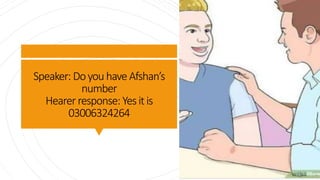
Speaker: Doyou have Afshan’s
number
Hearerresponse: Yesitis
03006324264
Another example
toexplain co-
operation
There is a woman sitting in a park
and a dog is lying on the ground in
front of her
Man: Does your dog bite?
Woman: NO
(The man reaches down to pet the
dog. The dog bites the man’s hand)
Man: Ouch! Hey! You said your dog
doesn’t bite
Woman: That’s not my dog
Analysisof
example
Cooperation is not present
in following conversation:
Man’s assumption was that
more was communicated
than was said.
Woman’s answer provides
less information than
expected .
(GriceTheory)
The philosopher Paul Grice
gave The Cooperative
principle in 1975
Co-operative
Principle
Grice (1975)gave the idea that
people co-operate with each
other in conversing.
Speaker should be co-operative
and intents to communicate
something.
Speaker’s intended meaning is
more than what the words mean.
It leads to implicature.
Ageneral co-
operative
principle andfour
maxims of
conversation
These are the guidelines for
effective and rational use of
language
Ageneralco-
operative
principle
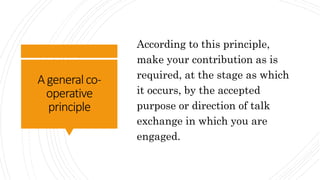
According to this principle,
make your contribution as is
required, at the stage as which
it occurs, by the accepted
purpose or direction of talk
exchange in which you are
engaged.
Fourmaximsof
conversation
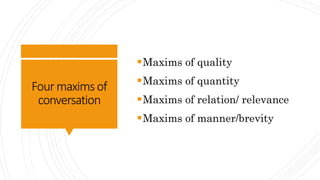
Maxims of quality
Maxims of quantity
Maxims of relation/ relevance
Maxims of manner/brevity
Maximsof
quality
This principle requires that;
Do not say what you believe to
be false.
Do not say that for which you
lack adequate evidence.
Conversation should be
genuine and justified.
Example
A: Where are you going?
B: I am going to the post
office.(obeying Maxim)
Example no 3
A:Are you going to college tomorrow?
B: I have an appointment with
doctor. I have asked for permission
with teacher?(disobeying maxims)
Maximsof
quantity
This maxim requires that:
Make your contribution as
informative as is required.
Do not make your contribution
more informative than is
required.
Example
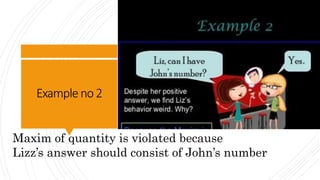
Exampleno2
Maxim of quantity is violated because
Lizz’s answer should consist of John’s number
Maximof
relevance
This maxim demands:
To be relevant
There should be a certain type
of regularity in conversational
behavior with respect to the
relevance of information
provided at each turn of a
conversation
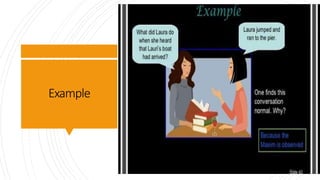
Example
Exampleno2
Example
Example no 1
Teacher: Why don’t you do your
homework?
Student: May I go to drink water.
Example no 2
Sara: How was your date?
Ayesha: Your dress is looking
amazing.
(Maxim is violating)
Maximof
manner
This principle requires:
Be perspicuous (apparent)
Avoid obscurity
Avoid ambiguity
Be brief
Be orderly
How something is being said
in conversation?
Example
Conclusion
These maxims are
necessary part of
conversation to make the
conversation successful.

Topic 4 The Co-operative Principles.pptx